Persian filing seeded every Indic script (~300 BCE)
The Achaemenid empire's chancery alphabet moved east with its tax collectors. Within a few generations, the script that grew from it — Brahmi — was carving an Indian emperor's regret across half a subcontinent, and would in time become the parent of every writing system used today in India, Sri Lanka, Tibet, and mainland and island Southeast Asia.
In the late fourth century BCE, a Persian chancery alphabet seeded a new Indic script: Brahmi. From it descends every writing system used today across South and Southeast Asia — a transmission carried east by empire.

Before the script
The Indian subcontinent in the fifth and fourth centuries BCE was not an illiterate place — but it was a place where writing did not yet do the work that mattered most. The Vedic corpus, the Brāhmaṇas, the early Upaniṣads, the Aṣṭādhyāyī of Pāṇini (composed sometime between the sixth and fourth centuries BCE) — all of this was carried in human memory by trained reciters, transmitted across generations through mnemonic devices of extraordinary precision and conserved by ritual specialists whose social authority rested on their custody of the unwritten word 1. Pāṇini's grammar references the words lipi ('script') and lipikara ('scribe') in Aṣṭādhyāyī 3.2.21, which is the earliest unambiguous Sanskrit acknowledgement that writing existed in his world — but the grammar itself was composed for oral transmission, in 3,996 highly compressed sūtras designed to be memorised and chanted rather than read 2. The Indus Valley civilisation had used a script almost two millennia earlier, but that script — still undeciphered — had vanished from active use around 1900 BCE, and there is no surviving evidence that any continuous Indian writing tradition bridged the intervening fifteen centuries 3.
What existed instead was a vast and disciplined oral-textual economy in which knowledge belonged to those who could recite it. Different Vedic schools (śākhās) preserved different recensions of the same hymns by means of padapāṭha, kramapāṭha, jaṭāpāṭha, and ghanapāṭha — recitation patterns of increasing complexity that built error-correcting redundancy directly into the act of memorisation. In padapāṭha, every word of a Vedic verse was recited in isolation; in kramapāṭha, words were chanted in overlapping pairs (1–2, 2–3, 3–4); in jaṭāpāṭha, in interlocking triplets that wove forward and backward through the line (1–2–2–1–1–2, 2–3–3–2–2–3); and in ghanapāṭha, in even denser permutations that made it computationally improbable for an error to survive a single full recitation cycle. The Sanskritist Frits Staal argued that the discipline of these recitation patterns was, in effect, an analogue digital-error-correction system designed to survive intact across millennia without writing. The texts could be recovered intact from any single competent reciter; the institution did not need writing to survive. It needed brahmins.
This is the world in which writing arrives. It does not arrive into an empty space, and it does not arrive as a neutral technology. It arrives, in its first sustained Indian deployment, as the working tool of an imperial bureaucracy that the subcontinent's northwestern populations had no choice but to deal with — and it arrives speaking Aramaic.
The northwest under Persian rule
The one part of the subcontinent where writing did already operate as an administrative technology, by the late sixth century BCE, was the far northwest. The Achaemenid Persian empire under Darius I (r. 522–486 BCE) had absorbed the territories west of the Indus into three satrapies — Gandāra, Sattagydia, and Hindūš — which appear on the Naqsh-e Rustam tomb inscription and on the great relief of Darius at Persepolis carrying tribute 4. Herodotus reports in Histories III.94 that the Indus satrapy alone paid 360 talents of gold dust annually, more than any other province of the empire and roughly 32 percent of total Achaemenid tribute revenue; the Gandāran satrapy, lumped together with the Sattagydians, Dadicae, and Aparytae, paid an additional 170 silver talents 5. The presence of Achaemenid administration in these territories from approximately 520 BCE until the empire's collapse before Alexander in 330 BCE — about 190 years — meant the presence of the Achaemenid chancery's working script: Aramaic. Three hundred and sixty talents of gold dust is, by the standard Athenian-talent conversion, roughly 9,400 kilograms of gold per year, or in modern terms the recurring annual extraction of a sum that would represent the wealth of a substantial nation. The Indus paid it. Where the payment was assessed, where the receipts were filed, where the next year's quota was forecast — all of this happened in Aramaic, on leather and on parchment, in chanceries staffed by scribes whose working repertoire was identical to that of their colleagues in Susa, Babylon, and Memphis.
The Aramaic that arrived
Aramaic in the late sixth and fifth centuries BCE was no longer the language of a particular people. It had been inherited as an administrative lingua franca from the Neo-Assyrian and Neo-Babylonian empires, and the Achaemenids elevated it to a standardised imperial register — what scholars now call Imperial Aramaic or Official Aramaic — used for correspondence, taxation, and law from Egypt to Bactria. The Khalili Collection of Aramaic Documents, published by Joseph Naveh and Shaul Shaked in 2012, preserves the internal correspondence of the satrap of Bactria, Akhvamazda, and his governor Bagavant from the 350s to 320s BCE: thirty leather letters and eighteen wooden tally sticks, written in a chancery hand that had been stable across the empire for nearly two centuries by the time they were composed 6. This was the script that the Achaemenid administration also used at its eastern frontier — and which scribes in Gandāra, Taxila, and the upper Indus learned in order to function inside the imperial system. Aramaic, in those territories, was the language of the state.
What the receiving cultures did not yet have was a fully developed script for any of the Indic vernaculars — Prakrit, Magadhi, the Sanskrit of the brahmins.
The two scripts that would emerge in the late fourth and third centuries BCE — Kharoṣṭhī in the Aramaic-speaking northwest and Brahmi across the rest of the subcontinent — emerged into that gap.
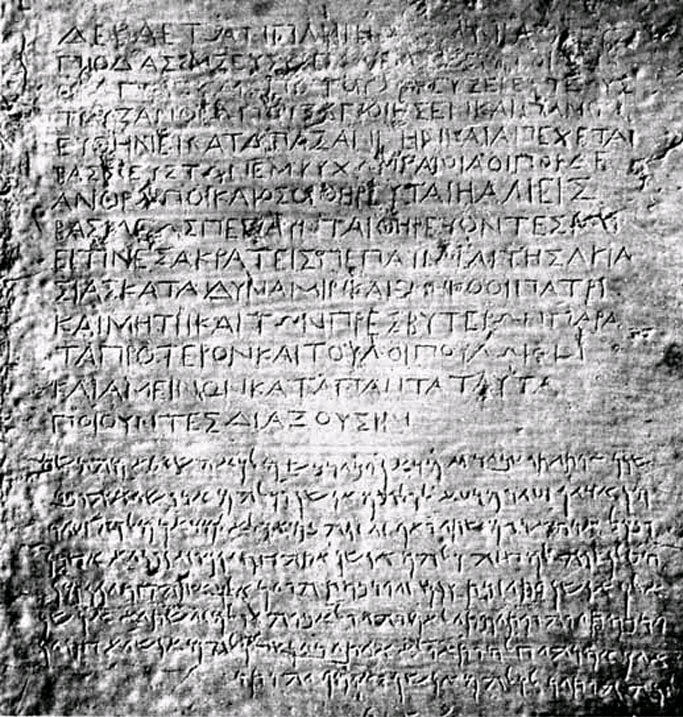
Three pieces of physical evidence anchor the chancery picture. The Aramaic inscription of Taxila, discovered by Sir John Marshall in 1915 on a fragment of marble that had belonged to an octagonal column, is written in Aramaic but datable, on epigraphic grounds, to the mid-third century BCE — the Mauryan, not the Achaemenid, period. The Pul-i-Darunteh Aramaic inscription, found in the Laghman valley of Afghanistan in 1932, juxtaposes Indian-language phrases with Aramaic translations, all written in Aramaic script. The Kandahar Greek-Aramaic bilingual inscription of Aśoka, found in 1958 under a metre of rubble at Chehel Zina near Kandahar, was carved around 260 BCE and is the earliest dated Aśokan inscription; its Aramaic text was, the inscription itself implies, intended to be read by the descendants of Achaemenid-era populations who still expected official communications in that language 15. Three generations after the Achaemenid empire's collapse, the Mauryan court was still using Aramaic at its western frontier. The chancery script outlived the empire that brought it.
The transmission
The scholarly history of Brahmi's origin is itself a layered argument that has been running for over a century. The dominant modern position is that Brahmi was derived, by deliberate scholarly adaptation, from the Aramaic script that had been the Achaemenid administrative working tool in the northwest — but the position has been challenged, refined, abandoned, and reasserted across five generations of Indologists, and a residual minority continues to argue for indigenous Indian invention.
Bühler's Semitic hypothesis
The foundational modern statement was Georg Bühler's On the Origin of the Indian Brahma Alphabet, published in Strasbourg in 1898 as the second edition of a study he had been refining since 1881. Bühler argued, on the basis of letter-shape comparisons, that twenty-two of the Brahmi consonants were derived from Phoenician-Aramaic prototypes — that the Brahmi gha descends from Aramaic gimel (or heth, depending on the line of derivation), the Brahmi tha from a circular form of Aramaic ṭēth, and so on through the alphabet 7. Bühler placed the transmission earlier than most current scholarship would, around the eighth or seventh century BCE, by way of merchant networks rather than the Achaemenid administration. The dating has not survived; the basic Semitic-derivation claim, with adjustments, has.
Bühler's case rested on three kinds of argument: epigraphic (shape-by-shape correspondences between Brahmi and Aramaic/Phoenician letters), phonetic (the Brahmi sound values map onto the Semitic sound values in ways consistent with derivation rather than coincidence), and historical (the obvious presence of Semitic scripts in the broader region from a sufficiently early date). The first kind of argument has been the most contested in the century since; the third has been the most strengthened by subsequent discoveries.
Salomon and the modern consensus
The authoritative modern survey is Richard Salomon's Indian Epigraphy: A Guide to the Study of Inscriptions in Sanskrit, Prakrit, and the other Indo-Aryan Languages, published by Oxford University Press in 1998. Salomon accepts the basic Semitic-derivation framework but moves the date of transmission forward to the fourth century BCE — that is, into the period of mature Achaemenid administration in the Indus and Gandāra, and very close to the period of the first datable Brahmi inscriptions 8. Salomon's review describes Bühler's earlier arguments for a Phoenician prototype as 'weak historical, geographical, and chronological justifications', and substitutes the immediately available chancery Aramaic as the source. In a 1995 article in the Journal of the American Oriental Society, Salomon laid out the formal correspondences in detail: Aramaic qoph lent its form to Brahmi kha; Aramaic ṭēth to Brahmi tha; consonantal Aramaic forms that had no Indic equivalent were repurposed to write Indic aspirated consonants, which Aramaic itself did not distinguish 9. The Brahmi gha may descend from Aramaic gimel with a modification for voicing and aspiration; the Brahmi pa and ba sit comfortably on Semitic prototypes; the sibilants, which proliferate in Indic phonology, were extended from a smaller Aramaic set by deliberate scholarly adaptation rather than direct inheritance. Where Aramaic had twenty-two letters, Brahmi requires roughly forty-seven graphic units (consonants, vowels, modifiers) to write Sanskrit and the early Prakrits. The scholarly task that produced Brahmi was therefore not simple translation of a script — it was the redesign of a Semitic abjad into an Indic alphasyllabary, a process that took the source script's basic graphic vocabulary and dramatically extended it.
The Kharoṣṭhī parallel
The second Indic script of the period — Kharoṣṭhī — provides the corroborating evidence that the Aramaic-derivation argument leans on most heavily. Kharoṣṭhī appears in the northwest, in the same Gandāra–Indus zone the Achaemenids had administered for nearly two centuries, and there is no serious scholarly dispute that it is an Aramaic derivative: it preserves the Aramaic right-to-left direction; its letter forms map onto Aramaic prototypes with high fidelity; and the earliest substantial Kharoṣṭhī inscriptions are the Aśokan rock edicts at Mansehra and Shahbazgarhi, dated to the mid-third century BCE 10. The Encyclopaedia Iranica entry on Gāndhārī language reports that the script almost certainly emerged from the period of Achaemenid occupation of the region, which it dates from 559 to 336 BCE 11. The parallel matters because it establishes the mechanism beyond reasonable doubt: Aramaic chancery practice, present in the northwest for the better part of two centuries, did produce a new Indic script. The question with Brahmi is not whether such a derivation is possible — it is — but whether it occurred in the same way.
Falk's revision and the dissenting voices
Not every specialist accepts the straightforward derivation. Harry Falk's Schrift im alten Indien: ein Forschungsbericht mit Anmerkungen, published in 1993 by Gunter Narr in Tübingen as volume 56 of the ScriptOralia series, is the standard German-language synthesis of the literature up to that point 12. Falk argued that Brahmi was a deliberate creation of the Mauryan chancery, possibly during Aśoka's own reign, combining elements drawn from Kharoṣṭhī (itself Aramaic) and from contemporary Greek letter forms that the Mauryans had access to through the Hellenistic kingdoms on their northwestern frontier. Falk's later position, restated in 2018, moved further still — toward a model in which Brahmi was substantially created from scratch by scholarly adaptation, drawing on multiple sources but standing apart from any one of them as a direct descendant. K.R. Norman, the Cambridge Pali specialist, argued in 2005 that the variations visible in the Aśokan edicts would be unlikely to have emerged so quickly if Brahmi had a single chancery origin — and that the script must therefore have been in development for some decades before Aśoka, perhaps from the late fourth century BCE 13. Excavations at Anuradhapura in Sri Lanka, published by R.A.E. Coningham and others in the Cambridge Archaeological Journal in 1996, recovered potsherds bearing single Brahmi letters from radiocarbon-dated contexts as early as the fifth or fourth century BCE — finds that remain contested but, if accepted, push the script's emergence well before the Mauryan chancery 14.
What the surviving evidence permits
What the present state of the evidence permits is a position somewhere between Bühler's confident direct derivation and the most thoroughgoing indigenous-invention claims. Brahmi emerged in the late fourth and third centuries BCE, in a context where Aramaic chancery practice had been operating for nearly two centuries in the same political space; it shares with Kharoṣṭhī (which is unambiguously Aramaic-derived) the basic abstraction of converting a consonantal alphabet into a script suitable for Indic phonology; and its appearance in mature form in the Aśokan edicts of the 260s and 250s BCE is consistent with a roughly 50-to-100-year development period under chancery conditions. The Aśokan inscription at Kandahar, dated to the eighth year of Aśoka's reign and therefore to approximately 260 BCE, is bilingual in Greek and Aramaic — the Aramaic version addressed, the inscription itself notes, to the populations of the former Achaemenid empire who still inhabited the region 15.
The continuity is intelligible. The script that the Mauryan administration adopted for its own languages was, at most one or two scholarly removes, the script its predecessor empire had used for governing the Indus.
The political geography of the transmission matters. Chandragupta Maurya, who founded the Mauryan dynasty around 322 BCE, did so on the immediate eastern margin of the territory the Achaemenids had governed and Alexander had briefly inherited. His treaty with Seleucus I Nicator in approximately 305 BCE ceded the eastern satrapies — Gandāra, Arachosia, Aria, the upper Indus — from Hellenistic to Mauryan rule, in exchange for five hundred war elephants 16. From that moment, the entire former Achaemenid northwest was inside the Mauryan empire, and the chancery scribes of those territories — by training Aramaic-literate, by recent assignment Hellenistic-literate, and now Mauryan subjects — became part of the empire's administrative apparatus. The continuity is not a metaphor. The institutions, and in many cases the scribes themselves, transferred.
What changed and what was replaced
The Aśokan moment — between roughly 260 and 232 BCE — is when the script that had been forming in chancery practice becomes visible to history, in stone, across nearly the whole of the Indian subcontinent. Aśoka, the third Mauryan emperor, after the Kalinga War of 261 BCE and his subsequent embrace of Buddhist dhamma, issued a corpus of rock and pillar edicts that survive at sites from Kandahar in southern Afghanistan to Brahmagiri in Karnataka. The edicts are inscribed in four scripts (Greek, Aramaic, Kharoṣṭhī, and Brahmi) and several languages (Greek, Aramaic, and various Prakrit dialects), but the substantial body of the corpus — the major and minor rock edicts, the pillar edicts — is in Brahmi and Prakrit 16.

Aśoka, born around 304 BCE and crowned around 268 BCE after a contested succession that the Buddhist tradition would later embellish into legend, was the grandson of Chandragupta and the son of Bindusāra. His empire stretched from the Hindu Kush in the west to the Bay of Bengal in the east, and from the Himalayan foothills in the north to the Tungabhadra in the south — almost the entire subcontinent except the southernmost Tamil-country kingdoms. The chancery that served him inherited the Aramaic-literate scribal corps of the northwest and added to it a wider literate apparatus across the new territories. The standardisation that the edict corpus exhibits — letter forms that are recognisably the same script at Kandahar in modern Afghanistan and Brahmagiri in modern Karnataka — implies a chancery that could enforce its conventions across thousands of kilometres.
A new political technology
The edicts were a new kind of political object. No previous Indian ruler had inscribed his moral and administrative directives onto rock faces and free-standing pillars for the explicit purpose of being read aloud to his subjects across an imperial territory. The text of Pillar Edict VII directs that the edict be inscribed wherever there are pillars, so that it may last 'as long as my sons and great-grandsons rule, as long as the sun and moon endure' 17. The technology that made this aspiration intelligible was the new script. Aśoka's chancery had a writing system in which a ruler's voice could be replicated identically in dozens of sites across a subcontinent the size of Western Europe, in a vernacular Prakrit that ordinary literate subjects could parse without specialised brahmin mediation. The edicts are not in Sanskrit — the ritual language of the brahmin establishment — but in Prakrit, in a script that, once standardised, could be taught to anyone.
The Aśokan corpus is the proof that the script worked as a political instrument. Forty-three rock inscriptions, fourteen pillar inscriptions, and a small number of cave inscriptions survive across more than thirty sites — at Girnar in Gujarat, Kalsi in Uttarakhand, Dhauli and Jaugada in Odisha (the territory of the conquered Kalingans), Brahmagiri and Erragudi in the Deccan, Sopara on the western coast, Bairat in Rajasthan, Lauriya Nandangarh and Lauriya Araraj in Bihar, Sanchi and Sarnath at the great Buddhist sites, and many others. Some sites cluster the major rock edicts as a group of fourteen; others isolate single minor rock edicts; the pillars stand alone with their own series of seven pillar edicts. The script is consistent enough across these sites that Bühler, Cunningham, and Prinsep could already in the nineteenth century compare letter forms from Girnar and Mansehra and reconstruct a unified Aśokan paleography 16. Standardisation on this scale is itself an administrative achievement — a chancery that can dispatch identical text and identical script across a subcontinent has, by that fact, made literacy into infrastructure.
The alphasyllabary adaptation
The critical Indic innovation in Brahmi was the conversion of the consonantal Aramaic alphabet into what linguists now call an alphasyllabary or abugida — a script in which each consonant carries an inherent vowel /a/, which can be modified by diacritic marks (mātrās) to write other vowels, and suppressed by a virāma (the halant in modern Devanāgarī) to write a bare consonant. This was not a small adjustment. It made the script natively suited to Indic phonology in a way that Aramaic itself was not — Aramaic, like Phoenician and Hebrew, simply did not write most vowels, leaving the reader to supply them from context. Brahmi made the vowel apparatus systematic, organised the consonant inventory along the phonetic principles that Pāṇini's grammar had already established for the oral tradition (stops grouped by point of articulation, voicing, aspiration; sibilants distinguished by place; nasals matched to their corresponding stop series), and produced an orthography that mapped onto the spoken sound system with greater regularity than almost any other ancient script 18.
Diffusion across South and Southeast Asia
What happened next was the script's diffusion — slowly through the late Mauryan and post-Mauryan periods, then with accelerating force during the spread of Buddhism and Hinduism across maritime and overland Asia. The northern branch of Brahmi evolved through Gupta and Siddham forms into the Devanāgarī script in use today for Sanskrit, Hindi, Marathi, Nepali, and dozens of other languages, and through parallel northern lines into Bengali, Gujarati, Gurmukhi (Punjabi), and Odia. The southern branch evolved through Kadamba, Pallava, and Vatteluttu into the scripts of the four major Dravidian languages (Tamil, Telugu, Kannada, Malayalam) and into Sinhala for the Buddhist literary culture of Sri Lanka. The Tibetan script, devised in the seventh century CE by Thonmi Sambhota under the king Songtsen Gampo, was modelled directly on a north Indian Brahmi-descended script. The Pallava script carried Brahmi to Southeast Asia, where it became the parent of Old Mon and Old Khmer, and through them of Burmese, Thai, Lao, Khmer, Cham, Javanese, Balinese, and Sundanese scripts; via the Sumatran kingdoms it also gave rise to Baybayin in the Philippines 19. By the period of European maritime contact in the sixteenth century, a single script lineage that had begun as Achaemenid chancery practice in the Indus governed the writing of religion, law, and literature for several hundred million people stretching from Sri Lanka to the Indonesian archipelago.
The routes of diffusion are themselves a map of the religious and commercial history of the Indian Ocean and mainland Southeast Asia. Buddhist monks travelling under the protection of Mauryan and post-Mauryan rulers carried the script north and east — to Bactria, where the Kushan empire of the first three centuries CE would commission a vast Buddhist literature in Gandhārī Prakrit written in Kharoṣṭhī; into Sri Lanka under Aśoka's son Mahinda around 250 BCE, where the Theravāda Buddhist tradition would preserve and develop the script in the form that became Sinhala; into Central Asia along the Silk Road, where Brahmi-derived scripts wrote Khotanese, Tocharian, and other lost languages; and eventually into Tibet in the seventh century CE through the agency of Thonmi Sambhota, the minister of Songtsen Gampo, who is credited in Tibetan tradition with adapting an Indian script of his time to the requirements of Tibetan phonology. The Pallava dynasty of southern India, which flourished from the fourth through the ninth centuries CE, exported the Pallava-Grantha script through maritime trade and through the diaspora of Tamil Hindu and Buddhist communities to the kingdoms of Funan, Champa, Srivijaya, and the Khmer empire — from which it would, by gradual and locally specific adaptations, become Old Mon, Old Khmer, Old Javanese, and the family of mainland and insular Southeast Asian scripts in use today.
What the new script displaced — and what it did not
What Brahmi displaced was the absolute monopoly of the oral brahmin tradition over the carriage of authoritative text. After Aśoka, an emperor could speak directly to his subjects in stone, without brahmin mediation; a Buddhist monastery could record and copy a canon without depending on oral recitation alone; a merchant could keep books in the vernacular; a sectarian movement (the Buddhists, the Jains, the various śramaṇa traditions) could fix its scriptures in a form less susceptible to the gradual interpolations that an oral tradition permits. The Pali canon of Theravāda Buddhism was committed to writing in the first century BCE in Sri Lanka, on palm leaves, in a script descended from Aśokan Brahmi — a moment whose institutional importance is hard to overstate 20. What Brahmi did not displace, in the short term, was the prestige of the oral Vedic tradition itself: the brahmin establishment continued to insist on oral transmission of the Veda for almost two more millennia, and refused for centuries to commit the most sacred recensions to writing even after writing had become universally available. The script changed the political and sectarian world. It did not, immediately, change the ritual one.
What the cost was
The transmission of the alphabet from Aramaic to Brahmi was, considered narrowly, peaceful. No campaign was fought to bring the script to India; no scribe was killed for using it; no rebellion put down because of it. The script arrived as a tool of administration and remained a tool of administration. But the empires that carried the tool, both the senders and the receivers, were not peaceful institutions, and the cost of the script — in the sense in which the Hidden Threads atlas tallies cost — is the cost of the political machinery within which the transmission occurred.
The Achaemenid extraction on the Indus
The Persian satrapies of Gandāra and Hindūš, where Aramaic chancery practice was first installed on the Indian subcontinent, were not lightly governed. Herodotus's figure of 360 talents of gold dust per year for the Indus alone — roughly 32 percent of total imperial tribute revenue — represents a sustained extraction from the most productive agricultural and craft populations of the subcontinent's northwest 5. Achaemenid satrapal administration relied on a chancery that could record obligations, transmit orders, audit collections, and prosecute non-payment across the empire's enormous distances; that chancery, in those territories, worked in Aramaic. The script that India would later inherit was, in its original deployment on Indian soil, the working tool of the apparatus that took 360 talents of gold dust a year out of the Indus and sent it westward to Persepolis. Josef Wiesehöfer's Das antike Persien describes the Achaemenid satrapal model as a system in which the satrap was personally responsible for delivering his province's tribute quota to the king; failure to deliver was prosecuted as treason; the Aramaic chancery existed to make the accounting visible from one end of the empire to the other 22. The peasants and weavers of the Indus paid into a system whose records were kept in a script they could not read, whose officials answered to a satrap they would never see, and whose tribute went to a capital city they would never visit. The script was the instrument of the visibility. It made the extraction administratively possible. The cost was paid by the peasants, weavers, miners, and artisans whose surpluses were assessed in Aramaic and whose receipts were filed in Aramaic, for the better part of two centuries 22. This is not the cost of the transmission proper — the transmission would have happened with or without the specific tribute level — but it is the cost of the script's first institutional life in the subcontinent, and an honest accounting includes it.
The Mauryan war that the script recorded
The second cost is the Kalinga War of 261 BCE, and it is the one Aśoka himself records. Major Rock Edict XIII — preserved in Brahmi at Girnar, Kalsi, Shahbazgarhi, Mansehra, Yerragudi, and elsewhere — admits in the emperor's own words that the Kalinga campaign produced casualties on a scale that he came to regret: 'a hundred and fifty thousand persons were carried away captive, a hundred thousand were slain, and many times that number perished' 23. The numbers are the emperor's own, in the emperor's own script, and there is no later scholarship that has revised them downward; if anything, the casualty estimates in modern surveys of the war run higher, with totals around 250,000 cited as combining the documented military deaths, the captives, and the famine and disease mortality that followed 24. The Kalinga War is not, strictly, a cost of the script's arrival — the war and its dead happened independently of whether the Mauryan chancery used Brahmi or not. But it is the war that the new script first recorded for posterity, and the edicts of remorse that the script enabled are the same edicts that detail the killing. The new script's first major public use was the inscription of an emperor's confession of mass killing, on rock faces across the territory he had killed for.
The Kalinga campaign was a war of conquest, not a defensive war or a punitive expedition: Kalinga, on the east coast, had remained an independent kingdom across the reigns of Chandragupta and Bindusāra and into the early years of Aśoka, and the empire chose to absorb it. The methods are not fully recoverable from the sources — the principal narrative source for the war is Aśoka's own Edict XIII, which is not a military report but a moral confession — but the numerical claim that one hundred thousand were killed and one hundred and fifty thousand deported, with many more dead of starvation and disease, is the emperor's own and survives across multiple inscriptional copies. Patrick Olivelle's recent biography emphasises that the edict's tone is not Buddhist triumph over violence but a kind of imperial regret-after-the-fact, in which the emperor commits himself to dhamma — a concept that he leaves deliberately broad, encompassing Buddhist precepts and brahmanical moral categories and the demands of a stable empire — rather than to military conquest 24. The Mauryan extractive apparatus did not, however, contract after Kalinga. The administrative reforms recorded in the edicts — the inspectors of dhamma, the rest houses along the highways, the medical herbs planted for human and animal use — were additions to, not substitutes for, the tax-and-tribute machinery that the empire continued to operate.
The longer cost — and the longer gift
The deeper cost is harder to specify in numbers and easier to specify in institutions. The arrival of writing in the Indian subcontinent — first as Aramaic chancery, then as Brahmi vernacular — transferred a substantial portion of the social authority that had rested on memorisation into a new domain in which the brahmin oral establishment did not have a monopoly. Over the next two thousand years, this would mean the gradual rise of literate sectarian movements (Buddhism, Jainism, the bhakti traditions) whose authority did not depend on Vedic recitation; the development of regional vernacular literatures in scripts descended from Brahmi; and the slow, contested erosion of an information regime in which knowledge belonged to those who could carry it in their heads. Some of this erosion was loss — the disappearance of śākhā recensions, the abandonment of recitation practices that had error-corrected the Vedic tradition for centuries before the Common Era. Some of it was emancipation, in the sense that a literate culture is one in which more people can dispute the authoritative text. The Hidden Threads atlas is reluctant to tally the loss of a closed information regime as a pure cost; it is also reluctant to celebrate the displacement of that regime as a pure gain. The honest account is that the script transferred power, and the people from whom power was transferred — over centuries, not decades — bore a cost the atlas cannot quantify but should not pretend was absent.
A note on the longest cost
The cost most difficult to weigh is the deepest one. Vedic mnemonic discipline did not disappear after the arrival of writing — it has been continuously transmitted for some twenty-five centuries longer — but its institutional centrality eroded, slowly, as alternative authorities accumulated around the new script. Buddhist monasteries assembled large written canons in Pali, in Gandhārī, in Sanskrit; Jain monastic libraries collected the Āgamas; the bhakti poets of medieval India composed in vernaculars that depended on Brahmi-descended scripts to circulate. By the medieval period, a sect's textual authority no longer rested on whether its reciters were competent — it rested on what its manuscripts said and how those manuscripts were copied, dated, and corrected. The shift from a chain-of-memory authority to a chain-of-manuscript authority changed who could speak with weight in Indian religious and intellectual life. Some of the people for whom the older regime had been weight-bearing — the śākhā specialists, the regional brahmanical lineages whose reputation rested on their custody of particular recensions — lost the foundations of their authority. The Hidden Threads atlas counts that loss as cost, even though the same shift was, for many of the people downstream from it, emancipation.
Against that cost stands the gift, which is one of the largest single legacies in the history of writing. Every literate person today in India, Sri Lanka, Nepal, Bhutan, Myanmar, Thailand, Laos, Cambodia, and large parts of Indonesia is reading and writing in a system descended, through about ninety generations of scribal and scholarly adaptation, from a chancery alphabet that Persian tax collectors brought to the Indus in the late sixth century BCE. The script outlived the empire that introduced it by 2,300 years and counting. It outlived the empire that first put it to public use within two centuries of Aśoka's death. It survived because, once it was in the hands of merchants and monks and scholars, it stopped belonging to any one empire — and because the daughter cultures, as in the Phoenician-to-Greek case to the west, outlived the parent.
What followed
-
-518Achaemenid conquest of the Indus, ~518 BCE: Darius I incorporates the satrapies of Gandāra, Sattagydia, and Hindūš into the Persian empire, bringing the Aramaic-language chancery administration with him. The Indus satrapy alone pays 360 talents of gold dust per year — approximately 32 percent of all Achaemenid tribute revenue.
-
-260Aśokan rock edicts inscribed in Brahmi, ~260–232 BCE: the Mauryan emperor issues a corpus of moral and administrative directives in stone across his empire, in four scripts (Greek, Aramaic, Kharoṣṭhī, Brahmi) and several languages. The Brahmi edicts are the first datable extensive use of the new script; they survive at over thirty sites from Kandahar to Karnataka.
-
-260Kandahar bilingual Greek-Aramaic edict, ~260 BCE: Aśoka's earliest inscription, carved at Chehel Zina near Kandahar, uses Aramaic to address the populations of the former Achaemenid empire who still inhabited the region. The continuity of chancery practice from Persian to Mauryan rule is visible in the same stone.
-
-29Pali canon committed to writing, 1st century BCE in Sri Lanka: the Theravāda Buddhist scriptural corpus, previously transmitted orally for four centuries, is written down on palm leaves in a Brahmi-descended script at the Aluvihāra monastery. The institutional shift from oral to written canon transforms how the tradition is preserved and transmitted.
-
700Diffusion across South and Southeast Asia, 4th–14th centuries CE: Brahmi's southern branch produces, via the Pallava script of the Tamil-country dynasties, the parent forms of Burmese, Thai, Lao, Khmer, Cham, Javanese, Balinese, Sundanese, and Baybayin scripts. The Tibetan script is devised in the 7th century from a northern Brahmi line. Every literate culture from Sri Lanka to the Philippines inherits the system.
-
1000Devanāgarī standardisation, ~7th–13th centuries CE: the northern Brahmi line evolves through Gupta and Siddham scripts into Nāgarī and then Devanāgarī, which becomes the standard script for Sanskrit, Hindi, Marathi, Nepali, and many other north Indian languages. Devanāgarī today is the third most widely used writing system in the world by number of speakers.
Where this lives today
References
- Staal, Frits. "The Sound of Religion." Numen 33.1 (1986): 33–64. On the Vedic oral tradition as a deliberate mnemonic technology and its intentional resistance to writing. en
- Pāṇini. Aṣṭādhyāyī, 3.2.21. Standard critical edition: Sharma, Rama Nath, The Aṣṭādhyāyī of Pāṇini. Munshiram Manoharlal, 1990–2003. The earliest unambiguous Sanskrit references to writing — lipi and lipikara. en primary
- Possehl, Gregory L. The Indus Civilization: A Contemporary Perspective. AltaMira Press, 2002. On the Indus script's disappearance c. 1900 BCE and the absence of a continuous bridging tradition. en
- Briant, Pierre. From Cyrus to Alexander: A History of the Persian Empire. Eisenbrauns, 2002 [French original Histoire de l'Empire perse, Fayard, 1996]. Chapters on the eastern satrapies and the Achaemenid administrative system. en
- Herodotus. Histories III.94–95. Loeb Classical Library, trans. A. D. Godley. Harvard University Press, 1921. The list of Achaemenid satrapal tribute, with the Indus paying 360 talents of gold dust annually. en primary
- Naveh, Joseph and Shaul Shaked (eds). Aramaic Documents from Ancient Bactria (Fourth Century B.C.E.) from the Khalili Collections. London: Khalili Family Trust, 2012. en primary
- Bühler, Georg. On the Origin of the Indian Brahma Alphabet. Second edition. Strasbourg: K. J. Trübner, 1898. en
- Salomon, Richard. Indian Epigraphy: A Guide to the Study of Inscriptions in Sanskrit, Prakrit, and the other Indo-Aryan Languages. New York and Oxford: Oxford University Press, 1998. en
- Salomon, Richard. "On the Origin of the Early Indian Scripts." Journal of the American Oriental Society 115.2 (1995): 271–279. en
- Glass, Andrew. A Preliminary Study of Kharoṣṭhī Manuscript Paleography. MA thesis, University of Washington, 2000. On the Aramaic-derivation of Kharoṣṭhī and its mature form in the Aśokan edicts. en
- Fussman, Gérard. "Gāndhārī Language." Encyclopaedia Iranica. Online edition. New York: Columbia University, 2012. en
- Falk, Harry. Schrift im alten Indien: ein Forschungsbericht mit Anmerkungen. ScriptOralia 56. Tübingen: Gunter Narr Verlag, 1993. de
- Norman, K. R. A Philological Approach to Buddhism: The Bukkyō Dendō Kyōkai Lectures 1994. London: School of Oriental and African Studies, 1997. On the chronology of Brahmi's emergence. en
- Coningham, R. A. E., F. R. Allchin, C. M. Batt, and D. Lucy. "Passage to India? Anuradhapura and the Early Use of the Brahmi Script." Cambridge Archaeological Journal 6.1 (1996): 73–97. en
- Kandahar Bilingual Rock Inscription (KAI 279). Discovered 1958 at Chehel Zina, Kandahar. Edited in Schlumberger, Daniel et al., "Une bilingue gréco-araméenne d'Asoka." Journal asiatique 246 (1958): 1–48. fr primary
- Hultzsch, E. (ed.). Corpus Inscriptionum Indicarum, Vol. I: Inscriptions of Asoka. New edition. Oxford: Clarendon Press, 1925. Standard edition of the Aśokan corpus. en primary
- Aśoka, Pillar Edict VII (Delhi-Topra). In: Hultzsch, Corpus Inscriptionum Indicarum I, pp. 130–137. en primary
- Bright, William. "A Matter of Typology: Alphasyllabaries and Abugidas." Studies in the Linguistic Sciences 30.1 (2000): 63–71. On the structural innovation of the Brahmi-derived script family. en
- Daniels, Peter T. and William Bright (eds). The World's Writing Systems. Oxford University Press, 1996. Chapters on Brahmi descendants in South and Southeast Asia. en
- Norman, K. R. Pali Literature: Including the Canonical Literature in Prakrit and Sanskrit of all the Hinayana Schools of Buddhism. Wiesbaden: Otto Harrassowitz, 1983. en
- Filliozat, Pierre-Sylvain. Le sanskrit. Que sais-je? Paris: Presses Universitaires de France, 1992. On the relationship between the oral Sanskrit tradition and the writing systems used to record it. fr
- Wiesehöfer, Josef. Das antike Persien: Von 550 v. Chr. bis 650 n. Chr. Düsseldorf: Artemis & Winkler, 1993. On Achaemenid provincial administration and the extractive apparatus of the satrapal system. de
- Aśoka, Major Rock Edict XIII (Kalsi version, with parallels at Girnar, Shahbazgarhi, Mansehra, Yerragudi and elsewhere). In: Hultzsch, Corpus Inscriptionum Indicarum I, pp. 47–49, 67–70. en primary
- Olivelle, Patrick. Ashoka: Portrait of a Philosopher King. New Haven: Yale University Press, 2024. On the Kalinga War's casualty figures and Aśoka's subsequent ideological reorientation. en