Aramaic becomes the Persian empire's chancery (~550–330 BCE)
A Levantine vernacular inherited from Assyrian and Babylonian practice ran the largest empire the ancient world had yet seen — and outlived the empire by a thousand years. The Aramean kingdoms whose language it was had been erased two centuries earlier.
By the late sixth century BCE, an Aramaic clerk could be reading a tax letter at Sardis on the Aegean and another could be filing a leather sheet at Bactra near the Indus, and the same trained hand could have written both. The Achaemenid Persians inherited Aramaic from the Assyrian and Babylonian empires they had absorbed — a small Levantine vernacular whose first speakers, the Aramean kingdoms of the northern Levant, had already been conquered, deported, and dissolved by the same Assyrian imperial machinery that then carried their language outward. From Cyrus's conquest of Babylon in 539 BCE to Alexander's burning of Persepolis in 330, satraps from the Nile cataracts to Bactria issued correspondence in Imperial Aramaic. The empire fell. The language kept going for another eight hundred years, becoming the parent of Hebrew square script, Arabic, Brahmi, Syriac, and the Mongolian vertical script in turn.

Persian life before Aramaic became the chancery
In the year 550 BCE, the Iranian highlands were not yet an empire and were not yet literate at scale. The young Persian state had begun as a vassal of the Median kingdom; its founder, Cyrus II, had defeated his Median overlord Astyages around that year and inherited the modest territorial holdings of a confederation that had governed western Iran from the city of Ecbatana. The Persian-speaking elite of Pārsa — the southwestern province around modern Fars — were a horse-breeding warrior aristocracy whose first political language was oral. Their gods were named in Old Persian; their genealogies were memorized; their oaths were sealed by speech and witness. They had no native script of their own.
This was not unusual for an Iranian-speaking population in the mid-first millennium BCE. Old Persian, the language of the royal court, would not acquire a writing system of its own until the reign of Darius I some thirty years later, when a cuneiform syllabary was deliberately devised — most likely on Darius's instructions — to inscribe royal proclamations on stone, palace walls, and a small handful of clay tablets at Persepolis.1 The script was monumental rather than administrative. Of the entire two-century span of the Achaemenid empire, no tax record, no satrapal letter, no commercial document, no court judgment, and no bureaucratic ration list survives in Old Persian cuneiform. The Old Persian script was for kings to display, not for clerks to use.
What the Persians had instead, before the chancery system stabilized, was an inheritance of administrative practice from the territories they had conquered. The Median kingdom they had absorbed had run its own affairs through hereditary scribes, but Median is essentially undocumented; almost no original Median textual material survives. When Cyrus took Lydia in 547 BCE, he inherited a Lydian administrative apparatus that wrote in Lydian and, increasingly, in Greek. When he took Babylon in 539, he inherited the deepest and oldest scribal tradition in the ancient Near East: the cuneiform bureaucracy that had recorded grain rations, temple offerings, and royal decrees in Sumerian and then Akkadian for nearly three thousand years. When his son Cambyses took Egypt in 525, he inherited the demotic scribes of the Saite chancery, who had been writing tax accounts on papyrus since the seventh century BCE.
Each of these provinces continued, under early Achaemenid rule, to keep its own records in its own script. The Persians had no doctrine of linguistic uniformity to impose. What they had was a practical problem: how does a single dynasty in Pārsa send instructions to a Lydian satrap in Sardis, a Babylonian temple administrator at Sippar, and an Egyptian provincial official at Memphis when none of these officials reads Old Persian and the Persian king's clerks do not read Lydian or Egyptian? The answer the Achaemenids did not invent but inherited was Aramaic.
The Median and pre-imperial situation
The Median kingdom that Cyrus dethroned had run its administration in a way the Greek sources describe in fragments and the cuneiform sources do not directly record. What the cuneiform record does suggest is that Aramaic, by the time Cyrus arrived at Babylon in 539, was already the secondary administrative language of Babylonian government — the script in which provincial officials, merchants, and clerks who could not read cuneiform conducted their work. The Persians did not encounter a monolingual Mesopotamia and impose Aramaic on it. They encountered a Mesopotamia that had been Aramaicizing for two centuries and let the trend complete itself.2
The linguistic situation Cyrus inherited at Babylon in 539 BCE can be summarized in four working tiers, each documented in a different surface:
- Sumerian — already a dead language for nearly 1,500 years, surviving only in scholarly and ritual contexts, copied on clay by specialist scribes for liturgical recitation.
- Akkadian (Late Babylonian) — the prestige administrative language of the Neo-Babylonian state, written in cuneiform on clay; declining in everyday use but still dominant in temple archives, royal inscriptions, and the most formal commercial contracts.
- Aramaic — the working second language of the chancery, written in cursive on papyrus or leather; the language in which most of the bureaucratic correspondence with the western provinces was being carried out by 539 BCE.
- Old Persian — the language of the new conquerors, oral, with no script of its own yet.
The Achaemenid administrative system that stabilized over the next two generations did not displace the Akkadian tradition by decree. It promoted the Aramaic tier from secondary to primary while leaving the others in their existing roles, and the Akkadian tier withered slowly underneath because no one staffed it any longer.
The script the Assyrians had already chosen
To understand what the Persians inherited, one has to look back two centuries. In the late tenth and early ninth centuries BCE, the Aramean populations of the northern Levant had organized themselves into a constellation of small kingdoms: Aram-Damascus under its Hadadezer and Hazael dynasties, Bit-Adini at Til-Barsip on the upper Euphrates, Bit-Bahiani at Guzana (modern Tell Halaf), Hamath on the Orontes, Sam'al in southeastern Anatolia. They spoke an Aramaic that was already, in linguistic terms, a mature West Semitic language; they wrote it in a 22-letter consonantal alphabet adapted from the Phoenician script, with which it shared its origin in the Late Bronze Age proto-alphabets of the Levant.3
The Aramean kingdoms did not survive contact with the Neo-Assyrian empire. From the reign of Ashurnasirpal II (883–859 BCE) onward, Assyrian armies moved west annually. The royal annals of Tiglath-Pileser III (744–727 BCE) describe the systematic absorption of the Aramean states: Damascus fell in 732, its king Rezin executed and its population deported; Hamath fell in 720 under Sargon II; Sam'al was reduced to provincial status. Assyrian deportation policy, applied at scale across these conquests, displaced perhaps four to five hundred thousand people from the Levant to Assyria and Babylonia between 745 and 627 BCE — the largest sustained population transfer in the recorded ancient Near East before the Babylonian deportations of Judah.4
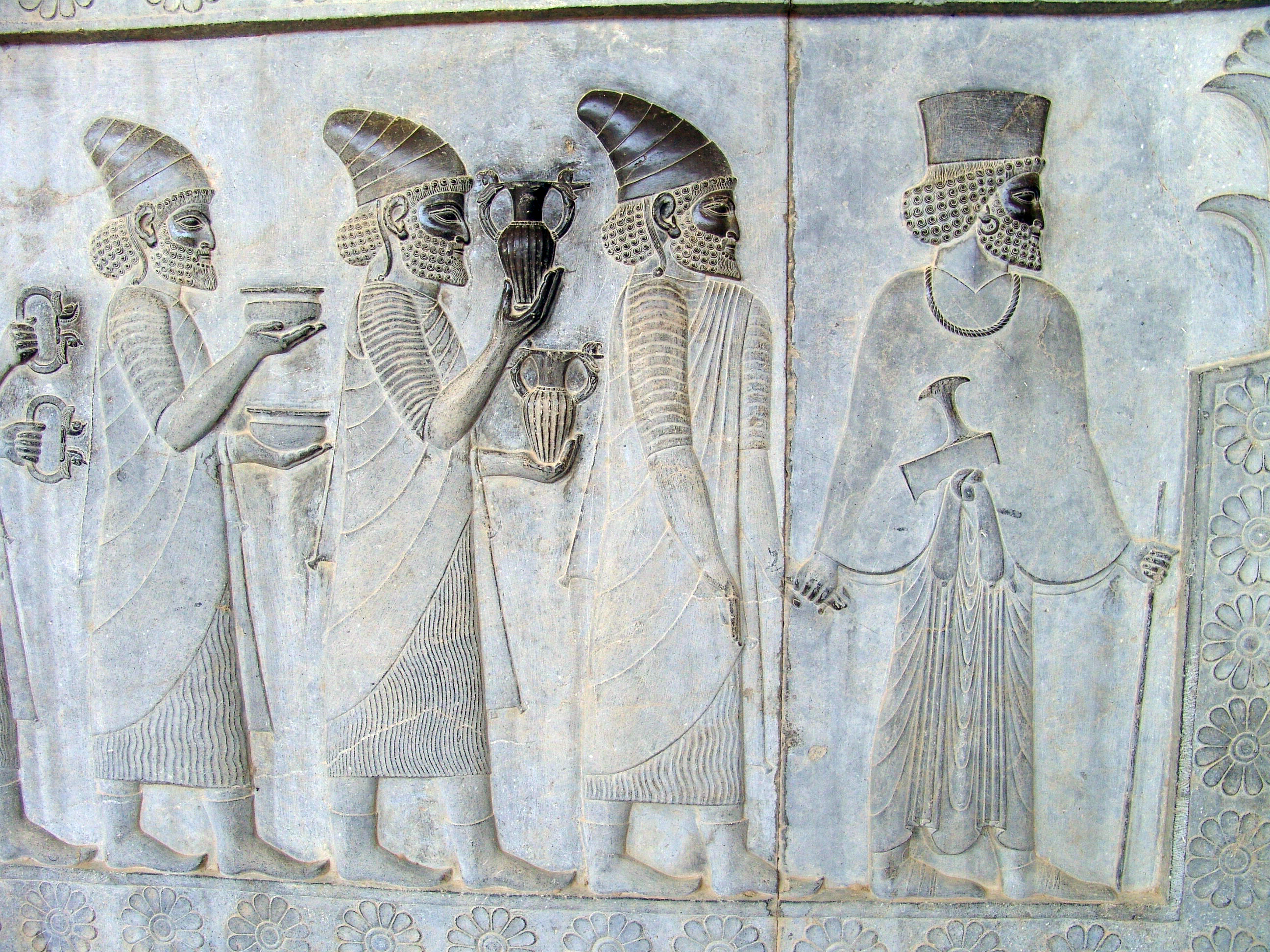
The Assyrians who carried out these conquests, however, found themselves administering a Levant whose population now spoke Aramaic, and a Mesopotamia whose population was being progressively re-settled with Aramaic-speaking deportees. The deported Arameans they brought back to Mesopotamia spoke Aramaic in their resettlement villages. The trading networks in the western provinces operated in Aramaic. By the eighth century BCE, an Assyrian provincial governor in the west had to deal with Aramaic at every level of his administrative day. Royal reliefs from Sargon II's palace at Khorsabad and from Ashurbanipal's at Nineveh show two scribes at work side by side: one writing on a clay tablet in cuneiform, the other writing on papyrus or leather in Aramaic.5 The Assyrian state had not chosen Aramaic; the Assyrian state had absorbed enough Aramaic-speakers, through its own deportation policy, that it had to use the language to function.
By the late seventh century BCE, when the Neo-Assyrian empire collapsed under Babylonian and Median pressure, Aramaic was already the de facto administrative second language of the imperial system. The Babylonian empire that succeeded Assyria continued the practice. When Cyrus took Babylon in 539, he therefore inherited not just the cuneiform tradition but the parallel Aramaic chancery that had been operating beside it for two centuries. The Persians did not have to design an administrative language. They had only to keep using the one they found.
How Imperial Aramaic was made
The German scholar Josef Markwart in 1927 coined the term Reichsaramäisch — "Imperial Aramaic" — to describe what the Achaemenid chancery did with the inherited language.6 Under Darius I (522–486 BCE) and his successors, the variant of Aramaic used for imperial correspondence stabilized into a remarkably uniform standard. A papyrus from Elephantine in southern Egypt and a leather document from Bactria, written more than five thousand kilometers apart, share the same orthography, the same legal formulae, the same chancery conventions. The orthographic and grammatical norms were tighter than anything the Aramean kingdoms themselves had ever maintained. Imperial Aramaic was, in Holger Gzella's formulation, "a standardized written variety used over a vast geographical and chronological span, with strikingly little regional variation" — the first sustained attempt in human history to fix a single written language across an imperial-scale territory.7
The mechanism of standardization was the chancery itself. According to the model proposed by Hans Heinrich Schaeder and refined by Margaretha Folmer, imperial orders were normally drafted in Old Iranian by Persian scribes, translated into Aramaic by bilingual chancery officials, and dispatched in Aramaic to the satrap, who then had the document translated locally into whatever language the recipients used — Egyptian demotic, Akkadian cuneiform, Greek, or Lydian. The Aramaic version was the canonical one; subscripts in other languages were derivative.8 The pattern is visible in the Persepolis Fortification Archive, in the Elephantine letters of the Persian satrap Aršāma, and in the Bactrian leather documents — three corpora separated by thousands of kilometers but operating on the same chancery template.
At Persepolis, the administrative archive recovered from the fortification of Darius's palace consists of around twenty to twenty-five thousand clay tablets. Most are in Elamite cuneiform; about a thousand are in Aramaic on tablets, papyrus, or leather; a small number are bilingual, with Aramaic subscripts identifying scribes and dates.9 The Persepolis Fortification Archive captures the Achaemenid bureaucracy in operation between roughly 509 and 493 BCE — the chancery's standard moment. Wouter Henkelman and his colleagues have shown from the scribal subscripts that the same individuals worked across both languages, and that at the highest level of the Persepolis administration the Aramaic and Elamite branches of the archive were not parallel systems but two faces of one system.
The Bisitun papyrus
The most direct surviving witness to how Imperial Aramaic functioned across the empire is the Aramaic translation of the Bisitun inscription. Darius I had inscribed his account of his accession to power on a cliff face at Mount Bisotun in western Iran around 519 BCE. The inscription is monumentally trilingual: Old Persian, Elamite, and Babylonian Akkadian, all in cuneiform. According to the inscription's own paragraph 70, Darius then ordered his account "sent to all the lands" in copies. One such copy, in Aramaic on papyrus, was found at Elephantine in Egypt early in the twentieth century — Berlin Papyrus 13447, the so-called Behistun papyrus, the only surviving Aramaic version of an Achaemenid royal inscription.10 It was written around 420 BCE, almost a century after Darius's original — meaning that the chancery had kept the text in circulation, in Aramaic, across the empire's full geographic span, for that entire period. The papyrus is the single most direct piece of evidence we have that Aramaic was the language in which the Achaemenid empire told itself its own story.
What Aramaic looked like in the field
The geographic reach of Imperial Aramaic is best documented in three corpora.
First, the Elephantine papyri: a body of several hundred Aramaic papyri and ostraca recovered from the island of Elephantine in the Nile near Aswan, between 1893 and 1910. The texts come from the Jewish military colony stationed there as part of the Persian garrison of Egypt. They include marriage contracts, divorce settlements, property sales, loan receipts, temple correspondence, the satrapal letters of Aršāma, and the Behistun papyrus itself. The principal collections were published by Arthur Cowley at Oxford in 1923 — eighty-seven papyri in his Aramaic Papyri of the Fifth Century B.C. — by Emil Kraeling for the Brooklyn Museum's Wilbour archive in 1953 (the family archive of the temple official Ananiah son of Azariah, covering 451–402 BCE), and in the multi-volume Textbook of Aramaic Documents from Ancient Egypt by Bezalel Porten and Ada Yardeni between 1986 and 1999.11
Second, the Bactrian leather documents: a collection of thirty leather sheets and eighteen wooden tally sticks acquired by the Khalili Family Trust and published by Joseph Naveh and Shaul Shaked in 2012 — work Professor Naveh did not live to see in print. The documents date from 353 to 324 BCE — that is, from the late Achaemenid period through Alexander the Great's conquest — and reflect the Aramaic chancery in operation in the empire's far eastern province. They include orders from the satrap Bessos, supply requisitions, and personnel lists from garrisons stationed near the modern Afghan-Uzbek border.12 The same chancery formulae appear that are used at Elephantine on the empire's far western border, confirming that Imperial Aramaic was genuinely a single working language across roughly five thousand kilometers of imperial territory.
Third, scattered finds from Anatolia, the Levant, and Mesopotamia: ostraca from Idumean garrisons in southern Palestine; coin legends from satrapal mints in Cilicia and Caria; dockets on cuneiform tablets at Babylon recording the contents in Aramaic for officials who read no cuneiform; seal impressions from Sardis to Susa.13 Wherever the Achaemenid administration extended, the Aramaic chancery extended with it.
The Aršāma letters
A particularly intimate window onto the chancery in operation comes from the small archive of letters from the Persian satrap of Egypt Aršāma, written in Aramaic on leather around 410 BCE and now held at the Bodleian Library in Oxford. The letters were sent from the satrap, who was traveling between his estates in Babylonia and Susa, to his Egyptian deputies and stewards, dealing with practical matters of estate management: the sealing of granaries, the assignment of slaves to particular tasks, the punishment of an absconding steward, the ordering of supplies. The letters are written in the same Imperial Aramaic that runs through the Elephantine and Bactrian corpora; they show the chancery being used not only for state correspondence but for the private estate management of the highest Persian aristocracy. The same standard, the same formulae, the same scribal training — applied at every level from royal proclamation to absentee-landlord memo.8

What Aramaic replaced
The Achaemenid chancery did not invent Aramaic, but its imperial use displaced — slowly, and unevenly — the previously dominant administrative scripts of the territories the Persians ruled.
Cuneiform Akkadian retreats
In Mesopotamia, cuneiform Akkadian had been the primary administrative script for nearly two thousand years. By the late Achaemenid period it was contracting. Late Babylonian cuneiform texts from the fifth and fourth centuries BCE are predominantly astronomical, ritual, and scholarly; the everyday administrative business of the satrapy had shifted onto perishable surfaces — papyrus and leather — in Aramaic. The clay tablet was reserved for tradition. The last datable cuneiform tablet known, an astronomical text from Babylon, is dated to 75 CE — but its world was already a museum world. The living script of administrative Mesopotamia was Aramaic, and had been since the Achaemenid period.14
The scholarly cuneiform tradition that survived into the early Common Era did so on a narrowing set of compositions: lunar tables, omen lists, royal hymns. The ration registers, contract archives, and provincial correspondence that had been the bulk of cuneiform's working volume for two millennia did not survive the Achaemenid centuries. They had been migrated, document by document, onto an alphabetic surface that no longer required clay or stylus.
Demotic restricted
In Egypt the displacement was partial rather than total. Demotic, the cursive script that had been used for native Egyptian administration since the seventh century BCE, continued under Persian rule for local affairs — temple business, internal Egyptian taxation, private contracts in Egyptian villages. But for correspondence between Memphis and the imperial center, and for matters involving Persians and Egyptians together, Aramaic became the working language. The Elephantine archive — written in Aramaic by a non-Egyptian colonial population for whom Aramaic was the only practical option — is the most complete Achaemenid documentary archive surviving from any province of the empire.
Phoenician on the eastern coast
The eastern Phoenician scripts of Tyre, Sidon, and Byblos, already weakened by the Assyrian and Babylonian conquests of the seventh and sixth centuries BCE, contracted further under the Achaemenids. The Phoenician cities supplied Persian fleets and prospered commercially, but their administrative correspondence with the satrapal authorities was in Aramaic. The Phoenician script's western branch — Punic in Carthage and the western Mediterranean — survived because Carthage was outside the Achaemenid orbit. Eastern Phoenician was absorbed into the Aramaic system within two generations.
What Aramaic gave that the displaced systems did not
The advantage Imperial Aramaic offered was not in any property of Aramaic the language as such; it was in the alphabet that Aramaic carried. Cuneiform required years of training and access to clay; demotic required a specialized scribal apprenticeship; Old Persian cuneiform was monumental. Aramaic's twenty-two-letter alphabet — inherited from the Phoenician system the Greeks had borrowed at almost the same moment — could be learned by an adult literate in another language in a few months. A satrap in Bactria could employ Aramaic clerks who had been trained at Susa or Babylon and who would, after a season of acclimation, be running his correspondence with Persepolis. The same was not true of any of the systems Aramaic replaced.
This was the practical genius of the Achaemenid arrangement: the empire ran on a script its administrators could acquire as adults. Bilingualism between, say, an Old Persian-speaking nobleman and an Akkadian-cuneiform-trained scribe required years of overlap; bilingualism between the same nobleman and an Aramaic clerk required, at most, a season. The chancery did not have to grow its own scribes from infancy, which meant it could move officials across the empire without losing them to retraining costs. This is the kind of low, grinding bureaucratic advantage that does not appear in any single tablet but explains why an empire spanning five thousand kilometers could be run by a state apparatus that was, by Mesopotamian standards, modestly sized.
What survived after the empire fell
In 330 BCE Alexander the Great destroyed the Achaemenid state. Darius III was murdered by his own satraps; Persepolis was burned; the Achaemenid administrative apparatus dissolved within the lifetime of the chancery's last working clerks. Greek, the language of Alexander's officers, became the new elite imperial language of the Hellenistic successor kingdoms — Seleucid in Asia, Ptolemaic in Egypt, Antigonid in Macedonia. Centralized administrative Aramaic, in the chancery sense, disappeared within a few decades of the conquest. Coin legends in Aramaic were replaced by Greek under the Diadochi; satrapal correspondence shifted to Greek; the Persepolis-Susa-Bactra chancery network was no longer there to standardize.
But Aramaic the language did not disappear. It went on living for another thousand years, in three related modes.
Aramaic as everyday language
Across the entire territory the Achaemenids had governed, the population of merchants, farmers, small officials, and rural communities kept speaking Aramaic. Greek was the language of the new conquerors and of the elite institutions they built; Aramaic remained the language people went home in. Hellenistic-period Aramaic dialects diversified across the old empire's territory: Palmyrene Aramaic on the Syrian desert margin, Nabataean Aramaic in the Arabian-Levantine borderland, Hatran Aramaic in upper Mesopotamia, and the Jewish Aramaic dialects of Judaea. The Aramaic that Jesus spoke in first-century Galilee was a descendant — at six centuries' remove — of the Imperial Aramaic the Persian chancery had standardized.15
Aramaic as a sacred and literary language
When sacred texts were composed in Aramaic in the centuries after Alexander, they were composed in dialects derived from the imperial standard. Substantial sections of the Hebrew Bible — the books of Daniel and Ezra in particular, with shorter passages in Jeremiah and Genesis — preserve Aramaic that draws on Achaemenid-period chancery norms; the Aramaic of Ezra, in particular, is at points closer to a fifth-century BCE imperial document than to anything in the rabbinic literature that succeeded it. The book of Daniel includes within its narrative purported royal correspondence in Aramaic — a literary echo of the chancery template the actual Achaemenid bureaucracy had used.16
The Babylonian Talmud, completed in the seventh century CE, is largely written in Jewish Babylonian Aramaic — a Middle Aramaic dialect of lower Mesopotamia descended from the Achaemenid chancery's eastern branch. Syriac, the literary form of the Aramaic spoken at Edessa in upper Mesopotamia, became the principal Christian liturgical language of the Middle East from the third century CE onward, the language of Ephrem the Syrian's hymnody, of Bardaisan's philosophical works, and of the Peshitta translation of the Bible. The Mandaic religious tradition of southern Iraq, still alive in small communities today, transmits its scriptures in a southeastern Aramaic dialect descended from the same imperial root.
Aramaic as a script-parent
The Aramaic alphabet — twenty-two consonantal letters in the cursive forms the chancery had standardized — became the parent of more script systems than perhaps any other writing tradition in human history. The descent lines, in summary form:
- Hebrew square script (in use today for Hebrew and Yiddish) descends directly from Achaemenid Imperial Aramaic by way of Jewish scribal practice; the older Paleo-Hebrew script that had been used in the First Temple period was abandoned in favor of the Aramaic square script during the Second Temple period.
- Arabic script descends from Aramaic via the Nabataean cursive — the script of the Aramaic-writing Nabataean kingdom of Petra, adapted in turn for early Arabic by the seventh century CE.
- Syriac, in its Estrangela, Serta, and Madnhaya variants, became the principal Christian liturgical writing system of the Middle East from the third century CE onward.
- Brahmi of ancient India, from which every script of the Indian subcontinent descends, was very probably adapted from an Aramaic model brought to the eastern frontier of the Achaemenid empire.
- Sogdian of Central Asia, derived from Syriac, became in turn the parent of Old Uyghur, Mongolian, and Manchu.
The Hebrew square script's relationship to its Achaemenid ancestor is the most direct of these lineages. Jewish communities in Babylonia, Egypt, and Judaea had been using Imperial Aramaic for everyday administration throughout the Persian period — the Elephantine archive is itself the documentary core of this practice. By the Second Temple period, the Aramaic letter forms had been adapted into the square Hebrew script visible in the Dead Sea Scrolls of Qumran (third century BCE through first century CE) and continuous with the script used today in Hebrew Bibles and in modern Israeli signage. The path from a fifth-century BCE Aramaic property contract at Elephantine to a twenty-first-century newspaper headline in Tel Aviv is unbroken.
The Brahmi script of ancient India, from which every script of the Indian subcontinent — Devanagari, Tamil, Bengali, Telugu, Kannada, Sinhala — and of Tibetan and Southeast Asian Buddhist literacy descends, was very probably adapted from an Aramaic model brought to the eastern frontier of the Achaemenid empire. The Bactrian leather documents are the surviving evidence of how Aramaic had reached that frontier; the early Brahmi inscriptions of Ashoka in the third century BCE show, in their letter forms and their right-to-left variant Kharoshthi cousin, the Aramaic ancestry that Achaemenid administration had carried across the Khyber Pass.17
The Sogdian script of Central Asia, derived from Syriac in the early Common Era, became in turn the parent of Old Uyghur. Old Uyghur was adopted by the Mongols under Chinggis Khan in the early thirteenth century CE; the Mongolian vertical script still used in Inner Mongolia today is a direct descendant. The Manchu script, devised in the early seventeenth century to write the Manchu language of the Qing imperial founders, was adapted from the Mongolian script in turn. Each of these writing systems carries, in its letter shapes and in its writing direction, traces of the same Aramaic chancery cursive that Persian satraps had used twenty-five centuries earlier.
A line drawn from the Aramaic alphabet through the Hebrew square script, the Arabic alphabet, the Brahmi-derived scripts of India and Southeast Asia, and the Mongolian-Manchu vertical scripts of Central Asia covers most of the literate territory of Eurasia outside the Latin and Cyrillic zones. The administrative innovation of the Achaemenid chancery — taking a small Levantine vernacular and turning it into a standardized imperial working language — survived its imperial moment by a margin no other administrative innovation in the ancient world matches.
What the cost was
The transmission of Aramaic to the Achaemenid chancery was, in the strict act of transmission, peaceful. The Persians did not invade Aramean territory to acquire the language; the Aramean kingdoms had been gone for two centuries by the time Cyrus took Babylon. The Assyrians and Babylonians had done the conquering. The Persians simply continued, and standardized, an inherited administrative practice. There is no Aramean revolt, no scribal massacre, no act of linguistic appropriation visible in the moment Imperial Aramaic stabilizes around 519 BCE.
But the transmission stood on top of conquests, and the chancery was the instrument of further extractions, and the ledger has to include both layers.
The Aramean kingdoms
The Arameans whose language eventually ran three empires did not survive the run. Aram-Damascus fell to Tiglath-Pileser III in 732 BCE; King Rezin was executed and his court butchered; the city was destroyed and its surrounding territory absorbed as an Assyrian province. Sam'al in Anatolia was reduced to provincial status under Sargon II in the late eighth century. Bit-Bahiani at Tell Halaf was already an Assyrian province by the late ninth century BCE. The Assyrian deportation system — galut in the Aramaic the deportees themselves used — moved hundreds of thousands of Levantines to Mesopotamia between 745 and 627 BCE. The figure is hard to pin down precisely, but the cumulative scale across the Neo-Assyrian period, calculated from royal annals and provincial records, is estimated at four to five hundred thousand individuals deported, with Aramaic-speakers forming a substantial share.18 The Aramean kingdoms whose language we are tracking did not exist as polities by the time their language became the working tongue of the Persian empire. They had been erased in the very process by which their language was disseminated.
It is the central irony of this transmission. The Aramaic that an Achaemenid clerk wrote on Egyptian papyrus in 420 BCE was the language of populations whose own kingdoms had been destroyed by the imperial structure that taught the Persians how to use the language. The dissemination of Aramaic and the destruction of the Aramean kingdoms were not separable events. They were the same event, viewed from different sides of the deportation list.
Achaemenid extraction
The Aramaic chancery was the bureaucratic instrument of the Persian empire's tribute system, and that system was extractive. Herodotus, drawing on Persian sources, gives a list of the annual tribute paid by each satrapy under Darius: 14,560 Euboic talents of silver across the empire, with Egypt assessed at 700 talents and grain for the satrapal garrison, India at 360 talents in gold dust, Babylonia at 1,000 talents and the upkeep of the satrap's household, Lydia at 500 talents.19 The figures are debated in detail but uncontroversial in their order of magnitude. The Aramaic correspondence that ran the system was the system's record-keeping arm: tax letters from the satrap to the king, manifests of grain shipped to garrisons, lists of conscripted craftsmen sent from Egypt to Susa.
In 486 BCE, on Darius's death, Egypt revolted against the burden of taxation and against the deportation of Egyptian craftsmen to build the royal palaces at Susa and Persepolis. Xerxes crushed the revolt; Egyptian sources from his reign are notable for their absence, since Xerxes — unlike his father Darius, who had been styled pharaoh and patronized Egyptian temples — appears never to have visited Egypt and treated it as a conquered province after the revolt. Babylonian revolts in the same period (484 and possibly 482 BCE) were also crushed; the cult statue of Marduk was removed from Esagila, the city's ziggurat was damaged, and several major temple precincts lost their endowments.20 The chancery in Aramaic recorded the suppression in tax adjustments and in the redirection of temple income to royal treasuries.
A further well-documented episode is the Sidonian revolt of 351 BCE, near the empire's end. Artaxerxes III crushed the revolt and burned the city; Diodorus Siculus reports 40,000 inhabitants killed, a figure likely high in literal accuracy but indicative of the order of magnitude.21 The Persian system, when challenged, responded with violence on the scale that the chancery had to record.
The Aramaic correspondence from the satrapal centers does not survive for these episodes — papyrus and leather did not last in the wet climates of Babylonia and Anatolia where most of the chancery work was done. What survives are the dry-climate margins: Elephantine in Upper Egypt and the Bactrian leather documents in dry Central Asia. The chancery's central body of correspondence — Susa, Persepolis, Babylon, Sardis, Memphis at the imperial center — is gone. We are reconstructing the operating system of an empire from a thin strip of marginal evidence preserved by accidents of climate. What we have shows that the chancery was uniformly Imperial Aramaic; what we do not have, but can infer with confidence, is that the orders to crush the revolts of 486, 484, and 351 BCE were transmitted in the same chancery hand that wrote the marriage contracts and grain receipts the dry climates preserved.
Local scripts displaced
The cost to the displaced administrative cultures is harder to quantify but is real. Cuneiform Akkadian, the script that had recorded the world's first cities, the world's first laws, the world's first epic, contracted to a scholarly liturgical use through the Achaemenid period and was effectively dead as a living administrative script by 100 BCE. Demotic Egyptian, restricted by the Achaemenids to local affairs, would survive into the Roman period; but the cumulative pressure of Aramaic, then Greek, then Coptic on Egyptian literate culture eroded it across a millennium. Eastern Phoenician disappeared as a written language during the Persian period.
These are not catastrophic losses on the scale of the Aramean kingdoms' dissolution, but they are losses. Each script carried a literature and a way of organizing knowledge that the alphabetic Aramaic system did not preserve. When cuneiform retreated, the Sumerian and Babylonian literary corpus retreated with it; only the texts that were translated or that survived on durable tablets came down to modernity. The scribal cultures that had maintained those texts dispersed as the demand for their training disappeared.
The rating
Cost severity 1 is appropriate for the transmission proper. The act of inheriting Aramaic from Babylonian practice and standardizing it across the empire was not in itself violent. The cost lies in the surrounding system: the Assyrian conquest of the Aramean kingdoms whose language the system used; the Achaemenid tribute apparatus the chancery served; the slow displacement of older administrative literacies across the imperial territory. To call the cost zero would understate the world the Aramaic chancery operated in. To call it catastrophic would mistake the language's spread for the violence of the empires that carried it.
The Achaemenids inherited Aramaic from peoples who had been conquered, used it to govern peoples they were taxing, and bequeathed it to a thousand years of religious and literary continuation that none of the conquering empires of antiquity ever matched. That is the full ledger.
The scripts your Hebrew, Arabic, Hindi, Tibetan, Mongolian, and Manchu neighbors read with are descended from one the Arameans handed forward without knowing they were handing anything forward at all — and that the Persians ran an empire on without ever calling it Persian.
What followed
-
-519Bisitun inscription's Aramaic version distributed empire-wide, c. 519 BCE: Darius's Aramaic copy preserved at Elephantine in Egypt (Berlin Papyrus 13447) survives as the only Aramaic version of an Achaemenid royal inscription, demonstrating the chancery's geographic reach across roughly five thousand kilometers.
-
-450Elephantine Jewish military colony's Aramaic archive, 5th century BCE: hundreds of papyri document marriage contracts, property sales, temple correspondence, and the satrapal letters of Aršāma, capturing Achaemenid Egypt's chancery system at the imperial periphery.
-
-340Bactrian Aramaic leather documents, 353–324 BCE: thirty leather sheets from the satrapy of Bactria, published from the Khalili Collection in 2012, prove that Imperial Aramaic was operating as a single working language at the empire's far eastern frontier through Alexander's conquest.
-
-200Aramaic of Daniel and Ezra preserved in the Hebrew Bible, 4th–2nd centuries BCE: substantial passages of the Hebrew Bible composed in Aramaic, drawing on Achaemenid chancery formulae — the imperial standard's literary afterlife in Jewish scripture.
-
-250Brahmi script adopted in India, ~250 BCE: Ashoka's rock edicts, the earliest substantial Indian inscriptions, use a script almost certainly adapted from the Aramaic that Achaemenid administration had carried to the eastern frontier — the parent of Devanagari, Tamil, Tibetan, and Southeast Asian Buddhist scripts.
-
650Babylonian Talmud completed in Jewish Babylonian Aramaic, 7th century CE: the central legal-religious compilation of rabbinic Judaism written in a Middle Aramaic dialect descended from the Achaemenid chancery's eastern branch, in continuous study to the present.
-
1204Mongolian vertical script adopted under Chinggis Khan, c. 1204 CE: derived from Old Uyghur, which descends through Sogdian from Syriac Aramaic, ultimately from the Achaemenid chancery cursive — the same script lineage governs documents in Inner Mongolia today.
Where this lives today
References
- Schmitt, Rüdiger. The Old Persian Inscriptions of Naqsh-i Rustam and Persepolis. Corpus Inscriptionum Iranicarum, Part I, Vol. I, Texts II. London: School of Oriental and African Studies, 2000. en primary
- Beaulieu, Paul-Alain. "Official and Vernacular Languages: The Shifting Sands of Imperial and Cultural Identities in First-Millennium B.C. Mesopotamia." In: Sanders, Seth L. (ed.), Margins of Writing, Origins of Cultures. Chicago: Oriental Institute, University of Chicago, 2006, pp. 187–216. en
- Lipiński, Edward. The Aramaeans: Their Ancient History, Culture, Religion. Orientalia Lovaniensia Analecta 100. Leuven: Peeters, 2000. en
- Tadmor, Hayim, and Shigeo Yamada. The Royal Inscriptions of Tiglath-pileser III (744–727 BC) and Shalmaneser V (726–722 BC), Kings of Assyria. Royal Inscriptions of the Neo-Assyrian Period 1. Winona Lake, IN: Eisenbrauns, 2011. en primary
- Reade, Julian. "Hormuzd Rassam and his discoveries." Iraq 55 (1993): 39–62. See also Reade's discussion of paired Aramaic and cuneiform scribes in the palace reliefs of Sargon II and Ashurbanipal. en
- Markwart, Josef. "Iranische Miszellen." Wiener Zeitschrift für die Kunde des Morgenlandes 34 (1927): 1–104. The article in which the term Reichsaramäisch is introduced. de
- Gzella, Holger. A Cultural History of Aramaic: From the Beginnings to the Advent of Islam. Handbuch der Orientalistik I/111. Leiden and Boston: Brill, 2015. en
- Folmer, Margaretha L. The Aramaic Language in the Achaemenid Period: A Study in Linguistic Variation. Orientalia Lovaniensia Analecta 68. Leuven: Peeters, 1995. en
- Henkelman, Wouter F. M. The Other Gods Who Are: Studies in Elamite-Iranian Acculturation Based on the Persepolis Fortification Texts. Achaemenid History XIV. Leiden: Nederlands Instituut voor het Nabije Oosten, 2008. Cf. also Azzoni, Annalisa, "The Bowman MS and the Aramaic Tablets," in Henkelman et al. (eds.), L'archive des fortifications de Persépolis, Persika 12 (Paris: De Boccard, 2008). en
- Greenfield, Jonas C., and Bezalel Porten. The Bisitun Inscription of Darius the Great: Aramaic Version. Corpus Inscriptionum Iranicarum, Part I, Vol. V, Texts I. London: Lund Humphries for the School of Oriental and African Studies, 1982. en primary
- Cowley, Arthur E. Aramaic Papyri of the Fifth Century B.C. Oxford: Clarendon Press, 1923. Kraeling, Emil G. The Brooklyn Museum Aramaic Papyri: New Documents of the Fifth Century B.C. from the Jewish Colony at Elephantine. New Haven: Yale University Press, 1953. Porten, Bezalel, and Ada Yardeni. Textbook of Aramaic Documents from Ancient Egypt, 4 vols. Jerusalem: Hebrew University, Department of the History of the Jewish People, 1986–1999. en primary
- Naveh, Joseph, and Shaul Shaked. Aramaic Documents from Ancient Bactria (Fourth Century BCE) from the Khalili Collections. Studies in the Khalili Collection 4. London: Khalili Family Trust, 2012. en primary
- Stolper, Matthew W. "The Babylonian Enterprise of Belesys." In: Briant, Pierre (ed.), Dans les pas des Dix-Mille: Peuples et pays du Proche-Orient vus par un Grec. Pallas 43. Toulouse: Presses Universitaires du Mirail, 1995, pp. 217–238. en
- Geller, Markham J. "The Last Wedge." Zeitschrift für Assyriologie 87 (1997): 43–95. On the latest datable cuneiform tablets and the contraction of cuneiform literacy in the Hellenistic and Parthian periods. en
- Beyer, Klaus. Die aramäischen Texte vom Toten Meer, samt den Inschriften aus Palästina, dem Testament Levis aus der Kairoer Geniza, der Fastenrolle und den alten talmudischen Zitaten. Vol. 1, Göttingen: Vandenhoeck & Ruprecht, 1984; Vol. 2, 2004. The standard reference grammar of Palestinian Aramaic; cf. Beyer, Klaus, The Aramaic Language: Its Distribution and Subdivisions, trans. John F. Healey, Göttingen: Vandenhoeck & Ruprecht, 1986. de
- Greenfield, Jonas C. "Aramaic in the Achaemenian Empire." In: Gershevitch, Ilya (ed.), The Cambridge History of Iran, vol. 2: The Median and Achaemenian Periods. Cambridge: Cambridge University Press, 1985, pp. 698–713. en
- Salomon, Richard. Indian Epigraphy: A Guide to the Study of Inscriptions in Sanskrit, Prakrit, and the Other Indo-Aryan Languages. New York: Oxford University Press, 1998. On the Aramaic ancestry of Brahmi and Kharoshthi. en
- Oded, Bustenay. Mass Deportations and Deportees in the Neo-Assyrian Empire. Wiesbaden: Reichert, 1979. The standard quantitative reconstruction of Neo-Assyrian deportation policy. en
- Herodotus. Histories III.89–97. In: Godley, A. D. (trans.), Herodotus, in four volumes, Loeb Classical Library, vol. II. Cambridge, MA: Harvard University Press, 1921. The tribute lists of Darius I. en primary
- Briant, Pierre. From Cyrus to Alexander: A History of the Persian Empire. Trans. Peter T. Daniels. Winona Lake, IN: Eisenbrauns, 2002. Originally published as Histoire de l'Empire perse: De Cyrus à Alexandre, Paris: Fayard, 1996. fr
- Diodorus Siculus. Library of History XVI.43–45. In: Sherman, Charles L. (trans.), Diodorus of Sicily, Loeb Classical Library, vol. VII. Cambridge, MA: Harvard University Press, 1952. On the sack of Sidon under Artaxerxes III. en primary