Europe's crowns licensed the slave trade and made it a system (1518)
How a Castilian licence, the asiento, chartered companies, colonial slave codes and marine insurance turned a Portuguese practice into a governed system that carried 12.5 million Africans across the Atlantic
On 18 August 1518 Charles V licensed a courtier to ship 4,000 Africans straight from Africa to the Indies. Contracts, charters, slave codes and insurance followed; by 1866 some 12.5 million people had been embarked, and 1.8 million had died at sea.
Before: an ocean with captives but no system (1444–1518)
On 22 January 1510, at Valladolid, Ferdinand of Aragon, governing Castile as regent, ordered the officials of the Casa de Contratación in Seville to send fifty slaves to Hispaniola to work its gold mines 1. The order fixes where things stood eight years before the system this record describes. Africans were already in the Caribbean, but they came the long way round: bought on the African coast by Portuguese traders, sold in Lisbon or Seville, often baptised and Spanish-speaking, and shipped west a few at a time under royal permission. No ship had yet sailed from Africa directly to the Americas. Enslavement was old on both sides of the ocean. What did not exist in 1510 was a trade organised to move millions.
The island the fifty were sent to was emptying. When the Spanish arrived in 1492 Hispaniola held a dense Taíno population living in chiefdoms under their caciques; Karen Anderson-Córdova's reconstruction puts it at up to about half a million, and the repartimiento of 1514, which divided the surviving Indigenous people among the Spanish settlers, counted some 26,000 2. Gold mining, forced labour, flight, famine and the first epidemics had done in two decades what the colonists then asked Africa to make good. The demand that the new trade would answer was a demand for workers to replace a people the colony had already destroyed.
Slaving without a system: Portugal, 1444–1518
Portugal had been buying and seizing Africans for seventy years. The first large landing of captives in Europe from the West African coast took place at Lagos, in the Algarve, on 8 August 1444, when the caravels of Lançarote de Freitas brought in 235 people taken on the Mauritanian coast; the atlas tells that day in its record on the sugar plantation (sugar_plantation_india_to_atlantic_1500) 3. The royal chronicler Gomes Eanes de Zurara watched the captives divided "to make an equal partition of the fifths", the crown's share being taken first, and recorded the scene that made the division possible 3:
"…then was it needful to part fathers from sons, husbands from wives, brothers from brothers. No respect was shewn either to friends or relations, but each fell where his lot took him."
In the seventy years that followed the Portuguese trade grew into a royal business. The crown claimed its fifth, licensed private contractors to trade on stretches of the coast, built a fort at Arguin off the Mauritanian shore, and sold captives into the households, workshops and estates of Lisbon, the Algarve, Andalusia and Valencia, and to the new sugar islands of Madeira and São Tomé 34. It was small by the standards of what followed. Its customers were Mediterranean: domestic service, urban labour, the cane fields of the Atlantic islands. The legal framework was the old Iberian law of slavery, inherited from Rome and the Siete Partidas, which treated the enslaved as property but also recognised their marriages and allowed them to buy or be granted their freedom.
What the Atlantic of 1518 lacked can be listed precisely, because each item was invented in the century and a half that followed:
- A direct route. Captives for the Americas passed through Iberian ports; none sailed straight from Africa to the Caribbean.
- A contract for supply. The crowns licensed individual shipments; there was no long-term contract that sold the right to supply a whole empire.
- Chartered companies. No joint-stock company held a monopoly of the African trade, with forts, ships and shareholders.
- A colonial law of race. No colony had a code that made African descent, inherited through the mother, the mark of hereditary bondage.
- Scale. The Americas had received, at most, a few thousand Africans; within three centuries they would receive more than ten million.
Kongo, the Gold Coast and the coast of captives
On the African side the coast the Portuguese traded with was not one place but several political worlds. In West-Central Africa the kingdom of Kongo, centred on its capital Mbanza Kongo south of the lower Congo river, had been in contact with Portugal since the arrival of Diogo Cão's ships in 1482–83. Its king, Nzinga a Nkuwu, had been baptised on 3 May 1491, and in 1509 the throne passed to Mvemba a Nzinga, baptised Afonso, who ruled until 1542 as a Christian king who corresponded with Lisbon, sent his sons to study there and asked for priests, teachers and masons 56. Kongo had slaves, as every large African state had: captives of war, people condemned in courts, dependents bought and sold. What Portugal added was a market for them that no African ruler controlled.
Further west, on the Gold Coast, the Portuguese had built the castle of São Jorge da Mina at Elmina in 1482 to buy gold, and they brought captives from elsewhere on the coast to sell to Akan merchants for it. In Senegambia and on the Upper Guinea coast Portuguese and Luso-African traders bought captives from Wolof, Mande and coastal states and from the trading communities that had grown up around them 4. John Thornton's influential reading of these societies stresses that across much of Atlantic Africa land was held corporately and could not be bought, so that slaves were the principal form of private, revenue-producing property recognised in law; the trade in people, he argues, ran through institutions Africans already had and African rulers controlled 5. Walter Rodney had argued the opposite emphasis a generation earlier: that the Atlantic trade did not tap an existing slavery so much as manufacture and expand it 7. Both positions are taken up below. For 1518 the point is narrower: the captives who would fill the Atlantic system were in African hands, and African states would decide for three centuries which of them reached the coast.
The Caribbean demand
By 1518 Hispaniola's settlers had begun to build sugar mills, and the colony's need for labour was being pressed at court 8. The Hieronymite friars whom the regent Cisneros had sent to govern the island in 1516 reported that the Taíno were dying, and the settlers asked for Africans 8. So, in the same years, did the Dominican Bartolomé de las Casas, who had begun his campaign against the enslavement and forced labour of the Indigenous Caribbean and who proposed that Castilian settlers be allowed to bring African slaves instead. Las Casas recorded decades later, in his Historia de las Indias, that he had come to regret the advice, having understood that the captivity of Africans was as unjust as that of the Indians 9. The episode matters less for what it says about Las Casas than for what it shows about the moment: the demand for African labour in the Caribbean was framed, at court, as a solution to the destruction of another people.
The demand was real and the supply was slow, because every shipment passed through Seville and every captive carried the costs of a double voyage. The settlers and their advocates at court asked for a simpler arrangement. They got one.
The transmission: how a trade became a system (1518–1713)
18 August 1518: the licence
On 18 August 1518 the young Charles V, king of Castile and soon to be emperor, signed a grant to Lorenzo de Gorrevod, a Savoyard courtier, governor of Bresse and member of his council. It was addressed to the officials of the Casa de Contratación in Seville and allowed Gorrevod to take to the Indies "four thousand negro slaves both male and female, provided that they be Christians, in whatever proportions he may choose", and to take them, if he wished, direct from "the isles of Guinea" and the African coast rather than through Seville 10. The licence was a privilege to sell, not to sail: Gorrevod had no ships and no African contacts. As David Wheat writes, the first direct voyages "were associated with Charles V's grant of 4,000 'licenses' in August 1518 to Laurent de Gorrevod, who ultimately subcontracted the asiento to a Genoese merchant consortium based in Seville" 4. The Genoese houses of Vivaldi, Fornari and Centurión bought the right and organised the shipping 4.
Three features of the 1518 grant became the template for three and a half centuries.
- The trade became a state concession. The right to bring Africans to the Spanish Indies belonged to the Crown, which sold it.
- The concession could be resold. A courtier who had never seen Africa sold his privilege to merchants who had capital and connections.
- The route went direct. Captives could now be carried from Africa to the Americas without touching Europe.
The voyages followed within months. Wheat's reconstruction from Spanish records documents voyages from Arguin, the Portuguese trading post off the Mauritanian coast, to Puerto Rico from 1519 to 1521; the island's accounts record 116 or 117 "piezas de esclavos de Argin" disembarked in 1519 and 1520, the earliest documented direct crossings 4. From São Tomé, the Portuguese plantation island in the Gulf of Guinea, the Cuerpo Santo docked in Puerto Rico in May 1524: at least 37 of its captives had died at sea, 67 were sold or handed to royal officials on the island, and the remaining 251 African women, men and children were landed at Santo Domingo. The Santa María de Begoña, which embarked at least 333 people at São Tomé early in 1527, entered the harbour of Santo Domingo on 15 June 4. Marc Eagle and David Wheat count some eighteen direct voyages to the Spanish Caribbean in these early decades, by the mid-1520s carrying up to about three hundred captives each 8.
The asiento: selling an empire's supply
The single licence grew into a contract. Over the sixteenth century the Castilian crown experimented with licences sold in batches; from 1595 it settled on the asiento, a contract that granted one contractor, for a term of years and against a fixed payment, the monopoly of supplying enslaved Africans to the Spanish Indies. The first great series of contracts went to Portuguese merchants. During the union of the Spanish and Portuguese crowns (1580–1640) Portuguese asentistas held the contract continuously from 1595 to 1640, and Enriqueta Vila Vilar's study of the Seville archives showed how they used it to make Cartagena de Indias and Veracruz the trade's American gateways and to tie Angola to Spanish America 11.
When Portugal broke from Spain in 1640 the contract passed through Genoese, Dutch and Portuguese hands, then to the French Guinea Company in 1701, and in 1713, by the peace of Utrecht, to Britain. The British asiento, held by the South Sea Company, was for 4,800 enslaved people a year over thirty years 1213. The asiento made a nation's share of the slave trade a matter of treaty, negotiated by diplomats and exchanged among powers at the end of wars. It is the clearest sign that the trade had become an object of state policy, not a commerce that states merely tolerated.
Chartered companies, then free trade
The powers that came late to the Atlantic built the trade into the new instrument of early modern commerce, the chartered joint-stock company.
| Year | Institution | Power | What it did |
|---|---|---|---|
| 1595–1640 | Portuguese asientos | Castile / Portugal | Monopoly supply of the Spanish Indies by Portuguese contractors |
| 1621 | West India Company (WIC) | Dutch Republic | Chartered 3 June 1621 with a 24-year monopoly; took Elmina (1637) and Luanda (1641) |
| 1660 / 1663 | Company of Royal Adventurers | England | Crown-backed monopoly of the African trade, rechartered 1663 |
| 1672 | Royal African Company (RAC) | England | Chartered 27 September 1672; forts on the Gold Coast; monopoly until 1698 |
| 1698 | Act opening the African trade | England | Trade opened to any English merchant paying 10% to the RAC |
| 1713 | South Sea Company asiento | Britain | Treaty right to supply the Spanish Indies |
The Dutch West India Company, chartered on 3 June 1621 with a twenty-four-year monopoly, seized the Portuguese castle of Elmina in 1637 and Luanda in 1641, and for a few decades made the Dutch Republic the Atlantic's principal carrier 14. In England the crown chartered the Company of Royal Adventurers into Africa in 1660, rechartered it in 1663, and replaced it in 1672 with the Royal African Company, which built and garrisoned forts on the Gold Coast 15. Its monopoly did not last. William Pettigrew has shown how independent traders and colonial planters fought the company in Parliament in the name of "freedom" of trade, and won: the act of 1698 opened the African trade to any English merchant who paid the company a ten per cent duty for the upkeep of its forts 12. Freedom to trade, in this argument, meant freedom to enslave.
The private trade that followed was larger than anything the companies had managed. Kenneth Morgan's figures show the rise of a single port: in 1721–30 Liverpool sent out 42 slave ships, 6 per cent of those leaving Britain; in 1791–1800 and 1801–07 it sent 77 and 79 per cent, and over the whole history of the British trade its ships delivered an estimated 1,171,171 people to the Americas 16. France followed the same path from company to private trade. Its monopolies — the Compagnie du Sénégal, the Compagnie des Indes — gave way to private shipowners in Nantes, La Rochelle, Bordeaux and Le Havre; Nantes alone fitted out the largest share of French slaving voyages in the eighteenth century 17.
The South Atlantic: a trade run from Brazil
The largest single branch of the system did not run from Europe at all. Luanda, founded by Paulo Dias de Novais in 1576, became the principal port of embarkation in Africa, and its trade ran increasingly not to Lisbon but to Brazil. Luiz Felipe de Alencastro's O trato dos viventes argued that Portuguese America and Angola formed a single South Atlantic economy, in which Brazilian merchants, Brazilian tobacco and cane brandy, and Brazilian ships bought captives in Angola for Brazilian plantations, and Lisbon was a partner rather than a centre 18. The episode that proves the argument is military. When the Dutch held Luanda from 1641, it was not Lisbon but an expedition fitted out in Rio de Janeiro under Salvador Correia de Sá that retook it, in August 1648 18.
The African side of the exchange
At every point on the African coast the system needed suppliers, and it found them. States, war leaders, merchant houses and brokers sold captives for textiles from India and Europe, firearms, gunpowder, iron bars, copper, cowrie shells, tobacco and alcohol. The trade could not be run against the will of the coastal powers, which set prices, taxed the ships and decided where Europeans could build. It could, however, run beyond their control. In 1526 Afonso of Kongo, the Christian king who had invited the Portuguese into his kingdom, wrote to João III of Portugal that the traders had escaped his authority 6:
"the mentioned merchants are taking every day our natives, sons of the land and the sons of our noblemen and vassals and our relatives… and so great, Sir, is the corruption and licentiousness that our country is being completely depopulated, and Your Highness should not agree with this nor accept it as in your service."
Afonso did not ask for the trade to end. He asked that it pass through his officials, who would check that those sold had been lawfully enslaved. Within a century the trade had outgrown that request. The Portuguese conquest of Ndongo from Luanda, the Kongo civil wars of the later seventeenth century, the rise of Dahomey on the Slave Coast and of Asante behind the Gold Coast were all tied, in different ways, to the market for captives 519. Whether African rulers controlled the trade, as Thornton argues, or were reshaped by it, as Rodney and Paul Lovejoy argue, is the central interpretive debate of the field; the two positions describe different moments and different places more than they contradict each other 5719.
What changed, and what was replaced
Law made a status hereditary
The trade delivered people; colonial law decided what they and their children would be. In the English and French colonies of the later seventeenth century, assemblies and kings wrote codes that replaced the old Iberian law of slavery, with its recognised routes to freedom, by a law in which African descent marked a person, and that person's descendants, for bondage.
- Barbados, 1661. "An Act for the better ordering and governing of Negroes" gave masters near-total disciplinary power and defined the enslaved by race. It became the model for the codes of Jamaica (1664), South Carolina (1696) and Antigua (1702) 20.
- Virginia, December 1662. Act XII settled the status of children born to enslaved women and free fathers: "all children borne in this country shalbe held bond or free only according to the condition of the mother" 21. The rule, partus sequitur ventrem, made bondage hereditary through women and made the sexual exploitation of enslaved women a source of new slaves for their masters.
- The French islands, March 1685. The edict "given at Versailles in the month of March 1685", known as the Code Noir, applied to the French Caribbean. Its articles ordered every slave baptised (art. 2), made a child's status follow the mother's (arts. 12–13), set penalties for flight that rose to death (art. 38) and defined the enslaved as movable property: "Déclarons les Esclaves être meubles" ("We declare slaves to be movables") 22.

The Code Noir is often read as a humanitarian regulation because it set limits — on working days, on the separation of married couples and young children by sale, on torture. Its own text answers that reading. A code that defines a person as furniture, in the same edict that regulates the conditions of that furniture's baptism, did not humanise the trade; it gave it a legal form that could be administered, inherited and taxed 2217.
What these codes displaced is as important as what they created. Under the Iberian law the enslaved could marry in church, appeal to royal courts and buy their freedom, and by the eighteenth century Spanish and Portuguese America had large free populations of African descent. The English and French codes narrowed or closed those paths. In the North American colonies, where the enslaved population grew by natural increase, the Virginia rule of 1662 turned every birth into an increase in a master's capital.
Captives became cargo
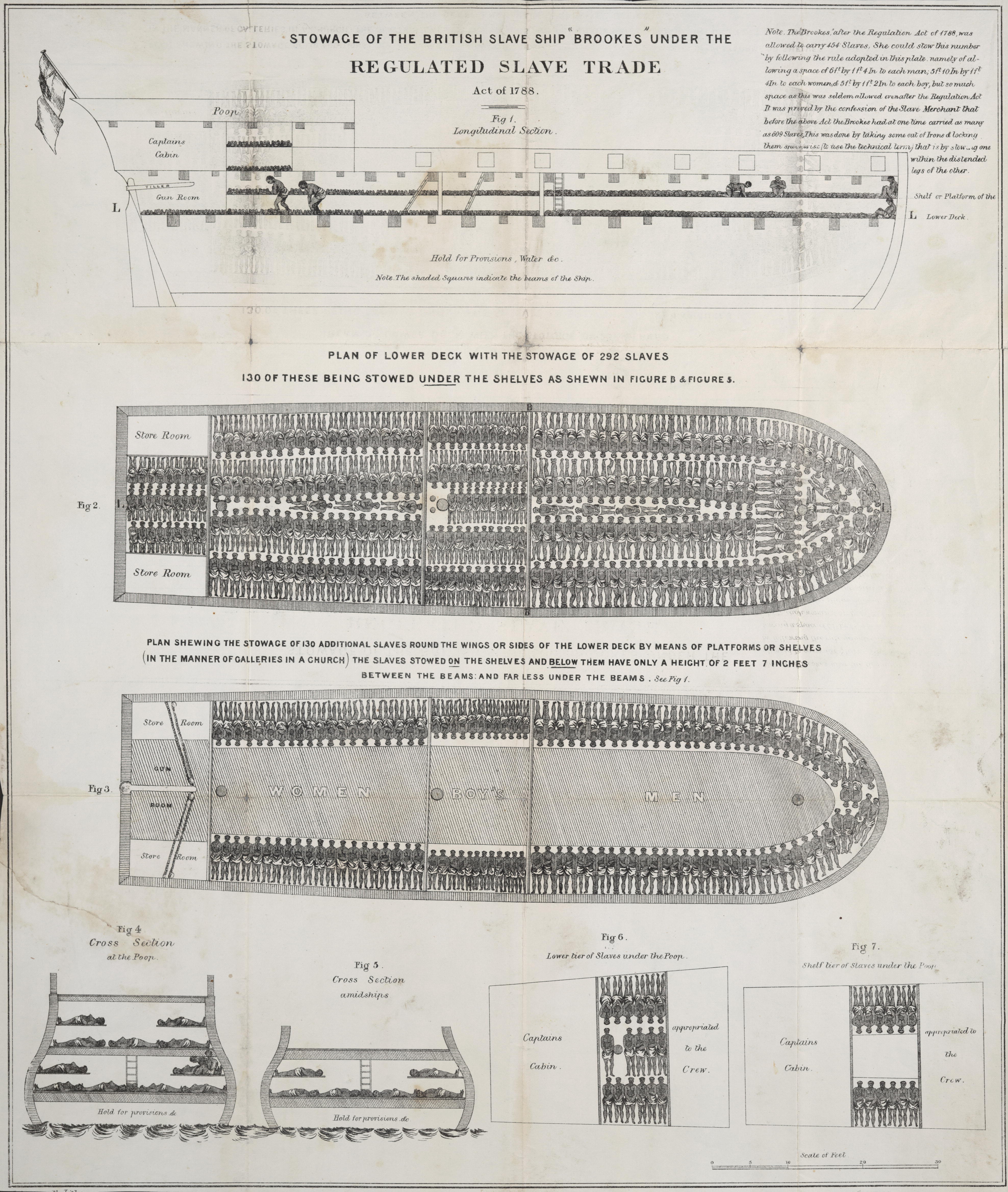
The ship was where the system's logic showed itself most plainly. A slaving voyage was an investment in which the captives were the cargo, bought at one price, carried at a cost and sold at another, and the ship was built and loaded to make that arithmetic pay. The plan of the Liverpool ship Brookes, first printed by the Plymouth committee of the Society for Effecting the Abolition of the Slave Trade late in 1788 and reworked in London in 1789, showed what a lawful cargo looked like. The London version laid out 454 people in rows and on shelves along the hull, the number the regulating act of 1788 would allow, and noted that the ship had carried as many as 609 on an earlier voyage 23.
Olaudah Equiano, who said he was taken from the Igbo country of the Bight of Biafra as a child, described the hold in his Interesting Narrative of 1789 24:
"The closeness of the place, and the heat of the climate, added to the number in the ship, which was so crowded that each had scarcely room to turn himself, almost suffocated us."
The most notorious demonstration that the law saw the captives as goods came in the case of the Zong, a Liverpool-owned ship insured at £30 for each captive. On 29 November 1781, short of water after navigational errors in the Caribbean, its crew began throwing Africans overboard. Over the following days the crew threw 54 women and children overboard, then 42 men, then 26 more; ten others leapt into the sea rather than be thrown. Trevor Burnard's re-examination of the case counts 122 murdered and ten driven to their deaths, 132 in all 25. The owners claimed on the insurance. At the Guildhall in March 1783 a jury found for them; on 22 May the underwriters' appeal came before the Court of King's Bench, where Lord Mansfield, as the abolitionist Granville Sharp's transcript records, declared that "the Case of Slaves was the same as if Horses had been thrown over board"; the court ordered a new trial, and no record of one survives 2526. No one was ever prosecuted for murder. Ian Baucom has made the Zong the emblem of a finance-capital Atlantic in which insurance turned killing into a recoverable loss 2726.
Money and the metropoles
The trade's ports grew rich, and the question of how much the slave economy built Europe has been argued since Eric Williams published Capitalism and Slavery in 1944. Williams held that the profits of slavery and the slave trade helped finance British industrialisation, and that Britain abolished the trade once the West Indian economy was in decline 28. Seymour Drescher's Econocide (1977) answered that the slave colonies were still profitable when Britain abolished the trade, so that abolition was an economic sacrifice imposed by popular pressure 29. Joseph Inikori moved the debate from profits to markets, arguing that the Atlantic economy built on African labour in the Americas was central to England's industrialisation between 1650 and 1850 30. The positions differ on causation; none disputes that Liverpool, Bristol, Nantes, Bordeaux, Middelburg, Lisbon, Rio de Janeiro and Salvador were made by the trade.
What the system displaced in Africa
The changes on the African side are harder to count than the ships, but the outline is no longer in serious doubt. Patrick Manning, whose demographic simulations began this line of work in Slavery and African Life (1990), puts the West African pattern bluntly: "population declined for West African population generally from 1730, and the decline continued well into the nineteenth century. Enough women were lost that the remaining population was unable to replace them or their children" 3132. Because the Atlantic trade took many more men than women, the societies left behind were short of men, and many of the women who remained were themselves held in slavery inside Africa. Manning describes the result as a new social order in which wealthy men controlled the labour of enslaved women and their children 32.
The system also changed what African states were for. Several of the region's strongest polities in the eighteenth century were organised around war and the sale of its captives, and the coastal trade rewarded those that could deliver people in volume:
- Kongo. The kingdom that Afonso had tried to manage fought Portuguese Angola at Mbwila on 29 October 1665, where its king António I was killed; the civil wars that followed, which lasted until the early eighteenth century, fed captives into the trade from every side 33.
- The Gold Coast. Asante, which defeated Denkyera in 1701 and came to control most of the Akan-speaking region, reduced raiding inside its realm but kept capturing people on its periphery; the population of the Gold Coast as a whole, Manning finds, declined for much of the eighteenth century 32.
- The Bight of Benin. Dahomey, which Manning calls "an efficient machine for warfare and enslavement", conquered Allada in 1724 and Savi, the Hueda capital, in 1727, and took control of the region's largest slave port, Ouidah; the atlas follows the captives of those wars in its Haitian Vodou record 32.
- West-Central Africa. Angola and the Kongo coast together supplied close to half of all the Africans carried across the Atlantic, most of them to Brazil 34.
Rodney's argument that the Atlantic trade did not simply draw on African slavery but expanded and hardened it has survived in a modified form. Manning, writing in 2014, credits Rodney with showing that the first century of Portuguese contact brought "an expansion of slavery where it had not previously been prevalent" on the Upper Guinea coast, and Thornton with showing the social change brought by the shortage of men 327. The economist Nathan Nunn later tested the long run directly. Using shipping records and documents that record the ethnic origins of slaves, he estimated exports for each modern African country and reported "a robust negative relationship between the number of slaves exported from a country and current economic performance" 35. What the system displaced, on this evidence, was not a single institution but the ordinary demographic and political growth of the regions it drew upon.
Ending it by law
The system that law had built was dismantled by law, slowly and against resistance, over sixty years.
| Year | Measure | Effect |
|---|---|---|
| 1792 / 1803 | Danish edict of 16 March 1792 | Danish trade banned from 1 January 1803 |
| 1807 | British Abolition Act, royal assent 25 March 1807 | No British slaving departures after 1 May 1807 |
| 1808 | United States prohibition | Importation banned from 1 January 1808 |
| 1831 | Brazilian law of 7 November 1831 | All slaves entering Brazil declared free; widely ignored |
| 1845 | Aberdeen Act, royal assent 8 August 1845 | Royal Navy authorised to seize Brazilian slavers |
| 1850 | Brazilian law 581, 4 September 1850 | Importation of slaves treated as piracy; the Brazilian trade ended |
| 1866–67 | Last transatlantic voyages, to Cuba | Spanish law against the trade, 1866–67 |

The Brazilian law of 1831 is the clearest case of a ban that the system absorbed. Its first article declared that "Todos os escravos, que entrarem no territorio ou portos do Brazil, vindos de fóra, ficam livres" ("All slaves who enter the territory or ports of Brazil from abroad shall be free") 36. The trade continued for two decades in open defiance, and the law became proverbial as a "lei para inglês ver", a law for the English to see. Only the law of 4 September 1850, whose fourth article declared that "A importação de escravos no territorio do Imperio fica nelle considerada como pirataria" ("The importation of slaves into the territory of the Empire is considered piracy within it"), and its enforcement under British naval pressure, closed the Brazilian trade 3738. Beatriz Mamigonian's study of the africanos livres, the Africans "freed" from captured ships and then bound to labour for the Brazilian state and private employers for years, shows how little the formal end of the trade meant to those it was meant to free 38.
What the cost was
The count
The Atlantic slave trade is one of the best-measured crimes in history, because the system that ran it kept accounts. The Trans-Atlantic Slave Trade Database, assembled over four decades by David Eltis, David Richardson and their collaborators from the records of ports, companies, customs houses, insurers and navies, documents some 36,000 voyages. Its estimates, which the field treats as the consensus figures, are that about 12.5 million people were embarked in Africa for the Americas between the early sixteenth century and 1866, and that about 10.7 million were landed alive 3439. The difference, some 1.8 million people, is the death toll of the Middle Passage alone: roughly one captive in seven who boarded a ship did not leave it alive. Herbert Klein, Stanley Engerman and their colleagues, comparing mortality on long-distance sea voyages of every kind, put the average death rate on eighteenth-century slaving voyages at about 12 per cent, falling over the course of the century 40.
The carriers can be counted by flag. The database's estimates of the people embarked on ships of each national flag are:
| Flag of the carrying ship | People embarked (estimate) |
|---|---|
| Portugal and Brazil | 5,848,266 |
| Great Britain | 3,259,441 |
| France | 1,381,404 |
| Spain and Uruguay | 1,061,524 |
| Netherlands | 554,336 |
| United States | 305,326 |
| Denmark and the Baltic | 111,040 |
| Total | 12,521,337 |
Every power that held an Atlantic coastline took part, and the two largest carriers between them moved more than seven in ten of all the captives 39. The table also shows where the trade's centre of gravity lay. The South Atlantic branch, run from Lisbon, Rio de Janeiro, Salvador and Luanda, was larger than any branch run from northern Europe, which is why the anchor of this record in the Americas is not Liverpool or Nantes but the Cais do Valongo in Rio de Janeiro. Between 500,000 and a million Africans are estimated to have come ashore at Valongo between its opening in 1811 and the formal ban of 1831; the wharf was paved over, excavated in 2011 and inscribed as a World Heritage site in 2017 41.
Deaths before the ship and after it
The database counts the people who reached the ships. It cannot count those who died on the way to them, and the evidence is that these were very many. Joseph Miller's reconstruction of the Angolan trade between 1730 and 1830, Way of Death, followed captives from the wars and raids of the interior along the caravan routes to Luanda and Benguela, through the holding pens of the port towns and onto the ships, and treated the Atlantic crossing as only one stage of a longer passage on which captives died at every step, from hunger, exhaustion, disease and violence; the book's title is its finding 42. Manning's simulations add the people killed in the wars and raids that produced captives, and the births that never happened in the regions they were taken from 31.
Arrival was not the end of the dying. Newly landed Africans were sold into regimes of labour and disease for which the first years were the most lethal, and the planters' word for this, "seasoning", treated the deaths as a cost of breaking in new workers. The atlas's sugar record (sugar_plantation_india_to_atlantic_1500) gives the plantation side of this ledger. The relevant point for the trade is that the slave societies of the Caribbean and Brazil did not reproduce their enslaved populations; they replaced them, and the trade existed to make replacement cheaper than survival 43.
The losses can be set out stage by stage:
- Capture and the march to the coast. Deaths in wars, raids, caravans and holding pens; unrecorded, and on Miller's evidence for Angola heavy at every stage.
- The Middle Passage. About 1.8 million dead of 12.5 million embarked.
- The first years in the Americas. "Seasoning" deaths on plantations and in mines, in societies whose enslaved populations fell without new imports.
- The societies left behind. Population decline across much of West Africa from about 1730, and the loss of women whose children would never be born 32.
People as cargo, in law
The cost was also legal and inherited, and it outlived the trade. The Virginia act of 1662 and the Code Noir of 1685 made enslavement descend through mothers, so that every child born to an enslaved woman in the English and French colonies was born property. In the United States, which closed its trade in 1808, the enslaved population continued to grow by birth to almost four million by 1860 44; the law of 1662 had made the trade's end compatible with slavery's expansion. The Zong showed what that law meant at sea. One hundred and thirty-two people were killed or driven to their deaths so that their owners could claim £30 a head, and the court heard the case as a dispute over goods 25.
The captives did not accept the arithmetic. Richardson's survey of shipboard resistance counts at least 485 collective acts of violent rebellion between about 1650 and 1860, of which 392 were revolts on board ship and 93 were attacks from the shore by Africans on ships or their boats 45. Most failed, and their suppression added to the dead. Richardson's argument is that the risk of revolt raised the cost of every voyage, by forcing larger crews, nets, guns and barricades, and so reduced the number of people carried: resistance that rarely freed anyone still cut the trade's volume 45.
The trade after its abolition
The final cost was the length of the ending. Britain banned its subjects' trade in 1807, but the database shows that the Atlantic trade did not shrink in proportion: Portuguese, Brazilian, Spanish and other ships carried hundreds of thousands of captives to Brazil and Cuba in the decades of illegality, many of them landed at Valongo under the law of 1831 that declared them free on arrival 3938. The Royal Navy's West Africa Squadron, the Aberdeen Act of 1845 and the Brazilian law of 1850 eventually shut the Brazilian trade; the last documented voyages reached Cuba in 1866 and 1867. Brazil abolished slavery itself only on 13 May 1888, by the Lei Áurea, the last state in the Americas to do so 46.
What the record shows, then, is a bill with four entries: some 12.5 million people taken, 1.8 million dead at sea and unknown numbers dead before and after, African societies that lost their growth for a century and a half, and a law of hereditary bondage that outlasted the ships. Each entry was produced by an institution that someone had designed: a licence, a contract, a charter, a code, a policy of insurance. That is the reason the trade could be ended by legislation, and the reason its ending took sixty years. The institutions had been built to last.
What followed
-
151818 August 1518: at Zaragoza, Charles V licenses Lorenzo de Gorrevod to take 4,000 enslaved Africans to the Indies, directly from Africa if he wishes; the licence is resold to Genoese merchants in Seville.
-
15261526: Afonso I of Kongo writes to João III of Portugal that the traders are seizing his subjects and kin and that his country is being "completely depopulated".
-
152715 June 1527: the Santa María de Begoña, which had embarked at least 333 captives at São Tomé, enters the harbour of Santo Domingo, one of the earliest documented direct voyages.
-
15951595: Castile grants the first of the Portuguese asientos, contracts selling the monopoly of supplying enslaved Africans to the Spanish Indies; Portuguese contractors hold it until 1640.
-
16371637: the Dutch West India Company, chartered in 1621, takes the castle of Elmina from the Portuguese; Luanda follows in 1641.
-
1648August 1648: an expedition fitted out in Rio de Janeiro under Salvador Correia de Sá retakes Luanda from the Dutch, binding Angola to Brazil.
-
1662December 1662: Virginia's Act XII makes a child's status follow the mother's, turning enslavement into a condition inherited through women.
-
167227 September 1672: the English crown charters the Royal African Company; its monopoly is broken in 1698, when the trade is opened to any English merchant paying a 10 per cent duty.
-
1685March 1685: the Code Noir, issued at Versailles, declares the enslaved of the French islands to be movable property and makes their status follow the mother's.
-
17131713: by the peace of Utrecht the asiento passes to Britain and the South Sea Company, a nation's share of the slave trade settled by treaty.
-
1781November–December 1781: the crew of the Liverpool-owned Zong kill 122 Africans and drive ten more to their deaths; the owners claim £30 a head on the insurance.
-
180725 March 1807: the British Abolition Act receives royal assent; no British slaving voyage may sail after 1 May 1807.
-
18504 September 1850: Brazil's Law 581 declares the importation of slaves piracy, two decades after the 1831 ban that the trade had openly ignored.
-
18671866–67: the last documented transatlantic slaving voyages land captives in Cuba, as Spain passes its law against the trade.
Where this lives today
References
- Archivo General de Indias, Seville, Indiferente 418, L.2, ff. 98v–99r: royal order of Ferdinand, Valladolid, 22 January 1510, to the officials of the Casa de la Contratación, to send fifty slaves to Hispaniola for the gold mines. Summary and transcription in First Blacks in the Americas, CUNY Dominican Studies Institute. es primary
- Anderson-Córdova, Karen F. Surviving Spanish Conquest: Indian Fight, Flight, and Cultural Transformation in Hispaniola and Puerto Rico. Tuscaloosa: University of Alabama Press, 2017. en
- Zurara, Gomes Eanes de. The Chronicle of the Discovery and Conquest of Guinea. Trans. Charles Raymond Beazley and Edgar Prestage. 2 vols. London: Hakluyt Society, 1896–1899. Vol. 1, chs. 24–25, pp. 81–82. en primary
- Wheat, David. "Luso-African Islands and Spanish Archipelagos in the Rise of the Atlantic Slave Trade, ca. 1519–1545." Itinerario, First View (2026). en
- Thornton, John. Africa and Africans in the Making of the Atlantic World, 1400–1800. 2nd ed. Cambridge: Cambridge University Press, 1998. en
- Afonso I of Kongo (Mvemba a Nzinga). Letters to João III of Portugal, 6 July and 18 October 1526. In António Brásio, ed., Monumenta Missionaria Africana: África Ocidental, vol. 1 (1471–1531), pp. 468–471, 489. Lisbon: Agência Geral do Ultramar, 1952. English translation of the July letter in Basil Davidson, The African Past (Boston: Little, Brown, 1964), 191–193. pt primary
- Rodney, Walter. How Europe Underdeveloped Africa. London: Bogle-L'Ouverture; Dar es Salaam: Tanzania Publishing House, 1972. en
- Eagle, Marc, and David Wheat. "The Early Iberian Slave Trade to the Spanish Caribbean, 1500–1580." In From the Galleons to the Highlands: Slave Trade Routes in the Spanish Americas, ed. Alex Borucki, David Eltis and David Wheat, 47–72. Albuquerque: University of New Mexico Press, 2020. en
- Las Casas, Bartolomé de. Historia de las Indias. Ed. Agustín Millares Carlo, with a study by Lewis Hanke. 3 vols. Mexico City: Fondo de Cultura Económica, 1951. Book III. es primary
- Worger, William H., Nancy L. Clark and Edward A. Alpers, eds. Africa and the West: A Documentary History. Vol. 1, From the Slave Trade to Conquest, 1441–1905. 2nd ed. New York: Oxford University Press, 2010. P. 25 (the licence of 18 August 1518). en primary
- Vila Vilar, Enriqueta. Hispanoamérica y el comercio de esclavos: los asientos portugueses. Seville: Escuela de Estudios Hispano-Americanos, 1977. es
- Pettigrew, William A. Freedom's Debt: The Royal African Company and the Politics of the Atlantic Slave Trade, 1672–1752. Chapel Hill: University of North Carolina Press for the Omohundro Institute, 2013. en
- Scelle, Georges. La traite négrière aux Indes de Castille: contrats et traités d'assiento. 2 vols. Paris: L. Larose & L. Tenin, 1906. fr
- Postma, Johannes Menne. The Dutch in the Atlantic Slave Trade, 1600–1815. Cambridge: Cambridge University Press, 1990. en
- Davies, K. G. The Royal African Company. London: Longmans, Green, 1957. en
- Morgan, Kenneth. "Liverpool's Dominance in the British Slave Trade, 1740–1807." In Liverpool and Transatlantic Slavery, ed. David Richardson, Suzanne Schwarz and Anthony Tibbles, 14–42. Liverpool: Liverpool University Press, 2007. en
- Pétré-Grenouilleau, Olivier. Les traites négrières: essai d'histoire globale. Paris: Gallimard, 2004. fr
- Alencastro, Luiz Felipe de. O trato dos viventes: formação do Brasil no Atlântico Sul, séculos XVI e XVII. São Paulo: Companhia das Letras, 2000. pt
- Lovejoy, Paul E. Transformations in Slavery: A History of Slavery in Africa. 3rd ed. Cambridge: Cambridge University Press, 2012. en
- Dunn, Richard S. Sugar and Slaves: The Rise of the Planter Class in the English West Indies, 1624–1713. Chapel Hill: University of North Carolina Press, 1972. en
- Virginia General Assembly. Act XII, December 1662, "Negro womens children to serve according to the condition of the mother." In William Waller Hening, ed., The Statutes at Large; Being a Collection of All the Laws of Virginia, vol. 2, p. 170. New York, 1823. en primary
- Édit du Roi touchant la police des îles de l'Amérique française (Code Noir). Versailles, March 1685. fr primary
- Rediker, Marcus. The Slave Ship: A Human History. New York: Viking, 2007. Ch. 10, "The Ship Brooks." en
- Equiano, Olaudah. The Interesting Narrative of the Life of Olaudah Equiano, or Gustavus Vassa, the African. Written by Himself. 2 vols. London, 1789. Vol. 1, ch. 2. en primary
- Burnard, Trevor. "A New Look at the Zong Case of 1783." XVII–XVIII: Revue de la Société d'études anglo-américaines des XVIIe et XVIIIe siècles 76 (2019). en
- Walvin, James. The Zong: A Massacre, the Law and the End of Slavery. New Haven: Yale University Press, 2011. en
- Baucom, Ian. Specters of the Atlantic: Finance Capital, Slavery, and the Philosophy of History. Durham, NC: Duke University Press, 2005. en
- Williams, Eric. Capitalism and Slavery. Chapel Hill: University of North Carolina Press, 1944. en
- Drescher, Seymour. Econocide: British Slavery in the Era of Abolition. Pittsburgh: University of Pittsburgh Press, 1977. en
- Inikori, Joseph E. Africans and the Industrial Revolution in England: A Study in International Trade and Economic Development. Cambridge: Cambridge University Press, 2002. en
- Manning, Patrick. Slavery and African Life: Occidental, Oriental, and African Slave Trades. Cambridge: Cambridge University Press, 1990. en
- Manning, Patrick. "Slavery and Slave Trade in West Africa, 1450–1930." In Africa's Development in Historical Perspective, ed. Emmanuel Akyeampong, Robert H. Bates, Nathan Nunn and James A. Robinson. Cambridge: Cambridge University Press, 2014. Working-paper version: African Economic History Network. en
- Thornton, John K. The Kingdom of Kongo: Civil War and Transition, 1641–1718. Madison: University of Wisconsin Press, 1983. en
- Eltis, David, and David Richardson. Atlas of the Transatlantic Slave Trade. New Haven: Yale University Press, 2010. en
- Nunn, Nathan. "The Long-Term Effects of Africa's Slave Trades." Quarterly Journal of Economics 123, no. 1 (2008): 139–176. en
- Brazil. Lei de 7 de novembro de 1831 (Lei Feijó). Coleção das Leis do Império do Brasil, 1831. pt primary
- Brazil. Lei nº 581, de 4 de setembro de 1850 (Lei Eusébio de Queirós). Coleção das Leis do Império do Brasil, 1850. pt primary
- Mamigonian, Beatriz Gallotti. Africanos livres: a abolição do tráfico de escravos no Brasil. São Paulo: Companhia das Letras, 2017. pt
- SlaveVoyages. Trans-Atlantic Slave Trade Database and Estimates. Ed. David Eltis, David Richardson et al. Accessed November 2026. en primary
- Klein, Herbert S., Stanley L. Engerman, Robin Haines and Ralph Shlomowitz. "Transoceanic Mortality: The Slave Trade in Comparative Perspective." William and Mary Quarterly 58, no. 1 (2001): 93–118. en
- UNESCO World Heritage Committee. "Valongo Wharf Archaeological Site." Inscription 1548, 41st session, Kraków, 2017. en primary
- Miller, Joseph C. Way of Death: Merchant Capitalism and the Angolan Slave Trade, 1730–1830. Madison: University of Wisconsin Press, 1988. en
- Klein, Herbert S. The Atlantic Slave Trade. 2nd ed. Cambridge: Cambridge University Press, 2010. en
- United States Census Office. Population of the United States in 1860; Compiled from the Original Returns of the Eighth Census. Washington, DC: Government Printing Office, 1864. en primary
- Richardson, David. "Shipboard Revolts, African Authority, and the Atlantic Slave Trade." William and Mary Quarterly 58, no. 1 (2001): 69–92. en
- Brazil. Lei nº 3.353, de 13 de maio de 1888 (Lei Áurea). pt primary