Averroes and Maimonides remake Latin theology (c. 1250) — at a cost
Two philosophers born in Córdoba a dozen years apart — a Muslim judge and a rabbi — gave Paris the method and the arguments on which Thomas Aquinas built his theology. Their philosophy was translated in the decade the friars burned the Talmud, its most literal Latin readers were condemned, and the Commentator was painted lying at the saint's feet.
Ibn Rushd was cursed in the mosque of his own state and confined at Lucena in 1195; within forty years Paris called him simply 'the Commentator'. Maimonides, who fled the same Almohad regime from the same city of Córdoba, became 'Rabbi Moyses' in Latin in the early 1240s, in the Paris that tried and burned the Talmud. From the first, Thomas Aquinas took the line-by-line method of reading Aristotle; from the second, the argument that reason can prove neither the world's eternity nor its beginning — the foundation of his division between reason and faith. The Paris masters who followed the Commentator most closely were condemned in 1270 and 1277, and painters put Averroes beneath Thomas's feet.

Before: a Latin theology with Aristotle's books and no one to explain them
Paris around 1225: the books had arrived, the reading had not
By the 1220s the schools of Paris owned more Aristotle than any Latin generation before them, and understood less of it than they wished. The translators of Toledo, Sicily and Constantinople had put the Physics, the Metaphysics, On the Heavens and On the Soul into Latin over the previous century, a story told in this atlas's record of the Toledo corridor. Possession had not produced comprehension. The texts were compressed, technical and frequently obscure in Latin dress, and the Paris authorities had twice tried to keep them out of the lecture halls altogether, in 1210 and again in 1215. Dag Nikolaus Hasse, whose survey of the Arabic influence on the Latin West is the standard orientation to the field, describes a Latin philosophy that, until the 1220s, read Aristotle mostly through Avicenna — through the great eleventh-century Persian synthesis that fused Aristotle with a Neoplatonic cosmology of emanating intelligences.1
That was the state of the art. A Paris theologian of 1225 learned his trade on Peter Lombard's Sentences, a twelfth-century anthology of patristic opinions arranged by topic. His account of knowledge was Augustine's: the human mind understands truth because God illuminates it from within. His world had been created from nothing, at a first moment, as Genesis said. His soul was a substance in its own right, made directly by God for each person, immortal and individual. Aristotle, where he was read at all, was a quarry for definitions and a source of anxieties — about a world without beginning, about a soul that might be no more than the form of a body, about a God who moved the heavens but did not seem to know or care what happened under them.
What was missing was not a text but a method: a way of reading Aristotle line by line that would say precisely what he meant, and a way of holding what he meant against what revelation taught without either abandoning the philosopher or diluting the faith. Both were supplied, within thirty years, by two men born in the same city a dozen years apart. Neither ever saw Paris.
Two exiles from Córdoba
Abū l-Walīd Muḥammad ibn Aḥmad ibn Rushd was born in Córdoba in 1126 into a family of Mālikī judges; his grandfather had been chief judge of the city. He trained in law, medicine and philosophy, served the Almohad caliphs as judge in Seville from 1169 and as chief judge of Córdoba from 1182, and was their court physician. The Almohad court asked him — the story is told by the chronicler ʿAbd al-Wāḥid al-Marrākushī — to explain Aristotle, whose books the caliph found obscure. The result was the largest body of Aristotle commentary written by any single person in the Middle Ages, in three forms: short epitomes, middle paraphrases, and long commentaries that quoted the text section by section and explained every clause.2 He also wrote, as a jurist, the Faṣl al-maqāl (The Decisive Treatise), arguing that the revealed law of Islam commands the study of philosophy for those capable of it, and that demonstration and revelation cannot contradict one another.3 Miguel Cruz Hernández's biography remains the fullest account of the life in Spanish.4
Moses ben Maimon — Maimonides, Rambam — was born in Córdoba in 1138, the son of a rabbinical judge. When the Almohads took the city in 1148 and ended the public practice of Judaism and Christianity there, the family stayed for some years, then left: for Fez, around 1159, and then, after a brief stay in the Land of Israel, for Egypt, where Maimonides became head of the Jewish community of Fustat and a physician at the Ayyubid court.5 He was the age's greatest codifier of Jewish law. In the early 1190s he finished, in Judaeo-Arabic, the Dalālat al-ḥāʾirīn — the Guide of the Perplexed — written for a reader who knew both the Torah and the philosophers and could not reconcile them.67
Both men were Andalusi in formation and Aristotelian in method; both were shaped, and displaced, by the same Almohad state. Ibn Rushd served it and was disgraced by it; Maimonides fled it. Maribel Fierro, the leading historian of Almohad religious policy, places the two in one frame: a regime that compelled the conversion of Jews, then suspected the converts, and that patronised philosophy at court while persecuting philosophers when the political wind changed.8
What the Latins did not yet have
The difference between Latin theology in 1225 and in 1275 can be stated as a short inventory of things the earlier generation lacked:
- An exact commentator. No Latin had a line-by-line exposition of the Physics, the Metaphysics or On the Soul. Avicenna gave a system, not a reading of the text.
- A theory of the intellect that took Aristotle's On the Soul III at its word. Augustine's illumination did the work that Aristotle assigned to an "agent intellect", and nobody had shown how the two fitted.
- An argued position on the eternity of the world. Aristotle held that the world had no beginning; Genesis said it did. Latin theology had assertion on one side and no rigorous account of what reason could and could not prove.
- A model of philosophical theology written from inside a scriptural religion. The Church Fathers had used Plato; nobody had yet built a theology on Aristotle and survived the attempt with orthodoxy intact.
- A vocabulary for the limits of language about God. The Latins had Pseudo-Dionysius on negative theology, but not a systematic treatment of what the names of God could and could not signify.
Every item on that list arrived from Córdoba.
The transmission: the Commentator and Rabbi Moses
Michael Scot and the long commentaries
The carrier of Ibn Rushd into Latin was a Scottish cleric whose life is known only in fragments. Michael Scot appears first at Toledo, where on 18 August, probably in 1217, he finished a Latin version of al-Biṭrūjī's astronomy, De motibus celorum, with the help of a Jewish collaborator named in the manuscript as Abuteus Levita. Lorenzo Minio-Paluello, in the standard biographical account, accepts as certainly Michael's the Latin version of Ibn Rushd's long commentary on On the Heavens, dedicated to Stephen of Provins — a man who, in 1231, sat on the papal commission charged with deciding which Aristotle the University of Paris could read. The long commentary on On the Soul, preserved in more than fifty manuscripts, is attributed to Michael in three or four of them. By 1232 he was at the court of the Hohenstaufen emperor Frederick II, to whom he dedicated a version of Avicenna's zoology; he was dead by about 1236.9
Roger Bacon, writing a generation later, remembered Michael's arrival among the Latins around 1230 bearing "certain books" of Aristotle together with the commentaries of learned men — Minio-Paluello reads this as the moment that brought Ibn Rushd into the Latin West.9 René-Antoine Gauthier, in a study that remains the basis of the chronology, dated the first Latin use of the commentaries to between 1225 and 1240, roughly a generation after the author's death.10 The speed is the point. Ibn Rushd died in December 1198. By the 1230s the Latin schools were calling him, without further identification, "the Commentator".2
The arrival can be laid out as a short sequence:
| Date | Event | Where |
|---|---|---|
| c. 1217–1235 | Michael Scot and others translate Ibn Rushd's long commentaries from Arabic | Toledo; the Hohenstaufen court 9 |
| c. 1225–1240 | First Latin use of the commentaries in the schools | Paris, Oxford 10 |
| 1230s | Ibn Rushd known in Latin simply as "the Commentator" | Paris 2 |
| 1234 | Roland of Cremona names Maimonides, from hearsay rather than a text | Latin schools 11 |
| 1241–1244 | The Latin Dux neutrorum (the Guide) made and in use | Probably Paris 11 |
| 1245–1252 | Albert the Great teaching at Saint-Jacques, then Cologne, with Thomas Aquinas as his student | Paris; Cologne 12 |
| 1255 | The Paris arts faculty makes the whole known Aristotle compulsory | Paris 1 |
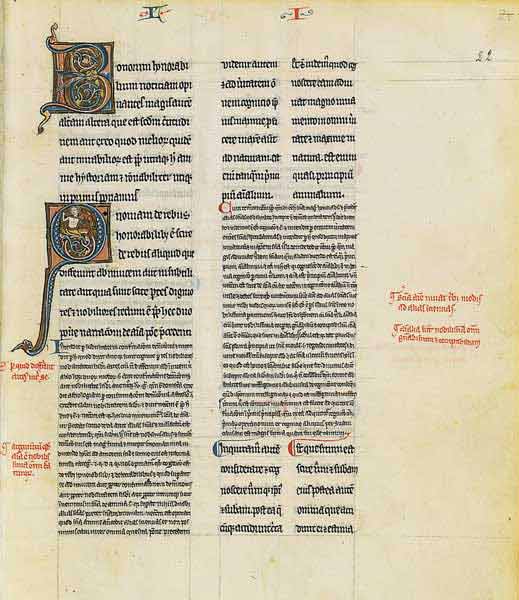
The Dux neutrorum: a Guide in Latin, and a question about why
The Latin Guide has no translator's name in any manuscript, and for a century and a half scholars have argued about where and when it was made. Diana Di Segni, who produced the critical edition of its first part, sets out the evidence. Roland of Cremona, writing in 1234, is the first Latin author to name Maimonides, and he does so from distorted second-hand knowledge — the Guide was evidently not yet available in Latin. Albert the Great's treatise On the Four Coeval Things, in its first redaction of 1241, knows only an excerpt that circulated as Liber de uno Deo benedicto; its second redaction of 1246 quotes the full Dux neutrorum. Caterina Rigo, on this evidence, dates the translation to 1241–1244.11
On the place, Wolfgang Kluxen's article of 1954 is still the turning point. The manuscripts, he wrote, "point unambiguously to France" ("verweisen die Handschriften eindeutig auf Frankreich"); and the Latin rests on the Hebrew version of Judah al-Ḥarīzī rather than on Samuel ibn Tibbon's, which would be odd at the court of Frederick II, where Ibn Tibbon's own son-in-law Jacob Anatoli lived.13 The southern Italian hypothesis has its defenders, but the earliest citations are Parisian.
Görge Hasselhoff has pushed the argument a step further. He places the translation in the Dominican convent of Saint-Jacques in Paris in the early 1240s, perhaps by a Jewish convert to Christianity, and asks whether it was a response to the Paris trial of the Talmud in 1240. "My tentative answer," he writes, "is yes."6 That question — why a Dominican house would translate a rabbi's philosophy in the same years that Dominicans were prosecuting the rabbis' books — belongs to the cost of this record, and it is taken up below.

Saint-Jacques, 1245–1252: a teacher and his student
The Andalusians entered Latin theology through the Dominican order, and through two men above all. Albert of Lauingen — Albert the Great — taught at Saint-Jacques from 1245 to 1248 and then founded the order's studium generale at Cologne. His student in both places was a young Neapolitan nobleman, Thomas of Aquino, who had joined the Dominicans against his family's violent opposition. Albert was, according to Hasselhoff, the first scholastic author to quote Maimonides from the Latin translation, between 1244 and 1246.6 He set out to expound the whole of Aristotle for the Latins, and his paraphrases are saturated with the Commentator.
Thomas returned to Paris in 1252 to lecture on the Sentences, and was regent master in theology there from 1256 to 1259 and again from 1268 to 1272. Jean-Pierre Torrell's biography reconstructs his working life: the Summa contra Gentiles (1259–1265), the commentaries on Aristotle written largely between 1268 and 1273, the Summa theologiae begun in 1265 and left unfinished when he stopped writing in December 1273. He died at Fossanova on 7 March 1274.12 Through all of it the two Andalusians are working partners. Averroes is "the Commentator", cited for what Aristotle meant. Maimonides is "Rabbi Moyses", cited on the names of God, on prophecy, on the reasons for the commandments of the Law, and — decisively — on creation.
What exactly crossed
It is worth being precise, because the popular image of "Aquinas Christianising Aristotle" leaves the intermediaries out. What the Latins took from Córdoba was:
- The literal commentary. Ibn Rushd's long commentaries quoted Aristotle section by section and explained each one. Thomas's own Aristotle commentaries follow the same form.
- A thesis on the intellect. In the long commentary on On the Soul, Ibn Rushd argued that the material, receptive intellect is one and the same for all human beings — a claim he said came to him "after long reflection and intense care".214
- An argument about argument. Maimonides held in the Guide that neither the eternity of the world nor its creation in time can be demonstrated by reason; creation is accepted on the authority of revelation, and on the ground that the philosophers' proofs of eternity do not compel.515
- A discipline of negative theology. Maimonides' account of the divine attributes — that to say "God lives" is to deny that God is like an inanimate thing — gave the Latins a test case for every name of God.16
- A posture toward revelation. Both men assumed, as Ibn Rushd argued in the Decisive Treatise, that truth does not contradict truth, and that a reasoned account of nature cannot finally conflict with a correctly read scripture.
The Decisive Treatise itself, Ibn Rushd's jurist's defence of philosophy, did not travel with the commentaries; his religious works, in the assessment of Fouad Ben Ahmed and Robert Pasnau, "seem to have had little influence on medieval Christian thought".2 The Latins received the Commentator and not the judge. They took the method and the doctrines, and they left behind the legal argument that had justified both inside an Islamic polity.
What changed and what was replaced
The Maimonidean move: the world's beginning cannot be proved
The most consequential single borrowing was also the most modest-looking. In his commentary on the Sentences, written in Paris between 1252 and 1256, Thomas asked whether the world had always existed. His answer reproduced the structure of Maimonides' argument in the Guide: "I say therefore that on neither side of the question are there demonstrations, but probable or sophistical arguments for both" ("Dico ergo, quod ad neutram partem quaestionis sunt demonstrationes, sed probabiles vel sophisticae rationes ad utrumque").15 Luis Xavier López-Farjeat, who has traced the sources of this article, shows Thomas working through the Islamic and Jewish positions — the theologians of the kalām, who claimed to prove creation, Avicenna and Averroes, who claimed to prove eternity, and Maimonides, who denied that either could be proved.15
In the Summa theologiae the position became doctrine: "By faith alone do we hold, and by no demonstration can it be proved, that the world did not always exist."16 The consequence is easy to understate. It drew a line through the middle of theology, separating what reason could establish from what only faith could hold, and it drew that line on a Jewish philosopher's map. Thomas's whole architecture — natural theology below, revealed theology above, and a frontier between them that reason could patrol but not cross — rests on that distinction.
The Commentator's method becomes the scholastic method
The second change was formal, and it outlasted the doctrines. Before the 1230s a Latin master expounding Aristotle offered glosses and summaries. After them he offered what the Commentator had offered: the text divided into sections, each section paraphrased, its argument reconstructed, objections raised and answered, the whole tested against rival interpretations. Hasse describes the long commentaries as the model for the university's practice of exposition, and the 1255 statute that made the whole of Aristotle compulsory in the Paris arts faculty presupposed a way of reading him that the Latins had learned from Córdoba.1
Dante, writing around 1310, put Ibn Rushd in Limbo among the virtuous pagans with a single line of identification: "Averoìs, che 'l gran comento feo" — Averroes, who made the great commentary.17 By then nothing more needed saying. The commentary had become the genre.
One intellect for all: the arts masters read Averroes as philosophers
The doctrines were harder to contain. In the 1260s a group of masters in the Paris arts faculty — the most prominent was Siger of Brabant, regent from about 1266, with Boethius of Dacia — began to teach Aristotle as a philosopher would, following the argument where the Commentator said it led, and reporting the results without always adding the theologian's correction.18 On the intellect, that meant Ibn Rushd's thesis, which in its Latin form came down to three claims:
- One intellect. There is a single receptive intellect for the whole human species, not one for each person.
- Joined through images. Individual human beings think by being joined to that intellect through their own images and perceptions, which are personal and perish with the body.
- No personal survival as a thinker. What outlasts death is not the individual soul as a knower but the species' single intellect, which never began and never ends.
Whether Ibn Rushd really held this has been argued over. Nadja Germann, reviewing Richard Taylor's 2009 translation of the long commentary, rejects the older view that the unicity thesis was "an invention by the Latin theologians"; Ibn Rushd held it.19 What the arts masters did with it is the other question. Siger's writings shift over the decade, and Fernand Van Steenberghen, Siger's great modern biographer, refused to call his circle "Averroist" at all, preferring "radical" or "heterodox Aristotelians": for him the Commentator was a secondary influence, and "Latin Averroism properly so called was born in the fourteenth century with John of Jandun or a little before him" ("L'averroïsme latin proprement dit est né au XIVe siècle avec Jean de Jandun ou peu avant lui").2021
1270: Thomas writes against the Averroists
Thomas, back in Paris in 1268 for his second regency, treated the unicity thesis as a direct threat. Its consequences, as he saw them, ran in a chain:
- If there is one intellect for all, then it is not this man who thinks.
- If it is not this man who thinks, then no individual soul survives death as a knower.
- If no individual soul survives, there is no personal merit, and no subject for reward or punishment. In 1270 he wrote De unitate intellectus contra Averroistas (On the Unity of the Intellect, against the Averroists). It is a technical work, built on close reading of Aristotle's Greek through William of Moerbeke's new translations, and it argues that Ibn Rushd had misread Aristotle. Thomas's verdict on the Commentator is famous: Averroes "was not so much a Peripatetic as a perverter of Peripatetic philosophy" ("qui non tam fuit Peripateticus, quam philosophiae Peripateticae depravator").22
The treatise ends with a challenge that tells the reader what was at stake in the faculty politics:
"If anyone glorying in the name of false science wishes to say anything in reply to what we have written, let him not speak in corners nor to boys who cannot judge of such arduous matters, but reply to this in writing, if he dares."22
On 10 December 1270 Étienne Tempier, bishop of Paris, condemned thirteen propositions. The first was the unicity of the intellect.18
The irony was structural. Thomas fought the Averroists with weapons he had taken from the Commentator — the literal commentary, the appeal to what Aristotle actually wrote, the conviction that demonstration and faith cannot finally conflict. Alain de Libera's 2004 commentary on De unitate intellectus, the fullest modern study of the work, reads it as an argument conducted inside the Andalusian's own terms.23
"Double truth": a charge, not a doctrine
The most durable legacy of the controversy is a phrase nobody owned. Thomas quoted, in his treatise, an unnamed opponent as saying: "Through reason I conclude necessarily that intellect is numerically one, but I firmly hold the opposite by faith."22 Tempier's 1277 prologue accused certain Paris masters of holding things to be true according to philosophy and not according to the Catholic faith, as if there were two contrary truths.18 From these two passages descended the textbook claim that the "Latin Averroists" — and behind them Ibn Rushd himself — taught a doctrine of "double truth".
The claim does not survive inspection. Hans Thijssen, in his survey of the 1277 condemnation, treats double truth as a polemical description of how arts masters handled texts, not as a coherent position anyone defended; no master is known to have taught that two contradictory propositions are both true.18 Ibn Rushd's own position in the Decisive Treatise was the reverse of double truth — that truth does not oppose truth.3 The label was invented by the opponents of the arts masters, transferred to an Andalusian judge who never wrote it, and fixed in the nineteenth century when Ernest Renan published Averroès et l'averroïsme (1852) and gave the movement its name.24
What was displaced
The reception changed what Latin theology was. It also pushed out what it had been:
- Augustinian illumination as the default account of knowledge. Thomas's Aristotelian account, in which the mind abstracts universals from sense experience by its own agent intellect, displaced it among the Dominicans. The Franciscan school of Bonaventure and John Peckham defended the older view and lost the long argument.
- Theology as meditation on authorities. The Sentences had arranged the Fathers; the new theology argued from first principles, objection by objection, in the disputed-question form.
- The arts faculty as a preparatory school. With a complete natural philosophy and a commentator to guide it, the arts masters had a subject of their own; the 1270 and 1277 condemnations were in part the theologians' attempt to put them back in their place.18
- Avicenna as the Latins' principal Arabic guide. Hasse charts a shift after the 1230s from an "Avicennised" Aristotle to an Averroist one in the reading of natural philosophy.1
- The Andalusians' own names. Within a century Ibn Rushd was a figure in Latin painting, Maimonides a "Rabbi Moyses" in footnotes, and the Muslim and Jewish context of their thought had been stripped away.
Twice revealed, once forgotten
The source culture's own reception ran in the opposite direction. Harry Wolfson called him "the twice-revealed Averroes": revealed to the Latins in the thirteenth century, and again in the sixteenth when the Hebrew versions were turned into Latin for the Venetian printers.25 Samuel ibn Tibbon, Maimonides' Hebrew translator, also made the first Hebrew version of Ibn Rushd, and by about 1340, according to Ben Ahmed and Pasnau, virtually all the commentaries were available in Hebrew.226 In the Islamic West, by contrast, many of Ibn Rushd's works survive only in Hebrew or Latin, not in their original Arabic.
Ben Ahmed and Pasnau caution against the easy version of this story: "Ibn Rushd is often described as a philosopher who failed to attract the attention of his first audience, resulting in the death of his philosophy at the hands of its intended Islamic readers … Still, the commonly heard claim that he had no influence on Islamic thought is false."2 The honest statement is narrower. The tradition of rigorous Aristotelian commentary that Ibn Rushd represented had no successor of his stature in the Maghreb or al-Andalus, and his greatest readers, in the centuries after his death, wrote in Hebrew and Latin.
What the cost was
Córdoba, 1195: the source was disgraced first
The transmission began with a disgrace. In 1195 the Almohad caliph Abū Yūsuf Yaʿqūb al-Manṣūr, preparing for war against Castile and courting the jurists, turned against Ibn Rushd — in the same year as the campaign against Castile that ended in his victory at Alarcos. Fierro reconstructs the episode from the Arabic sources. Before his punishment, "Averroes had to endure standing up in the mosque and being cursed and physically abused." Others who studied the rational sciences were persecuted at the same time. Ibn Rushd was then confined — in prison according to Ibn ʿIdhārī, in exile according to Ibn ʿAbd al-Malik al-Marrākushī, perhaps both.8 The secondary tradition, following Roger Arnaldez and the detailed study by Émile Fricaud, reports that his philosophical works were ordered burned; the Arabic sources Fierro examines do not mention a burning, and the claim should be read as reported rather than established.2728
The place of exile was not arbitrary. "Lucena," Fierro writes, "is a town situated some sixty km south of Cordoba and was famous in al-Andalus for its abundant Jewish population, being called Lucena of the Jews." Ibn ʿAbd al-Malik al-Marrākushī gives the reason for sending him there: because of what some said, that he descended from the Banū Isrāʾīl — the Israelites — and had no known lineage among the tribes of al-Andalus.8 Fierro reads the charge not as genealogy but as insult: in a state that had forced Jews to convert and then suspected the converts, the accusation of Jewish descent was a way of degrading a Muslim judge. Dominique Urvoy, she notes, called the confinement "doubly abasing".8
He was recalled before his death at Marrakesh in December 1198. The mystic Ibn ʿArabī, then a young man, watched his remains loaded for the return to Córdoba. In Henry Corbin's French translation, rendered here into English:
"When the coffin containing his ashes had been loaded on the flank of a beast of burden, his works were placed on the other side to balance it… and I said to myself: on one side the master, on the other his works. Ah, how I would like to know whether his hopes were fulfilled!"29
Thirty years later his works, carried north in a different sense, were being read in Paris.
Montpellier and Paris: the other books burned
The Maimonides strand of the transmission ran through a decade of book-burning. In 1232, in Montpellier, Rabbi Solomon ben Abraham and his students issued a ban against Maimonides' Guide and the philosophical first book of his legal code. According to Jewish sources, the anti-Maimonideans appealed to the Dominicans and the Franciscans, and Maimonides' philosophical works were publicly burned — at Montpellier in December 1233, by the account the Jewish Encyclopedia follows, or at Paris by another.3031 The year, the place, and whether Jews denounced the books to the friars are all contested. If the burning happened as reported, it was, in the Jewish Encyclopedia's words, "the first public official burning of Hebrew books".31
Six years later the friars turned on the Talmud. In 1238 or 1239 Nicholas Donin, a Jewish convert, sent Pope Gregory IX a list of thirty-five charges against it. On 9 June 1239 the pope wrote to the archbishops of France: "If what is said about the Jews living in the kingdom of France and other provinces is true, no punishment would be sufficient or worthy of their crime" ("Si vera sunt, quae de iudaeis in regno Franciae et aliis provinciis commorantibus asseruntur, nulla de ipsis esset poena sufficiens sive digna").32 Copies of the Talmud were seized. In June 1240, at the court of Louis IX with Blanche of Castile presiding, Rabbi Yeḥiel of Paris and Rabbi Judah of Melun were made to answer Donin's charges.3233 The verdict was the fire. In the Place de Grève, in June 1242 by the traditional date (June 1241 in Paul Lawrence Rose's redating), "24 wagon loads of books totaling thousands of volumes were handed to the executioner for public burning."30 On 15 May 1248 the papal legate Odo of Châteauroux — chancellor of the University of Paris at the time of the trial — issued the final condemnation.32
These events are usually told separately from the reception of Maimonides. Hasselhoff's argument ties them together. The Dux neutrorum was made in the Paris of the Talmud trial, probably in its Dominican convent; and in the Latin reading Maimonides served as "a perfect example of a Jew who uses his ratio whereas the rest of Judaism, related to the Talmud, is connected only with blasphemies, errors and fables".6 The rabbi's philosophy was admitted to the Latin schools in the same years and by the same institutions that burned the rabbis' law. One was translated, the other was confiscated; the Jewish community of Paris lost both, since Maimonides belonged to it and the Talmud was its text.
Learning turned into a weapon
The Dominican engagement with Arabic and Hebrew did not stop at Paris. The order's language schools — a studium arabicum at Tunis, to which Ramon Martí was assigned in 1250, and later Hebrew schools in Aragon — trained friars to read the scriptures and commentaries of Muslims and Jews in order to refute them.34 The Barcelona disputation of July 1263, before James I of Aragon, set Naḥmanides against the convert Pablo Christiani, with Raymond of Penyafort and Ramon Martí on the Christian side. Within a year, on 23 March 1264, the king commissioned Martí, Penyafort and two other Dominicans to purge the Jews' books of "blasphemies" — the first recorded Dominican censorship of the Talmud in Spain, in Moisés Orfali's account.34 Naḥmanides was prosecuted for blasphemy for publishing his account of the disputation, and left for the Land of Israel.35
In 1278 Martí completed the Pugio fidei adversus Mauros et Iudaeos — The Dagger of Faith against the Moors and the Jews — a Latin and Hebrew arsenal whose first part borrows from Thomas, Albert and Peter of Tarentaise.34 The philosophy that Andalusian Muslims and Jews had built for their own communities was returned to their descendants as an instrument of conversion.
One legend about this should be set aside. A chronicle finished in 1313 by the Dominican Peter Marsilio claims that Raymond of Penyafort asked Thomas to write the Summa contra Gentiles as a handbook for missionaries. Mark Jordan has shown that the story rests on that single late source and calls it "a bit of local hagiography".36 The weaponisation was real; it did not need Thomas's commission.
7 March 1277 and the man in the Street of Straw
The sequence of the final crackdown was quick:
- Late 1276. The inquisitor of France, Simon du Val, summons Siger of Brabant and two colleagues.37
- 18 January 1277. Pope John XXI asks Tempier to investigate rumours of error in Paris.18
- 7 March 1277. Three years to the day after Thomas's death, the bishop condemns 219 propositions and excommunicates anyone who taught them or listened to them unless they reported themselves within seven days.18
- 18 March 1277. At Oxford, the Dominican archbishop Robert Kilwardby issues his own prohibitions.18 Thijssen notes that Siger of Brabant and Boethius of Dacia "have been singled out as the most prominent targets of the 1277 censure", and that "other propositions may well have been derived from the teaching of theologians, such as Thomas Aquinas."18 Some of Kilwardby's Oxford articles were read as aimed at Thomist positions. Luca Bianchi's study of the condemnation reads it as a turning point in the evolution of scholastic Aristotelianism rather than its end.38 The articles were revoked as touching Thomas only in 1325, two years after his canonisation.1839
Siger had already been summoned when the bishop acted. What followed is uncertain. The traditional account puts Siger at the papal curia at Orvieto, where he died before November 1284, stabbed — according to a Brabantine chronicle — by a clerk who had gone mad. Pasquale Porro, re-examining every source, has argued that much of this Italian ending is a "black legend" ("leggenda nera").37 The facts that survive are enough: a master of arts was summoned before an inquisitor for teaching what an Andalusian judge had written about the soul, and no further teaching of his at Paris is recorded.
Dante gave him the last word, and gave it to Thomas. In Paradiso X, the soul of Thomas Aquinas points out to the poet a light among the wise: "the eternal light of Siger, who, lecturing in the Street of Straw, syllogised truths that earned him hatred" ("essa è la luce etterna di Sigieri, / che, leggendo nel Vico de li Strami, / silogizzò invidïosi veri").17

Averroes under Thomas's feet
The last cost is iconographic, and it is the one the reader can still see. In Pisa, in the church of Santa Caterina, a panel painted in the 1320s or 1330s — attributed traditionally to Francesco Traini and by Shazia Jagot to Lippo Memmi — shows Thomas enthroned between Plato and Aristotle, with Ibn Rushd lying beneath him. Jagot calls it "the panel painting which first establishes an Aquinas-Averroes iconographic formula created to uphold the orthodoxy of Thomistic Aristotelianism by casting Averroes into a contemptible position".40 Andrea di Bonaiuto repeated the formula in the Spanish Chapel of Santa Maria Novella in Florence in the 1360s, presenting the Commentator as both heterodox philosopher and Muslim; Benozzo Gozzoli painted it again in the 1470s in the panel now in the Louvre.40
The picture made an argument the texts never made. Thomas had used Ibn Rushd for twenty years and refuted him on one thesis; the painters turned the Commentator into a defeated enemy at the feet of the saint who had depended on him. Petrarch, writing On His Own Ignorance and That of Many Others in 1367–1370 against four young Venetian admirers of the Commentator, carried the hostility into humanism.41
What this record does not claim
- It does not claim that the burnings of 1233 and 1242 were caused by the translation of Maimonides. The causal arrow, if Hasselhoff is right, runs the other way: the Talmud trial created the occasion for the translation.
- It does not claim that Ibn Rushd's disgrace was caused by his Latin reception, which began after his death. It is included because the transmission's source was, at the moment of transmission, under persecution by its own state.
- It does not claim that Siger of Brabant was murdered for his opinions. The manner of his death is uncertain and the dramatic version may be legend.
- It does not claim that the condemnations of 1270 and 1277 stopped the reception. They did not. The Aristotelian theology that the Andalusians made possible became, in the long run, the Catholic Church's own.
The bill
| Date | Event | Who paid |
|---|---|---|
| 1195 | Public humiliation and confinement of Ibn Rushd; his works reportedly ordered burned | Ibn Rushd; the students of the rational sciences in al-Andalus 827 |
| 1232–1233 | Ban and, according to Jewish sources, burning of Maimonides' philosophical works | The Jewish communities of Languedoc 3031 |
| 1240–1242 | Talmud seized, tried and burned in Paris: 20–24 cartloads | The Jews of France 323033 |
| 1263–1264 | Barcelona disputation; Dominican censorship of Hebrew books; Naḥmanides prosecuted | The Jews of Aragon 3435 |
| 1270, 1277 | Condemnations; Siger of Brabant and colleagues summoned before the inquisitor | Paris arts masters 1837 |
| 1320s–1470s | The Triumph of St Thomas iconography: the Commentator painted as defeated | The memory of Ibn Rushd 40 |
The transmission itself was intellectual, and much of what it built was humane: a theology that took reason seriously, a university that read its sources exactly. Its bill was paid in humiliation, books and exile rather than in lives on any demographic scale. But it was paid almost entirely by the communities that had produced the philosophy — the Andalusi Muslim judge confined to the town of the Jews, the Jewish communities whose books were burned in the decade their greatest philosopher was translated — and by the Latin masters who took the Andalusians most literally.
What followed
-
1195The Almohad caliph al-Manṣūr turns on Ibn Rushd: cursed and abused in the mosque, he is confined at Lucena, the town known as 'Lucena of the Jews'; his works are reportedly ordered burned.
-
1198Ibn Rushd dies at Marrakesh in December; his body is carried back to Córdoba with his books as its counterweight, as Ibn ʿArabī remembered.
-
1217Michael Scot finishes a Latin al-Biṭrūjī at Toledo; over the next two decades he and others put Ibn Rushd's long commentaries into Latin.
-
1230Latin Ibn Rushd reaches the schools of Paris and Oxford; within a decade he is known simply as 'the Commentator'.
-
1233According to Jewish sources, Maimonides' philosophical works are burned at Montpellier after the anti-Maimonideans appeal to the friars.
-
1240Trial of the Talmud at the court of Louis IX: Rabbi Yeḥiel of Paris made to answer the convert Nicholas Donin's charges.
-
1242Twenty to twenty-four cartloads of Hebrew manuscripts burned in the Place de Grève, Paris (June 1242, or 1241 in Rose's redating).
-
1244The Latin Dux neutrorum, Maimonides' Guide, is in use at Paris; Albert the Great is the first scholastic to quote it.
-
1252Thomas Aquinas begins lecturing on the Sentences at Paris and adopts Maimonides' position that neither the world's eternity nor its beginning can be demonstrated.
-
1255The Paris arts faculty makes the whole known Aristotle compulsory, read by the method of the Commentator.
-
1263Barcelona disputation: Naḥmanides against Pablo Christiani, with Raymond of Penyafort and Ramon Martí; Dominican censorship of Hebrew books follows in 1264.
-
1270Thomas writes De unitate intellectus against the Averroists; Bishop Tempier condemns thirteen propositions, the first the unicity of the intellect.
-
1277On 7 March Tempier condemns 219 propositions; Siger of Brabant, already summoned by the inquisitor Simon du Val, is the most prominent target.
-
1278Ramon Martí completes the Pugio fidei against Muslims and Jews, borrowing from Thomas and Albert.
-
1284Siger of Brabant dies at Orvieto before November, reportedly stabbed by his clerk; the story may be legend.
-
1323Thomas Aquinas canonised at Avignon; in 1325 the 1277 articles are revoked insofar as they touch him.
-
1330In Pisa a Triumph of St Thomas establishes the image of Ibn Rushd lying defeated beneath the saint.
-
1879Leo XIII's encyclical Aeterni Patris makes Thomas the Catholic Church's model philosopher — a synthesis built with the Andalusians.
Where this lives today
References
- Hasse, Dag Nikolaus. "Influence of Arabic and Islamic Philosophy on the Latin West." Stanford Encyclopedia of Philosophy, substantive revision 3 December 2025. en
- Ben Ahmed, Fouad, and Robert Pasnau. "Ibn Rushd [Averroes]." Stanford Encyclopedia of Philosophy, first published 2021, revised 20 August 2025. en
- Averroës. The Book of the Decisive Treatise Determining the Connection between the Law and Wisdom, and Epistle Dedicatory. Trans. Charles E. Butterworth. Provo: Brigham Young University Press, 2001. en primary
- Cruz Hernández, Miguel. Abû-l-Walîd Muhammad Ibn Rušd (Averroes): vida, obra, pensamiento, influencia. Córdoba: Monte de Piedad y Caja de Ahorros de Córdoba, 1986; 2nd ed. 1997. es
- Seeskin, Kenneth. "Maimonides." Stanford Encyclopedia of Philosophy, revised 18 November 2024. en
- Hasselhoff, Görge K. "The Translation of Maimonides' Dux neutrorum as a Reaction to the Talmud Trial?" In Alexander Fidora and Görge K. Hasselhoff (eds.), The Talmud in Dispute during the High Middle Ages, 219–233. Bellaterra: Universitat Autònoma de Barcelona, Servei de Publicacions, 2019. en
- Maimonides, Moses. The Guide of the Perplexed. Trans. Shlomo Pines, with an introductory essay by Leo Strauss. 2 vols. Chicago: University of Chicago Press, 1963. en primary
- Fierro, Maribel. "Ibn Rushd al-Ḥafīd (Averroes) and his exile to Lucena: Jewish ancestry, genealogy and forced conversion." Al-Qanṭara 38, no. 2 (2017): 131–152. doi:10.3989/alqantara.2017.005. en
- Minio-Paluello, Lorenzo. "Michael Scot." In Charles C. Gillispie (ed.), Dictionary of Scientific Biography, vol. 9. New York: Charles Scribner's Sons, 1974. en
- Gauthier, René-Antoine. "Notes sur les débuts (1225–1240) du premier « averroïsme »." Revue des sciences philosophiques et théologiques 66 (1982): 321–374. fr
- Di Segni, Diana. Moses Maimonides and the Latin Middle Ages: Critical Edition of Dux neutrorum I, 1–59. Inaugural dissertation, Universität zu Köln / Università del Salento, 2013. (Published as Moses Maimonides, Dux neutrorum vel dubiorum, pars I, ed. D. Di Segni. Leuven: Peeters, 2019.) en
- Torrell, Jean-Pierre. Saint Thomas Aquinas, vol. 1: The Person and His Work. Trans. Robert Royal. Washington, DC: Catholic University of America Press, 1996. (French original: Initiation à saint Thomas d'Aquin: sa personne et son œuvre. Fribourg: Éditions universitaires; Paris: Cerf, 1993.) en
- Kluxen, Wolfgang. "Literargeschichtliches zum lateinischen Moses Maimonides." Recherches de théologie ancienne et médiévale 21 (1954): 23–50. de
- Averroes (Ibn Rushd) of Cordoba. Long Commentary on the De Anima of Aristotle. Trans. Richard C. Taylor with Thérèse-Anne Druart. Yale Library of Medieval Philosophy. New Haven: Yale University Press, 2009. en primary
- López-Farjeat, Luis Xavier. "Aquinas on the Eternity of the World in II Sent., d. 1, q. 1, a. 5 and his Arabic/Islamic and Jewish Sources." Aquinas and the Arabs Project, Marquette University. en
- Thomas Aquinas. Summa theologiae, I, q. 13, a. 2 and I, q. 46, a. 2. Trans. Fathers of the English Dominican Province, 2nd rev. ed., 1920. en primary
- Dante Alighieri. Commedia: Inferno IV.144 and Paradiso X.133–138. Italian text, Wikisource. it primary
- Thijssen, Hans. "Condemnation of 1277." Stanford Encyclopedia of Philosophy, revised 18 December 2023. en
- Germann, Nadja. Review of Averroes, Long Commentary on the De Anima of Aristotle, trans. R. C. Taylor. Notre Dame Philosophical Reviews 2010.02.21. en
- Hasse, Dag Nikolaus. "Averroica secta: Notes on the Formation of Averroist Movements in Fourteenth-Century Bologna and Renaissance Italy." In Jean-Baptiste Brenet (ed.), Averroès et les averroïsmes juif et latin, 307–331. Turnhout: Brepols, 2007. en
- Van Steenberghen, Fernand. Maître Siger de Brabant. Philosophes médiévaux 21. Louvain: Publications universitaires; Paris: Vander-Oyez, 1977. fr
- Thomas Aquinas. De unitate intellectus contra Averroistas (1270). Latin text with English translation; see also Ralph McInerny, Aquinas against the Averroists: On There Being Only One Intellect. West Lafayette: Purdue University Press, 1993. la primary
- Libera, Alain de. L'unité de l'intellect : commentaire du De unitate intellectus contra averroistas de Thomas d'Aquin. Paris: Vrin, 2004. fr
- Renan, Ernest. Averroès et l'averroïsme : essai historique. Paris: Auguste Durand, 1852. fr
- Wolfson, Harry A. "The Twice-Revealed Averroes." Speculum 36, no. 3 (1961): 373–392. en
- Robinson, James T. "Samuel Ibn Tibbon." Stanford Encyclopedia of Philosophy, revised 6 March 2024. en
- Arnaldez, Roger. "Ibn Rushd." Encyclopaedia of Islam, New Edition, vol. III, 909–920. Leiden: Brill, 1971. fr
- Fricaud, Émile. "Le problème de la disgrâce d'Averroès." In André Bazzana et al. (eds.), Averroès et l'averroïsme (XIIe–XVe siècle) : un itinéraire historique du Haut Atlas à Paris et à Padoue, 155–189. Lyon: Presses universitaires de Lyon, 2005. fr
- Rguig, Hicham. "L'itinérance de « morts très spéciaux » sur les routes du Maroc médiéval : des destins singuliers." Hespéris-Tamuda 58, no. 2 (2023): 301–327. (Quotes Ibn ʿArabī, al-Futūḥāt al-Makkiyya, in Henry Corbin's translation, L'imagination créatrice dans le soufisme d'Ibn ʿArabī. Paris: Flammarion, 1977.) fr
- Glikson, Yvonne. "Talmud, Burning of." Encyclopaedia Judaica, 2nd ed. Detroit: Macmillan Reference USA, 2007. en
- Gottheil, Richard, and William Popper. "Confiscation of Hebrew Books." Jewish Encyclopedia. New York: Funk & Wagnalls, 1901–1906. en
- Fidora, Alexander. "The Trial of 1240 against the Talmud: A Reassessment of the Christian Account plus a New Edition." Sefarad 82, no. 1 (2022): 7–29. doi:10.3989/sefarad.022-001. en
- Friedman, John, Jean Connell Hoff and Robert Chazan. The Trial of the Talmud: Paris, 1240. Mediaeval Sources in Translation 53. Toronto: Pontifical Institute of Mediaeval Studies, 2012. en primary
- Orfali, Moisés. Review of G. K. Hasselhoff and A. Fidora (eds.), Ramon Martí's Pugio Fidei: Studies and Texts (Santa Coloma de Queralt: Obrador Edèndum, 2017). Sefarad 78, no. 2 (2018): 415–418. es
- Beinart, Haim, and Yom Tov Assis. "Barcelona, Disputation of." Encyclopaedia Judaica, 2nd ed. Detroit: Macmillan Reference USA, 2007. en
- Jordan, Mark D. "The Protreptic Structure of the Summa contra Gentiles." The Thomist 50, no. 2 (1986): 173–209. en
- Porro, Pasquale. "Il filosofo, il poeta e l'arcivescovo. Qualche precisazione sulla fine di Sigieri di Brabante." Noctua 5 (2019). doi:10.14640/QuadernidiNoctua5-26. it
- Bianchi, Luca. Il vescovo e i filosofi: la condanna parigina del 1277 e l'evoluzione dell'aristotelismo scolastico. Quodlibet 6. Bergamo: Pierluigi Lubrina, 1990. it
- Piché, David, with Claude Lafleur. La condamnation parisienne de 1277: texte latin, traduction, introduction et commentaire. Sic et Non. Paris: Vrin, 1999. fr primary
- Jagot, Shazia. "Averroes, Islam, and Heterodoxy in the Spanish Chapel 'Triumph of St Thomas Aquinas'." Interfaces: A Journal of Medieval European Literatures 6 (2019): 7–32. doi:10.13130/interfaces-06-02. en
- Gagliardi, Antonio. "La scienza l'ignoranza la fede. De sui ipsius et multorum ignorantia." Quaderns d'Italià 11 (2006): 111–130. it