How Gandhara's Buddha was carved into Bamiyan's cliffs (~500 CE)
In the cliffs of the Hindu Kush, a young and contested image — the human figure of the Buddha, born in Gandhara — was magnified to the scale of a mountain and relayed east toward China. Fourteen centuries later it was dynamited in three weeks.
In the sixth and seventh centuries CE, in a caravan valley high in the Hindu Kush, the Buddhist communities of Central Asia took the Greco-Buddhist image they had received from Gandhara and carved it into a cliff at colossal scale: two standing Buddhas, 38 and 55 metres tall, surrounded by hundreds of painted caves whose murals include the earliest oil paintings known anywhere on earth. The Chinese pilgrim Xuanzang saw them gilded and gemmed in 630. The Bamiyan synthesis of Gandharan, Sasanian, Indian, and local forms became a school in its own right and helped carry the colossal-Buddha idea east to Yungang and Dunhuang. Buddhism faded from the valley under Islam by the tenth century; the Mongols sacked it in 1221; and in March 2001 the Taliban destroyed the colossi with artillery and dynamite — weeks after massacring the valley's Hazara people at Yakawlang.

Before the cliff was carved
A valley that water and trade made
The Bamiyan valley lies at roughly 2,500 metres in the Hindu Kush of central Afghanistan, a green ribbon of irrigated barley and orchard between the snow line of the Koh-i-Baba to the south and a wall of soft red conglomerate cliff to the north. It was never a capital of empires, but it was a hinge. Caravan routes from Balkh — ancient Bactra, the city Greek and Persian writers called "the mother of cities" — descended from the north; roads from the Kabul valley, Gandhara, and the Indian plains came up from the south-east; tracks toward Herat and the Iranian plateau ran west. Goods, monks, and money moving between South Asia, Central Asia, and China passed through, and the valley grew rich on the traffic. The British-led survey of Shahr-i Zohak and the valley's fortifications by P. H. B. Baker and F. R. Allchin mapped a landscape fortified and resettled across many centuries — fortress after fortress at the valley mouths — a place worth holding because it controlled the passes.10
A high mountain crossing is a place of fear as much as profit. Snow closes the passes; bandits work the defiles; a caravan that loses its animals loses everything. For such a road a shrine is not decoration but infrastructure: a place to give thanks for survival and to buy insurance against the next stage. This is the economic logic beneath the religious one. The merchants who endowed Bamiyan's monasteries were buying merit and goodwill at the exact point where they felt most exposed, and the monks who received their gifts turned caravan anxiety into stone.
By the third and fourth centuries CE this corridor had become thoroughly Buddhist. Monastic communities clustered in the cliffs, supported by donations from traders for whom a sanctuary at a dangerous crossing was both devotion and advertisement. What did not yet exist, in 300 CE, was the thing Bamiyan would become famous for: a mountain wall carved into colossal images of the Buddha. The valley had monks long before it had monuments, and the calibration matters — when the colossi finally rose, they rose into a landscape already saturated with worship, money, and traffic, the accumulated surplus of three centuries of caravan piety.
A religion that had refused to picture its founder
It is easy to forget that the seated, standing, teaching Buddha — the most reproduced human figure in the art of half the world — had to be invented, and that for centuries Buddhism deliberately refused to make it. In the earliest surviving Buddhist art, from the great stupas of Bharhut and Sanchi in the second and first centuries BCE, the founder is present only as a marked absence: an empty throne, a parasol shading no one, a pair of footprints, a riderless horse, the wheel of the law set turning, the tree under which he woke. Worshippers gathered at these signs and understood exactly who was meant. This was not a failure of skill — the same reliefs teem with finely carved people, animals, and architecture. It was a theology. The man who had passed into final nirvana was, in the strictest sense, no longer anywhere to be pointed at.4
The anthropomorphic Buddha — a body, a face, a hand raised in reassurance — emerges only around the first and second centuries CE, and it emerges at two ends of the Kushan world at once: at Mathura in the Indian heartland, in red sandstone and an indigenous idiom, and at Gandhara on the north-western frontier, in grey schist and a frankly Hellenistic one. Scholars have argued for more than a century over which came first and why the image appeared when it did; what is not in dispute is that the figure was young. The image Bamiyan would magnify to the size of a cliff was, historically, a recent and once-contested innovation. The receiving culture of the Hindu Kush did not inherit an ancient way of carving Buddhas. It inherited a new one — barely four or five centuries old — and pushed it to a scale no one had attempted.
Bactria between empires
The political ground beneath the valley was unstable in a way that shaped the art directly. The Kushan empire — the Kushan-era Indian world of Mathura and Gandhara, bridging Hellenistic, Iranian, and Indic traditions — had been the great patron under which the Buddha image and Greco-Buddhist sculpture took form, roughly between 30 and 375 CE. By the time the Bamiyan colossi were carved, the Kushans were long gone. Their successors in Tokharistan were first the Kushano-Sasanians, Persian governors of the eastern marches, and then, from the fifth century, the Hephthalites or "White Huns," a steppe-derived power that dominated Bactria and the Hindu Kush until the mid-seventh century, when a Western Turk and Sasanian alliance broke them.
This dynastic churn is not background colour; it is written on the ceilings. Above the head of the 38-metre Buddha, the painted vault carried rows of richly dressed royal donors whose belted caftans, ribboned crowns, and frontal poses link them to Central Asian Hephthalite courtly tradition rather than to India.1 The colossi were not the gift of a single pious Indian dynasty. They were commissioned in a frontier world of Hunnic kings, Iranian-speaking aristocrats, Sogdian merchants, and an international monastic establishment, all of whom had a stake in the prestige of the valley and the road. The synthesis that Bamiyan is praised for — a Gandharan body, a Sasanian textile, an Indian gesture, a local face — was, before it was a style, simply a portrait of who actually lived, ruled, and paid there.
The transmission: how Gandhara's image climbed into the cliff
The Gandharan invention moves north
The raw material of the transmission was the Gandharan Buddha: a figure built from Hellenistic visual grammar — heavy naturalistic drapery falling in deep, undercut folds, a calm classicising face with wavy hair gathered in a topknot, a body modelled with weight and a hint of contrapposto — fastened to a wholly Buddhist subject and iconography. Kurt Behrendt's study of the art of Gandhara traces how, in the workshops of the Peshawar basin and the Swat valley under Kushan patronage, this image was standardised into a repertoire of poses and gestures that could be reproduced, scaled, and exported.4 It travelled the way everything on the Silk Road travelled: with monks who carried texts, relics, and devotional habits; with merchants who endowed shrines along their routes; and with the craftsmen who followed the commissions from one wealthy valley to the next.
The carriers were not anonymous abstractions. The road up from Gandhara into the Hindu Kush was the same artery along which, generations earlier, the emperor Ashoka's missionaries and then Kushan monks had pushed Buddhism north and east; by the time of the colossi it was a dense, established network of monasteries spaced roughly a day's travel apart, each a node for the movement of texts, relics, novices, and craftsmen. A sculptor trained in a Gandharan workshop could find work the length of the route; so could a relic, a sūtra, or a new fashion in the carving of drapery. The transmission of the Buddha image was therefore not a single event but a continuous seepage along a living vessel of trade and pilgrimage, in which Bamiyan was one especially wealthy stop, able to commission on a scale its neighbours could not.
Bamiyan sat squarely on the road that carried this image from Gandhara up toward Bactria and on to the Tarim oases. What the valley's patrons did with the inherited form was the decisive creative act. Instead of a portable cult statue, a relief panel, or a niche figure a few times life-size, they conceived the Buddha at the scale of architecture — as a permanent feature of the landscape itself, visible from the far side of the valley, approached rather than merely seen. The choice to carve standing Buddhas tens of metres into a living cliff converted the Gandharan image from sculpture into geography. It also fixed the form in place: a portable statue can be hidden, sold, or carried to safety, but a Buddha that is part of the mountain shares the mountain's fate.
Carving the colossus
The two famous figures stood in deep arched niches near either end of the cliff: the eastern Buddha about 38 metres tall, the western about 55 metres — at the time, the tallest standing Buddha statues in the world. Their dating long rested on style alone, and estimates ranged across centuries. That changed when radiocarbon analysis of organic material from the statues' surfaces and structure, carried out by Catharina Blänsdorf and colleagues and published in Michael Petzet's ICOMOS volume on the remains, placed the eastern Buddha at roughly 544–595 CE and the western at roughly 591–644 CE.7 The cliff, in other words, was carved within living memory of the people Xuanzang would meet in 630.
| Eastern Buddha | Western Buddha | |
|---|---|---|
| Height | c. 38 metres | c. 55 metres |
| Radiocarbon date | c. 544–595 CE | c. 591–644 CE |
| Position | east end of cliff | west end of cliff |
| Local later name | Khing But ("grey/white idol") | Surkh But ("red idol") |
The technique was a hybrid of subtraction and addition, documented in detail by Zémaryalaï Tarzi's study of the rupestral architecture and décor of the caves.2 The rough body was hewn from the living conglomerate — a weak, pebbly puddingstone, quick to cut and quick to lose. The fine modelling, especially the deep cascading folds of the monastic robe, was then built up in a mud-and-straw plaster carried on a substructure of wooden dowels and ropes pegged into the rock; the outer surface was finished in lime plaster, painted, and in places gilded, so that from the valley floor the figures read as standing colossi of metal and jewel. Behind and beside them, stairs and galleries were tunnelled through the cliff so that pilgrims could climb to the head and circumambulate.
The list of what the colossi were, materially, is worth holding in mind, because each element is also a vulnerability — the same features that made them possible made them fragile and, in the end, destructible:
- A core of soft conglomerate cliff, structurally continuous with the niche and the mountain around it.
- Drapery and modelling in straw-tempered earthen plaster, keyed to the rock by wooden pegs and twisted ropes.
- A finishing skin of lime plaster, pigmented and partly gilded, repainted and re-gilded over generations.
- Stairways, galleries, and an honeycomb of hundreds of caves — cells, sanctuaries, and assembly halls — cut into the surrounding cliff.
The labour behind the figures is nearly invisible in the record, but it was immense. To rough out two standing colossi from a cliff, drive their internal stairs and galleries, model their robes in plaster, and paint and gild their surfaces was the work of years and of a large, organised, skilled workforce — quarrymen, plasterers, painters, gilders — fed by the valley's agricultural and commercial surplus. Around the two great niches the monks and their patrons cut a honeycomb of more than seven hundred caves and chambers, many of them painted, turning roughly a kilometre and a half of cliff face into a single continuous monument that was at once monastery, pilgrimage destination, and dynastic advertisement. Nothing about it was improvised or cheap. The Buddhas were the visible summit of an enormous, sustained investment of human effort that only a rich and stable node on the Silk Road could have carried.
The painted caves and the oldest oil in the world
Around the great niches the cliff is riddled with caves, and their painted ceilings are, art-historically, as important as the colossi themselves. The murals show seated Buddhas in vermilion robes ranged in rows, haloed bodhisattvas, a sun god riding a chariot in a manner borrowed from Iranian and classical sources, hunting scenes, and the Hephthalite donors already mentioned, in an idiom that fuses Indian iconography with Sasanian and Sogdian dress, jewellery, and textile pattern.1 Zémaryalaï Tarzi's survey and the large multi-volume Japanese documentation project led by Takayasu Higuchi recorded, photographed, and mapped this painted world cave by cave in the 1970s — work that turned out to be a rescue archive, because much of what they recorded was later defaced, looted, or lost.23

In 2008 a team of conservation scientists — Marine Cotte, Yoko Taniguchi, and colleagues working with the European Synchrotron Radiation Facility, the Getty Conservation Institute, and Japanese and French institutions — established something genuinely startling about these paintings. Using synchrotron-based micro-imaging on minute paint samples, they showed that the binding medium in a number of the Bamiyan murals, painted around the middle of the seventh century, was a drying oil, probably pressed from walnut or poppy seed, used over an underlayer in a recognisably "oil-painting" technique.5 That makes Bamiyan the earliest securely identified oil painting anywhere in the world — by some six or seven centuries earlier than oil technique is conventionally credited to the painters of late-medieval Flanders. Drying oils had been known to Roman and Egyptian writers, but as medicine and cosmetic, not as a vehicle for pigment on a wall. The valley was not a provincial echo of metropolitan art. In at least one technique it was ahead of everyone, and the discovery only became possible because so much had already been destroyed: the samples came from fragments left after 2001.
The palette was as international as the iconography, and as local. The brilliant blue that backed many of the painted Buddhas was ultramarine, ground from lapis lazuli — and the lapis came from almost next door, from the mines of Sar-e Sang in Badakhshan in north-eastern Afghanistan, the ancient world's near-sole source of the stone, which had been traded west to Egypt and Mesopotamia for thousands of years. Bamiyan therefore holds among the earliest documented uses of ultramarine as a pictorial pigment — the same blue that would become, a millennium later, the most expensive colour in European painting, reserved for the robe of the Virgin. Alongside it the painters laid vermilion (mercury sulphide) for the famous red robes and lead white for the flesh, bound variously in those drying oils, in resins, and in gums.5 The valley sat on the rarest pigment, the money, and the traffic of ideas all at once: a place where the most precious colour on earth was a regional product and where the painters were, by accident of geography, unusually free to experiment.
Xuanzang's witness, 630 CE
The richest single description of the living shrine comes from the Chinese pilgrim Xuanzang, who reached the valley on 30 April 630 and recorded it in the Da Tang Xiyu Ji, the Great Tang Dynasty Record of the Western Regions, compiled in 646.6 He describes a flourishing kingdom — he calls it Fanyanna — with more than ten monasteries and several thousand monks of the Lokottaravāda school of the Mahāsāṃghika tradition. He describes a standing stone Buddha, by his measure "a hundred and forty or fifty feet" high, of "dazzling golden colour" and "adorned with brilliant gems"; a second great figure cast or sheathed so as to gleam like metal; and, in a monastery to the east, a reclining Buddha of immense length representing the moment of final nirvana. He notes the king's lavish patronage and a great assembly at which the ruler gave away his wealth to the monks.
Xuanzang's account is not only the earliest detailed textual witness to the statues; it is the document that fixed Bamiyan in the imagination of the Buddhist east and, much later, guided the archaeologists who came to dig. His reclining "sleeping Buddha," which later readers reckoned at some 300 metres, has never been found, despite decades of searching by Zémaryalaï Tarzi after 2002; Tarzi's excavations instead recovered a smaller (roughly 19-metre) reclining figure and dozens of sculpture heads from the eastern monastery. Whether the colossal sleeping Buddha was metaphor, pious exaggeration, or a genuinely lost monument remains open. But the report itself travelled. Pilgrims and translators carried Xuanzang's marvels back to China, where the idea of a Buddha the size of a cliff was already taking on a life of its own.
What changed and what was replaced
The colossal idea travels east
The most important thing Bamiyan transmitted was not any single figure but a possibility made visible: that the Buddha could be carved at the scale of a mountain, and that to do so was an act of supreme religious merit. As Llewelyn Morgan argues in his history of the monuments, for some fourteen centuries the colossi stood at the exact meeting point of the Indian, Iranian, Central Asian, and Chinese worlds, and their fame ran in both directions along the Silk Road.9 The great rock-cut cave-temple complexes of China — Yungang near Datong under the Northern Wei from the later fifth century, Longmen near Luoyang from around 500, and above all the Mogao caves at Dunhuang — belong to the same impulse. The civilisation that produced the colossal cliff Buddhas of medieval China did so having heard, through a steady traffic of pilgrims and texts, of the gigantic standing Buddhas in the far western mountains.1
This is the heart of the record's claim, and its limit. No one carved a copy of Bamiyan at Dunhuang; the influence is not a tracing but a transmission of ambition and idiom along a shared road. The Central Asian Buddhist world did not merely receive the Gandharan image — it amplified it to monumental scale and relayed it eastward, and the receiving cultures further along the route, the oasis painters of Kizil and the monastic patrons of Dunhuang, drew on Bamiyan precedents in turn. A line can be drawn, with care, from a contested innovation in first-century Gandhara, through a sixth-century cliff in the Hindu Kush, to the colossal Buddhas of Tang and pre-Tang China. Bamiyan is the high node in the middle of that line — the place where the image first became landscape.
Why scale at all? The answer lies in the logic of merit that drove Buddhist patronage. To commission an image of the Buddha was to generate spiritual merit for oneself, one's family, and one's dead; to commission the largest image anyone had ever seen was to generate that merit on a matching scale, and to say so publicly. Kings and merchants competed in devotion as they competed in trade, and a colossus was the most legible possible statement that a ruler had both the wealth and the piety to move a mountain for the Buddha. Once Bamiyan had shown that a Buddha could be the size of a cliff, the gesture became repeatable wherever a dynasty wished to advertise its merit in permanent stone — which is part of why the idea found such fertile ground in the imperial cave-temple programs of China, where successive courts poured state resources into ever-larger rock-cut Buddhas.
A school is born: the Bamiyan style
What art historians call the "Bamiyan style" is the synthesis itself hardened into a tradition. Deborah Klimburg-Salter's study, The Kingdom of Bāmiyān, situates the valley as the religious, political, and commercial centre of the Hindu Kush and reconstructs the distinctive visual idiom that radiated from it.1 Its ingredients can be named precisely:
- A Gandharan-Hellenistic command of the draped, weighted, three-dimensional human body.
- Gupta-era Indian iconographic conventions for posture, gesture (mudrā), and the auspicious marks of a Buddha.
- Sasanian and Sogdian dress, textile patterns, and decorative motifs — ribboned diadems, pearl roundels, hunting kings, solar and lunar deities.
- Local Hephthalite courtly portraiture among the donor figures on the niche ceilings.
- A technical repertoire that included the oil-bound mural technique unmatched in Europe for centuries.
The paintings of Bamiyan are generally regarded as among the precursors of the art of the Kizil caves in the Tarim Basin, and elements of their composition and palette recur, transformed by local taste, at Kizil and Dunhuang.1 What had begun as a frontier improvisation — a way of solving the problem of how to honour a foreign god with the materials and craftsmen at hand — set, over generations, into a recognisable school whose reach is still legible across thousands of kilometres of Central Asian cliff.
The names the conquerors kept
There is a revealing fact buried in the later history. When Islam came to the valley, the new inhabitants did not erase the Buddhas from memory or from speech; they renamed and kept them. The two figures became Surkh But and Khing But — the "red idol" and the "grey" or "white idol" — and a local legend grew up that they were not gods at all but a pair of doomed lovers, Salsal and Shamama, turned to stone. Medieval Muslim geographers and travellers described them as wonders. The figures were absorbed into the folklore and the wonder-literature of the Islamic world rather than expunged from it.912 This matters enormously for the cost framing that follows: the statues stood, intact and admired, under more than a thousand years of Muslim rule. Whatever destroyed them in 2001 was not a timeless religious reflex. For most of Islamic history the Buddhas were simply part of the landscape of marvels, with names in the local tongue.
What the image displaced
Every arrival displaces something. The colossal painted Buddha of Bamiyan completed the long defeat of the aniconic tradition: the empty throne and the lone footprint, once theologically required, became archaic and provincial. The monumental image also reorganised the religious landscape of the valley itself, pulling pilgrimage, donation, and royal ritual toward the cliff and away from whatever local and pre-Buddhist cults had preceded it; Klimburg-Salter reads the close physical relationship of palace and monastic complex as evidence that the cliff had become the literal centre of the kingdom's life, the place where political and sacred power were performed together.1 And the sheer scale changed expectations wherever it was reported. After Bamiyan, monumentality itself entered the vocabulary of devotion — a standard of pious ambition against which later kings and abbots measured their own merit. The cost of all this, in stone and labour and, eventually, in the sheer size of the target the valley now presented to anyone who wanted to make a point, was not yet visible.
What the cost was
The slow ending: Islamization and the Mongol sack
The bill for Bamiyan came due over more than a millennium, in instalments. The first was gradual and not, in itself, violent toward the statues. The Saffarid ruler Yaʿqūb ibn Layth took Bamiyan around 870–871, and over the following centuries, through the Ghaznavid period of Sultan Mahmud and after, Islam progressively replaced Buddhism across the Hindu Kush. The monasteries lost their patrons, their pilgrims, and their endowments; the monastic community shrank and, by roughly the tenth century, ceased to exist. The painted caves fell silent. Yet the statues themselves survived this religious transition for some seven hundred years — repainted in places, renamed, woven into Muslim legend, but standing. As Morgan stresses, under Islam the Buddhas were for the most part celebrated as wonders, not attacked as idols.9
The conversion was neither instant nor uniform. Bamiyan retained Buddhist and other non-Muslim communities for generations after the first Muslim conquests, and the region's full Islamization stretched across the Ghaznavid and Ghurid centuries. But the direction was settled. Each generation the monasteries drew fewer novices and fewer gifts, until the institution that had carved, repainted, and maintained the Buddhas simply ceased to exist, and the statues passed into the keeping of people who admired them as the work of vanished giants rather than as objects of their own worship. The figures outlived their religion in the valley by a thousand years — orphaned monuments, kept on by sheer mass and by the human reluctance to destroy something so plainly extraordinary.
The second instalment was sudden, catastrophic, and human. In the spring of 1221 the Mongol army of Genghis Khan, sweeping through Khorasan in pursuit of the Khwarazmian prince Jalāl al-Dīn, besieged the valley's great citadel at Shahr-e Gholghola. During the siege a favourite grandson of the khan, Mütügen, son of Chagatai, was killed by an arrow from the walls. Genghis Khan's response was annihilation: the city was stormed and its population massacred so thoroughly, the chroniclers say, that the place is remembered to this day as Shahr-e Gholghola, the "City of Screams."910 The Buddhist monuments were by then the relics of a vanished faith, and the Mongols left the statues largely alone. The people of the valley they did not. The 1221 sack is the largest single act of killing in Bamiyan's recorded history, and it is a reminder that the valley's worst catastrophes have generally fallen on its living inhabitants, not on its stone.
Rediscovery, cannon fire, and the long road to 2001
For Europeans the Buddhas were "rediscovered" in the early nineteenth century, when British travellers and agents of the Great Game — among them William Moorcroft and Alexander Burnes — passed through and described the colossi to a Western audience that folded them into the new disciplines of archaeology and art history. The statues had already taken damage over the centuries: their faces were gone, and tradition variously blamed the iconoclasm of later rulers and the cannon of Aurangzeb or Nader Shah, who are said to have used the figures for target practice. In 1933 the French Citroën "Yellow Cruise" (Croisière Jaune) expedition reached Bamiyan, and French archaeologists of the Délégation Archéologique Française en Afghanistan made the valley a centre of study. By the late twentieth century the Buddhas were a fixed point in the world's mental map of human heritage — which is precisely what made their destruction such effective theatre.12
Twenty-five days in 2001
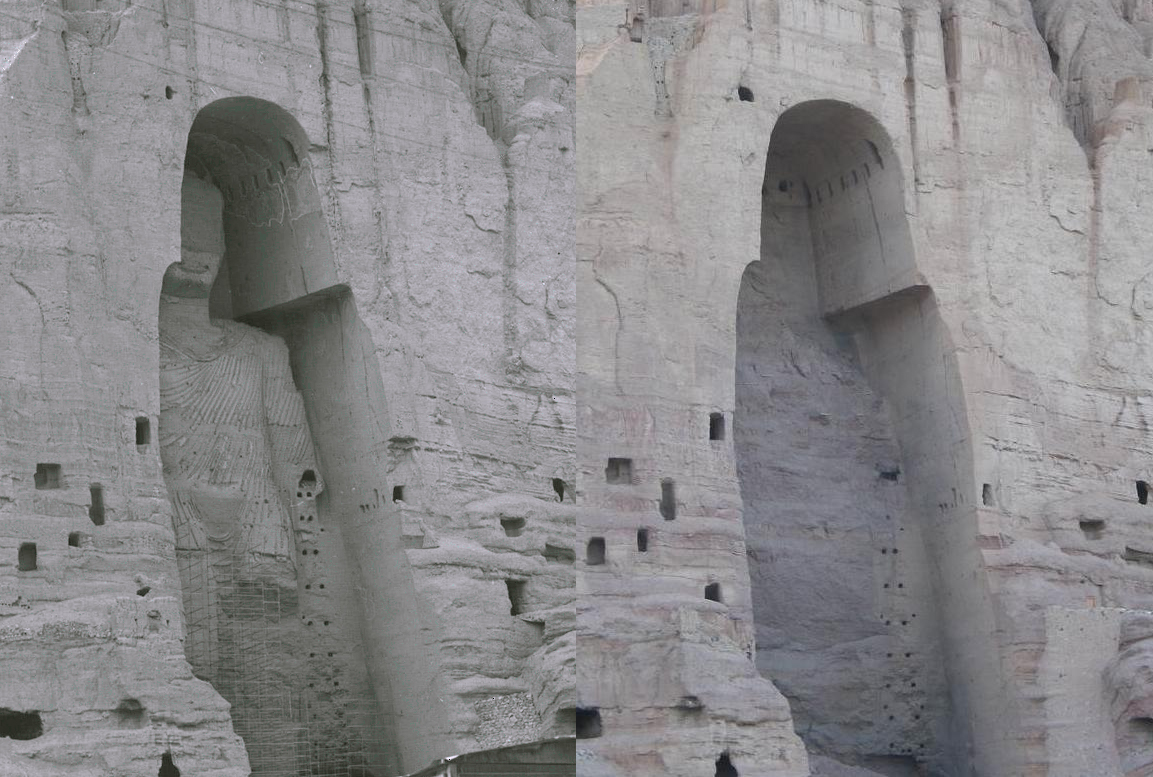
The destruction the world remembers came at the very end of the story. On 26 February 2001, after consulting a council of clerics, the Taliban leader Mullah Mohammad Omar issued an edict ordering the destruction of all non-Islamic statues in Afghanistan. Work on the Bamiyan Buddhas began on 2 March and continued, against the obstinate strength of the figures, for several weeks.8 The sequence is well documented and worth stating without euphemism:
- The statues were first shelled with anti-aircraft guns, tank fire, and artillery, which scarred them deeply but did not bring them down.
- When bombardment failed, men were lowered down the cliff face on ropes to drill holes into the bodies and pack them with explosives.
- The charges were detonated over successive days; rockets were fired at the heads that survived.
- The demolition was finished with dynamite laid in the deepest cavities. By late March 2001, both niches were empty.
The international response was immediate, loud, and useless. UNESCO sent thirty-six formal letters of protest; Muslim religious authorities in Egypt, Iraq, and Pakistan issued rulings against the act; museums and governments offered to buy the statues outright or to remove and shelter them. None of it moved the decision, and that imperviousness was the point. Finbarr Barry Flood, writing in The Art Bulletin within a year of the event, argued that the destruction should be read not as the timeless expression of an "Islamic" theology of images — the statues had, after all, stood unmolested under Muslim rule for thirteen centuries — but as a thoroughly modern and calculated gesture, a regime staging its defiance precisely by attacking what it knew the wider world held sacred.8
The people of the valley
The cost of 2001 was never only sculptural, and to tell it as the loss of art alone is to repeat the very error Flood warns against. Bamiyan is the heartland of the Hazara, a Shia, mostly Persian-speaking people long treated as the lowest stratum of Afghan society and repeatedly targeted as heretics and outsiders. In the late nineteenth century, under the amir Abdur Rahman Khan, the Hazara were subjected to campaigns of conquest, enslavement, and massacre that killed a large share of their population and reduced many of the survivors to servitude; the twentieth century brought further cycles of dispossession. The Taliban's assault on them in 2000–2001 fell along this much older fault line. The destruction of the Buddhas cannot be cleanly separated from the war against the people who lived beneath them. Pierre Centlivres, in his account of the monuments and their end, reads the dynamiting as bound up with the Taliban's hostility to the Hazara — an assault on what had become, in effect, the symbolic capital of a despised people, the grand setting of their homeland.12
The chronology makes the connection unanswerable. Only weeks before the explosives went into the Buddhas, in January 2001, Taliban forces retaking the district of Yakawlang in the Bamiyan highlands rounded up some 300 Hazara men — including aid workers — and shot them by firing squad in public view. Human Rights Watch, investigating the killings, confirmed roughly 170 dead.14 The same campaign in the same months that emptied the niches also filled the graves. To remember the statues and forget Yakawlang is to mistake the smaller loss for the whole.
The empty niches
In 2003 UNESCO inscribed the Cultural Landscape and Archaeological Remains of the Bamiyan Valley on the World Heritage List and, in the same act, on the List of World Heritage in Danger, recognising at once the outstanding universal value of what had stood there and the precariousness of what remained.11 International teams stabilised the fractured cliff and the gaping niches, gathered and conserved tens of thousands of fragments of the shattered statues, and excavated the surrounding monastic terraces; Tarzi's campaigns recovered the 19-metre reclining Buddha and many sculpture heads.2 What they have not done — what remains fiercely debated — is rebuild the colossi. The safeguarding work since 2003 has consolidated the remains and recorded them in extraordinary detail, including digital and projection-based "returns" of the figures to their niches, but it has deliberately stopped short of physical restoration. The volume edited by Masanori Nagaoka on the future of the statues lays out the competing positions — full anastylosis from surviving fragments, partial reconstruction, a single rebuilt Buddha, or the conscious preservation of the empty niches as themselves the most honest possible monument.13
The destruction also changed the law of heritage. The deliberate, broadcast dynamiting of the Buddhas helped prompt UNESCO's 2003 Declaration Concerning the Intentional Destruction of Cultural Heritage, and it became the reference case — later joined by Palmyra and the shrines of Timbuktu — for treating the calculated obliteration of monuments as an offence against all of humanity rather than the internal affair of whichever regime holds the ground.11 That an act of erasure should produce a new international norm against erasure is a bitter kind of legacy, but it is a real one, and it belongs in the ledger beside the loss.
In the meantime the niches have been filled, briefly, by other means. In June 2015 a Chinese couple, Zhang Xinyu and Liang Hong, mounted a projector worth some 120,000 dollars on scaffolding and threw a three-dimensional light image of the larger Buddha back into its empty niche for two evenings, while more than a thousand local people gathered with music to watch the figure "return" for a few hours. Conservators in Germany and elsewhere hold tens of thousands of fragments in crates, awaiting a decision that has not come. When the Taliban returned to power in 2021, the future of the niches passed back into the hands of the movement that had emptied them. The light switches off; the fragments stay boxed; the niches remain.
So the valley's present state is two vast empty niches in a red cliff, larger than the statues that once filled them, visited now precisely for an absence. The transmission that began as a young, contested image in Gandhara, rose to the scale of a mountain in the Hindu Kush, and seeded the colossal Buddhas of China ended as the most-watched cultural destruction of its century. For fourteen hundred years the Buddhas were a thread running from India to China and, at the last, into the world's evening news. What it finally cost to cut that thread was measured not only in the rubble heaped at the foot of the cliff, but in the bodies at Yakawlang — the people of the valley and the masterpiece above them destroyed, deliberately, in the same season.
What followed
-
600c. 550–620 CE: the two colossal standing Buddhas — 38 metres (eastern) and 55 metres (western) — are carved into the Bamiyan cliff, finished in plaster, painted, and gilded; radiocarbon dating places the eastern figure c. 544–595 and the western c. 591–644.
-
63030 April 630 CE: the pilgrim Xuanzang records Bamiyan as a flourishing kingdom of more than ten monasteries and several thousand monks, its golden, gem-adorned Buddhas the centre of the valley's religious life — the earliest detailed witness to the statues.
-
650Mid-7th century CE: painters bind a number of the cave murals with drying oils from walnut or poppy seed — the earliest securely identified oil paintings anywhere in the world, centuries before the technique is conventionally credited to late-medieval Europe.
-
490Late 5th–6th centuries CE: at Yungang near Datong, the Northern Wei carve colossal cliff Buddhas, part of a Chinese monumental tradition shaped by the same Silk Road impulse that produced Bamiyan.
-
7007th–8th centuries CE: the cave-temple painters of Kizil and the great Buddhas of Mogao at Dunhuang draw on Bamiyan precedents, carrying the colossal-Buddha idea and the Central Asian synthesis deep into China.
-
871c. 870–871 CE: the Saffarid Yaʿqūb ibn Layth takes Bamiyan; over the following centuries Islam progressively replaces Buddhism in the Hindu Kush and the monastic community ends, though the statues survive as celebrated wonders.
-
1221Spring 1221 CE: Genghis Khan's Mongols besiege the valley's citadel at Shahr-e Gholghola, and after a grandson of the khan is killed, massacre the population so completely the ruins are remembered as the 'City of Screams.'
-
2001January 2001: weeks before the statues fall, Taliban forces retaking Yakawlang in the Bamiyan highlands shoot some 170 Hazara men by firing squad in public view — documented by Human Rights Watch.
-
2001March 2001: on Mullah Omar's edict, the Taliban destroy both colossal Buddhas with anti-aircraft fire, artillery, explosives lowered down the cliff, and dynamite over several weeks, despite 36 UNESCO protest letters and fatwas against the act.
-
20032003: UNESCO inscribes the Cultural Landscape and Archaeological Remains of the Bamiyan Valley on the World Heritage List and the List of World Heritage in Danger; the niches are stabilised and fragments conserved, but the colossi are deliberately not rebuilt.
Where this lives today
References
- Klimburg-Salter, Deborah E. The Kingdom of Bāmiyān: Buddhist Art and Culture of the Hindu Kush. Series Maior V. Naples and Rome: Istituto Universitario Orientale and Istituto Italiano per il Medio ed Estremo Oriente, 1989. en
- Tarzi, Zémaryalaï. L'architecture et le décor rupestre des grottes de Bāmiyān. 2 vols. Paris: Imprimerie Nationale / Librairie C. Klincksieck, 1977. fr
- Higuchi, Takayasu, ed. Bāmiyān: Art and Archaeological Researches on the Buddhist Cave Temples in Afghanistan, 1970–1978. 4 vols. Kyoto: Dōhōsha, 1983–1984. (In Japanese.) jp
- Behrendt, Kurt A. The Art of Gandhara in the Metropolitan Museum of Art. New York: The Metropolitan Museum of Art, 2007. en
- Cotte, Marine, Jean Susini, V. Armando Solé, Yoko Taniguchi, Javier Chillida, Emilie Checroun, and Philippe Walter. "Applications of Synchrotron-Based Micro-Imaging Techniques to the Chemical Analysis of Ancient Paintings." Journal of Analytical Atomic Spectrometry 23 (2008): 820–828. en
- Xuanzang. The Great Tang Dynasty Record of the Western Regions (Da Tang Xiyu Ji), c. 646 CE; on Bamiyan (Fanyanna), visited 30 April 630. Translated by Li Rongxi. Berkeley: Numata Center for Buddhist Translation and Research, 1996. zh primary
- Blänsdorf, Catharina, et al. "Dating of the Buddha Statues — AMS 14C Dating of Organic Materials." In The Giant Buddhas of Bamiyan: Safeguarding the Remains, edited by Michael Petzet. ICOMOS Monuments and Sites XIX. Berlin: Bässler, 2009. en
- Flood, Finbarr Barry. "Between Cult and Culture: Bamiyan, Islamic Iconoclasm, and the Museum." The Art Bulletin 84, no. 4 (2002): 641–659. en
- Morgan, Llewelyn. The Buddhas of Bamiyan. Wonders of the World. London: Profile Books; Cambridge, MA: Harvard University Press, 2012. en
- Baker, P. H. B., and F. R. Allchin. Shahr-i Zohak and the History of the Bamiyan Valley, Afghanistan. Ancient India and Iran Trust Series 1; BAR International Series 570. Oxford: British Archaeological Reports, 1991. en
- UNESCO World Heritage Centre. "Cultural Landscape and Archaeological Remains of the Bamiyan Valley." World Heritage List, inscription no. 208 (2003); inscribed simultaneously on the List of World Heritage in Danger. Paris: UNESCO. en primary
- Centlivres, Pierre. Les Bouddhas d'Afghanistan. Lausanne: Éditions Favre, 2001. fr
- Nagaoka, Masanori, ed. The Future of the Bamiyan Buddha Statues: Heritage Reconstruction in Theory and Practice. Cham: Springer / UNESCO, 2020. en
- Human Rights Watch. "Afghanistan: Massacres of Hazaras" (on the Yakawlang massacre, January 2001). New York: Human Rights Watch, vol. 13, no. 1(C), February 2001. en primary