The Bantu expansion remakes a continent — at the cost of the populations already there
Over 2,500 years, Niger-Congo-speaking populations from the Cameroon-Nigeria border carried iron metallurgy, agriculture, and a single language family across most of Sub-Saharan Africa. The hunter-gatherer and forest forager populations they encountered were absorbed, displaced into smaller refuges, or — in the cases best preserved by genetic and linguistic evidence — substantially eliminated as distinct cultural communities.
Sometime around 1500 BCE, populations speaking an early form of what would become the Bantu language family began moving outward from a homeland in the Cameroon-Nigeria border region around the Niger-Benue confluence. They carried with them iron metallurgy, polished stone tools, the cultivation of yams, oil palm, and (later) bananas, and a Niger-Congo language structure that would, over the next 2,500 years, give rise to the roughly 500 Bantu languages spoken today by ~350 million people from Kenya to South Africa to the Atlantic. The expansion is one of the largest demographic events of human prehistory. It is also a story conventionally told in the passive voice — "the Bantu spread," "the languages diffused" — that elides what happened to the hunter-gatherer, forest forager, and Cushitic pastoralist populations whose territory was being expanded into. Genetic, linguistic, and archaeological evidence from the past three decades has begun to reconstruct the cost. The Khoisan-speaking populations of southern Africa, today numbering perhaps 50,000, are the descendants of populations that occupied a territory ten times larger before the Bantu arrived. The forest-foraging Mbuti, Aka, and Twa survived in the dense Central African rainforests where Bantu agricultural settlement could not reach.

Pre-Bantu Sub-Saharan Africa
In 1500 BCE, the southern half of the African continent — everything south of the Sahel — was occupied by a substantially different set of populations than the modern map shows.
The rainforests of central Africa (modern Cameroon, Gabon, Republic of Congo, Democratic Republic of Congo) were home to hunter-gatherer populations whose modern descendants include the Aka, Mbuti, Twa, Baka, Efe, and other groups historically called by the European exonym Pygmies. The genetic and linguistic record indicates these populations had lived in the central African rainforests for tens of thousands of years before any Bantu speakers arrived, and that they had developed sophisticated foraging strategies adapted to dense rainforest environments. They were not a single people; they spoke distinct languages (most now extinct or surviving only as substrate features in Bantu languages they later adopted), and they had varied cultural practices.1
The savanna and the southern African veld were occupied by ancestors of modern Khoisan-speaking populations: the San (also called Bushmen, a colonial term now largely rejected) and the Khoekhoe (also Hottentots, also rejected). Genetic studies indicate that southern African Khoisan populations represent some of the deepest-branching modern human lineages — their genetic divergence from other modern human populations is older than any other documented human population split. They occupied a territory in 1500 BCE that included much of modern South Africa, Botswana, Namibia, Angola, and southern Zambia, with related Khoisan-speaking populations extending into eastern Africa.2 Their languages — characterized by the famous click consonants — were spoken across an area an order of magnitude larger than the territories where Khoisan languages are spoken today.
The Horn of Africa was occupied by Cushitic-speaking pastoralist populations whose modern descendants include Somali, Oromo, Afar, and others. These populations had developed cattle pastoralism and were spreading southward along the East African Rift, reaching the Great Lakes region by the second millennium BCE. The Cushitic pastoralist expansion was older than the Bantu expansion and would, in eastern Africa, become entangled with it; modern East African populations and languages reflect the layered settlement of Cushitic, Nilotic, and Bantu populations across a region that had earlier been Khoisan-speaking.
What all of these pre-Bantu populations had was deep adaptation to specific African environments and a long demographic history. What they did not have, by 1500 BCE, were two technologies that the Bantu speakers were about to bring with them: iron metallurgy and intensive agriculture. The hunter-gatherers had stone tools, bone tools, and wooden tools, made with skill but limited in cutting and clearing power. The Cushitic pastoralists had domesticated cattle but not the technology to systematically clear forest for permanent agricultural settlement. Neither group practiced the kind of intensive shifting agriculture, supported by iron axes and hoes, that the expanding Bantu would.
The Bantu homeland
The Bantu language family is one branch of the Niger-Congo phylum, the largest African language family by speaker count. The family's internal diversification suggests an origin in a relatively small homeland, with subsequent radiation outward. Linguistic reconstruction by Joseph Greenberg in the 1950s and 1960s, refined by Bernd Heine, Tom Güldemann, Christopher Ehret, and others over the following half-century, points to a homeland in the highlands and forest-savanna mosaic of the Cameroon-Nigeria border region around the Niger-Benue confluence. This is the area, roughly modern central Cameroon and adjacent Nigerian territory, where the deepest internal divisions among Bantu languages are concentrated and where the surrounding non-Bantu Niger-Congo languages still cluster.3
The Proto-Bantu speakers of around 3000–1500 BCE were settled agricultural villagers. Their reconstructed vocabulary indicates: yam cultivation (the African yam Dioscorea cayenensis was a staple); oil palm tending; goat husbandry; pottery production; dugout canoe technology for river travel; and stone-tool manufacture. By the late second millennium BCE, the homeland populations had also acquired iron metallurgy — possibly through diffusion from across the Sahara, possibly through independent or semi-independent local development; the precise origin of West African iron technology is debated. What is not debated is that by 1000 BCE, ironworking was established in West Africa and was being carried by the expanding Bantu populations.
The expansion appears to have started in the late second millennium BCE, around 1500–1000 BCE. The driving conditions are debated. One account emphasizes climatic shift — the period from c. 2500 to c. 500 BCE saw the gradual expansion of the Sahara's southern margin, the drying out of large areas of the West African savanna, and the related contraction of the rainforest that had earlier separated West African and Central African populations. As the rainforest contracted, savanna corridors opened that allowed agricultural populations to move south and east through territory their ancestors had not been able to cross. Another account emphasizes population growth — Proto-Bantu agriculture supported higher population densities than the surrounding hunter-gatherer cultures, and population pressure on the homeland's territory pushed groups outward. A third account emphasizes the iron technology — once the Bantu had iron axes and hoes, they could clear and cultivate territory in ways earlier inhabitants could not, and the expansion took the form of agricultural settlement of marginal-and-previously-occupied territory.4
All three accounts probably contain truth. The expansion that resulted, by whatever combination of causes, was the largest single demographic event in African prehistory.
The expansion: routes and chronology
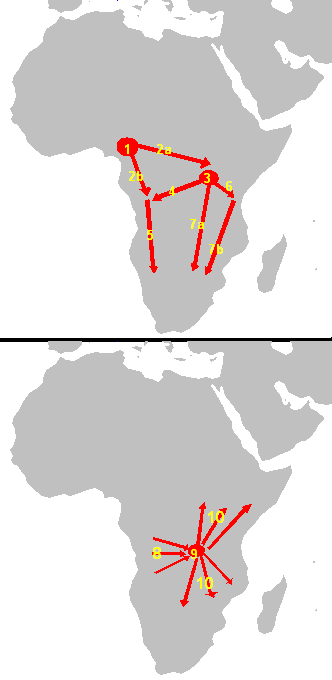
Linguistic reconstruction, archaeological evidence, and increasingly precise genetic analyses indicate two principal axes of Bantu expansion.
The western route ran south along the Atlantic coast and into the Congo Basin: from the Proto-Bantu homeland through modern Gabon and the Republic of Congo into the equatorial rainforest. The challenge here was the rainforest itself — dense, malaria-bearing, ill-suited to West African yam-and-oil-palm agriculture in its interior, and occupied by sophisticated forest-forager populations who lived on the rainforest's actual resources. The Bantu agricultural settlement of the Congo Basin was slow, partial, and concentrated along rivers and the rainforest's coastal margin. Forest-forager populations survived in the rainforest interior — they survive there today, in the central African rainforests where Bantu agriculture cannot easily settle.5
The eastern route — sometimes called the savanna route — ran from the Proto-Bantu homeland east through the savanna belt south of the Sahel, across the southern margin of the Sahara, and into eastern Africa. By 1000 BCE, eastern Bantu speakers had reached the Great Lakes region. By 500 BCE, they were in modern Tanzania and were beginning to push south into Mozambique. By the early Common Era, Bantu speakers had reached southern Africa: the Mzonjani complex in modern KwaZulu-Natal is dated to the early third century CE, and Bantu agricultural settlement reached the limits of dryland agriculture in the early Iron Age, around the modern Eastern Cape.
The encounter with the existing populations — Khoisan in the south, Cushitic pastoralists in the east, forest foragers in the rainforest, smaller scattered populations elsewhere — happened in many specific local situations across a vast geographic and temporal range. The encounters were not uniform. The patterns visible in the modern genetic, linguistic, and archaeological record include several distinct mechanisms.
What happened to the populations the Bantu encountered
The absorption pattern: in some areas, the existing population was absorbed into the expanding Bantu communities through intermarriage, language shift, and cultural assimilation. East African Bantu populations carry substantial Cushitic and (in some cases) Khoisan ancestry; East African Bantu languages have substrate features (some click consonants in southeastern Bantu languages, lexical borrowings, some grammatical structures) that linguists read as legacies of absorbed pre-Bantu populations. In these cases, the existing population is not gone — they are visible in modern Bantu populations as inherited genetic and linguistic substrate. But the existing community as a self-conscious cultural unit ended; the language was lost or survived only as substrate; the cultural autonomy was incorporated into the Bantu cultural framework.6
The displacement pattern: in some areas, the existing population was displaced into smaller territorial refuges. Modern Khoisan-speaking populations of southern Africa survive in a fraction — perhaps a tenth or smaller — of their probable pre-Bantu range. The Khoisan-speaking territory today is concentrated in the Kalahari Desert (San) and the western Cape (Khoekhoe and related groups), regions where Bantu agricultural settlement could not effectively establish itself because of arid climate or other ecological constraints. Where Bantu cattle-herding-and-cropping populations could establish themselves, they did, and the Khoisan-speaking populations that had been there before were pushed outward, absorbed, or eliminated.
The survival-by-environment pattern: forest-forager populations in the central African rainforests survived because the rainforest itself prevented Bantu agricultural settlement of its interior. Aka, Mbuti, Twa, Baka, and other forest forager groups today live in the dense Central African rainforests where Bantu yam-and-banana agriculture can establish only along rivers and forest margins, not in the rainforest interior. The forest foragers retained their territory because the territory was ecologically inhospitable to the expanding agricultural population. Their relationship with neighboring Bantu agricultural populations is complex — many forest forager groups have lived in symbiotic exchange with neighboring Bantu villages for centuries, providing forest products in exchange for agricultural goods, sometimes in conditions that approach hereditary servitude — but their cultural and linguistic distinctiveness has been preserved by the rainforest environment.7
The elimination pattern: in some areas, the existing population was substantially eliminated as a distinct cultural community without leaving major modern descendants. The most studied case is the population that occupied parts of central and southern Africa before the Bantu arrival but does not survive as a distinct population in any modern reckoning — visible in modern genetic studies only as ancestry components in modern Bantu populations, with no language descendants and no documented historical descendants as a distinct group. Whether elimination took the form of disease, starvation, violent displacement, or absorption-into-irrelevance is not always reconstructable; the evidence is genetic-statistical rather than narrative-historical.8
What changed in the receiving territory
The Bantu expansion remade Sub-Saharan Africa physically as well as demographically.
Iron metallurgy spread with the expansion. Iron furnaces, slag deposits, and iron-tool finds appear at archaeological sites across the expansion route in chronological order: West African sites of the late second millennium BCE; central African sites of the early first millennium BCE; East African Lakes Region sites of the mid-first millennium BCE; southern African sites of the early Common Era. The Iron Age in Sub-Saharan Africa is, in substantial part, a Bantu Iron Age — though local variants, independent inventions, and pre-Bantu iron metallurgy in some West African sites complicate the picture.9
Agricultural land-use changed. Forest cover decreased across the savanna-rainforest mosaic where Bantu shifting cultivation cleared trees with iron axes; soil profiles in the Congo Basin show measurable change in the period of Bantu agricultural establishment. Cattle were brought south of the tsetse fly belt by Bantu populations in eastern Africa, intermixing with Cushitic cattle traditions to produce the East African pastoralist cultures that would later, after further population movements, produce the Maasai, the Turkana, and other cattle-keeping peoples of the Great Lakes region.
Language redrew. By 500 CE, Niger-Congo Bantu languages were spoken across most of the region from modern Cameroon to the Cape. Pre-Bantu language families — represented today by the Khoisan languages of southern Africa, by the surviving non-Bantu languages of the Cushitic and Nilotic families in east and northeast Africa, and by the small surviving families in the rainforest interior — had been displaced or restricted to refuge zones across the period of expansion. Modern Sub-Saharan African languages are predominantly Niger-Congo (with the Bantu sub-family by far the largest constituent), with a small set of other families surviving in specific geographic refuges. The pre-Bantu linguistic landscape — what Sub-Saharan Africa sounded like in 1500 BCE — is recoverable today only through historical linguistic reconstruction and through the small surviving language families.
The cultural inheritance the modern world holds from Sub-Saharan Africa is, in substantial part, Bantu — Bantu music traditions (drum patterns, polyrhythm, call-and-response structures), Bantu aesthetic categories (the Yoruba orisha cosmology and Bantu spirit-religion are examples), Bantu kinship structures (lineage-based clan systems with specific Bantu features in inheritance and marriage), Bantu agricultural cuisines (yam-based, banana-based, sorghum-based), Bantu ironworking traditions. The modern East African Swahili coast is Bantu-speaking; the modern South African townships are predominantly Bantu-speaking; the modern Atlantic slave trade's African source populations were predominantly Bantu and West African Niger-Congo. What modern visitors think of as African culture is, in substantial part, the inheritance of the cultural complex that emerged from the Bantu expansion.
What the cost was
The Bantu expansion is the largest single demographic event in African prehistory. It happened over a long enough period that the conventional narrative of cultural transmission as a moment-of-contact event does not quite apply — what we are looking at is a 2,500-year process across an entire continent. But the Hidden Threads framework requires honest framing of what was paid in the process, and the modern scholarly consensus permits reasonable estimates.
Demographic displacement is the most visible cost. The Khoisan-speaking populations of southern Africa today number perhaps 50,000 across all surviving groups. The pre-Bantu Khoisan-speaking territory probably extended over an area capable of supporting populations several orders of magnitude larger; the demographic contraction is the cumulative result of the Bantu agricultural expansion (which displaced Khoisan hunter-gatherer populations from territory the Bantu could cultivate), the Khoekhoe pastoralist transition (which itself involved cultural change), and — much later, in the historical period — European colonial settlement of southern Africa, which compressed the Khoisan populations further. The Bantu portion of this long compression is real, even if it cannot be precisely quantified.10
Linguistic loss is harder to quantify but real. Pre-Bantu Sub-Saharan Africa's linguistic landscape is reconstructable only through limited substrate evidence in modern Bantu languages and through a few small surviving language families. How many distinct languages were spoken across the territory in 1500 BCE that are not spoken there today? The number is not knowable, but the order of magnitude — given the rule of thumb that hunter-gatherer territories typically contain higher language density than agricultural territories of comparable area — is plausibly in the hundreds. The vast majority of the languages of pre-Bantu Sub-Saharan Africa are gone, with no descendants in any modern language.
Forest forager populations survive but in conditions that have been compressed and complicated. Modern Mbuti, Aka, Twa, Baka, and related populations live in many cases in symbiotic-or-subordinate relationships with neighboring Bantu agricultural villages, with some accounts (the colonial-era and post-colonial documentation of the Twa-Tutsi-Hutu structure in Rwanda; the documentation of Aka relationships with neighboring Ngandu villages in the Central African Republic) describing relationships that approach hereditary servitude. The forest forager survival is not, in many specific local cases, a story of cultural autonomy. It is a story of structural subordination within the Bantu-dominated regional cultures.
The Bantu expansion is also not a single homogeneous story. Different waves moved at different times, in different routes, under different ecological and demographic conditions. The encounter with pre-existing populations in West Africa and the Congo Basin in the second and first millennia BCE was different in character from the encounter with Khoisan populations in southern Africa in the first millennium CE. Some encounters were more violent than others; some were more absorptive; some involved technology transfer in both directions. The conventional smooth-narrative of "the Bantu expansion" elides this complexity. The honest narrative is that across 2,500 years, a relatively narrow homeland population, equipped with iron tools and intensive agriculture, expanded its territory across most of a continent, and the populations encountered along the way did not, in most cases, survive as autonomous cultural communities.11
This matters for how Hidden Threads tells the story. Most cost-bearing transmissions in this atlas displace the cost across cultural and continental boundaries — Iberian Portuguese conquest costs paid by indigenous Americans; Han imperial extraction costs paid by Xiongnu and Tarim populations. The Bantu expansion is one of the rare cases of a major cultural-demographic transformation entirely internal to a single continent, in which the cost was paid by populations the historical record has often had difficulty seeing as separate cultures because their descendants are partly absorbed into the modern Bantu populations that displaced them. The Khoisan-speaking populations are visible because they survived in marginal environments. The forest foragers are visible because the rainforest preserved them. The populations who lived in the territories that became the Bantu agricultural heartland are not visible — they are dissolved into the genetic and partial linguistic substrate of the populations that absorbed them.
The modern Bantu-speaking populations of Sub-Saharan Africa — perhaps 350 million people across modern Kenya, Tanzania, the Democratic Republic of Congo, Angola, Zambia, Zimbabwe, Mozambique, South Africa, and a dozen other nation-states — are, in the long demographic perspective, the inheritors of the expansion. They are also, like Greek-speakers in the relationship to their pre-alphabetic Mycenaean ancestors and like the Han Chinese in their relationship to the displaced Xiongnu, the descendants of an absorption that did not survive being absorbed. The Khoisan, the forest foragers, and the smaller pre-Bantu populations whose names we mostly do not have are the third party of the transmission. The Hidden Threads atlas's editorial commitment requires that they appear in the record of what the Bantu expansion was, not as background to a celebration of African cultural achievement but as part of the cost the achievement was paid for with.
What followed
-
-1000Iron metallurgy reaches the Cameroon-Nigeria border region, c. 1000 BCE: Proto-Bantu populations acquire the technology that will allow them to clear forest and cultivate at densities the surrounding hunter-gatherer cultures cannot match.
-
-700Western Bantu route reaches the Atlantic coast and Congo Basin, ~1000–500 BCE: Bantu agricultural populations move south through modern Gabon into the equatorial rainforest, settling along rivers and the rainforest's coastal margin.
-
-800Eastern Bantu route reaches the Great Lakes region, ~1000 BCE: Bantu speakers crossing the savanna belt south of the Sahel reach modern Uganda, Rwanda, and Tanzania, encountering Cushitic pastoralist and forest forager populations.
-
250Mzonjani Iron Age complex established in modern KwaZulu-Natal, ~250 CE: the southernmost reach of Bantu agricultural settlement; Khoisan-speaking populations are progressively displaced from territory the Bantu can cultivate.
-
500Bantu agricultural settlement reaches its dryland-agriculture limit at the Eastern Cape, ~500 CE: the Bantu cultivation frontier stabilizes where dryland farming can no longer be sustained.
-
800Khoisan-speaking populations confined to surviving territorial refuges by the early historical period: modern Khoisan languages are spoken today across an area perhaps a tenth the size of the pre-Bantu Khoisan-speaking range; modern Khoisan-speaking populations number ~50,000.
-
1000Forest forager populations (Aka, Mbuti, Twa, Baka, others) survive in the central African rainforest interior, where Bantu agricultural settlement cannot establish — modern populations total ~500,000 in subordinate-and-symbiotic relationships with neighboring Bantu agricultural communities.
-
2000Modern Bantu-speaking population: ~350 million speakers across ~500 distinct Bantu languages. The cultural and linguistic legacy of Sub-Saharan Africa is, in substantial part, the inheritance of the Bantu expansion.
Where this lives today
References
- Bahuchet, Serge. Les pygmées aka et la forêt centrafricaine: ethnologie écologique. Études Pygmées 1. Paris: SELAF/Peeters, 1985. The standard ethnographic study of the Aka forest forager populations. fr
- Schlebusch, Carina M., Helena Malmström, Torsten Günther, et al. "Southern African ancient genomes estimate modern human divergence to 350,000 to 260,000 years ago." Science 358, no. 6363 (2017): 652–655. The recent genetic study placing the divergence of southern African Khoisan ancestors as the deepest documented modern human population split. en
- Vansina, Jan. Paths in the Rainforests: Toward a History of Political Tradition in Equatorial Africa. Madison: University of Wisconsin Press, 1990. The standard scholarly history of the Bantu settlement of the equatorial African rainforests, drawing on linguistic and archaeological evidence. en
- Ehret, Christopher. The Civilizations of Africa: A History to 1800. 2nd edition. Charlottesville: University of Virginia Press, 2016. The most comprehensive single-volume history of pre-1800 Africa drawing on linguistic, archaeological, and genetic evidence. en
- Klieman, Kairn A. "The Pygmies Were Our Compass": Bantu and Batwa in the History of West Central Africa, Early Times to c. 1900 C.E. Heinemann Social History of Africa Series. Portsmouth, NH: Heinemann, 2003. Specifically on the relationships between Bantu and forest forager populations across the Bantu settlement of central Africa. en
- Pakendorf, Brigitte, Koen Bostoen, and Cesare de Filippo. "Molecular Perspectives on the Bantu Expansion: A Synthesis." Language Dynamics and Change 1, no. 1 (2011): 50–88. en
- Bahuchet, Serge, and Henri Guillaume. "Aka–Bantu Relations: Symbiosis and Exploitation." In: Leacock, Eleanor, and Richard B. Lee (eds.), Politics and History in Band Societies. Cambridge: Cambridge University Press, 1982, pp. 189–211. en
- Lipson, Mark, et al. "Ancient DNA from West Africa Expands Our Understanding of Population History." Nature 577 (2020): 665–670. Recent ancient-DNA work documenting populations and lineages in West Africa that do not survive as distinct modern groups. en
- Holl, Augustin F. C. "Early West African Metallurgies: New Data and Old Orthodoxy." Journal of World Prehistory 22, no. 4 (2009): 415–438. The standard treatment of the disputed origins of West African ironworking and its relationship to the Bantu expansion. en
- Marks, Shula, and Anthony Atmore (eds.). Economy and Society in Pre-Industrial South Africa. London: Longman, 1980. The standard reference for southern African demographic history including the Bantu-Khoisan encounter. en
- Vansina, Jan. How Societies Are Born: Governance in West Central Africa Before 1600. Charlottesville: University of Virginia Press, 2004. Vansina's late synthesis of the institutional development of Bantu-speaking societies in west central Africa, with attention to the variations and complexities the broader 'expansion' label tends to flatten. en
- Greenberg, Joseph H. The Languages of Africa. The Hague: Mouton, 1963. The foundational classification of African language families and the establishment of the Bantu sub-family within Niger-Congo. en
- Güldemann, Tom (ed.). The Languages and Linguistics of Africa. The World of Linguistics 11. Berlin: De Gruyter Mouton, 2018. The most comprehensive recent synthesis of African language families and their reconstructed deep history. en
- Maret, Pierre de. "Archaeologies of the Bantu Expansion." In: Mitchell, Peter J., and Paul Lane (eds.), The Oxford Handbook of African Archaeology. Oxford: Oxford University Press, 2013, pp. 627–643. en