The Black Death reached Europe in 1347 on its own trade routes
A bacterium from a Central Asian marmot reservoir travelled west along the commercial integration the Mongol Empire had built, entered the Genoese colony of Caffa during a siege in 1346, and reached Messina and Marseille the following year. Between twenty-five and fifty million people died. This is the one transmission in the atlas that carried no gift at all.
In October 1347 twelve Genoese galleys put into the harbour at Messina carrying Yersinia pestis, and within six years between a quarter and three-fifths of Latin Europe was dead. The bacterium had come west from a rodent reservoir in the Tian Shan — ancient DNA recovered from graves at Kara-Djigach near Lake Issyk-Kul dates an ancestral strain to 1338-39 — travelling the same caravan and galley routes that had carried Aristotle, paper, silk and the positional zero into Christendom. At the besieged Black Sea port of Caffa in 1346 the notary Gabriele de' Mussi reported that the Golden Horde catapulted plague corpses over the walls, the most-cited biological warfare story in history and probably a real one, though the pandemic travelled on many ships rather than a few. What followed was not only mass death but mass blame: from 1348, often before the plague arrived, Latin towns burned their Jews alive.

Before: a continent that had already stopped growing
Latin Christian Europe in the summer of 1347 held somewhere between seventy and eighty million people, and it had stopped being able to feed them comfortably about thirty years earlier. The three centuries before 1300 had been a long demographic expansion — forests cleared, marshes drained, new villages planted on marginal soil, the population of the Latin West perhaps tripling. By 1300 the expansion had run out of good land. Holdings were subdivided to the point of unviability; in parts of Norfolk and Picardy peasant tenancies had fallen below the acreage that could sustain a household in a bad year. Bruce Campbell's synthesis of climate, price, and yield data places the turn decisively before the plague: the Medieval Climate Anomaly was ending, growing seasons were shortening, and the commercial expansion that had linked Flanders to Tuscany was already contracting 1.
Then came the rain. The Great Famine of 1315–17 began with a wet spring across northern Europe that would not end, rotting seed in the ground for three consecutive harvests. Mortality in the worst-hit northern towns reached ten to fifteen per cent. Cattle murrain followed in 1319–20, stripping the plough teams and the manure supply from an agriculture that had no other fertiliser. The generation that met the plague in 1347 was, in significant part, a generation that had been malnourished as children — a fact that would matter, in ways nobody could then have articulated, for who lived and who died 2.
The shape of a crowded continent
The Latin West of 1347 was, by its own historical standards, densely urbanized and tightly commercialized. Paris held perhaps two hundred thousand people, Venice, Genoa, Florence, and Milan somewhere between fifty and a hundred thousand each, and beneath them lay a mesh of several thousand market towns of one to ten thousand. Fairs at Champagne had given way to permanent factors and bills of exchange; Florentine and Sienese banking houses had branches from London to Cyprus; the Flemish cloth towns imported English wool by the shipload and exported finished textiles across the continent. Grain moved routinely from Sicily and the Black Sea to feed cities that could not feed themselves.
Every one of those features is also a description of an efficient disease-distribution system. Dense settlement, high-volume grain shipping, and a permanent circulating population of merchants, sailors, pilgrims, and carters gave Yersinia pestis precisely the conditions it required — because the grain ships carried, along with the grain, the black rat and its fleas. The commercial sophistication that made fourteenth-century Europe rich is inseparable from the speed at which it died. That is not a paradox the period could have seen, and it is not one the record poses as irony. It is simply the mechanism.
What this culture had, and what it did not
It is worth being precise about the categories fourteenth-century Latin Europe possessed, because the plague would break most of them.
It had a theory of disease, and it was a good theory by the standards of its own logic and a useless one in practice. Epidemic illness was understood as miasma — corrupted air, generated by rotting matter, unfavourable conjunctions of planets, or exhalations from the earth — acting on bodies whose humoral balance made them susceptible. The Paris medical faculty's consultation of October 1348, commissioned by Philip VI, traced the pestilence to a conjunction of Saturn, Jupiter, and Mars in Aquarius on 20 March 1345. This was not stupidity. It was the correct output of an inherited Galenic-Aristotelian system applied rigorously to a phenomenon it had no instruments to see 3.
It had, therefore, no concept of contagion in the modern sense — though it had something adjacent, a practical intuition that proximity to the sick was dangerous, which existed in unresolved tension with the miasma theory the physicians taught. It had no quarantine, no public health boards, no bills of mortality, no institutional machinery whatsoever for counting or containing an epidemic. Every one of those things is a post-plague invention.
It had a labour regime that assumed people were the abundant factor of production and land the scarce one. Serfdom in its various regional forms — English villeinage, French servage, the German Leibeigenschaft — rested on that arithmetic. Lords could impose labour services, entry fines, and marriage dues because a tenant who resented them had nowhere better to go. There was always another body for the holding.
And it had a Jewish population living under a specific and precarious legal arrangement: tolerated, taxed, protected by charter from particular lords or bishops, excluded from most guilds and from landholding, concentrated in the Rhineland cities — Mainz, Worms, Speyer, Cologne, Strasbourg — in communities some of which were then three hundred years old. They had survived the massacres of the First Crusade in 1096 and rebuilt. The Rhineland in 1347 was the demographic and scholarly heartland of Ashkenazi Jewry 4.
The world the Mongols had made
The last thing to establish about 1347 is that Latin Europe was, by the standards of any previous century, extraordinarily well connected to Central Asia — and that this was recent, deliberate, and someone else's achievement.
The thirteenth-century Mongol conquests had produced, for the first time since Alexander, a single political authority spanning the routes from the Yellow River to the Black Sea. Under the Jochid khanate of the western steppe — the Golden Horde — the northern Black Sea littoral was licensed out to Italian merchants. Genoa held Caffa in the Crimea from the 1260s under grant from the khan; Venice held Tana at the mouth of the Don. Caffa by the 1340s was a substantial fortified port, its inner wall enclosing some six thousand houses and its outer wall eleven thousand, shipping grain, slaves, wax, furs, and silk into the Mediterranean 5.
This is the atlas's recurring subject seen from an unfamiliar angle. The same integration that carried Aristotle's Physics west through Toledo, that carried paper and the positional zero and the compass, that made Genoese and Venetian fortunes and stocked Italian counting-houses with Central Asian goods — that integration was a physical network of ships, caravans, warehouses, and grain sacks. It moved whatever could travel. In 1346 what could travel was Yersinia pestis.
The transmission
The reservoir: Issyk-Kul, 1338
For six centuries the plague's origin was a matter of inference. Since 2022 it has been a matter of sequenced DNA.
Maria Spyrou and colleagues examined seven individuals exhumed from two Nestorian Christian cemeteries, Kara-Djigach and Burana, in the Chüy valley near Lake Issyk-Kul in what is now Kyrgyzstan. The cemeteries had been excavated in the 1880s, and their tombstones carried Syriac inscriptions with dates and, unusually, causes of death. A cluster of burials was dated to 1338–39, and the inscriptions named the cause. One reads: "In the Year 1649 [= AD 1338]… This is the tomb of the believer Sanmaq. [He] died of pestilence [= mawtānā]" 6.
Three of the seven individuals yielded Yersinia pestis DNA. The reconstructed genome placed the strain at a precise and remarkable position on the plague phylogeny. In the paper's own words, the two reconstructed genomes "represent a single strain and are identified as the most recent common ancestor of a major diversification commonly associated with the pandemic's emergence" — the four-way branching event that plague geneticists call the big bang polytomy, from which the Black Death lineage and most surviving Y. pestis strains descend 6.
Two cautions belong here, and the record states them rather than smoothing them over. First, this establishes an ancestral strain in a specific place at a specific date; it does not establish a simple straight line from Issyk-Kul to Caffa to Marseille. What happened in the eight years between is not sequenced. Second, the reservoir is ecological, not national: most surviving strains of this ancient lineage are isolated from marmots and their fleas in the Tian Shan mountains, animals that had carried plague in those uplands for a very long time without producing a pandemic. Spyrou's team drew the connection to human networks explicitly, noting that the site's position "in proximity to trans-Asian networks… lend[s] support to scenarios implicating trade in Y. pestis dissemination" 6. The bacterium did not become a world event until commerce gave it a vehicle.

Caffa, 1346
In 1343 a brawl in Tana between Italian merchants and local Muslims ended with a dead Mongol, and Jani Beg, khan of the Golden Horde, expelled the Italians and moved against Caffa. The siege that followed was long and intermittent: a first investment lifted in February 1344 after the defenders' catapults killed a reported fifteen thousand of the khan's troops, a second begun in 1345 and lifted after roughly a year 5.
What happened at the end of it is the most cited anecdote in the history of epidemic disease. The account comes from Gabriele de' Mussi, a notary of Piacenza, writing in 1348 or early 1349:
The Tartar army, he wrote, was struck by plague, and the dying "ordered corpses to be placed in catapults and lobbed into the city in the hope that the intolerable stench would kill everyone inside." He continues: "What seemed like mountains of dead were thrown into the city, and the Christians could not hide or flee or escape from them." Genoese survivors, he says, then took ship for the Mediterranean, carrying the pestilence with them 7.
De' Mussi almost certainly was not at Caffa. He appears to have written from Piacenza on the basis of report, and his Historia de Morbo is not reportage but an extended moral meditation: the plague as the expression of divine anger, the narrative details fitted to that frame. Rosemary Horrox's complete translation restores exactly this quality to a text long quarried for its factual fragments 8.
What Wheelis actually argued
The corpse-catapulting story is routinely dismissed in popular accounts as a myth, and routinely presented in others as the origin of the pandemic. The standard scholarly treatment — Mark Wheelis's 2002 analysis in Emerging Infectious Diseases — says neither, and the distinction is worth getting right.
Wheelis argues that the attack was plausible and probably worked. Handling plague cadavers is a genuine transmission route; among United States plague cases between 1970 and 1995, roughly twenty per cent were attributed to direct contact with infected material. Defenders tasked with disposing of the bodies would have been exposed. He judged it, in his words, "plausible that the events recounted by de' Mussi could have been an effective means of transmission of plague into the city" — and, more strikingly, thought rat-to-rat transmission across the siege lines the less likely route, since rats are sedentary animals that rarely travel more than a few tens of metres from the nest 5.
What Wheelis denies is not the attack but its importance. His conclusion is unambiguous: "The siege of Caffa, for all of its dramatic appeal, probably had no more than anecdotal importance in the spread of plague." The pandemic did not travel on a handful of fleeing Genoese galleys from a single siege. It moved west stepwise, on many ships over more than a year, through a Black Sea and Mediterranean port system in which plague was by 1346 already circulating widely — Constantinople, Trebizond, Alexandria, the Aegean 5.
So the record's honest formulation is this: the catapults are probably real, probably effective, and probably irrelevant. The vehicle was the trade network, and the trade network had many ships.
What was actually travelling
It is worth pausing on the biology, because the mechanism explains the geography.
Yersinia pestis is primarily a disease of rodents, transmitted between them by fleas. In its bubonic form it reaches humans when an infected flea — classically the oriental rat flea, whose gut the multiplying bacteria block, leaving it permanently starving and biting repeatedly — feeds on a person after its rodent host dies. The bacteria drain to the nearest lymph node, which swells into the bubo that gave the disease its name. Untreated bubonic plague kills perhaps half to two-thirds of those infected. In the pneumonic form, where infection reaches the lungs, it transmits directly between people in respiratory droplets and is almost invariably fatal. A septicaemic form kills faster still.
The best clinical description from the period comes from Guy de Chauliac, physician to Clement VI at Avignon, who stayed in the city through the epidemic of 1348, contracted plague himself, and survived. Writing later in his Chirurgia magna, he distinguished two presentations: a first, lasting about two months, with continuous fever and the spitting of blood, killing within three days; a second, running through the remainder, with continuous fever and swellings and carbuncles on the external parts, chiefly under the armpits and in the groin, killing within five 20. That is pneumonic and bubonic plague, described accurately by a man who had no idea what caused either.
This is why the plague travelled by sea and by grain. Rats are sedentary — Wheelis's point about the siege lines at Caffa — but ships carry rats and cargo carries fleas, and a galley moving from Caffa to Messina relocates an entire rodent ecosystem in a fortnight. Overland the disease moved at the speed of carts and pack animals, a few kilometres a day; by sea it jumped hundreds of kilometres between ports and then radiated inland from each. The map of the Black Death's spread through Latin Europe is, to a first approximation, a map of its harbours and its navigable rivers.
West, port by port
The plague's Mediterranean progress in the autumn and winter of 1347 can be dated with reasonable confidence from port records and chronicles.
| Date | Port | Source and detail |
|---|---|---|
| Autumn 1346 | Caffa, Tana | Plague in the Golden Horde's siege army; Italian colonies infected |
| Early–mid 1347 | Constantinople | Plague in the Byzantine capital; described by the emperor John VI Kantakouzenos |
| October 1347 | Messina, Sicily | Twelve Genoese galleys arrive from the east |
| Late 1347 | Genoa, Venice | Arrival in the northern Italian ports |
| November 1347 | Marseille | First major Provençal outbreak; plague enters the Rhône corridor |
| January–March 1348 | Avignon, Pisa, Florence | Papal court and Tuscan cities |
| June 1348 | Melcombe / Bristol, England | First English landfall |
| 1349–1350 | Northern Germany, Low Countries, Scandinavia | |
| 1351–1353 | Baltic, Novgorod, Muscovy | The circuit closes in the east |
The Sicilian arrival has the best contemporary witness. The Franciscan Michele da Piazza wrote: "In October 1347, at about the beginning of the month, twelve Genoese galleys, fleeing from the divine vengeance which Our Lord had sent upon them for their sins, put into the port of Messina" 9. Note what da Piazza's sentence assumes — that the sailors were fleeing divine vengeance and brought it with them. The moral framework arrives with the disease and is inseparable from it. That framework will shortly get people killed.
Marseille received the plague in November 1347 and became the principal portal into the French interior, feeding the Rhône corridor toward Avignon, where the papal court sat and where Clement VI would spend 1348 watching roughly half his city die. Jean-Noël Biraben's two-volume reconstruction of plague chronology and geography across France and the Mediterranean remains the standard mapping of this diffusion 10.
What changed and what was replaced
The dead
Between 1347 and 1353 the Black Death killed a proportion of Latin Europe that has no parallel in the documented history of the continent. What that proportion was is genuinely disputed, and the record names the dispute rather than picking a comfortable number.
| Scholar | Estimate for Europe | Basis |
|---|---|---|
| Older twentieth-century consensus | 30–40% | Regional manorial and testamentary studies |
| Klaus Bergdolt (1994) | approx. one third | German and Italian chronicle synthesis |
| Ole Benedictow (2004) | 55–60% | Systematic aggregation of local mortality series |
Benedictow's revision is the aggressive position: he raised rates previously argued at forty to forty-five per cent to fifty-five and sixty, and proposed sixty per cent or more as a general European figure — a rate previously claimed only for particular localities and never as a continental average 11. Bergdolt's German synthesis holds nearer the traditional third 12. The truth is probably regionally various in ways a single number conceals: some Tuscan and Provençal towns lost more than half, some Bohemian and Polish districts comparatively little.
Whatever the exact figure, the structural consequence is not in dispute. A civilization organized around surplus population became, in six years, a civilization with a labour shortage.
The aggregate numbers conceal what the experience was. Agnolo di Tura, a shoemaker and tax collector of Siena who kept a chronicle, recorded the arrival of the plague in his city in May 1348: great pits dug across Siena and piled with the dead, hundreds dying day and night, the ditches filled and more dug. His own account ends with a sentence that has outlived every mortality estimate ever calculated from it — "And I, Agnolo di Tura, called the Fat, buried my five children with my own hands" 21. His wife Nicoluccia and all five children died. He is the arithmetic of the table above, seen from inside a single household.
Physical desertion followed the mortality, though not immediately and not evenly. Marginal land cleared during the thirteenth-century expansion was the first to be abandoned, since survivors could now take better holdings on better soil. German historians count roughly forty thousand settlements lost across the late medieval centuries — the Wüstungen — of which a large share date to the post-plague generations; England has some three thousand deserted medieval villages. The plague did not usually empty a village outright in 1349. It removed enough people that the village stopped being worth staying in over the following fifty years.
Who died, and why it was not random
Bioarchaeology has substantially revised the old picture of a plague that struck indiscriminately. Sharon DeWitte's work on the East Smithfield cemetery in London — a burial ground used only for Black Death dead in 1349–50, and therefore an unusually clean sample — tested whether mortality was selective with respect to pre-existing health. It was. Analysing several hundred skeletons, DeWitte and James Wood found that individuals who bore skeletal markers of prior physiological stress were significantly more likely to die, alongside the elderly; men and women faced roughly equal risk 13.
This is where the Great Famine returns. The cohort that had been malnourished as children in 1315–17 was in its forties in 1348, and it was disproportionately among the dead. The plague did not fall on a healthy population. It fell on one that a generation of climate failure had already weakened, and it took the weakened first. DeWitte's later work on post-plague cemeteries found the corollary: survivors and those born after the epidemic lived measurably longer than their pre-plague counterparts, a grim demographic dividend produced by the removal of the frail 14.
A further layer, and a contested one, concerns immunity. Jennifer Klunk and colleagues, examining ancient DNA from London and Danish cemeteries spanning the plague years, reported that variation near the immune gene ERAP2 was under strong positive selection, with one variant associated with a substantially higher chance of survival — and with elevated susceptibility to autoimmune conditions such as Crohn's disease in modern populations 15. That finding has since been directly challenged: Barton, Santander and colleagues argued in 2025 that the allele-frequency shifts are within what genetic drift and sampling error can produce, and that the evidence for selection is insufficient 16. The atlas does not adjudicate between them. It notes that a claim widely reported as settled — that the Black Death rewired European immunity — is, as of 2026, actively disputed by population geneticists.
The end of the old labour bargain
The most durable institutional change the plague produced in Latin Europe was the collapse of the demographic assumption underlying serfdom.
With a third to a half of the workforce dead, surviving labourers discovered that they could demand wages, refuse services, and walk to a better manor. Landlords faced a choice between paying more and watching land go untilled. The seigneurial response was immediate and legislative:
- The Ordinance of Labourers, 18 June 1349 — issued in England while the epidemic was still running through the midlands and north, as emergency legislation to secure the coming harvest. It required all able-bodied persons under sixty without private means to accept work at pre-plague wage rates.
- The Statute of Labourers, February 1351 — enacted at the first post-plague Parliament, fixing wages at 1346 levels, making it an offence for landless men to seek new masters or to be offered higher pay, and establishing enforcement machinery through specially commissioned justices.
- Parallel measures across the continent — wage and price controls in Castile, Aragon, France, and the Italian communes over the same years.
They failed. Nearly every contemporary comment on the English statutes records evasion, and modern work on their enforcement confirms that they neither held wages down nor stopped mobility, largely because employers desperate for hands had every incentive to break a law written for their collective rather than individual benefit 17. Real wages in England roughly doubled over the following century. Villeinage decayed; labour services were commuted to money rents; the manorial economy that had defined the Latin West for three hundred years unwound over the following four generations.
The political consequence followed. The English rising of 1381 took the labour legislation and its associated poll taxes as a central grievance; the French Jacquerie of 1358 and the Ciompi revolt in Florence in 1378 belong to the same post-plague sequence of conflict over who would absorb the shock.
Institutions invented against the plague
Latin Europe's other lasting acquisition was a public health apparatus it had entirely lacked in 1347, built in the plague's aftermath and largely in northern Italy:
- Quarantine. Ragusa (Dubrovnik) imposed a thirty-day isolation on arriving ships and travellers in 1377 — the trentino — later extended to forty days, the quarantino, from which the word descends. Venice, Genoa, Marseille, and Pisa followed.
- Permanent health boards. Temporary plague commissions in Venice, Florence, and Milan hardened over the fifteenth century into standing magistracies with powers over burial, market regulation, and movement.
- Bills of mortality and death registration. Systematic counting of deaths, initially to detect outbreaks, which became the raw material of demography.
- The lazaretto. Venice established an isolation hospital on Santa Maria di Nazareth in 1423, the model for the plague hospitals of the following three centuries.
- Health passes and cordons sanitaires. Documentary controls on movement between jurisdictions, the direct ancestor of the modern travel-health certificate.
These are the institutional descendants that survive. The modern architecture of epidemic control — isolation, notification, certification, the state's claim to regulate movement in a health emergency — is a fourteenth- and fifteenth-century Italian invention responding to this transmission.
Piety, art, and the sacred
The plague also rearranged the religious life of the Latin West, and not in the direction of straightforward loss of faith. The clergy died at rates at least as high as the laity — parish priests administering last rites were structurally exposed — and the replacements ordained hurriedly to fill the gaps were often younger and less trained, a quality problem that fifteenth-century reformers would still be complaining about. Chantry foundations and endowed masses for the dead multiplied enormously. New intercessory cults, notably of St Sebastian and St Roch, spread rapidly as plague-specific patrons.
The universities felt it as an institutional shock. Several were effectively suspended for a period; new foundations followed within a generation in places that had previously sent students abroad — Prague had been founded in 1348, and Vienna, Kraków, Pécs, Heidelberg, and Cologne received their charters in the decades after the plague, partly because travel to Paris and Bologna had become less attractive and partly because local churches needed trained clergy they could no longer import. The vernacular gained ground in the same decades, in England conspicuously: English displaced French in the grammar schools during the second half of the fourteenth century, and Parliament was opened in English in 1362. Historians differ on how much of that shift to attribute to plague mortality among French-speaking teachers and how much to longer-running political causes, and the record does not overclaim the link — but the timing is not a coincidence anyone has succeeded in explaining away.
In art, the danse macabre and the transi tomb — the memorial that depicts its occupant as a decomposing corpse — became widespread from the later fourteenth century. Klaus Bergdolt's study traces the plague's imprint through the art and literature of the late Middle Ages in detail, alongside the flagellant processions and the pogroms 12. It is easy to overstate the causal line from plague to a morbid aesthetic; the imagery has roots before 1347. What the plague supplied was mass audience and universal reference.
What the cost was
The bacterium was not the whole bill
The Black Death's cost begins with the dead and does not end there. Between twenty-five and fifty million people died in Latin Europe in six years, depending on which mortality estimate one accepts, out of a population of seventy to eighty million. Whole villages were abandoned — some fifteen hundred Wüstungen in Germany alone over the following decades, several thousand deserted settlements in England. This is the largest single mortality event in European history, and it is not close.
But a transmission's cost, in this atlas's terms, includes what the receiving culture did in response. And what Latin Christian Europe did, beginning before the plague had even reached most of the places where it happened, was to hunt and burn its Jewish population.
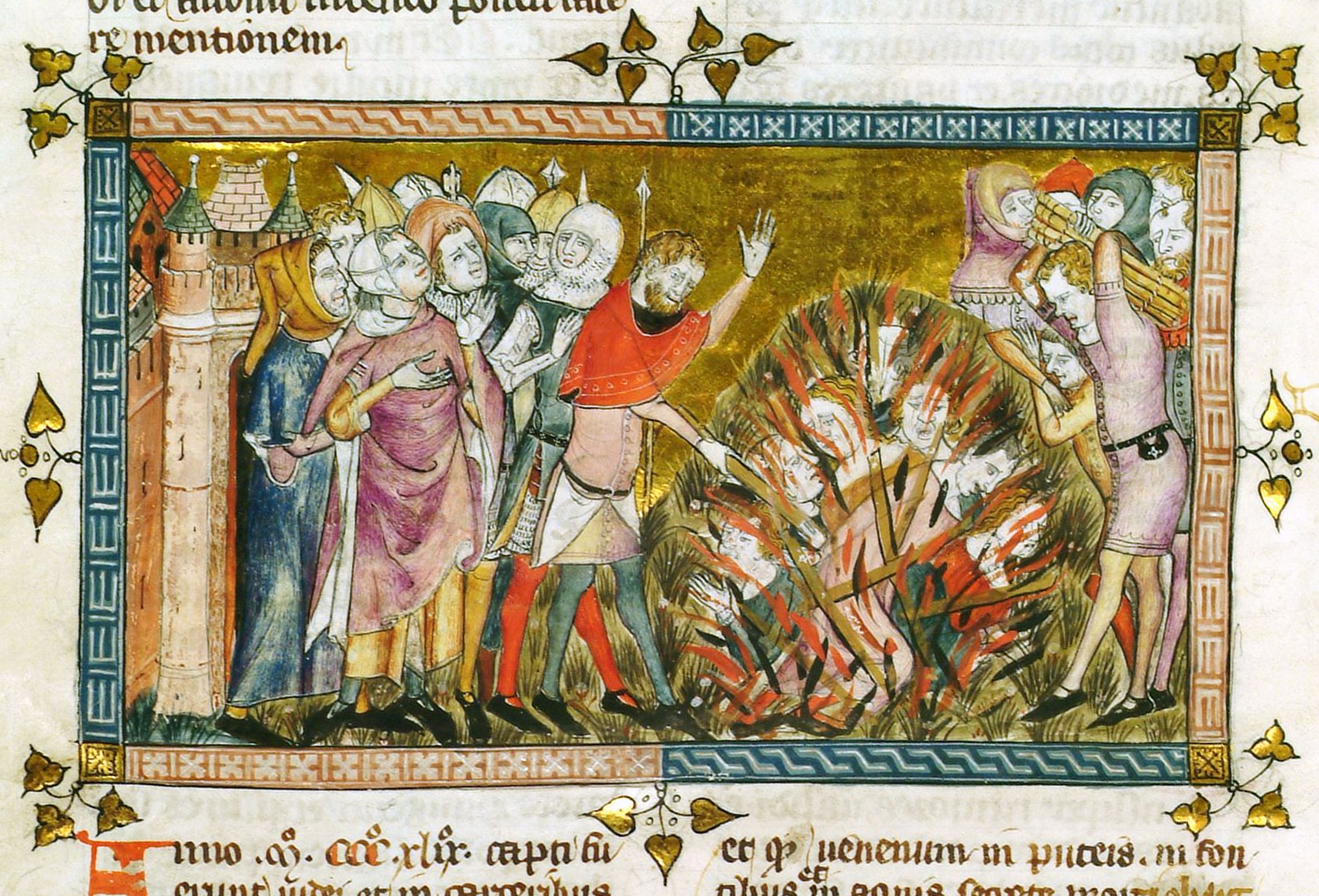
The burnings, 1348–1351
The accusation was well-poisoning: that Jews had introduced poison into wells, springs, and food supplies as part of a universal conspiracy against Christians. It took organized form in the autumn of 1348, when confessions were extracted under torture at Chillon on Lake Geneva and circulated northward as documentary proof. From there the killings moved up the Rhine.
Samuel Cohn's study of the chronology is the crucial corrective to the intuitive reading. The massacres were not a spontaneous eruption of grief-crazed mobs in plague-stricken towns. In a substantial number of cases the killings preceded the plague's arrival — communities destroyed their Jews in anticipation, on the strength of rumour arriving ahead of the disease 4.
Strasbourg is the definitive case. On 14 February 1349 the city's Jewish community — some two thousand people — was marched to the Jewish cemetery and burned on a wooden platform, the crowd stripping the victims of clothing in search of money as they went. Children and young women were offered baptism as an alternative. The plague did not reach Strasbourg until months later. The massacre followed a coup in which the guilds deposed the city council that had been protecting the Jews, and it cancelled the debts owed to the community's moneylenders by the men who carried it out.
The sequence across the Empire:
- January 1349 — Basel and Freiburg: the Jewish communities burned.
- 14 February 1349 — Strasbourg: approximately 2,000 killed.
- 21–22 March 1349 — Erfurt: estimates of the dead range from about 100 to as many as 3,000.
- August 1349 — Mainz and Cologne: at Mainz, the Jews barricaded and fired their own quarter rather than be taken; chronicle figures, certainly inflated, run to 6,000 dead.
- 1349–1351 — killings and expulsions continue through Swabia, Bavaria, Franconia, Flanders, Aragon, and Provence.
Cohn's article documents a persecution that eradicated almost entirely the principal Jewish communities of Europe — those of the Rhineland — along with many others 4. The three-century-old Ashkenazi heartland at Mainz, Worms, Speyer, and Cologne did not recover. The demographic centre of Ashkenazi Jewry shifted permanently eastward into Poland and Lithuania, whose rulers offered charters of protection to the refugees. That displacement is one of the most consequential population movements in European history, and its proximate cause is a pandemic in which its victims played no part whatever.
Two features of the persecution deserve to be stated without softening. The first is that it was profitable. In Strasbourg, in Basel, in the Franconian and Swabian towns, the men who organized the killings were frequently the men who owed money to the people they killed, and the debts died with the creditors. Charles IV had in several instances pre-assigned the property of Jews who might be killed in imperial cities to local lords and municipalities, which converted a rumour into a transaction with an identified beneficiary. The second is that the accusation was not believed by everyone who acted on it. Town councils that had defended their Jewish communities were in several cases overthrown precisely because they were defending them, which means the defence was available, articulated, and locally defeated.
The failure of authority
It is not the case that no one objected. Pope Clement VI issued two bulls from Avignon, on 6 July and 26 September 1348, rejecting the well-poisoning accusation outright — he pointed out that Jews were dying of the plague alongside Christians, and that the pestilence was killing in places where no Jews lived — and ordering the clergy to protect them. He characterized those carrying out the killings as having been seduced by the Devil, and he protected the Jews of Avignon effectively within his own jurisdiction 18.
Outside it, the bulls were largely ignored. In the imperial cities of the Rhineland, where the emperor Charles IV had in several cases already granted away in advance the property of Jews who might be killed, papal instruction carried little weight against local guild politics and local debt. The atlas records this precisely because it undercuts the comfortable idea that medieval antisemitic violence was an inevitable product of universal belief: the highest authority in Latin Christendom named the accusation false, in writing, twice, within a year — and the burnings continued anyway, in the places where killing Jews was locally profitable.
The flagellant movement belongs to the same story. Bands of penitents moving from town to town scourging themselves in public processions grew rapidly through 1349, and their arrival was in a number of cities the immediate trigger for the local massacre. Clement VI condemned the movement in October 1349, by which point it had done its work.
The rating, and the argument for it
The cost of this transmission is rated at the maximum, and the reasoning is worth setting out plainly.
Between twenty-five and fifty million people died. The mortality was not random: it fell hardest on those whom the Great Famine had already damaged, which is to say on the poor. Something on the order of forty to sixty Jewish communities were destroyed by fire and sword in a two-year window, on the basis of an accusation the Pope had formally declared false, and the Ashkenazi world's centre of gravity was permanently relocated. The seigneurial classes responded to the survivors' improved bargaining position with legislation designed to nullify it, which in turn fed the revolts of 1358, 1378, and 1381.
And unlike almost every other record in this atlas, there is nothing on the other side of the ledger. The Phoenicians gave Greece an alphabet while being conquered; Toledo gave Latin Europe Aristotle at the cost of a conquered al-Andalus. Those transmissions carried both a gift and a bill. This one carried no gift at all. Latin Europe received a bacterium and, eventually, a set of institutions invented to defend against it — which is to say, it received a wound and then a scar. Quarantine is not a gift from the Golden Horde. It is what the survivors built afterwards.
What the connection cost
The final point is the one that makes this record belong in a series about cultural transmission at all.
The Black Death moved west because Eurasia in the fourteenth century was integrated as it had not been for a thousand years, and that integration was a real achievement — of Mongol route security, of Genoese and Venetian capital, of the caravan and the galley. The same infrastructure that carried the Aristotelian corpus, the positional zero, paper, silk, and the compass into Latin Europe carried Yersinia pestis. Monica Green's work has pushed the frame wider still, arguing that the Second Plague Pandemic must be understood at Eurasian and African scale rather than as a European event, and that the molecular evidence supports a much broader geography of dissemination than the traditional narrative allowed 19.
The moral to resist is that connection is therefore dangerous, that the open road was a mistake. Nobody in Genoa or Sarai chose to move a pathogen, and the alternative to the integrated fourteenth century was not a safe Europe but a poorer and more ignorant one. What the record documents is narrower and harder: that the infrastructure of exchange is indifferent to what it carries, that the same route serves the book and the flea, and that a civilization which had spent a century learning to receive from the East received, in 1347, something it could not refuse and did not survive intact.
The bill was paid by the malnourished poor of the Latin West, who died first, and by the Jews of the Rhineland, who did not die of plague at all.
What followed
-
1353Between 25 and 50 million people died in Latin Europe between 1347 and 1353 — the largest single mortality event in the continent's recorded history, with scholarly estimates ranging from roughly one third to sixty per cent of the population.
-
1350Mortality was selective rather than random: bioarchaeology at the East Smithfield plague cemetery in London shows that people already weakened by the Great Famine of 1315-17 and other physiological stress died at significantly higher rates.
-
1349Roughly forty to sixty Jewish communities were destroyed between 1348 and 1351 on the false accusation of well-poisoning, including some 2,000 people burned at Strasbourg on 14 February 1349 — months before the plague reached the city.
-
1360The demographic centre of Ashkenazi Jewry shifted permanently eastward into Poland and Lithuania, whose rulers offered charters of protection to refugees from the Rhineland massacres.
-
1400Serfdom in western Europe decayed as surviving labourers gained bargaining power; real wages in England roughly doubled over the following century despite legislation designed to prevent it.
-
1351England enacted the Ordinance of Labourers on 18 June 1349 and the Statute of Labourers in February 1351, fixing wages at pre-plague rates and criminalising labour mobility. Both failed, and the grievance fed the rising of 1381.
-
1377Quarantine was invented in response: Ragusa imposed a thirty-day isolation on arriving ships in 1377, extended to forty days — the quarantino — and copied by Venice, Genoa, Marseille and Pisa.
-
1423Permanent municipal health boards, death registration, health passes and the lazaretto emerged in the Italian city-states over the following century, forming the institutional ancestor of modern public health.
-
1400Thousands of marginal settlements were abandoned across the following generations — the German Wustungen and some three thousand deserted medieval villages in England — as survivors moved to better land.
Where this lives today
References
- Bruce M. S. Campbell. The Great Transition: Climate, Disease and Society in the Late-Medieval World. Cambridge: Cambridge University Press, 2016. en
- William Chester Jordan. The Great Famine: Northern Europe in the Early Fourteenth Century. Princeton: Princeton University Press, 1996. en
- Report of the Medical Faculty of the University of Paris, October 1348, in Rosemary Horrox, trans. and ed., The Black Death. Manchester: Manchester University Press, 1994. en primary
- Samuel K. Cohn, Jr. 'The Black Death and the Burning of Jews.' Past & Present 196 (August 2007): 3-36. en
- Mark Wheelis. 'Biological Warfare at the 1346 Siege of Caffa.' Emerging Infectious Diseases 8, no. 9 (September 2002): 971-975. en
- Maria A. Spyrou et al. 'The source of the Black Death in fourteenth-century central Eurasia.' Nature 606 (2022): 718-724. en
- Gabriele de' Mussi. Historia de Morbo (Ystoria de Morbo), c. 1348-49, translated in Rosemary Horrox, The Black Death. Manchester University Press, 1994. en primary
- Rosemary Horrox, trans. and ed. The Black Death. Manchester Medieval Sources. Manchester: Manchester University Press, 1994. en primary
- Michele da Piazza. Cronaca, 1347-1361, translated in Rosemary Horrox, The Black Death. Manchester University Press, 1994. en primary
- Jean-Noel Biraben. Les hommes et la peste en France et dans les pays europeens et mediterraneens. 2 vols. Paris and The Hague: Mouton, 1975-1976. fr
- Ole J. Benedictow. The Black Death 1346-1353: The Complete History. Woodbridge: Boydell Press, 2004. en
- Klaus Bergdolt. Der Schwarze Tod in Europa: Die Grosse Pest und das Ende des Mittelalters. Munich: C. H. Beck, 1994. de
- Sharon N. DeWitte and James W. Wood. 'Selectivity of Black Death mortality with respect to preexisting health.' Proceedings of the National Academy of Sciences 105, no. 5 (2008): 1436-1441. en
- Sharon N. DeWitte. 'Mortality Risk and Survival in the Aftermath of the Medieval Black Death.' PLOS ONE 9, no. 5 (2014): e96513. en
- Jennifer Klunk et al. 'Evolution of immune genes is associated with the Black Death.' Nature 611 (2022): 312-319. en
- Alison R. Barton, Alejandro Santander et al. 'Insufficient evidence for natural selection associated with the Black Death.' Nature (2025). en
- Mark Bailey. 'The implementation of national labour legislation in England after the Black Death, 1349-1400.' The Economic History Review (2025). en
- Pope Clement VI. Bulls Quamvis perfidiam, 6 July 1348, and 26 September 1348, Avignon, rejecting the well-poisoning accusation against the Jews. la primary
- Monica H. Green. 'Taking "Pandemic" Seriously: Making the Black Death Global.' The Medieval Globe 1 (2014): 27-61. en
- Guy de Chauliac. Chirurgia magna, 1363, on the plague at Avignon in 1348. la primary
- Agnolo di Tura del Grasso. Cronaca senese, on the plague at Siena, 1348. it primary