How Cai Lun's report made paper China's writing surface (105 CE)
In 105 CE a eunuch engineer of the Han court presented the throne with sheets made from bark, hemp waste, rags, and fishing nets. Within three centuries they had retired bamboo and silk across the Chinese world. The technology was free. The court that minted it never was.
In 105 CE, Cai Lun — eunuch, courtier, and director of the Han imperial workshops at Luoyang — presented Emperor He with a new writing material: thin sheets made from tree bark, hemp waste, rags, and old fishing nets. The dynastic history's explanation is an accountant's sentence: silk was costly, bamboo was heavy. Archaeology has since found hemp paper three centuries older in China's northwest, but it was the court's specification, and the patronage of Empress Deng, that turned a wrapping material into the empire's writing surface. Within three centuries paper had retired the bamboo strip entirely; from China it reached Japan by 610 and the Islamic world after 751. The transmission itself cost nothing — paper was made from waste. Its author was less fortunate: in 121, caught in a palace purge, Cai Lun bathed, dressed in his finest silk, and drank poison.

China before paper: an empire run on bamboo and silk
In the first century CE, the Chinese empire was the most document-dependent state on earth, and it did not yet run on paper. From the capital at Luoyang — a walled city of perhaps half a million people, seat of the restored Han dynasty since 25 CE — imperial government reached out through roughly a hundred commanderies and over a thousand counties, and every link in that chain was made of writing: tax registers, household counts, legal codes, military rosters, edicts, memorials, calendars 14. The physical form of all that writing was the jiandu — narrow strips of bamboo or tablets of wood, each typically one Han foot long (about twenty-three centimeters), each carrying a single column of thirty to forty brush-written characters, bound side by side with hemp cords into mats that rolled up like window blinds 3. A short administrative order might occupy a few strips. A book occupied thousands.
The system worked, and had worked for centuries — the earliest surviving Chinese references to bound strip-documents go back beyond 1000 BCE, when oracle-bone inscriptions already used a graph showing strips held together by cords 3. But the system was heavy in the most literal sense. The Records of the Grand Historian reports that the First Emperor of Qin, three centuries before our period, set himself a daily quota of one shi — roughly thirty kilograms — of documents to read, and weighed the strips on a scale to hold himself to it 35. Édouard Chavannes, the French sinologist whose 1905 study of pre-paper Chinese books founded the field in the West, put the problem in a single dry sentence: "C'est parce que ces écrits étaient rédigés sur des fiches de bambou qu'ils étaient si lourds" — it is because these writings were composed on bamboo strips that they were so heavy 5.
The weight of the written state
The anecdotes the Han told about themselves return obsessively to this weight. When the courtier Dongfang Shuo submitted a memorial to Emperor Wu around 130 BCE, the Book of Han records that it ran to three thousand strips, that two men were needed to carry it into the palace, and that the emperor took two months to work through it 3. The strips themselves survive in quantity to confirm the picture. Along the dried watercourses of the Edsen-gol, on the empire's northwestern frontier, Sino-Swedish expeditions in 1930–31 recovered some ten thousand inscribed wooden strips from the ruins of Han garrison posts — the working files of border companies, studied in Michael Loewe's two-volume Records of Han Administration (1967), still the fundamental Western analysis of how the Han state actually wrote itself into existence 4.
What the garrison strips record is the granular texture of administration before paper 4:
- Ration registers — monthly grain issues to named soldiers, down to fractions of a bushel
- Duty rosters and absence reports — who stood watch, who was ill, who was late
- Signal-fire instructions — codified sequences of flags, smoke columns, and beacon fires for relaying alarms along the wall
- Equipment inventories — crossbows, arrows, armor, carts, each item counted and conditions noted
- Mail logs — the time of arrival and dispatch of official correspondence, recorded to the hour
The strips moved. The Han state ran a relay post network along its arterial roads — stations at fixed intervals, with stabled horses, provisioned couriers, and clerks who logged every document in and out, sometimes to the hour 413. One such station, Xuanquanzhi on the Dunhuang road, was excavated almost intact between 1990 and 1992: tens of thousands of inscribed strips, the working archive of a single posthouse, recording the passage of envoys, the feeding of their horses, and the relay of imperial orders across two thousand kilometers of corridor 13. Multiply that one station by the empire's whole network and the scale of the medium problem becomes visible. Government at Han scale meant moving wood — wagonloads of it, daily, in every direction, forever. Every reduction in the weight of a document was a reduction in the cost of holding the empire together 41314.
Every one of these documents was a physical object of wood and cord, prepared by hand before a single character could be written. Fresh bamboo had to be cured over fire to drive out sap and deter insects — the procedure called sha qing, "killing the green," a phrase that survives in modern Chinese as an idiom for finishing a manuscript 3. Errors could not be blotted out; they were scraped away with the shu dao, the scribe's knife, an instrument so essential that "knife and brush" became a metonym for clerical office, and clerks themselves were called "knife-and-brush officials" 34.
Silk: the writing surface money could barely buy
There was an alternative, and it was beautiful and ruinous. Plain woven silk took ink superbly, weighed almost nothing, rolled into compact scrolls, and could carry maps and diagrams that no assembly of two-centimeter-wide strips could hold. The tomb of a Han aristocrat at Mawangdui, sealed in 168 BCE, preserved a library of silk manuscripts — two complete copies of the Laozi, treatises on astronomy and medicine, and topographic maps of the southern frontier — that shows what the medium could do in wealthy hands 3. But silk was money. Bolts of silk circulated as currency alongside coin in the Han economy; writing a long text on silk meant, quite directly, writing on cash 36. The dynastic history's own summary of the situation before 105 CE — the sentence this entire record turns on — is an exercise in cost accounting: silk was too expensive, bamboo was too heavy 1.
So the Han wrote on a hierarchy of surfaces sorted by price. Strips of bamboo and tablets of poplar or tamarisk for the daily business of empire; silk for sacred texts, finished literature, maps, and gifts; stone for what was meant to outlast dynasties 3. Between the unaffordable and the unliftable there was a gap, and by the first century CE the most heavily administered society in the world was pressing against it from both sides. The gap had a shape: something cheap enough to issue to every clerk in a thousand county offices, light enough for a courier's satchel, smooth enough for the brush. What filled it would come not from the scholars but from a workshop. 36
A technology waiting in the wash-water
The materials were already in Chinese hands. Hemp had been cultivated in China for millennia — for cordage, for cloth, for the cheap garments of the poor — and the processing of hemp and the pounding, rinsing, and sun-drying of fibrous waste were ordinary village work 6. Archaeology, as the third section of this record details, has shown that coarse hemp sheets — felted mats of beaten fiber, the physical thing we call paper — were being produced in western China by the second century BCE, generations before anyone at court took notice 61213. What did not yet exist was the decision that this rough packing-and-wrapping material could be engineered, standardized, and presented to the throne as the empire's new writing surface. That decision has a date, a place, and a name attached to it, because the Han bureaucracy wrote everything down — on bamboo 1.
The transmission: a report to the throne, 105 CE
The name is Cai Lun. He was born around the middle of the first century CE in Guiyang commandery, in the far south of the empire — the region of modern Leiyang, Hunan — and entered the palace at Luoyang around 75 CE as a eunuch in the imperial harem service 110. The choice that placed him there was almost certainly not his own; castration was the standard price of palace employment for boys of families without rank, and the Eastern Han court was staffed by thousands who had paid it. Rafe de Crespigny's biographical dictionary of the Later Han traces the career that followed: under Emperor Zhang, Cai Lun became a junior attendant at the Yellow Gates; under Emperor He, from 89 CE, he rose to Regular Palace Attendant — zhongchangshi — the highest office a eunuch could then hold, with a salary rank of two thousand bushels and direct access to the emperor's person 110.
The workshop master
The court he rose through was learning, in exactly these years, what eunuchs were for. In 92 CE the young Emperor He, kept from power by the family of Empress Dowager Dou, used the only men the consort clans could not recruit — the palace eunuchs, led by Zheng Zhong — to break the Dou faction and take his throne in fact as well as name 1014. It was the first time in Han history that eunuchs had made an emperor, and it set the pattern of the dynasty's remaining century: emperors enthroned as children, consort clans ruling as regents, and the eunuch service as the throne's private counterweight, rewarded with offices, fiefs, and resentment 14. Cai Lun, already a Regular Palace Attendant when the coup unfolded, belonged to the first generation of eunuchs who were not merely servants but players 10.
Around 97 CE, Cai Lun received an additional appointment that history would remember better than his political titles: director of the imperial workshops, the shangfang — the palace manufactory that produced weapons, instruments, and furnishings for the emperor's own use 110. The dynastic history pauses, unusually, to praise his work there: the swords and implements made under his supervision "were all of fine quality and workmanship, and served as models for later generations" 1. The detail matters because it identifies what kind of mind was about to take up the problem of writing surfaces. Cai Lun was not a scholar irritated by heavy books. He was the empire's chief production engineer, a manager of materials, kilns, and skilled labor, with a documented record of process improvement — and, in the eunuch way, with everything to gain from a conspicuous service to the throne 10.
The Book of the Later Han, compiled by Fan Ye in the fifth century from earlier court records, gives the act itself in fewer than fifty characters. In Tsien Tsuen-Hsuin's standard translation: "In ancient times writings and inscriptions were generally made on tablets of bamboo or on pieces of silk called chih. But silk being costly and bamboo heavy, they were not convenient to use. Cai Lun then initiated the idea of making paper from the bark of trees, hemp waste, old rags, and fishing nets" 12.
In the first year of the Yuanxing era — 105 CE — he submitted the process to Emperor He. The emperor praised his ability. "From this time," the history continues, "there was no one who did not use it, and throughout the empire it was called the paper of Marquis Cai" 12.
What was actually new
Read against the archaeology, the Hou Hanshu's claim has to be calibrated, and the calibration makes Cai Lun more interesting rather than less. Sheets of felted hemp fiber existed before him; what the evidence does not show before 105 CE is paper as a deliberate, specified product of the state, made to a standard suitable for the brush and announced as a replacement for bamboo and silk 26. The materials list in his report is itself the signature of an engineer. Tree bark — the paper mulberry, whose long bast fibers remain the basis of fine East Asian papers — was a new raw material, not a reuse of textile waste; hemp ends, rags, and worn-out fishing nets were waste streams with a price of approximately nothing 269. Pan Jixing, the leading modern Chinese historian of papermaking, whose 2009 history synthesizes decades of laboratory analysis of excavated paper, credits the Cai Lun period with precisely this transformation: from incidental hemp sheet to engineered writing material, with bark fiber as the decisive innovation 6.
The process his workshop standardized, reconstructed from later Chinese technical literature and from the practice it founded, ran in essence 269:
- Retting and washing — soaking the bark, hemp, rags, and nets to loosen and clean the fiber
- Pounding — beating the wet fiber to a pulp, separating it into individual filaments
- Casting — suspending the pulp in a vat of water and lifting a screen-bottomed mold through it, so that a thin, even mat of interlocked fiber settled across the screen
- Pressing and drying — couching the wet sheets, pressing out the water, and drying them smooth, ready for the brush

Every later papermaking tradition on earth — Korean, Japanese, Central Asian, Arab, European, and the industrial Fourdrinier machines that produced the page or screen you are reading from — is a refinement of this sequence. None abandons it 29. Dard Hunter, the American historian and practicing papermaker whose 1947 survey remains the craft's standard reference, organized the entire global history of the material as a single diffusion outward from this Han workshop 9.
Why the court version won
A technology does not spread because it is clever; it spreads because institutions adopt it. The Hou Hanshu preserves, almost in passing, the evidence of the adoption. When Empress Deng Sui — the formidable consort who would rule the empire as regent for fifteen years — was established as empress in 102 CE, she pointedly declined the customary tribute of gold and brocades from the provinces and commanderies, directing that the annual offerings be "paper and ink, nothing more" 12. The detail is easy to read past and worth stopping on: three years before Cai Lun's formal presentation, paper was already a product fit to name in an imperial sumptuary edict, and the woman who would shortly control the Chinese state was its patron. Cai Lun was her ally and her instrument — he had aligned himself with Deng's faction at court, and his workshop served her household's program of conspicuous frugality 110.
The court's endorsement gave paper what the anonymous hemp sheets of the northwest had never had: a specification, a prestige name — "Marquis Cai's paper" — and a distribution network coextensive with the imperial bureaucracy itself 12. Every commandery clerk who received a paper document from Luoyang learned the new medium by handling it. The state that had weighed its emperor's daily reading in kilograms began, office by office, to write itself onto sheets that weighed nothing. The process took two and a half centuries to complete, as the next section traces — but it began as most Chinese institutional change began, at the top, with the throne's example and the regent's purse 26.
It is worth being precise about what this transmission was, because the atlas mostly records movement between cultures, and this record's movement is vertical rather than horizontal: from a palace workshop down and outward into the general life of the Chinese world, from one engineer's specification to a hundred million users across two millennia. The carrying mechanism was not a ship or a caravan but the most powerful adoption engine then existing on earth — the Han document system itself, which touched every literate person in East Asia and told them, implicitly, what writing was supposed to feel like 214.
What changed and what was replaced
Paper before Cai Lun: what the ground gave up
For eighteen centuries, Cai Lun was simply the inventor of paper — venerated in China as the craft's founding saint, credited in every world history. Twentieth-century archaeology complicated the story in the most productive way. Beginning in 1933, and accelerating from the 1950s, excavations in the dry northwest of China produced sheet after sheet of hemp paper from contexts that closed before Cai Lun was born 61213. The principal finds 61213:
| Find | Site | Date of context | What it is |
|---|---|---|---|
| Baqiao paper | tomb near Xi'an, Shaanxi (1957) | ~2nd century BCE | coarse hemp sheets, no writing; whether deliberate paper or accidentally felted fiber is still argued |
| Fangmatan map | tomb 5, Fangmatan, Tianshui, Gansu (1986) | early 2nd century BCE | fragment, 5.6 × 2.6 cm, with an ink-drawn map — the oldest surviving paper bearing marks |
| Xuanquan fragments | Xuanquanzhi postal station, Dunhuang, Gansu (1990–92) | Western Han through Jin layers | over 460 paper fragments in eight grades, some inscribed — including a list of medicines |
| Juyan and Loulan papers | Edsen-gol and Lop Nor sites | 1st–4th century CE | paper documents found physically interleaved with wooden strips in working archives |
The Fangmatan fragment, excavated by the Gansu Provincial Institute of Cultural Relics and Archaeology and published in the journal Wenwu in 1989, sits in the Gansu Provincial Museum as the single most consequential scrap of refuse in the history of writing: a palm-sized piece of hemp paper, drawn with mountains, watercourses, and roads, buried on the chest of a tomb occupant roughly three centuries before 105 CE 12. The Xuanquan station — a postal relay on the Dunhuang road, excavated to international attention in the early 1990s and published by Hu Pingsheng and Zhang Defang — showed that the northwestern garrisons were using hemp paper for humble purposes, wrapping and occasionally writing, throughout the last century BCE 13.
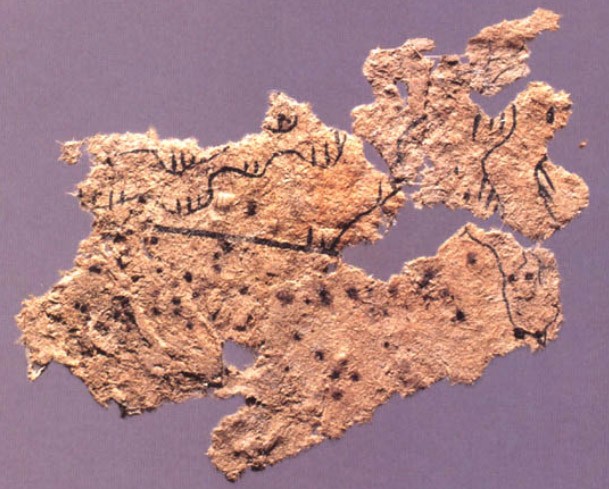
The scholarly debate that followed was genuine and is not yet fully closed. Pan Jixing and most mainland specialists read the finds as true paper and date the craft's origin to the Western Han, demoting Cai Lun to improver and popularizer; a minority, following doubts first raised about the Baqiao material's manufacture, has questioned whether the earliest fragments were deliberately made sheets at all 6. What no one now defends is the literal reading of the Hou Hanshu — that no paper of any kind existed before the eunuch's report. The text itself, read closely, never quite says so: it says writing was done on bamboo and silk, and that Cai Lun "initiated the idea" of making paper from bark, hemp, rags, and nets — a statement about materials and intent that the archaeology, remarkably, does not contradict 126.
Three centuries of coexistence
What followed 105 CE was not a revolution but a long, traceable substitution — and the desert archives let us watch it happen. At the Juyan garrisons, paper appears alongside wooden strips in the second century CE, used first for the lowest-stakes purposes 46. At Loulan in the Lop Nor desert, the archives of the third and early fourth centuries are genuinely mixed: the same offices, sometimes the same clerks, writing on wood for routine forms and on paper for letters and drafts 36. Paper had to earn each genre. The standardized formats of strip administration — the cord-bound register, the sealed tablet — were embedded in procedure, law, and habit, and bureaucracies surrender their forms slowly 34.
The formal end of the bamboo age can be dated with unusual precision, because it too was decreed from a throne. In 404 CE, the warlord Huan Xuan, briefly usurping the Jin throne, issued an edict: in antiquity there was no paper, hence documents were written on strips — but now "let all who use strips replace them with yellow paper" 26. The order ratified what practice had already decided; finds of administrative strips dwindle to nothing in the fourth century. Three hundred years had elapsed between Cai Lun's report and the obsolescence of the system it attacked: roughly the same interval, for comparison, that separates the printing press from the steam one 26.
Beyond China's borders, the substitution became an export. Papermaking reached the Korean peninsula with Chinese commanderies and Buddhist monasteries, and in 610 CE, the Nihon Shoki records, the Goguryeo monk Damjing arrived at the Japanese court and "made ink and paper" — the craft's first documented crossing to Japan, where it would become washi 29. Westward, paper documents travelled the Silk Road oases centuries before the craft itself followed; when papermaking finally passed into the Islamic world after 751 CE, in the aftermath of the battle of Talas, it set off what Jonathan Bloom has called an administrative and intellectual revolution in the Abbasid empire — a transmission, with its own costs, that this atlas records separately 8.
The book remade
Inside the Chinese world, what paper changed first was the economics of the text. A medium made from bark, rags, and fishing nets is a medium whose raw material costs approach zero; the price of a book collapsed toward the cost of the labor of copying it 26. The consequences compounded across centuries:
- The scroll replaced the bundle. The paper roll — light, continuous, brush-friendly — became the standard book form, and with it came the apparatus of Chinese book culture: title slips, roller ends, the very word juan ("roll") as the unit of a text 23.
- Calligraphy became an art. The brush on smooth, absorbent paper permitted — and the falling cost of practice surface democratized — the cursive and running scripts whose aesthetics organized Chinese elite culture from the second century onward. It is no accident that China's first celebrated master calligraphers appear within two generations of Cai Lun 26.
- Libraries scaled. Collections that had filled carts could fill shelves. The imperial library rebuilt at Luoyang, and every private collection after it, grew on a medium an order of magnitude cheaper and lighter than its predecessors 23.
- Buddhism arrived onto paper. The greatest text-copying enterprise in Chinese history — the translation and reduplication of the Buddhist canon, beginning in earnest in the second century CE — was a paper phenomenon almost from its start. The sutra-copying economies of Dunhuang, whose cave library would eventually preserve tens of thousands of paper manuscripts, are unthinkable on silk budgets or bamboo logistics 28.
- Printing became possible. Woodblock printing, emerging by the seventh century, presupposes paper: a cheap, smooth, uniform sheet that can be pressed against an inked block by the thousand. The print revolution usually dated to Gutenberg had its precondition manufactured in a Han palace workshop 29.
The Dunhuang library cave is the proof of scale, preserved by accident. When a walled-up chamber in the Mogao cave-temples was opened in 1900, it held some forty thousand paper manuscripts and printed documents, sealed since the early eleventh century: sutras by the thousand, but also contracts, almanacs, model letters, school exercises, shopping lists — the full sediment of a provincial paper culture 27. Among them was the Diamond Sutra of 868 CE, the earliest dated printed book in existence. Nothing remotely comparable survives, or could have existed, from the bamboo age; the cave is what writing looks like after eight centuries of Cai Lun's economics 278.
And the changes ran past the book entirely. Jean-Pierre Drège's collection of the principal Chinese texts on paper documents the medium escaping the scriptorium within a few centuries of Cai Lun: paper armor and paper clothing for the poor; paper flowers, kites, lanterns, and fans; sacrificial imitation money burned for the dead, which by the Tang had become an industry; window paper; wrapping paper; and — first attested to the fastidious disgust of a sixth-century scholar — toilet paper 7. By the Song dynasty the state was printing paper money, the world's first, in editions of millions of notes 27. No other material in Chinese history was asked to be currency, scripture, armor, offering, and window glass at once. A society that could make sheets from rags for next to nothing kept discovering what else a cheap flat surface could be 7.
Mark Edward Lewis has argued that writing in early China was, before it was anything else, an instrument of authority — that texts administered populations, controlled officials, and doubled the state in a parallel written world 11. Paper did not create that order; the bamboo state had already built it. What paper did was lower the cost of participating in it, by enough orders of magnitude that the written world could eventually take in examination candidates, merchants, monks, letter-writing families, popular fiction, paper money, and government forms in every county office of every subsequent dynasty 211.
Fossils of the bamboo age
What was displaced did not vanish; it fossilized. Modern Chinese still counts books in juan, "rolls," though nothing has been rolled for centuries; still calls a chapter a pian, originally a unit of bound strips; still writes the character ce, "volume," as a little pictogram of strips threaded on a cord — a three-thousand-year-old picture of an object no living person has used 3. The verb "to delete," shan, is written with the knife radical beside that same pictogram: to delete is, graphically, to scrape a bamboo strip 3. "To finish a draft" remains sha qing, "killing the green," the old fire-curing of fresh bamboo 3. The very word that came to mean paper, zhi, had first named the silk writing-cloth it replaced, and carries the silk radical to this day 13.
The crafts of the old system — strip preparation, cord binding, the scribe's knife — dwindled into niche and ceremony. Silk remained a painting and luxury surface but surrendered the workaday text 36. If there were workshops and workers whose living depended on jiandu manufacture, the sources do not record their complaint; the substitution ran slowly enough, across ten generations, that the bamboo age ended without a recorded protest. It is one of the very few replacements in this atlas in which nothing organized seems to have been broken — no institution abolished, no caste dispossessed, no language silenced. The losses were graphical, and Chinese writing keeps them, embalmed, in the body of its characters 3.
What the cost was
A bill of almost nothing
Measured by the standards this atlas applies to transmissions — conquest, slaving, epidemic, extraction, the displacement of peoples and gods — the documentation of paper at the Han court in 105 CE is that rarest of entries: a transformation of world-historical magnitude whose own bill, as far as the surviving record reaches, was approximately zero. The transmission was internal to the Chinese world; no foreign population was subjugated to accomplish it. It was peaceful; no one was killed to move a technique from a palace workshop into the general culture. It displaced a logistics, not a people. The raw materials were waste — rags, hemp ends, worn nets, bark — and the labor was the existing labor of workshops and, later, of papermaking villages that the craft enriched rather than enserfed 26. Even the knowledge displaced was not lost but absorbed: the brush, the ink, the scribal training of the bamboo age transferred to paper intact 3.
The costs that do attach to paper's later career belong to other entries and other agents. The prisoners of Talas in 751, by the traditional account, carried papermaking west as captives — that bill is recorded where it was incurred, in the transmission from Tang China to the Abbasid world 8. The paper bureaucracies of every subsequent empire wrote tax rolls and proscription lists as efficiently as they wrote poetry; the instrument's neutrality is the standing moral of every record in this atlas about writing, and paper merely cheapened the instrument 11. Charging those uses to a Han workshop would empty the idea of cost of its meaning. The honest entry for 105 CE reads: bill, none documented.
But this record would be incomplete — and false to the texture of the history — if it stopped there. The transmission cost nothing. The people in the story are another matter.
The inventor's account
Cai Lun's career was made by the machinery of palace violence long before it was made by paper. In 82 CE, as a young attendant, he was the instrument by which Empress Dou destroyed a rival: when Consort Song, mother of the heir apparent, was accused — on Dou's fabricated charge — of witchcraft, it was Cai Lun who was sent to interrogate her 110. Consort Song and her sister died by suicide; her son was deposed from the succession. The service bound Cai Lun to the empresses' faction, and the empresses' faction raised him: to Regular Palace Attendant, to the workshops directorate, and in 114 CE — under the regency of his patron Empress Deng — to the fief of three hundred households and the title by which paper itself was named, Marquis of Longting 110. In the 110s, Deng set him to supervise the scholars collating the canonical texts at the Eastern Lodge: the empire's authoritative editions, prepared under the direction of the man whose material would carry them for the next two thousand years 110.
In the spring of 121 CE, Empress Deng died, and the protection died with her. The emperor who now took personal power, An, was the grandson of Consort Song — the woman Cai Lun had interrogated to her death thirty-nine years earlier 110. The Hou Hanshu's closing lines on the inventor of paper are as spare as its account of his invention. Ordered to present himself to the Ministry of Justice, Cai Lun bathed, dressed himself in his finest silk robes, and drank poison. His fief was abolished 110.
The symmetry is terrible and exact, and it belongs in the accounting. The institution that produced the documentation of papermaking — the eunuch service of the Han palace — was itself built on a standing human cost: thousands of boys castrated into the emperor's service, deployed as the throne's instruments against the families of consorts and the consorts themselves, and discarded when factions turned 1014. Paper's documented origin runs through that institution at every step. A eunuch engineer perfected it; an empress's politics sponsored it; a palace purge killed its author. The technology was free. The court that minted it never was.
The myth as cost
One further entry belongs on the ledger, because this atlas counts distortions of memory among the things transmissions break. The very efficiency of the Han documentary machine — one engineer, one date, one imperial endorsement, recorded in one official history — flattened a long, anonymous, plural history of papermaking into a single inventor myth. For eighteen centuries, the hemp-beaters of the Western Han northwest, whoever they were, had no existence at all; the craft's origin belonged to one named official, worshipped by papermakers' guilds as the trade's founding deity, his supposed workshop sites marked by temples, his name attached by Chinese tradition to the craft the way Western tradition attaches printing to Gutenberg 69. Hunter, visiting Chinese paper mills in the early twentieth century, found Cai Lun's image still receiving offerings beside the vats 9.
The myth was not harmless to knowledge. It assigned the invention to the year 105, the place Luoyang, and the class of palace officials — and for as long as the written record was the only record, nothing could contradict it. It took the accidents of desert preservation, and the spades of twentieth-century archaeology, to return the first three centuries of paper to the nameless people who actually made it 61213. That recovery is itself a lesson the atlas keeps relearning: official documentation is a searchlight, and what it illuminates it also organizes around itself. The Hou Hanshu did not lie. It did what court records do — it remembered the court's version 16.
Weighing the bill
Set the entries side by side and the verdict is unusual but clear. Against the transmission proper: no conquest, no captives, no displaced people, no destroyed institution, no silenced language — a domestic diffusion, crown to country, of a technique made from waste fiber 26. Against its human context: one consort family destroyed with the future inventor as interrogator (82 CE), and the inventor's own coerced suicide in the backwash of the same feud (121 CE) — costs of the Han court's succession politics, in which paper was incidental 110. Against its memory: a powerful invention myth that erased the craft's anonymous founders for eighteen hundred years, corrected only by archaeology within living memory 61213.
This record therefore carries a cost severity of zero, and carries it without complacency. The zero measures the transmission, not the world it happened in; the Han palace was a violent institution, and the violence touched everyone in this story, including its protagonist, fatally. But the violence did not move the technology, and the technology did not require the violence. Paper left the Han court the way the best things in this atlas travel — by being obviously, overwhelmingly useful — and the bill for its first journey, from a workshop in Luoyang into the hands of the Chinese world, was paid in rags and fishing nets. What the world did with cheap writing afterward is the longest open account in human history, and it is still accumulating 2811.
What followed
-
-150Fangmatan, Tianshui, early 2nd century BCE: a hemp-paper fragment bearing an ink-drawn map is buried on the chest of a tomb occupant — the oldest surviving paper with marks on it, three centuries before Cai Lun.
-
-50Xuanquanzhi postal station, Dunhuang road, 1st century BCE: garrison clerks use coarse hemp paper for wrapping and occasional writing — over 460 fragments in eight grades survive in the station's refuse.
-
102102 CE: Empress Deng Sui, newly enthroned, declines tribute of gold and brocades and directs the provinces to send 'paper and ink, nothing more' — paper named in an imperial edict three years before Cai Lun's report.
-
105105 CE: Cai Lun, director of the imperial workshops, presents standardized paper of bark, hemp, rags, and fishing nets to Emperor He; the empire adopts 'the paper of Marquis Cai'.
-
114114 CE: Empress Deng's regency ennobles Cai Lun as Marquis of Longting, with a fief of three hundred households — the title by which paper itself was named.
-
121121 CE: Empress Deng dies; Emperor An, grandson of the consort Cai Lun had interrogated to her death in 82 CE, orders him to the Ministry of Justice. Cai Lun bathes, dresses in silk, and drinks poison.
-
404404 CE: the usurper Huan Xuan decrees that all documents still written on bamboo strips be replaced with yellow paper — the bureaucratic death certificate of the bamboo age.
-
610610 CE: the Goguryeo monk Damjing arrives at the Japanese court and, the Nihon Shoki records, 'makes ink and paper' — the craft's first documented crossing to Japan, where it becomes washi.
-
751After 751 CE: papermaking passes from Tang China into the Abbasid world in the aftermath of the battle of Talas — a separate transmission, with its own cost ledger, recorded in this atlas.
-
868868 CE: the Diamond Sutra is printed at Dunhuang — the earliest dated printed book on earth, on the cheap uniform sheets that woodblock printing presupposes.
Where this lives today
References
- Fan Ye 范曄. Hou Hanshu 後漢書, juan 78, 'Biography of Cai Lun' 宦者列傳·蔡倫傳. Beijing: Zhonghua Shuju critical edition, 1965. zh primary
- Tsien, Tsuen-Hsuin. Paper and Printing. Science and Civilisation in China, Vol. 5, Part 1, ed. Joseph Needham. Cambridge: Cambridge University Press, 1985. en
- Tsien, Tsuen-Hsuin. Written on Bamboo and Silk: The Beginnings of Chinese Books and Inscriptions. Chicago: University of Chicago Press, 1962; 2nd ed. with afterword by Edward L. Shaughnessy, 2004. en
- Loewe, Michael. Records of Han Administration. 2 vols. Cambridge: Cambridge University Press, 1967. en
- Chavannes, Édouard. 'Les livres chinois avant l'invention du papier.' Journal Asiatique, 10e série, t. V (janvier–février 1905): 5–75. fr
- Pan Jixing 潘吉星. Zhongguo zaozhi shi 中国造纸史 (A History of Chinese Papermaking). Shanghai: Shanghai Renmin Chubanshe, 2009. zh
- Drège, Jean-Pierre. Le papier dans la Chine impériale: origine, fabrication, usages. Paris: Les Belles Lettres (Bibliothèque chinoise, 24), 2017. fr
- Bloom, Jonathan M. Paper Before Print: The History and Impact of Paper in the Islamic World. New Haven: Yale University Press, 2001. en
- Hunter, Dard. Papermaking: The History and Technique of an Ancient Craft. 2nd ed. New York: Alfred A. Knopf, 1947; repr. New York: Dover, 1978. en
- de Crespigny, Rafe. A Biographical Dictionary of Later Han to the Three Kingdoms (23–220 AD). Leiden: Brill, 2007. en
- Lewis, Mark Edward. Writing and Authority in Early China. Albany: State University of New York Press, 1999. en
- Gansu Provincial Institute of Cultural Relics and Archaeology 甘肃省文物考古研究所. 'Gansu Tianshui Fangmatan Zhanguo Qin Han muqun de fajue' 甘肃天水放马滩战国秦汉墓群的发掘 (Excavation of the Warring States, Qin, and Han tombs at Fangmatan, Tianshui, Gansu). Wenwu 文物 1989, no. 2. zh
- Hu Pingsheng 胡平生 and Zhang Defang 张德芳, eds. Dunhuang Xuanquan Hanjian shicui 敦煌悬泉汉简释粹 (Selected Annotated Han Strips from Xuanquan, Dunhuang). Shanghai: Shanghai Guji Chubanshe, 2001. zh primary
- Twitchett, Denis, and Michael Loewe, eds. The Cambridge History of China, Volume 1: The Ch'in and Han Empires, 221 B.C.–A.D. 220. Cambridge: Cambridge University Press, 1986. en