Chan crosses to Korea and Kamakura Japan as Seon and Zen (c. 1200)
Zen did not travel to Japan through Korea. Chinese Chan crossed the sea twice: to Silla in the ninth century, where it became Korean Seon, and to Kamakura Japan around 1200, where warrior rulers made it a state church. Japanese Zen got that patronage by promising to protect the state, and seven centuries later its institutions blessed Japan's wars.
In 1200 Eisai opened Kamakura's first Zen temple as Chinul moved his Seon community to Songgwangsan. Both drew on Song Chan, neither through the other, and Japan's Zen swore to protect the state.

Before: two Buddhist worlds without Chan
Kamakura Japan before Zen: Tendai, esoteric rites and armed monasteries
In the spring of 1191 a Tendai monk named Myōan Eisai landed at Hirado in northern Kyushu, coming home from his second voyage to China. The Buddhist establishment he came back to had been built six centuries earlier, around a religion carried from the Korean kingdom of Baekje in the mid-sixth century. Its centre in 1191 was a mountain. Enryakuji, on Mount Hiei above Kyoto, had been founded by Saichō (767–822) in 788. By the twelfth century it had grown into a mountain city, traditionally counted at three thousand lodges, with estates across the provinces and the political weight of a great noble house.7 Its rival in the old capital of Nara was Kōfukuji, the clan temple of the Fujiwara. Alongside both stood Shingon, the esoteric school Kūkai had brought from Tang China in 806.7
What these institutions sold, and what the court bought, was ritual. Tendai and Shingon monks performed esoteric rites for rain, for safe childbirth in the imperial family, for the defeat of rebels, and for the protection of the state. The doctrine behind the rites was a vast synthesis. Tendai taught the Lotus Sutra as the summit of the Buddha's teaching, and it absorbed esoteric ritual, Pure Land devotion, monastic precepts and meditation under one roof. Nothing in Japanese Buddhism of the 1180s was organised as a separate school of meditation. Meditation existed as one practice among many in the Tendai curriculum, and it was not what people paid for.78
The establishment was also armed. Enryakuji and Kōfukuji kept bodies of fighting monks and lay retainers. When the court displeased them, they carried their gods' sacred palanquins into Kyoto and paralysed the government until it gave way. The Genpei War of 1180–1185, which ended with the Minamoto victory and a new warrior government at Kamakura, reached the monasteries directly. In the twelfth month of 1180 Taira forces burned Tōdaiji and Kōfukuji in Nara. Kamakura's founder, Minamoto no Yoritomo, paid to rebuild them.7
The four earlier visits of Chan to Japan
Chan had touched Japan before. It had never taken root, and the failures tell us what had to change before it could:
- Dōshō (629–700) studied in Tang China under the pilgrim-translator Xuanzang and also learned meditation from a Chan teacher. When he returned in 661 he built a meditation hall at Gangōji in Nara. The hall served the Hossō school he founded, not a Chan lineage.7
- Daoxuan (702–760), a Chinese monk of the Northern Chan line, came to Nara in 736 to help establish ordination. His Japanese disciple Gyōhyō later taught the young Saichō.7
- Saichō himself, on his voyage of 804–805, received four transmissions in China — Tiantai doctrine, esoteric ritual, the bodhisattva precepts, and a Chan lineage of the Niutou ("Oxhead") school. In the Tendai he founded, Chan became one ingredient of four.7
- Yikong, a Chinese Chan master, was invited to Kyoto in the mid-ninth century by Tachibana no Kachiko, the widowed empress known as Danrin. He taught at a temple she built for him and went home after a few years, finding no following. Dumoulin records the tradition that a stone was later set up at the Rashōmon gate to mark that Chan had once been taught in Japan.7
All four came through the court, and all four ended inside the court's existing synthesis. In the 1180s, a monk who wanted to practise Chan as Song China practised it had no Japanese teacher, no Japanese monastery and no Japanese lineage to join.
Silla and Goryeo Korea before Seon
Korea had received Buddhism in the late fourth century. By the time of the unified Silla kingdom (668–935) it had built one of the most sophisticated doctrinal cultures in Asia. Its two great figures were Wonhyo (617–686), whose commentaries were read in China and Japan, and Uisang (625–702), who brought the Huayan (Korean Hwaeom) teaching from Tang China and founded Buseoksa. Hwaeom taught the interpenetration of all phenomena. In practice it meant the scholastic study of the Avataṃsaka Sūtra, conducted in great monasteries endowed by the Silla court in and around the capital at Gyeongju. Bulguksa, begun in 751, is the monument of that world.23
Korean tradition dates Chan's first arrival to Beomnang (fl. 632–646), said to have studied with the Fourth Patriarch Daoxin, and to Sinhaeng (704–779), who trained in the Northern line. As in Japan, neither founded a lasting school.3 Korean monks were also already inside Chinese Chan. The Silla monk Musang (684–762), known in China as Reverend Kim (Kim heshang), led a Chan community in Chengdu in Sichuan. The eighth-century Lidai fabao ji places him in the line of transmission it claims for its own school, and Wendi Adamek's study shows how central he was to Sichuan Chan.1 Musang never went home. Chan reached Korea as a school only with a later generation, and it went to the provinces, not the capital.
Goryeo before Chinul: a state church and a military coup
The Goryeo dynasty (918–1392), which reunified the peninsula after Silla's collapse, made Buddhism a pillar of the state. The founder, Wang Geon, left injunctions to his successors that told them to protect the monasteries whose prayers had won him the kingdom. The court held state examinations for monks, separately for the meditation and the doctrinal schools, and appointed the successful candidates to monastic ranks up to royal preceptor and national preceptor.23 Royal princes entered the order. The great monasteries of the capital, Gaegyeong, held land, slaves and commercial privileges, and Buddhist festivals were state occasions.
That wealth made the monasteries part of politics. In 1170 a group of military officers overthrew the civil officials of the court and began a century of military rule; from 1196 the Choe family ran the government under a puppet king. Monks from the capital's monasteries took part in the struggles, and some led armed revolts against the generals.2 This was the world Chinul grew up in. Seon in late-twelfth-century Goryeo was an established institution with its own examination track and its own careerists, and it no longer had the provincial distance of the Nine Mountain founders. What Chinul did with it, around 1200, belongs in the next section.
The transmission: two crossings from one source
The source: Chan in Tang and Song China
The tradition both countries received was not one thing. In the eighth and ninth centuries the dominant line of Chinese Chan was the Hongzhou school of Mazu Daoyi (709–788) and his disciples. It favoured sudden awakening, spontaneous dialogue and the claim that "ordinary mind is the Way."35 By the twelfth century Chan had become the dominant form of elite monastic Buddhism in Song China. Most large public monasteries were designated Chan monasteries. The state appointed their abbots, regulated their ordinations and, in the Northern Song, sold blank ordination certificates to raise revenue.45 The Chanyuan qinggui of 1103, a monastic code compiled by Changlu Zongze, set out the bureaucratic life of these institutions in detail: their offices, rituals, meal procedures and ceremonies for the emperor's long life.4
Song Chan was also divided. Morten Schlütter has shown that the formative quarrel of twelfth-century Chan set the Linji master Dahui Zonggao (1089–1163) against the revived Caodong lineage of Hongzhi Zhengjue (1091–1157).5 Dahui taught kanhua ("observing the phrase") meditation, concentrating on a single critical phrase of a kōan until the doubt it raised broke open. He attacked the quiet sitting of the Caodong teachers as "heretical silent illumination." The Caodong side made seated meditation itself the expression of awakening. Japan would receive both sides of this quarrel, as two separate schools. Korea would receive Dahui's side and build it into a single national order.56
By the early thirteenth century the most prestigious Chan monasteries of the Southern Song were grouped into an official hierarchy of "Five Mountains and Ten Temples." The ranking was traditionally credited to the chief councillor Shi Miyuan.615 Two of the five stood near the port of Mingzhou (Ningbo): Tiantong and Ayuwang. It was there, a few days' sail from Kyushu, that Japanese monks would learn Chan.
First crossing: Tang Chan to Silla, 784–936
The first school-founding crossing went to Korea. In 784 the Silla monk Doui sailed for Tang China with a Silla embassy. He trained at Kaiyuan monastery in Hongzhou under Xitang Zhizang (735–814), one of Mazu's leading disciples, and returned to Silla in 821.23 His teaching was not welcome in the capital, where the doctrinal schools dominated. He withdrew to Jinjeonsa in the Seorak mountains on the northeast coast and left the founding of an institution to his successors. His grand-disciple Chejing (804–890) established the Gajisan school at Borimsa.3
Over the next century the pattern repeated itself until Korea had the Nine Mountain Schools (Gusan Seonmun). Each was founded by a Korean monk who had trained in China. The table gives the founders the sources record.3
| School | Founder | Chinese training |
|---|---|---|
| Gajisan (Borimsa) | Doui; Chejing (804–890) | Xitang Zhizang, Mazu line |
| Silsangsan | Hongcheok (fl. 830) | Xitang Zhizang |
| Dongnisan | Hyejeol (785–861) | Xitang Zhizang |
| Bongnimsan | Weongam (787–869) | Zhangjing Huaihui, Mazu line |
| Sagulsan | Beom'il (810–889) | Yanguan Qi'an, Mazu line |
| Sajasan | Doyun (797–868) | Nanquan Puyuan, Mazu line |
| Seongjusan | Muyeom (800–888) | Magu Baoche, Mazu line |
| Huiyangsan | Doheon (824–882) | Korean teachers of the Mazu line |
| Sumisan | Ieom (869–936) | Caodong lineage |
Eight of the nine came from the Mazu line; only Sumisan descended from the Caodong.3 The geography matters as much as the lineage. The schools stood in the mountains of the provinces, often under the patronage of regional strongmen whose power was rising as the Silla court weakened in the ninth century.2 Seon came to Korea as a provincial religion, the faith of a periphery that was pulling away from the capital.
Second crossing: Song Chan to Kamakura Japan, 1168–1279
The crossing to Japan came three centuries later, and it came straight from China. Korea was not a stage on the way.
Eisai (1141–1215). Eisai first sailed for China in 1168, as a Tendai monk visiting Mount Tiantai, the home of his own school. He found that the great monasteries of the Song had become Chan monasteries. On his second voyage, in 1187, he studied under the Linji master Xu'an Huaichang, followed him to Tiantong, and in 1191 came home with a certificate of transmission.78 He built Japan's first Zen temple, Shōfukuji, at Hakata. He then moved toward the capital, where his timing was bad. In 1194, at the request of Enryakuji, the court proscribed the propagation of Zen. The target was the Daruma school of Dainichi Nōnin, a self-taught Zen teacher who had sent two disciples to China in 1189 to obtain a certificate by letter from the master Zhuoan Deguang.910 Eisai was caught in the same ban.
His answer, written in 1198, was the Kōzen gokokuron, "A Treatise on Letting Zen Flourish to Protect the State."8 The title is the argument. Eisai presented Zen as the monastic discipline that would make Buddhism effective again in the age of the Dharma's decline. He insisted that Zen practice began with strict observance of the precepts, and he offered it to the rulers as a new protector of the realm. The warriors accepted the offer before the court did. Hōjō Masako, Yoritomo's widow, sponsored Jufukuji in Kamakura in 1200. In 1202 the second shogun, Minamoto no Yoriie, gave Eisai land in Kyoto for Kenninji. Kenninji was licensed as a mixed Tendai, esoteric and Zen monastery, and Eisai never broke openly with Hiei.7
Dōgen (1200–1253). The second founder was a disciple of Eisai's successor at Kenninji. Dōgen sailed in 1223 with his teacher Myōzen and studied in the monasteries around Mingzhou. Myōzen died at Tiantong in 1225. In the same year Dōgen found his master there: Tiantong Rujing (1163–1228), abbot of the Caodong line, the side of the Song quarrel that Dahui had condemned.117 Dōgen returned to Japan in 1227. He brought no relics or images, by his own account, only Rujing's teaching that "just sitting" (shikan taza) is itself awakening. His first writing at home was the Fukan zazengi, a manual of seated meditation for everyone.11 From 1233 he taught at Kōshōji at Fukakusa, south of Kyoto, and began the essays in Japanese that became the Shōbōgenzō. The best known of them, "Genjōkōan," puts the practice in a sentence: "To study the Buddha Way is to study the self. To study the self is to forget the self."12
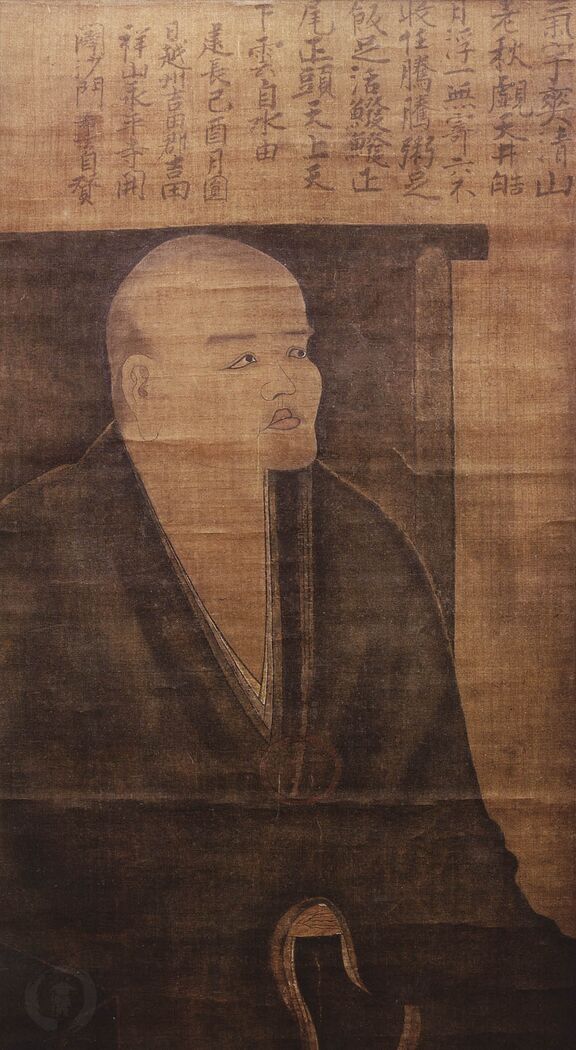
In 1243 Dōgen left Kyoto for Echizen on the Japan Sea coast. He settled on the estates of the warrior Hatano Yoshishige, where in 1244 he founded the monastery later named Eiheiji.13 Why he left is debated. Pressure from Enryakuji, rivalry with the new and lavishly patronised Tōfukuji of Enni Ben'en, and Dōgen's own wish for a remote monastery on the Song model have all been argued. Steven Heine and William Bodiford treat the move as the decisive turn toward a rural, provincial Sōtō school.1113
The émigré masters. The third current was Chinese monks who came to Japan, and it had the deepest effect on the warrior government itself. In 1246 the Linji master Lanxi Daolong (1213–1278) landed at Hakata. The regent Hōjō Tokiyori brought him to Kamakura and in 1253 made him founding abbot of Kenchōji. Kenchōji was the first monastery in Japan built and run purely on the Song Chan model, with its Chinese plan, Chinese code and Chinese-speaking abbot.15 After 1279, with the Southern Song falling to the Mongols, Chinese masters had reasons to leave home. Tokiyori's son Tokimune invited Wuxue Zuyuan (1226–1286), who became founding abbot of Engakuji in 1282.1516

The crossing itself: Hakata, Mingzhou and the merchant ships
None of this travel needed an embassy. Official relations between the Japanese court and China had lapsed after 894. What carried the monks was private trade. Chinese merchant ships sailed the route between Mingzhou and Hakata on the summer and autumn monsoons, and the Japanese monks who went to study bought passage on them. A Chinese merchant community lived in Hakata itself.1516 One of its leading members, Xie Guoming, sponsored Jōtenji in Hakata for the monk Enni Ben'en, who had studied in China from 1235 to 1241 under the Five Mountains master Wuzhun Shifan. Enni went on to become founding abbot of Tōfukuji in Kyoto, built for the regent Kujō Michiie.15
The traffic went in both directions and grew after the Mongol conquest of the Southern Song. Japanese monks sailed to study in the Chinese monasteries, Chinese monks sailed to teach in the Japanese ones, and the ships that carried them also carried books, tea bowls, paintings, incense and copper coins. Hanuki Masaya's study of the formation of medieval Zen monasteries shows how closely the founding of Japanese Zen houses followed this trade and the patronage of the warrior houses who controlled its ports.16 The religion moved as cargo. It needed a merchant to carry it, a warrior to house it and a Chinese master to certify it.
Korea again, c. 1200: Chinul and the Samādhi and Prajñā Society
In the decades when Eisai and Dōgen were sailing to Mingzhou, the most important monk in Korea was going nowhere. Chinul (1158–1210) never went to China. He was ordained young, passed the Goryeo state examination for monks in 1182, and became disgusted with the worldliness of a monastic establishment entangled with the court and with a military regime that had seized power in 1170.2 In 1190 he issued a compact for a retreat community, the Encouragement to Practice: The Compact of the Samādhi and Prajñā Society. It opens with a sentence Korean Buddhists still quote, rendered by Buswell as the image of a person who has fallen to the ground and must use that same ground to get up.2
Chinul's China came to him through books. He read the Huayan commentator Li Tongxuan and the Chan-Huayan synthesis of Guifeng Zongmi. In 1198, in a hermitage on Mount Jiri, he read the Records of Dahui Zonggao and, by his own account, reached final awakening through them.2 From 1200 he moved his community to Gilsangsa on Mount Songgwang in the far southwest. When the new buildings were finished in 1205, King Huijong renamed the monastery Suseonsa and the mountain Jogyesan, after the mountain of the Sixth Patriarch in China.23 There Chinul taught the method that defines Korean Seon: sudden awakening followed by gradual cultivation, and hwadu, Dahui's critical-phrase meditation, as its sharpest tool.
The two crossings, set side by side:
| Date | Korea | Japan |
|---|---|---|
| 821 | Doui returns from Hongzhou | — |
| 1191 | — | Eisai returns from Tiantong |
| 1198 | Chinul reads Dahui on Mount Jiri | Eisai writes the Kōzen gokokuron |
| 1200–1205 | Suseonsa built at Songgwangsan | Jufukuji (1200), Kenninji (1202) |
| 1227 | — | Dōgen returns from Tiantong |
| 1253 | — | Lanxi Daolong opens Kenchōji |
| 1347 | Taego Bou receives a Linji transmission in Yuan China | — |
Why the chain story is told
The calendar this record was written from calls the path "Chinese Chan to Korean Seon to Japanese Zen." It is an easy story to believe. Buddhism itself did reach Japan from Baekje in the sixth century, and Korean Seon is older than Japanese Zen by three hundred years. But the record does not support a chain for Chan. None of the founders of Japanese Zen trained in Korea or under a Korean master, and Japanese Zen's lineage documents, ordination records and monastic codes all lead back to Mingzhou and Hangzhou.71315 Korea and Japan are two branches from one Chinese trunk. They were cut at different times — the Tang Hongzhou school for Korea, the Southern Song Five Mountains for Japan — and that is why the two traditions differ.
What changed and what was replaced
In Japan: a new kind of monastery, and a new client
The most visible change in Kamakura Japan was architectural and administrative. Kenchōji and Engakuji were laid out on the axial plan of Song Chan monasteries, with gate, Buddha hall, Dharma hall and abbot's quarters on a line, and a monks' hall where the community sat, slept and ate in assigned places. Monks wore Song robes, chanted in a Song pronunciation of Chinese, kept Song ceremonial, and in the early generations often took instruction through interpreters or brush-talk in written Chinese.15
New categories came with the buildings:
- The kōan. A recorded exchange between masters, used as the object of meditation and as the test of a student's insight. Kōan study came with the Linji masters and became the defining practice of Rinzai.15
- Sitting as awakening. Dōgen's insistence that seated meditation is itself the realisation of Buddhahood, not a technique toward it, made zazen the centre of Sōtō practice.1112
- The lineage certificate. Authority came from a documented, face-to-face transmission from master to disciple, traced back through Chinese masters to the Buddha. This is why Nōnin's certificate obtained by letter mattered so much, and why it was attacked.910
- The monastic code. Life in the monastery was regulated by qinggui, codes adapted from the Chinese, which fixed everything from the abbot's ascent of the Dharma hall to the procedure for washing bowls.415
- Tea. Eisai's Kissa yōjōki recommended powdered tea as medicine. The Azuma kagami records that in 1214 he cured the shogun Minamoto no Sanetomo of a hangover with a bowl of tea and a copy of his treatise.19
The deeper change was the client. Tendai and Shingon had served the court; the new Zen monasteries of Kamakura served the warrior government. The Hōjō regents used the Chinese abbots as teachers, as advisers, and as a cultural credential: a government of provincial warriors could now show that it possessed the newest and most prestigious Buddhism of the continent.1516
The Gozan: Zen as government
Under the Ashikaga shoguns, who took power in the 1330s, the relationship became formal. The Gozan, "Five Mountains," were a ranked hierarchy of officially sponsored Rinzai monasteries on the Southern Song model. The ranking was revised several times and fixed in 1386, when Ashikaga Yoshimitsu placed Nanzenji above all the others.15 The system worked like this:
- Two sets of five ranked monasteries, in Kyoto (Tenryūji, Shōkokuji, Kenninji, Tōfukuji, Manjuji) and Kamakura (Kenchōji, Engakuji, Jufukuji, Jōchiji, Jōmyōji), below them the jissetsu ("ten temples") and below those dozens of provincial monasteries.15
- Abbots were appointed by the shogunate, and from 1379 an official called the sōroku, a Zen monk himself, administered the whole network for the shogun.15
- At the urging of the monk Musō Soseki, the Ashikaga brothers Takauji and Tadayoshi founded a "temple for the peace of the realm" (Ankokuji) and a "pagoda for the benefit of beings" (Rishōtō) in each province. Their stated purpose was to pray for the dead of the wars that had brought the Ashikaga to power.15
- Gozan monks, trained in literary Chinese, drafted the shogunate's diplomatic correspondence with Ming China and Joseon Korea and staffed its missions.1516
The monasteries became landlords, lenders and cultural academies. Their monks wrote Chinese poetry and prose (the "literature of the Five Mountains"), printed Chinese books, and taught Neo-Confucian learning, which first reached Japan largely through them. Ink painting, garden design and the formal tea gathering grew up in their orbit.157
Outside the Gozan: Sōtō in the provinces
The Sōtō line went the other way. After Dōgen, the Echizen community took in a group of former Daruma school monks in 1241, among them Ekan and Gikai. Dōgen's successor, Koun Ejō, had also come from that school.913 Under Keizan Jōkin (1264–1325) and his heirs, Sōtō spread through the provinces among local warriors and villagers. It did so by offering what the people of the countryside wanted: precept ceremonies for laypeople, prayers for worldly benefit, and above all funerals. Bodiford's study of the period sums up the result: "the Soto school rapidly expanded from a single, small, exclusive monastic community to several extended networks of temples spread throughout the rural areas of nearly every Japanese province."14 The Zen funeral, adapted from the rites Chinese monasteries performed for deceased monks, became the funeral of ordinary Japanese, and it remains so.13
What was replaced in Japan
Zen did not destroy the older schools. Enryakuji, Kōfukuji and the Shingon monasteries remained powerful until the sixteenth century. What Zen displaced was their monopoly. It took from them:
- The court's and warriors' patronage for state-protection ritual, which now went also to Zen monasteries praying for the shogun.15
- The role of cultural intermediary with China. The great Chinese learning of the Heian period had come through embassies and Tendai and Shingon monks; from the thirteenth century it came through Zen monks.1516
- The meditation strand of Tendai's synthesis, now claimed as the property of a separate school with its own lineage.78
- Popular funerary religion in many villages, where Sōtō temples became the place the dead were buried and remembered.13
In Korea: Seon becomes the national order
In Korea the change ran deeper and more slowly. The Nine Mountain schools of the ninth and tenth centuries had made Seon one of the two great divisions of Korean Buddhism, Seon (meditation) against Gyo (doctrine). In 1097 the royal monk Uicheon founded a Korean Cheontae (Tiantai) school to reconcile them under doctrinal leadership.23 Chinul answered from the Seon side. His synthesis brought Hwaeom doctrine inside Seon, as the understanding that precedes and supports meditation. That made Seon the frame into which the rest of Korean Buddhism could fit.2
Chinul's successor at Suseonsa, Hyesim (1178–1234), compiled the first large Korean kōan collection, the Seonmun yeomsong, in 1226.3 In the fourteenth century Taego Bou brought a direct Linji transmission from Yuan China and is honoured as a patriarch of the later order.3 In 1424 the Joseon court forced all the Buddhist schools into two, one Seon and one Gyo, under a state that favoured Confucianism and sharply restricted the Buddhist establishment.3 The modern Jogye Order, the largest Buddhist body in South Korea, takes its name from Chinul's mountain and holds him as its founding spirit.23
What Seon replaced in Korea was the primacy of the doctrinal schools — above all Hwaeom, which had been the intellectual centre of Silla Buddhism. Hwaeom was absorbed rather than abolished, studied in Seon monasteries as the theory of a practice.
The practice Chinul chose is still the practice of Korean monasteries. Twice a year, in summer and in winter, Korean Seon halls hold three-month meditation retreats in which monks sit with a single hwadu, most often Zhaozhou's answer "No" (mu) to the question whether a dog has Buddha-nature, the same phrase Dahui recommended to his students in twelfth-century China.25 A practice that Japanese Rinzai developed into graded curricula of hundreds of kōan, Korean Seon kept as one phrase held for a lifetime. The difference goes back to the moment of transmission: Korea took Dahui's method through a single reader of his books, while Japan took the Song monastery whole, with its collections, its examinations and its abbots.
What the cost was
The bill in Kamakura: a ban, a burning, an exile
The transmission of Chan to Japan and Korea was carried by monks and books. No population was conquered for it and no one was enslaved for it. Its costs were real but limited, and they belong mostly to the institutions that the transmission created. This section names them in order.
The first was suppression. The 1194 ban on the propagation of Zen was issued by the court at Enryakuji's request, aimed at Nōnin's Daruma school and catching Eisai. The petition condemned the Daruma school's teaching as unintelligible and baseless.910 The ban did not kill anyone, but it shaped everything after it. Eisai's response was to make Zen safe for the state: his Kenninji was a Tendai, esoteric and Zen monastery together, and his treatise promised the rulers protection.8 From its first decade, Japanese Zen bought its survival by accepting the state's terms.
The Daruma school did not survive as a school. Its community at Tōnomine, a Tendai complex near Nara, was reduced to ashes when armed forces of Kōfukuji raided the mountain in 1227 and 1228. Breugem's study is careful on the point: the raids came out of the economic and political rivalry between Kōfukuji and Enryakuji, not a campaign against Zen.10 But the people burned out were Zen monks, and the survivors scattered, many to Echizen, where they became the core of Dōgen's community.910
The pattern of the older order meeting the new with force was not special to Zen. In 1207 the court exiled the Pure Land preacher Hōnen and executed four of his disciples after the old schools petitioned against his movement.7 Dōgen's departure from Kyoto in 1243 sits inside the same climate, although the evidence does not let the record call it a persecution.1113
Zen inside war
Zen came to Kamakura during war and was put to work in it. Engakuji was founded in 1282 after the second Mongol invasion. Its purpose, as Tokimune's foundation set it out, was to pray for the dead of the Mongol invasions of 1274 and 1281 — Japanese and Mongol alike.1516 The tradition that Tokimune consulted his Chinese teacher Wuxue Zuyuan as the second invasion approached is a staple of later Zen histories. The documents show more simply that the regency's Zen monasteries prayed for victory and for the dead.15
The Ashikaga made the link explicit. The Ankokuji and Rishōtō network placed a monastery and a pagoda in each province to calm the spirits of the war dead. Its political function was to plant the new regime's presence in every province.15 Tenryūji, at the top of the Kyoto Gozan, was founded in 1339 by Ashikaga Takauji for the soul of the emperor Go-Daigo — the ruler Takauji had driven from Kyoto and whose angry spirit he had reason to fear. Its construction was paid for in part by the Tenryūji-bune, trading ships licensed to sail to Yuan China in 1342 on condition that their Hakata merchant pay 5,000 kanmon to the temple whatever the voyage earned.15
The Gozan monasteries were great landholders, and their estates were worked by peasants who paid the rents that maintained the monks' Chinese learning. Collcutt documents monastic estates managed by monk-officials whose job was revenue.15 When the Ōnin War (1467–1477) destroyed much of Kyoto, the Gozan monasteries burned with the shogunal order that had built them. The system never recovered its old power.1516
The long bill: Imperial-Way Zen
The heaviest cost appears long after the transmission, but it grows directly from the bargain Eisai made in 1198: Zen as the protector of the state. In the late nineteenth and early twentieth centuries, as Japan built an empire, the Zen schools aligned themselves with it. Brian Victoria's Zen at War (1997; 2nd ed. 2006) documented leading Zen teachers who presented military obedience and killing as the expression of Zen's selflessness. The Sōtō master Harada Daiun Sōgaku wrote: "[If ordered to] march: tramp, tramp, or shoot: bang, bang. This is the manifestation of the highest Wisdom [of Enlightenment]."17
Robert Sharf had already argued in 1993 that the "Zen" presented to the West in these decades — above all by D. T. Suzuki — was a modern, nationalist construction that made Zen the essence of Japanese culture.18 Victoria's treatment of Suzuki has been sharply contested, notably by Satō Kemmyō, and the debate over individual teachers continues.17 The institutions themselves did not wait for it to be settled:
- 1992: the Sōtō school issued a statement of repentance: "Since the Meiji period, our (Soto Zen) sect has cooperated in waging war."17
- 27 September 2001: the general assembly of the Myōshinji branch of Rinzai declared: "Even though it was national policy at the time, it is truly regrettable that our sect, in the midst of wartime passions, was unable to maintain a resolute anti-war stance and ended up cooperating with the war effort."17
- October 2001: Myōshinji administrators stated that the Japanese translation of Victoria's book had given them "the opportunity" to address their war responsibility.17
The cost of that complicity cannot be measured in the record of a thirteenth-century transmission. The bodies were counted in China, Korea and the Pacific, and the Zen schools were not their cause. But the doctrine that made Zen useful to empire was named in the founding text of Japanese Zen: Kōzen gokokuron, Zen for the protection of the state.817
The bill in Korea
Korean Seon carries a lighter bill. Its rise marginalised the doctrinal schools that had been the glory of Silla, but it did so by absorbing their teaching, not by persecuting them. Its monasteries prospered under Goryeo, and Goryeo's great Buddhist estates did help provoke the Confucian reaction of early Joseon. When that reaction came, in the restrictions of the 1400s, Seon was its victim, not its agent.3 The Mongol invasions of the 1230s burned monasteries — Hwangnyongsa in 1238 among them — and destroyed the first Korean printing of the Buddhist canon. That loss belongs to the Mongol wars, not to the arrival of Chan.
Who paid
Set together, the bill runs as follows:
- The Daruma school, banned in 1194 and burned out of Tōnomine in 1227–1228, which ceased to exist as an independent school.910
- The peasants of the Gozan estates, whose rents supported the monasteries that served the shogunate.15
- The dead of the wars the Zen monasteries were founded to pacify, from the Mongol invasions to the wars of the Ashikaga founding — honoured, not killed, by Zen, but used in their honouring.15
- The victims of Japan's wars of 1894–1945, whose deaths leading Zen teachers blessed, as the Sōtō and Myōshinji statements later acknowledged.17
The transmission of Chan to Korea and Japan gave both a meditative tradition that is still practised in thousands of monasteries and that has spread across the world. It was carried peacefully, by monks who crossed a dangerous sea to study. But in Japan it was also a contract with power from its first decade. The price of that contract came due, with interest, seven centuries later.
What followed
-
821The Silla monk Doui returns from training under Xitang Zhizang in Hongzhou; his heirs found the Gajisan school, first of Korea's Nine Mountain Seon schools.
-
1191Eisai returns from Tiantong with a Linji transmission and founds Shōfukuji at Hakata, the first Zen temple in Japan.
-
1194At Enryakuji's request the court bans the propagation of Zen, aimed at Nōnin's Daruma school; Eisai replies with the Kōzen gokokuron (1198), offering Zen as protector of the state.
-
1200Chinul moves his Samādhi and Prajñā Society to Songgwangsan; renamed Suseonsa in 1205, it becomes the root of Korea's Jogye Order.
-
1228Kōfukuji forces burn Tōnomine in 1227–1228, destroying the Daruma school's community; survivors later join Dōgen in Echizen.
-
1244Dōgen founds the monastery later named Eiheiji in Echizen, base of a Sōtō school that spreads through rural Japan through funerals and lay precept rites.
-
1253Lanxi Daolong becomes founding abbot of Kenchōji in Kamakura, the first Japanese monastery built entirely on the Song Chan model.
-
1282Engakuji is founded under Wuxue Zuyuan to pray for the Japanese and Mongol dead of the invasions of 1274 and 1281.
-
1386Ashikaga Yoshimitsu fixes the Gozan ranking, with Nanzenji above all: Rinzai Zen becomes an arm of shogunal government, diplomacy and learning.
-
1992The Sōtō school issues a statement of repentance for cooperating in Japan's wars since the Meiji period; Myōshinji follows in 2001.
Where this lives today
References
- Adamek, Wendi L. The Mystique of Transmission: On an Early Chan History and Its Contexts. New York: Columbia University Press, 2007. en
- Buswell, Robert E., Jr. (trans. and intro.). The Korean Approach to Zen: The Collected Works of Chinul. Honolulu: University of Hawai'i Press, 1983. en primary
- Buswell, Robert E., Jr., and Donald S. Lopez Jr. The Princeton Dictionary of Buddhism. Princeton: Princeton University Press, 2014. en
- Foulk, T. Griffith. "Myth, Ritual, and Monastic Practice in Sung Ch'an Buddhism." In Patricia Buckley Ebrey and Peter N. Gregory (eds.), Religion and Society in T'ang and Sung China, 147–208. Honolulu: University of Hawai'i Press, 1993. en
- Schlütter, Morten. How Zen Became Zen: The Dispute over Enlightenment and the Formation of Chan Buddhism in Song-Dynasty China. Kuroda Studies in East Asian Buddhism 22. Honolulu: University of Hawai'i Press, 2008. en
- 杨曾文 (Yang Zengwen). 《宋元禅宗史》 (A History of Chan Buddhism in the Song and Yuan). 北京: 中国社会科学出版社, 2006. zh
- Dumoulin, Heinrich. Zen Buddhism: A History. Vol. 2: Japan. Trans. James W. Heisig and Paul Knitter. Bloomington: World Wisdom, 2005 (orig. 1990). en
- Eisai (Myōan Yōsai). "A Treatise on Letting Zen Flourish to Protect the State" (Kōzen gokokuron, 1198). Trans. Gishin Tokiwa. In Zen Texts, BDK English Tripiṭaka. Berkeley: Numata Center for Buddhist Translation and Research, 2005. en primary
- Faure, Bernard. "The Daruma-shū, Dōgen, and Sōtō Zen." Monumenta Nipponica 42, no. 1 (1987): 25–55. en
- Breugem, Vincent M. N. From Prominence to Obscurity: A Study of the Darumashū, Japan's First Zen School. PhD dissertation, Leiden University, 2012. en
- Heine, Steven. Did Dōgen Go to China? What He Wrote and When He Wrote It. New York: Oxford University Press, 2006. en
- Dōgen. "Genjōkōan" (Shōbōgenzō, 1233). Trans. Robert Aitken and Kazuaki Tanahashi. In Kazuaki Tanahashi (ed.), Moon in a Dewdrop: Writings of Zen Master Dōgen. San Francisco: North Point Press, 1985. en primary
- Bodiford, William M. Sōtō Zen in Medieval Japan. Kuroda Institute Studies in East Asian Buddhism 8. Honolulu: University of Hawai'i Press, 1993. en
- Bodiford, William M. "The Growth of the Sōtō Zen Tradition in Medieval Japan." PhD dissertation, Yale University, 1989. en
- Collcutt, Martin. Five Mountains: The Rinzai Zen Monastic Institution in Medieval Japan. Harvard East Asian Monographs 85. Cambridge, MA: Council on East Asian Studies, Harvard University, 1981. en
- 葉貫磨哉 (Hanuki Masaya). 『中世禅林成立史の研究』 (Studies in the Formation of Medieval Zen Monasteries). 東京: 吉川弘文館, 1993. ja
- Victoria, Brian Daizen. Zen at War. 2nd ed. Lanham, MD: Rowman & Littlefield, 2006 (1st ed. Weatherhill, 1997). en
- Sharf, Robert H. "The Zen of Japanese Nationalism." History of Religions 33, no. 1 (1993): 1–43. en
- 『吾妻鏡』 (Azuma kagami), entry for Kenpō 2 (1214), 2nd month, 4th day. In 新訂増補国史大系 32–33. 東京: 吉川弘文館, 1932–1933. ja primary