Chimor’s smiths taken to Cuzco (c. 1470) — and a kingdom dismantled
Chimor ruled a thousand kilometres of irrigated Peruvian coast from the walled royal compounds of Chan Chan. Between 1462 and 1470 an Inca army came down the Moche river and defeated its last independent king, Minchançaman. The Incas held him hostage in Cuzco, broke his kingdom into valley lordships, carried off its treasury to gild the Temple of the Sun, and resettled its goldsmiths in the imperial capital. How much of the Inca way of ruling they learned from the coast is still argued.
Between 1462 and 1470 an Inca army descended the Moche river to Chan Chan, the adobe capital of Chimor, and defeated King Minchançaman. The Incas took him to Cuzco as an honoured hostage and set his son on the throne as their client, then divided the kingdom among the old dynasty’s heirs until, as John Rowe wrote, it was “only a memory”. Chimor’s treasury, the richest plunder ever brought to Cuzco, became a band of gold on the Temple of the Sun, and its metalworkers were moved to the capital to work for the state. Seventy years later the Spanish melted the gold at Cajamarca, dug up the tombs of the Chimú kings, and watched the coast’s population fall by as much as fifty-eight to one.

Before: a kingdom of walled palaces on the desert coast
At the mouth of the Moche valley on the north coast of Peru, a few kilometres from the Pacific surf, the rulers of Chimor built their capital out of mud. Chan Chan was raised over more than five centuries; Alan Kolata's sequence of its adobe brick types runs from about 900 to 1476, and he read that sequence as a record of "the birth, expansion, and end" of the Chimú economy and state 1. Its core, some six square kilometres, was dominated by huge rectangular enclosures that archaeologists call ciudadelas, walled compounds whose adobe walls rose to about nine metres 2. Kent Day counted ten of them and matched them to the ten kings named in the colonial record; UNESCO, which inscribed the site in 1986 and placed it on its List of World Heritage in Danger the same year, describes nine 23. Around and between them lay the smaller compounds of lesser nobles, the cane-walled barrios of craftsmen and servants, sunken gardens dug down to the water table, and cemeteries.
The people who lived here spoke Muchik, the language the Spanish later called la lengua yunga or Mochica 4, and they farmed a desert. Rain almost never falls on this coast. Every field depended on water brought from the Andes by the short rivers that cut across the coastal plain, and every valley that supported a population did so through canals. Chimor's rulers extended those canals across valley divides; Charles Ortloff described Chimú intervalley canal systems "up to 50 miles in length" and treated their surveying as one of the engineering achievements of the pre-Hispanic world 5. Michael Moseley, who led the Chan Chan–Moche Valley Project in the late 1960s and 1970s, built his account of the kingdom on that hydraulic base 6.
Chimor was a dynastic state with a written-down genealogy, though the writing came after its fall. An anonymous history of Trujillo composed in 1604, damaged, and published by Rubén Vargas Ugarte in 1936, preserves a king list: a founder named Taycanamo who came by sea, his son Guacricaur, Ñancenpinco who carried the kingdom south to the Santa valley and north to Pacasmayo, and after several more reigns Minchançaman, who ruled when the Incas came 78. John Rowe translated the passage in 1948 and made it the backbone of his history of the kingdom 8.
Ten kings, ten compounds
The ciudadelas were not ordinary palaces. Each enclosed courts, corridors, hundreds of storerooms, small U-shaped structures that archaeologists call audiencias, and in most cases a burial platform: a raised mass of cells built around a central chamber, in which a king was buried with offerings and attendants 29. Geoffrey Conrad, who excavated the platforms, found evidence of "ritual human sacrifice, and repeated ceremonies that were part of the cult of the dead king" 9. Most platforms had been gutted long before archaeologists reached them. In September 2026 a team under Jorge Meneses reported an unlooted platform in the Gran Chimú compound holding thirty-eight individuals, one in the central chamber, twenty in the side chambers and eighteen on the platform itself, with shell, copper and gold 10.
The features that recur across the compounds are the core of the evidence for how Chimor was governed:
- Massive enclosing walls, up to about nine metres high, usually with a single narrow entrance 2.
- Audiencias, small U-shaped rooms set at the turnings of corridors, which Day read as checkpoints where officials controlled access to stored goods 2.
- Storerooms in the hundreds, far more than any household could fill, holding the kingdom's textiles, metal and food 211.
- Burial platforms, each the tomb of one ruler and the focus of a continuing cult 9.
- Walk-in wells and sunken gardens, reaching the water table inside the walls 6.
Conrad drew a radical inference from this pattern. If each king built a new compound and was buried in it, he argued, the dead ruler's wealth must have stayed with his cult while his successor inherited only the office. The new king therefore had to win his own wealth, by new taxes, new irrigation or new conquests. Conrad called this "split inheritance" and claimed it "was the driving force behind imperial expansion" in both Chimor and the Inca empire 12. The idea was attacked as soon as it appeared. In the same issue of American Antiquity, Allison Paulsen wrote that "Conrad's discussion bears little relation to the generally accepted outline of Peruvian prehistory", and placed it in "a previously unidentified archaeological specialty, the Archaeology of the Absurd" 13. The argument returns below, because it concerns what the Incas may have learned from the coast.
A coast a thousand kilometres long
Chimor grew by conquest. Carol Mackey dated its expansion in phases: the neighbouring valleys from about 1200, the Casma valley around 1300, and the Lambayeque region around 1400 14. Theresa Topic concluded that the Chimú "appear to have been more aggressive than other north coast groups, with military action more important than alliances" 15. Izumi Shimada dates the Chimú conquest of the Sicán people of Lambayeque to around 1375; it brought in the metalworking tradition of Batán Grande and Túcume, which had produced arsenical copper and gold alloys on an unprecedented scale 16.
| Phase | Approximate date | Territory taken |
|---|---|---|
| Core | c. 900–1200 | Moche valley and its immediate neighbours, ruled from Chan Chan |
| First expansion | from c. 1200 | Jequetepeque valley; provincial centre at Farfán built in Chan Chan's image |
| Southern expansion | c. 1300 | Casma valley and the southern frontier towards the Santa and beyond |
| Northern expansion | c. 1375–1400 | Lambayeque and the Sicán centres of Batán Grande and Túcume |
| Maximum extent | c. 1450–1470 | From the Tumbes region in the north to Paramonga or the Chillón valley in the south |
The southern limit is reported differently in the colonial sources: Antonio de la Calancha named Paramonga, Bernabé Cobo the Chillón basin above Lima 4. At its greatest extent Chimor controlled roughly a thousand kilometres of coast and the most productive irrigated land in the Andes. Its provincial centres copied the capital. At Farfán in the Jequetepeque valley, Mackey found a compound modelled on the ciudadelas, lightly staffed, which she describes as a centre "that had functioned for several centuries under Chimú rule" before the Incas arrived 17.
The canals that made this coast habitable were also a source of scholarly argument. Ortloff, Moseley and Robert Feldman published the Chicama–Moche intervalley canal as a feat of hydraulic engineering that had failed because tectonic uplift tilted its bed 18. Ian Farrington rejected the uplift explanation the following year 19. The dispute does not change the basic fact that Chimú rulers organised water across whole valley systems, and that whoever held the canal heads held the coast.
Craftsmen of the capital

Chan Chan was a city of makers. John Topic concluded that metalwork, weaving and the brewing of maize beer were concentrated in the capital, in the barrios around the royal compounds, and that control of this production was a foundation of royal power 11. The goldsmiths and silversmiths of the north coast worked in a tradition more than a thousand years old. Heather Lechtman showed how their predecessors gave copper-rich alloys a gold surface by "depletion gilding", treating the finished object so that its copper oxidised away and left the gold at the surface 20. Chimú smiths raised beakers from single sheets, cut and chased ceremonial knives, and made ear spools, collars and masks for the dead kings.
Rowe's judgement of the Chimú was precise: "The men of Chimor were not great artists, but they were superlative engineers and craftsmen, and they produced in great quantities" 8. The kingdom's storerooms, its standardised moulded pottery and its workshops point to the same conclusion. What Chimor had in abundance was organised skill: the capacity to make many things, well and alike, under royal control.
The children of Huanchaquito
The Chimú state also killed. Less than a kilometre from Chan Chan, at a site called Huanchaquito–Las Llamas, Gabriel Prieto, John Verano and their colleagues excavated "a single mass killing of more than 140 children and over 200 camelids directed by the Chimú state, c. AD 1450" 21. The final count was 140 individuals, 137 children and three adults, with 200 young llamas; the radiocarbon dates cluster between about 1400 and 1450. The children were between five and fourteen years old, most of them between eight and twelve, boys and girls, and isotope analysis suggests they came from several regions of the kingdom. "Skeletal evidence clearly indicates that the children and camelids were sacrificed by cutting open the thoracic cavity," the team wrote 21. A thick layer of mud beneath the burials, marked with footprints, points to heavy rain and flooding, the kind of El Niño disaster that could ruin the canals on which the whole kingdom lived. At Pampa La Cruz nearby, Prieto's team has reported a further 132 children and 260 young llamas from several events, some of them dating to the decades of Inca rule 22.
This is the Chimor the Incas conquered: a state of engineers and craftsmen, of royal cults and storerooms, which was capable of turning its own children into an offering against the weather. None of that was the Incas' doing. It is the baseline against which their conquest must be measured.
The transmission: how Chimor was taken apart and carried to Cuzco
The Incas came to the north coast from the highlands, late, and as the conquerors of a world that until a generation earlier had been their equal or superior. In the 1460s the Inca state centred on Cuzco was expanding under Pachacuti Inca Yupanqui and his son Topa Inca. Chimor was the richest and most complex state in its path. The principal account of what happened survives in the Miscelánea antártica of the cleric Miguel Cabello Valboa, completed in 1586 and unpublished in Spanish until the twentieth century. Rowe built his narrative on it, and judged Cabello's chronology "conservative and probably reliable": on that reckoning, "the Inca conquest took place between 1462 and 1470" 8.
Cajamarca, about 1461
The war began at Cajamarca, the highland kingdom that commanded the passes to the northern coast. According to Cabello, "about 1461" Pachacuti sent his half-brother, the general Capac Yupanqui, on a raiding expedition north through Jauja to the Callejón de Huaylas, with orders to turn back at the Yanamayo river 8. When Chanca auxiliaries deserted, Capac Yupanqui pursued them past his limit and turned north against Cajamarca. Its king, Cusmanco, called on his ally Minchançaman of Chimor, who sent "a detachment under a prince of his own house" 8. Cajamarca fell, an Inca garrison was installed, and Capac Yupanqui, who had gone far beyond his orders, "was put to death by Pachacuti's order before he ever reached Cuzco" 8.
The alliance between Cajamarca and Chimor is the first evidence that the coastal kingdom understood the threat. A Chimú army in the highlands meant that Minchançaman's rule depended on keeping the Incas off the passes above his canal heads. When Cajamarca became an Inca garrison, the passes were lost.
Down the Moche river
The second expedition was larger. Cabello names its commander as Topa Capac, a son of Pachacuti by a secondary wife, assisted by his uncles Auqui Yupanqui and Tillca Yupanqui; the young Topa Inca went with the army, "probably with nominal command" 8. From Cajamarca the army marched "south to Huamachuco and then descended the Moche river to Chimor; Minchançaman put up a bitter but unavailing resistance" 8. After the main army turned north to Ecuador, Auqui Yupanqui and Tillca Yupanqui "continued down the coast to finish the occupation of Chimor" 8.
The sources disagree about who won the war, and the disagreement matters, because each version flatters a different Inca ruler:
| Source | Written | Conqueror of Chimor | Notes |
|---|---|---|---|
| Miguel Cabello Valboa, Miscelánea antártica | 1586 | Topa Capac, with Topa Inca in nominal command | Dated 1462–1470 in Rowe's reading; the fullest narrative |
| Pedro de Cieza de León, El señorío de los Incas, ch. 58 | c. 1550 | Topa Inca in person | Reports that the Inca came close to defeat in battle |
| Bernabé Cobo, Historia del Nuevo Mundo, Book XII, ch. 13 | 1653 | Pachacuti | Places the conquest after Chincha and the central coast |
| Patricia Netherly, "El reino de Chimor y el Tawantinsuyu" | 1988 | Topa Inca | Has Topa Inca reach Chimor after the Quito campaign 23 |
Cieza, who travelled the coast in 1548, gave the most vivid account of the fighting. In his telling, Topa Inca had a hard war in the valley of Chimo, "and in the battle the Inca came close to being utterly routed; but his men prevailed and won the field" 24. Cobo, writing a century later from older sources, said only that the lord of Chimo "was very powerful, and would not surrender to the Inca before coming to blows with him and being defeated, as he was" 25. None of the sources gives a number of dead.
A popular story, repeated on many websites, holds that the Incas won by seizing the canal heads and threatening to cut Chan Chan's water. It does not appear in Cabello as Rowe reports him, in Cieza's chapter on the conquest, or in Cobo 82425. The strategic logic is real, since the coast lived on highland water, but the story itself is a later embellishment and this record does not repeat it as fact.
The king in Cuzco, the son on the coast
What the Incas did after the victory was the real transmission. "Inca administration of the conquered kingdom was very shrewd," Rowe wrote. "At first, its integrity and constitution were respected; Minchançaman was kept in honored exile at Cuzco, and a son of his was appointed to the throne as Inca puppet" 8. The son, Chumun-caur, had been living at Huaura on the southern edge of the kingdom with his mother, Chanquir-guanguan. He was followed by Guaman-chumo, probably educated in Cuzco, and then by Anco-cuyuch 87.
The continuity was a façade. By the time the Spanish arrived, Rowe found, "the unity of the kingdom had been subverted by the ingenious policy of setting up each son of the old dynasty as hereditary lord of a town or valley", and "the old kingdom was only a memory" 8. María Rostworowski, reading the colonial lawsuits in which north-coast lords defended their titles, reconstructed a society of local lords under greater lords, in which succession passed to brothers before sons; the Incas worked through that structure and broke the top layer off it 26. Chimor survived as a set of lordships, each answering to the Inca governor rather than to Chan Chan. The tribute of most of the coastal valleys, Cieza recorded, was carried up to Cajamarca 24.
The capital itself lost its purpose. No new ciudadela was begun after the conquest; Kolata's construction sequence ends in the 1470s 1. Cieza, seeing the valley seventy years later, remembered the Incas' respect for it: "When the Kings Yncas made themselves lords of these coast valleys, they held that of Chimu in great estimation, and ordered large buildings and pleasure-houses to be erected in it" 27. But the kings of Chimor no longer built there, and the cult of the dead kings, which depended on the living dynasty, no longer had a court to sustain it.
Smiths for the Sun
The most concrete transfer was of metal and the people who worked it. "The Incas looted Chimor, taking enormous riches, and carried Minchançaman off to Cajamarca and from there to Cuzco," Rowe summarised Cabello. "The plunder from this campaign was the richest ever brought to Cuzco, and most of it came from Chimor" 8. Pachacuti used it to make statues of the creator god Viracocha, of the Sun and of Mama Ocllo, "and to make a great band of gold to put on the wall of the Temple of Coricancha", the Sun temple at the centre of Cuzco 8.
The craftsmen followed the gold. Cieza's account is explicit, and its original wording is worth giving in full:
And because they are skilled at working metals, many of them were taken to Cuzco and to the chief towns of the provinces, where they worked silver and gold into jewels, vessels and cups, and whatever else they were ordered.
In Cieza's Spanish, the coastal people were "hábiles para labrar metales" 24. Rowe, citing the same passage, concluded that "North coast workmen were much respected and a colony of them was established at Cuzco to work directly for the imperial government" 8. The Incas moved people in the other direction too. The resettlement policy that the Quechua sources call mitmaq was, in Rowe's words, "applied to Chimor as to other conquered areas, but we have no information on the settlers who were brought in to the north coast" 8. What does survive is a list, in a grammar of the Muchik language published by the priest Fernando de la Carrera in 1644, of Muchik-speaking colonies the Incas had planted in the Cajamarca highlands: Santa Cruz on the upper Reque, Niepos, San Miguel and San Pablo, Cachen, Balsas on the Marañón, Huambos and Condebamba 8.
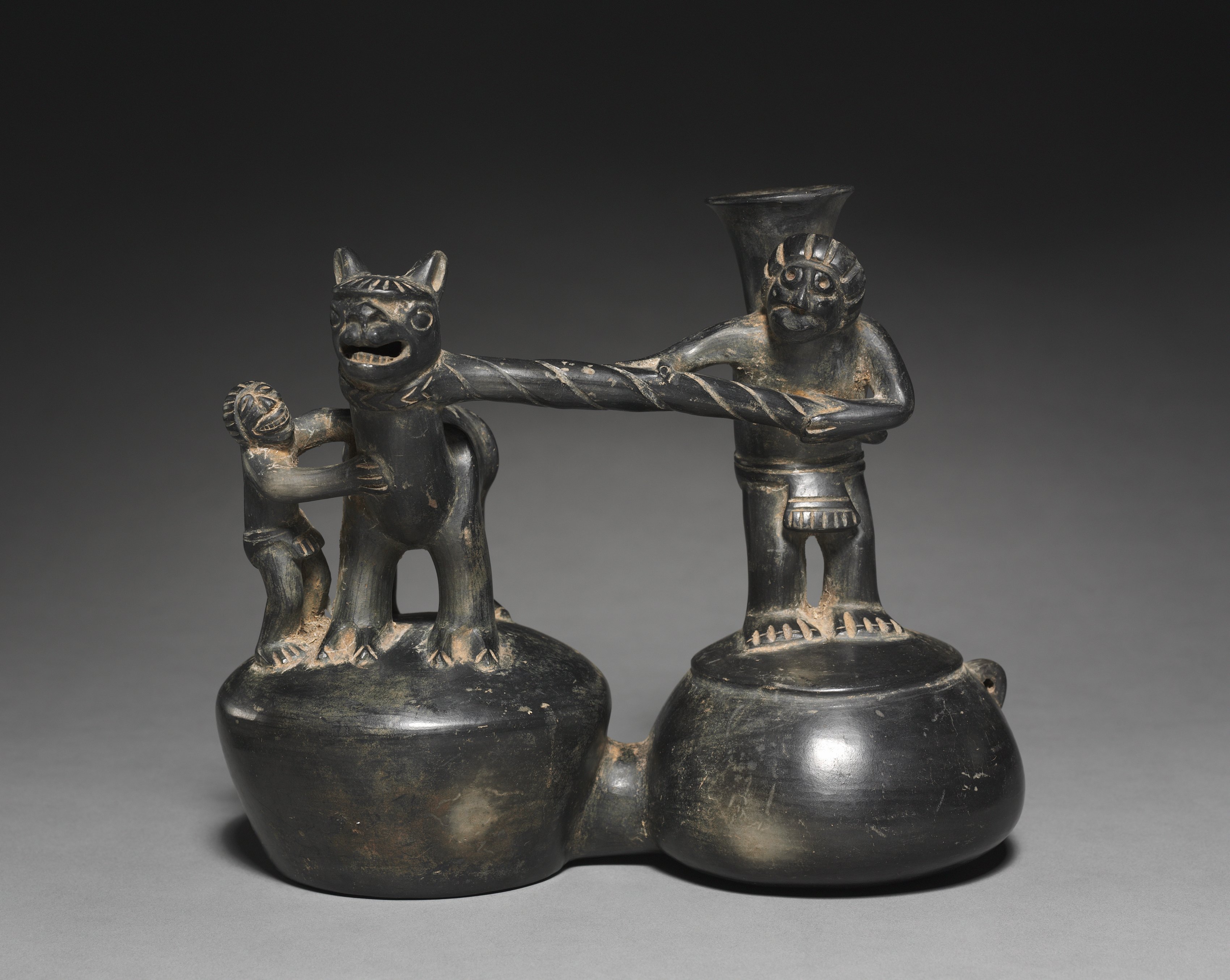
The material record shows the meeting of the two traditions. North-coast potters began to make vessels in Inca shapes, the flared-necked jars called aryballoi and double-chambered whistling vessels, in the burnished blackware that Chimú workshops had produced for centuries. The style, called Chimú-Inka, is itself a document of the conquest: the conquered craftsmen working to the conqueror's forms in their own technique.
What changed and what was replaced
Rowe's verdict on the Incas' encounter with Chimor became the starting point for every later argument: "The kingdom of Chimor was superior in organization and culture to anything the Incas had ever seen at the time they conquered it, and they learned eagerly from their new subjects" 8. The linguist Rodolfo Cerrón-Palomino, writing in Spanish in 1989, put the same claim even more strongly: Chimú civilisation "turned out to be one of the highest of all those subjugated by the Incas in their expansion. From it they learned the refinements proper to a highly elaborated culture, manifest above all in its hydraulic technology" 4. What exactly the Incas learned is harder to show.
What the Incas may have learned
Rowe was careful about his own claim. "We know too little about the constitution of Chimor to be sure just what administrative principles the Incas borrowed," he wrote, "but one of them was probably the system of governing through a hereditary local nobility" 8. He suggested that Topa Inca, organising the empire after the northern conquests, "must have had the experience of Taycanamo's descendants as his principal model" 8. His list of probable borrowings is short:
- Indirect rule through hereditary local lords, the system the Spanish later called the curacazgo, which Chimor had used to govern its conquered valleys 8.
- The rectangular town plan, with walled compounds on a grid, which Rowe saw in later Inca administrative centres 8.
- Mass production methods for textiles, pottery and metal, organised in state workshops 811.
- Certain metalworking techniques, carried by the smiths resettled in Cuzco 824.
- Hydraulic engineering on the scale of whole valley systems, in Cerrón-Palomino's reading 4.
None of these borrowings can be proven from a single document. Rowe himself noted "the scantiness of Inca style buildings or artifacts on the north coast", which in 1948 seemed to suggest that the Incas left the coast largely as they found it 8. The historian Susan Ramírez, approaching the conquest from the colonial lawsuits, has argued that the Inca impact on north-coast society was shallower and briefer than the chronicles imply 28.
The split-inheritance argument
Conrad's thesis tied the two states together more tightly than Rowe's. The Inca kings, like the Chimú kings, were mummified after death and their estates passed not to the new ruler but to the panaca, the descent group that maintained the dead king's cult and lived off his lands. A new Inca therefore had to acquire his own estates, as a new Chimú king had to build a new ciudadela. Conrad proposed that the Incas had learned the institution from Chimor, or shared it with Chimor, and that in both states it drove conquest and generated "administrative and economic stresses eventually leading to imperial collapse" 12.
The thesis has had a long afterlife in textbooks and a hard reception from specialists. Paulsen's attack was on its chronology and its handling of the archaeological sequence 13. Few scholars now treat split inheritance as the single engine of either empire, but the parallel it identified, between royal compounds that became tombs and royal estates held by the dead, remains one of the strongest arguments for a shared ideology of kingship on the coast and in the highlands. Whether the Incas borrowed it from Chimor, or both inherited it from an older Andean idea of the ruler who does not die, the evidence cannot settle.
Farfán and Chiquitoy Viejo: the Inca on the coast
Archaeology since Rowe has filled the gap he noticed. At Farfán, Mackey found that "when the Inkas conquered the Jequetepeque valley during the 1470s, they occupied Farfán, a centre that had functioned for several centuries under Chimú rule" 17. They did not leave it as they found it. Mackey documents new ranks of officials, new storage, new production and a burial structure for women weavers of the kind the Incas called aclla. Her comparison of storage captures the difference between the two systems: "the Chimú government designated limited spaces for storage far from its capital, whereas the Inkas distributed the stored goods" 17. Under Chimor the provinces sent their wealth to Chan Chan; under the Incas it was kept and redistributed where it was produced. Farfán, a lightly staffed administrative outpost under Chimú rule, became under Inca rule something closer to a town.
In the Chicama valley, Conrad excavated Chiquitoy Viejo, an Inca administrative centre built to supervise exchange and inspect shipments of high-status goods and tribute 29. Together, Farfán and Chiquitoy Viejo show that the Incas did more than leave Chimú lords in place: they rebuilt the provincial system around their own logic of storage and redistribution, while using its buildings, its lords and its craftsmen.
Water, lords and the managed coast
The canals did not change hands in a single moment. Patricia Netherly's study of late pre-Hispanic irrigation on the north coast argued that the canals were managed not by a central bureaucracy but through the hierarchy of local lords who commanded the labour of each section of the system 30. That hierarchy was exactly what the Incas preserved when they kept Chimú lords in office. The Inca state drew tribute and labour from the coast through the same men who had organised its water for Chan Chan. In that sense the most important transmission ran in both directions at once: the Incas took Chimor's goldsmiths and treasure to Cuzco, and in exchange left in place the system of lords who made the coast productive, now answering to Cajamarca.
What was displaced
The conquest replaced a coastal state with a set of provinces, and the losses were specific:
- The sovereignty of the Chimú dynasty. Minchançaman ended his life as a hostage in Cuzco, and his heirs ruled as clients answerable to an Inca governor 8.
- The unity of the kingdom. The heirs of the old dynasty were set up as hereditary lords of single towns and valleys, until Chimor was "only a memory" 8.
- Chan Chan as a royal capital. No new ciudadela was built after the conquest, and the city ceased to be the seat of a living king 1.
- Royal control of craft. The skilled metalworkers who had worked for Chimú kings were moved to Cuzco and the provincial capitals to work for the Inca state 24.
- The flow of wealth to the coast. Tribute that had gone to Chan Chan went to Cajamarca and Cuzco, and the treasure of the royal storerooms went to gild the Coricancha 248.
What the cost was
The bill for this transmission comes in two parts. The first is the cost of the Inca conquest itself: a war, a plundered treasury, a broken dynasty and the forced movement of craftsmen and colonists. The second arrived seventy years later, when the gold the Incas had carried to Cuzco was melted down by Spaniards and the royal tombs the Incas had left alone were dug out for treasure. The second part is not the Incas' doing, but it is the end of the same chain: the conquest gathered Chimor's wealth into a form that made it easy to seize.
The cost of the conquest
The sources name no casualties. Rowe's "bitter but unavailing resistance" and Cieza's report of a battle the Inca nearly lost describe a real war, fought along the Moche valley and down the coast, but no chronicler counted its dead 824. The same silence covers the deportations. Cieza says "many" metalworkers were taken to Cuzco and the provincial capitals; Carrera's grammar lists the Muchik colonies planted in the highlands; Rowe states plainly that "we have no information" on numbers 248. Figures in the thousands that circulate on popular sites have no traceable source and are not repeated here.
What can be stated is the nature of the cost. A royal family lost its throne, and its head lived out his life as a hostage. Craftsmen were taken from their workshops and resettled hundreds of kilometres away to serve a foreign god's temple. Farming communities were uprooted from irrigated coastal valleys and planted in highland villages where their language was foreign. The treasury of a state was carried off as plunder. These are the ordinary costs of Inca conquest, imposed on Chimor at the scale of the empire's largest prize.
The gold that went to Cuzco, and on to Cajamarca
The plunder of Chimor ended up in the fire. In 1532 the Inca ruler Atahualpa was captured by Francisco Pizarro's men at Cajamarca, the same town whose fall had opened the road to Chimor seventy years before. The ransom he paid, gathered from across the empire and supplemented by the stripping of the Coricancha, was assayed and melted down from mid-May 1533. James Lockhart, who reconstructed the careers of the men who shared it, found that "the total gold and silver, spoils and ransom together, turned out to be worth over 1.5 million pesos", and that all but the royal fifth went to the more than 160 men of Cajamarca 31.
How much of that metal was Chimú work cannot be known. Rowe asked the question himself: of the gold the Spanish took from Cuzco in 1533, how much "had been brought from Chimor seventy years before" 8? He did not answer it, and no one can. What is certain is that the craft the Incas prized enough to deport its makers was destroyed for its bullion. Of the gold band on the Coricancha wall, nothing survives.
Digging up the dead kings
The royal tombs at Chan Chan were looted next. The Spanish founded Trujillo beside the ruins in the 1530s, and its settlers formed treasure-hunting partnerships, the compañías de huaca, to mine the burial platforms and the great mounds of the valley 32. The colonial courts recorded the result. In August 1558 Don Antonio Chayguaca, the cacique of Chimo, sued two Spaniards who had claimed the mound called Yomayoguán near Chan Chan, arguing that it was "the burial place of his father, grandfather and ancestors" 33. The find later helped secure his lineage's hold on its chieftainship, and he used part of it to endow a fund for his people.
The largest recorded haul came from a mound later called Huaca Toledo. According to Miguel Feijóo de Sosa's description of Trujillo, published in 1763 from the treasury books, the royal accounts recorded that in 1576 Garci Gutiérrez de Toledo paid the Crown, as its fifth "for the extraction of the Peje pequeño from the huaca of the Gran Chimu, fifty-eight thousand five hundred and twenty-seven castellanos of gold", and some years later a further twenty-seven thousand and twenty 34. The fifth was a fifth: the gross extraction was several times larger. The figures come to us at second hand, through Feijóo and Ricardo Palma's retelling, not from the original register; but the treasury entries are the best evidence that the tombs of Chimor's kings held gold on a scale the Incas had chosen not to touch 34.
| Year | Event | Source |
|---|---|---|
| 1462–1470 | Inca conquest; Chimor's treasury carried to Cuzco, "the richest ever brought" there | Cabello Valboa via Rowe 8 |
| 1533 | Atahualpa's ransom melted at Cajamarca: over 1.5 million pesos in gold and silver | Lockhart 31 |
| 1548 | Cieza finds "much gold and silver" taken from the tombs of the principal men, and few Indians left in the valley | Cieza 27 |
| 1558 | Lawsuit over the mound of Yomayoguán, burial place of the lords of Chimo | Glave 33 |
| 1576 | Royal fifth of 58,527 castellanos of gold paid on the Peje pequeño of Huaca Toledo | Feijóo de Sosa 34 |
The emptying of the coast
The people paid most. Cieza, in the valley in 1548, wrote that "in the tombs of the principal men much gold and silver have been found. But at present there are few Indians in the valley, most of the land being divided amongst Spaniards who are citizens of the new city of Truxillo" 27. Linda Newson, summarising the demographic research, gives Noble David Cook's estimate for Peru as a whole: a fall "from about 9 million to 600,000 in 1620" 35. On the coast it was worse. Citing C. T. Smith, Newson reports that while the central highlands lost population by a ratio of about 3.4 to 1 by 1571, the adjacent coastal areas fell by "a staggering 58:1", and the irrigation systems on which coastal life depended "fell into disrepair as population decline undermined the bureaucratic structures and labour supply" 35.
Rowe recorded what came after on the north coast: the floods and locusts of 1578, and encomenderos "levying the tribute of the dead on the survivors" 8. He also recorded, fairly, what had come before. Inca rule had "brought over fifty years of peace and material well-being which were poor preparation for the shock" of the civil war, the Spanish conquest "and the twenty years of looting and revolution which followed it" 8. The Inca conquest was costly, but it was not the catastrophe. The catastrophe came later, and fell on a coast whose kingdom the Incas had already taken apart.
The bill
- A war of conquest, c. 1462–1470, fought down the Moche valley and along the coast against Minchançaman's "bitter but unavailing resistance"; no source counts its dead 824.
- A dynasty broken. Minchançaman held hostage in Cuzco for the rest of his life; his heirs reduced to clients and then to lords of single valleys until the kingdom was "only a memory" 8.
- Craftsmen deported. Metalworkers taken "to Cuzco and to the chief towns of the provinces" to work gold and silver for the Inca state, and Muchik-speaking communities resettled in the Cajamarca highlands, in numbers no source records 248.
- A treasury plundered, "the richest ever brought to Cuzco", turned into the gold of the Coricancha, and in 1533 melted down with Atahualpa's ransom 831.
- The royal tombs looted by Spanish treasure companies from the 1550s, with a royal fifth of 58,527 castellanos of gold paid on a single find in 1576 3334.
- A coast emptied, its population falling by as much as 58 to 1 in the first half-century of Spanish rule, and its canals failing with it 35.
What followed
-
900Building begins at Chan Chan, at the mouth of the Moche valley; over the next five centuries its kings raise the walled royal compounds archaeologists call ciudadelas.
-
1200Chimor takes the Jequetepeque valley and builds Farfán, a provincial centre modelled on the compounds of Chan Chan.
-
1375Chimú armies conquer the Sicán people of Lambayeque, bringing the metalworking tradition of Batán Grande and Túcume under Chan Chan.
-
1450At Huanchaquito–Las Llamas, less than a kilometre from Chan Chan, the Chimú state kills 137 children, three adults and 200 llamas in a single sacrifice after catastrophic floods.
-
1461Capac Yupanqui takes Cajamarca after its king calls on Chimor for help; a Chimú detachment fights on the losing side.
-
1470An Inca army descends the Moche river; King Minchançaman resists and is defeated, and is carried off to Cuzco as a hostage.
-
1470Chimú plunder, the richest ever brought to Cuzco, is made into statues and a great band of gold for the wall of the Coricancha.
-
1470North-coast metalworkers are resettled in Cuzco and the provincial capitals to work gold and silver for the Inca state.
-
1470Muchik-speaking communities are planted as colonists in the Cajamarca highlands, at Niepos, San Miguel, Huambos and other villages.
-
1475The Incas occupy Farfán and reorganise it with new officials, new storage and a compound for women weavers.
-
1533Atahualpa’s ransom, over 1.5 million pesos in gold and silver, is melted down at Cajamarca.
-
1548Cieza de León finds the Chimo valley held by Spaniards of the new city of Trujillo, with few Indians left in it.
-
1558Don Antonio Chayguaca, cacique of Chimo, sues two Spaniards over the mound of Yomayoguán, the burial place of his ancestors.
-
1576A royal fifth of 58,527 castellanos of gold is paid on treasure dug from the Huaca Toledo near Chan Chan.
-
1986Chan Chan is inscribed as a World Heritage Site and placed on the List of World Heritage in Danger in the same year.
Where this lives today
References
- Kolata, Alan L. "Chronology and Settlement Growth at Chan Chan." In Chan Chan: Andean Desert City, edited by Michael E. Moseley and Kent C. Day, 67–85. Albuquerque: University of New Mexico Press, 1982. en
- Day, Kent C. "Ciudadelas: Their Form and Function." In Chan Chan: Andean Desert City, edited by Michael E. Moseley and Kent C. Day, 55–66. Albuquerque: University of New Mexico Press, 1982. en
- UNESCO World Heritage Centre. "Chan Chan Archaeological Zone." World Heritage List, no. 366 (inscribed 1986; List of World Heritage in Danger from 1986). en
- Cerrón-Palomino, Rodolfo. "Quechua y mochica: lenguas en contacto." Lexis (Pontificia Universidad Católica del Perú) 13, no. 1 (1989): 47–68. es
- Ortloff, Charles R. "Surveying and Hydraulic Engineering of the Pre-Columbian Chimú State: AD 900–1450." Cambridge Archaeological Journal 5, no. 1 (1995): 55–74. en
- Moseley, Michael E., and Kent C. Day, eds. Chan Chan: Andean Desert City. School of American Research Advanced Seminar Series. Albuquerque: University of New Mexico Press, 1982. en
- Anonymous. Historia anónima de Trujillo [1604]. Published in Rubén Vargas Ugarte, "La fecha de la fundación de Trujillo." Revista Histórica (Lima) 10, no. 2 (1936): 229–239. es primary
- Rowe, John Howland. "The Kingdom of Chimor." Acta Americana 6, nos. 1–2 (1948): 26–59. en
- Conrad, Geoffrey W. "The Burial Platforms of Chan Chan: Some Social and Political Implications." In Chan Chan: Andean Desert City, edited by Michael E. Moseley and Kent C. Day. Albuquerque: University of New Mexico Press, 1982. en
- Archaeology (Archaeological Institute of America). "Burial Platform Excavated at Peru's Chan Chan." 10 September 2026. en
- Topic, John R. "Craft Production in the Kingdom of Chimor." In The Northern Dynasties: Kingship and Statecraft in Chimor, edited by Michael E. Moseley and Alana Cordy-Collins, 145–176. Washington, DC: Dumbarton Oaks, 1990. en
- Conrad, Geoffrey W. "Cultural Materialism, Split Inheritance, and the Expansion of Ancient Peruvian Empires." American Antiquity 46, no. 1 (1981): 3–26. en
- Paulsen, Allison C. "The Archaeology of the Absurd: Comments on 'Cultural Materialism, Split Inheritance, and the Expansion of Ancient Peruvian Empires'." American Antiquity 46, no. 1 (1981): 31–37. en
- Mackey, Carol J. "Chimu Administration in the Provinces." In The Origins and Development of the Andean State, edited by Jonathan Haas, Shelia Pozorski and Thomas Pozorski. Cambridge: Cambridge University Press, 1987. en
- Topic, Theresa Lange. "Territorial Expansion and the Kingdom of Chimor." In The Northern Dynasties: Kingship and Statecraft in Chimor, edited by Michael E. Moseley and Alana Cordy-Collins, 177–194. Washington, DC: Dumbarton Oaks, 1990. en
- Shimada, Izumi. "Sicán." In Encyclopedia of Latin American History and Culture. Via Encyclopedia.com. en
- Mackey, Carol. "La transformación socioeconómica de Farfán bajo el gobierno inka." Translated by Rafael Segura. Boletín de Arqueología PUCP 7 (2003): 321–353. es
- Ortloff, Charles R., Michael E. Moseley, and Robert A. Feldman. "Hydraulic Engineering Aspects of the Chimu Chicama–Moche Intervalley Canal." American Antiquity 47 (1982): 572–595. en
- Farrington, Ian S. "The Design and Function of the Intervalley Canal: Comments on a Paper by Ortloff, Moseley, and Feldman." American Antiquity 48, no. 2 (1983): 360–375. en
- Lechtman, Heather. "Pre-Columbian Surface Metallurgy." Scientific American 250, no. 6 (1984): 56–63. en
- Prieto, Gabriel, John W. Verano, Nicolas Goepfert, Douglas Kennett, Jeffrey Quilter, Steven LeBlanc, Lars Fehren-Schmitz, et al. "A Mass Sacrifice of Children and Camelids at the Huanchaquito-Las Llamas Site, Moche Valley, Peru." PLOS ONE 14, no. 3 (2019): e0211691. en
- Andina (Agencia Peruana de Noticias). "Peru: Up to Three Child Sacrifice Ceremonies Reported in Pampa La Cruz." en
- Netherly, Patricia J. "El reino de Chimor y el Tawantinsuyu." In La frontera del estado inca, edited by Tom D. Dillehay and Patricia J. Netherly, 85–105. BAR International Series 442. Oxford: British Archaeological Reports, 1988. es
- Cieza de León, Pedro de. Segunda parte de la Crónica del Perú, que trata del señorío de los Incas Yupanquis [c. 1550], ch. LVIII. Edited by Marcos Jiménez de la Espada. Madrid, 1880. es primary
- Cobo, Bernabé. Historia del Nuevo Mundo [1653], Book XII, ch. 13. Edited by Marcos Jiménez de la Espada. Vol. 3, 163–164. Seville: Sociedad de Bibliófilos Andaluces, 1892. es primary
- Rostworowski de Diez Canseco, María. "Ethnohistorical Considerations about the Chimor." In The Northern Dynasties: Kingship and Statecraft in Chimor, edited by Michael E. Moseley and Alana Cordy-Collins, 447–460. Washington, DC: Dumbarton Oaks, 1990. en
- Cieza de León, Pedro de. The Travels of Pedro de Cieza de León, A.D. 1532–50, Contained in the First Part of His Chronicle of Peru [1553], ch. LXVIII. Translated by Clements R. Markham. London: Hakluyt Society, 1864. en primary
- Ramírez, Susan E. "The Inca Conquest of the North Coast: A Historian's View." In The Northern Dynasties: Kingship and Statecraft in Chimor, edited by Michael E. Moseley and Alana Cordy-Collins, 507–537. Washington, DC: Dumbarton Oaks, 1990. en
- Conrad, Geoffrey W. "Chiquitoy Viejo: An Inca Administrative Center in the Chicama Valley, Peru." Journal of Field Archaeology 4, no. 1 (1977): 1–17. en
- Netherly, Patricia J. "The Management of Late Andean Irrigation Systems on the North Coast of Peru." American Antiquity 49, no. 2 (1984): 227ff. en
- Lockhart, James. The Men of Cajamarca: A Social and Biographical Study of the First Conquerors of Peru. Austin: University of Texas Press, 1972. en
- Delibes Mateos, Rocío. "'Y hecha compañía determinaron de cavar a la ventura…': la formación de compañías de huaca en Trujillo del Perú (s. XVI)." Americanía: Revista de Estudios Latinoamericanos 1 (2015): 6–58. es
- Glave, Luis Miguel. "Fray Alonso Granero de Ávalos y los naturales andinos." Cuadernos Interculturales 5, no. 8 (2007): 15–50. es
- Feijóo de Sosa, Miguel. Relación descriptiva de la ciudad y provincia de Trujillo del Perú. Madrid, 1763. Quoted in Ricardo Palma, "El Peje chico," Tradiciones peruanas. es primary
- Newson, Linda A. "The Demographic Collapse of Native Peoples of the Americas, 1492–1650." Proceedings of the British Academy 81 (1993): 247–288. en