Christianity became a Greek religion (~50 CE) — and the cost ran both ways
Around 50 CE in Jerusalem, a small council of Aramaic-speaking Jewish leaders agreed that gentile converts to the Jesus movement would not have to be circumcised. Within three centuries the decision had translated a regional messianic sect into the empire's official religion — and within another century the religion that had been persecuted was persecuting in turn.
Around 50 CE in Jerusalem, a small council of Aramaic-speaking Jewish followers of Jesus decided that gentile converts would not have to be circumcised. The Pauline mission then carried the movement, in Greek, across the urban networks of the eastern Roman Empire. Within three centuries the obscure Galilean sect had become the empire's official religion; within another century it was demolishing the temples it had once been killed in front of. The bill, paid by Christians under Nero and Diocletian and then by pagans under Theodosius and Justinian, ran into the tens of thousands of named dead and into civilisations forgotten.

A pagan world without exclusive religion
When the Pauline mission began to move the Jesus movement out of Roman Judaea in the late 40s CE, the eastern Mediterranean was not a religious vacuum. It was one of the most densely religious environments in antiquity. The cities of the empire — from Antioch on the Orontes, perhaps half a million inhabitants, to provincial centres like Philippi and Thessalonica — were saturated with cult. Temples stood at every civic intersection. Statues of the gods crowded the agorai. Festivals punctuated the year; sacrifices punctuated the day; oaths invoked deities at every contract. In the markets, the meat had usually passed across a temple altar before reaching the butcher's slab. In the household, the lares and penates of Roman tradition, or their Greek equivalents, occupied a small shrine in the courtyard and were fed daily by the head of the household. The civic calendar was a religious calendar; the magistrate was a part-time priest; the soldier swore by the genius of the emperor; the merchant poured a libation before opening his stall.1
What this religiosity did not include — and the absence is essential to understanding what Christianity changed — was exclusivity. A literate first-century Greek-speaking inhabitant of Ephesus could and routinely did honour the goddess Artemis in her great temple, the deified Augustus in the precinct dedicated to him, Isis in the Egyptian quarter, and a household god at home, without sensing contradiction. There was no theological language in which one was meant to choose between gods; one chose among them as one chose among friends and civic obligations. The Latin word religio meant something close to "scrupulous observance of correct ritual." It was not a private system of belief but a public system of practice. A Roman magistrate who failed to perform the proper sacrifice for the city's harvest was guilty of a civic offence; what he privately thought about the gods was beside the point.2
Civic cults and the contract with the gods
The mainstream public religion of the Greco-Roman city was civic and transactional. The community owed the gods certain rites — sacrifices, festivals, processions, vows fulfilled — and in return the gods owed the community certain favours: rain, victory in battle, fertility, deliverance from plague. The transaction was reciprocal and the formula explicit: do ut des, "I give so that you may give." Robin Lane Fox's Pagans and Christians documents the texture of this religious infrastructure at the level of the polis: which civic offices carried priestly duty, which festivals brought the whole population into the streets, which oracles were consulted before campaign, which gods were paired with which months on the local calendar.3 The system was thick, traditional, and locally varied; what made it cohere across the empire was less doctrinal agreement than a shared assumption that the gods existed, took an interest in human affairs, and required the maintenance of correct ritual relations.
The imperial cult, which spread through the eastern provinces from the time of Augustus, was an extension of this transactional logic. The emperor's genius — his divine essence, in the same sense any Roman paterfamilias was thought to have a genius — was honoured in temples and altars across the eastern Mediterranean from the late first century BCE onward. By the time the Pauline mission was active, no city of any size in the Greek-speaking east was without an imperial-cult precinct. Refusing to participate in this cult was not a private religious choice. It was a refusal of civic membership. The Christian movement's later difficulty with the imperial authorities would arise less from theological disagreement with Roman polytheism in the abstract than from the political consequences of withdrawing from these civic acts.4
The mystery religions and the philosophical schools
Around and beneath the civic cults, the eastern empire hosted a rich variety of voluntary religious associations that promised something more personal: initiation into mysteries, knowledge of cosmic secrets, the prospect of a beneficent afterlife. The cult of Isis, spreading from Egypt through the Hellenistic and Roman world, offered initiates a personal relationship with a saviour goddess. The cult of Mithras, attested from the late first century CE and concentrated in army camps and along merchant networks, offered men a graded brotherhood of initiation in underground sanctuaries. The Eleusinian Mysteries, ancient and prestigious, drew prosperous Athenian-connected initiates from across the Greek world. None of these movements demanded that the initiate abandon the civic cults; one could be initiated at Eleusis and still sacrifice to the city's patron deity the following week. They functioned as supplements, not substitutes.
Alongside the mysteries ran the philosophical schools — Stoicism, Platonism, Epicureanism, Cynicism — which functioned in the Hellenistic and early imperial world as something between intellectual movements and ways of life. Stoicism's ethical seriousness shaped the conduct of the educated Roman elite from Cicero to Marcus Aurelius. Platonism, in the form it would assume under Plotinus in the third century CE and his successors, would become the dominant late-antique philosophical framework and would eventually be absorbed into Christian thinking. A philosophical school was not a religion in any modern sense, but it provided what the civic cults did not: an internal ethic, a doctrine, a practice of self-formation. The educated members of the elite read the Stoic philosophers as serious moral teachers; the same readers could, without any sense of contradiction, participate in the civic cults and entertain themselves at the local Eleusinian or Isiac celebration.
Hellenistic Jews and the Greek-speaking diaspora
The Jewish communities of the eastern Mediterranean — the immediate environment in which the Christian movement first travelled — were themselves already substantially Hellenized. The Jewish diaspora in the first century CE included perhaps four to five million people, with the largest community at Alexandria and substantial settlements at Antioch, Damascus, Sardis, Ephesus, Rome itself, and across Asia Minor.5 These communities spoke Greek, read the Hebrew scriptures in Greek translation — the Septuagint, completed in stages from the third century BCE onward at Alexandria — and in many cities had attracted around themselves a penumbra of theosebeis, "God-fearers": Greek-speaking gentiles who attended synagogue services, observed the Sabbath and some food rules, and venerated the Jewish God without undergoing the full conversion that would have required circumcision. The God-fearer category is critical to understanding what Christianity, in its Pauline form, would shortly offer.6
The philosopher Philo of Alexandria, writing in the first half of the first century CE, is the clearest witness to how far Hellenistic Judaism had travelled. Philo wrote in elegant Greek prose; he interpreted the Hebrew scriptures through allegorical methods borrowed from Hellenistic philological practice; he absorbed Platonic and Stoic vocabulary into his account of divine reality; and in his treatment of the Logos — the divine Word as cosmic intermediary between transcendent God and material creation — he prepared a theological vocabulary that Christian writers would adopt within decades. Philo's Logos was not yet Christ. It was, however, the philosophical equipment that made it possible to say in Greek, two generations later, that the Word became flesh and dwelt among us.
This is the religious world the Christian movement entered when it began to move out of Aramaic-speaking Galilee and Judaea. It was crowded, learned, multilingual, transactional, and tolerant in its way — tolerant in the sense that it accepted any new cult that did not threaten the civic order. The Christians, when they came, would test that tolerance to its breaking point. Within four centuries they would replace the religious world they entered with a categorically different one.
The Pauline transmission
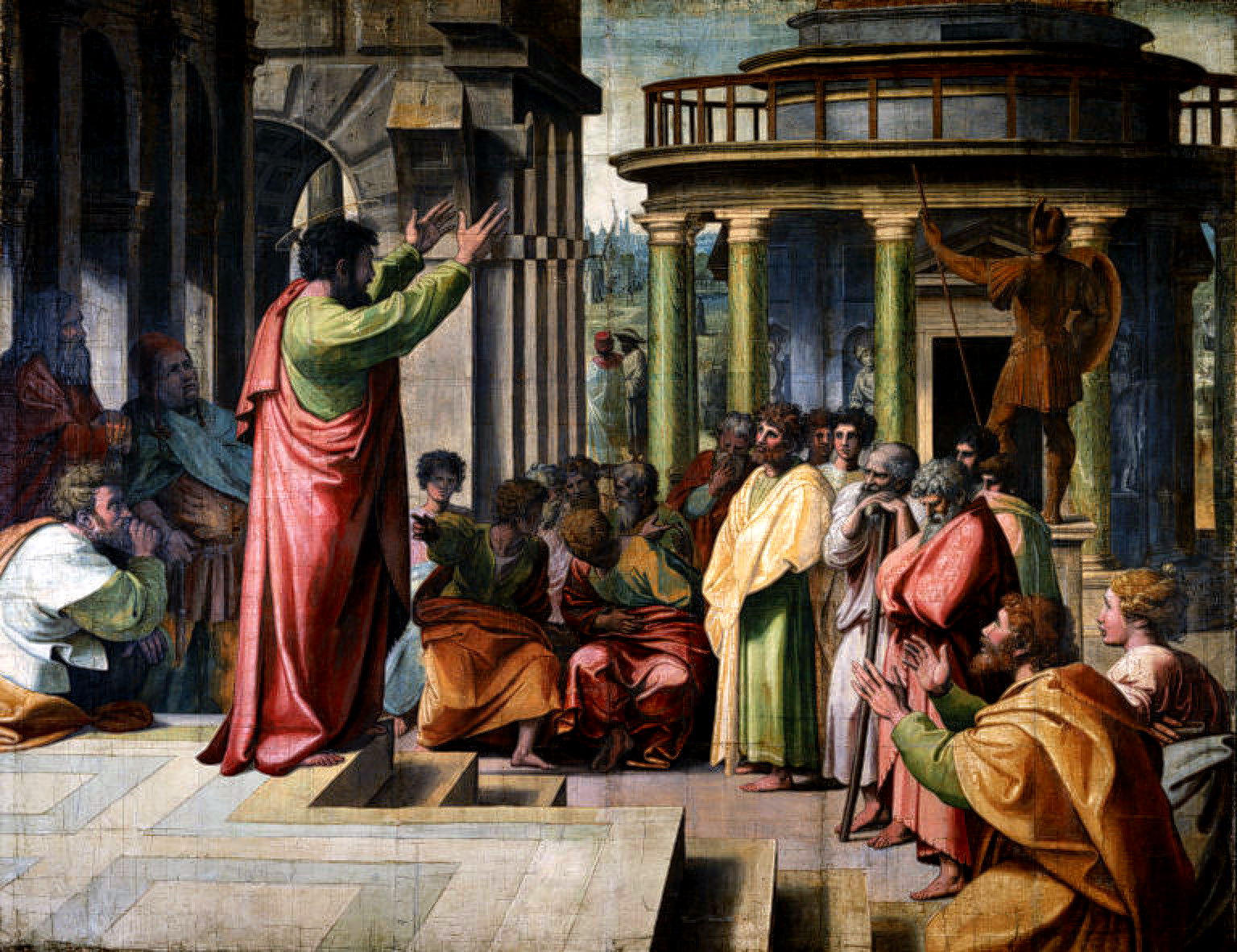
The transmission has a date, a city, and a set of named participants. Around 49 or 50 CE — Paul, the Christian movement's most important early missionary, gives a partial account in his Letter to the Galatians and Luke gives a different account in Acts 15 — a small council of leaders of the Jesus movement met at Jerusalem to decide whether gentile converts to the movement would have to be circumcised and follow the Jewish food laws as a condition of membership. Paul, who had been working a mission to gentiles in the Greek-speaking cities of Asia Minor, argued no. James the brother of Jesus, the head of the Jerusalem community, argued for a compromise. Peter wavered. The compromise carried, in the version Acts preserves: gentile converts would be asked to abstain from food sacrificed to idols, from blood, from things strangled, and from sexual immorality — but not to be circumcised, not to follow the full Mosaic law.7
The decision is conventionally called the Jerusalem Council. It is also the moment Christianity became something it had not been: a religion that could be entered by gentiles without first becoming Jewish. The two accounts (Acts 15; Galatians 2.1–10) differ in their emphases and their politics — Galatians, written by Paul shortly after the event, reads as a defence of his own gentile mission against subsequent attempts to walk back the decision — but on the basic outcome they agree. Without that decision, the movement would have remained a sect within Judaism, comparable in scale to the Essenes or the followers of John the Baptist, almost certainly extinguished by the destruction of Jerusalem in 70 CE.8
Why Paul, and why Greek
Paul of Tarsus, the apostle the Greek-speaking churches would call Paulos, was perfectly positioned to be the bridge. Born into a diaspora Jewish family in Tarsus in Cilicia, a Hellenistic city on the southern coast of Asia Minor, he was Greek-speaking from childhood and educated in the rhetorical and philosophical idioms of his urban environment. He had also received a serious Jewish education — by his own account in Pharisaic tradition — and was fluent in the categories of Second Temple Judaism. He could, and did, switch registers: in his letters he quotes the Septuagint in Greek, argues in Greek philosophical idiom, addresses urban Greek-speaking congregations, and uses the Greek civic vocabulary of ekklēsia (citizen assembly) for the local Christian community. Paula Fredriksen's Paul: The Pagans' Apostle makes the case that Paul never thought of himself as anything other than a Jew — but he was a Greek-speaking Jew of the diaspora, and he addressed his mission to Greek-speaking gentiles within a Jewish diasporic framework whose linguistic and conceptual equipment was already half-Hellenized.9
The geography of the Pauline mission tracks the urban network of the Greek-speaking eastern empire. Antioch — where, Acts reports, "the disciples were first called Christians" — was the staging base. Paul's documented journeys took him to Cyprus, southern and central Anatolia, Macedonia (Philippi, Thessalonica, Beroea), Achaia (Athens, Corinth), the Aegean coast of Asia Minor (Ephesus). His letters were addressed to congregations at Corinth, Rome, Philippi, Thessalonica, Galatia, and Colossae. Wayne Meeks's The First Urban Christians established what has become the consensus picture: the Pauline mission was a phenomenon of the eastern empire's cities, conducted in Greek, organised around households of moderate prosperity, drawing its earliest converts from God-fearers already attached to the synagogue and from artisans and traders in the urban network.10
The conditions that let it spread
Four conditions made the transmission viable. The first was the Septuagint: the Hebrew scriptures had already been available in Greek translation for two centuries, which meant that the new movement's scriptural argument — that Jesus was the promised Messiah of the Jewish prophets — could be carried out in Greek without any further linguistic work. The second was the diaspora synagogue network, which gave the Pauline mission a ready set of urban institutions to address. Acts records Paul's standard practice of beginning in the local synagogue and recruiting both Jews and God-fearers; the synagogue infrastructure was the trellis on which the early Christian network grew.11 The third was the imperial road and shipping system, which made travel between Antioch, Ephesus, Corinth, and Rome a matter of weeks rather than months. The fourth was the Greek philosophical vocabulary already developed by Hellenistic Jews like Philo, which gave the new movement the conceptual equipment to articulate its claims in a register the educated Greek-speaking gentile would recognise as serious.
What the movement offered, within this scaffolding, was something the existing religious environment did not offer: a single, exclusive, universal God who demanded inner conformity rather than civic ritual, who promised resurrection of the body and a final judgment, who admitted converts irrespective of social class or ethnic origin, who organised communities around mutual aid rather than transactional sacrifice, and who claimed the loyalty Roman civic religion had asked of the citizen but redirected it toward an invisible kingdom. Rodney Stark's sociological study estimates the movement's growth rate during the first three centuries at roughly forty percent per decade — comparable to the Mormon growth rate from 1830 onward — beginning from perhaps a thousand adherents around 40 CE and reaching five to six million by 300 CE, or roughly ten percent of the empire's population on the eve of Constantine.12 The rate is plausible because it does not require mass conversions; it requires a steady, sustained accumulation through household networks, marriages, and a low but consistent stream of new recruits over ten generations.
What the Empire saw, and how it reacted
From the perspective of the Roman authorities, the new movement was at first nearly invisible. It looked like a Jewish sect — Tacitus, writing in the early second century, still describes Christians as having originated in Judaea and as bearers of a exitiabilis superstitio, a "pernicious superstition" — and was treated through the legal framework that the empire had developed for Judaism: a permitted variant of religious practice with certain accommodations.13 As long as the movement appeared internally Jewish, it benefited from the religio licita status that Judaism had been granted. As the gentile component grew through the second century, and the movement became visibly something other than Judaism, that protection eroded.
The first formal Roman action against Christians as Christians is conventionally dated to Nero's response to the Great Fire of Rome in 64 CE. Tacitus's account, written about fifty years after the event, reports that Nero, looking for scapegoats for a fire that public opinion suspected he had set, fixed the blame on the Christian community of the city. Christians were rounded up; some were torn apart by dogs in the arena, some were crucified, some were dipped in pitch and burned as living torches to illuminate Nero's gardens.14 The scale was local — Tacitus does not give a number, but the scholarly consensus reads the affected community as in the low hundreds at most — but the precedent was set. The legal category nomen ipsum ("the name itself" — being a Christian) became a sufficient basis for prosecution. The 64 CE event was not the start of systematic persecution; it was the start of the empire's pattern of treating Christianity, when it noticed it at all, as a movement whose mere existence was potentially actionable.
What changed in the receiving culture, and what was replaced
The transmission was slow. The Christian movement was a marginal urban phenomenon through most of the second century, and even at the end of the third — on the eve of Diocletian's persecution and Constantine's eventual conversion — it represented perhaps ten percent of the empire's population, heavily concentrated in eastern cities. What changed over the four centuries between the Jerusalem Council and the Edict of Thessalonica was not just the religious composition of the empire's population. It was the underlying category of religion itself, and what was displaced was a particular relationship between the political and the cultic.15
From civic ritual to interior conscience
The deepest change Christianity worked on the Greco-Roman world was a redefinition of what religion was for. Pagan civic religion had been transactional, public, and external: the citizen performed certain rites, the community honoured certain festivals, and the gods, properly addressed, delivered the goods. Christianity proposed instead that religion was a matter of interior belief, individual conscience, and lifelong moral discipline — and that the consequence of getting it wrong was not a failed harvest but eternal damnation. The category of belief in something like its modern sense, in which a person's interior assent to a proposition matters more than their external conduct, owes more to the Christian centuries than to the centuries before. The question "What do you believe?" became, within the Christian framework, a serious religious question; in the pagan framework, it would have been close to a category error.
Peter Brown's Rise of Western Christendom traces how this interiorisation reshaped the religious institutions of the post-Constantinian empire. The bishop replaced the civic priest as the dominant religious office. The bishop's authority was not, as the priest's had been, an extension of civic office held by appointment of the magistrates; it was an ecclesiastical authority claimed through apostolic succession, exercised over a permanent congregation, and increasingly entangled with civil administration as the fourth century progressed. By the late fourth century, the bishop of a major eastern city — Ambrose at Milan, John Chrysostom at Antioch and later at Constantinople — wielded political influence that no civic priest had ever held.16 When Ambrose, in 390, refused communion to the emperor Theodosius until Theodosius did public penance for ordering a massacre at Thessalonica, the relation between religious and civil authority had been re-described.
Temples emptied, festivals decommissioned
The material consequences were visible across the empire. Through the late fourth and fifth centuries the empire's pagan temples were progressively closed, repurposed, or demolished. Some — like the Pantheon at Rome — became churches and were thereby preserved. Others — the Serapeum at Alexandria, the Temple of Artemis at Ephesus, dozens of provincial shrines — were demolished outright. The Codex Theodosianus, the imperial law collection compiled in 437/438 CE under Theodosius II, preserves the legal record of the imperial campaign against the cults: a series of edicts from the 380s and 390s prohibiting sacrifice, ordering the closure of temples, abolishing public funding for pagan festivals, criminalising private rites.17 By the time of Justinian's codification a century later, public pagan practice was illegal and pagans were a barely-tolerated minority subject to systematic legal disabilities.
The civic festivals that had structured the year were progressively decommissioned or rebadged. The Saturnalia became the season of Christmas. The Lupercalia became, by the late fifth century, a Christian festival of purification. The Olympic Games, founded in the eighth century BCE, were ended by Theodosius in 393 because the festival was inseparable from sacrifice to Olympian Zeus; the next Olympic Games would not be held until 1896. The pagan religious infrastructure of the empire — the temples, the priesthoods, the calendars, the festivals, the oracles — was systematically dismantled across roughly a century after the Edict of Thessalonica.
Greek philosophy folded in, then folded under
The transmission's relationship to Greek philosophy is more complex. The new movement's earliest articulate theologians — Justin Martyr in the mid-second century, Clement of Alexandria and Origen in the late second and early third — were trained in Greek philosophy and saw the new religion as the completion of what Greek philosophy had been reaching toward. Justin called Socrates a Christian before Christ. Clement read Plato as a preparatory teacher whose curriculum led naturally to Christ. Origen wrote a sustained engagement with the philosopher Celsus's attack on Christianity (Celsus's Alēthēs Logos, c. 178 CE) that mobilised the philosophical vocabulary of Platonism to defend the new faith. Through these centuries Greek philosophy was being folded into Christian theology: Logos doctrine from Philo and the Stoics, allegorical exegesis from Alexandrian Platonism, the ascetic disciplines of late Platonism, the cosmological vocabulary of middle Platonism. By the time of Augustine in the late fourth and early fifth century, Christian theology was substantially built out of Hellenistic philosophical materials.18
But as the empire became Christian, the independent existence of the philosophical schools became precarious. The Neoplatonic Academy at Athens — the institutional heir, at remove, of Plato's school — was closed by Justinian in 529, on the grounds that it was "propagating not philosophy but pagan religious ideas" and was attempting to maintain worship of the ancient gods. Its remaining scholars — Damascius, Simplicius, Priscian, Eulamius, Hermeias, Diogenes, Isidore — emigrated to the Sassanid Persian court under Khosrau I, taking their libraries with them; some returned several years later under terms negotiated in the Byzantine-Persian peace of 532, but the school itself did not reopen.19 The closing was not a singular act of cultural vandalism; it was the institutional culmination of a century in which independent pagan philosophical instruction had become increasingly difficult to sustain in a Christian empire. The philosophical heritage of antiquity survived in Christian transmission — Christian copyists preserved Aristotle, Plato, and the Neoplatonists for the Byzantine and later the Arab and Latin worlds — but the autonomous pagan school that had been a feature of Greek intellectual life for nine hundred years was over.
The slow severing from Judaism
The most subtle and longest-running displacement was the gradual separation of Christianity from the Judaism out of which it had grown. Daniel Boyarin's Border Lines argues that the two religions did not divide in any clean moment but were progressively partitioned over the first three to four centuries CE — and that the partition was as much an act of self-definition by emerging rabbinic Judaism (in the wake of the Temple's destruction in 70 CE and the failed Bar Kokhba revolt of 132–135 CE) as by emerging orthodox Christianity.20 In the first generations, the categories were fluid: there were Jews who followed Jesus, gentiles who followed Jesus while observing Jewish practice (the Judaizers Paul argued against in Galatians), gentiles who followed Jesus and did not, and a continuing range of Jewish positions independent of the Jesus movement. By the late second century, the heresiological literature on both sides was hardening the categories. By the late fourth century, with Christianity now the empire's favoured religion, the relationship had become hierarchical and frequently hostile: Christian theological literature developed an extensive Adversus Judaeos ("against the Jews") tradition; John Chrysostom's eight sermons against the Judaizers (Antioch, 386–387 CE) are an unusually venomous early specimen.
The practical consequences for Jewish communities in the empire would unfold over centuries. The Theodosian Code (438 CE) and the Justinianic Code (529 CE and later) progressively restricted Jewish civic life: Jews could not hold most public offices; they could not build new synagogues without imperial permission; they could not own Christian slaves; they could not testify against Christians in court. The institutional anti-Judaism of late-antique Christianity is the bridge between the relatively coexistent Jewish-Christian-pagan urban world of the first three centuries and the medieval European pattern of episodic anti-Jewish violence — the Crusader pogroms of 1096, the expulsions from England (1290), France (1394), and Spain (1492), the blood libel cases, the ghettos. None of this was determined by the transmission of 50 CE. But the conceptual equipment that made it possible — Christianity's claim to be Israel's true heir, the supersessionist reading of the Hebrew scriptures, the rhetorical positioning of the Jews as Christ-killers — was developed in the first four centuries of the religion's existence, and inherited by the medieval and early-modern Christian polities as part of the cultural patrimony.
What the cost was
The transmission's cost runs in two directions, separated by the watershed of the Edict of Milan in 313. Before 313, Christians were the persecuted minority, intermittently subjected to lethal Roman state violence under specific emperors and for specific reasons. After 313, and decisively after 380, Christians were the institutionally favoured majority, and the lethal state violence ran the other way — against pagans, against Jews, against heretics, and eventually, in the form of Christianising military campaigns at the empire's frontiers, against the peoples of pre-Christian Europe. The integrated honest account requires holding both halves of the ledger at once.
The pagan persecutions of Christians (64–311 CE)
The Roman persecutions of Christians were episodic, regionally uneven, and on the whole limited in scale. They were not the campaign of systematic empire-wide eradication that some Christian historiographies later imagined. Marie-Françoise Baslez's Les persécutions dans l'Antiquité documents how the persecutions concentrated in particular cities at particular moments under particular governors, and how the legal mechanism — Roman administrative law applied to a movement that refused civic rituals — was less an ideological war than a recurring administrative collision.21
The pattern: Nero at Rome in 64, perhaps a few hundred dead in the immediate aftermath of the fire. Sporadic local persecutions through the late first and second centuries — the martyrs of Lyon in 177 CE, perhaps forty-eight identified by name in Eusebius's account, killed during a wave of plague-era civic anxiety. Pliny the Younger as governor of Bithynia around 112 CE writing to Trajan for guidance on what to do with denounced Christians and being told to punish the obstinate but not to seek them out. The Decian persecution of 250–251 CE, the first empire-wide attempt: an edict requiring all inhabitants to sacrifice and obtain certificates of compliance, applied broadly but inconsistently, producing in the surviving record perhaps a few thousand named martyrs and a much larger number of lapsi — those who sacrificed under coercion and were later readmitted to communion through penance.22 The Valerian persecution of 257–258, narrower in scope, targeting clergy and the propertied classes. Then, after nearly forty years of peace, the Great Persecution under Diocletian and his colleagues, 303–311 CE: the most sustained and best-documented of the persecutions, with edicts requiring the destruction of churches, the burning of scriptures, the dismissal of Christian officeholders, and ultimately the execution of those who refused to sacrifice.
Modern scholarship — synthesising Eusebius's Ecclesiastical History, Lactantius's De Mortibus Persecutorum, the Acta Martyrum, and the archaeological and epigraphic record — estimates the documented executions during the Great Persecution at three to four thousand across the empire, concentrated heavily in the eastern provinces under Diocletian's eastern co-emperor Galerius and in Egypt under the prefect Sossianus Hierocles.23 The number is much lower than the medieval and early-modern Christian estimates, which sometimes ran to hundreds of thousands, but it is the cost framing the surviving documentary record will support. The persecutions were real, the martyrdoms were real, but the scale was thousands rather than millions, concentrated in particular years and places, and conducted within the bureaucratic Roman administrative tradition rather than as a generalised civilisational war.
The Christian persecutions after Theodosius (380 CE onward)
The ledger inverts after 313, decisively after 380. The Edict of Milan, jointly issued by Constantine and Licinius in 313, legalised Christianity and restored property confiscated during Diocletian's persecution. The Edict of Thessalonica, issued by Theodosius I in 380, went further: it made Nicene Christianity the empire's official religion and declared other Christian confessions and pagan cults legally suspect. Over the next half-century, the imperial state turned the machinery of administrative coercion that had been used against Christians against the cults it now displaced.24
The destruction of the Serapeum at Alexandria in 391 CE is the emblematic event. The Serapeum — a great temple complex on a hill above the city, holding a cult statue of Sarapis that was one of the most prestigious in the late-antique Mediterranean and a library that was a surviving remnant of the once-great Alexandrian collections — was destroyed by Christian crowds under the leadership of Patriarch Theophilus of Alexandria, with imperial military support. The provocation, as the sources report it, was Theophilus's deliberate desecration of cult objects from a smaller pagan temple, which he paraded through the streets in a calculated act of religious humiliation. The pagans of Alexandria fortified the Serapeum in response; Christians were killed in the initial street fighting; the Serapeum was then besieged and demolished under Theodosian decree.25 The library, if it survived the earlier sacks of Alexandria, did not survive 391.
Twenty-four years later, in March 415, the Alexandrian philosopher Hypatia — a Neoplatonist mathematician and teacher who held public lectures in the city, was respected by Christian and pagan students alike, and had become entangled in a political dispute between the city prefect Orestes and Patriarch Cyril — was attacked by a Christian crowd, dragged from her chariot, taken to the Caesarion church, and murdered with broken roof-tiles or oyster shells. Maria Dzielska's scholarly biography reconstructs the event from the surviving accounts (the Christian historian Socrates Scholasticus, the contemporary letters of Synesius of Cyrene who had been her student, and the later hostile account of John of Nikiu) and argues that Hypatia was killed not principally as a philosopher but as a political ally of Orestes against Cyril — but that the parabalani, the Christian para-ecclesiastical hospital workers who served Cyril's interests and conducted the actual killing, were able to do what they did because the climate of Cyril's rhetoric had made it permissible.26
The Athenian Academy — the institutional successor of Plato's school, by the sixth century the centre of late Neoplatonist teaching — was closed by Justinian in 529 CE. Its scholars emigrated to the Persian court of Khosrau I, the last serious institutional refuge for pagan philosophy in the eastern Mediterranean world. The closure was not lethal; the scholars survived and some returned under negotiated terms. But the institutional independence of pagan philosophical instruction in the Roman empire was over. The intellectual centre of gravity of Mediterranean religious culture was now Christian, and the institutional infrastructure that had supported a separate philosophical tradition — endowments, teaching positions, libraries, patronage networks — was being progressively redirected toward Christian theological formation.27
The cost paid in the conversion of northern Europe
The Christianisation of the empire was a four-century process conducted largely through legal and institutional pressure, with episodic violence against specific targets but without a sustained military-conversion campaign at scale. The Christianisation of northern Europe, however, which took place between the sixth and tenth centuries, was substantially conducted by the sword.
The Saxon Wars of Charlemagne, 772–804 CE, are the most thoroughly documented case. Charlemagne's Frankish kingdom, by the late eighth century the dominant power in western Europe, conducted a thirty-year intermittent campaign to subdue and Christianise the still-pagan Saxon peoples of north-central Germany. The Capitulary on the Saxons (Capitulatio de partibus Saxoniae), issued around 785 CE, prescribed death for any Saxon who refused baptism, who continued to practice pagan rites, who cremated the dead, or who attacked a Christian church. The Massacre of Verden in October 782 — the conventional Frankish annalist's figure is 4,500 Saxons beheaded in a single day at Verden on the Aller, following a Frankish defeat in the Süntel battle — is the most notorious single event of the campaign. Some modern scholarship has argued that the figure may be inflated, or that the Latin verb in the Royal Frankish Annals ("decollati") may have been an error for "deported." But the annalist's account is contemporary, the figure was repeated in later Frankish sources without challenge, and the broader pattern of Charlemagne's Saxon campaign — mass deportations, forced baptisms under threat of execution, the systematic destruction of Saxon sacred sites including the Irminsul in 772 — is well established in the contemporary record.28
The Verden massacre is one episode in a broader pattern. The Christianisation of the Frisians, the Old Saxons, the Pomeranians, the Wends, the Prussians, the Lithuanians, and ultimately the Baltic peoples between the eighth and the early fifteenth centuries was conducted by a mixture of missionary preaching and military coercion, with the balance varying by region and period. Charlemagne, Boniface, Otto I, Henry the Lion, the Teutonic Order — each carried a Christian mission and a sword. The cost of the transmission, by the time it had reached the Baltic in the fourteenth century, ran in some periods to mass casualty events whose victims are unrecorded.
The integrated cost
The cost-severity rating of 4 (high but not catastrophic) for this record is anchored to the documentary record. The Roman persecutions of Christians killed in the low thousands across two-and-a-half centuries; the Christian persecutions of pagans (Serapeum, Hypatia, lesser temple destructions and individual killings across the late fourth and fifth centuries) killed in the low thousands again; the Christianisation of northern Europe killed, by the conservative reading of the surviving sources, in the tens of thousands across four centuries. None of this rises to the demographic catastrophe of the Antonine Plague (perhaps 5–10 million dead) or the demographic erasure of the Americas after 1492 (in the tens of millions).
What the cost does include, which is harder to express in body counts, is the institutional erasure of religious and intellectual traditions that had been continuous for centuries before they were displaced: the pagan philosophical schools of the eastern Mediterranean, the local cults of the empire's countless cities, the religious traditions of pre-Christian northern and eastern Europe, and the institutional autonomy of Judaism within the late-antique imperial framework. The transmission was real, the religion it produced has shaped two billion contemporary lives, and the institutions, art, literature, ethics, and political vocabulary of much of the modern world derive from it. The bill — the persecutions in both directions, the temples and academies demolished, the Saxon massacres, the long degradation of Jewish civic life inside Christian polities — is the second half of the ledger that the honest account does not hide.
The Pauline mission's decision at Jerusalem in 50 CE not to require circumcision was, in narrow editorial terms, an act of administrative compromise within a small religious movement. In its consequences, distributed across the centuries that followed, it was one of the most expensive decisions in the documented history of cultural transmission.
What followed
-
50Jerusalem Council, c. 50 CE: the small council at Jerusalem agrees that gentile converts to the Jesus movement need not be circumcised, severing the new religion's dependence on Jewish ritual law and enabling its rapid spread through the Greek-speaking gentile cities of the empire.
-
64Nero's persecution at Rome, 64 CE: in the aftermath of the Great Fire of Rome, Nero scapegoats the city's Christian community. Tacitus reports victims torn apart by dogs, crucified, and burned as living torches. The first documented Roman state action against Christians as Christians; scale local but the legal precedent established for treating the name itself (nomen ipsum) as actionable.
-
303Great Persecution under Diocletian, 303–311 CE: empire-wide edicts ordering destruction of churches, burning of scriptures, dismissal of Christian officeholders, execution of those refusing to sacrifice. Modern scholarship estimates three to four thousand documented executions, concentrated in the eastern provinces under Galerius. The last and largest of the pre-Constantinian persecutions.
-
313Edict of Milan, 313 CE: Constantine and Licinius legalise Christianity and order restitution of property confiscated during Diocletian's persecution. The legal status of the religion changes from suspect to permitted; within two generations it will change again from permitted to compulsory.
-
380Edict of Thessalonica, 380 CE: Theodosius I, Gratian, and Valentinian II make Nicene Christianity the empire's official religion. Pagan cults are progressively criminalised; non-Nicene Christian confessions declared heretical. The fourth-century transformation from persecuted minority to institutionally favoured majority is complete.
-
391Destruction of the Serapeum at Alexandria, 391 CE: Christian crowds under Patriarch Theophilus, with imperial military support, demolish the Serapeum temple-complex and its library. The emblematic transition from Christianity-as-persecuted to Christianity-as-persecutor. The library, if not destroyed in the earlier sacks of Alexandria, did not survive.
-
415Murder of Hypatia at Alexandria, March 415 CE: the Neoplatonist mathematician and teacher Hypatia is attacked by a Christian crowd led by the parabalani of Patriarch Cyril, dragged from her chariot, taken to the Caesarion church, and killed with broken roof-tiles. Her murder is the most famous single act of Christian violence against a pagan intellectual in late antiquity.
-
529Closing of the Athenian Academy, 529 CE: Justinian closes the Neoplatonist school at Athens, the institutional heir of Plato's academy, on grounds of pagan religious propagation. Its scholars (Damascius, Simplicius, others) emigrate to the Sassanid Persian court at Ctesiphon. The institutional autonomy of pagan philosophical instruction in the Roman empire ends after nine hundred years.
-
782Massacre of Verden, October 782 CE: during Charlemagne's thirty-year Saxon Wars, the Royal Frankish Annals record 4,500 Saxons beheaded in a single day at Verden on the Aller following Frankish defeat in the Süntel battle. Charlemagne's Capitulatio de partibus Saxoniae prescribes death for refusal of baptism. The emblematic case of Christianisation by the sword in northern Europe.
-
438Theodosian Code published, 438 CE: the imperial legal collection compiled under Theodosius II preserves the late-fourth- and early-fifth-century edicts criminalising pagan sacrifice, restricting Jewish civic life, and establishing the legal architecture of the Christian empire. Codifies the institutional displacement begun under Theodosius I and continued by his successors.
Where this lives today
References
- Beard, Mary; North, John; Price, Simon. Religions of Rome, vol. I: A History. Cambridge: Cambridge University Press, 1998. en
- Rüpke, Jörg. Religion in Republican Rome: Rationalization and Ritual Change. Philadelphia: University of Pennsylvania Press, 2012. en
- Lane Fox, Robin. Pagans and Christians in the Mediterranean World from the Second Century AD to the Conversion of Constantine. London: Viking / New York: Knopf, 1986. en
- Brown, Peter. The Rise of Western Christendom: Triumph and Diversity, A.D. 200–1000. 2nd ed. Oxford: Wiley-Blackwell, 2003 (10th anniversary revised ed., 2013). en
- Harnack, Adolf von. Die Mission und Ausbreitung des Christentums in den ersten drei Jahrhunderten. 4., verbesserte und vermehrte Auflage. Leipzig: J. C. Hinrichs, 1924. (Originally Leipzig, 1902; the foundational study of early Christian expansion in German scholarship.) de
- Fredriksen, Paula. Paul: The Pagans' Apostle. New Haven: Yale University Press, 2017. en
- Acts of the Apostles, chapter 15; Paul, Letter to the Galatians 2.1–10. Greek critical text: Nestle-Aland, Novum Testamentum Graece, 28th edition. Stuttgart: Deutsche Bibelgesellschaft, 2012. en primary
- Baslez, Marie-Françoise. Saint Paul: artisan d'un monde chrétien. Paris: Fayard, 2008. See also her Saint Paul (Paris: Fayard, 1991; rev. ed. 2008) for the historicity of the Jerusalem Council and the Pauline-James-Peter triangle. fr
- Fredriksen, Paula. Paul: The Pagans' Apostle, op. cit., chs. 1–3. en
- Meeks, Wayne A. The First Urban Christians: The Social World of the Apostle Paul. 2nd ed. New Haven: Yale University Press, 2003 (1st ed. 1983). en
- Acts of the Apostles, chapters 13–18 (the Pauline missionary journeys). Greek critical text as above. en primary
- Stark, Rodney. The Rise of Christianity: A Sociologist Reconsiders History. Princeton: Princeton University Press, 1996. en
- Tacitus. Annals XV.44 (the Neronian persecution of 64 CE). Loeb Classical Library text and English translation: Jackson, J. (trans.), Tacitus, Annals, Books XIII–XVI, Loeb Classical Library 322. Cambridge, MA: Harvard University Press, 1937. en primary
- Tacitus, Annals XV.44, as above; for the modern scholarly assessment of the 64 CE event see Champlin, Edward. Nero. Cambridge, MA: Harvard University Press / Belknap, 2003, esp. chapter 4. en
- MacMullen, Ramsay. Christianizing the Roman Empire (A.D. 100–400). New Haven: Yale University Press, 1984. en
- Brown, Peter. The Rise of Western Christendom, op. cit., esp. chs. 3–5 on the post-Constantinian episcopate. en
- Codex Theodosianus, Book XVI (de religione). Critical edition: Mommsen, Theodor; Meyer, Paul M. (eds.), Theodosiani libri XVI cum constitutionibus Sirmondianis. Berlin: Weidmann, 1905. English translation: Pharr, Clyde (trans.), The Theodosian Code and Novels, and the Sirmondian Constitutions. Princeton: Princeton University Press, 1952. en primary
- Brown, Peter. Augustine of Hippo: A Biography. New ed. with an epilogue. Berkeley: University of California Press, 2000 (1st ed. 1967). en
- Watts, Edward J. City and School in Late Antique Athens and Alexandria. Berkeley: University of California Press, 2006. On Justinian's 529 closure see ch. 5; cf. Cameron, Alan, "The Last Days of the Academy at Athens," Proceedings of the Cambridge Philological Society 195 (1969), 7–29. en
- Boyarin, Daniel. Border Lines: The Partition of Judaeo-Christianity. Divinations: Rereading Late Ancient Religion. Philadelphia: University of Pennsylvania Press, 2004. en
- Baslez, Marie-Françoise. Les persécutions dans l'Antiquité: Victimes, héros, martyrs. Paris: Fayard, 2007. fr
- Eusebius of Caesarea. Ecclesiastical History (Historia Ecclesiastica), books VI–VIII (on the Decian, Valerian, and Diocletianic persecutions). Loeb Classical Library text and English translation: Lake, Kirsopp; Oulton, John E. L. (trans.), Eusebius, The Ecclesiastical History, 2 vols., Loeb Classical Library 153, 265. Cambridge, MA: Harvard University Press, 1926–1932. en primary
- de Ste. Croix, G. E. M. Christian Persecution, Martyrdom, and Orthodoxy. Edited by Michael Whitby and Joseph Streeter. Oxford: Oxford University Press, 2006. The synthetic modern assessment of the documented Roman persecution figures; on the Great Persecution numbers see esp. chs. 1, 3, 6. en
- Codex Theodosianus XVI.1.2 (Edict of Thessalonica, 380 CE), text and translation in Pharr (as ref. 17). The original Latin: "Cunctos populos, quos clementiae nostrae regit temperamentum, in tali volumus religione versari, quam divinum Petrum apostolum tradidisse Romanis...". en primary
- Hahn, Johannes; Emmel, Stephen; Gotter, Ulrich (eds.). From Temple to Church: Destruction and Renewal of Local Cultic Topography in Late Antiquity. Religions in the Graeco-Roman World 163. Leiden: Brill, 2008. On the Serapeum see esp. the chapter by J. Hahn. en
- Dzielska, Maria. Hypatia of Alexandria. Translated by F. Lyra. Revealing Antiquity 8. Cambridge, MA: Harvard University Press, 1995 (Polish original: Hypatia z Aleksandrii, Kraków: Universitas, 1993). en
- Watts, Edward J. City and School in Late Antique Athens and Alexandria, op. cit., chs. 4–5; Cameron, Alan. The Last Pagans of Rome. New York: Oxford University Press, 2011. en
- Annales regni Francorum (Royal Frankish Annals), entry for the year 782. Latin text: Kurze, Friedrich (ed.), Annales regni Francorum inde ab a. 741 usque ad a. 829, MGH Scriptores rerum Germanicarum in usum scholarum 6. Hannover: Hahn, 1895. On the historiography of the Verden figure see Nelson, Janet L. King and Emperor: A New Life of Charlemagne. London: Allen Lane, 2019, ch. 8. en primary