A Sufi night drink reached Mecca by 1500 and remade the city
Coffee left the Ethiopian forest as a wild plant and the Yemeni Sufi lodge as an aid to prayer. In Mecca, Cairo and Istanbul it became the coffeehouse: a new public room that jurists put on trial, sultans closed and Europe copied, and whose demand ended on the plantations.
Around 1500 a Yemeni Sufi drink reached Mecca. In 1511 the city's market inspector had it burned; by 1555 Istanbul had coffeehouses, and in 1633 drinking it in public there was a capital crime.
Before: cities without a coffeehouse
In 1450 a man in Cairo, Damascus or the new Ottoman capital at Edirne who wanted company after dark had few places to find it. The mosque was open for the night prayer and closed after it. The public bath, the ḥammām, was a daytime institution with separate hours for women. The market shut at sunset, and the streets of most quarters were barred at night by gates and watchmen. Wine was sold in taverns run by Christians and Jews, which Muslims entered at legal and social risk, and in the Ottoman lands a thick fermented millet drink called boza was sold in shops that the authorities periodically closed because it, too, intoxicated.114 The household was the normal place of hospitality, and its hospitality was graded by the rank of the host. There was no room in the Islamic city — and no room in Latin Europe either — where men of different stations could sit for the price of a cup, talk, listen to a storyteller, play a board game and stay until midnight without drinking alcohol.1
That absence is the measure of the transmission. Ralph Hattox, whose Coffee and Coffeehouses (1985) remains the standard account of the drink's first century, built his book around the argument that the coffeehouse was a genuinely new institution in Near Eastern society, and that most of the controversy coffee provoked was really controversy about the place where it was drunk.1 Before coffee, the categories of public sociability looked like this:
- The mosque and the Sufi lodge — religious gathering, ordered by ritual, with the lodge (zāwiya, tekke) open at night for devotions.
- The tavern — sociability around wine, legally forbidden to Muslims and socially marked.
- The boza shop — a cheaper, weaker version of the same, intermittently banned.
- The household reception — hospitality given by rank, to invited guests.
- The street and the market — open to all, closed at night.
Nothing in that list was both public, sober and nocturnal. Within a century of 1500, coffee had made a place that was all three. The change is easiest to see in the capital that would give the coffeehouse its classic form. Istanbul in the first half of the sixteenth century was the largest city in Europe and western Asia, newly rebuilt after the conquest of 1453 and growing on migration from the Balkans and Anatolia. Its social life was organised by quarter (mahalle), each with its mosque, its imam and its watch, and by guild, each with its masters, its patron saints and its ceremonies. Robert Mantran, the historian of seventeenth-century Istanbul, describes a city in which leisure outside the household was either religious, through the lodges of the dervish orders, or disreputable, through the taverns of Galata on the far side of the Golden Horn.11 Between the two there was a gap, and the gap had a price: a respectable man who wanted conversation with friends had to host a dinner, and a dinner cost far more than most men could spend often.1112 That economic detail, recorded by an Ottoman historian a century later, is the hinge on which the whole institution would turn.
The forest where the plant grew
The plant itself came from the other side of the Red Sea. Coffea arabica is a natural hybrid of two diploid species, Coffea canephora and Coffea eugenioides, and the genome study published by Jarkko Salojärvi and colleagues in Nature Genetics in 2024 dates the founding hybridisation to between 350,000 and 610,000 years ago, in the montane forests of what is now south-western Ethiopia.4 The species survived there through repeated climatic bottlenecks, which is why its wild populations hold most of the little genetic diversity it has; the cultivated varieties carried around the world are a narrow sample of it, separated from the wild progenitors by a split the same study places some 30,500 years ago.4 The narrowness matters to the history. Almost all the arabica grown commercially from the eighteenth century onwards descends from a handful of plants that left the Yemeni terraces for Malabar, Java, Amsterdam and Paris, which is why the crop has so little resistance to the diseases that now threaten it — and why the Ethiopian forests, with their wild diversity, have become a resource that plant breeders depend on.421
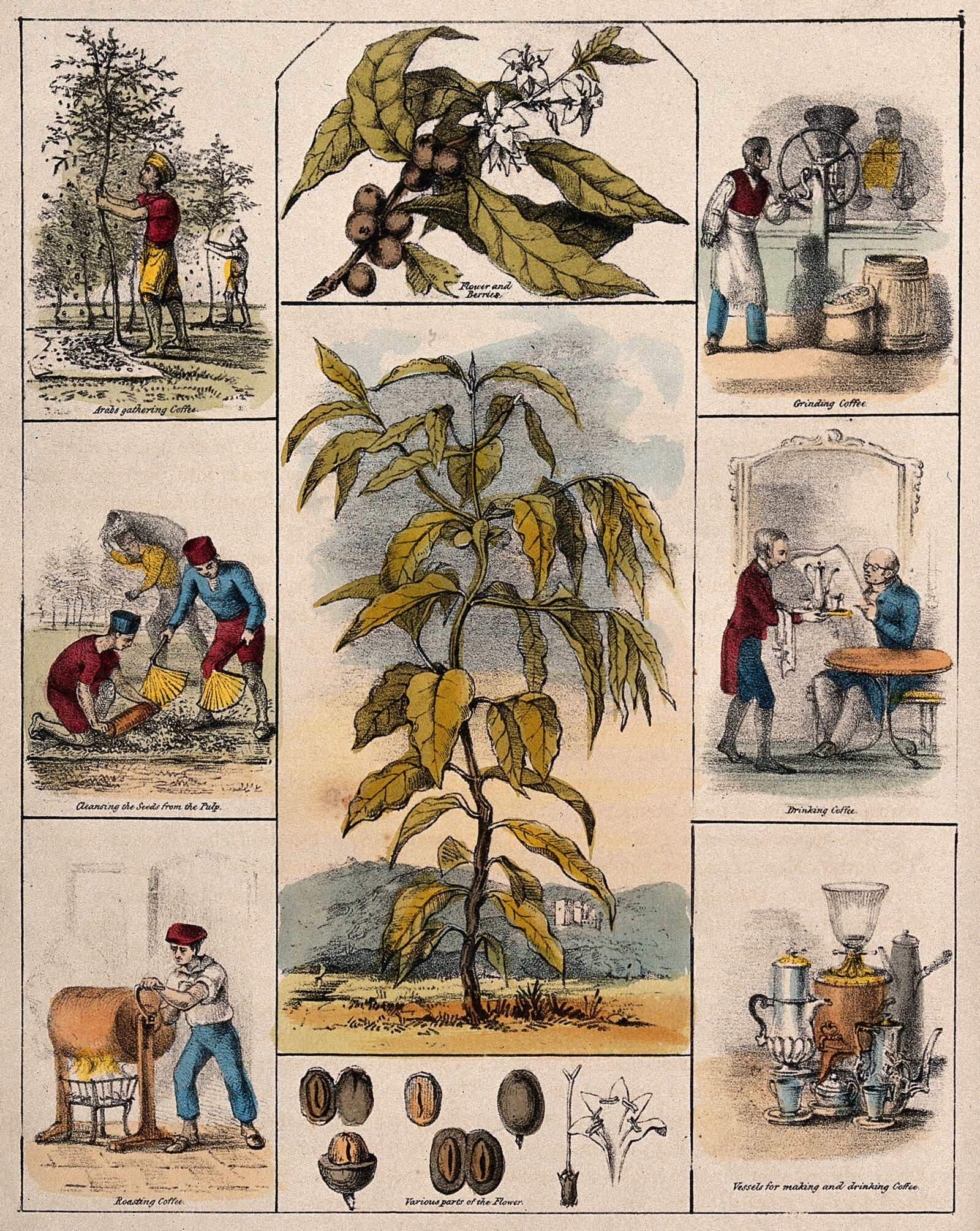
The forest belt between the Omo and Gojeb rivers was organised from the late fourteenth century as the kingdom of Kaffa, ruled by a sacred king from Bonga. Its people chewed the berries, used the leaves, and roasted the beans in butter, and neighbouring Oromo communities used coffee in ritual meals; but none of these uses is recorded in writing before the nineteenth century, and none of them, as far as the evidence goes, involved a daily brewed drink of the Yemeni kind.56 The region exported little coffee before the modern period. Merid Wolde Aregay, reviewing the evidence in the Journal of African History in 1988, found coffee leaving Ethiopia through the port of Zayla by 1690 and probably from the south-western kingdom of Enarya in the eighteenth century — two centuries after the drink had conquered Arabia and Egypt.5
Words for a drink that did not yet exist
The Arabic word the drink would take, qahwa, already existed and already meant something else. Medieval Arabic lexicographers gave it as a name for wine, deriving it from a verb meaning to lose one's appetite: wine, they said, takes away the desire for food.17 Alan Kaye, in a short note in the Journal of the American Oriental Society (1986), argued that the root more plausibly meant "dark", and that the name passed to the new drink because of its colour and its place in the evening.7 Either way, the drink's name came from the vocabulary of the forbidden. The bean was something different: Arabic bunn, a borrowing of the Ethiopian word būn, still the Amharic buna.7 The popular derivation of coffee from the place-name Kaffa has no support in the sources. Qahwa gave Ottoman Turkish kahve, which gave Italian caffè, Dutch koffie and English coffee; the resemblance to Kaffa is an accident.7 The story of Kaldi, the Ethiopian goatherd whose animals danced after eating the berries, is a legend first printed in Europe in the later seventeenth century, long after the drink's arrival.1 What the written record actually holds begins not in the forest but in a Yemeni port, in the generation before 1500.
The transmission: from the Sufi lodge to the Tahtakale coffeehouse
The earliest connected history of coffee was written in Cairo around 1558 by ʿAbd al-Qādir al-Jazīrī, a jurist and secretary to the officials who organised the annual pilgrimage caravan, in a treatise titled ʿUmdat al-ṣafwa fī ḥill al-qahwa — roughly, The Best Support for the Lawfulness of Coffee.2 It is a defence brief as much as a history: al-Jazīrī collected every report he could find about where the drink came from and every ruling for and against it, in order to show that it was lawful. A copy reached the French royal library, and Antoine Galland, the translator of the Thousand and One Nights, published a French version in 1699 under the title De l'origine et du progrès du café; most of what Europe learned about coffee's Arabian origins it learned through that book.3 Al-Jazīrī's account names the man who brought the drink into Yemeni religious life. Jamāl al-Dīn Muḥammad ibn Saʿīd al-Dhabhānī, a scholar and mufti of Aden who died in 1470 or 1471, had travelled to the African coast across the strait, where he saw people using qahwa; on his return to Aden he fell ill, remembered it, sent for it, and found that among its properties was that it drove away fatigue and lethargy.12 He introduced it to the Sufis of Aden, who adopted it for their night devotions. Hattox reads the report carefully: the Arabic says the Africans "used" the substance, not that they drank it, and nothing in the text proves that the brewed drink itself was an African invention rather than a Yemeni one.1
Aden and the night prayers
The Sufis who adopted the drink belonged above all to the Shādhilī order, and the drink served a precise need. Their central practice was dhikr, the rhythmic collective remembrance of God, performed through the night and often until dawn. A beverage that kept the body awake and the mind clear was, for them, an aid to worship. In the Yemeni lodges it was prepared in a large vessel, ladled out by the shaykh or a senior member and passed around the circle while the names of God were recited — a communal act that resembled, uncomfortably for its critics, the passing of a wine cup.12
Ottoman memory kept a different founder. Katip Çelebi, writing in Istanbul in 1656, opened his short chapter on coffee in The Balance of Truth by naming the inventor of coffee-drinking as the Shādhilī shaykh ʿUmar of Mocha, who had used it to keep men awake for their prayers.17 Mocha's own tradition honoured a Shādhilī saint, ʿAlī ibn ʿUmar al-Shādhilī, as its patron and as the founder of the drink, and the port's coffee came to be associated with his name.110 The traditions do not agree on the founder, and none of them can be checked against a document written in the founder's lifetime. They agree on the essentials, which is what matters for the history: the drink was Yemeni, Sufi and nocturnal before it was anything else, and its first users understood it as a tool of devotion. That origin would be held against it. Critics in Mecca and Cairo would describe Sufi coffee circles as a disguised version of the drinking parties the law forbade, and defenders would answer that a drink which kept men awake for the remembrance of God could not be the same thing as one which made them forget Him.12
By the end of the fifteenth century the drink had left the lodges. Students, merchants and craftsmen who attended the Sufi gatherings carried the habit into their own houses and shops, and the highland terraces of western Yemen began to be planted with the shrub. Michel Tuchscherer, the principal historian of the Red Sea coffee trade, places the earliest cultivated coffee in the upland districts of Ḥarāz and Banī Maṭar, west of Ṣanʿāʾ, where the crop was grown on terraces watered by mountain rain.8
The Yemeni terraces and the port of Mocha
Within a century the terraces had become the world's only commercial coffee landscape. Peasant growers in the western highlands sold the dried fruit to merchants in inland markets; caravans carried it down to the Red Sea coast; and from the coast it went north by ship to Jeddah, where much of it was transshipped for Suez and sold in Cairo, the great redistribution centre for the Ottoman Mediterranean.89 The Ottomans occupied Yemen in stages from 1538, lost it to the Zaydī imams of the Qāsimī house in 1635, and in both regimes coffee became the region's most valuable export. Nancy Um, in her study of the merchant houses of Mocha, shows how the port rose under the Ottomans and, after 1635, turned toward the Indian Ocean, where Gujarati, Arab, Armenian and later Dutch and English merchants bought coffee for silver.10 The trade was large and specific. Tuchscherer's collaborative volume on the coffee trade before the colonial plantations, published by the French Institute of Oriental Archaeology in Cairo in 2001, assembled Ottoman customs registers, Cairene court records and merchant archives to show that by the seventeenth century coffee had displaced spices as the most lucrative cargo moving through the Red Sea, and that a group of great Cairo merchants built fortunes on it.9 The Yemeni monopoly would last until the end of the seventeenth century.
| Stage | Approximate dates | What happened |
|---|---|---|
| Ethiopian forest | before 1450 | wild Coffea arabica; leaves and berries used locally |
| Aden and Yemeni Sufi lodges | c. 1450–1500 | brewed drink adopted for night dhikr (al-Dhabhānī, d. 1470/71) |
| Yemeni highland terraces | c. 1500 onwards | first cultivated coffee landscape (Ḥarāz, Banī Maṭar) |
| Mecca and Medina | by c. 1500; ban 1511 | first public coffeehouses; first prohibition |
| Cairo | early 1500s; attacks 1530s | lodge of Yemeni students at al-Azhar; trade hub |
| Damascus, Aleppo | first half of 1500s | coffeehouses in Syrian cities |
| Istanbul | first mention 1539; coffeehouses 1554–55 | Tahtakale coffeehouses of Ḥakam and Shams |
| Europe | 1573 (description) to 1680s | Rauwolf in Aleppo; Oxford, London, Paris, Vienna |
Mecca, 1511: the first trial
Coffee reached Mecca around the year 905 of the Hijra — 1500 CE — and there for the first time it met a public authority. Pilgrims, students and merchants drank it in the Holy City; Sufi groups drank it in the precinct of the mosque itself during their night devotions; and houses selling it to the public opened, where men gathered, played games and listened to music.113 In June 1511 the market inspector (muḥtasib) of Mecca, a Mamluk officer named Khāʾir Beg, convened a meeting of jurists and physicians. Witnesses testified that the drink altered the mind, physicians testified that it was harmful to the body, and the meeting concluded that the gatherings at which it was served resembled those of wine drinkers.12 Khāʾir Beg prohibited the sale and the public drinking of coffee. Stocks were seized and burned in the streets, and sellers and drinkers were beaten.1 He then sent the decision to the Mamluk sultan in Cairo, Qānṣūh al-Ghawrī, for approval — and did not get it. The sultan's reply, as al-Jazīrī preserved it, condemned the abuses of the gatherings but declined to declare the drink itself unlawful, and Cairo's own jurists were divided.12 The ban lapsed. Within a few years Mecca's coffeehouses were open again.1
The Meccan episode set the pattern for the following century. The arguments that were tried against coffee in Mecca, and then in Cairo and Istanbul, fell into a small number of types, which Hattox reconstructs from al-Jazīrī's dossier and the surviving fatwas:12
| Argument against coffee | Its basis | How it fared |
|---|---|---|
| Intoxication (iskār) | the Prophet's prohibition of every intoxicant | failed: jurists who tried the drink found no intoxication |
| Bodily harm (ḍarar) | Galenic humoral medicine, which classed coffee as cold and dry | contested: physicians disagreed and many prescribed it |
| Burnt matter | a ruling that substances roasted to carbon were unlawful | marginal; answered by other jurists |
| Resemblance to wine-drinking | the cup passed hand to hand in a circle, as wine was | persistent as rhetoric, weak as law |
| The company and the place | gambling, music, idle talk, sedition | never resolved; the basis of every later ban |
The first two arguments lost — almost no jurist could sustain the claim that coffee intoxicated once he had drunk it — and the last, the argument about the place, never went away.111 That is why the history of coffee in the Islamic world is mostly the history of the coffeehouse: the drink won its case early, while the room where it was sold stood trial for two centuries.
Cairo and the lodge of the Yemenis
Cairo received coffee through al-Azhar, the great mosque-university, where Yemeni students lived in their own residential lodge (riwāq) and drank coffee during their devotions, as they had at home.1 From the students it spread to the city, and by the 1530s Cairo was the main market and the main battleground of the drink. In 1534–35, according to al-Jazīrī, a preacher's sermons against coffee roused a crowd that attacked coffeehouses and beat the men inside them. The chief judge of the city responded by convening scholars at his house, having coffee served to them, and observing them through the evening; when no one was found to be intoxicated, the trade was allowed to resume.12
The scene is characteristic. Coffee advanced not by a single decision but through a series of local trials, each of which ended with the drink permitted and the place where it was drunk placed under suspicion. When the Ottomans conquered Egypt in 1517 they inherited both the drink and the dispute, and by the middle of the century the legal question was in practice settled in the drink's favour; what remained was a question of public order.1 From Cairo and the pilgrimage routes the coffeehouse moved north into Syria. Damascus and Aleppo had coffeehouses by the middle of the sixteenth century, large enough to impress European visitors, and the Syrian merchants who ran them would carry the institution to the Ottoman capital.111 It also moved east: the Encyclopaedia Iranica records coffeehouses in the Safavid cities of Qazvin and Isfahan by the reign of Shah ʿAbbās I (1588–1629), clustered around the great square of Isfahan and near the madrasas, where they became meeting places for poets, artists and officials.13 By 1600 the institution reached from the Yemeni highlands to the Balkans and the Iranian plateau.
Istanbul, 1554–55: the Tahtakale coffeehouses
Coffee was known in Istanbul before it was sold there. Cemal Kafadar, in his study of leisure and nocturnal sociability in the early modern city, has found the earliest Ottoman mention of coffee in the capital in a record of 1539.14 The public coffeehouse came later, and its arrival was recorded by the Ottoman historian İbrahim Peçevi (1574–1649), who wrote in the 1640s from older informants. In Robert Mantran's French rendering, Peçevi says that until the year 962 of the Hijra — 1554–55 — coffee was unknown "both in the capital and generally in the Ottoman territories, and there were no coffeehouses."1112 In that year two men from Syria, Ḥakam of Aleppo and Shams of Damascus, came to Istanbul and opened two large shops in the market quarter of Tahtakale, near the Golden Horn, and began to sell coffee.1112 Peçevi's description of what followed is the earliest sketch of the institution. The shops filled with men of learning and leisure — poets, judges without posts, teachers seeking promotion, idlers — who read, played chess and backgammon and recited verse, and found that for a coin or two they could have the pleasures of company that had previously required the expense of a dinner.1112 The Persian scholar Sayyed ʿAlī Al-e Dāwūd, summarising the Ottoman and Persian sources for the Encyclopaedia Iranica, records that the first Istanbul coffeehouse "was frequented by so many dignitaries, writers, and poets that it became known as the 'academy of scholars.'"13
What changed and what was replaced
The drink changed less than the room. Coffee itself was a mild stimulant with a bitter taste, which most early drinkers took black and unsweetened from small porcelain or earthenware cups. What it brought into the Ottoman city was the kahvehane, a shop whose only reason to exist was the company it sold. By the end of the sixteenth century there were coffeehouses in every quarter of Istanbul, Cairo, Damascus and Aleppo, from large establishments with fountains and raised benches to stalls in the corner of a market; within another century they had become, in Ahmet Yaşar's phrase for the Turkish volume he edited in 2009, spaces of "socialisation and power", where the city talked about its rulers.15
A new public room
The activities the coffeehouse housed were not new. What was new was that they were gathered in one place, open to almost anyone with a coin, and lasted into the night. The Ottoman, Arab and European sources describe:
- Talk and news — the coffeehouse became the place where rumours, official announcements and political opinion circulated, and where the state learned what the city thought.115
- Storytelling and performance — the meddah, the professional storyteller, performed in coffeehouses, as did musicians and, later, shadow-puppet players of the Karagöz theatre.14
- Games — chess, backgammon and the mancala game mangala, which jurists also suspected.111
- Reading and poetry — the "academy of scholars" of Tahtakale was the elite end of a culture of recitation and literary competition.13
- Guild and neighbourhood life — coffeehouses served particular trades, quarters and, in the seventeenth century, the Janissary corps, whose soldiers increasingly owned and ran them.15
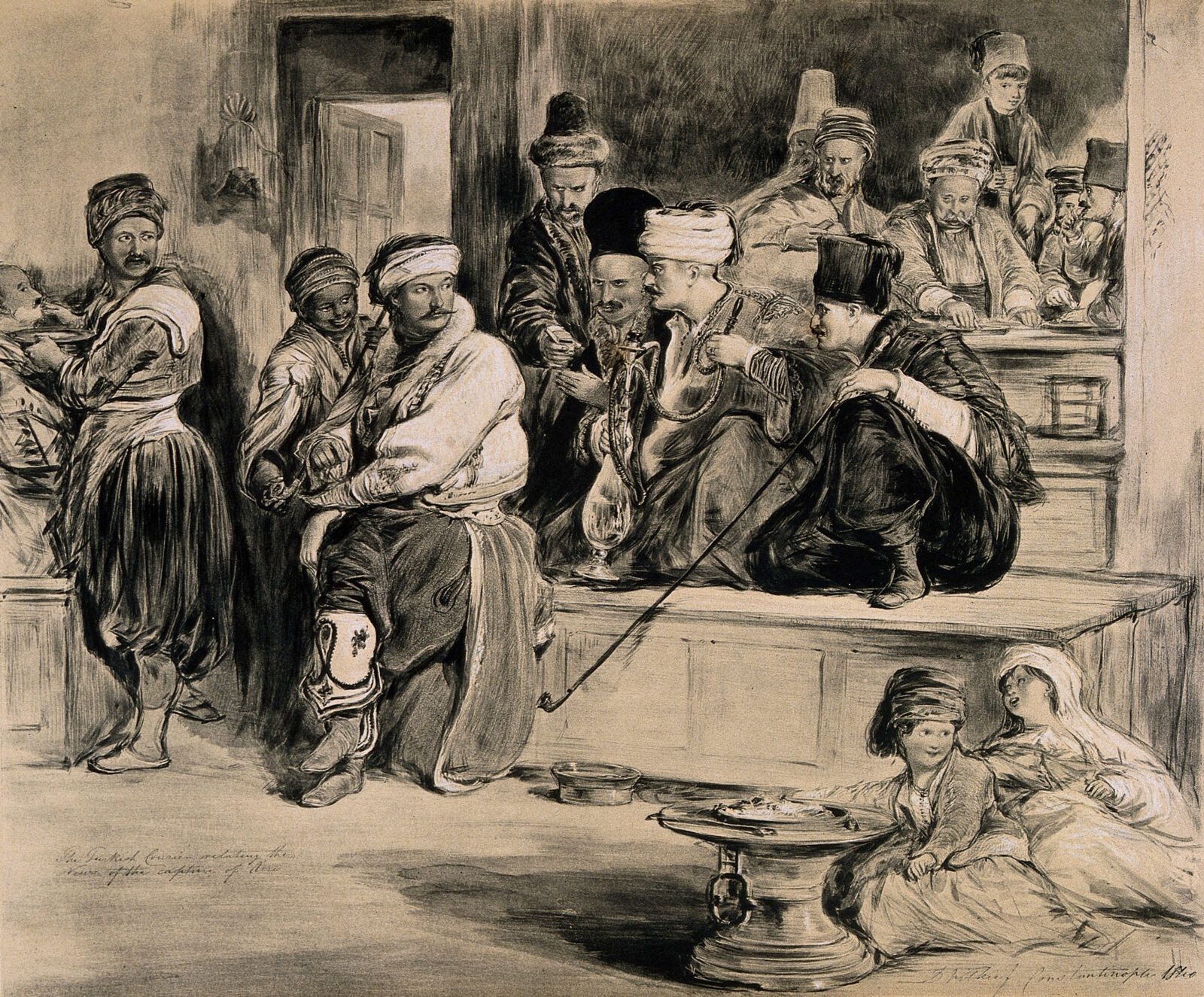
Kafadar's argument is that the deepest change was in the use of time. Before coffee, respectable urban life ended at dusk except for devotions; the coffeehouse made the evening a time of secular sociability, and with it brought lamps, late hours and a new acceptance of the night as a time for leisure.14 The drink that Yemeni Sufis had taken to stay awake for God kept the whole city awake for itself.
What the coffeehouse displaced
The institution took its customers from older ones, and the losers said so. Peçevi records the complaint of the religious establishment directly. In Mantran's French version, "the imams, the muezzins and the hypocritical devout said: 'people rush to the coffeehouses, and nobody comes to the mosques.'"1112 The coffeehouse competed with the mosque for the evening hour, with the tavern and the boza shop for customers who wanted company and a drink, and with the household for hospitality.
The displacement can be listed:
- The Sufi lodge lost its monopoly on the drink. What had been a devotional aid shared in a circle became a commodity sold by the cup. Some Sufi orders continued to use coffee in dhikr; most drinkers had never seen a lodge.1
- The tavern lost part of its function. Coffee offered the sociability of the wine cup without its legal stigma, and Ottoman and Arab writers repeatedly compared coffee gatherings to wine gatherings — sometimes to condemn coffee, sometimes to praise it as the sober alternative.117
- The household lost its control of hospitality. Peçevi's observation that a coin or two now bought the company that a dinner had once required describes a shift from hospitality by rank to sociability by purchase.11
- Religious authority lost a share of the evening. The complaint about empty mosques was polemical, but it recorded a real competition for time and attention.1116
Law, medicine and the state
The legal argument was effectively won by coffee before 1600, though it was never formally closed. Katip Çelebi, the most original Ottoman scholar of the seventeenth century, summarised a century of fatwas in 1656: coffee had been forbidden, permitted, forbidden again; jurists had declared it unlawful because it was roasted until it became carbon, and other jurists had answered them; and people had gone on drinking it.17 His own position was pragmatic. Prohibition of something the population had made a habit of, he argued, produced only disobedience and contempt for the law; the wise course was to leave such matters alone.17 Galenic physicians, meanwhile, wrote treatises balancing coffee's cold, dry nature against its benefits, and prescribed it for phlegm, the stomach and the head.1
The state's interest was different. Coffee was taxed at every stage — in Yemeni markets, at Jeddah and Suez, in the customs of Cairo and Istanbul — and the coffeehouse was licensed and watched.915 Tuchscherer's contributors show Ottoman officials collecting coffee duties that made the commodity a significant item of the Egyptian revenue by the seventeenth century.9 The capital's own trade was organised in guilds. Evliya Çelebi, describing Istanbul's corporations in the middle of the seventeenth century, counted coffee sellers with 55 shops and 100 members, and coffee wholesalers with 300 warehouses and 500 members, "great merchants" each with partners in Egypt and in Ṣanʿāʾ in Yemen — a chain of credit and correspondence running the whole length of the route the drink had travelled.11 A sultan who closed the coffeehouses therefore lost money as well as information, and so did a powerful body of merchants with friends at court. Every prohibition of the sixteenth and seventeenth centuries was eventually undone by that combination of habit, revenue and commercial interest.915
Into Europe
European travellers met the coffeehouse in the Ottoman cities before they met the drink at home. The German physician and botanist Leonhard Rauwolf, who was in Aleppo in 1573, published the first European account of coffee-drinking in his travel book of 1582. In the English translation of 1693 he describes "a very good drink they call Chaube that is almost as black as ink and very good in illness, especially of the stomach," which the Aleppines drank "in the morning early in the open places before everybody, without any fear or regard, out of China cups, as hot as they can, sipping it a little at a time."18 Rauwolf's emphasis — public, early, unashamed — is precisely what struck a European; there was no equivalent at home. The beans followed the merchants. Venetian traders handled coffee through their Levantine and Egyptian connections from the early seventeenth century, and English merchants of the Levant Company acquired the habit in Smyrna and Aleppo.19 The first English coffeehouse was opened in Oxford around 1650 by a Jewish man known as Jacob; in 1652 Pasqua Rosée, the servant of the Levant Company merchant Daniel Edwards, opened a coffee stall in St Michael's Alley off Cornhill in the City of London, with a handbill advertising the "vertue" of the drink.1920 In Paris the decisive moment was the embassy of Süleyman Ağa from Mehmed IV in 1669, whose receptions made coffee fashionable at court, and Antoine Galland, who would later translate al-Jazīrī, was among the Orientalists who described the drink's Arabian history to French readers.319
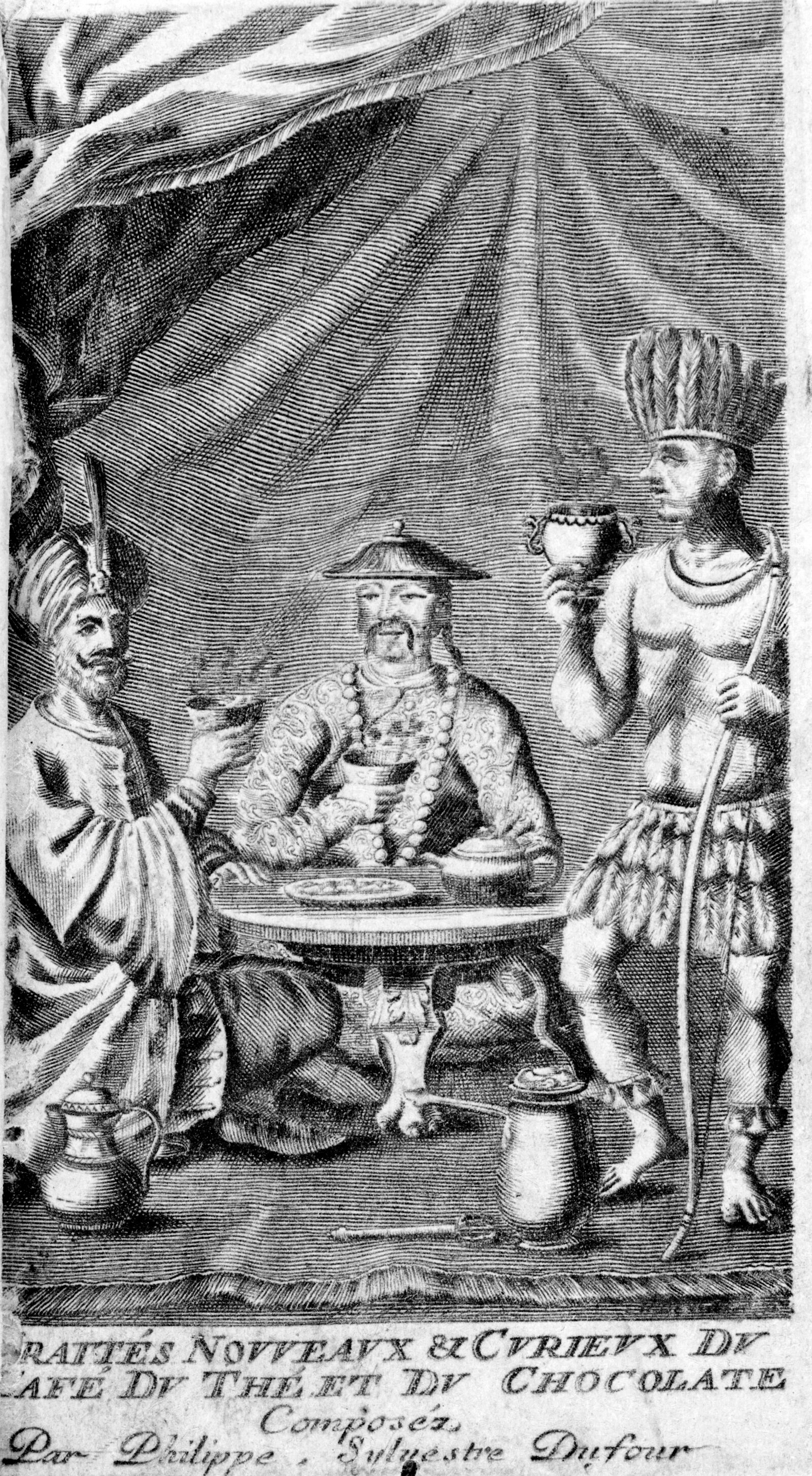
The European coffeehouse that resulted was, in its first decades, consciously Ottoman. It sold a "Turkish" drink, often under signs of the Turk's head; Philippe Sylvestre Dufour's Traitez nouveaux et curieux du café, du thé et du chocolate (Lyon, 1685; second edition 1688) put a turbaned Ottoman drinker at the head of its frontispiece, beside a Chinese tea drinker and an Amerindian with chocolate.23 By the 1670s London had dozens of coffeehouses, and they had acquired the same reputation they had in Istanbul. On 29 December 1675 Charles II issued a proclamation for their suppression as places where false reports were spread and the government defamed; the order provoked such opposition that it was withdrawn within days, before it took effect.20 Brian Cowan, whose Social Life of Coffee (2005) is the standard account of the British case, shows that the English coffeehouse was regulated by licensing rather than suppressed — the same accommodation the Ottomans had reached a century before.20 The European chronology, in outline:
| Year | Place | Event |
|---|---|---|
| 1573 | Aleppo | Leonhard Rauwolf sees coffee drunk in public; published 158218 |
| 1592 | Venice | Prospero Alpini describes the coffee plant in his De plantis Aegypti19 |
| c. 1650 | Oxford | first English coffeehouse, kept by Jacob20 |
| 1652 | London | Pasqua Rosée's coffee stall in St Michael's Alley, Cornhill1920 |
| 1669 | Paris | embassy of Süleyman Ağa makes coffee fashionable at court19 |
| 1675–76 | London | Charles II's proclamation against coffeehouses, withdrawn20 |
| 1685 | Vienna | Johannes Diodato receives the first privilege to serve coffee19 |
| 1699 | Paris | Galland's French version of al-Jazīrī3 |
Markman Ellis, in his cultural history of the coffeehouse (2004), stresses how quickly the European version lost its Ottoman dress: within a generation it had become a London, Parisian or Viennese institution, with newspapers, auctions, insurance and the Royal Society's virtuosi, and its debt to Istanbul and Cairo had faded into a turban on a shop sign.19 The forgetting was itself part of the transmission. Europe took the room, the drink and the habits of talk and news, and then told the story as if the coffeehouse had been invented in Cornhill.
What the cost was
The transmission's bill was paid in three places: in the cities where the coffeehouse was fought over, in the colonies where Europe chose to grow the drink it had learned to want, and in the forest where the plant began, which gained almost nothing.
Bans, beatings and the ban of 1633
The repression along the route was real but intermittent, and its scale is poorly documented. In Mecca in 1511 coffee was burned and its drinkers beaten.1 In Cairo in 1534–35 a crowd attacked coffeehouses and their customers.12 In Istanbul the sultans of the later sixteenth century repeatedly restricted coffeehouses, closing them or limiting their hours when they were reported as centres of idleness and sedition, and reopening them under pressure from customers and from the revenue.15 None of these episodes produced a recorded death toll. The severest prohibition came in the seventeenth century, at the intersection of politics and religious revival. A movement of preachers led by Kadızade Mehmed (d. 1635), the Kadızadelis, campaigned in Istanbul against what they called innovations — Sufi music and dance, the veneration of saints' tombs, tobacco and coffee — and found a patron in the young sultan Murad IV.16 In September 1633 a fire destroyed a large part of the city; according to the chronicler Naʿīmā, cited by Mantran, the discontent that followed was voiced loudly in the coffeehouses, and Murad IV issued a decree prohibiting coffee and tobacco, "an order which was rigorously carried out."11
The coffeehouses of the capital were demolished or closed, and they remained closed for the rest of Murad's reign and that of his successor Ibrahim, reopening only under Mehmed IV.11 Contemporary and later accounts, Ottoman and European, describe offenders — smokers in particular — being executed, and tell of the sultan patrolling the streets in disguise. Madeline Zilfi's study of the Kadızadeli movement places the prohibitions within a decades-long contest between revivalist preachers and the Sufi and learned establishment, in which coffeehouses were among the targets.16 The accounts of the executions cannot be counted, and the figures of tens of thousands sometimes repeated in modern popular writing have no documentary basis. What can be said is that for seven years the drinking of coffee in public in the Ottoman capital was a capital crime.
The monopoly and its breaking
The larger cost came after the transmission reached Europe, and it came because Europe did not intend to keep buying from Mocha. Through the seventeenth century, the Dutch and English East India companies bought Yemeni coffee for silver at Mocha and paid the duties of the imams.10 The Yemeni monopoly ended when the Dutch East India Company (VOC) obtained plants: arabica seedlings sent from the Malabar coast to Java in 1696 were lost to flood, and a second consignment in 1699 survived and was planted around Batavia; the first Java coffee reached Amsterdam in 1711.21
The VOC did not plant coffee with free labour. In the Priangan highlands of western Java it required the local regents to deliver coffee at fixed prices, a system of compulsory cultivation that the regents passed down to the peasants of their districts as labour and delivery obligations.21 The French took arabica to the Caribbean in the 1720s, and by the late 1780s the slave colony of Saint-Domingue had become the largest single source of the world's coffee. Michel-Rolph Trouillot's study of the colony's coffee boom shows how the expansion of coffee estates into the mountains between the 1760s and 1789 multiplied the enslaved workforce and created a class of coffee planters, many of them free people of colour, whose position was central to the revolution that began in 1791.22 In the nineteenth century the centre of world production moved to Brazil, where coffee was grown by enslaved Africans and their descendants until abolition in 1888.21
The full bill for plantation coffee — on Java, in Saint-Domingue, in Brazil — is larger than the bill for the transmission recorded here, and it is shared with the sugar complex from which the plantation was borrowed. But the line from the Sufi lodge to the plantation is direct. The demand that the Ottoman coffeehouse created, and that Europe copied, was the demand the plantations were built to supply.
The costs, in summary:
- Mecca, 1511 — coffee seized and burned; sellers and drinkers beaten under the market inspector's ban.1
- Cairo, 1534–35 — crowd violence against coffeehouses after anti-coffee preaching.12
- Istanbul, 1633–1640 — coffee and tobacco prohibited; coffeehouses demolished; executions reported and not countable.1116
- Java, from the 1700s — compulsory cultivation and delivery imposed on Priangan peasants by the VOC through local regents.21
- Saint-Domingue, 1720s–1791 — coffee estates worked by enslaved Africans, expanding rapidly from the 1760s.22
- Brazil, nineteenth century — the world's largest coffee economy, worked by slaves until 1888.21
What Ethiopia received
The forest that produced the plant was largely bypassed by the trade it started. Through the sixteenth and seventeenth centuries the world's coffee came from Yemeni terraces, not Ethiopian forests, and the Ethiopian highland kingdom treated the drink with suspicion. The Ethiopian Orthodox Church, at some point before the eighteenth century, came to forbid coffee to Christians as a Muslim drink, and the prohibition held in the Christian highlands until the late nineteenth century.56 Aregay's evidence shows Ethiopian rulers trying, in the seventeenth and early eighteenth centuries, to profit from coffee exports through Zayla and the Red Sea, and European attempts in 1705 and 1737 to buy coffee directly from Ethiopia failing; by then the plantations of Java and the Caribbean had made the effort unnecessary.5 When coffee drinking finally spread in the Christian highlands, it was through the example of an emperor. Richard Pankhurst, in his Economic History of Ethiopia (1968), attributes the rapid spread of the drink between 1880 and 1886 "largely" to "Emperor Menelik, who himself drank it, and to Abuna Matewos who did much to dispel the belief of the clergy that it was a Muslim drink."6
The same emperor's armies conquered the kingdom of Kaffa in 1897 and incorporated its forests into the Ethiopian state.6 Large-scale commercial export of Ethiopian coffee began only in the twentieth century. The country now counts coffee as its principal export and its coffee ceremony as a national institution; but for the four centuries in which coffee made fortunes in Mocha, Cairo, Amsterdam and Saint-Domingue, the forest of origin was the one place on the route that the money did not reach.
What followed
-
1511Mecca's market inspector Khāʾir Beg convenes jurists and physicians, bans the sale and public drinking of coffee, and has stocks burned and drinkers beaten; the Mamluk sultan declines to confirm the ban and it lapses — the first of a century of trials.
-
1555Ḥakam of Aleppo and Shams of Damascus open two coffeehouses in the Tahtakale market of Istanbul; within a generation the kahvehane is found in every quarter of the Ottoman capital.
-
1633After the great fire of Istanbul, Murad IV prohibits coffee and tobacco; the capital's coffeehouses are demolished or closed until the reign of Mehmed IV, and offenders are executed.
-
1635After the Qāsimī imams expel the Ottomans from Yemen, Mocha turns toward the Indian Ocean and becomes the world's coffee port, where Indian, Arab, Armenian, Dutch and English merchants buy Yemeni coffee for silver.
-
1652Pasqua Rosée opens a coffee stall in St Michael's Alley, Cornhill, the first coffeehouse in London; within a generation the City has dozens, and Charles II's attempt to suppress them in 1675 fails.
-
1699The Dutch East India Company plants arabica from Malabar around Batavia; Java coffee reaches Amsterdam in 1711, Yemen's monopoly ends, and coffee becomes a crop of compulsory deliveries in the Priangan highlands.
-
1789On the eve of revolution the slave colony of Saint-Domingue is the world's largest single source of coffee, its mountain estates worked by enslaved Africans.
-
1886Coffee drinking spreads quickly in the Ethiopian Christian highlands after Menelik and Abuna Matewos dispel the clergy's view of it as a Muslim drink; in 1897 Menelik's armies conquer the kingdom of Kaffa.
Where this lives today
References
- Hattox, Ralph S. Coffee and Coffeehouses: The Origins of a Social Beverage in the Medieval Near East. Seattle: University of Washington Press, 1985. en
- al-Jazīrī, ʿAbd al-Qādir ibn Muḥammad al-Anṣārī. ʿUmdat al-ṣafwa fī ḥill al-qahwa. Cairo, c. 1558. Partial edition in A. I. Silvestre de Sacy, Chrestomathie arabe, 2nd ed., vol. 2. Paris: Imprimerie royale, 1826. ar primary
- Galland, Antoine. De l'origine et du progrès du café: sur un manuscrit arabe de la Bibliothèque du Roy. 1699. Reprint, Paris: Éditions La Bibliothèque, 1992. fr primary
- Salojärvi, Jarkko, et al. "The genome and population genomics of allopolyploid Coffea arabica reveal the diversification history of modern coffee cultivars." Nature Genetics 56 (2024): 721–731. en
- Aregay, Merid W. "The Early History of Ethiopia's Coffee Trade and the Rise of Shawa." Journal of African History 29, no. 1 (1988): 19–25. en
- Pankhurst, Richard. Economic History of Ethiopia, 1800–1935. Addis Ababa: Haile Sellassie I University Press, 1968. en
- Kaye, Alan S. "The Etymology of 'Coffee': The Dark Brew." Journal of the American Oriental Society 106, no. 3 (1986): 557–558. en
- Tuchscherer, Michel. "Coffee in the Red Sea Area from the Sixteenth to the Nineteenth Century." In The Global Coffee Economy in Africa, Asia, and Latin America, 1500–1989, edited by William Gervase Clarence-Smith and Steven Topik, 50–66. Cambridge: Cambridge University Press, 2003. en
- Tuchscherer, Michel, ed. Le commerce du café avant l'ère des plantations coloniales: espaces, réseaux, sociétés (XVe–XIXe siècle). Cahier des Annales islamologiques 20. Le Caire: Institut français d'archéologie orientale, 2001. fr
- Um, Nancy. The Merchant Houses of Mocha: Trade and Architecture in an Indian Ocean Port. Seattle: University of Washington Press, 2009. en
- Mantran, Robert. "Le café à Istanbul au XVIIe siècle." In Le café en Méditerranée: histoire, anthropologie, économie, XVIIIe–XXe siècle. Aix-en-Provence: Institut de recherches et d'études sur le monde arabe et musulman, 1980. fr
- Peçevî İbrahim Efendi. Târîh-i Peçevî. Written c. 1640s. 2 vols. İstanbul: Matbaa-i Âmire, 1864–1867 (1281–1283 AH). tr primary
- Al-e Dāwūd, Sayyed ʿAlī. "Coffeehouse." In Encyclopaedia Iranica, vol. VI, fasc. 1, 1–4. Costa Mesa: Mazda, 1992. en
- Kafadar, Cemal. "How Dark is the History of the Night, How Black the Story of Coffee, How Bitter the Tale of Love: The Changing Measure of Leisure and Pleasure in Early Modern Istanbul." In Medieval and Early Modern Performance in the Eastern Mediterranean, edited by Arzu Öztürkmen and Evelyn Birge Vitz. Late Medieval and Early Modern Studies 20. Turnhout: Brepols, 2014. en
- Yaşar, Ahmet, ed. Osmanlı Kahvehaneleri: Mekân, Sosyalleşme, İktidar. İstanbul: Kitap Yayınevi, 2009. tr
- Zilfi, Madeline C. "The Kadizadelis: Discordant Revivalism in Seventeenth-Century Istanbul." Journal of Near Eastern Studies 45, no. 4 (1986): 251–269. en
- Kâtib Çelebi. The Balance of Truth. Translated with an introduction and notes by G. L. Lewis. London: George Allen and Unwin, 1957. (Mîzânü'l-hakk fî ihtiyâri'l-ehakk, 1656.) en primary
- Rauwolf, Leonhard. Aigentliche beschreibung der Raiß inn die Morgenländer. Lauingen, 1582. English translation in John Ray, ed., A Collection of Curious Travels and Voyages. London, 1693. de primary
- Ellis, Markman. The Coffee-House: A Cultural History. London: Weidenfeld & Nicolson, 2004. en
- Cowan, Brian. The Social Life of Coffee: The Emergence of the British Coffeehouse. New Haven: Yale University Press, 2005. en
- Clarence-Smith, William Gervase, and Steven Topik, eds. The Global Coffee Economy in Africa, Asia, and Latin America, 1500–1989. Cambridge: Cambridge University Press, 2003. en
- Trouillot, Michel-Rolph. "Motion in the System: Coffee, Color, and Slavery in Eighteenth-Century Saint-Domingue." Review (Fernand Braudel Center) 5, no. 3 (1982): 331–388. en
- Dufour, Philippe Sylvestre. Traitez nouveaux et curieux du café, du thé et du chocolate. Lyon, 1685; 2nd ed., Lyon: Jean-Baptiste Deville, 1688. fr primary