Italy learned cotton from Islam by 1400 — and left Syria the fields
Cotton left India as a fibre, a tool kit and a set of cloth types. The Islamic world made it an everyday cloth between 700 and 1100; from the twelfth century the towns of the Po valley copied its fabrics, its tools and its names, and by 1400 Venice's cotton convoys were bringing home almost 12,000 sacks of Syrian fibre a year.
In 1400 Venice's cotton cogs brought home almost 12,000 sacks of raw cotton from Mamluk Syria, to be spun by Lombard village women and woven into fustian in Milan and Cremona. Italy had learned the fibre, the tools and the cloth from the Islamic world; it now bought only the fibre.

Before: a world of wool and linen
Around the year 1000, the people of the Po valley dressed in two fibres. Wool came from the sheep of the Alpine foothills and the Apennines and, for the best cloth, from abroad; it was spun, woven, fulled and dyed in town workshops that were already among the largest employers in Milan, Florence and their neighbours. Linen came from flax, and Lombardy was flax country. The plant grew in the irrigated lowlands between the Ticino and the Adda, was retted in ditches, beaten, combed and spun by women in the villages, and woven into the shirts, sheets, towels and undergarments that sat next to the skin. Hemp, coarser, made sacking, rope and the sails of the river barges. Silk, for churches and the very rich, was bought from Byzantium and the Islamic world. Cotton, as a cloth for ordinary people, did not exist. Maureen Fennell Mazzaoui, whose 1981 study remains the foundation of the subject, treats the Italian cotton industry that later appeared as a transplant: every essential element — the fibre, the tools, the cloth types and many of their names — was taken from the Islamic Mediterranean.12
The two native fibres organised more than wardrobes. They organised the year, the household and the town. Flax was a peasant crop and a women's craft; wool was an urban industry with guilds, inspectors and merchant-capitalists who put raw wool out to spinners and bought back yarn. When the illustrated health handbooks known as the Tacuinum sanitatis were copied in Lombard workshops at the end of the fourteenth century, they still sorted clothing into those two kinds: vestis lanea, wool, which warms but irritates the skin, and vestis linea, linen, which cools but presses on the skin and blocks its breathing, a fault the text corrects by mixing linen with silk. By then cotton had been woven in Lombardy for two hundred years, yet the medical category it entered was still the one linen had made. That is how completely the two older fibres had defined what cloth was.1
What Latin Europe knew about cotton
Europe had heard of cotton for fifteen hundred years without growing or weaving it. Herodotus, writing in the fifth century BCE, put it among the marvels at the eastern edge of the world: in India, "wool more beautiful and excellent than the wool of sheep grows on wild trees; these trees supply the Indians with clothing."3 Pliny the Elder, in the first century CE, knew of a shrub in Upper Egypt, toward Arabia, that some called gossypion and more called xylon, whose fibre made the garments most valued by Egyptian priests.4 The plant was not unknown in the Roman Mediterranean: Michael Decker has shown that cotton was cultivated in Roman and late-antique Egypt and the Near East before the Arab conquests, one of several reasons he rejects the strong form of the claim that Islam introduced it.5
But in Latin Europe north of the Mediterranean littoral, cotton remained a rumour and an import. Raw cotton wool — bambagia, a word that came into Italian through Byzantine Greek from Persian — was used for padding, for quilting the jackets worn under armour and for candlewicks. Finished cotton cloth arrived as an exotic, in small quantities, from the Islamic world. The fourteenth-century Travels attributed to "Sir John Mandeville" still described a fruit in the far east that opened to reveal a little lamb, the fable of the "vegetable lamb" by which a world that did not grow cotton tried to explain a wool that came from a plant. The fable says less about cotton than about distance: the people who told it had never seen a cotton boll split on the bush.

Cotton's long road out of India
The fibre that Europe imagined as a lamb had been worked in South Asia for at least seven thousand years. In 2002 Christophe Moulherat and colleagues published threads preserved by copper corrosion inside a bead from a burial at Mehrgarh, in the Kachi plain of Balochistan, dated to the first half of the sixth millennium BCE. They identified the fibres as cotton, genus Gossypium — the oldest known from the Indian subcontinent. The preservation was a chemical accident: metallic salts from the corroding copper had impregnated the threads and fixed their structure.6 For the next six thousand years South Asia was the world's great cotton manufactory; Giorgio Riello's global history of the fibre puts India at the centre of every cotton system before 1750.7
India developed the tools that defined cotton processing everywhere it later went:
- The roller gin, a pair of rollers turned against each other that squeezed the seeds out of the boll — the step that makes cotton usable at all.
- The bow, a large string bow whose plucked string, held in a pile of ginned cotton, beat the fibres loose and fluffy for spinning.
- The reel, for winding spun yarn into skeins.
- Mordant dyeing and block-printing, which made Indian cloth the luxury of the Indian Ocean world.18
Indian cloth reached Egypt by sea long before Italy saw a cotton loom. The Newberry collection in the Ashmolean Museum in Oxford holds more than twelve hundred block-printed and resist-dyed cotton fragments, most of them recovered from the rubbish heaps of Fustat, the old capital of Egypt. Ruth Barnes, who catalogued them, traced them to Gujarat and dated them from the later tenth to the fifteenth century — the material residue of a trade that carried Indian cotton through the Red Sea into the Islamic Mediterranean for five hundred years.8 Egyptian workshops learned from what arrived. The Cleveland Museum of Art's fragment of block-printed Mamluk cotton, with its repeated fish, is an Egyptian design made with the Indian technique of printing from carved wooden blocks.
The transmission: from the caliphate's fields to the Po valley
Cotton did not travel to Italy directly from India. It came in two stages. In the first, roughly 700 to 1100, it became a mass crop and an everyday cloth across the Islamic world, from Khurasan to al-Andalus. In the second, from about 1100, Italian ports and then the towns of the Po valley learned to weave it — and Venice and Genoa built a sea trade to feed them with fibre grown in the lands of their Muslim trading partners.
The Islamic cotton belt, 700–1100
In 1974, and at book length in 1983, the economic historian Andrew Watson argued that the early Islamic world carried through an agricultural transformation: some eighteen crops, cotton among them, spread from India and the east across the caliphate together with irrigation techniques and the practice of summer cropping, which allowed a second harvest in the hot months when the Mediterranean's winter-grain fields lay idle.9 Cotton, a summer crop that wanted heat and water, was exactly the kind of plant the new regime favoured.
Watson's thesis is now contested. Decker argued in 2009 that several of Watson's "new" crops, cotton included, were already grown in the Roman and late-antique Mediterranean, and that change was slower and more uneven than a "revolution" implies.5 The disagreement is about introduction and tempo, not about the outcome. By the tenth century cotton was grown in Iran, Iraq, Syria, Egypt, North Africa, Sicily and al-Andalus on a scale no earlier Mediterranean state had seen. The twelfth-century Sevillian agronomist Ibn al-ʿAwwām, writing his Kitāb al-filāḥa on the estates of the Aljarafe, gave cotton its place in the chapter on fibre crops beside flax and hemp — a field crop with its own instructions, not a curiosity.10
Richard Bulliet has made the strongest case for how far the boom went. On his reading, a surge in the production and export of cotton made Iran the richest region of the caliphate in the ninth and tenth centuries, and the expansion of cotton growing ran in parallel with the spread of Islam through Iranian society. In the eleventh century, he argues, a prolonged cooling of the climate cut the crop back and ended Iran's primacy.11 The causal link Bulliet draws between cotton and conversion is his own argument; the scale of the trade he documents is not in doubt.
Across the caliphate, cotton moved down the social scale. Mazzaoui describes it passing, in the early Islamic empire, from a luxury into an ordinary article of daily use, favoured by Islamic sumptuary norms and woven pure or mixed with linen, silk and wool.1 Much of it was made in the royal workshops called ṭirāz, which Ashtor describes in every Near Eastern country under the Abbasids and Fatimids, often leased to entrepreneurs and producing for export alongside a flourishing private industry.12
Tools from three directions
The Islamic workshops assembled a tool kit from every neighbour. From India came the roller gin, the bow and the reel. Mazzaoui has the Islamic artisans taking the raised horizontal treadle loom and the spinning wheel from Byzantine and Persian craftsmen.1 Arnold Pacey, following the Indian historian Irfan Habib, places the spinning wheel's invention in the Middle East, probably by the eleventh century; the earliest clear picture of one is in the copy of al-Ḥarīrī's Maqāmāt illustrated by Yaḥyā al-Wāsiṭī in Baghdad in 1237. In India itself, Habib found no unambiguous reference to a spinning wheel before 1350 — the wheel travelled into India with the Delhi Sultanate, not out of it.13
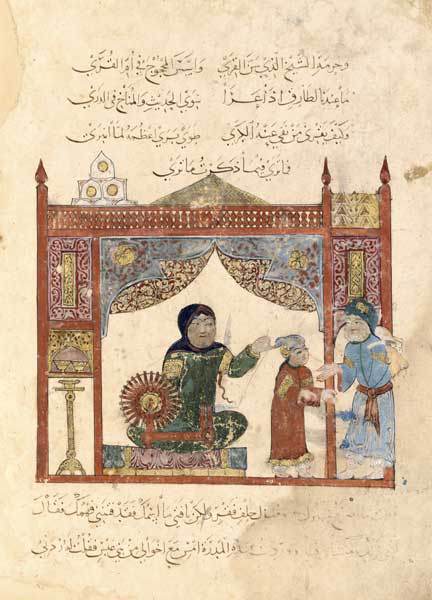
The wheel mattered more for cotton than for any other fibre. Cotton's short staple can be spun on a spindle, but slowly; the wheel multiplied a spinner's output and produced the soft, loosely twisted yarn that served as weft. When the tool kit reached Italy, it arrived complete — gin, bow, wheel, reel and treadle loom — together with the cloth types they had been built to make.1
The western gateway: Sicily, Apulia and the ports
Italians met cotton first in the zones where Islamic rule had planted it. In Sicily, Calabria and Apulia cotton was grown in the fields, and local weavers made cheap cloth, clothing and household goods for regional markets; in that region, Mazzaoui notes, cotton and linen appear to have overshadowed wool.1 Stephan Epstein's study of late medieval Sicily found its textile manufactures robust enough that the island's supposed "colonial" dependence on northern cloth does not stand up — a reminder that the south was a centre of its own, not only a field for the north.14
The ports of Genoa, Venice and Pisa, deep in the Levant trade, met cotton as merchandise: raw fibre, yarn and finished cloth. In Barcelona, Marseille and several Italian ports, artisans specialised in coarse cottons and sailcloth.1 By the twelfth century cotton was a familiar commodity on Mediterranean ships. What had not yet happened was the creation of a large industry that would turn imported fibre into cloth for distant markets. That happened in Lombardy.
The Po valley learns to weave cotton, 1100–1300
From the early twelfth century, Mazzaoui finds cotton weaving established beside wool in the towns of the Po valley — Genoa, Venice, Milan, Cremona, Piacenza, Pavia, Brescia, Monza, Bergamo, Parma, Mantua, Verona, Padua, Bologna — and, by the thirteenth, guilds of fustagnari, fustian-makers, in the major centres.12 Lombardy had what an imported fibre needed: flax for the warp, a female workforce already skilled in spinning, capital from merchants who had grown rich on wool, rivers and Alpine passes for distribution, and Venice and Genoa for supply. Mazzaoui treats the cotton towns of northern Italy as a single production zone, marked by close economic interdependence and a strong tendency to standardise their products.2
The new cloths were Islamic in model and often in name. The commonest, fustian, combined a linen warp with a cotton weft; its name is usually traced to Fustat, though Mazzaoui derives it from the Arabic fushtān. Cotone itself comes from Arabic quṭn; bambagia from Persian by way of Greek; and a series of other trade names kept the memory of where a cloth had first been made.1 Italian merchants launched cottons modelled on Islamic prototypes into European markets, and in doing so introduced most of Latin Europe to a fibre its grandparents had known only as a fable.17
The cotton cogs: Venice and Mamluk Syria
An industry that grew none of its own fibre depended on the sea. Raw cotton was light, bulky and cheap per sack, the opposite of the spices on which Venetian Levant trade had been built, and moving it profitably required ships, schedules and state organisation. Eliyahu Ashtor, who reconstructed this trade from the Venetian archives and the letters of the Datini company of Prato, found the Venetian authorities "taking measures to foster the importation of cotton from various Levantine countries" as early as 1295. Cotton was already worth fighting over: in 1308 a Genoese galley captured Venetian ships of the Sanudo and Soranzo firms carrying more than five hundred sacks of it.1215
The merchant manuals of the fourteenth century ranked the world's cotton by origin. Francesco Balducci Pegolotti, the Florentine banker who compiled La pratica della mercatura around 1340, gave this order, best first:16
| Rank (Pegolotti) | Origin | Pegolotti's note |
|---|---|---|
| 1 | Hama (Amanno), Syria | "la miglore ragione" — the best kind |
| 2 | Aleppo, Syria | like that of Hama |
| 3 | Armenia (Cilicia) | next after Hama and Aleppo |
| 4 | Damascus (lo Sciame), Syria | shorter staple |
| 5 | Acre, Syria | after Damascus |
| 6 | Cyprus | after Acre |
| 7 | Latakia (la Leccia), Syria | after Cyprus |
| 8 | Basilicata, Apulia | after the good cotton of Latakia |
| 9–11 | Malta, Calabria, Sicily | the lowest grades listed |
The table is a map of the transmission. The best fibre came from the Muslim interior of Syria; the Latin lands of southern Italy, where Islamic rule had planted cotton three centuries earlier, came last. Pegolotti's buying instructions — cotton should be white, full, free of seed, husk and leaf, and dry, and the buyer should insist that the middle and the ends of the sack match the sample he was shown — describe a bulk commodity, bought by the sack and never wholly inspected.16
The trade was disrupted in the 1360s by war between the Latin powers and the Mamluk sultanate, including the sack of Alexandria by Peter I of Cyprus in 1365; in 1367 Venice ran short of cotton and sent an extra cog to Alexandria to find some.12 When trade was restored, Venice organised a dedicated line. Every year at the end of January or the beginning of February a convoy of cogs left Venice to collect the cotton bought in Syria, and at the end of July a smaller convoy followed; in the 1390s the two together counted at least ten ships.12
Ashtor's figures for the cargoes show how large the trade became:1215
- 1380s: 5,000 sacks were an unusually large cargo for a single convoy; 3,000 made a poor one.
- End of the fourteenth century: about 8,000 sacks a year, in twelve or more cogs carrying 500–600 sacks each.
- 1386 and 1394: almost 10,000 sacks.
- 1400: almost 12,000 sacks.
A sack held about 144 kilograms. Ashtor reckoned the normal annual purchase at some 5,500 North Syrian qinṭārs worth perhaps 140,000 dinars — and part of it came from Cyprus, the only Latin-ruled source high on Pegolotti's list.12 The record's anchor year, 1400, is the year the cotton cogs carried the most.
What changed and what was replaced
A cloth for everyone
Silk had come to Italy as a luxury for elites who already bought luxury cloth. Cotton came the other way. Mazzaoui's central finding is that the Italian cotton industry was geared from the beginning to mass consumption: its success depended on creating demand for a new class of affordable fabric among people who had never worn it.1 Her 1972 article describes the north Italian cotton towns as producers of low-priced cloth for popular consumption.2
The range was wide. Italian workshops wove pure cottons and mixtures with warps of wool, silk, linen and hemp; sheer veils, napped fustians in plain colours, stripes, checks and ribs; heavy buckram, canvas and sailcloth; quilted bedcovers.1 Cotton needed fewer processing steps than wool, and the large centres produced in volumes woollen manufacture could not match: Venice more than 60,000 pieces of fustian a year in the late fourteenth century; Cremona over 60,000 bolts in the early fifteenth, of which some 40,000 went to Venice alone.1
The industry also gave Europe one of its first mass-market trademarks. Because cloths were standardised by the length, weight and count of their yarns, merchants could order them unseen across Europe; the quality of a brand was guaranteed by registered merchant marks and guild seals.1 A buyer in Vienna or Bruges who had never been to Milan knew what a Milanese mark meant — which is exactly why, as the cost section shows, it was worth counterfeiting.
The Lombard machine
What made the Lombard industry new was not the loom but the organisation around it. The work was divided across a whole region:1
- Supply: raw cotton bought in Venice or Genoa, graded by origin and never mixed across grades.
- Beating: urban artisans, battitori, opened the raw cotton with the bow.
- Spinning and warping: put out to peasant women in the flax districts around Milan, Novara, Pavia and Cremona, and supervised by wholesale thread merchants, filaroli or telaroli, who worked on commission or on their own account. The women spun cotton weft and prepared linen warp threads, cavezzi, to guild-prescribed lengths, weights and densities.
- Weaving, dyeing and pressing: in the towns, by masters of the fustian guild, financed through partnerships with merchant members.
- Bleaching: in the lake district, by contractors employing a seasonal, largely female workforce.
The standardisation reached into the tools. When Lombard artisans migrated to set up cotton weaving in the Veneto, Romagna, Tuscany, Umbria, the Marches and Lazio, the new centres aligned their measures, loom reeds and heddles to the Lombard standard, so that a warp prepared in a Lombard village could be woven on a loom in central Italy.117 Fustian workers organised in minor guilds or attached to the wool guilds can be found from Florence, Arezzo and Siena to Perugia, Assisi, Ancona and Rome.17 The so-called Perugia towels of the fifteenth and sixteenth centuries, with their bands of blue patterning, are among the best-known survivors of that Umbrian diffusion.

What cotton displaced
The new fibre did not abolish wool or linen. It took a share of each and changed what each was for.
| Before cotton | After the fustian industry |
|---|---|
| Linen for shirts, sheets, towels, underclothes | Linen increasingly sold as the warp of fustian; cotton and mixed cloths take the cheaper end of the linen market |
| Light woollens for ordinary outer wear | Fustians, napped and dyed, compete with light woollens on price and durability |
| Quilted armour padding of raw bambagia | Cotton becomes a cloth, not only a stuffing |
| Sailcloth of hemp | Cotton and cotton-hemp sailcloth for galleys and cogs |
| Flax-spinning as a household craft | Spinning for merchant middlemen, to guild specifications, for distant markets |
The last line of that table is the deepest change. Spinning had been part of the peasant household economy; under the fustian industry it became wage work, done at home but for a merchant, to a specification set in a town the spinner might never visit.1 In southern Europe, cotton and linen together came to rival wool in everyday dress, and the Italian industry's range of cheap, durable and varied fabrics permanently changed what Europeans expected to wear and how much they expected to pay for it.1
The Islamic origin did not survive in memory. Within two centuries fustian was a European cloth, made in Milan, Cremona and Ulm. Ashtor found the Venetians selling fustian from the north Italian industry in the Mamluk Levant in the early fifteenth century, alongside English and Irish serge, to the middle and lower strata of its towns.12
Over the Alps: Ulm, Augsburg and the Fuggers
The transmission did not stop in Lombardy. In the 1350s and 1360s the war between Venice and Louis the Great, king of Hungary — in which the emperor Charles IV and the leading south German towns, Nuremberg, Augsburg and Regensburg, sided with Hungary — and Charles IV's war against Bernabò Visconti of Milan cut German merchants off from Lombard fustian. They began to make their own. Ashtor dates the wave of foundations to about 1365: fustian weaving appears in Vienna in 1369, Augsburg in 1372, Nördlingen in 1373 and Landshut in 1375. The raw cotton was bought, as the Italians bought theirs, in Venice.1218
Wolfgang von Stromer, whose 1978 study of the founding of the central European cotton industry presents it as an act of late medieval economic policy, showed the Swabian industry growing out of the linen districts of the upper Danube — Ulm, Augsburg, Memmingen — exactly as the Lombard industry had grown out of Lombardy's flax.18 Its cloths were sold under four common brands, the ox, the lion, the grape and the wheel, across central and northern Europe.18
One immigrant to Augsburg in 1367 was a master weaver, Hans Fugger. The family firm's own history records that he did not sit at the loom himself: he advanced cotton and flax to weavers on credit and took their fustian in return, which he sold on at a profit.19 Two generations later, his grandson Jakob Fugger was the richest merchant-banker in Europe, and the fortune that had begun in putting out Syrian cotton to Swabian weavers was lending to emperors.
Syria becomes a supplier
At the eastern end of the system, cotton changed the land. Ashtor found that cotton plantations in Egypt and Syria were extended again at the end of the fourteenth and the beginning of the fifteenth centuries, and that in Palestine the increase "must have been particularly spectacular": western travellers around 1300 and Ibn Faḍl Allāh al-ʿUmarī around 1345 do not mention cotton there, but an Arabic author of the 1360s dwells on cotton planting in the district of Acre, and the Ottoman cadastres made after 1516 show cotton important around Acre, Nazareth, Safed and Jaffa.12 Much of that crop did not go to Syrian looms. "Although Syria and Palestine had their own cotton manufacturing plants," Ashtor wrote, "it seems that the greater part of the cotton crops was exported to Europe."12
Jong-Kuk Nam's study of the late medieval Mediterranean cotton trade, centred on the merchants of Venice, Genoa, Barcelona and Florence, follows the whole chain from consumption back to supply — the growing regions, the shipping and the provisioning of the manufacturing centres — and describes the same structure: a sea trade in raw fibre organised by Latin merchants for Latin manufacturing towns.20
A chronology of the transmission:
| Date | Event |
|---|---|
| first half of 6th millennium BCE | Cotton threads in a copper bead at Mehrgarh, Balochistan |
| 5th century BCE | Herodotus describes Indian "wool" that grows on trees |
| c. 700–1100 | Cotton becomes a mass crop across the Islamic world, from Iran to al-Andalus |
| 1237 | Earliest clear illustration of a spinning wheel, Baghdad |
| early 12th century | Cotton weaving established in the towns of the Po valley |
| 1295 | Venice acts to foster cotton imports from the Levant |
| c. 1340 | Pegolotti ranks the cotton of Hama the best in the Mediterranean |
| c. 1365–1375 | Fustian weaving founded in south German towns, on Venetian cotton |
| 1370s | Twice-yearly Venetian cotton convoy to Mamluk Syria established |
| 1400 | Venetian cotton cogs bring almost 12,000 sacks from Syria |
| early 15th century | Ashtor's "collapse" of Levantine industrial production |
What the cost was
No army carried cotton to Italy. The transmission was commercial, voluntary and, on its own terms, generous: it gave ordinary Europeans a cheap, washable, durable cloth they had never had. The bill was economic, and it was paid at both ends of the trade and along the way. It is smaller than the bills in many atlas records, and it should be stated at its true size.
The Levant's looms: decline or deindustrialisation?
The heaviest charge is the one most debated. Ashtor argued that at the beginning of the fifteenth century the industrial economy of Egypt and Syria broke down. "At the beginning of the fifteenth century a great change took place in the economic structures of the Near East: there was a sharp decline in industrial production," he wrote. "It would perhaps not be an exaggeration to speak of a collapse."12 His causes were several: labour costs that rose after the Black Death and the epidemics that followed it emptied the Levant's towns; dyes and other inputs that had to be imported from Europe at high cost; state interference and heavy taxation under the Mamluk regime; and the sale of the Levant's own raw materials — cotton first among them — to European industries instead of to its own.1221
The thesis has been contested for forty years. Maya Shatzmiller has called the supposed connection between European ascent and Islamic decline "a misconstrued link," pointing out that imports of European manufactures went together with continuing Levantine exports.22 Francisco Apellániz has read the late Mamluk economy as a successful transformation toward a state-directed system rather than a collapse. Georg Christ, reviewing the debate in 2016, concluded that the critics had not dismantled Ashtor's evidence, but that his word was wrong: "Although Ashtor's theses are factually sound, the notion of decline is misleading." Christ proposes deindustrialisation instead — Egypt and Syria handing parts of manufacturing to a junior partner, Venice and its hinterland, which took over the production of some goods and the supply of others.21

Whatever word is chosen, the shape of the exchange in cotton is not in dispute. By 1400 Venice was taking nearly 12,000 sacks of Syrian raw cotton a year, while fustian from the north Italian industry was being sold in the Levant.1221 Christ's own examination of Venetian cargo lists for 1419 finds upper German fustian and Italian cotton among the goods unloaded at Alexandria, and raw cotton among the goods loaded there.21 The pattern — fibre out, finished cloth in — was the one that later defined the global cotton economy.
The spinners in the countryside
The Lombard system rested on the labour of women it rarely named. Spinning and warp-making were put out to peasant women in the flax villages, paid through thread merchants who stood between them and the guild masters in town; bleaching on the lakes was seasonal, largely female work.1 The guilds legislated about these women constantly — the count of their yarn, the length and weight of their warps — and invoked them when it suited the guild.
In 1448, during the short-lived Ambrosian Republic, the fustian guild of Milan denounced the unlicensed export of cotton and linen yarn and warp threads to Cremona and Florence as a harm to the "innumerable poor persons" who lived by the Milanese industry. The republic's answer was a licensing regime enforced by fines: five florins for every set of warp threads and twenty soldi per pound of yarn carried out of the duchy without licence, and fifty gold ducats per bale for any fustian moved without trademarks and inspection seals.1 The "poor persons" in whose name the decree was issued were the people whose yarn it now held captive inside the duchy, to be sold only where the guild allowed.
That tension ran through the industry's whole history. When cotton weaving spread to Lombard boroughs and villages, the Milanese guild fought to keep beating, finishing and the final sealing of cloth in the city, and the rural workers fought back; the countryside eventually won, and by the late sixteenth century much of the industry had moved to towns such as Busto Arsizio and Gallarate.1 Each victory for one group of workers was a loss of livelihood for another.
Trade war, embargo and counterfeit
Cotton was strategic, and it was fought over:
- 1308: a Genoese galley seized Venetian ships carrying more than five hundred sacks of cotton.12
- 1338–1347: Milan's fustian-makers protested at rising prices for unfinished cloth and speculation in raw cotton; in 1347, months before the plague reached Lombardy, the guild capped weekly cotton purchases by members and limited each master to fifteen looms and each new entrant to four or five.231
- 1367: a shortage of cotton in Venice, as the new German industry competed with the Italian for Venetian supply; the Senate sent an extra cog to Alexandria.12
- 1373: the officials of the Fondaco dei Tedeschi in Venice complained that German merchants buying Levant cotton were making cheap imitations of Italian fustians with counterfeit copies of Italian trademarks, and barred them from exporting cotton beaten and spun in Venetian territory.18
- 1412–1413 and 1418–1433: Sigismund of Luxembourg, king of Hungary and later emperor, imposed what Stromer called a "continental blockade" on Venice and tried to route Levant cotton to the German industry through the Black Sea ports instead.24
The Venetian figures recorded by Doge Tommaso Mocenigo in 1421 show what was at stake: the cotton trade with Lombardy was worth 280,000 ducats a year, of which spun cotton yarn alone accounted for 30,000.25
The towns the industry left behind
The fustian industry moved, and each move left a wreck behind it. One of the first casualties was the cotton industry of Barcelona, which had worked cotton since before the Lombard boom. Squeezed between Italian and German imports, it collapsed: in 1441 the city council recorded that only six to ten workshops remained of the more than three hundred that had operated at the guild's height. A subsidy for 1,000 pieces a year was cut to 900 in 1443 and then abandoned, and the craft shrank to making sailcloth for the fleet.261
The Italian towns followed. The table shows the scale of the fall:
| Centre | Peak | Later |
|---|---|---|
| Barcelona | more than 300 cotton workshops | 6–10 workshops (1441) |
| Venice | more than 60,000 pieces a year (late 14th c.) | 170 looms, c. 5,100 pieces (1599) |
| Cremona | over 60,000 bolts a year, 40,000 to Venice (early 15th c.) | 138 firms (1627), 60 (1631), 41 (1648); 8,000 pieces for export, some 300 workers (1761) |
Sources: Carrère and Mazzaoui for Barcelona; Mazzaoui for Venice and Cremona.26117
The work did not vanish; it went to the countryside and to cheaper centres in Piedmont, Liguria and Swabia, where wages were lower and guild controls weaker. The people who paid were the urban artisans of the towns it left behind, and the guild masters of Cremona who in 1648 declared themselves too "poor and miserable" to pay their share of the levy.1
Even the German industry paid when the supply line broke. In the early 1570s, when the Ottoman conquest of Cyprus cut off one of its sources, the council of Ulm lifted its long-standing ban on spun Syrian cotton and on Brazilian cotton imported through Marseille.27 The second of those fibres points to the next chapter of cotton's history.
What the bill does not include
Honesty about cost requires stating its limits. The transmission itself took nothing by force. Cotton spread through the Islamic world as a crop farmers chose and a cloth consumers wanted, and it reached Italy by trade with partners who sold willingly and were paid for it. The Levant's industrial difficulties had many causes, plague and Mamluk fiscal policy among them, and European demand for raw cotton was only one.21 Sicily and southern Italy, which grew the lowest grades on Pegolotti's list, kept textile industries of their own.14
Nor does this record carry the far heavier bill of cotton's later history. Giorgio Riello calls the period from about 1000 to 1500 "the first cotton revolution," a dispersed, many-centred system with India at its heart.7 The system that replaced it after 1500 — European manufacturing fed by plantation cotton grown by enslaved Africans in the Americas, and Indian handloom industries undercut by British mills — was built on violence of another order, which Sven Beckert calls "war capitalism."28 That bill belongs to other records. What the medieval transmission contributed was the template: manufacture at the centre, fibre from someone else's fields, and an industry that moved on whenever another town could make the same cloth more cheaply.
What followed
-
-5500In the first half of the sixth millennium BCE, cotton threads are buried in a copper bead in a grave at Mehrgarh in Balochistan — the oldest cotton known from the Indian subcontinent, preserved by the corrosion of the metal.
-
-430Herodotus describes India as the land where wool finer than sheep's wool grows on wild trees and clothes the Indians. For fifteen hundred years Latin Europe knows cotton mainly as a marvel and an import.
-
900Across the ninth and tenth centuries cotton becomes a mass summer crop of the Islamic world. In Iran, on Richard Bulliet's reading, a cotton boom makes the region the richest in the caliphate; cotton becomes an everyday cloth from Khurasan to al-Andalus.
-
1237In Baghdad, Yaḥyā al-Wāsiṭī paints a spinning wheel in a copy of al-Ḥarīrī's Maqāmāt — the earliest clear picture of the tool that Italy's cotton spinners will inherit, along with India's roller gin and bow.
-
1130From the early twelfth century the towns of the Po valley — Milan, Cremona, Pavia, Piacenza, Venice, Genoa and others — weave cotton beside wool. Fustian, a linen warp with a cotton weft modelled on Islamic cloth, becomes Latin Europe's first mass-market cotton fabric.
-
1295Venice acts to foster cotton imports from the Levant. In 1308 a Genoese galley seizes Venetian ships carrying more than five hundred sacks of cotton: the raw fibre has become worth fighting for.
-
1340Francesco Balducci Pegolotti's merchant manual ranks the cotton of Hama in Syria the best in the Mediterranean and that of Sicily, Calabria and Malta the lowest — a map of a supply that runs from the Muslim Levant to Latin manufacturing towns.
-
1347Months before the plague reaches Lombardy, the fustian guild of Milan caps its members' weekly cotton purchases and limits each master to fifteen looms, blaming speculation in raw cotton for its costs.
-
1367Cut off from Lombard fustian by war, south German towns found their own industry on Venetian cotton — Vienna 1369, Augsburg 1372, Nördlingen 1373. In 1367 the master weaver Hans Fugger moves to Augsburg and begins putting out cotton to weavers on credit.
-
1400Venice's twice-yearly convoy of cotton cogs, running to Mamluk Syria since the 1370s, brings home almost 12,000 sacks of raw cotton, the peak of the trade. Ashtor finds that most of Syria's and Palestine's cotton crop is now exported to Europe.
-
1412Sigismund of Luxembourg imposes an embargo on Venice (1412–1413, renewed 1418–1433) and tries to route Levant cotton to the German industry through the Black Sea ports — cotton has become an instrument of continental trade war.
-
1441Barcelona's council records that only six to ten cotton workshops remain of more than three hundred at the guild's height, crushed between Italian and German imports. The craft is reduced to sailcloth for the fleet.
-
1448Milan's fustian guild, speaking for the 'innumerable poor persons' of the industry, wins a licensing regime that fines the unlicensed export of yarn and warp threads — the village spinners' work is held inside the duchy by law.
Where this lives today
References
- Mazzaoui, Maureen Fennell. The Italian Cotton Industry in the Later Middle Ages, 1100–1600. Cambridge: Cambridge University Press, 1981. en
- Mazzaoui, Maureen Fennell. "The Cotton Industry of Northern Italy in the Late Middle Ages: 1150–1450." Journal of Economic History 32.1 (1972): 262–286. en
- Herodotus. The Histories 3.106. Translated by A. D. Godley. Loeb Classical Library. Cambridge, MA: Harvard University Press, 1920. Perseus Digital Library edition. grc primary
- Pliny the Elder. Naturalis historia 19.2.14 (on gossypion / xylon in Upper Egypt). Translated by H. Rackham. Natural History, vol. V. Loeb Classical Library. Cambridge, MA: Harvard University Press, 1950. la primary
- Decker, Michael. "Plants and Progress: Rethinking the Islamic Agricultural Revolution." Journal of World History 20.2 (2009): 187–206. en
- Moulherat, Christophe, Margareta Tengberg, Jérôme-F. Haquet, and Benoît Mille. "First Evidence of Cotton at Neolithic Mehrgarh, Pakistan: Analysis of Mineralized Fibres from a Copper Bead." Journal of Archaeological Science 29.12 (2002): 1393–1401. en
- Riello, Giorgio. Cotton: The Fabric that Made the Modern World. Cambridge: Cambridge University Press, 2013. en
- Barnes, Ruth. Indian Block-Printed Textiles in Egypt: The Newberry Collection in the Ashmolean Museum. 2 vols. Oxford: Clarendon Press, 1997. en
- Watson, Andrew M. Agricultural Innovation in the Early Islamic World: The Diffusion of Crops and Farming Techniques, 700–1100. Cambridge: Cambridge University Press, 1983. (Developing "The Arab Agricultural Revolution and Its Diffusion, 700–1100," Journal of Economic History 34.1, 1974.) en
- Ibn al-ʿAwwām. Kitāb al-filāḥa (late 12th century), ch. 22 (flax, hemp, cotton and other fibre crops). Translated by J.-J. Clément-Mullet as Le livre de l'agriculture d'Ibn-al-Awam. 2 vols. Paris: A. Franck, 1864–1867. fr primary
- Bulliet, Richard W. Cotton, Climate, and Camels in Early Islamic Iran: A Moment in World History. New York: Columbia University Press, 2009. en
- Ashtor, Eliyahu. Levant Trade in the Later Middle Ages. Princeton, NJ: Princeton University Press, 1983. (Cotton convoys pp. 114–115; cotton cargoes c. 1380–1400 pp. 188–189; decline of Levantine industries pp. 200–201.) en
- Pacey, Arnold. Technology in World Civilization: A Thousand-Year History. Cambridge, MA: MIT Press, 1990, pp. 23–24. en
- Epstein, Stephan R. "The Textile Industry and the Foreign Cloth Trade in Late Medieval Sicily (1300–1500): A 'Colonial Relationship'?" Journal of Medieval History 15 (1989). en
- Ashtor, Eliyahu. "The Venetian Cotton Trade in Syria in the Later Middle Ages." Studi Medievali, 3rd ser., 17 (1976): 675–715. Reprinted in Studies on the Levantine Trade in the Middle Ages. London: Variorum, 1978. en
- Pegolotti, Francesco Balducci. La pratica della mercatura (c. 1340). Edited by Allan Evans. Cambridge, MA: Mediaeval Academy of America, 1936, pp. 366–367 ("Cotone mapputo, cioè bambagia in lana"). it primary
- Mazzaoui, Maureen Fennell. "La diffusione delle tecniche tessili del cotone nell'Italia dei secoli XII–XVI." In Tecnica e società nell'Italia dei secoli XII–XVI: Atti dell'undicesimo Convegno internazionale di studio, Pistoia, 28–31 ottobre 1984. Pistoia, 1987. it
- Stromer, Wolfgang von. Die Gründung der Baumwollindustrie in Mitteleuropa: Wirtschaftspolitik im Spätmittelalter. Stuttgart: Anton Hiersemann, 1978. de
- Fürstlich und Gräflich Fuggersche Stiftungen. "The Fugger Family Firm: The Most Important Firm of Its Time." fugger.de, accessed 9 October 2026. en
- Nam, Jong-Kuk. Le commerce du coton en Méditerranée à la fin du Moyen Âge. The Medieval Mediterranean 68. Leiden: Brill, 2007. fr
- Christ, Georg. "Decline or Deindustrialization? Notes on the Entangled Histories of Levantine and European Industries in the Late Middle Ages." Comparativ 26.3 (2016): 25–44. en
- Shatzmiller, Maya. "A Misconstrued Link: Europe and the Economic History of Islamic Trade." In Relazioni economiche tra Europa e mondo islamico, secc. XIII–XVIII, edited by Simonetta Cavaciocchi. Atti delle Settimane di Studi 38. Florence: Istituto Internazionale di Storia Economica "F. Datini", 2007. en
- Barbieri, Gino. Origini del capitalismo lombardo: studi e documenti sull'economia milanese del periodo ducale. Milan, 1961. it
- Stromer, Wolfgang von. "Die Kontinentalsperre Kaiser Sigismunds gegen Venedig 1412–1413, 1418–1433 und die Verlagerung der transkontinentalen Transportwege." In Trasporti e sviluppo economico, secoli XIII–XVIII, edited by Anna Vannini Marx. Atti della Quinta Settimana di Studio, Istituto Internazionale di Storia Economica "F. Datini". Florence, 1986. de
- Sanuto, Marino. Vite de' duchi di Venezia (oration of Doge Tommaso Mocenigo). In L. A. Muratori, ed., Rerum Italicarum Scriptores, vol. XXII, col. 954. Milan, 1733. it primary
- Carrère, Claude. Barcelone, centre économique à l'époque des difficultés, 1380–1462. 2 vols. Paris and The Hague: Mouton, 1967, pp. 370–371. fr
- Nübling, Eugen. Ulms Baumwollweberei im Mittelalter. Leipzig, 1890, pp. 166–169. de
- Beckert, Sven. Empire of Cotton: A Global History. New York: Alfred A. Knopf, 2014. en