Byzantium gave the Slavs an alphabet (863) and took their gods
Two brothers from Thessalonica built a script for a language that had none, and translated the Gospels into it. Within a year of the survivor's death the mission was banned, its clergy expelled, and its youngest members sold at the Venice slave market. The alphabet outlived everyone.
In 862 Rastislav of Moravia asked the emperor at Constantinople for teachers who could instruct his people in their own tongue — not because Moravia lacked Christianity, but because its priests were Frankish. Constantinople sent Constantine and Methodius, brothers from Thessalonica. Before leaving, Constantine built an alphabet from scratch for a language that had never been written: Glagolitic, forty-odd letters, fitted to Slavic sounds Greek could not spell. They arrived in 863 and translated the Gospels, the Psalter and the liturgy. Constantine died in Rome in 869; Methodius was imprisoned in Swabia for two and a half years by Frankish bishops and died in 885. Within months the Slavonic liturgy was banned, his disciples were expelled, and the youngest were sold at Venice. The survivors rebuilt the project in Bulgaria, where a second alphabet was made and named for a man who had not invented it. Around 250 million people read it today.

Before: a people described only by others
In the middle of the ninth century the Slavic-speaking peoples occupied a belt of Europe running from the Elbe to the Dnieper and from the Baltic down to the Peloponnese, and not one of them could write their own language. This is not a rhetorical flourish. It is a documented condition, and the man who documented it was a Bulgarian monk who signed himself Chernorizets Hrabar — "Hrabar the Black-Robed" — writing at the very end of that century, within living memory of the change. Before baptism, he says, the Slavs had no letters at all, and reckoned and divined "with strokes and incisions" — črъty i rězy — and when they became Christians they were forced to write Slavic speech with Roman and Greek letters, without system, and badly 9.
That sentence is the whole of the pre-transmission record from the inside. Everything else we know about the Slavs of 850 was written by Greeks, Franks, Latins and Arabs, in Greek, Latin and Arabic, about a people they regarded variously as a nuisance, a mission field, a military problem, and a commodity. Florin Curta has argued at length that even the category "Slav" is largely a Byzantine administrative invention — a label imposed from the outside on populations of the lower Danube that had no shared name for themselves 13. Whether or not one accepts the strong form of that argument, its underlying observation is unarguable: the Slavs enter European history as an object of other people's prose.
Counted by strangers
Because the Slavs did not count themselves, they were counted. Somewhere at Reichenau between the 830s and the 850s — Bernhard Bischoff's dating, based on the hand — a monk compiled the short Latin list now called the Descriptio civitatum et regionum ad septentrionalem plagam Danubii, the "Description of cities and lands north of the Danube", known to scholarship as the Bavarian Geographer. It enumerates dozens of Slavic peoples along the Frankish frontier and, beside each name, the number of civitates — strongholds, or districts — that each was reckoned to hold 8. It is an inventory, and it reads like one: the document does not ask what these peoples called themselves or believed, only how many fortified places would have to be taken.
The Arabic-language geographers of the same century, working from the other end of the trade routes, produce a similar effect from a different angle: descriptions of Slavic funerary practice, kingship and settlement, written by men who knew Slavs mainly as merchandise moving south. Between the Frankish inventory and the Arabic ethnography there is a great deal of information about ninth-century Slavs and not one sentence of it in their own words. Historians of every other major European people can, at some point, put down the outsiders' accounts and pick up an insider's. For the Slavs before 863 there is nothing to pick up.
What they had instead
The absence of writing was not an absence of complexity. The archaeology of the ninth-century middle Danube shows a stratified, militarised, wealthy polity. At Mikulčice on the river Morava — the best-excavated seat of the Moravian princes, dug continuously since 1954 — archaeologists have uncovered twelve churches and more than 2,500 graves, with grave goods that separate a warrior-and-court elite from everyone else with brutal clarity: gilded spurs, Carolingian swords, silver-gilt gombíky buttons, and jewellery whose Byzantine and Frankish parentage is visible at a glance 17. This was not a periphery waiting to be discovered. It was a node.

What it lacked was a way of fixing anything in words. That absence had four practical consequences, each of which the mission of 863 would address:
- No law that outlived the man who declared it. Moravian custom was memory, and memory is negotiable.
- No liturgy in a language anyone in the congregation understood. Frankish priests said Mass in Latin to Slavic-speaking villages.
- No theology that could be argued in Slavic. The vocabulary for trinity, grace, resurrection and sin did not exist, and would have to be built.
- No account of themselves. Whatever the Moravians believed about their own origins, gods and dead was told aloud and died with the tellers.
A religion that left no book
The last of these is the atlas's real subject in this section, because it is the one thing the transmission destroyed absolutely. There is no pre-Christian Slavic scripture, no ritual text, no theogony, no prayer. The entire reconstructed pantheon — Perun the thunderer, Veles the cattle-god of the underworld, Svarog, Mokoš — comes to us through the writings of the men who came to abolish it. Juan Antonio Álvarez-Pedrosa's Brill compendium of 2021 assembles every known medieval source on Slavic pre-Christian religion in its original language: the entire corpus fits in one volume of 548 pages, written across seven languages by outsiders and converts between the ninth and fifteenth centuries 11. There is nothing else. There will never be anything else.
So the "Before" section of this record has a peculiar shape. We can describe with precision what the Moravian elite wore, ate, and was buried with; we can date their churches and count their horses. We cannot say with any confidence what they thought happened when they died. The alphabet that arrived in 863 made the Slavs recordable — and by the time anyone was writing Slavic down, the only Slavs permitted to write were Christian ones, and the thing they wrote first was a Gospel.
The Franks were already there
One more piece of the pre-transmission picture matters, because without it the mission looks like charity rather than politics. Moravia in 862 was already Christian, at least officially. Missionaries from Salzburg and Passau had been working the middle Danube for two generations; the Conversio Bagoariorum et Carantanorum, compiled at Salzburg in 870, is essentially an archdiocesan property claim dressed as a mission history, asserting Salzburg's jurisdiction over Pannonia against all comers 8. Moravian princes were baptised. Moravian churches were built. What Moravia did not have was a church of its own, staffed by its own clergy, answering to anyone other than the East Frankish bishops whose king had invaded Moravia three times in twenty years.
That is the situation into which Rastislav, prince of the Moravians, sent an embassy to Constantinople in 862.
The transmission: two brothers from Thessalonica
The Vita Methodii, written by a disciple within a year or two of Methodius's death in 885, preserves what it says was Rastislav's message to the emperor Michael III. The wording is worth quoting exactly, because it is the founding document of Slavic literacy and it is, transparently, a diplomatic instrument:
"We have prospered through God's grace, and many Christian teachers have come to us from among the Italians, Greeks and Germans, teaching us in various ways. But we Slavs are a simple people, and have no one to instruct us in the truth, and explain wisely. Therefore, O kind lord, send the type of man who will direct us to the whole truth." 1
Note what the message concedes and what it asks. It concedes that teachers have already come — Italians, Greeks, Germans. It asks not for Christianity, which Moravia has, but for instruction "in the truth" by someone who is not a Frank. The self-deprecation ("we Slavs are a simple people") is the standard register of a petitioner to the Roman emperor at Constantinople. Vladimír Vavřínek's 2013 study makes the political architecture explicit: the mission's fate was bound from the first day to Moravia's struggle for independence from the Frankish empire, and to the parallel contest between Constantinople and Rome for jurisdiction over Bulgaria 6.
Michael's calculation
Byzantium's motives were not evangelical either. Sergey Ivanov's study of Byzantine missionary practice — the standard Russian-language treatment — argues that the empire had no systematic missionary programme at all, and that Byzantine outreach to barbarians was almost always an instrument of statecraft activated when a diplomatic opening appeared 7. In 862 the opening was large. Rastislav was offering the emperor a client church on the Frankish frontier, in the same years that Boris of Bulgaria was manoeuvring between Constantinople, Rome and East Francia over the same question. Ihor Ševčenko put the point without decoration: the main purpose of those who dispatched Cyril and Methodius "may have been the furtherance of Byzantium's ideological and cultural interests" 5.
The emperor Michael III and the patriarch Photios chose two brothers from Thessalonica. Constantine — the younger, a philosopher and librarian, veteran of embassies to the Arabs and the Khazars, on which last journey he had recovered relics he identified as those of Clement, the martyred first-century bishop of Rome — and Methodius, the elder, a former provincial administrator in a Slavic-speaking district who had left office for a monastery. Thessalonica's hinterland was Slavic-speaking; the brothers had grown up hearing it. That is the whole of the qualification, and it was decisive.
The philosopher before Moravia
Constantine was not an obvious choice for a frontier mission, and understanding why he was sent explains a great deal about what the mission became. He had been educated at the imperial school in Constantinople alongside the future emperor, had held the chair of philosophy there, and had served as librarian at Hagia Sophia. He had also already done this work twice.
The first time was an embassy to the Arabs, probably in the 850s, where the Vita has him disputing points of theology at a caliphal court. The second was the Khazar mission of around 860–861, north to the steppe khaganate between the Black Sea and the Caspian, whose elite had adopted Judaism and whose court was being courted simultaneously by Christian, Jewish and Muslim envoys. Constantine argued there too. By the Vita's own accounting the diplomatic result was modest — roughly two hundred baptisms — but he came back with something the empire valued more: relics he identified, near Cherson in the Crimea, as those of Clement, the first-century bishop of Rome martyred in exile there 1.
Three things about that career shaped 863. He was a professional disputant, trained to argue Christianity across a language and a religion, which is what he would do at Venice and at Rome. He had worked among peoples whose languages had scripts of their own — Khazars, Armenians, Georgians, Goths — which is why his list of writing peoples came so readily to hand. And he was carrying, physically, a papal saint. When he walked into Rome in 867 with a Slavic Gospel book in one hand and Clement's bones in the other, the second item was what made the first negotiable.
The alphabet Constantine made
The Vita Constantini records Constantine's first response to the commission as a question that has become one of the most quoted sentences in Slavic letters: "Who can write a language on water and acquire for himself a heretic's name?" 1 Both halves are precise. Writing Slavic was technically hard, and doing it was doctrinally dangerous.
He did it anyway, and he did something more radical than the commission required. He could have adapted the Greek alphabet, as the Slavs were already doing informally and badly. Instead he built a new one from first principles. Glagolitic — from glagolъ, "word", "utterance" — has around forty letters and looks like nothing else in the Mediterranean world: circles, triangles, loops. Its letterforms do not derive transparently from Greek, Latin, Hebrew or Coptic, and a century and a half of paleographic argument has not settled where they came from. What is not in dispute is the phonological work. Slavic had sounds Greek could not write — the nasals ǫ and ę, the reduced vowels ъ and ь, the affricates č, ž, š, ц — and Constantine gave each of them a sign. Horace Lunt's grammar, the standard English-language description of the language, sets out a system in which the fit between sign and sound is close to exact 14.
The first sentence translated into Slavic was the opening of the Gospel of John: Iskoni bě slovo — "In the beginning was the Word, and the Word was with God, and the Word was God" 1. The choice was not accidental. Constantine also composed, or is credited with, the Proglas, a verse preface to the Gospels that is the first original poem in any Slavic language: an argument, in Slavic, that Slavs should read in Slavic.
The brothers arrived in Moravia in 863 with a script, a Gospel book, and a programme. They stayed roughly forty months, and in that time they did the following:
- Translated the Gospels, the Psalter, and the liturgical offices into Slavic.
- Trained a body of native Moravian clergy who could read them.
- Established a school — later Moravian tradition calls it an academy — where the script was taught.
- Began the translation of the Nomocanon, the Byzantine collection of church law, giving the Slavs a written legal vocabulary for the first time.
- Went to Rome to get all of it authorised.
Rome, and the men who said only three languages counted
The doctrinal danger Constantine had named in his first answer arrived on schedule. The Frankish clergy of the middle Danube held what its opponents called the trilingual doctrine: that God could be worshipped only in Hebrew, Greek and Latin, the three languages of the inscription Pilate had nailed above the cross. The Vita Methodii states the position in its opponents' own words — that "except for the Jews, Greeks, and Latins, it is improper for any people to have their own letters, according to the inscription which Pilate had written on the Lord's cross" 1.
Constantine confronted the trilingualists in Venice in 867, in front of an assembly of bishops, priests and monks. His counter-argument, as the Vita preserves it, ran on three tracks:
- Precedent. He listed the peoples who already worshipped in their own scripts: "Armenians, Persians, Abkhazians, Iberians, Sogdians, Goths, Avars, Turks, Khazars, Arabs, Egyptians, and many others" 1. The trilingual rule was not the practice of the universal church; it was a local Frankish habit.
- Nature. "Does not God's rain fall upon all equally? And does not the sun shine also upon all?" 1
- Scripture. He quoted Paul against them — "I would that ye all spake with tongues, but rather that ye prophesied" 1 — turning the apostle's ranking of gifts into an argument for vernacular worship.
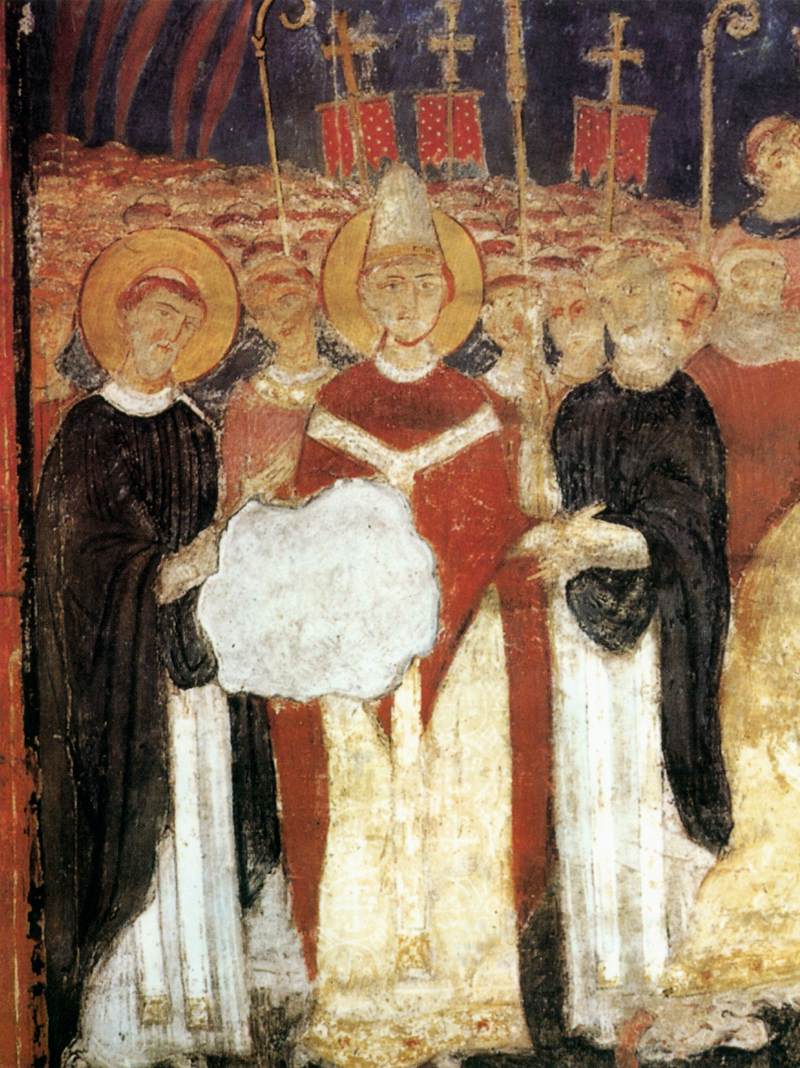
Then he went to Rome and won. Hadrian II, who had received from Constantine the relics of Pope Clement recovered in the Crimea, approved the Slavonic books and had them laid on the altar of Santa Maria Maggiore. It is worth being exact about the transaction: a Byzantine philosopher secured papal authorisation for a Slavic liturgy, in Rome, partly by handing the papacy the bones of one of its own first-century martyrs. Constantine did not leave. He took monastic profession, adopted the name Cyril, and died in Rome on 14 February 869, aged forty-two. He is buried in the basilica of San Clemente, in the church of the saint whose relics he had carried across Europe 1 2.
Methodius in a Swabian cell
Methodius went back alone, consecrated archbishop of Pannonia and Moravia with a jurisdiction that cut directly across Salzburg's claims. The Frankish bishops responded as a corporate body. Around 870 they seized him, tried him at a synod before Louis the German, and — in the Vita Methodii's account — "banished to Swabia, and detained for two and a half years" 1. He was released only when Pope John VIII laid an interdict on the bishops responsible, forbidding them to celebrate Mass until they let him go. The Vita adds, with evident satisfaction, that four of them died 1.
Francis Dvornik's 1970 reconstruction, still the fullest treatment in English, follows the sequence through papal letters preserved in the Roman registers: John VIII's bull Industriae tuae of 880 confirming the Slavonic liturgy to Svatopluk, and the counter-current of Frankish pressure that never stopped running underneath it 2. Methodius spent his last decade translating — the Vita credits him and two stenographers with rendering nearly the whole Bible in eight months — and fighting a suffragan bishop, the Swabian Wiching of Nitra, who was working steadily to destroy him. He died on 6 April 885. Before dying he named as his successor Gorazd, "a free countryman of yours who is Orthodox and well versed in Latin letters" 1 — a native Moravian, chosen precisely because he could not be dismissed as a Greek.
The succession lasted a matter of months.
What changed and what was replaced
The liturgy people could hear
The immediate change was audible. From 863 a Slavic-speaking congregation in Moravia could hear the Gospel, the Psalms and the eucharistic prayers in words they used at home. Nothing comparable existed anywhere in Latin Europe. The Roman rite was in Latin, which by the ninth century no European congregation outside Italy spoke; vernacular preaching existed, vernacular liturgy did not. Old Church Slavonic became, alongside Latin and Greek, the third liturgical and literary language of Europe — and the only one of the three that had been built, deliberately, for the people who were going to use it. Anthony-Emil Tachiaos frames the brothers' whole enterprise as an act of acculturation rather than conversion: Moravia was not being made Christian, it was being made able to be Christian in its own voice, which is a different and more invasive operation 4.
The second change was legal and administrative. The Nomocanon translation gave Slavic a written vocabulary for jurisdiction, penalty, testimony and precedent; the Zakon sudnyj ljudem, the earliest Slavic law code, follows Byzantine models in a Slavic idiom. A prince who could issue a written instrument was a different kind of prince from one who could not.
The third was lexical, and it is the most durable. To translate the Greek scriptures Constantine and Methodius had to manufacture Slavic words for concepts the language had no terms for. Much of the abstract vocabulary of every modern Slavic language — the words for conscience, grace, mercy, nature, essence, resurrection — descends from ninth-century calques on Greek made by two brothers under deadline. Lunt's grammar catalogues the machinery 14. Simon Franklin's study of writing in early Rus traces what that inheritance did four centuries later and a thousand miles north-east, where a Slavonic literary language arrived fully formed and was simply adopted 16.
The night of 885, and the road south
Then it was destroyed. Within months of Methodius's death, Pope Stephen V reversed Rome's position: his letter to Svatopluk of September 885 forbade the celebration of the divine service in Slavic, permitting the language only for preaching and for explaining the Gospel to the uneducated, and instructing that disobedient clergy be expelled from the church and from the country 2 8. Wiching, who had spent a decade undermining Methodius, was now the man enforcing the ban. Gorazd, the successor Methodius had named, disappears from the record.
What happened next is described in the Vita Clementis, a Greek life of Clement of Ohrid attributed to Theophylact, archbishop of Ohrid around 1100. The disciples were arrested. Dvornik notes that the blow fell hardest on those who were Byzantine subjects and therefore had no local protection — "Clement, Angelarius, Naum, and Laurentius — and to the native Gorazd" 2. The senior men were driven out of Moravia in winter. The younger ones, according to the Vita, were taken to Venice and sold at the slave market, and were bought back only because an official of the Byzantine emperor happened to be in the city and recognised what he was looking at 10.
That episode should be handled carefully — the Vita Clementis was written roughly two centuries after the events it describes, by a Greek archbishop with an interest in Byzantine martyrdom, and no independent source confirms the sale. But it is not implausible, and that is the point. Ninth-century Venice was one of the principal transit markets for slaves moving from central Europe to the Islamic Mediterranean. Michael McCormick's reconstruction of early medieval commerce identifies this traffic as one of the motors of Venetian and Carolingian economic revival, with Slavs supplying so large a share of the human cargo that the ethnonym replaced the older Latin word for a slave in most of the languages of Europe 15. Greek sklavos, Latin sclavus, Arabic ṣaqāliba: the modern English word slave is the name of these people. Constantine had argued the trilingual bishops down in Venice in 867. Nineteen years later, his students were for sale there.
Preslav: the second alphabet
Clement, Naum and Angelarius went south to Bulgaria, where Boris I — baptised in 864, ruling a state whose Bulgar elite and Slavic majority he was trying to weld into one Christian people — received them as an asset. He was right. The refugees became the founders of the most productive literary workshop in early medieval Europe. Jonathan Shepard's survey of the ninth-century Slavs and Bulgars sets out why the offer was irresistible on Boris's side: a Turkic-speaking Bulgar warrior elite ruling a Slavic-speaking majority needed a single religious language that belonged to neither Constantinople nor Rome, and the expelled Moravians arrived carrying exactly that 20.
The sequence is compressed and consequential:
| Year | Event |
|---|---|
| 864 | Boris of Bulgaria is baptised, taking the emperor Michael III's name |
| 866 | Pagan boyar revolt crushed; fifty-two leading boyars killed with their families |
| 885–886 | The Slavonic liturgy is banned in Moravia; Methodius's disciples expelled |
| 886 | Naum and others establish a literary school at Pliska; Clement is sent west to Kutmichevitsa |
| 889 | Boris abdicates for a monastery; his son Vladimir-Rasate attempts a pagan restoration |
| 893 | Boris returns, deposes and blinds Vladimir; Simeon becomes ruler |
| 893 | Council of Preslav: the capital moves to Preslav, Slavonic replaces Greek as the language of church and state, Byzantine clergy are replaced by Slavic ones, Clement is made bishop |
| c. 893–900 | Cyrillic is systematised at the Preslav school and begins to displace Glagolitic |
The last line is the one most often got wrong. Cyril did not invent Cyrillic. He invented Glagolitic. Cyrillic — the script now used by something on the order of a quarter of a billion people — was assembled at Preslav in the 890s, after his death, by scholars who took the Greek uncial majuscules for the sounds Greek had and kept a dozen Glagolitic letters for the sounds it did not. Then they named it after him. Clement of Ohrid is traditionally credited with the invention, and the tradition is old, but the attribution is disputed and probably belongs to the Preslav school collectively rather than to any one man 3 21. The record should say so plainly rather than smoothing it.
Glagolitic did not vanish at once. It survived in Bulgaria into the eleventh century, and on the Adriatic coast for eight hundred years more: the Missale Romanum Glagolitice of 1483 was the first missal printed anywhere in Europe in a script other than Latin, and Glagolitic remained in Croatian liturgical use into the twentieth century 22. But in the Orthodox Slavic world Cyrillic won, and it won because Preslav, not Moravia, became the place where Slavic books were made.
Ohrid, and the machinery of mass literacy
The Bulgarian phase is where the transmission stops being an élite project and becomes an industrial one. Boris sent Clement west in 886 to Kutmichevitsa, the south-western district of the Bulgarian realm around Ohrid and Devol, with a mandate to teach. Clement built two parallel schools, one for adults and one for children, and the Vita Clementis records that in the seven years between 886 and 893 he trained some three thousand five hundred pupils in the Slavonic language and the Glagolitic script 10 3.
The figure should be held at arm's length — it comes from a hagiography written two centuries later, and round numbers in hagiography are rhetorical as often as they are statistical. But even discounted heavily it describes something without parallel in ninth-century Europe: a state-sponsored programme of vernacular literacy, aimed at ordinary people rather than at clerks, staffed by refugees, producing enough trained readers in seven years to supply a national church. Naum ran the eastern half of the same operation from Pliska and then Preslav 3 21. Nothing comparable was attempted in Latin Europe for another six hundred years.
The output is what Ševčenko meant by his third paradox — that "the peak achievements of Old Church Slavonic literature stand at its difficult beginnings, not at the end of a leisurely development" 5. Within two generations of a language acquiring its first alphabet, Slavic writers were producing original homilies, hagiography, polemic and verse of a quality that later centuries did not surpass. The surviving manuscript witnesses are correspondingly early: the Kiev Folios, a Glagolitic mass-book of the tenth century now in Kyiv, and the Codex Zographensis, a Glagolitic tetraevangelion of the tenth or eleventh century that spent centuries at the Zograf monastery on Mount Athos and is now in St Petersburg 14.
The northern inheritance
Four generations later the whole apparatus was exported north, intact and free. When Vladimir of Kyiv accepted Christianity for the Rus around 988, he did not commission a translation programme, invent a script, or coin theological vocabulary. All of it already existed, in a Slavic close enough to the East Slavic of Kyiv to be read without difficulty. Simon Franklin's study of writing in early Rus describes a literate culture that begins not with laborious first steps but with a complete inherited toolkit — scriptures, liturgy, law, chronicle conventions and a supply of trained Bulgarian clergy — installed within a generation 16. The birchbark letters excavated at Novgorod, in which eleventh-century townspeople write to each other about debts, marriages and errands in ordinary Cyrillic, are the downstream evidence of how far and how fast that toolkit spread.
This is the sense in which Ševčenko's corollary bites. The mission was sent to Moravia. Moravia lost it within a year of Methodius's death and lost its own existence within twenty-five. The inheritance went to the people it was never aimed at.
What the letters displaced
Set against the gains, the displacements are stark and mostly irreversible:
- The oral religious system. Not modified — deleted. No Slavic pagan text exists in any script, because the script arrived in the hands of the men suppressing the religion 11.
- The Frankish-Latin settlement in Moravia — replaced for twenty-two years, then violently reimposed.
- Glagolitic itself, displaced by the daughter script named for its inventor, and surviving only on the Adriatic margin.
- Greek as the language of the Bulgarian church, expelled by the Council of Preslav in 893 along with the Greek clergy who spoke it.
- The tribal-aristocratic order of pagan Bulgaria, whose leadership was physically eliminated in 866.
- Any possibility of a single Slavic Christendom. The Moravian church died; Bohemia and Poland went Latin; Bulgaria, Serbia and later Rus went Orthodox and Cyrillic. The confessional and alphabetic border laid down in these decades still runs through the middle of Europe.
What the cost was
This record's cost severity is 3, and the reasoning is worth setting out, because a reader who has followed the story so far may reasonably think the number should be lower. There was no invasion. Byzantium did not conquer Moravia; it sent two scholars. Nobody was killed to make the alphabet, and the receiving princes asked for what they got. Judged as an act, the transmission of 863 is one of the least coercive in this atlas.
The cost is in the settlement, not the act. Making a people literate in the language of a revealed religion means making them literate as adherents of that religion, and the cost falls on everyone in that society who was not one — plus, in this case, on the missionaries themselves.
The named violences
The documented human cost of the Christian-linguistic settlement of the Slavs, in order:
- c. 870–873 — Methodius, imprisoned. Seized by Frankish bishops, tried before Louis the German, held in Swabia for two and a half years. Released by papal interdict 1 2.
- 866 — the Bulgarian boyars. Boris I, having accepted baptism in 864, faced a revolt of the pagan aristocracy. Fifty-two leading boyars were killed together with their whole families — the kin included deliberately, to prevent the hereditary transmission of the opposition. The Bulgarian nobility was left without leadership, which was the object 12 21. The scale of it is confirmed obliquely by Boris's own anxiety: the hundred and six questions he sent to Pope Nicholas I in 866 include queries about how a Christian ruler should deal with subjects who refuse the faith, and what penance is owed for killing them 19.
- 885–886 — the disciples. Arrested, imprisoned, expelled from Moravia in winter. The younger ones taken to Venice and sold; redeemed by a Byzantine official who happened to be in the city 10 2.
- 893 — Vladimir-Rasate, blinded. Boris's eldest son, having tried to restore the old religion after his father's abdication, was deposed by the father who had abdicated, blinded, and imprisoned. Regino of Prüm's Chronicon has Boris capturing him "without much difficulty", putting out his eyes, and sending him to prison 18. The dynasty enforced the conversion on itself.
- 1096 — Sázava. The monks of Sázava, the last house in Bohemia celebrating in Slavonic, were expelled for the second and final time in December 1096 under Břetislav II, and their Slavonic books destroyed. The Slavonic rite in the western Slavic lands ends there.
The cost that has no victims' names
And then there is the loss that cannot be itemised because it left no record — which is precisely what makes it the largest entry on the bill. An entire religious civilisation, practised across half of Europe for centuries, exists today only as reconstruction: a handful of god-names in Christian polemic, some place-names, some folk survivals filtered through a thousand years of Christian custody, and the archaeological remains of sanctuaries whose rites we cannot recover. Álvarez-Pedrosa's Brill volume of 2021 is the whole surviving corpus, and every text in it was written by someone hostile to or ignorant of what it describes 11.
Compare what the same centuries preserved elsewhere. Greek and Roman paganism left libraries; Norse religion left the Eddas, written down by Christians but written down; even the Egyptian temple religion left its own liturgies. Slavic pre-Christian religion left nothing in its own voice, because Slavic literacy and Slavic Christianity arrived in the same crate, on the same day, carried by the same two men. There was never a window in which a Slavic pagan could have written a Slavic pagan book.
Who paid, and who collected
The ledger is unusually legible:
- Byzantium got a client church on the Frankish frontier, an alphabet bearing a Byzantine saint's name, and eventually the largest Orthodox population on earth — none of it in Moravia, where the mission was actually sent.
- The Moravian Slavs got twenty-two years of a church in their own language, then the ban, the expulsions, and, in the first decade of the tenth century, the destruction of their polity by the Magyars. Nothing of Moravia survived except the memory.
- The Bulgarians got the exiles, the schools at Pliska, Preslav and Ohrid, Cyrillic, and a literary culture that made Bulgaria the intellectual centre of the Slavic world for a century — at the price of fifty-two decapitated lineages and a blinded prince.
- The Rus, four generations later, got the whole apparatus prefabricated: alphabet, scriptures, liturgy, legal vocabulary, ready to install after 988 without a single missionary having to invent anything 16.
- The Slavic pagan world paid the entire principal.
Ihor Ševčenko organised his classic 1964 essay on this mission around three paradoxes, and the first of them is the frame this record has been building toward. The Thessalonican brothers, he wrote, "failed both in Moravia proper, the area for which their mission was originally destined, and in Pannonia, where it was vigorously pursued" — and yet "although the Cyrillo-Methodian mission itself was a failure, its aftermath turned it into a success that left its mark upon world history" 5. His corollary is sharper still: the mission's most important achievement "lives on in Russia, a part of the Slavic world where the mission was never active, rather than among the Slavs for whom it was intended" 5.
His second paradox is the one that keeps this record's cost rating from going higher. Ševčenko was struck, as anyone reading the Vitae is struck, by "the spirit of friendliness and equality with which this mission was conducted by the two Byzantines, although their cultural background must have conditioned them to hold a low opinion of all barbarians, particularly that low man on the barbaric totem pole, the Slav" 5. Constantine's answer to the trilingualists — that God's rain falls on everyone — was not a diplomatic formula. It was a genuinely unusual claim in ninth-century Europe, and he built an alphabet to back it.
The line still running
What the settlement of 863–893 produced, and what has proved most persistent, is a border. The Slavs did not become one thing. They were divided, in the two centuries after the mission, into a Latin-script Catholic half and a Cyrillic-script Orthodox half, and the seam has not moved much since:
- Czechs, Slovaks, Poles, Slovenes, Croats — Latin script, Rome.
- Bulgarians, Serbs, Macedonians, Russians, Ukrainians, Belarusians — Cyrillic script, Orthodoxy.
The Croatian and Serbian cases show how sharply the line cuts: two forms of a single language, mutually intelligible, written in two alphabets, on two sides of a confessional border laid down when the Moravian mission failed and the Bulgarian one succeeded. Vlasto's survey of the Slavs' entry into Christendom traces that bifurcation across every Slavic people in turn, and its conclusion is that the choice of alphabet was never merely technical — it was the choice of which Christendom, and therefore which Europe, a people would belong to 3.
Roughly 250 million people read Cyrillic today. Every one of them is reading a script assembled at Preslav in the 890s by men who had been expelled from Moravia, some of whom had been sold in Venice, working under a khan who had killed fifty-two families to keep the religion they had brought. That is the whole transmission in one sentence: a gift, freely asked for and freely given, whose bill was paid by people who never saw it itemised.
What followed
-
863Constantine constructs the Glagolitic alphabet, around forty letters purpose-built for Slavic phonology rather than adapted from Greek, and translates the opening of John's Gospel: the first sentence ever written in a Slavic language.
-
867At Venice in 867 Constantine defeats the 'trilingual' doctrine that only Hebrew, Greek and Latin may be used in worship, listing the Armenians, Persians, Abkhazians, Iberians, Sogdians, Goths, Avars, Turks, Khazars, Arabs and Egyptians who already read scripture in their own scripts.
-
869Pope Hadrian II authorises the Slavonic liturgy at Rome and has the Slavic books laid on the altar of Santa Maria Maggiore; Old Church Slavonic becomes the third liturgical language of Europe. Constantine dies there on 14 February 869 and is buried in San Clemente.
-
870Frankish bishops seize Methodius, try him before Louis the German and hold him in Swabia for two and a half years; he is freed only when Pope John VIII forbids them to celebrate Mass until they release him.
-
866Boris I of Bulgaria, baptised in 864, crushes the pagan boyar revolt: fifty-two leading boyars are killed together with their entire families, the kin included deliberately so that the opposition cannot be inherited.
-
886Pope Stephen V bans the Slavonic liturgy in September 885 and Bishop Wiching expels Methodius's disciples from Moravia; the Vita Clementis records that the youngest were taken to Venice and sold at the slave market, redeemed by a Byzantine official who happened to be in the city.
-
893Clement teaches roughly 3,500 pupils in Glagolitic and Slavonic at Kutmichevitsa between 886 and 893, in parallel schools for adults and children — a programme of vernacular mass literacy without parallel in ninth-century Europe.
-
893The Council of Preslav in 893 makes Slavonic the language of the Bulgarian church and state, expels the Greek clergy, deposes and blinds the pagan-restorationist prince Vladimir-Rasate, and installs Simeon; Cyrillic is systematised at the Preslav school in the following years and begins to displace Glagolitic.
-
988The Rus adopt Christianity around 988 and receive the entire Slavonic apparatus prefabricated — script, scriptures, liturgy, legal vocabulary — without having to invent any of it; Cyrillic is today read by roughly 250 million people.
-
1096The monks of Sázava, the last house in Bohemia celebrating in Slavonic, are expelled for the final time in December 1096 and their Slavonic books destroyed, ending the Slavonic rite in the western Slavic lands.
Where this lives today
References
- Kantor, Marvin, trans. Medieval Slavic Lives of Saints and Princes. Michigan Slavic Translations 5. Ann Arbor: University of Michigan, 1983. Contains the Vita Constantini (Life of Constantine) and Vita Methodii (Life of Methodius), the two near-contemporary Slavonic lives that are the primary narrative sources for the mission. en primary
- Dvornik, Francis. Byzantine Missions Among the Slavs: SS. Constantine-Cyril and Methodius. Rutgers Byzantine Series. New Brunswick: Rutgers University Press, 1970. en
- Vlasto, A. P. The Entry of the Slavs into Christendom: An Introduction to the Medieval History of the Slavs. Cambridge: Cambridge University Press, 1970. en
- Tachiaos, Anthony-Emil N. Cyril and Methodius of Thessalonica: The Acculturation of the Slavs. Crestwood, NY: St Vladimir's Seminary Press, 2001. en
- Ševčenko, Ihor. “Three Paradoxes of the Cyrillo-Methodian Mission.” Slavic Review 23, no. 2 (1964): 220–236. en
- Vavřínek, Vladimír. Cyril a Metoděj mezi Konstantinopolí a Římem. Praha: Vyšehrad, 2013. cs
- Иванов, С. А. Византийское миссионерство: Можно ли сделать из «варвара» христианина? Москва: Языки славянской культуры, 2003. ru
- Magnae Moraviae Fontes Historici, 5 vols. Brno: Univerzita J. E. Purkyně, 1966–1977. The Latin, Greek and Slavonic source corpus for Great Moravia, including the Conversio Bagoariorum et Carantanorum (871), the Descriptio civitatum et regionum ad septentrionalem plagam Danubii (the “Bavarian Geographer”), and the papal correspondence of John VIII and Stephen V. la primary
- Černorizec Hrabar. O pismenechŭ (On the Letters). Old Church Slavonic, late ninth or early tenth century, Preslav. cu primary
- Theophylact of Ohrid (attrib.). Vita Clementis (Legenda Bulgarica), Greek, late eleventh or early twelfth century. PG 126. el primary
- Álvarez-Pedrosa, Juan Antonio, ed. Sources of Slavic Pre-Christian Religion. Leiden and Boston: Brill, 2021. en
- Curta, Florin. Southeastern Europe in the Middle Ages, 500–1250. Cambridge Medieval Textbooks. Cambridge: Cambridge University Press, 2006. en
- Curta, Florin. The Making of the Slavs: History and Archaeology of the Lower Danube Region, c. 500–700. Cambridge Studies in Medieval Life and Thought. Cambridge: Cambridge University Press, 2001. en
- Lunt, Horace G. Old Church Slavonic Grammar. 7th revised edition. Berlin and New York: Mouton de Gruyter, 2001. en
- McCormick, Michael. Origins of the European Economy: Communications and Commerce, AD 300–900. Cambridge: Cambridge University Press, 2001. en
- Franklin, Simon. Writing, Society and Culture in Early Rus, c. 950–1300. Cambridge: Cambridge University Press, 2002. en
- Poláček, Lumír, et al. Great Moravian Elites from Mikulčice. Brno: Institute of Archaeology of the Czech Academy of Sciences, 2018. en
- Regino of Prüm. Chronicon. Ed. Friedrich Kurze. MGH Scriptores rerum Germanicarum 50. Hannover, 1890. la primary
- Nicholas I. Responsa ad consulta Bulgarorum (866). MGH Epistolae VI, Epistolae Karolini aevi IV. Berlin, 1925. la primary
- Shepard, Jonathan. “Slavs and Bulgars.” In The New Cambridge Medieval History, Volume 2: c. 700–c. 900, ed. Rosamond McKitterick. Cambridge: Cambridge University Press, 1995. en
- Златарски, Васил. История на българската държава през средните векове, том I, ч. 2. София: Държавна печатница, 1927. bg
- Misal po zakonu rimskoga dvora (Missale Romanum Glagolitice). [Venice or Kosinj], 22 February 1483. The first missal printed anywhere in Europe in a script other than Latin. hr primary