Egyptian medicine reaches Cos — the Hippocratic inheritance (~500 BCE)
For two thousand years before any Greek physician set foot in Saïs, Egyptian temple schools had been practising case-based, written, observationally grounded medicine. The Hippocratic Corpus on Cos inherited the structure. The credit ran the other way.
Around 450 BCE, Herodotus walked through the Egyptian Delta and reported back to the Greek world that every city was full of specialist physicians — of the eyes, of the teeth, of the stomach. Behind that one sentence stood a thousand-year tradition of case-archive medicine taught in temple schools at Memphis, Saïs and Heliopolis. In the following century, the Hippocratic Corpus on the island of Cos inherited the case-study format, the channel anatomy, the formulary, and the separation of medicine from priestcraft. The credit went to Greece.
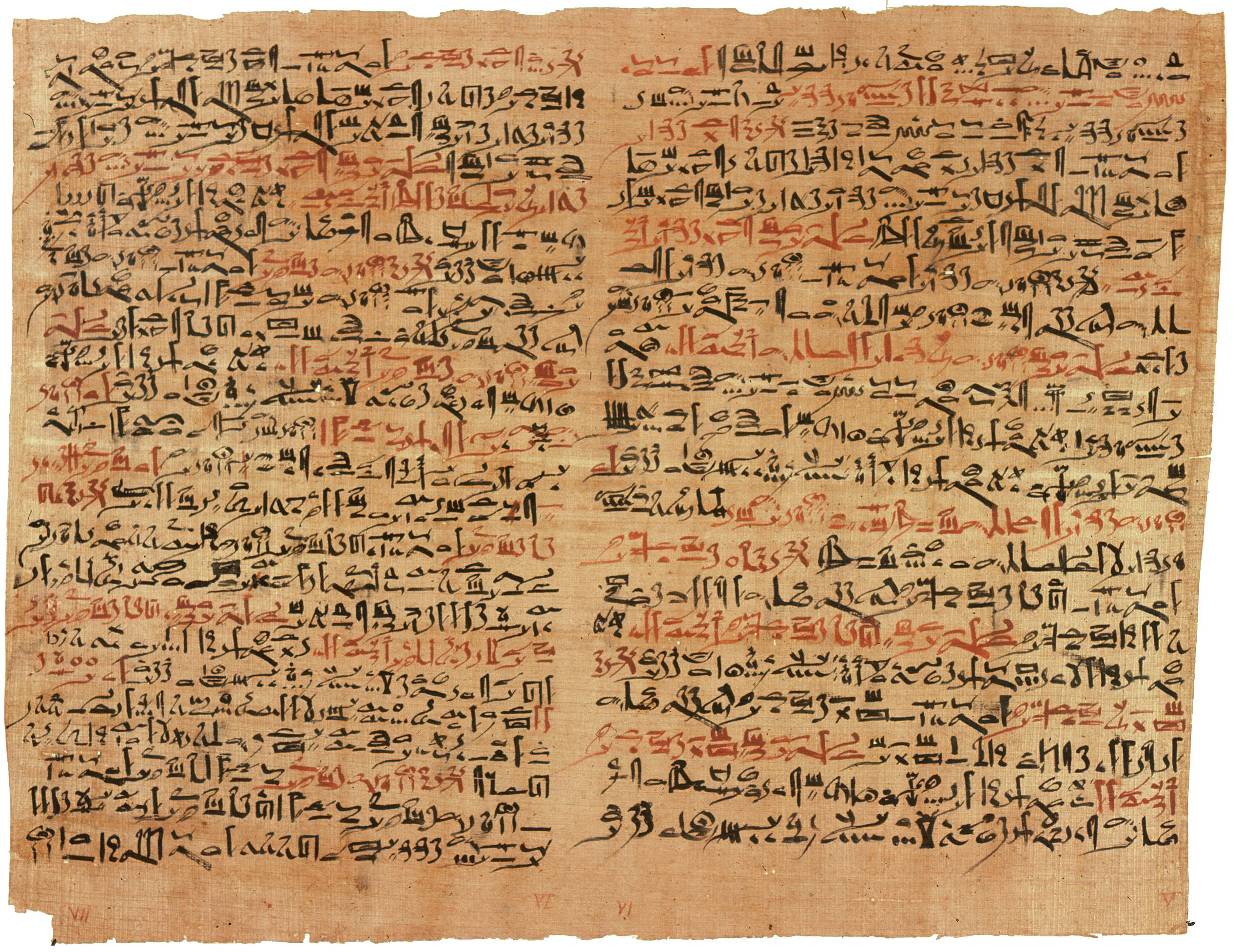
Before Egypt taught Cos: the patchwork of Greek medicine c. 700–550 BCE
When the Hippocratic Corpus would be assembled on Cos between roughly 440 and 350 BCE, it would inherit a Greek medical landscape that already carried three distinct and partly incompatible streams. None of them, by themselves, could have produced the systematic case-archive, the dietary and pharmacological apparatus, and the polemical naturalism that became the Hippocratic legacy. The Egyptian contact filled the gap. To feel the change, the receiving culture's pre-transmission state has to be drawn concretely.
Machaon, Podalirius, and the battlefield iatros
The earliest detailed Greek medical scenes come from the Iliad, fixed in writing in the eighth century BCE but preserving older oral traditions. Machaon and Podalirius — sons of Asclepius and the Achaean army's chief medical officers at Troy — perform empirical wound care under fire. Machaon is named eleven times in the poem; Podalirius twice. When Machaon himself is wounded by an arrow from Paris in Book XI, the army's morale collapses, and Nestor races him out of the line in a chariot: evidence that the iatros was already a recognized, named social role rather than an anonymous functionary 1. The procedures recorded in the Iliad are concrete: extraction of arrows, cleansing of wounds with warm water and wine, herbal poultices of pharmaka praea (mild drugs), bandaging, and cauterization. Podalirius handles internal medicine and diagnosis; Machaon handles surgery. The division between physic and surgery that would anchor the later Hippocratic tradition is already present in the heroic age — but as inherited practice, not as a theoretical doctrine. There is no case-archive. There is no anatomical vocabulary beyond the ordinary words of the body. There is no medical writing.
Epidaurus and the cult of incubation
Alongside the iatric tradition stood the temple cult of Asclepius. The sanctuary at Epidaurus emerged in the sixth century BCE out of an earlier cult of Apollo Maleatas; by the fifth century it had become the great pan-Hellenic healing centre of the Greek mainland. The practice at its core was enkoimesis — incubation. The supplicant slept in the abaton, the sleeping hall, and was visited by the god in a dream. On waking, the patient was understood to have been cured or to have received instructions. The iamata — inscribed cure records — survive at Epidaurus and at the parallel sanctuary on Cos itself, and they document a parallel empirical tradition running quietly beneath the divine framing: dietary regimens, baths, herbal compounds, surgical operations performed by the neokoros attendants, with the god credited for the outcome 2. Whole guild-families of practitioners, the Asklepiadai, traced descent from Asclepius and trained their sons in inherited technique. Hippocrates of Cos was, by tradition, an Asklepiad on his father's side; the new medicine would emerge from inside the old, not against it.
The Ionian opening
By the time of Thales of Miletus (c. 624–546 BCE), a new and parallel movement was underway on the Ionian coast. The Milesian philosophers were proposing that the cosmos had a natural order accessible to reason without invocation of the gods. Anaximander asked what the world was made of and answered with the apeiron, the boundless. Anaximenes proposed air condensing and rarefying. Empedocles of Acragas, a century later, would offer the four-element doctrine — earth, water, air, fire — that the Hippocratics would map onto the four humours 3. The Ionian move was philosophical rather than medical, but it created the intellectual room in which a naturalistic medicine could become respectable. Where Homeric Greek medicine had heroic practitioners but no theory, and Asclepian Greek medicine had cosmology but in the form of cult, the Ionians offered explanatory theory without yet bringing it inside the clinic.
What Greek medicine did not yet have
A picture by negative space, then. By 550 BCE the Greek-speaking world had practitioners, sanctuaries, and the beginnings of natural philosophy. It did not have a written medical tradition with continuity across generations. It did not have a case-archive in which examination, diagnosis, prognosis, and outcome were recorded in a fixed template. It did not have a systematic pharmacopoeia. It did not have an anatomical vocabulary for the internal vessels of the body. It did not have a theory of disease that would let it argue, in writing, against the priestly explanation of seizures and fits. Most of all, it did not have an institutional setting in which medicine was taught as a discipline — not by inheritance from father to son, not by the chance of cult initiation, but by formal training in a school where dozens of students learned together from named teachers who taught from texts. That was what existed eight hundred miles to the south, along the Nile.
How the transmission ran — the Saïte century and the Persian century
Naucratis and the Saïte opening
The political conditions for Greek-Egyptian medical contact opened in the seventh century BCE. The Twenty-Sixth Dynasty — the Saïte — came to power in the Delta in 664 BCE under Psamtik I and ruled until the Persian conquest of 525 BCE. Psamtik used Greek and Carian mercenaries to consolidate his throne and, in return, granted the Milesian-led Greek trading colony of Naucratis its emporium-rights around 620–615 BCE. Naucratis was the only officially sanctioned Greek port in Egypt; it sat on the Canopic branch of the Nile in the western Delta, about sixteen kilometres south of Saïs itself, the dynastic capital and the seat of the temple of Neith 4. Greek physicians and philosophers who wished to study in Egypt did so through Naucratis. The temples that contained the Per Ankh — the House of Life — were within a day's travel by river. Egyptian customs duties on Greek goods were the dynasty's revenue stream; the dynasty had every reason to keep the conduit open.
This was not yet the empire-to-empire contact of the later Hellenistic period. The Saïte pharaohs were sovereign, the Greek visitors were guests, and the asymmetry of cultural prestige still ran in Egypt's favour. Plato, writing in the fourth century BCE, would put into the mouth of an Egyptian priest of Neith at Saïs the famous line that the Greeks were children: "You Greeks are always children. There is no such thing as an old Greek" 5. The Egyptian priesthood received the Greek visitors as students. Some came to study mathematics; some came to study religion; some came to study medicine. The accounts the Greek tradition would later treasure date their formative travels to this Saïte century.
Solon, Thales, Pythagoras — what the tradition records
Plato's Timaeus opens with Critias relating that the Athenian lawgiver Solon (c. 638–558 BCE) visited Egypt and learned from the priests of Neith at Saïs; Plutarch later names his Saïte teacher as Sonchis. The dialogue is not a medical text — its subject is history and the Atlantis story — but it establishes the precedent. Thales of Miletus, the philosopher commonly named as the founder of the Ionian tradition, is reported by Plutarch in the Convivium septem sapientium to have travelled to Egypt and measured the pyramids by shadow ratios at the court of Amasis (r. 570–526 BCE) 6. Pythagoras of Samos (c. 570–495 BCE) was, according to the much later biographers Porphyry and Iamblichus, a student of Egyptian priests at Heliopolis, Memphis, and Diospolis (Thebes), with twenty-two years of training before his capture by the Persians. The Pythagorean tradition does not preserve a medical text, but the famous Pythagorean dietary rules and the doctrine of the harmony of opposites carry Egyptian colour.
These accounts have to be handled carefully. The biographies of Pythagoras and Thales date from the third century BCE and later; the Egyptian-study motif served, in part, to legitimise Greek learning by giving it a Pharaonic genealogy. What cannot be doubted is that the tradition was unanimous, the dates are plausible against the Saïte context, and there is no reason to invent a pre-Hippocratic Egyptian curriculum if none existed. The careful position, taken by Vivian Nutton in his synthesis of ancient medicine, is that the named figures probably did travel, that what they brought back is harder to reconstruct than later Greek admirers suggest, and that the cumulative effect of the Saïte-period contact is more visible in institutional method than in any single biographical anecdote 7.
Herodotus at Saïs, c. 450 BCE
The first direct outsider's description of Egyptian medicine that the Greek tradition preserves is Herodotus of Halicarnassus, who visited Egypt around 450 BCE during the second decade of Achaemenid rule. Book II of his Histories is the locus classicus. At II.84 he writes:
Herodotus enumerates: physicians of the eyes, of the head, of the teeth, of the affections of the stomach, of the more obscure ailments 8. The passage is editorial as much as descriptive — Herodotus is signalling to a Greek reader that the Egyptian medical world contains specialisations the Greeks do not yet have. The reader will not find an Athenian oculist or a Spartan dentist in any source of the fifth century BCE; what Herodotus describes is a level of professional organisation that Greek medicine will only acquire piecemeal over the following centuries, and that the Hippocratic Corpus, even at its mature stage, never fully achieves. The Egyptian medical world Herodotus walks through is the world of the Per Ankh.
Democedes of Croton at the Persian court
The most circumstantially attested case of Greek-Egyptian medical competition runs through Herodotus' third book. Democedes of Croton, a Greek physician of the southern Italian colonial world, was captured around 522 BCE when the tyrant Polycrates of Samos was killed by the Persian satrap Oroetes; Democedes was sent to Susa as part of Oroetes' household goods. At Susa, Darius I had dislocated his foot dismounting from a horse, and the king's Egyptian physicians — the medical staff of the Achaemenid court — had treated him with what Herodotus calls biaiotera — violent methods. Darius could not sleep. Democedes was produced; he set the joint with mild means and clean dressings; the king recovered 9. Herodotus' phrasing is precise: Democedes "changed the violent treatment of the Egyptians for milder remedies, and made the king able to sleep".
The episode is, in one reading, a Greek triumph: a Greek physician displaces the Egyptian medical establishment at the centre of the Persian world. In another, harder reading, it is evidence of the structure that Greek medicine was now self-confident enough to compete in — and the structure was Egyptian. The Achaemenid royal medical staff was Egyptian because that was where the institutional medical tradition lived; Democedes is the first Greek who beats them at their own game. The contest is between two traditions, not between a tradition and an absence. Democedes later cured Atossa, Darius' queen, of a breast tumour by surgical means; the episode is preserved in Herodotus III.133–134. After two years at the Persian court he escaped, by a story-book ruse, back to Croton.
What the Per Ankh actually was
The Egyptian institution at the receiving end of the Saïte-period contact was the Per Ankh, the House of Life: a complex of medical training, scribal training, scriptorium, and library attached to the major temples. The best-attested Per Ankh of the period was at Saïs itself, specialising in midwifery and the gynaecological tradition associated with the goddess Neith, with female students documented in the inscriptional record — the so-called swnt, the female swnw, attested in titles from the Old Kingdom onward and given a known late-Period example in Peseshet, imy-r swnwt, "overseer of female physicians" 10. The Memphis house, associated with Imhotep — by then deified as a god of medicine — had an international reputation. Heliopolis had its school under the priesthood of Re. The classes of practitioner are well attested by titles in the inscriptional and papyrological record: the swnw (the generalist physician, attested from the Old Kingdom onward), the wabau-Sekhmet (the priest-physician of Sekhmet, whose lion-headed goddess was both source and remover of disease), and the sau (the magician-healer who worked with spells and amulets). These were not three competing professions; they were three integrated levels of intervention. A serious case would be examined by the swnw, treated with the appropriate herbal and surgical means, framed within Sekhmet-priestly intercession where infection or fever threatened, and protected with the sau's incantations as ancillary insurance. The specialisations Herodotus enumerated — oculist, dentist, gastric physician — were sub-categories of the swnw class, with named specialist titles preserved in the Old Kingdom and later inscriptions. This was the structure the Greek visitors encountered. It was older than any institution in their own world. It was the institutional model the Hippocratic school on Cos would, half consciously, reproduce.
What changed and what was replaced
The case-study format, Edwin Smith to Epidemics
The most consequential single inheritance from Egyptian medicine into the Hippocratic Corpus is the case-study form. The Edwin Smith Surgical Papyrus, in its surviving form, is a copy made in the seventeenth or sixteenth century BCE of a text whose grammatical features and explanatory glosses point, on Breasted's analysis and later philological work, to an Old Kingdom original of around the twenty-seventh century BCE 11. The papyrus presents forty-eight cases — head injuries first, then face, neck, clavicle, ribs, spine — each following a rigid four-part template. First the title: "Instructions concerning a wound in the head, penetrating to the bone of his skull". Then the examination: "If thou examinest a man having...", with the specific physical findings the swnw should look for. Then the diagnosis: "Thou shouldst say concerning him...". Then the verdict, in one of three fixed formulae: "an ailment which I will treat"; "an ailment with which I will contend"; or "an ailment not to be treated". Then the treatment.
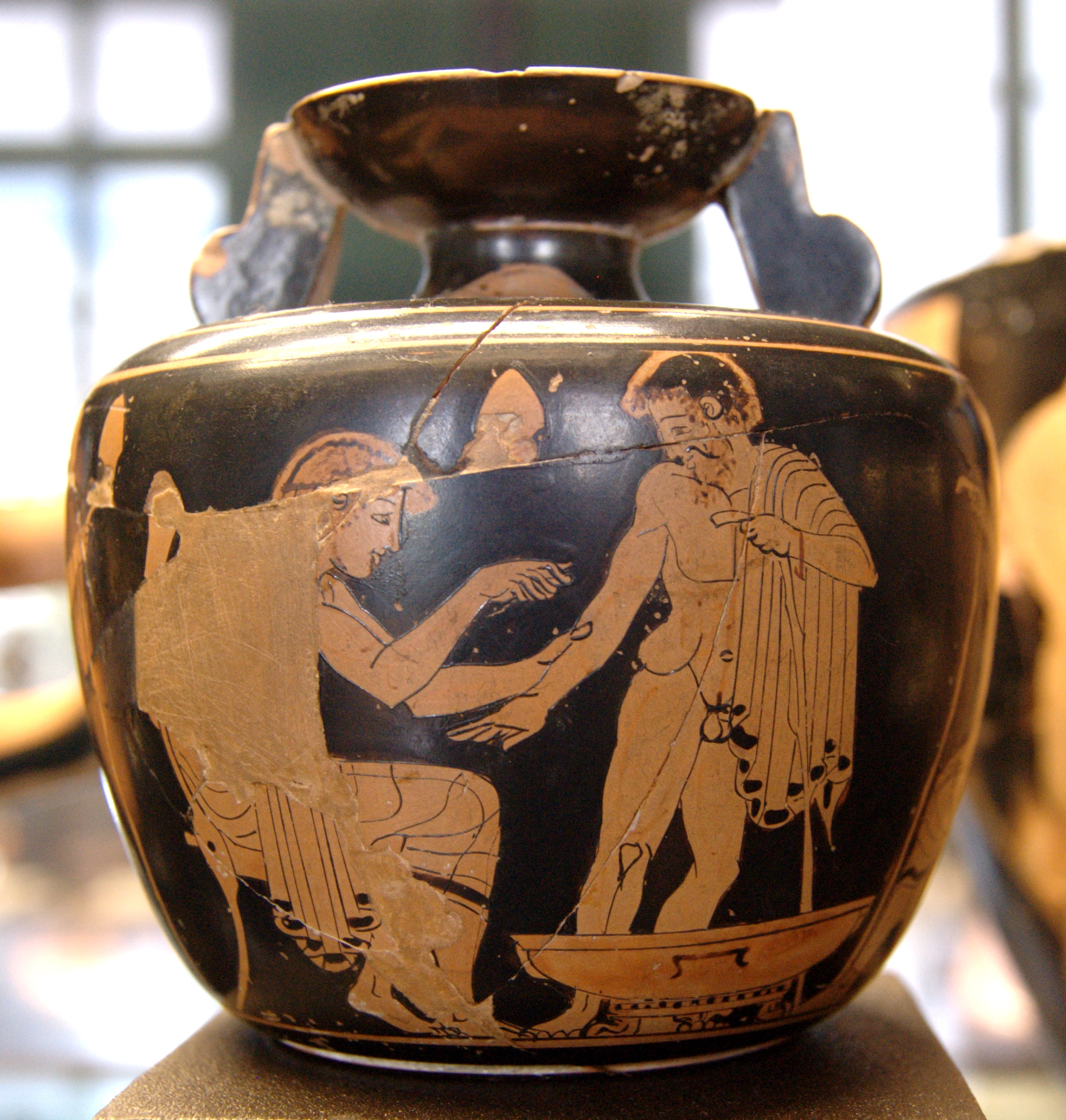
The Hippocratic Epidemics I and III, composed on Cos and Thasos in the late fifth century BCE, present forty-two named case histories — the patient identified by name, by neighbourhood, by occupation where relevant — and follow a structurally cognate template: history, presenting findings, daily course of the illness with the days numbered, outcome 12. The Hippocratic version adds the day-by-day prognostic tracking that the Egyptian template did not require, and it abandons the three fixed verdict-formulae. But the underlying intellectual move — that a physician's knowledge is built case by case, that each case is a written record, that the cases accumulate as the discipline's working archive — is the Egyptian invention. The Egyptian model, on this point, runs continuously through the Hippocratic tradition into Galen's case histories of the second century CE, into the medieval Arabic and Latin tradition, into the modern clinical case report. The lineage is documentable.
Channels, vessels, and the metu system
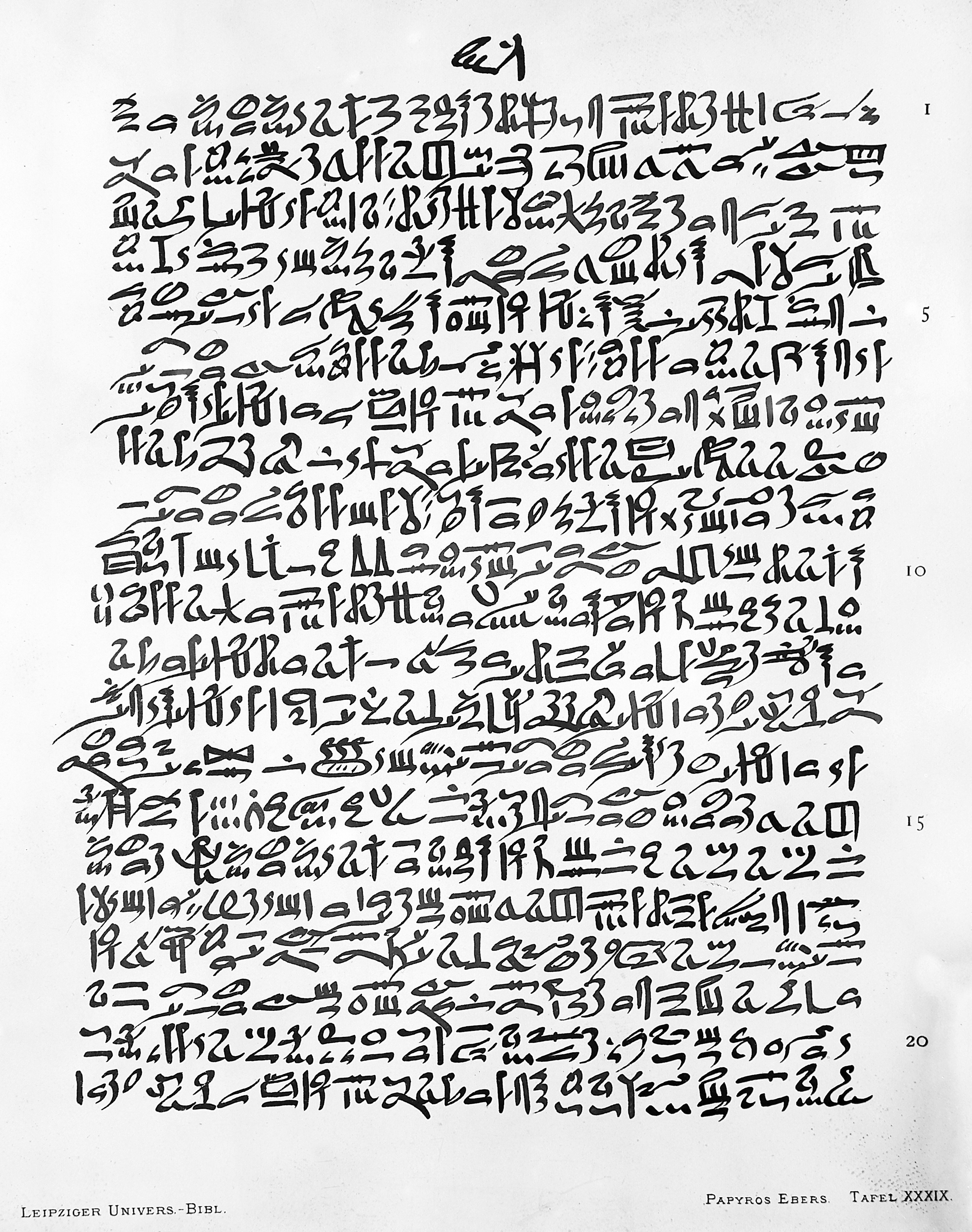
The Ebers Papyrus, copied around 1550 BCE in the reign of Amenhotep I but compiled from much older material, contains in its §856 a "treatise on vessels" — a systematic account of the metu, the channels that carry blood, air, mucus, urine, faeces, semen, and tears through the body. The Ebers count is twenty-two metu converging on the heart; the parallel Berlin Medical Papyrus gives fifty-two metu total 13. The Egyptian channel system is not anatomical in the dissection-based sense the Alexandrian anatomists would later make of it; it is functional, derived from clinical observation of pulse, swelling, and the courses of pain. But it is systematic and written.
The Hippocratic treatise On the Nature of Man, composed in the late fifth or early fourth century BCE, presents a vasculature in which four pairs of great vessels descend from the head through the body, carrying the humours; On the Sacred Disease maps the brain to the rest of the body through vessels and channels. The Hippocratic tradition before Alexandrian dissection has no direct anatomical knowledge of the cardiovascular system, but it has a written channel-system that occupies the place the Ebers treatise occupies in the Egyptian one. The Cnidian rival school's doctrine of whdw — putrefactive matter generated in the intestines and circulating through metu to lodge in distant organs — is the direct ancestor of the Hippocratic humoral theory, and it derives, as Robert Steuer and J. B. de C. M. Saunders demonstrated in their 1959 monograph, structurally and terminologically from the Egyptian wḫdw doctrine 14. The Hippocratic four humours are a Greek philosophical refinement of an Egyptian clinical concept.
Pharmacopoeia and the Ebers inventory
The Ebers Papyrus contains 842 numbered prescriptions and the Hearst Papyrus 260; together with the Berlin, London, and Chester Beatty papyri the Egyptian pharmacopoeia preserved in writing for the New Kingdom approaches two thousand named formulations 15. The drugs are mineral, vegetable, and animal, and many are still in active use. Honey and grease appear in roughly every other Edwin Smith dressing — the antimicrobial properties of honey are now well established by modern wound-care research. Opium poppy, mandrake, juniper, frankincense, myrrh, cumin, fennel, fenugreek, garlic, onion, willow bark — the staples of the Hippocratic materia medica are also staples of the Ebers list, and where they overlap the indications often overlap too. The Hippocratic Diet in Acute Diseases and the regimen-treatises of the Corpus reproduce a pharmacological framework already mature in the Egyptian record by the time the Greeks arrived. What the Hippocratics added was the philosophical superstructure that bound the regimen to the humoral theory; what they inherited was the formulary itself.
The Kahun papyrus and the gynaecological tradition
The Kahun Gynaecological Papyrus, dated to around 1825 BCE, is the oldest known gynaecological text in any tradition. It contains thirty-four sections, each presenting an examination protocol followed by a treatment; the diagnostic tests include a famous garlic-or-onion pessary fertility test in which a clove was inserted vaginally overnight and the patient's mouth was examined the next morning for the smell — a test which, on the Egyptian model of an internally connected channel-system, would demonstrate that the metu were patent 16. The Hippocratic treatises Diseases of Women I and II, composed in the late fifth or fourth century BCE, present the same diagnostic structure and include the garlic test in a closely related form. The Egyptian temple of Neith at Saïs, whose female students Egyptian sources document, is the most plausible institutional channel: the Hippocratic gynaecological tradition is, at the level of specific named tests, downstream from the Per Ankh tradition of Saïs.
Surgical technique and the language of fracture
The Edwin Smith Papyrus's surgical sections — wounds in the head, dislocation of the mandible, fracture of the clavicle and the ribs, dislocation of the cervical vertebrae — are paralleled in the Hippocratic surgical writings On Wounds in the Head, On Fractures, and On Joints. The Edwin Smith physician palpates the wound, examines the patient for paralysis below the level of injury, classifies the case by the verdict formulae, and applies grease-and-honey dressings or splinting 17. The Hippocratic surgical works describe the same examination procedures, the same splinting techniques (the bandaging diagrams of On Fractures would not have surprised an Egyptian swnw), and the same approach of immobilisation followed by gradual loading. The Hippocratic move is, again, to add the theoretical apparatus — a discussion of why bones heal, drawn from natural philosophy — but the practice that the apparatus surrounds is recognisably older.
The Cnidian rival and the Coan synthesis
Before the Coan synthesis took its mature form, a rival Greek medical school flourished at Cnidos, on the Carian peninsula opposite Cos, in the late fifth century BCE. The Cnidian school is preserved in the Hippocratic Corpus only as a polemical foil — On Regimen in Acute Diseases opens by attacking the Cnidian Sentences for treating each disease as a discrete entity with its own treatment, ignoring the patient's broader humoral state. But the Cnidian doctrine, with its emphasis on the whdw-derived putrefaction theory, on disease as a localised lesion identifiable by examination, and on the multiplication of diagnostic categories, is the more direct heir of the Egyptian tradition. The Coan school, working at a slight distance from the Egyptian source, philosophised the inheritance into a humoral system; the Cnidians kept it closer to the clinical model. Steuer and Saunders argue, on the basis of the surviving Cnidian fragments, that the Cnidos-Egypt link is the principal channel through which the Per Ankh tradition entered Greek medicine, and that the Coan refinement is a second-order Greek transformation of an already-Hellenised Cnidian receipt of Egyptian material 18.
The polemic against the sacred
Of the forty-eight cases in the Edwin Smith Papyrus, forty-seven contain no magical or incantatory material. Case 9 alone — a depressed skull fracture — includes a spell, and even that spell is bracketed within the examination protocol rather than substituted for it. The Egyptian medical tradition had separated, in working practice, the rational swnw domain from the magical sau domain by the seventeenth century BCE 18. The Hippocratic treatise On the Sacred Disease, composed around the late fifth century BCE, took the separation a step further into explicit polemic:
The author argues that epilepsy is a disease of the brain caused by phlegm descending from the head, that its hereditary pattern shows the natural mechanism, and that the priests and charlatans who treat it as divine possession are merely covering their ignorance. This is sharper than anything in the Egyptian tradition; the Edwin Smith physician was content to keep magic in its compartment and to work in his own. But the Hippocratic polemic is built on a foundation the Egyptian tradition had already laid: that medicine has its own domain, distinct from priestcraft, in which examination, prognosis, and treatment proceed by their own logic. Heinrich von Staden, in his work on the Hellenistic Alexandrian medical school, emphasises that the rupture between Greek medicine and Greek religion that On the Sacred Disease makes explicit was less a Greek invention than a Greek extension of a separation Egyptian medicine had been practising for a thousand years 19.
What the Hippocratics added that was Greek
The inheritance was substantial, but the Hippocratic Corpus is not a translation of Egyptian medicine. What the Greeks added — what is genuinely Greek and not borrowed — is identifiable. First, the systematic four-humour doctrine, mapping blood, phlegm, yellow bile, and black bile to four temperaments and four seasons, with health defined as the eukrasia, the good mixture, and disease as dyskrasia. The doctrine took the Egyptian channel-system and the Cnidian whdw and made them into a philosophy. Second, the prognostic apparatus of Prognostics and Aphorisms, extending the Egyptian template into systematic prediction. Third, the professional oath. The Hippocratic Oath has no documented direct Egyptian source, although the Sekhmet-priestly code of conduct provides suggestive analogies; the Oath is the Greek tradition's distinctive contribution to medical ethics, and it remains the genealogical root of the modern profession's self-understanding. Fourth, the explicit polemic — On the Sacred Disease — which raised the Egyptian practical separation into Greek doctrine. Fifth, the dietary and regimen treatises that built a non-pharmacological therapeutics around the humoral theory: On Regimen in Acute Diseases, On Regimen I–III. The Greek emphasis on regimen — on diet, exercise, climate, sleep, and enkrateia (self-mastery) as the daily armature of health — runs through these treatises with a philosophical seriousness that the Egyptian pharmacopoeia did not need to develop, because its institutional setting did not require the patient to participate in his own cure to the degree the Hippocratic schema asks for. These are the Hippocratic Corpus's distinctively Greek voice. What the Hippocratics did, in sum, was take an Egyptian working institution and convert it into a Greek written tradition — preserving the case-archive, the channel-anatomy, the formulary, and the rational/magical separation, while overlaying them with a four-humour philosophy, a professional ethics, and a regimen-based therapeutics that were genuinely their own. The genealogy is mixed; the credit, for twenty-three centuries, was not.
What the cost was
The exchange was consensual at the moment
The first thing to be honest about is that the transmission itself was peaceful. The Saïte pharaohs welcomed Greek students; Naucratis was an authorised emporium; the named travellers — Solon, Thales, the Pythagorean tradition, Herodotus, Democedes (in his Italian Greek capacity rather than as a Saïte visitor) — were honoured guests. The Per Ankh charged its Greek students fees, and the fees were the Egyptian institution's revenue. There is no record in the seventh, sixth, or fifth centuries BCE of Greeks taking Egyptian medical material by coercion. The cost of the transmission, at the moment of the transmission, was zero or near it.
525 BCE: the rupture at Pelusium
What followed the transmission was not zero. In 525 BCE, the Persian king Cambyses II defeated Pharaoh Psamtik III at the Battle of Pelusium and ended the Saïte dynasty. Psamtik III ruled for six months as a Persian client before being deposed. The Twenty-Seventh Dynasty — the Achaemenid — reorganised Egyptian priestly institutions, redirected temple revenues, and damaged the network of Per Ankh houses that had been the institutional basis of Egyptian medical training. The evidence is preserved in the autobiographical inscription on the Vatican naophorous statue of the Egyptian noble Udjahorresnet, an admiral of the Saïte navy who survived the conquest and joined Persian service. Udjahorresnet claims credit for restoring the Per Ankh at Saïs under Darius I, after its disruption — "I made it as it had been" — and the inscription is the principal contemporary evidence that the Persian conquest did indeed damage the institution it now reports restoring 20. Greek physicians who travelled to Saïs in the second half of the sixth century BCE were entering a damaged institution, even if the damage was repaired in the next generation. The cost was real and contemporary with the transmission, but it was not the cost of the transmission.
The 343 BCE second conquest
The Twenty-Seventh Dynasty was Persian; the Twenty-Eighth through Thirtieth, native; and then in 343 BCE the Persian king Artaxerxes III reconquered Egypt and inaugurated the brief Thirty-First (Second Achaemenid) Dynasty. The second Persian conquest was more destructive than the first. Diodorus Siculus reports temple-treasury looting, deportation of sacred animals, destruction of inscriptions; the Per Ankh houses at Memphis, Heliopolis, and Saïs were structurally damaged for the second time within two centuries. When Alexander arrived in 332 BCE and was received as a liberator, the Egyptian medical institution he found was an institution in its second cycle of decline. The Hellenistic Egyptian medicine of the Ptolemaic period inherits the swnw tradition only in the diminished form to which two Persian conquests had reduced it.
The Ptolemaic absorption
When the Ptolemies founded the great Library and the Mouseion at Alexandria in the third century BCE, they assembled the medical canon at the new Greek-speaking capital. Herophilus of Chalcedon, working at Alexandria around 280 BCE, performed the first systematic human dissection in the Greek-speaking world; Erasistratus of Ceos followed. The Egyptian swnw tradition continued to exist, and the papyrological evidence of the Ptolemaic period — including the Tebtunis papyri of the second century BCE — shows Egyptian physicians practising and even teaching alongside Greek colleagues. The funerary stele of the priest-physician Psenptais III, found at Saqqara, gives his career in both Demotic and Greek into the first century BCE: a swnw who is also an iatros, paid by two patron-systems. But von Staden's reconstruction of the Alexandrian medical world is unambiguous on the structural point: the Egyptian medical tradition was now subordinated within a Hellenocentric institutional frame, its practitioners auxiliaries within a school whose canonical language was Greek and whose authority figures were Greek 21. Where the Per Ankh of Saïs had been the senior institution to which Greek students came in the sixth century BCE, the Mouseion of Alexandria in the third century BCE was the senior institution to which Egyptian-trained physicians came as juniors. The direction of the prestige gradient had reversed in two and a half centuries. The transmission that had run, in the Saïte century, from a senior tradition to a junior one was now reversed. The senior was Greek; the senior language was Greek; the case archive being assembled at Alexandria was being assembled in Greek. Egyptian medical knowledge that did not pass through that filter — that did not get translated, paraphrased, or absorbed into a Greek treatise — increasingly did not pass at all.
Two and a half millennia of mis-attribution
By the second century CE, when Galen of Pergamon constructed the canonical synthesis of ancient medicine that would carry the field through to the Renaissance, the Egyptian source had become decorative. Galen wrote some twenty thousand pages of medical commentary; he travelled to Alexandria as a young man specifically to study at what was, by then, the inherited Greek medical canon. He cites Hippocrates on almost every page. He cites the Egyptian past — when he cites it at all — as the world's oldest and noblest medicine, and then moves on. Galen cites the Egyptians as ancient and venerable; he does not cite the Edwin Smith Papyrus or the Ebers Papyrus, neither of which any Greek-speaking physician of his era could read. Hieratic was a script understood within the Egyptian temple priesthood and effectively no one else; Coptic, the latest living form of the Egyptian language, had no relationship to the medical papyri. Demotic medical material survived into the Roman period but was a fraction of the older tradition. The medical lineage the Roman world inherited and that the medieval Islamic world received through Arabic translation — Hippocrates, Galen, Dioscorides — was, in its written form, Greek. The Egyptian priority that the Hippocratics had been honest about in some of their texts (the Hippocratic treatise On Ancient Medicine refers obliquely to older traditions) was, by Galen's time, opaque.
The papyri were unreadable for the next eighteen hundred years. Hieroglyphic decipherment did not begin in earnest until Champollion's 1822 breakthrough on the Rosetta Stone; the Edwin Smith Papyrus was not purchased in Luxor until 1862 (by the American antiquarian Edwin Smith, after whom it is named), and James Henry Breasted's translation, the first that brought its medical content into a modern scholarly language, did not appear until 1930 — twenty-three centuries after Hippocrates 22. The Ebers Papyrus was bought by Georg Ebers in 1873 and published in facsimile in 1875; Wolfhart Westendorf's two-volume Handbuch der altägyptischen Medizin (Brill, 1999) is the standard modern philological synthesis 23. For the entire intervening period, Western medicine narrated itself as a Greek and then Greco-Roman creation, with Egyptian medicine as a remote and partly mythical antecedent. The mis-attribution was structural. It was a function of which texts could be read, which institutions had survived, and which language carried the canon.
What the bill names
To name the cost honestly is to refuse two easy stories. The first is the story in which the Greeks invented medicine, the Egyptians had something quaint and magical, and the transmission was a matter of the new replacing the obsolete. That story is false; the Egyptian medical tradition had been doing case-based, written, observationally grounded medicine for two thousand years before any Greek physician set foot in Saïs. The second is the story in which the Greeks stole Egyptian medicine, claimed it as their own, and the transmission was an act of intellectual theft. That story is also false; the exchange in the Saïte century was paid for, welcomed, and visible.
The cost of this transmission, named precisely, is not the cost of the transmission itself. The exchange between the Greek visitors and the Egyptian temple schools was, at the moment it happened, a fair one: paying students, willing teachers, fees that supported the receiving institution. The bill is what came after. It is two Persian conquests that the Saïte century could not have predicted but that left the Egyptian medical institution structurally weaker than it had been. It is the Ptolemaic reorganisation, which turned the older tradition into an auxiliary of the newer one. It is twenty-three centuries during which the Egyptian medical tradition was unreadable to its inheritors, while the inheritors narrated themselves as the founders. The cost was not paid by the swnw of Saïs in 600 BCE. It was paid by Egyptian medicine as a tradition, distributed across millennia. The Hippocratic Corpus, in 2026, is still in print in nine modern languages. The Edwin Smith Papyrus is in print in three. The asymmetry is the bill, and it is the bill that the atlas's cost-severity rating of one acknowledges and refuses to inflate. The transmission was a gift. The history of how the gift was carried, credited, and forgotten is the cost.
What followed
-
-620Pharaoh Psamtik I authorises the Greek trading emporium of Naucratis on the Canopic branch of the Nile, sixteen kilometres south of Saïs — establishing the physical and legal conduit for Greek-Egyptian intellectual contact for the following three centuries.
-
-525Persian king Cambyses II defeats Pharaoh Psamtik III at Pelusium, ending the Saïte dynasty and damaging the network of Per Ankh medical training houses at Saïs, Memphis, and Heliopolis — preserved in the autobiographical inscription of Udjahorresnet, who claims credit for restoring the Saïs institution under Darius I.
-
-522Democedes of Croton displaces the Egyptian medical staff at Darius I's court in Susa, treating the king's dislocated foot with mild means after the Egyptian physicians' violent methods had failed — the first attested case of Greek medicine being preferred over Egyptian at a great-power court (Herodotus III.125–137).
-
-450Herodotus of Halicarnassus visits Egypt during the second decade of Achaemenid rule and preserves at Histories II.84 the only extant outsider's description of Egyptian medical specialisation — shaping Greek perception of Egypt as the homeland of organised medicine.
-
-410The Hippocratic Epidemics I and III are composed on Cos and Thasos, presenting forty-two named patient case histories in a structurally cognate template to the Edwin Smith Papyrus's forty-eight cases — extending an Egyptian writing technology twelve centuries old into the canonical Greek case-archive.
-
-343Artaxerxes III's second Persian conquest of Egypt completes the institutional collapse of the surviving Per Ankh houses; Diodorus Siculus records temple-treasury looting and the destruction of inscriptions, leaving the Egyptian medical tradition Alexander would inherit nine years later in its second cycle of decline.
-
-280Herophilus of Chalcedon performs the first systematic human dissection at Alexandria under Ptolemaic patronage, drawing on Egyptian anatomical knowledge from the mummification tradition but writing in Greek and crediting only Greek discovery — the moment the senior-junior relationship between Egyptian and Greek medicine reverses.
-
1862Edwin Smith purchases the surgical papyrus in Luxor; James Henry Breasted's first translation appears in 1930 from the Oriental Institute of the University of Chicago — closing a 2,300-year gap during which the Egyptian medical priority underlying the Hippocratic case-method was unrecoverable to the inheriting tradition.
Where this lives today
References
- Homer, Iliad. Loeb Classical Library 170–171. Trans. A. T. Murray, rev. William F. Wyatt. Cambridge, MA: Harvard University Press, 1924, rev. 1999. Books IV (Menelaos wounded), XI (Machaon wounded), and II.731–732 (the catalogue entry on Machaon and Podalirius as iatroi from Tricca). en primary
- Edelstein, Emma J., and Ludwig Edelstein. Asclepius: A Collection and Interpretation of the Testimonies. 2 vols. Baltimore: Johns Hopkins University Press, 1945, reissued 1998. The standard scholarly edition of the Asclepian iamata and other testimonia. en
- Kirk, G. S., J. E. Raven, and M. Schofield. The Presocratic Philosophers. 2nd ed. Cambridge: Cambridge University Press, 1983. The standard English-language synthesis of the Milesian and Eleatic philosophers, including the medical implications of Empedocles' four-element doctrine. en
- Möller, Astrid. Naukratis: Trade in Archaic Greece. Oxford Monographs on Classical Archaeology. Oxford: Oxford University Press, 2000. The definitive monograph on the Greek emporium in Saïte Egypt and its commercial and intellectual conduit role. en
- Plato. Timaeus and Critias. Trans. Robin Waterfield. Oxford World's Classics. Oxford: Oxford University Press, 2008. Timaeus 21e–23b contains the priest-of-Saïs scene with Solon; the Greeks-as-children passage is at 22b. en primary
- Plutarch. Moralia Vol. II: Convivium septem sapientium (The Banquet of the Seven Sages). Loeb Classical Library 222. Trans. F. C. Babbitt. Cambridge, MA: Harvard University Press, 1928. The Thales-in-Egypt episode at 147a. en primary
- Nutton, Vivian. Ancient Medicine. 2nd ed. London and New York: Routledge, 2013 (1st ed. 2004). The standard scholarly synthesis of Graeco-Roman medicine in English; chapters 2 (Before Hippocrates) and 3 (Hippocrates) cover the Egyptian-Greek transmission. en
- Herodotus. Histories, Books I–II. Loeb Classical Library 117. Trans. A. D. Godley. Cambridge, MA: Harvard University Press, 1920. Book II.84 on Egyptian medical specialisation; II.77 on the prevalence of disease and health practices. en primary
- Herodotus. Histories, Books III–IV. Loeb Classical Library 118. Trans. A. D. Godley. Cambridge, MA: Harvard University Press, 1921. The Democedes episodes at III.125–137, including the displacement of the Egyptian physicians at Susa. en primary
- Ghalioungui, Paul. The House of Life: Per Ankh — Magic and Medical Science in Ancient Egypt. 2nd ed. Amsterdam: B. M. Israël, 1973. The classic monograph on the Egyptian medical training institution; Peseshet's title as overseer of female physicians is discussed in chapter 4. en
- Breasted, James Henry, trans. The Edwin Smith Surgical Papyrus: Published in Facsimile and Hieroglyphic Transliteration with Translation and Commentary. 2 vols. Oriental Institute Publications III–IV. Chicago: University of Chicago Press, 1930. The first scholarly translation; volume I, pp. 73–82, on the Old Kingdom dating of the original. en primary
- Hippocrates. Vol. I: Ancient Medicine. Airs, Waters, Places. Epidemics 1 and 3. The Oath. Loeb Classical Library 147. Trans. W. H. S. Jones. Cambridge, MA: Harvard University Press, 1923; revised editions through 2022. The forty-two case histories of Epidemics I and III at pp. 146–287. en primary
- Bardinet, Thierry. Les Papyrus médicaux de l'Égypte pharaonique : traduction intégrale et commentaire. Penser la Médecine. Paris: Fayard, 1995. The definitive French translation of all major Egyptian medical papyri; Ebers §856 on the metu at pp. 70–82. fr primary
- Steuer, Robert O., and J. B. de C. M. Saunders. Ancient Egyptian and Cnidian Medicine: The Relationship of Their Aetiological Concepts of Disease. Berkeley and Los Angeles: University of California Press, 1959. The foundational philological argument that the Cnidian whdw doctrine derives from the Egyptian wḫdw concept. en
- Nunn, John F. Ancient Egyptian Medicine. London: British Museum Press, 1996. The standard one-volume English-language synthesis; chapter 6 on pharmacology and chapter 8 on the medical papyri. en
- Stevens, John M. "Gynaecology from Ancient Egypt: The Papyrus Kahun." Medical Journal of Australia 2, no. 25–26 (1975): 949–952. Discusses the thirty-four sections of the Kahun papyrus and the garlic-pessary fertility test that recurs in Hippocratic Diseases of Women. en
- Hippocrates. Vol. III: On Wounds in the Head. On the Surgery. On Fractures. On Joints. Mochlicon. Loeb Classical Library 149. Trans. E. T. Withington. Cambridge, MA: Harvard University Press, 1928. The Hippocratic surgical works, paralleling Edwin Smith Cases 1–27 on head and clavicular injuries. en primary
- Westendorf, Wolfhart. Handbuch der altägyptischen Medizin. 2 vols. Handbuch der Orientalistik, Abteilung 1: Der Nahe und Mittlere Osten, Band 36. Leiden: Brill, 1999. The standard German philological synthesis of Egyptian medicine, including the rational-magical separation in the medical papyri. de
- Hippocrates. Vol. II: On the Sacred Disease. Prognostic. Regimen in Acute Diseases. The Sacred Disease. Loeb Classical Library 148. Trans. W. H. S. Jones. Cambridge, MA: Harvard University Press, 1923. The polemic at On the Sacred Disease 1. en primary
- Lloyd, Alan B. "The Inscription of Udjaḥorresnet: A Collaborator's Testament." Journal of Egyptian Archaeology 68 (1982): 166–180. The principal modern study of the Vatican naophorous statue and the Per Ankh restoration claim. en
- von Staden, Heinrich. Herophilus: The Art of Medicine in Early Alexandria — Edition, Translation and Essays. Cambridge: Cambridge University Press, 1989. The authoritative reconstruction of the Hellenistic Alexandrian medical school; chapter 1 on the Egyptian-Greek institutional relationship. en
- Allen, James P. The Art of Medicine in Ancient Egypt. New York: Metropolitan Museum of Art / New Haven: Yale University Press, 2005. Catalogue of the 2005 Met exhibition; includes the reception history of the Edwin Smith and Ebers papyri from purchase to publication. en
- Jouanna, Jacques. Hippocrate. Paris: Arthème Fayard, 1992. The definitive modern biography of Hippocrates and reconstruction of the Coan school in its Aegean context; chapters on the Cnidos rivalry and the Egyptian sources at pp. 76–104. fr
- Lloyd, G. E. R. Magic, Reason and Experience: Studies in the Origin and Development of Greek Science. Cambridge: Cambridge University Press, 1979. Comparative methodological study of Greek, Egyptian and Babylonian scientific writing; chapter 1 on the rational-magical distinction. en