Arabia's script crossed to Africa and became Ge'ez (~500 BCE)
A consonantal alphabet borrowed from Sabaean Yemen was indigenised over a thousand years into the seven-vowel fidäl — the only ancient African script still in daily national use, and for most of its life the private key of a clerical class.
In the early first millennium BCE, South Arabian traders and settlers carried the musnad alphabet across the Red Sea into the Tigray highlands, where the Sabaean moon-god Almaqah was worshipped in a stone temple at Yeha that still stands. Over the next thousand years the borrowed consonantal script was made African: detached from the Sabaic language, cut to fit Ge'ez, and — in the fourth century CE, as King Ezana turned Christian — fitted with a system of seven vowels found in no other alphabet. The result, the fidäl, became the alphabet of a Christian empire and the guarded property of its clergy. It is the only ancient African script in unbroken daily use today.

Before: a highland world without letters
The people the script found
Before there was writing in the Horn of Africa, there were the highlands themselves: a spine of basalt plateau rising above two and three thousand metres in what is now the Tigray region of northern Ethiopia and the Eritrean interior, cut by gorges, cooled by altitude, and green in the summer rains when the lowlands around it were bare. People had farmed and herded there for a very long time. By the second millennium BCE the northern Horn supported settled agro-pastoralist communities growing barley, wheat, and the indigenous cereals teff and finger millet, herding cattle, and living in stone-founded villages that archaeologists group under labels such as the Ona culture of the Asmara plateau 1. These were not isolated people. Obsidian, marine shell, cattle, and metalwork moved through their exchange networks, and those networks reached the Red Sea coast and, across it, the incense kingdoms of southern Arabia 7.
What these communities did not have was a script. Their world was organised, governed, remembered, and transmitted entirely through speech. Genealogy was recited, not filed. Law was what elders remembered and witnesses affirmed. A debt existed as long as two people and a community agreed it existed. This is not a deficiency to be pitied; oral cultures carry staggering quantities of precise information, and the highland societies of the early first millennium BCE were complex enough to raise monumental stone, work metal, and organise long-distance trade. But it means the change that was coming had no local precedent. There was no category in the highlands for a mark that stood for a sound — and once such a mark arrived, it would slowly reorganise who held knowledge and who did not.
The chronology matters here, because it is the ground on which the later argument stands. The pre-Aksumite sequence in the northern Horn now reaches back well into the second millennium BCE: excavated settlements on the Eritrean and Tigrayan plateaus show cereal agriculture, cattle-keeping, craft production, and growing social hierarchy centuries before any South Arabian inscription appears 13. Domesticated highland crops such as teff and finger millet, worked metal, and planned villages are all in place before the moment of contact. This is the single most important fact for reading the transmission correctly: writing did not arrive in an empty or a simple place. It arrived in a stratified, productive, long-settled African society that was perfectly capable of adopting a new technology on its own terms, and did. Everything the colonisation model got wrong flows from ignoring that stratigraphy — from assuming the ruins had to have been built by newcomers because the locals could not have managed it.
A civilisation of speech
To feel what writing would replace, it helps to be specific about what an unwritten highland polity actually was. Authority rested in persons and in the collective memory of a community, not in documents. A ruler's reach extended as far as his agents could carry his spoken word and enforce it in person. Contracts were sealed by ritual and remembered by witnesses; when the witnesses died, the contract's exact terms died with them unless someone had learned them by heart. Religious knowledge — the names of the powers, the order of the rites, the songs owed to them — lived in the trained memories of ritual specialists and was passed mouth to ear across generations.
This produced a particular shape of society. Knowledge could not be hoarded on a shelf, but it also could not be checked against a fixed original. Every recitation was both a preservation and a small revision. Prestige attached to the person who remembered well, not to the person who owned the record. When writing arrived it would slowly dismantle this arrangement, and the dismantling would create new kinds of winners and new kinds of losers. But in roughly 1000 BCE none of that had happened yet. The highlands were a place where everything worth keeping had to be kept in a human head. That is the calibration this record needs: the transmission that follows did not bring information to a people who had none — it brought a new place to keep information, outside the body, and a new set of gatekeepers to guard it.
What Saba' was
Across the southern Red Sea, in the highland oases of what is now northwestern Yemen, a very different kind of society had been literate for centuries. The kingdom of Saba' — the Sheba of Hebrew and later legend — was the dominant early power of Ancient South Arabia, grown rich on the overland trade in frankincense and myrrh that moved north from the coasts of the Hadramawt toward the Mediterranean 913. Saba' engineered the Great Dam of Ma'rib to turn a seasonal desert wadi into irrigated farmland, raised temples to the moon-god Almaqah as patron of the kingdom, ruled through a priest-king called the mukarrib, and — crucially for this story — wrote. Its inscriptions on stone and bronze record dedications, building works, campaigns, and laws in a form fixed enough to be read identically a thousand years later.
The scale of that wealth is worth pausing on, because it is what put Sabaean ships and caravans in contact with the African shore in the first place. Frankincense and myrrh — the aromatic resins of trees that grew in southern Arabia and the Horn — were burned by the ton in the temples of Egypt, the Levant, Mesopotamia, and later Greece and Rome, and the overland route that carried them north through the Arabian desert was one of the richest arteries of the ancient world 9. Saba' sat astride its southern end. The kingdom's temples to Almaqah, its irrigation works at Ma'rib, and its literate bureaucracy were all financed by that trade, and the same commercial reach that sent Sabaean goods north sent Sabaean traders, ideas, gods, and letters west across the narrow strait into Africa. The transmission of the alphabet was a by-product of the incense economy — writing rode across the Red Sea on the back of commerce, as it so often has.
The Sabaeans wrote in a script scholars call Ancient South Arabian, or by its own later name, musnad. It was a consonantal alphabet — an abjad — of twenty-nine letters, in which only consonants were obligatorily written and the reader supplied the vowels from knowledge of the language 6. Its monumental form was geometric and severe, the letters built from straight strokes and clean curves designed to be carved deep into hard stone and read at a distance on temple walls; a parallel cursive form, the zabur, was scratched onto wooden sticks for letters and accounts 6. The musnad had itself descended, in the late second millennium BCE, from the same Proto-Sinaitic root that produced the Phoenician alphabet — meaning that the writing Saba' would carry into Africa was a cousin of the writing that Phoenician merchants were, in the same centuries, carrying to the Greeks. The alphabet was fanning out across the ancient world along two branches at once, and the southern branch was about to cross a strait. The musnad was a script built for stone — severe, symmetrical, monumental, a writing that looked like architecture — and it was that architectural, prestige quality, as much as its usefulness, that would recommend it to an African elite looking for the trappings of a literate state.
The transmission: a script carried across a strait
Settlers, traders, or something between
For most of the twentieth century the standard account of how South Arabian civilisation reached the Horn was blunt: colonisation. Sabaeans crossed the Bab al-Mandab, conquered or displaced the local population, and planted an outpost of Yemeni culture on African soil, of which the writing, the gods, and the monumental architecture were simply the transplanted furniture. The theory had the attraction of tidiness. It also carried an unmistakable assumption — that civilisation in the Horn must have been an import, because Africans could not have generated a literate state on their own. That assumption belonged to the colonial-era scholarship that produced it, and it shaped how the ruins of Yeha were read for a century.
That account has been dismantled over the past forty years, and the dismantling is one of the more important correctives in the archaeology of the region. Rodolfo Fattovich, David Phillipson, Francis Anfray, and others have argued from the excavated evidence that the northern Horn already possessed complex, hierarchical agro-pastoralist societies before Sabaean influence arrived, and that what happened was not conquest but contact 31. In the revised model the local elite of an indigenous highland chiefdom adopted South Arabian writing, religion, and building styles selectively, as prestige goods and instruments of power, grafting them onto a society that was already there and already stratified. Phillipson in particular has insisted that the South Arabian contribution to the northern Horn was smaller, and the indigenous contribution far larger, than the colonisation model allowed 1. The population that carved the first African inscriptions was, on the current reading, a fusion — Semitic-speaking incomers intermarried with indigenous Cushitic-speaking agro-pastoralists — not a garrison of foreigners 3.
The distinction is not academic hair-splitting; it changes what the whole record means. If the script arrived as the language of conquerors, its later history is a story of a colonial imposition slowly naturalising. If it arrived as a prestige technology adopted and adapted by a local elite, its history is a story of African agency from the very first inscription — a borrowing, not a takeover. The weight of current evidence sits with the second reading, and it is the reading this record follows. It is worth being explicit that specialists whose primary training is in South Arabian epigraphy have tended to weight the Sabaean role more heavily than the Africanist archaeologists do; the debate is live, and this record takes a side while naming the other.
Yeha and the kingdom of Di'amat
The place where the transmission becomes visible is Yeha, a site in the Tigray highlands about fifty kilometres northeast of Aksum. Here, around the seventh century BCE, rose the Great Temple — a towering rectangular sanctuary of finely dressed sandstone blocks, laid without mortar and still standing more than twelve metres high after twenty-seven centuries, dedicated to the Sabaean moon-god Almaqah 7. It is the oldest standing structure in Ethiopia, and it is unmistakably South Arabian in plan, technique, and dedication. Nearby, German Archaeological Institute excavations directed by Iris Gerlach have exposed a second monumental complex, the Grat Be'al Guebri, built with a timber-and-stone framing system that has direct parallels in Sabaean architecture at Sirwah in Yemen — the same construction signature, five hundred kilometres across the sea 7.

Yeha was a centre of the polity that its own inscriptions call D'MT, conventionally rendered Di'amat, which flourished from roughly the eighth to the fourth century BCE. Its rulers took the South Arabian royal title mukarrib and left dedications in the Sabaic language, carved in monumental musnad, invoking Almaqah alongside indigenous divine names such as the local deities of the Di'amat pantheon 13. The excavations have turned up more than temple walls: incense altars, bronze and stone votive objects, seals, and the debris of a cult imported wholesale from Yemen and installed in African stone 7. But the inscriptions are the hinge of the whole story. They are the physical evidence that the script had crossed the water and taken root. Whether the people who carved them were Sabaean settlers, the local elite writing in a prestige language, or — most probably — the mixed population the archaeology now favours, the letters are on the African side of the strait, and they will never leave it again 34.
The crossing
The strait itself is the reason the transmission happened at all. At the Bab al-Mandab — the "Gate of Grief" — the southern Red Sea narrows to about thirty kilometres, an easy passage for the small craft of the incense trade, with the Dahlak islands as stepping stones further north. Across that gap moved not an army but a current: traders, craftsmen, priests of Almaqah, and the scribes who served them, over generations rather than in a single wave 73. The archaeology suggests a diffuse, commercial, cumulative contact — a trade diaspora settling among and marrying into a local population — rather than a dated conquest with a general's name attached. That is precisely why the "colonisation" language fits so poorly: there is no invasion horizon in the ground, only a deepening South Arabian presence layered into an African society that was already building, farming, and organising on its own account.
The finds bear this out. Beyond Yeha, sites such as Hawelti and Melazo near Aksum have yielded seated female statues, incense altars, and inscribed objects that blend Sabaean form with local execution — South Arabian models worked by hands that were adapting, not merely copying 17. Roger Schneider, Abraham Drewes, and the RIÉ epigraphers who catalogued these texts showed a script and a language being handled by a society making them its own 45. By the time the record goes quiet on Di'amat, around the fourth century BCE, the alphabet was no longer a visitor. It was a resident, waiting for the language it would eventually be re-cut to fit.
The musnad on African stone
What exactly had been transmitted, in these first centuries, was a specific and limited thing: a consonantal writing system and the scribal conventions that came with it. The Di'amat inscriptions are in Sabaic — a South Arabian language, not a local one — and in the monumental musnad script, following South Arabian orthographic norms. At this stage the highlands had borrowed a foreign script to write a foreign language, much as medieval Europe wrote Latin, or Meiji-era clerks wrote classical Chinese. The technology was present; the indigenisation had not yet happened. The gap between having a script and owning one would take the better part of a thousand years to close.
The borrowed system had definite properties, and setting them beside what the highlands would eventually make of it shows how much room for change the seed contained:
| Feature | Sabaean musnad (as borrowed) | Ge'ez fidäl (what emerged) |
|---|---|---|
| Type | Consonantal abjad | Vocalised abugida (alphasyllabary) |
| Signs | 29 consonants; vowels unwritten | 26 base consonants × 7 vowel orders (200+ characters) |
| Vowels | Supplied by the reader from memory | Written into the shape of each character |
| Direction | Right-to-left or boustrophedon | Fixed left-to-right from the 4th century CE |
| Language written | Sabaic (a South Arabian language) | Ge'ez (a local Ethio-Semitic language) |
| Domain | Kings, gods, dedications | Kings, gods — then scripture, then a whole literature |
Each row of that table is a change the African side made and the Arabian side did not. The letter count fell; the vowels arrived; the direction fixed; the language became local; and the domain, in time, widened from monument to manuscript. The transmission delivered a seed, not a finished plant. What the highlands did with that seed — over centuries, and largely after their contact with Saba' had lapsed — is the heart of the record.
What changed and what was replaced: from abjad to fidäl
The script becomes African
Sometime after the Di'amat polity faded and before and during the rise of the Aksumite kingdom in the first century CE, the imported writing system began to drift away from its South Arabian parent. The language being written shifted from Sabaic to Ge'ez — the local Ethio-Semitic language of the northern highlands — and the letterforms began to diverge from the Yemeni models. Scholars call this stage Old Ge'ez or the Old Ethiopic writing system: still an abjad, still consonants only, but now a distinct African script writing an African language 6. The number of letters was reduced from the South Arabian twenty-nine to twenty-six, dropping signs for consonantal distinctions the local language did not need 6. The forms rounded and simplified; the writing direction, after a period of variability, would eventually settle.
This first transformation is easy to underrate because it produced no monument as dramatic as the Yeha temple. But it is the decisive move. A script is not truly transmitted until it has been detached from the language it was born to write and re-fitted to a new one; in that detaching, the borrower takes ownership of the technology. From this point forward the history of the script is an internal African history, and its later developments owe nothing to Saba', which by the late third century CE had itself been swallowed by its Himyarite rival across the Yemeni highlands 913. The parent civilisation was dying at exactly the moment the daughter script was coming into its own — a pattern the atlas sees again and again, where a transmission outlives the culture that sent it because the receiving culture makes it thoroughly its own.
The vowel revolution
The change that made the Ethiopic script unique among all the descendants of the ancient Near Eastern alphabet came in the fourth century CE, and it came fast. Within perhaps two generations, the consonantal abjad was converted into an abugida — an alphasyllabary — in which every consonant carries an inherent vowel and is systematically modified, by small strokes, loops, rings, and changes of leg length or position, to mark each of seven vowel qualities 6. A single base letter blossomed into a set of seven vocalised forms, called orders, so that the reader no longer had to supply the vowels from memory; they were written into the shape of each character. This is the fidäl, the Ethiopic syllabary of more than two hundred characters still used today, in which a literate person reads not consonant-plus-guess but consonant-plus-vowel, fixed and unambiguous, off the page.
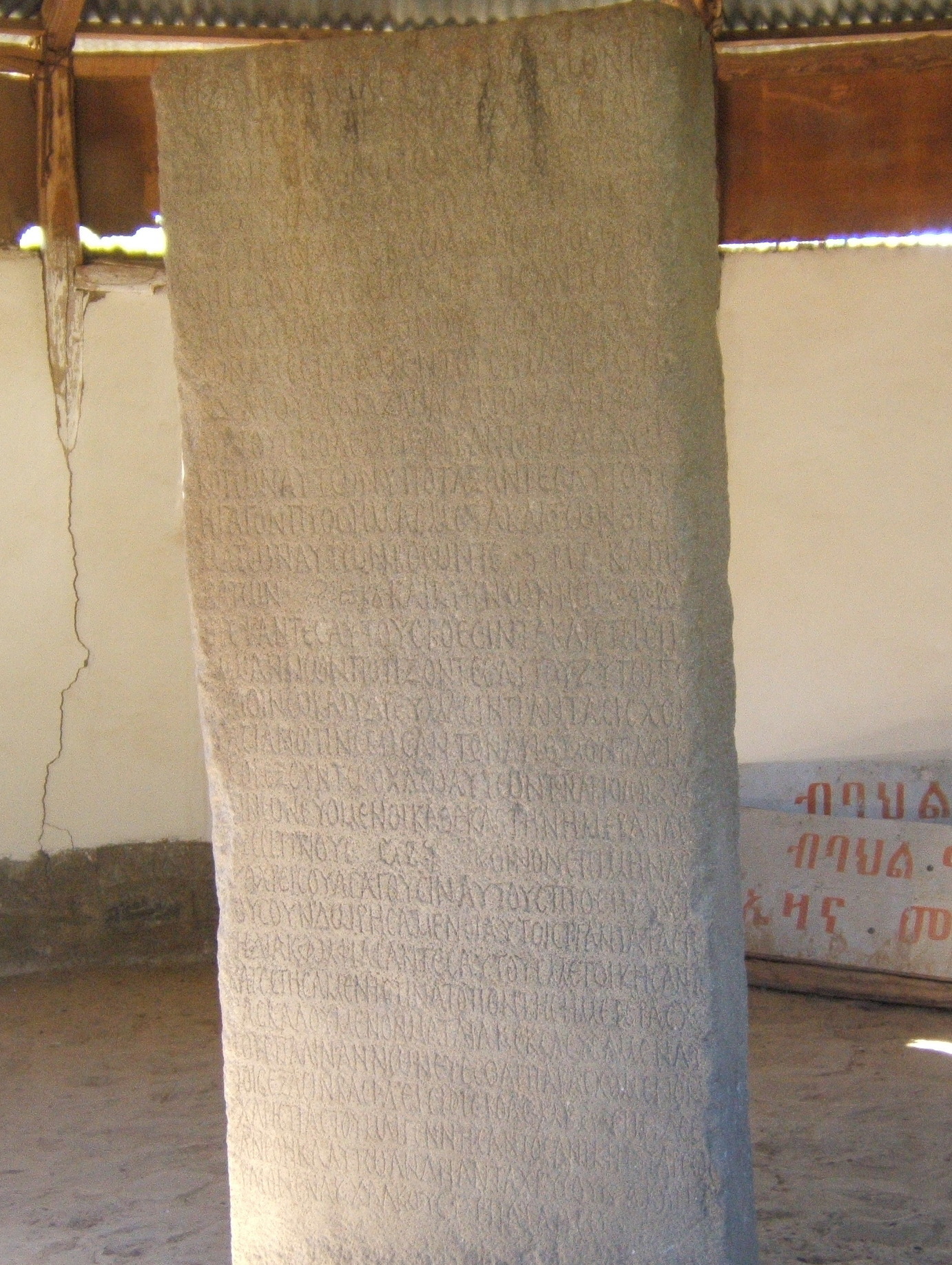
The transition can be dated with unusual precision because it is stamped on objects, not merely inferred from manuscripts. A coin of the Aksumite king Wazeba, from the late third or early fourth century CE, already carries an individual vocalised letter — about thirty years before the change becomes general 6. The fully vocalised system then appears in the monumental inscriptions of Wazeba's successor Ezana, whose reign in the mid-fourth century produced the trilingual and multi-script royal texts that are the showpieces of early Aksumite epigraphy 514. The Ezana Stone at Aksum records the king's deeds in Greek, in Ge'ez written in the old unvocalised South Arabian-derived script, and in Ge'ez written in the new vocalised fidäl — the moment of transition frozen in a single monument, the ancestral abjad and its vocalised descendant standing side by side on the same stone 5. Few writing systems anywhere leave so exact a snapshot of their own turning point.
The Indian question
Why did the vowels arrive, and arrive so suddenly? Here the record must be honest about a genuine scholarly disagreement rather than manufacture a false certainty. Two explanations compete, and neither has won.
The first points across the Indian Ocean. Aksum in the fourth century was a commercial power plugged into a trade system that reached the ports of western India, and the writing systems of India — the Brahmi-derived scripts — were themselves abugidas, alphasyllabaries in which consonants carry inherent vowels modified by diacritics. The structural resemblance between the fidäl and the Brahmic scripts is close enough that scholars including Yuri Kobishchanov and the writing-systems specialist Peter T. Daniels have proposed that Indian scripts, encountered through Indian Ocean trade, supplied the model — or at least the idea — for Ethiopic vocalisation 96. On this reading the vowel revolution was a second transmission, layered onto the first: an Arabian script vocalised on an Indian principle, the two great limbs of the ancient alphabet meeting on the African shore of the Red Sea.
The second explanation credits internal innovation. On this view the Aksumite scribes, working under the pressures of a newly literate Christian bureaucracy that needed to fix the exact sounds of scripture and liturgy so that the sacred words could not drift, solved the vowel problem themselves, out of the resources of their own script, without needing a foreign template. The systematic, patterned way the vowel marks attach to the consonants looks, to these scholars, like a single coherent local design rather than a set of borrowings. The two hypotheses are not fully reconcilable, and the surviving evidence does not settle the question — there is no bilingual, no scribal note, no transitional chart that would decide it. What is not in dispute is the outcome: the Horn produced, in a few decades, one of the most complete and durable vocalised writing systems in the ancient world, and did the decisive design work on African soil.
A Christian script
The vowel revolution did not happen in a vacuum. It coincided almost exactly with the event that would define the next sixteen centuries of highland history: the conversion of King Ezana and the Aksumite court to Christianity, around 330 to 340 CE 2. Tradition credits the vocalisation itself to Frumentius — known in Ethiopia as Abba Selama, "Father of Peace" — the Syrian-Greek missionary said to have converted Ezana and become the first bishop of Aksum 62. The historical reality is less tidy than the tradition, since a vocalised letter already appears on Wazeba's coinage before Frumentius's likely influence, and the change was probably the work of a scribal generation rather than a single hand. But the association captures something true: the fidäl reached its mature form in the same decades that the script became the vehicle of a scripture, and the needs of that scripture — exactness, fixity, reproducibility — are exactly the needs a vowel system serves.
The consequences arrived quickly and compounded:
- A fixed direction. With Christianisation the script settled permanently into left-to-right writing, breaking finally with the right-to-left and boustrophedon norms of its South Arabian ancestor 6.
- A translated Bible. Over the fourth to sixth centuries the scriptures were rendered into Ge'ez — work associated in tradition with the "Nine Saints," monks of the late fifth and sixth centuries — creating a vast written corpus and making the language a literary and liturgical vehicle 12.
- A liturgical anchor. Ge'ez became, and remains, the sacred language of the Ethiopian and Eritrean Orthodox Tewahedo churches: the language in which God is addressed, the chant sung, and the canon preserved 1012.
- A manuscript culture. A tradition of hand-copied parchment codices grew up around the script and ran unbroken for a millennium and a half — one of the great manuscript cultures of the world, and among the least studied outside the field 12.
What that manuscript culture preserved is one of the quiet marvels of the transmission. Because the Ge'ez Bible was translated early, from Greek, and because the Ethiopian church then held a broader canon than any other Christian tradition — around eighty-one books — the fidäl became the vault for scriptures that were lost everywhere else. The Book of Enoch and the Book of Jubilees, ancient Jewish works that vanished from the Greek and Hebrew traditions, survive complete only in Ge'ez, copied by highland scribes across fifteen centuries until modern scholars came looking for them 1012. The wall around literacy, in other words, also functioned as a strongroom: the same clerical monopoly that kept most people out kept these texts in existence. The cost and the achievement are the same institution seen from two sides.
The script that Saba' had exported as a tool of kings and moon-gods had become, on the African side of the strait, the alphabet of a Christian civilisation. And a Christian civilisation with an alphabet does a particular thing with it: it decides who is allowed to read. That decision is where the cost of this transmission finally comes due.
What the cost was: the monopoly and the survivor
Literacy behind a wall
The cost of this transmission is not a body count. No city was sacked for the fidäl, no population enslaved to carry it; the act of borrowing a script does not, in itself, kill anyone. The cost is subtler and longer, and it is a cost of access. For most of its history the writing that the highlands had made their own was locked away from the very people who spoke the highland languages. Ge'ez, the language the vocalised script was perfected to write, stopped being anyone's mother tongue somewhere around the end of the first millennium CE, surviving only as the frozen liturgical and literary language of church and court 10. The languages people actually spoke — Amharic, Tigrinya, Tigre, and the rest — were written little or not at all for centuries. To be literate did not mean to write one's own speech; it meant to have learned a dead sacred language and its several-hundred-character script inside an ecclesiastical institution that decided who entered.
That institution guarded the gate, and it did so through a long, filtering course of study. Literacy in Ge'ez was concentrated in the clergy and in the class of learned church scholars known as debtera — cantors, scribes, poets, and teachers who mastered the liturgical language, copied the manuscripts, ran the church schools, and monopolised the arts of reading and writing 12. Church education proceeded in stages, and each stage shed most of those who began it:
- The reading house (nəbab bet): learning the fidäl and reading the Psalter aloud in Ge'ez, usually by memorising it whole — the foundation, reached by relatively few children and completed by fewer.
- The music house (zema bet): mastering the chant of the liturgy, years of it.
- The poetry house (qene bet): composing qene, the dense, punning devotional verse in Ge'ez that was the summit of highland learning — attained by a small scholarly elite.
- The commentary and manuscript houses: the interpretation of scripture and the copying of books, the province of the fully trained debtera alone.
The scribe's skill was real and demanding, and the manuscript culture it sustained was magnificent. But it was also a fence. Knowledge that lived in fidäl-written codices was accessible only to those the church had trained, and the church trained whom it chose — overwhelmingly male, overwhelmingly bound for religious service.
The script as identity, and who fell outside it
Vocalised Ge'ez did not stay a neutral technology. It became the marker of a specific identity: Christian, highland, and bound to the imperial state that the Solomonic dynasty rebuilt and legitimised from 1270 CE onward. The written tradition was overwhelmingly a religious one — Bibles, liturgies, saints' lives, royal chronicles composed by churchmen — and to write in the fidäl was, for most of its history, to participate in a Christian-imperial culture. This had a shadow side, and the record should name it plainly rather than euphemise it, while resisting the temptation to turn a real cost into a polemic.

The consequences of a script fused to a Christian-imperial identity fell along predictable lines:
- Oral and non-textual traditions were devalued. In a culture where prestige knowledge was the written, sacred kind, the vast oral inheritance of the highlands — and of the many peoples the highland state absorbed — carried less authority precisely because it was unwritten. What could not be entered in the fidäl slid toward the informal and the folk.
- Non-Christian communities sat outside the lettered centre. The Muslim populations of the Horn maintained their own Arabic literacy in their own institutions; the Beta Israel (Ethiopian Jews) used Ge'ez for their own sacred texts yet remained socially marginal; and the many peoples incorporated into the expanding highland empire, especially the southern peoples brought in during the nineteenth-century conquests, spoke languages the fidäl was not used to write and stood outside the church-school system entirely.
- A clerical-royal ceiling on knowledge. Because literacy was ecclesiastical, secular and popular knowledge had no easy written channel, and the productive energies of writing were directed largely toward liturgy, hagiography, and dynastic chronicle rather than toward broad public literacy 12. Mass literacy in the highland languages is overwhelmingly a twentieth-century development.
None of this was the doing of the Sabaean traders who first carried the musnad across the water in the early first millennium BCE. But it is the long downstream cost of the thing they started: a writing system so tightly fused to a religious and imperial elite that, for most of its life, it sorted the population into the lettered and the excluded, and the line between them ran along faith, class, sex, and region.
The outlier that survived
And yet the record's final and most important fact runs the other way, and it is the reason the transmission earns a persistence rating at the very top of the scale. Nearly every other writing system that ancient Africa produced or received was extinguished. Egyptian hieroglyphs fell silent and had to be deciphered anew in the nineteenth century, the key to three thousand years of records lost for more than a millennium. The Meroitic script of Nubia went dark for two thousand years and is only partly readable now. The Libyco-Berber scripts of North Africa withered to the desert margins, surviving as Tuareg tifinagh but driven out of the settled world by Latin and then Arabic. Almost everywhere, the arrival of foreign empires — Roman, Arab, Ottoman, and finally European colonial — meant the death, replacement, or marginalisation of indigenous writing.
The Ge'ez script did not die. It is, on any reasonable accounting, the only ancient African writing system in continuous daily use from antiquity to the present. It survived the collapse of Aksum in the seventh and eighth centuries, the long medieval centuries of the Solomonic state, the rise of Islam that reordered the trade of the Red Sea all around it, and — the decisive test — the European colonial scramble for Africa, because the highland Christian state defeated the one serious colonial invasion it faced and was never durably ruled from outside. When Amharic and Tigrinya finally came to be written in earnest, they were written in the fidäl, the same syllabary the Aksumite scribes had perfected in the fourth century, extended with a handful of extra characters for sounds Ge'ez lacked. Today the script carries the daily business of tens of millions of people: it is the national script of Ethiopia, co-official in Eritrea, and the living hand of Amharic and Tigrinya newspapers, shop signs, schoolbooks, keyboards, and phone screens 10.
Into the age of print and pixels
Survival is not the same as ease, and the fidäl's passage into the modern world exacted its own toll from the technology it had outlasted every empire to keep. A script of more than two hundred distinct characters is a hard thing to print and a harder thing to type. The earliest printed Ge'ez appeared not in Ethiopia but in sixteenth-century Europe, set by orientalist scholars; movable-type printing came late and awkwardly to the highlands, and the mechanical typewriter never fit the syllabary comfortably — Ethiopian typewriters demanded ingenious, cramped compromises, and many characters had to be built up from parts or dropped. For a while, in the mid-twentieth century, there was even scholarly and official pressure to romanise Amharic outright, to trade the ancestral script for the convenience of the Latin keyboard, as Turkish and Malay had done. It did not happen.
Digital technology closed the gap the machine age had opened. Ge'ez was encoded in the Unicode standard in the late 1990s, and Amharic and Tigrinya are now typed, texted, and rendered on every phone and screen through input methods that map the syllabary onto ordinary keyboards 10. The script that a twentieth-century engineer could barely fit on a typewriter carriage is, in the twenty-first, simply another Unicode block — and the tens of millions who write it daily are, for the first time in its history, a genuinely mass literate public rather than a clerical elite. The wall did not so much fall as become irrelevant, outflanked by schoolrooms and software. The survivor adapted one more time.
This is the anti-exceptionalist point the record exists to make, and it cuts against two errors at once. Writing in the Horn of Africa was not a gift of the modern colonial world — the fidäl was fifteen centuries old when the first European mapmakers reached Aksum. Nor was it a mere transplanted colony of Yemen, a piece of Arabia set down on the wrong continent. It was a technology carried across a strait in the early first millennium BCE, taken over by an African elite, detached from its foreign language, cut down and rebuilt with a vowel system found in no other alphabet, welded to a scripture, and carried unbroken through twenty-eight centuries to the smartphones of Addis Ababa and Asmara. The Sabaean settlers gave the highlands a set of consonants. Everything that made those consonants into one of the most durable writing systems on earth — the vowels, the script's survival, its two thousand years of literature — the highlands did themselves. The bill for that achievement was paid, quietly and for a very long time, by everyone the fidäl kept outside the wall.
What followed
-
-700c. 700 BCE: the Great Temple of Almaqah rises at Yeha in the Tigray highlands — finely dressed Sabaean-style stone, still standing over twelve metres high, the oldest standing structure in Ethiopia.
-
-600c. 800–400 BCE: the kingdom of Di'amat (D'MT) leaves dedications in the Sabaic language and monumental musnad script, its rulers taking the South Arabian royal title mukarrib and invoking Almaqah.
-
1501st–3rd century CE: 'Old Ge'ez' emerges — the imported abjad detached from Sabaic and re-fitted to the local Ge'ez language, its inventory cut from twenty-nine letters to twenty-six. The script becomes African.
-
300late 3rd–early 4th century CE: a coin of the Aksumite king Wazeba carries an individual vocalised letter — the first stamped evidence of the vowel system, about thirty years before it becomes general.
-
340c. 330–340 CE: King Ezana converts to Christianity; the Ezana Stone records his reign in Greek, unvocalised Ge'ez, and the new fully vocalised fidäl side by side — the transition frozen in one monument. Writing fixes left-to-right.
-
5004th–6th century CE: the Bible is translated into Ge'ez, creating a vast written corpus and making the language the literary and liturgical anchor of Aksumite and later highland Christianity.
-
1270from 1270 CE: under the Solomonic dynasty, Ge'ez literacy is concentrated in the clergy and the debtera scholar class — cantors, scribes, and teachers who monopolise reading, writing, and manuscript copying for centuries.
-
195019th–21st century: Amharic and Tigrinya come to be written in the fidäl. It is the national script of Ethiopia, co-official in Eritrea, and the only ancient African writing system in continuous daily use — carried through the colonial era unbroken.
Where this lives today
References
- Phillipson, David W. Foundations of an African Civilisation: Aksum and the Northern Horn, 1000 BC–AD 1300. Eastern Africa Series. Oxford: James Currey, 2012. The standard synthesis of the archaeology; argues that indigenous highland societies preceded and outweighed South Arabian influence, and that the older colonisation model over-stated the Sabaean role. en
- Munro-Hay, Stuart C. Aksum: An African Civilisation of Late Antiquity. Edinburgh: Edinburgh University Press, 1991. The standard English-language account of the Aksumite kingdom, its Christianisation under Ezana, its coinage, and its inscriptions. en
- Fattovich, Rodolfo. "The 'Pre-Aksumite' State in Northern Ethiopia and Eritrea Reconsidered." In Trade and Travel in the Red Sea Region, edited by Paul Lunde and Alexandra Porter, 71–77. BAR International Series 1269. Oxford: Archaeopress, 2004. Reassesses the Di'amat polity as a contact phenomenon between an indigenous chiefdom and South Arabians rather than a Sabaean colony. en
- Drewes, Abraham J. Inscriptions de l'Éthiopie antique. Leiden: E. J. Brill, 1962. A foundational corpus and study of the ancient inscriptions of Ethiopia, pre-Aksumite and Aksumite, in the original scripts. fr primary
- Bernand, Étienne, Abraham J. Drewes, and Roger Schneider. Recueil des inscriptions de l'Éthiopie des périodes pré-axoumite et axoumite. 3 vols. Paris: Académie des Inscriptions et Belles-Lettres / de Boccard, 1991–2000. The standard critical edition (RIÉ) of the pre-Aksumite and Aksumite inscriptions, including the royal texts of Ezana in their several scripts and languages. fr primary
- Getatchew Haile. "Ethiopic Writing." In The World's Writing Systems, edited by Peter T. Daniels and William Bright, 569–576. New York: Oxford University Press, 1996. The standard concise scholarly account of the origin and structure of the Ethiopic script, its descent from Ancient South Arabian, the reduction of the letter inventory, and the fourth-century vocalisation. en
- Japp, Sarah, Iris Gerlach, Holger Hitgen, and Mike Schnelle. "Yeha and Hawelti: Cultural Contacts between Saba and D'MT — New Research of the German Archaeological Institute in Ethiopia." Proceedings of the Seminar for Arabian Studies 41 (2011): 145–160. Reports the DAI excavations at Yeha, including the Almaqah temple and the Grat Be'al Guebri, and their Sabaean architectural parallels. en
- Hatke, George. Aksum and Nubia: Warfare, Commerce, and Political Fictions in Ancient Northeast Africa. New York: New York University Press and Institute for the Study of the Ancient World, 2013. On Aksum as an autonomous northeast African power and its wider regional relations. en
- Kobishchanov, Yuri M. Axum. Edited by Joseph W. Michels, translated by Lorraine T. Kapitanoff. University Park: Pennsylvania State University Press, 1979. Translated from the Russian; discusses Aksumite trade, its Indian Ocean connections, and the hypothesis of Indic influence on Ethiopic vocalisation. en
- Ullendorff, Edward. The Ethiopians: An Introduction to Country and People. 3rd ed. London: Oxford University Press, 1973 (first published 1960). A classic introduction covering the Semitic languages of Ethiopia, Ge'ez as a liturgical language, and the fidäl script. en
- Uhlig, Siegbert, ed. Encyclopaedia Aethiopica. 5 vols. Wiesbaden: Harrassowitz, 2003–2014. The standard reference work for Ethiopian and Eritrean studies, with authoritative entries on Ge'ez, the fidäl, Yeha, Di'amat, Ezana, and Frumentius. en
- Bausi, Alessandro. "Writing, Copying, Translating: Ethiopia as a Manuscript Culture." In Manuscript Cultures: Mapping the Field, edited by Jörg B. Quenzer, Dmitry Bondarev, and Jan-Ulrich Sobisch, 37–77. Studies in Manuscript Cultures 1. Berlin: De Gruyter, 2014. On the Ge'ez manuscript tradition, the ecclesiastical concentration of literacy, and Ethiopia as one of the world's great and least-studied manuscript cultures. en
- Robin, Christian Julien, ed. L'Arabie antique de Karib'îl à Mahomet: Nouvelles données sur l'histoire des Arabes grâce aux inscriptions. Revue des mondes musulmans et de la Méditerranée 61. Aix-en-Provence: Édisud, 1991. Standard French scholarship on the Sabaean kingdom, the musnad script, and Ancient South Arabian epigraphy on the source side of the transmission. fr
- Marrassini, Paolo. Storia e leggenda dell'Etiopia tardoantica: Le iscrizioni reali aksumite. Testi del Vicino Oriente antico. Brescia: Paideia, 2014. An edition with commentary of the Aksumite royal inscriptions, including those of Ezana, tracing the shift from the unvocalised to the vocalised script. it primary