The Buddha's first body was carved by Greek hands (~100 CE)
In Gandhara, under Kushan patronage in the first and second centuries CE, sculptors working in a Hellenistic tradition inherited from Greco-Bactria fused the heroic Greek body and its draped mantle with the thirty-two marks of a Buddha. The standing figure they invented became the template for Buddhist sculpture from the Yungang grottoes to Hōryū-ji to the Kamakura Daibutsu — and outlived by a millennium and a half the Gandharan civilization that made it.
Around 100 CE, in the schist workshops of Gandhara — the country around Peshawar, then ruled by the Kushans — sculptors trained in a Greek artistic tradition that had survived two centuries after the last Greek king carved the first images of the Buddha in human form. For nearly five hundred years Buddhists had refused to show him, marking his presence with an empty throne or a pair of footprints. The new figure fused an Apollo-like Hellenistic body and its deep-folded mantle with the Indic marks of a Buddha. It became the standard form across East Asia for eighteen centuries — long after Gandhara itself was destroyed.

Before the image: a Buddhism that would not show the Buddha
The aniconic centuries
For roughly the first half-millennium of its existence, Buddhist art did not depict the Buddha. Siddhartha Gautama died around 400 BCE by the chronology most widely accepted among modern specialists — a century later than the traditional date — and for four to five hundred years after him, the sculptors who covered the great stupa railings at Bharhut (c. 100 BCE) and the carved gateways of Sanchi (late first century BCE) with crowded narrative reliefs of his life told every episode of that life without once carving his body.10 Where the Buddha should walk, they cut a pair of footprints into the stone; where he should sit enlightened, they carved a vacant seat beneath a Bodhi tree; the first sermon at Sarnath is a wheel flanked by deer; the final passing is a domed stupa. The most important presence in each scene is marked by a deliberate, worked, unmistakable absence.
The vocabulary of substitution was rich and exact, not a crude shorthand. The wheel (dharmachakra) stood for the doctrine set turning at the first sermon; the Bodhi tree, often with a railing and an empty seat, for the awakening at Bodh Gaya; the stupa for the parinirvana, the final passing; a riderless, caparisoned horse with a parasol held over the empty saddle for the Great Departure from the palace at night; a pair of footprints (buddhapada), the soles marked with wheels, for the simple fact that the teacher had walked there; the lotus for his purity; and the empty throne, returned to again and again, for the teaching presence itself.10 This was a developed theological language of allusion, capable of narrating a complete life and a metaphysics of transcendence. Whatever drove it — doctrine, decorum, or the literal accuracy of depicting devotion at relics — it was a sophisticated system, and the new image did not improve on its sophistication so much as answer a different need.
Scholars have argued for more than a century about why. The older explanation — that an absolute doctrinal prohibition forbade depicting a being who had passed beyond name and form — has been steadily complicated. Susan Huntington and others proposed that many supposedly "aniconic" panels are not scenes from the Buddha's biography at all but representations of later devotion at the sites and relics he left behind, in which case his bodily absence is simply historical accuracy rather than taboo.10 The debate is unresolved. What is not in doubt is the visual habit itself: the narrative art of early Indian Buddhism was an art of indicating the Buddha rather than showing him, and it sustained that discipline across centuries and hundreds of reliefs without apparent strain.
What the receiving culture already had
The world that would eventually receive the new image was not artistically impoverished, and this matters for measuring what changed. Mauryan and post-Mauryan India possessed a confident monumental stone tradition: the polished sandstone pillars of Ashoka in the third century BCE, the lion capital at Sarnath that is now the emblem of the Indian republic, the massive yaksha and yakshi nature-spirit figures, and the dense relief programs at Bharhut, Sanchi, and later Amaravati.6 Indian sculptors could model the human body with assurance and a frank sensuous fullness; the yakshis who bracket the Sanchi gateways are among the most accomplished figures in early Indian art. The absence of a Buddha figure was therefore not a shortfall of skill or ambition.
It was a category — a thing the culture had decided not to do. The receiving tradition had everything materially required to carve a Buddha except the impulse, or the permission, to give the Enlightened One a face. Ananda Coomaraswamy, who would later insist on the Indian origins of the eventual image, was right at least about this much: the sculptural competence was wholly present and indigenous well before any Greek influence is invoked.6 The transformation that came was not the arrival of skill. It was the crossing of a conceptual line that Buddhist art had held for five centuries — the line between suggesting the teacher and depicting him.
A Hellenized frontier
Gandhara — the country around Peshawar (ancient Purushapura) and the Swat valley, straddling what is now the border of Pakistan and Afghanistan — sat at the far northwestern edge of the Indian world and the far eastern edge of the Greek one. Alexander of Macedon had marched through Bactria and across the Hindu Kush into the Punjab between 329 and 325 BCE, and his passing was not a tourist's. His successors left Greek and Macedonian garrisons, settlers, and administrators scattered across the region, and north of the Hindu Kush, in Bactria proper, those settlers built a Greek world that lasted for generations after Alexander himself was dust.213
The excavated city of Ai Khanoum on the Oxus is the proof of how deep that world ran. Dug by Paul Bernard's French archaeological mission between 1965 and 1978 — before the Soviet invasion closed Afghanistan to such work and looters finished what war began — it revealed a thoroughly Greek city two thousand miles from the Aegean: a theatre seating several thousand, a gymnasium, Corinthian colonnades, a heroon shrine, and a courtyard where a traveller named Klearchos had inscribed the maxims of Delphi, copied from the oracle's own precinct and set up on the Oxus for the edification of a Greek population that read them in Greek.13 A Greek city, with a Greek civic body, quoting the Delphic oracle, on the river that marks the edge of Central Asia.
Gandhara itself had felt Alexander directly. In 327–326 BCE his army fought through the Swat valley and the hill country north of the Kabul river, storming the rock-fortress the Greeks called Aornos, before Ambhi — the king the Greek sources call Taxiles, ruler of Taxila — opened his city to the Macedonians without a fight and provisioned them for the advance to the Hydaspes.2 The Greek imprint on the northwest was therefore double: the deep, durable settlement of Bactria north of the mountains, and, in Gandhara proper, a layered memory of conquest, alliance, and garrison-founding that left Greek names on the land and Greek blood in the population. When the Hellenistic sculptural tradition arrived in force under the Kushans, it arrived in a country that had carried a Greek stratum for three centuries.
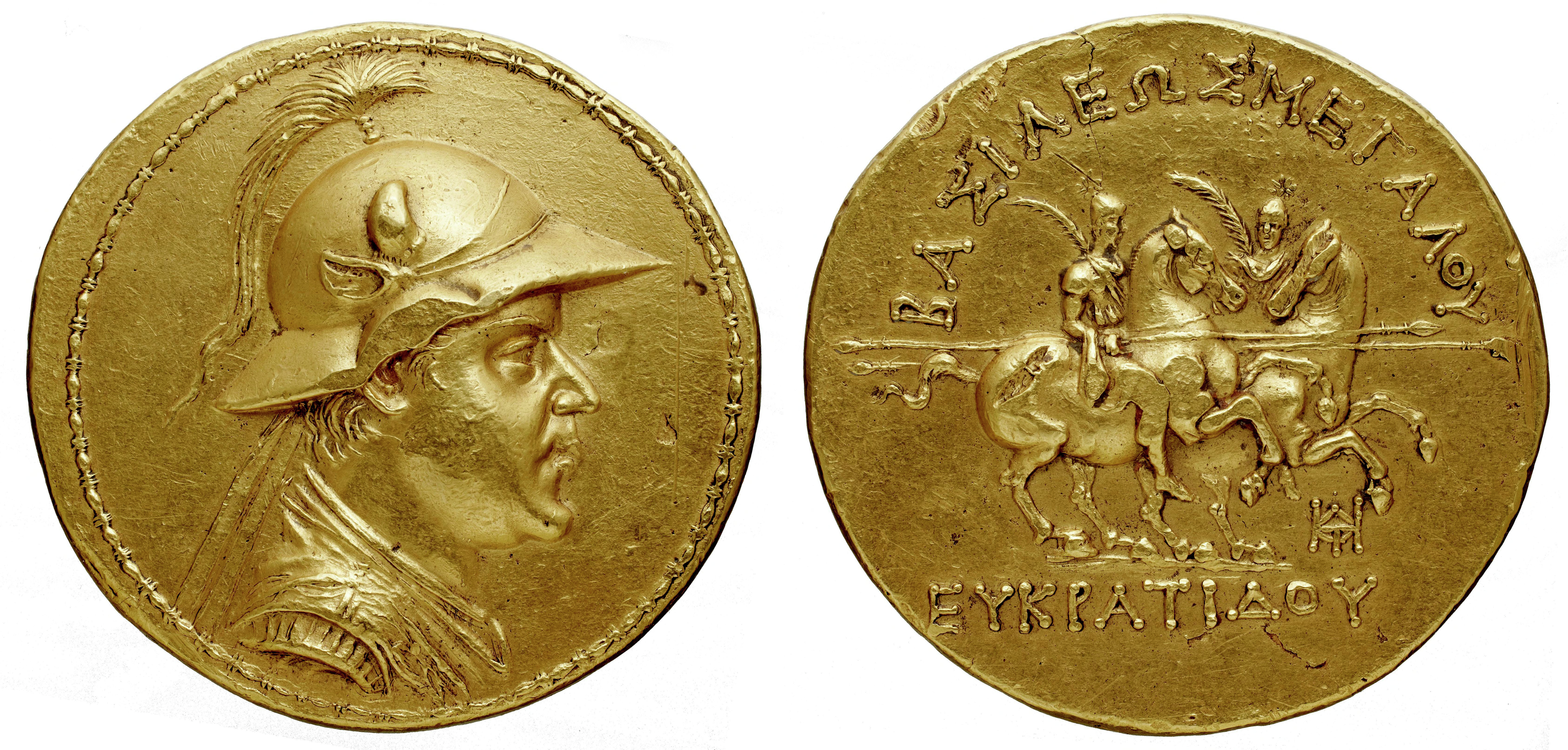
The coinage carried the same world at full strength. Greco-Bactrian and Indo-Greek kings — Diodotus, Demetrius, Eucratides, Menander — struck portrait coins of a realism unmatched anywhere in the ancient world, individualized faces in high relief that owe nothing to provincial imitation. Eucratides issued a twenty-stater gold piece weighing 169 grams, the largest gold coin to survive from antiquity. And the kings who minted these objects ruled populations already turning Buddhist: the Indo-Greek king Menander I (r. c. 155–130 BCE) is remembered in the Pali Milindapañha, "The Questions of King Milinda," as a Greek ruler who pressed the monk Nāgasena on points of doctrine and, in the text's telling, took refuge in the Buddhist teaching.15 Greek metaphysical training and Indian Buddhist argument were already in the same room, on the same frontier, three centuries before anyone carved the Buddha's face.
The religious imagination of this frontier was syncretic in metal long before it became syncretic in stone. The Indo-Greek kings who ruled south of the Hindu Kush after the Bactrian dynasty fragmented carried the Greek pantheon on their coinage — Zeus enthroned, Athena Alkidemos hurling her thunderbolt, Herakles with his club, the mounted Dioscuri.2 Several struck bilingual issues, Greek legend on one face and Kharoshthi or Brahmi on the other, and some set Indian divinities beside the Greek ones; one king, Agathocles, even issued coins depicting figures recognizable as Indic deities in a Greek visual idiom. A culture that could put an Indian god into Greek drapery on a coin in the second century BCE was already rehearsing, in miniature and in precious metal, the synthesis that its sculptors would perform at monumental scale in stone two or three centuries later.
The transmission: Greek hands, Indic rules
How the Greek vocabulary survived its kings
The Greco-Bactrian kingdom did not last. Around 145 BCE nomadic peoples whom the Chinese sources call the Yuezhi, driven west off the steppe by the Xiongnu, overran Bactria; Ai Khanoum was burned and abandoned, its theatre and gymnasium left to silt and the river.13 But — and this is the hinge of the whole story — the conquerors did not erase the Hellenistic culture they found. They settled into it. Over the following two centuries one Yuezhi group consolidated the rest into the Kushan empire, a state that would stretch from the Oxus across the Hindu Kush deep into northern India, with its winter capital at Purushapura.5
The Hellenistic sculptural vocabulary — the inherited know-how of carving drapery so it falls and clings, modelling a face in the round, balancing a standing body on shifted weight — survived the death of the Greek kingdoms because it lived in workshops, not in dynasties. It passed from master to apprentice along the frontier, a craft tradition outlasting the political order that had imported it. By the time the Kushans were ready to spend their Silk Road wealth on Buddhist monuments, the region still held sculptors who worked, by inheritance, in a recognizably Greek idiom.23 The Greeks lost their kingdoms and kept their chisels.
Kushan patronage and the schist workshops
Under the Kushans, and especially under Kanishka I — whose accession Harry Falk's analysis of an astronomical reference now dates to 127 CE, resolving a chronology that had wandered across a century of scholarship — Gandhara became the workshop of a new sacred art.512 Kanishka is remembered in Buddhist tradition as a patron on the scale of Ashoka, and whatever the legend's exaggerations, the material record bears out a region suddenly dense with monasteries (saṃghārāmas) and stupas, funded by the merchant wealth that the Kushan peace pumped along the routes between Han China, India, and Rome.
The Gandharan sculptors worked principally in a grey-blue schist flecked with mica — a stone that took crisp detail and held a soft sheen — and, in the later phases, in lime stucco that could be modelled fast and cheap for the proliferating shrines.38 Their output was industrial in scale and devotional in purpose: thousands of standing and seated Buddhas, princely bodhisattvas, garland-bearing erotes, and narrative reliefs of the Buddha's life and former lives, made to clad the drums and stairways of stupas and to fill the niches of monastery courtyards. W. Zwalf's catalogue of the British Museum's holdings alone runs to some 680 objects, and the British Museum's is one collection among dozens.8 This was not a handful of experimental pieces. It was a mature regional school producing sacred sculpture at volume.
The Greek inheritance in Gandhara was never confined to the Buddha's body. The whole decorative grammar of the stupa came from the classical Mediterranean: Corinthian and pseudo-Corinthian capitals, acanthus scrolls, egg-and-dart mouldings, vine-and-grape friezes, garland-bearing cupids (erotes) staggering under heavy swags of fruit, tritons, sea-monsters, and atlas figures crouched to bear an entablature.37 Dionysiac scenes of revellers and wine-pressing appear on Buddhist reliefs with their Greek origin undisguised, their meaning quietly reassigned. A pilgrim circumambulating a Gandharan stupa moved through a frieze-world that a Roman provincial would have found half-familiar — and that had been bent, motif by motif, to frame the life of an Indian teacher.
The workshops sat at one of the great commercial crossings of the ancient world, and their cosmopolitanism was material as well as stylistic. Gandhara's wealth was Silk Road wealth: it lay astride the route by which Chinese silk moved west and Mediterranean gold and glass moved east, and Roman coins, intaglios, bronzes, and glassware have been excavated from Kushan-period sites such as Begram.59 The sculptors recorded their dedications in Kharoshthi, the region's administrative script, itself a descendant of Aramaic; they worked for monasteries endowed by merchants and converted nobility; and when they needed a model for a draped male figure or a curly-haired youth, they drew on a Hellenistic repertoire that the caravans kept refreshing with new contact. The synthesis was not a single inspired leap but the settled habit of a place where these traditions had been adjacent for centuries.
The grammar of the fusion
The Gandharan Buddha is a precise marriage of two systems, and the precision is the point. From the Hellenistic side came the body and the way of handling it: a youthful, idealized, heroic male form; a face on the Apollo model, with a straight nose continuous with the brow, full lips, and a serene set; wavy hair; and above all the himation, the Greek mantle, draped over both shoulders and falling to the ankles in deep, naturalistic, weight-bearing folds that a Greek sculptor of drapery would have recognized at once.13 Reviewing John Boardman's study of how classical art travelled, the archaeologist Brunilde Sismondo Ridgway singled out exactly this object — "the Greek idiom of the humanized standing Buddha" — as the diffusion of classical form reaching "its most revealing expression."162
From the Indic side came the rules. A Buddha's body was scripturally required to bear the lakshanas, the thirty-two marks of a "great man" (mahāpuruṣa), and the sculptors had to fit the Greek body to the Indian checklist. The ingenuity of the fit is the substance of the synthesis:
- The ushnisha, the cranial protuberance signifying transcendent wisdom, was rendered as a topknot — the wavy hair gathered and bound at the crown, exactly as a Greek god's or athlete's might be. The most spiritual of the marks was solved by the most Greek of hairstyles.
- The urna, the tuft of hair between the brows, became a small raised dot or whorl, a point of light in the centre of the Apollo-face.
- The elongated earlobes, stretched by the heavy gold earrings that Prince Siddhartha wore before his renunciation, hang empty in the finished Buddha — the act of giving up the world made legible in the flesh of the ears.
- The mudras, the codified hand gestures — abhaya, the raised open palm of reassurance; dhyana, the cupped hands of meditation; dharmachakra, the turning of the wheel of teaching — fixed the hands into a precise vocabulary of meaning.
- The halo (nimbus) behind the head, itself partly a Hellenistic and Iranian solar borrowing, marked the figure as more than human.
- The monastic robe, the saṃghāṭi, was the Greek himation reread as the three-part robe of a Buddhist monk — the same cloth, the same folds, a different doctrine.
How the classical element actually reached the Kushan workshops is itself debated, and the debate matters for what kind of transmission this was. Foucher and the early diffusionists imagined a direct line of descent from Alexander's Greeks. Later scholars, noting that the floruit of Gandharan sculpture falls squarely in the first three centuries CE, argued that much of the classical flavour is Roman-provincial rather than Greek — a "second Hellenism" arriving fresh along the trade routes that linked the Kushan realm to the Mediterranean, carried by craftsmen, portable objects, and pattern-books rather than inherited from the Bactrian past.212 Boardman's account stresses the continuity from the genuinely Greek Bactrian substrate; others emphasize the contemporary Roman contact attested by the imported bronzes and glass of Begram. The positions are not exclusive, and most current treatments allow both: an inherited Hellenistic foundation, refreshed by living commerce with Rome. What is certain is that the product was neither Greek nor Roman but Gandharan — a local synthesis that turned classical means to wholly Buddhist ends.
Who carved the first one?
Priority is contested, and the quarrel is both old and political. Alfred Foucher, in the monumental L'art gréco-bouddhique du Gandhâra (1905), argued that the Buddha image was born in Gandhara out of Greek art — his subtitle promised a study of "the origins of the classical influence in the Buddhist art of India and the Far East," and his thesis gave the West the credit for the idea of the image itself.1 Ananda Coomaraswamy answered him in 1927, in an essay titled "The Origin of the Buddha Image," insisting that the figure was an Indian creation at Mathura, south of Delhi, derived from the indigenous yaksha tradition and owing nothing essential to Greece.6 As later commentators have noted, Coomaraswamy's strictly Indian origin suited the anti-colonial mood of his moment as neatly as Foucher's Greek origin had suited the imperial one. The argument over a sculpture was also an argument over who owned the achievement.
The modern consensus refuses both pure claims. The earliest anthropomorphic Buddhas appear at both Gandhara and Mathura within roughly the same span — the first and second centuries CE, before and during Kushan rule — and the question of which workshop carved the very first is probably unanswerable on present evidence.1012 More to the point, most specialists now find it the less interesting question. Two distinct formal solutions emerged nearly together: the Hellenistic draped body at Gandhara, and the rounder, indigenous, yaksha-derived fullness at Mathura. What is not in dispute is which of the two travelled. The Mathura type remained largely Indian. The Gandharan standing figure, draped and Apollo-faced, became the ancestor of the Buddha image across half the world.
What changed and what was replaced
From symbol to body: the image becomes the cult
The arrival of the Buddha image changed what Buddhist devotion was for, and not only what it looked like. The aniconic stupa had been at bottom a reliquary — a mound raised over a fragment of the Buddha's cremated body or a possession he had touched, made holy by contact and circumambulated by the faithful who walked its base. The image was a different kind of object. It returned the worshipper's gaze; it had a face to be looked at and to look back; it could be installed, named, bathed, clothed, and addressed.1011 Over the first centuries CE the Buddha figure migrated from the edge of the narrative relief to the centre of the shrine, and image-worship became a structuring practice of Buddhist life, entangled with the relic cult and with the devotional turn that accompanied the early Mahayana. The empty throne, after five hundred years, was filled.
The change reached into the architecture of the monastery itself. Where the early Buddhist establishment had been organized around the stupa and the relic it enclosed, the mature Gandharan monastery added the image-shrine — a cella built to house a cult statue — and over time the image and the relic grew entangled, the consecrated statue treated as itself a kind of living presence to be tended, gilded, and addressed.1011 Juhyung Rhi and the contributors to Pia Brancaccio and Kurt Behrendt's volume on Gandharan Buddhism have traced how images in these monasteries became objects of a developing cult in their own right, accumulating offerings and ritual attention rather than merely illustrating doctrine. The Buddha image did not simply join the existing devotional system; it reorganized that system around a new centre of gravity — and the reorganization, not just the figure, is what travelled east.
This was a genuine transformation of religious experience, and it ran in only one direction. Once the image existed and proved devotionally powerful, it did not retreat. The marked absence that had carried so much meaning at Bharhut and Sanchi became, within a few generations, a thing of the past — a convention superseded rather than a living option held in reserve.
The same workshops produced a second great image type with an equally long future: the bodhisattva. Where the Buddha appeared as a renunciant in a plain monastic robe, the bodhisattva — a being bound for buddhahood but still moving in the world — was carved as a Gandharan prince, bare-chested or lightly draped, laden with the necklaces, armlets, turban, and moustache of a Kushan aristocrat, and often identifiable as the future Buddha Maitreya or as Siddhartha in his princely life before renunciation.310 The contrast between the two types was itself doctrine made visible: the jewelled prince and the robed ascetic, the world embraced and the world renounced, set side by side in the same stone. This princely, ornamented figure would become, carried east, the visual foundation for the great compassionate bodhisattvas of East Asian Buddhism — Avalokiteshvara among them — whose images would come to rival the Buddha's own in devotional weight.
The standing draped Buddha as a template
Among the Gandharan types — seated meditating Buddhas, the gaunt Fasting Siddhartha whose every rib and tendon the sculptors rendered in unflinching Hellenistic anatomical detail, narrative panels swarming with figures — one form proved canonical above the rest.34 It was the standing Buddha: frontal, calm, the right hand raised in the abhaya gesture of reassurance, the body wrapped in the deep-folded mantle that falls in long catenary curves to the ankles. The Cleveland Museum of Art, describing one such figure, puts the synthesis plainly: "Combining elements from both the Mediterranean and South Asian worlds, the artists of Gandhara created a new vision of the Buddha during the period of high contact between the two regions from the 100s to 200s AD."

This is the figure that would define East Asian Buddhist sculpture. Its proportions, its logic of drapery, its repertoire of gestures became a template — copied, abstracted, stylized, and re-localized at every stop along its route, but recognizably continuous across eight thousand kilometres and well over a thousand years. The brief that commissioned this record put the lineage as a single arc: from the Hellenistic Apollo, through the schist workshops of Gandhara, to the bronze Daibutsu on the hillside at Kamakura. It is not an exaggeration.
The road east
The image travelled with the monks and merchants of the Silk Road, and it travelled fast, mutating at each stage as local sculptors took the Gandharan template and reread it in their own materials and proportions:23
- Bamiyan (central Afghanistan): colossal Buddhas carved into the cliff, 38 and 55 metres tall, draped in the descended Gandharan manner around the sixth century CE — and dynamited by the Taliban in March 2001, the last and most public destruction in this long story.
- The Tarim Basin oases (Khotan, Kucha, Miran): Gandharan forms reproduced in clay, stucco, and wall-painting between the third and sixth centuries, the relay stations of the transmission across Central Asia.
- The Yungang grottoes (Northern Wei China): colossal seated Buddhas begun around 460 CE, their drapery and ushnisha visibly descended, through Central Asian intermediaries, from the Gandharan prototype.
- Korea and Japan: Buddhism reached the Yamato court in 538 or 552 CE; the bronze Shaka Triad cast by Tori Busshi for Hōryū-ji in 623 CE carries the Gandharan-derived form, filtered through China, into the Japanese archipelago.
- The Kamakura Daibutsu (1252 CE): a thirteen-metre bronze whose draped shoulders, ushnisha, urna, and downcast meditative gaze belong to the same lineage — some 6,000 kilometres and 1,150 years from the schist workshops of Peshawar.
The transmission carried companions as well as the central figure. In Gandhara the Buddha's thunderbolt-bearing protector Vajrapani was frequently carved as a bearded, muscular Herakles complete with club and lion-skin — a straight lift from the Greek repertoire.23 That Herakles, travelling east as Vajrapani, became the glowering Niō (Kongōrikishi) strongmen who to this day flank the gates of Japanese temples. A worshipper in Nara bowing between two temple guardians is standing, by unbroken descent, between two copies of a Greek demigod.
At each remove the form grew less Greek and more local, and the manner of its travelling is the proof that what moved was an idea rather than a style. The deep naturalistic folds of the Gandharan himation, cut to catch real raking light, flattened in China into rhythmic linear pleats and then into the schematic cascades of Japanese wood and gilt bronze; the Apollo-face broadened, calmed, and turned inward; the slight Hellenistic weight-shift stiffened into hieratic frontal symmetry.23 But the underlying scheme held across every translation — a draped figure, crowned with the ushnisha, marked with the urna, fixing a defined gesture, set against a halo. What travelled was not a template to be traced line for line but a solution to a problem the aniconic tradition had refused for five centuries: how to give the formless a face. Gandhara had solved it, and its solution proved portable in a way the rounder Mathura type, for all its indigenous authority, never quite was.
The eastward journey also changed the image's scale and its politics. In Gandhara the Buddha was typically life-sized or smaller, an object for a monastery niche or the drum of a stupa. Carried into the Hindu Kush and across Central Asia, it grew colossal: the cliff Buddhas of Bamiyan at 38 and 55 metres, the rock-cut giants of Yungang and later Longmen, the great cast bronzes of Nara and Kamakura.3 To sponsor such a figure became one of the supreme acts of Buddhist merit-making available to a ruler or a community, binding state power to the image in a way the modest schist statuettes of Peshawar never had. By the eastern end of its long route, the Greek-bodied Buddha had become a monument to dynasties as much as a focus for monks — the same form, scaled up to carry the ambitions of empires that had never heard of Gandhara.
What the image displaced
The gain carried one quiet cost, internal to the transmission itself and worth naming precisely because it is the only cost that the making of the image actually caused. The anthropomorphic Buddha did not so much abolish the aniconic tradition as overgrow it. Within a few centuries the older symbolic vocabulary — the empty throne, the footprints, the wheel standing in for the teacher — fell out of mainstream devotional use, surviving as decorative quotation rather than as living theology.106 A particular aesthetic, and the subtle doctrine of presence-through-absence that it had expressed for five hundred years, was marginalized by the very success of the image that succeeded it. This was a real loss. It was also a bloodless one. No one was killed for the empty throne; an aesthetic was retired, not a people.
What the cost was
A synthesis substantially without victims
By the grim standards of this atlas, the Greco-Buddhist synthesis was unusually cheap in human terms, and honesty requires saying so as plainly as honesty elsewhere requires tallying the dead. The transmission was not carried at the point of a sword. The Hellenistic sculptural vocabulary reached the Kushan workshops by inheritance and apprenticeship, not by conquest; the Indic iconography was supplied by the Buddhist sangha itself, from within; the patrons were Kushan rulers and Silk Road merchants who commissioned and paid for the work. The whole world that produced the image — Greek, Iranian, Indian, Central Asian, nomadic — was multicultural by its very formation, a frontier where these traditions had already been intermarrying for centuries before a chisel touched the first schist Buddha. On every side, the fusion was substantially voluntary.
This is why the record carries a cost severity of 1 rather than 0. Two considerations keep it off zero. The first is the aesthetic displacement just described — a genuine, if non-violent, loss of a five-century devotional tradition. The second is more structural: the Kushan state, like every empire, financed its monasteries and its art out of the surplus of conquest, tribute, and the taxed labour of farmers and the unfree, and the serene schist Buddhas were beautiful objects paid for by an imperial economy whose human costs do not appear anywhere on their surface. Neither of these is the violence of the transmission proper. But neither of them is nothing, and an honest ledger records the substrate as well as the gift.
The bill that came centuries later
The destruction of Buddhist Gandhara, when it came, was severe — and it came from outside, long after the synthesis was complete and the image had already escaped eastward beyond recall. In the late fifth and early sixth centuries CE the Alchon Huns, a branch of the Hephthalite or "White Hun" confederation, swept down into the northwest.9 Their king Mihirakula (r. c. 502–530 CE) is remembered across both Indian and Chinese sources as a persecutor of Buddhism on a vast scale; Xuanzang reports that he destroyed some 1,400 monasteries.14 The great monastic city of Taxila, a centre of Buddhist learning and sculpture for centuries, was wrecked in this period and never recovered. The numbers are reported rather than measured, and Mihirakula's may be inflated by hostile monastic memory, but the archaeological collapse of monastic Gandhara across the sixth century is not in doubt.94
The Hun assault on the northwest was part of a wider sixth-century catastrophe across northern India. The Alchon Huns under Toramana and Mihirakula also broke against the Gupta empire to the southeast, and the long wars of resistance drained the very states that might otherwise have sustained the northwestern monasteries.9 Buddhism in Gandhara did not vanish in a single season — Buddhist activity flickers on at some sites for generations afterward — but the dense institutional fabric of monasteries, stupas, and endowed workshops that had made the region the foundry of the Buddha image was shattered in this window, and it did not regenerate. The economy of pious patronage that had paid the sculptors was gone, and with it the conditions under which the school had flourished for half a millennium.
Xuanzang in the ruins
When the Chinese pilgrim Xuanzang reached Gandhara around 630 CE, on the journey that would make him the most famous traveller in Buddhist history, he found a ruin.14 The royal house was extinct and the country reduced to a dependency of Kapisa; of the monasteries, in Samuel Beal's 1884 translation, the greater number were "deserted and in ruins," choked with wild vegetation and "solitary to the last degree." The man who had crossed the whole width of Asia precisely to gather the texts and relics of the faith described the birthplace of its central image as a depopulated wreck. Three to four centuries further on, the conversion of the region to Islam under the Ghaznavids in the early eleventh century closed the account; Buddhist Gandhara was finished, and its schist Buddhas were left in the ground to wait for nineteenth- and twentieth-century archaeologists to dig them out.43
There is a final, modern entry in the ledger that this atlas should not omit. The schist Buddhas that now fill the cases in Tokyo, London, Berlin, Paris, and New York reached those cases through a century of colonial-era excavation, purchase, and removal. British and French archaeologists — John Marshall's decades-long campaign at Taxila among them — recovered and recorded an immense body of material with real scholarly care, and museums have preserved objects that might otherwise have been lost.48 But much of Gandharan sculpture left the region altogether, through colonial-period export, the antiquities market, and outright looting that has intensified with every modern war across Afghanistan and Pakistan. The image that Gandhara gave the world is now, with some irony, most easily seen everywhere except in Gandhara. That dispersal is not the cost of the ancient transmission; it is the cost of a modern one — the carrying-away of the objects themselves — and clarity about the first should not be allowed to launder the second.
The honest ledger
The cost framing here is, instructively, the near-inverse of the Phoenician alphabet's. With the alphabet, the transmission was peaceful and the senders — the Phoenician city-states — were annihilated in the same centuries by separate, parallel conquests that had nothing to do with the borrowing. With the Gandharan Buddha, the transmission was likewise peaceful, but it was the senders' own descendant culture — Buddhist Gandhara itself — that was destroyed, centuries later, by Hun and then Muslim forces wholly unconnected to the making of the image. In both cases the honest account must hold two facts together without letting either cancel the other: the gift was real and substantially unburdened, and the civilization that produced it did not survive to see how far the gift would travel.
The Buddha image outlived Gandhara by a millennium and a half, and outlived it spectacularly. It is today among the most reproduced human forms on earth — in the museum case in Tokyo, on the hillside at Kamakura, in the meditation app and the gift-shop figurine. Almost none of the hundreds of millions of people who have bowed before some descendant of it know that its body was first worked out by Greek-trained hands on the far northwestern frontier of India, under nomad kings, in a country that the religion it served could not, in the end, protect.
What followed
-
-250c. 250 BCE — the satrap Diodotus breaks Bactria away from the Seleucids, founding the independent Greco-Bactrian kingdom and establishing a durable Hellenistic culture on the Oxus.
-
-145c. 145 BCE — the nomadic Yuezhi overrun Bactria and Ai Khanoum is burned and abandoned; the Greek kingdoms fall, but the Hellenistic sculptural craft survives in the region's workshops.
-
127127 CE — the accession of Kanishka I (dated by Harry Falk's astronomical reckoning) inaugurates the height of Kushan Buddhist patronage; Gandhara becomes the workshop of a new sacred art in grey-blue schist.
-
1501st–2nd century CE — the first images of the Buddha in human form are carved at Gandhara (and, in a different idiom, at Mathura), ending nearly five centuries of Buddhist aniconism.
-
460c. 460 CE — the Yungang grottoes are begun in Northern Wei China; the colossal seated Buddhas carry the Gandharan drapery and ushnisha eastward through Central Asian intermediaries.
-
520c. 515–530 CE — Hephthalite (Alchon Hun) persecution under Mihirakula devastates Buddhist Gandhara; Xuanzang reports some 1,400 monasteries destroyed, and Taxila never recovers.
-
623623 CE — Tori Busshi casts the bronze Shaka Triad for Hōryū-ji; the Gandharan-derived Buddha form, filtered through China, reaches the Japanese archipelago.
-
630c. 630 CE — the pilgrim Xuanzang finds Gandhara's monasteries 'deserted and in ruins'; the birthplace of the Buddha image is by then a depopulated wreck, though the image itself has long since travelled beyond reach.
-
12521252 CE — the Kamakura Daibutsu is cast in Japan: a thirteen-metre bronze whose draped shoulders, ushnisha, and downcast gaze belong to the same lineage, 6,000 km and over a millennium from the schist workshops of Peshawar.
Where this lives today
References
- Foucher, Alfred. L'art gréco-bouddhique du Gandhâra: étude sur les origines de l'influence classique dans l'art bouddhique de l'Inde et de l'Extrême-Orient. 2 vols. Paris: Imprimerie Nationale / Ernest Leroux, 1905–1951. fr
- Boardman, John. The Diffusion of Classical Art in Antiquity. Princeton: Princeton University Press, 1994. en
- Behrendt, Kurt A. The Art of Gandhara in the Metropolitan Museum of Art. New York / New Haven: The Metropolitan Museum of Art / Yale University Press, 2007. en
- Marshall, John. The Buddhist Art of Gandhāra: The Story of the Early School, Its Birth, Growth and Decline. Memoirs of the Department of Archaeology in Pakistan, vol. 1. Cambridge: Cambridge University Press, 1960. en
- Rosenfield, John M. The Dynastic Arts of the Kushans. Berkeley: University of California Press, 1967. en
- Coomaraswamy, Ananda K. "The Origin of the Buddha Image." The Art Bulletin 9, no. 4 (1927): 287–329. en
- Ingholt, Harald, and Islay Lyons. Gandhāran Art in Pakistan. New York: Pantheon Books, 1957. en
- Zwalf, Wladimir. A Catalogue of the Gandhāra Sculpture in the British Museum. 2 vols. London: British Museum Press, 1996. en
- Errington, Elizabeth, and Joe Cribb, eds. The Crossroads of Asia: Transformation in Image and Symbol in the Art of Ancient Afghanistan and Pakistan. Cambridge: The Ancient India and Iran Trust, 1992. en
- Rhi, Juhyung. "Gandharan Images of the 'Śrāvastī Miracle': An Iconographic Reassessment." PhD dissertation, University of California, Berkeley, 1991. en
- Brancaccio, Pia, and Kurt Behrendt, eds. Gandhāran Buddhism: Archaeology, Art, Texts. Vancouver and Toronto: University of British Columbia Press, 2006. en
- Rienjang, Wannaporn, and Peter Stewart, eds. Problems of Chronology in Gandhāran Art: Proceedings of the First International Workshop of the Gandhāra Connections Project, University of Oxford, 23rd–24th March 2017. Oxford: Archaeopress Archaeology, 2018. en
- Bernard, Paul, et al. Fouilles d'Aï Khanoum. Mémoires de la Délégation archéologique française en Afghanistan (MDAFA), vol. 21 ff. Paris: Klincksieck / De Boccard, 1973– . fr
- Xuanzang. Si-Yu-Ki: Buddhist Records of the Western World. Translated from the Chinese of Hiuen Tsiang by Samuel Beal. 2 vols. London: Trübner & Co., 1884. en primary
- The Questions of King Milinda (Milindapañha). Translated by T. W. Rhys Davids. Sacred Books of the East, vols. 35–36. Oxford: Clarendon Press, 1890–1894. en primary
- Ridgway, Brunilde Sismondo. Review of John Boardman, The Diffusion of Classical Art in Antiquity. Bryn Mawr Classical Review 1995.04.04. en