Gunpowder crossed Eurasia as loot, not as a gift (1232–1326)
A Song state industry that had been shipping gunpowder arrows to the frontier by the hundred thousand since 1083, taken at the storming of Kaifeng in 1233 together with the artisans who made it, walked west along Mongol relay roads and reached a Latin Europe that put it in a metal tube by 1326 — and never gave it a name that remembered whose it was.
By 1023 the Northern Song were running a state gunpowder works at Kaifeng; by 1083 the court was shipping gunpowder arrows to frontier garrisons by the hundred thousand. In 1232 the Mongols met those weapons at the walls of Kaifeng, from the receiving end, and when the city fell the following year they took the arsenal, the formulas and the artisans who knew how to use them. Mongol practice was to spare craftsmen and deport them, and the relay roads that carried envoys carried specialists just as readily. Within a lifetime saltpetre had an Arabic name meaning snow of China, and within a century Florence was ordering metal cannon. Latin Europe called the substance salt of stone, after the walls it was scraped off, and never gave it a name that remembered where it came from.
What Latin Europe had instead
On 25 June 1218, outside the walls of Toulouse, the most successful commander in Latin Christendom stopped to help his wounded brother and was killed by a stone. Simon de Montfort had taken Béziers, Carcassonne, Minerve and Lavaur; a papal legate had given him the county of Toulouse and he had held it for six years. The machine that killed him was a stone-throwing engine inside the besieged city, and the anonymous continuator of the Canso de la crozada — writing within living memory, from the Toulousain side — records who was working it: donas e tozas e mulhers, ladies and girls and women.22 The stone struck his helmet and, in the poem's account, broke his eyes, brains, teeth, forehead and jaw into pieces.
Hold that scene, because it is an exact picture of what organised violence in Latin Europe could and could not do in the century before gunpowder reached it. The decisive weapon was a lever. It was made of timber by carpenters, powered by a falling box of earth and stone, aimed by adjusting the sling release, and it could be operated — well enough to kill the greatest field commander of the age — by townswomen who had never been trained to fight. Nothing in the technology was secret. Nothing in it was chemical. A besieged city's advantage was that it could build the same machines as the besieger, from the same materials, using the same skills, and shoot back.
That symmetry is the thing gunpowder would destroy, and it is why the Before of this record has to be drawn carefully. Thirteenth-century Latin Europe was not technologically backward. It was in the middle of a boom in exactly this kind of engineering. The counterweight trebuchet had arrived in the west in the late twelfth century and was being built at increasing scale across the thirteenth, and it was genuinely formidable: Kelly DeVries and Robert Douglas Smith note that the largest of these engines threw stones of well over a hundred kilograms and were, until the fifteenth century, the most powerful weapons on earth.23 When Edward I of England besieged Stirling Castle in 1304 he ordered his master engineer, James of St George, to build a trebuchet called the Warwolf. It took five master carpenters and forty-nine labourers roughly three months; it filled thirty wagons when broken down for transport; and the garrison's offer to surrender before it was finished was refused, because the king wanted to see it work.
The arithmetic of a wall
What made this world what it was, though, was not the engine. It was the wall. A besieger in 1250 had four ways through a masonry curtain wall, and every one of them was slow.
| Method | How it worked | What it cost the attacker |
|---|---|---|
| Bombardment | Counterweight trebuchets battering a section of curtain wall or the parapet | Weeks to months; timber, carpenters, a supply of dressed stone shot |
| Mining | Tunnelling beneath a tower and firing the props to collapse it | Weeks; skilled miners; useless against rock-cut foundations |
| Escalade | Ladders and siege towers against the parapet | Hours, and casualties measured in hundreds |
| Starvation | Blockade until the garrison ate through its stores | Months to years; the besieging army usually sickened first |
Richard the Lionheart's Château Gaillard, the most advanced fortification in Europe when it was built in 1198, held Philip Augustus for months in 1203–04 and fell in the end to sappers who got into the inner bailey through a latrine chute. The point is not that walls were impregnable. It is that they bought time, and time was the currency. A lord with a good castle could not be conquered quickly, and a lord who could not be conquered quickly frequently could not be conquered at all, because the besieging army ran out of money, food, feudal service obligation or campaigning season first. The whole political architecture of Latin Christendom — the autonomy of the count in his county, the bishop in his city, the free commune behind its circuit wall — rested on that arithmetic.23
The Church had tried, once, to regulate the pace of change. Canon 29 of the Second Lateran Council in 1139 placed under anathema the deadly and God-detested art of crossbowmen and archers, when used against Christians. It was ignored, as such prohibitions are, but it records something real: that Latin Europe already had a category for a weapon whose problem was that it made killing too easy, and too indifferent to the rank of the man killed.
What Europe did have: fire without chemistry
It would be wrong to say that Latin Europe had no incendiary warfare. It had a great deal, and had had for centuries — it simply had nothing that burned by its own internal supply of oxygen, which is the whole of the difference.
Crusading armies had met Byzantine and Muslim fire weapons repeatedly across the twelfth and thirteenth centuries and brought home a respectful vocabulary for them. The liquid incendiary the Latin sources call Greek fire was a petroleum-based mixture projected under pressure, and it terrified everyone who met it. Jean de Joinville, who was with Louis IX in Egypt in 1249–50 and watched the Ayyubid garrison throw it at the crusaders' siege engines, could only describe it by size and sound: a mass as broad as a cask, with a tail of flame behind it the length of a lance, roaring like thunder and lighting the whole camp as bright as day.24 Naphtha pots, sulphur-and-pitch fire arrows, quicklime, boiling fat and burning brushwood were all standard equipment on both sides of any thirteenth-century siege.
But all of this burned in air. It could not be enclosed, because enclosing it put it out. Nothing in the European or Byzantine incendiary tradition would drive a projectile down a tube, because nothing in it produced its own gas. The step from Greek fire to gunpowder is not a step in degree; it is a step across a chemical category, and the thing that carries you across it is saltpetre.
The thing Europe did not have
What Latin Europe did not have was any idea what saltpetre was.
This is the gap the record is about, and it is worth stating plainly, because it is easy to imagine that a continent with alchemists, a translation movement running out of Toledo and universities at Bologna, Paris and Oxford must have been close to the discovery. It was not close. Potassium nitrate does not occur in obvious deposits in northern Europe. It has to be recognised, gathered from the efflorescence on the walls of stables and cellars, and — crucially — purified, because the crude scrapings are heavily contaminated with calcium and magnesium nitrates that render the resulting powder hygroscopic and useless. Nobody in Latin Europe knew any of this in 1250. The Latin name eventually attached to the substance, sal petrae, salt of stone, describes where you find it and says nothing whatever about what it does.
Roger Bacon, writing to Pope Clement IV in 1267 in the work known as the Opus tertium, gives what is generally taken to be the first European notice of the mixture, and what is striking is that he is describing a toy:
We have an example of these things in that children's toy which is made in many diverse parts of the world; namely a device no bigger than one's thumb. From the violence of that salt called saltpetre so horrible a sound is made by the bursting of a thing so small, no more than a bit of parchment, that we find the ear assaulted by a noise exceeding the roar of strong thunder, and a flash brighter than the most brilliant lightning.11
J. R. Partington, whose 1960 History of Greek Fire and Gunpowder remains the standard treatment of the Latin and Arabic textual evidence, concluded that Bacon had most likely seen a demonstration of a Chinese firecracker, plausibly by way of the Franciscans — his acquaintance William of Rubruck had travelled to the Mongol court at Karakorum in 1253–55 and come back.10 A learned man in the intellectual capital of Latin Christendom, holding in his hand the most consequential military technology of the next six hundred years, correctly identifies the active ingredient, and files it under conjuring.
He was not being stupid. He was being accurate about what he had been shown. A firecracker is a firecracker, and the distance between a scrap of parchment that goes bang and a metal tube that throws an iron ball through a gate is not a distance a clever man crosses by thinking harder. It is crossed by metallurgy, by a purification process, by decades of somebody else's trial and error with charge ratios, and by the institutional appetite to pay for all three. Latin Europe in 1267 had none of that and had never seen any of it done. What it would eventually receive was not an idea. It was the results of three hundred years of a foreign state's weapons programme.
The powder, the empire, and the road between
An industry, not a curiosity
The single most durable error about this transmission is that the Chinese invented gunpowder and used it for fireworks until Europeans thought of the gun. Tonio Andrade's The Gunpowder Age — the standard modern treatment, and the one this record follows on the Chinese chronology — dismantles it comprehensively.1 The Song state did not treat gunpowder as an amusement. It treated it as ordnance, and organised its production the way it organised salt and iron.
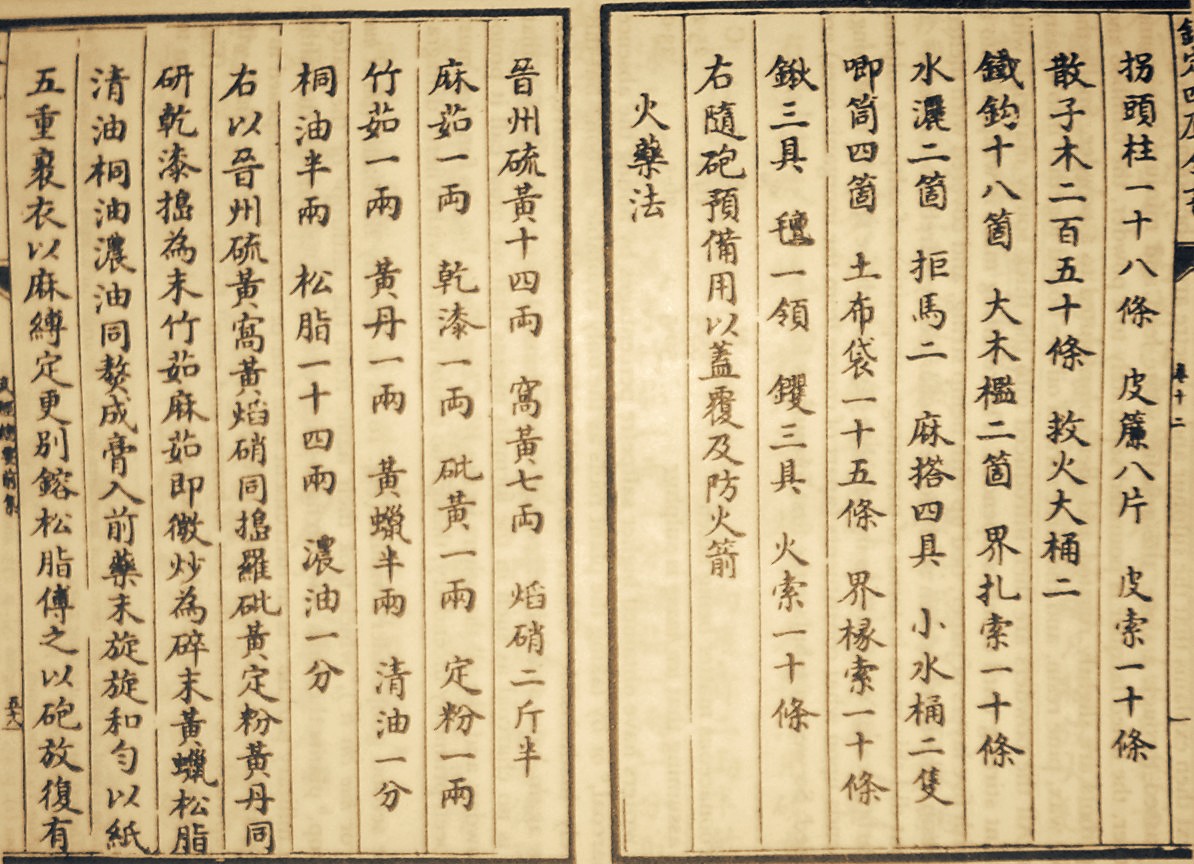
The Northern Song court was operating a gunpowder works at the capital, Kaifeng, by 1023, staffed with artisans, carpenters and tanners inside a military production complex.1 In 1044 the court-commissioned military compendium Wujing zongyao, compiled under Zeng Gongliang and Ding Du, printed three written formulas for gunpowder — the first written gunpowder formulas anywhere on earth, and by some decades the earliest surviving evidence that anyone knew the proportions well enough to set them down.32 In 1073 the court banned the export of sulphur and saltpetre across the Liao frontier, which is not a thing a state does about fireworks. And in 1083 the imperial court dispatched 100,000 gunpowder arrows to one frontier garrison and 250,000 to another.1
The weapons themselves developed under exactly the pressure the atlas would expect: three centuries of a state that could not win on its northern frontier by conventional means and therefore had to be inventive. The sequence is documented closely enough to tabulate.
| Date | Development | Where |
|---|---|---|
| 969–970 | Gunpowder-tube propelled fire arrows presented to the throne by Feng Jisheng and Yue Yifang; the designers rewarded | Song court |
| 1000–1002 | Further gunpowder arrows, pots and caltrops presented; the court orders the plans printed and distributed | Song court |
| 1023 | State gunpowder works in operation at the capital | Kaifeng |
| 1044 | Three written formulas printed in the Wujing zongyao | Kaifeng |
| 1083 | 350,000 gunpowder arrows shipped to two frontier garrisons | Northern frontier |
| 1132 | Fire lances used by Song defenders against Jin siege towers | De'an, Hubei |
| 1221 | Cast-iron casing bombs used by the Jin against the Song | Qizhou, Hubei |
| 1232 | Zhentianlei, heaven-shaking thunder, used by the Jin against the Mongols | Kaifeng |
| 1259 | Bamboo fire lance firing a pellet wad that occludes the barrel — the first bullet | Shouchun, Anhui |
By 1221 the casings were cast iron. The Song commander Zhao Yurong survived the siege of Qizhou and left a description that Andrade translates: the bombs were "in shape like gourds, but with a small mouth. They are made with pig iron, about two inches thick, and they cause the city's walls to shake."1 The same account records thirteen catapults firing in sequence, each shot followed by an iron fire bomb "whose sound was like thunder."1 This is not a curiosity. This is fire support.
Two Chinese surveys carry the technical detail further than any Western-language work: Wang Zhaochun's history of Chinese firearms and Pan Jixing's history of the powder itself, which between them track the composition ratios, the workshop organisation and the regional distribution of production across the whole span from the Tang alchemists to the Qing.1819
1232, at the walls of Kaifeng
The Mongols first met these weapons the way most armies meet a new technology: from the receiving end.
Chinggis Khan's campaigns against the Jurchen Jin began in 1211, and Stephen Haw's argument — the strongest statement of the case for Mongol agency in this transmission — is that Jin defectors carried gunpowder knowledge into Mongol service from the earliest years, and that gunpowder weapons were consequently in Mongol hands and Mongol use from the 1210s onward.5 By 1232 the position had reversed: the Mongol army was besieging Kaifeng, and the Jin were defending it with the most advanced gunpowder ordnance in existence.
The Jin shi, the dynastic history of the Jin, describes the principal weapon in a passage Joseph Needham translated: "The heaven-shaking-thunder bomb is an iron vessel filled with gunpowder. When lighted with fire and shot off, it goes off like a crash of thunder that can be heard for a hundred li, burning an expanse of land more than half a mu, and the fire can even penetrate iron armour."42 The tactical use was more inventive than the description suggests. Mongol sappers working at the base of the wall sheltered under leather screens; the Jin defenders tied the bombs to iron chains and lowered them down the wall face to where the miners were digging. The screens did not survive the blast, and neither did the men beneath them.1
They also had the flying fire lance, whose construction the sources record with the specificity of a workshop note: sixteen layers of chi-huang paper rolled into a tube slightly over two feet long, stuffed with willow charcoal, iron fragments, magnet ends, sulphur and white arsenic, with a fuse at the end.1 It threw flame roughly ten paces. It is, in Andrade's reading of the sequence, the direct ancestral form of the firearm.
Kaifeng held for over a year. It fell in 1233. The arsenal, the workshops, the formulas and — decisively — the artisans passed into Mongol hands.
The corridor moved people
This is the mechanism, and it is not a pleasant one.
Mongol siege practice, as Thomas Allsen documented in Culture and Conquest in Mongol Eurasia, systematically exempted craftsmen from the general fate of a stormed city and deported them instead. Allsen's central argument is that the cultural traffic of the Mongol century was not an incidental by-product of conquest but something the Mongols actively organised: they treated human skill as a resource of empire and moved it deliberately between their realms.9 Artisans from Central Asia were resettled in north China; artisans from north China were sent west. The jam, the relay-post network the atlas records elsewhere as the infrastructure of the Pax Mongolica, carried specialists as readily as it carried envoys.
Two campaigns show the corridor working, in both directions, inside a single generation:
- West, 1253–60. Möngke's quriltai of 1251 dispatched his brother Hülegü against the Ismāʿīlī fortresses and the Abbasid caliphate. The Persian sources record that the army was accompanied by a thousand crews of Chinese siege engineers and catapult specialists. Alamut fell in 1256; Baghdad in 1258.
- East, 1268–73. Qubilai's siege of the twin Song fortresses of Xiangyang and Fancheng on the Han River stalled for five years against walls that traction trebuchets could not break. He wrote to his nephew Abaqa, Ilkhan of Iran, who sent two engineers — Ismāʿīl of Hilla and ʿAlāʾ al-Dīn of Mosul. They built counterweight trebuchets, the type the Chinese sources call huihui pao, the Muslim trebuchet. Fancheng fell within days of their first shots; Xiangyang surrendered in March 1273.
That second episode matters more than its military result. It is the proof that this was not a story of the East giving and the West taking. In the same decades that Chinese gunpowder specialists were being walked to Iraq, Iraqi and Persian engineers were being shipped to Hubei, and the machine that finally broke the Song was a western import. The corridor was a corridor. What determined the direction of any given cargo was not civilisational genius. It was whose army wanted what, and who had been captured.
The oldest guns on earth
Somewhere between the fire lance of 1259 and the Florentine purchase order of 1326, the tube stopped being a flamethrower and became a gun: the barrel got metal, the charge got stronger, and the projectile stopped being a spray of scrap and became a single ball occluding the bore. That transition happened in China, under Mongol rule, and the surviving hardware is the best evidence for when.
Three objects carry the argument, and each carries a caveat:
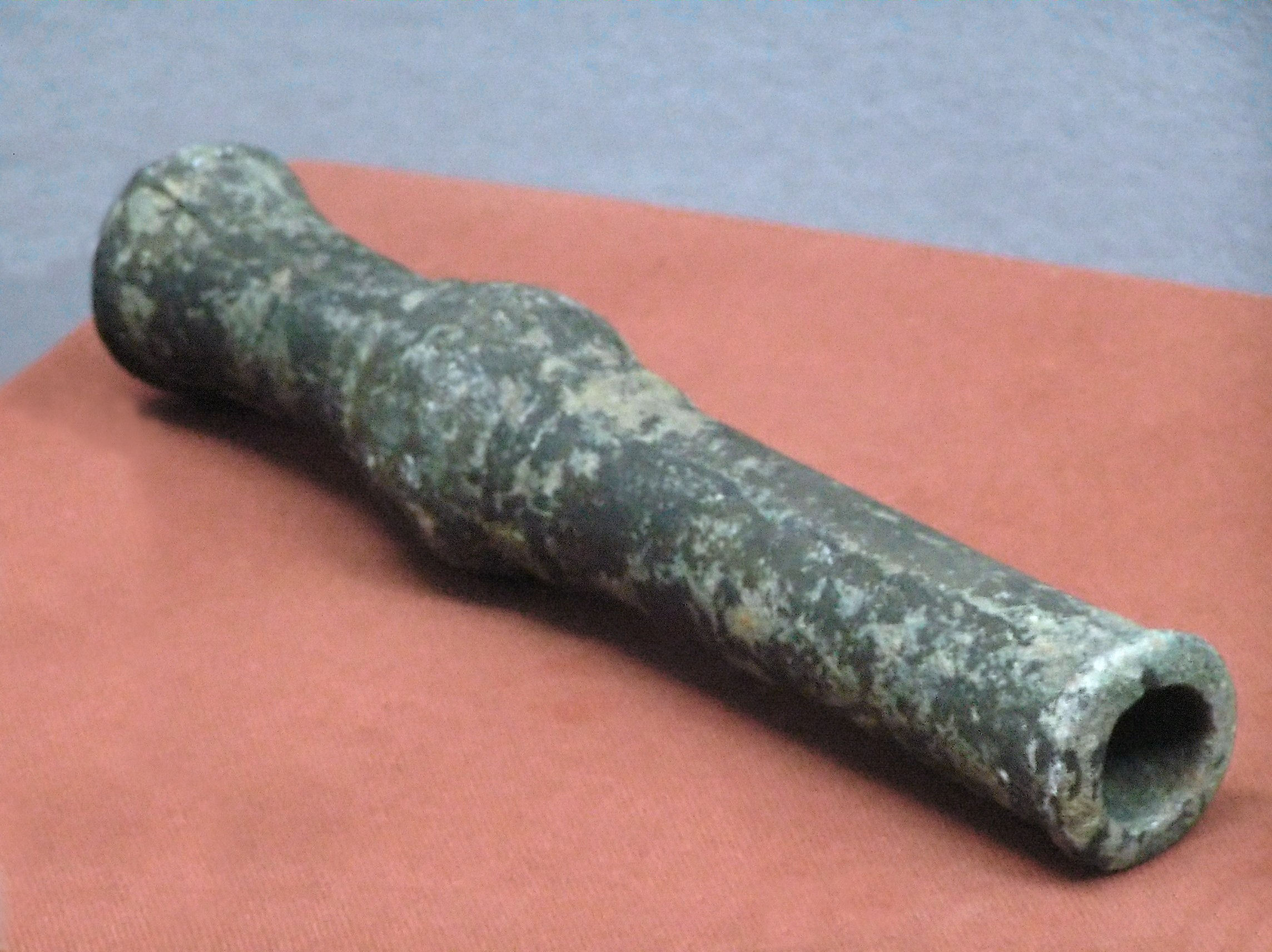
- The Heilongjiang hand cannon. A bronze piece 34 centimetres long and weighing 3.55 kilograms, excavated in 1970 at Banlachengzi in Acheng district, Heilongjiang. It is routinely called the oldest surviving firearm in the world and dated to 1288, on the argument that it belongs to Li Ting's campaign against the rebel prince Nayan in that year. The date is an inference from the archaeological context and the historical record, not an inscription on the object, and it should be stated as such.
- The Xanadu gun. A bronze gun bearing an inscription in ʼPhags-pa script that includes its own date of manufacture, corresponding to 1298. It is the earliest firearm anywhere that dates itself, which makes it the anchor of the whole chronology.
- The Wuwei bronze cannon. A larger and heavier piece from Gansu, variously dated across the Yuan period, and a useful reminder that the Chinese sequence had already reached artillery scale while Europe was still copying out recipes.
The first textual reference to a hand cannon in the Chinese sources is dated 1230; the oldest surviving example is dated to the 1280s or 1290s. Whatever else is contested, the gun existed in China, as manufactured metal ordnance, a generation before the earliest firm European evidence — and it existed there under a Mongol administration whose western frontier was in Anatolia.
What the sources say, and what they do not
The atlas does not manufacture certainty, and here it must not, because the central causal link in this record is the one place where the scholarship genuinely divides.
The case for Mongol transmission is made most fully by Iqtidar Alam Khan and Stephen Haw. Khan, in a 1996 article in the Journal of Asian History and at book length in Gunpowder and Firearms: Warfare in Medieval India, argues that the Mongols carried bombs, fire lances and rockets west across Eurasia and that this is how the technology reached both the Islamic world and north India.78 Haw's 2013 article in the Journal of the Royal Asiatic Society argues the wider case: that gunpowder weaponry was in routine Chinese use by the early thirteenth century, that Jin defectors put it into Mongol hands from 1211, and that it played a material part in the conquests themselves.5
Against this stands Kate Raphael, whose 2009 article in the same journal examined Mongol siege warfare on the Euphrates between 1260 and 1312 and concluded that none of the major sources for those campaigns implies the use of anything that has to be gunpowder.6 Her point is methodological and hard to answer: fire is not gunpowder, noise is not gunpowder, and a chronicler's thunder is a simile. Bert Hall's Weapons and Warfare in Renaissance Europe makes the parallel argument on the European side, treating the earliest claimed sightings with considerable caution.13
The honest statement of the position is this:
- Certain. Gunpowder was invented in China; the formulas were written down in China by 1044; gunpowder weapons of several kinds were in mass production in China before any European had heard of the substance. No serious scholar disputes any of this.
- Certain. Latin Europe had metal guns by 1326 and knew nothing of the substance before the second half of the thirteenth century.
- Strongly supported. The recipe reached the Arabic-writing world during the thirteenth century, across the Mongol span, and in Arabic it was named for its origin.
- Contested. Whether Mongol armies themselves deployed gunpowder weapons in the Middle East and eastern Europe, and whether Europeans saw them do it.
- Not supported. That the Mongols used firearms at the battle of Mohi in 1241. Master Roger's Carmen miserabile describes fire and a great noise at the Sajó, and later writers have read guns into it; there is no artefact, no residue and no unambiguous text. The atlas does not make that claim.
What survives the scepticism is the timing and the vocabulary. A technology invented in China and unknown in Europe appears in Arabic sources in the middle of the thirteenth century, in Latin sources at the end of it, and as manufactured ordnance in the second quarter of the fourteenth — during and immediately after the only period in history when a single political system spanned the distance between them.
The word that travelled
The vocabulary is the strongest single piece of evidence, and it is also the record's sharpest irony.
Ibn al-Bayṭār, the Andalusian botanist and pharmacologist who died at Damascus in 1248, records potassium nitrate in his compendium of simple medicaments under the name thalj al-Ṣīn — snow of China. Persian usage called it Chinese salt. Around 1280 the Syrian military writer al-Ḥasan al-Rammāḥ compiled the Kitāb al-furūsiyya wa-l-manāṣib al-ḥarbiyya, which contains something over a hundred formulations for incendiaries and propellants and — the technically decisive contribution — a workable procedure for purifying crude saltpetre: boil it in a minimum of water, use only the hot solution, and add wood ash to precipitate out the calcium and magnesium as carbonates.12 That procedure is what turns a scraping off a stable wall into a usable propellant, and it is the reason the Arabic-writing world had good powder before the Latin one did.
In Latin, the earliest recipes appear in the Liber ignium ad comburendos hostes attributed to a Marcus Graecus, which its modern editors date to roughly 1280–1300 and which reads, on Partington's assessment, like a compilation translated in part from Arabic.10
And here is the thing. Arabic named the substance after the place it came from. Persian named it after the place it came from. Latin named it sal petrae, salt of stone, after the walls it was scraped off.
What the gun changed, and what it buried
1326: two documents, one year
Latin Europe's gun arrives in the record twice in the same year, at opposite ends of Christendom, in documents that have nothing to do with each other.
In February 1326 the council of Florence ordered the appointment of officials to procure canones de metallo — metal cannon — together with iron balls to fire from them. It is an administrative minute, and that is what makes it good evidence: it is a purchase order, not a chronicle, and purchase orders do not embroider.
In the same year an English clerk named Walter de Milemete completed a presentation manuscript on kingship for the fourteen-year-old Edward III. In the margin of one folio of De nobilitatibus, sapientiis, et prudentiis regum, a knight in mail touches a heated iron to the mouth of a vase-shaped vessel lying on a trestle. A large arrow is emerging from it, pointed at a gate.13

Two things about that picture deserve notice. The gun is bulbous and vase-shaped, a pot-de-fer, and it is firing a bolt rather than a ball — which is what you would expect of a culture that had just received a propellant and was fitting it to the projectile it already knew how to make. And the artist has clearly never watched one fired; the composition is decorative, the gunner's posture impossible. Europe in 1326 had the object and did not yet have the practice.
Later chroniclers report guns at Metz in 1324 and at the Granadan siege of Baza in 1325, and there are scattered claims that run earlier still. Hall's judgement, which this record follows, is that these are mostly later interpolations and cannot bear weight.13 Florence in 1326 is the first firm ground.
The wall stops working
For the first half-century the guns were, militarily, close to useless — loud, dangerous to their crews, and less effective than the trebuchets that stood beside them. Hall is emphatic that the European gunpowder revolution was slow, uneven and much later than the popular chronology assumes.13 Guns were present at Crécy in 1346 and changed nothing there. They were used against town gates and wooden hoardings, for terror and noise, for the better part of a century.
Then the metallurgy caught up, and the arithmetic of the wall inverted.
Clifford Rogers, in an argument that has framed the field since 1993, identifies two revolutions inside the Hundred Years' War: an Infantry Revolution in the fourteenth century, and an Artillery Revolution in the fifteenth, in which gunpowder weapons reversed the long-standing superiority of the defence in siege warfare.14 The French royal artillery train of the 1440s and 1450s took fortresses in days that would have held for a season a hundred years earlier. Volker Schmidtchen's study of the German material traces the same transition on the other side of the Rhine and adds the sociological consequence: the emergence of the Büchsenmeister, the master gunner, as a new and jealously guarded technical profession with its own secrets, its own manuscripts and its own price.15
| Latin Europe, c. 1250 | Latin Europe, c. 1500 | |
|---|---|---|
| Decisive siege weapon | Counterweight trebuchet, built on site by carpenters | Cast bronze or wrought-iron bombard, foundry-made and hauled |
| Who could work it | Anyone, including the besieged townswomen of Toulouse | A licensed specialist with a guarded craft |
| Time to breach a good wall | Weeks to months, often never | Days |
| Cost of the decisive weapon | Timber, labour, local stone | Metal, powder, transport and wages — beyond most lords |
| What a strong castle bought its holder | Political autonomy | A slower surrender |
| Wall design | High and thin, with tall projecting towers | Low, thick, angled, earth-backed |
What was displaced
The list of things the gun pushed out of European life is longer than the list of things it brought in, and most of it went quietly.
- The great timber engines and the men who built them. The trebuchet was obsolete within a century of the bombard's maturity. The engineer-carpenter — James of St George's profession — was displaced by the gunfounder, whose skill was metallurgical and came out of the bell-casting trade.
- The high curtain wall. Every masonry fortification in Europe built before roughly 1450 was, at a stroke, the wrong shape. The answer — low, thick, angled, earth-backed bastions — meant demolishing and rebuilding on a scale only states could finance.
- The military value of a small lordship. A count with a castle had been a political fact. A count with a castle and no artillery train became a tenant.
- The trained bowman. Not immediately and not everywhere, but the logic was inescapable: the English longbow took a decade of a man's life to train and the arquebus took a fortnight. Kenneth Chase's global survey argues that this labour arithmetic, more than any inherent superiority of the weapon, is what governed where firearms spread and where they did not.20
- The besieged city's ability to answer in kind. In 1218 Toulouse could build the same machine as Simon de Montfort. By 1450 the besieged could not cast their own bombards, could not buy powder and could not train gunners in the time available.
The money
Peter Lorge's comparative study makes the point that a military revolution driven by gunpowder happened in Asia three centuries before it happened in Europe, and that the interesting question is therefore never who had the technology but what kind of state the technology required.21 The answer, in Europe, was an expensive one. Powder was a consumable, guns were capital, gunners were wages, and sieges that ended in days still cost more than sieges that had lasted months. The fiscal apparatus of the early modern European state — permanent taxation, public debt, salaried officials to collect it — grew up around the need to pay for this, and it is the largest and least visible of the transmission's consequences.
The bill
Fifty days at Kaifeng
The transmission's most precisely countable cost is the siege in which the technology changed hands.
Kaifeng in 1232 held perhaps a million people, swollen far past its normal population by refugees driven in from the north Chinese countryside. The Mongol blockade cut it off through the summer. Starvation set in, and then epidemic disease. The Jin shi records that the great pestilence lasted more than fifty days and that more than 900,000 coffins were carried out of the city gates in that period — and it adds, in the manner of a bureaucracy that knows what it is not counting, that the figure excludes the poor who could not afford burial.4 Modern estimates put mortality across the whole siege at something like forty to fifty per cent of the people inside.
Whether the disease was plague is genuinely contested; the physician Li Gao's account of what the doctors of Kaifeng were treating describes large purulent swellings, and some scholars read that as bubonic while others do not. The atlas takes no position on the pathogen. What is not contested is the arithmetic: the technology that would eventually arm the world passed from one owner to another inside a city where, by the record of the state that lost it, nine hundred thousand people were buried in under two months.
The artisans were the shipment
The second cost is the one that is easiest to sanitise, and the atlas will not.
The Mongol practice of sparing craftsmen is often described admiringly, as evidence of a pragmatic empire that valued skill. It was that. It was also enslavement and forced relocation operating as technology policy. Allsen's account is clear about the direction of agency: the movements were organised from above, and the specialists had no say in whether they went, where they went, or whether they saw their families again.9 A gunpowder artisan taken at Kaifeng in 1233 and set to work for a Mongol prince is not a participant in an exchange. He is the cargo.
This is why the record refuses the vocabulary of cultural exchange for this transmission. Exchange implies two parties and consent. What happened here is that an army destroyed the polity that owned a technology, took the people who knew how to make it, and moved them along its own roads.
What is billable here, and what is not
The atlas already carries a record for the Mongol century's own accounts — the Pax Mongolica and the trade revival it enabled, rated at the maximum cost severity. This record must not bill the same deaths twice, and the accounting is worth stating in the open.
Billed here. The sieges in which gunpowder was the instrument or the object of transfer: Kaifeng in 1232–33 and its epidemic; Xiangyang and Fancheng between 1268 and 1273, five years of blockade ending in a bombardment over a civilian population. The systematic deportation of artisans, which was simultaneously the transmission mechanism and a harm in itself. And a share — not the whole — of the demographic catastrophe in north China, where Jinping Wang's study of the region's post-conquest social order describes wartime destruction between 1211 and 1234 that wiped out more than a third of the population and dismantled the existing social order altogether.17 The share is partial because the campaigns were not fought in order to acquire gunpowder; gunpowder made the sieges shorter and the storms more certain, but the armies would have come regardless.
Not billed here. The Mongol conquests as a whole, which are the neighbouring record's ledger. The colonial artillery of the sixteenth century onwards, which is a descendant and is named as one. The Black Death, which travelled the same corridor fifteen years after the last event in this record and has its own entry.
The saltpetre men
One consequence belongs here even though it lands two centuries downstream, because it is structural rather than incidental: somebody has to make the powder, and in Europe that meant digging up other people's floors.
Potassium nitrate could not be mined in northern Europe. It had to be harvested from the nitrogenous crust that forms in stables, cellars, privies and dovecotes, or cultivated in artificial nitre beds of manure and urine. David Cressy's Saltpeter: The Mother of Gunpowder traces what this meant in practice in England: royal commissions empowering saltpetre men to enter private property and dig, with the complaints of aggrieved subjects set aside as a matter of policy, because the crown's powder supply outranked them.16 It is a small cruelty beside a siege, and it is the one that lasted longest and touched the most people: for the better part of two centuries, the price of a state's guns was that its subjects could not refuse the men who came to dig out the floor of the byre.
1543, and the circuit closing
In the autumn of 1543 a Chinese junk carrying Portuguese passengers made landfall on the island of Tanegashima, off southern Kyushu. Two of the Portuguese had matchlock arquebuses. The lord of the island bought both at an extraordinary price and set his swordsmiths to reverse-engineer them; within a decade the Japanese were manufacturing firearms at scale, and within fifty years they were arguably the best gunsmiths in the world.
The technology those two Portuguese carried ashore was Chinese. It had left China as loot, crossed Eurasia in the baggage of an empire, acquired a lock and a stock and a serpentine in Europe, and come back around the far side of the planet to a country some fifteen hundred kilometres from the Kaifeng arsenal that first mass-produced it — arriving as a foreign marvel, sold by strangers, to a buyer who had no idea he was buying back a neighbour's invention.
That is the whole shape of the thing. A Song bureaucracy wrote down the proportions in 1044 and shipped its arrows by the hundred thousand. A steppe empire took the workshops by storm and walked the workmen west. An Arabic-writing world learned to purify the salt and named it for the country it came from. A Latin Europe that had been unable to name it at all put it in a metal tube, aimed it at a gate, and over the next four hundred years used it to open every wall on earth — including, in the end, the walls of the place where it was invented.
Nobody in this story handed anything to anybody.
What followed
-
10231023: the Northern Song court puts a state gunpowder works into operation at Kaifeng, staffed with artisans, carpenters and tanners — the world's first industrial-scale production of an explosive.
-
10441044: the court-commissioned Wujing zongyao prints three gunpowder formulas — the earliest written recipes for the substance anywhere on earth.
-
11321132: Song defenders use fire lances against Jin siege towers at De'an — the first securely documented use of the tube weapon that would become the gun.
-
12321232: the Jin defend Kaifeng against the Mongols with cast-iron zhentianlei bombs lowered on chains onto the sappers at the wall foot, and with flying fire lances. The Mongols meet gunpowder ordnance from the receiving end.
-
12331233: Kaifeng falls. The arsenal, the workshops, the formulas and the artisans who ran them pass into Mongol hands, and the technology begins to move as captured property.
-
12481248: Ibn al-Bayṭār dies at Damascus having recorded potassium nitrate under the name thalj al-Ṣīn, snow of China. The Arabic name for the substance carries its origin; the Latin one never will.
-
12581258: Hülegü's army takes Baghdad, accompanied on the Persian sources' account by a thousand crews of Chinese siege engineers walked west from north China.
-
12671267: Roger Bacon describes a firecracker to Pope Clement IV — the first European notice of gunpowder, correctly identifying saltpetre and classifying the whole thing as a children's toy.
-
12731273: Xiangyang and Fancheng fall after five years of siege, broken by counterweight trebuchets built by Ismaʿīl of Hilla and ʿAlāʾ al-Dīn of Mosul, sent east from the Ilkhanate. The corridor ran both ways.
-
1280c. 1280: al-Ḥasan al-Rammāḥ compiles the Kitāb al-furūsiyya in Syria, with over a hundred formulations and a wood-ash procedure for purifying saltpetre — the step that turns a wall scraping into a propellant.
-
12981298: the Xanadu gun is cast, bearing an inscription in ʼPhags-pa script that includes its own date — the earliest firearm anywhere that dates itself, made in China under Mongol rule.
-
13261326: the council of Florence orders officials appointed to procure canones de metallo and iron balls, and Walter de Milemete's presentation manuscript for the boy Edward III shows a knight firing a vase-shaped gun at a gate. Latin Europe has the object.
-
14531453: the walls of Constantinople, which had held for eleven centuries, are breached by Ottoman siege artillery. The arithmetic that had made a strong wall a political fact no longer holds anywhere in Europe.
-
15431543: Portuguese passengers on a Chinese junk sell two matchlocks on Tanegashima. A Chinese invention returns to East Asia from the far side of the planet as a foreign marvel, and the circuit closes.
Where this lives today
References
- Andrade, Tonio. The Gunpowder Age: China, Military Innovation, and the Rise of the West in World History. Princeton: Princeton University Press, 2016. en
- Needham, Joseph, with Ho Ping-Yü, Lu Gwei-Djen and Wang Ling. Science and Civilisation in China, Volume 5: Chemistry and Chemical Technology, Part 7: Military Technology — The Gunpowder Epic. Cambridge: Cambridge University Press, 1986. en
- 曾公亮、丁度等《武經總要》(Zeng Gongliang and Ding Du et al., Wujing zongyao), compiled by 1044. zh primary
- 脱脱等《金史》(Toqto'a et al., Jin shi, History of the Jin), 1344. Beijing: Zhonghua Shuju critical edition, 1975. zh primary
- Haw, Stephen G. "The Mongol Empire — the first 'gunpowder empire'?" Journal of the Royal Asiatic Society, 3rd ser., 23, no. 3 (2013): 441–469. en
- Raphael, Kate. "Mongol Siege Warfare on the Banks of the Euphrates and the Question of Gunpowder (1260–1312)." Journal of the Royal Asiatic Society, 3rd ser., 19, no. 3 (2009): 355–370. en
- Khan, Iqtidar Alam. "Coming of Gunpowder to the Islamic World and North India: Spotlight on the Role of the Mongols." Journal of Asian History 30, no. 1 (1996): 27–45. en
- Khan, Iqtidar Alam. Gunpowder and Firearms: Warfare in Medieval India. Aligarh Historians Society Series. New Delhi: Oxford University Press, 2004. en
- Allsen, Thomas T. Culture and Conquest in Mongol Eurasia. Cambridge Studies in Islamic Civilization. Cambridge: Cambridge University Press, 2001. en
- Partington, J. R. A History of Greek Fire and Gunpowder. Cambridge: W. Heffer & Sons, 1960; reissued with a new introduction by Bert S. Hall, Baltimore: Johns Hopkins University Press, 1999. en
- Bacon, Roger. Opus tertium, in Fr. Rogeri Bacon Opera quaedam hactenus inedita, ed. J. S. Brewer. Rerum Britannicarum Medii Aevi Scriptores 15. London: Longman, Green, Longman and Roberts, 1859. Quoted in the translation of J. R. Partington, A History of Greek Fire and Gunpowder (1960). la primary
- al-Rammāḥ, al-Ḥasan. Kitāb al-furūsiyya wa-l-manāṣib al-ḥarbiyya (Book of Military Horsemanship and Ingenious War Devices), Syria, c. 1280. ar primary
- Hall, Bert S. Weapons and Warfare in Renaissance Europe: Gunpowder, Technology, and Tactics. Johns Hopkins Studies in the History of Technology 22. Baltimore: Johns Hopkins University Press, 1997. en
- Rogers, Clifford J. "The Military Revolutions of the Hundred Years' War." Journal of Military History 57, no. 2 (1993): 241–278. en
- Schmidtchen, Volker. Bombarden, Befestigungen, Büchsenmeister: Von den ersten Mauerbrechern des Spätmittelalters zur Belagerungsartillerie der Renaissance. Düsseldorf: Droste, 1977. de
- Cressy, David. Saltpeter: The Mother of Gunpowder. Oxford: Oxford University Press, 2013. en
- Wang, Jinping. In the Wake of the Mongols: The Making of a New Social Order in North China, 1200–1600. Cambridge, MA: Harvard University Asia Center, 2018. en
- 王兆春《中国火器史》北京:军事科学出版社, 1991. zh
- 潘吉星《中国火药史》上海:上海远东出版社, 2016. zh
- Chase, Kenneth. Firearms: A Global History to 1700. Cambridge: Cambridge University Press, 2003. en
- Lorge, Peter A. The Asian Military Revolution: From Gunpowder to the Bomb. New Approaches to Asian History 3. Cambridge: Cambridge University Press, 2008. en
- William of Tudela and an anonymous successor. The Song of the Cathar Wars: A History of the Albigensian Crusade (La canso de la crozada). Translated by Janet Shirley. Crusade Texts in Translation 2. Aldershot: Ashgate, 1996. en primary
- DeVries, Kelly, and Robert Douglas Smith. Medieval Military Technology. 2nd ed. Toronto: University of Toronto Press, 2012. en
- Jean de Joinville. The Life of Saint Louis, c. 1309. In Joinville and Villehardouin, Chronicles of the Crusades, translated by Caroline Smith. London: Penguin Classics, 2008. en primary