Rome borrowed Greek philosophy as it conquered Greece (~100 BCE)
Rome conquered the Greek world and then borrowed its mind. The philosophy that became the substrate of Western thought arrived in the baggage of the armies that had enslaved the philosophers.
By the early second century BCE, Rome ruled the Mediterranean but had no philosophical language of its own. Within a hundred years that had changed completely. Greek philosophy reached Rome along the roads its legions had cut — carried by enslaved tutors, looted libraries, and visiting Athenian ambassadors. Cicero built a Latin vocabulary for the mind almost from nothing, coining or repurposing the words — quality, essence, moral, individual — that European thought still uses. Lucretius put Epicurus into Latin verse; Stoicism became the working ethic of the senatorial class. The inheritance outlived Rome itself, running through the medieval schools to early-modern philosophy. But the teachers often arrived in chains, and the same decades saw Corinth burned, Epirus enslaved, and the groves of Plato's Academy cut down for Sulla's siege engines.

Rome before philosophy spoke Latin
By the early second century BCE the Roman Republic had broken the two great military powers of the Mediterranean — Carthage at Zama in 202 and the Macedonian kingdom of Philip V at Cynoscephalae in 197 — and yet it possessed no word of its own for "philosophy." The Latin of Cato the Elder (234–149 BCE), censor in 184, had an enormous and exact vocabulary for law, land, ritual, kinship, and war; it had almost none for the soul, the cosmos, the good, or the categories of knowledge. A Roman who wanted to discuss what a Greek meant by psuchē, ousia, poiotēs, or to telos had either to learn Greek or to do without the concept. Most of the senatorial class chose to learn Greek.1
This was not the illiteracy that had preceded the alphabet in archaic Greece. The Roman elite of Cato's day read Greek fluently, kept Greek secretaries, knew the Homeric poems, and had begun to collect Greek art. What Rome lacked was not access to Greek thought but a philosophy conducted in its own language — and, more deeply, a settled judgment about whether it wanted one. The question of whether systematic Greek reasoning belonged in a Roman life was, for three generations, genuinely open and frequently hostile.
The sufficiency of ancestral custom
Roman public life was organized around the mos maiorum, the way of the ancestors: a body of inherited custom, precedent, and exemplary biography that did the work other cultures assigned to ethical theory. A young Roman learned how to live not by reading a treatise on the good but by absorbing the recorded deeds of named ancestors — the exempla whose busts stood in the atrium and whose conduct set the standard of duty, courage, and restraint. Virtue was virtus, and virtus was demonstrated in the field, the forum, and the family, not argued from first principles.2
The system was conservative, concrete, and proud of being unsystematic. It treated the Greek habit of arguing every proposition both ways as a kind of cleverness that loosened the bonds of obligation rather than strengthening them. A Roman of the old school did not want to be shown that justice could be defended and attacked with equal skill; he wanted his sons to do their duty. The category Rome did not yet have — and partly did not want — was the self-conscious, theoretical examination of the grounds of conduct that Greeks had practised since Socrates.
A decree against the philosophers
This suspicion was not merely temperament; on occasion it was policy. In 161 BCE the Senate empowered the praetor to expel philosophers and rhetoricians from the city, a decree preserved in the antiquarian record of Suetonius and Aulus Gellius. Greek teachers of argument were regarded, by the men who governed Rome, as importers of a dangerous facility with words.3 Cato the Elder gave the suspicion its sharpest voice. Plutarch reports that Cato distrusted Greek philosophy as a solvent of Roman seriousness and warned his son that Rome would lose its empire when it became infected with Greek letters — even as Cato himself, late in life, learned Greek and read it closely.4
What Rome possessed instead of philosophy was formidable in its own right: a forensic and political rhetoric of great practical power, a developed civil law administered by the pontifices and rooted in the Twelve Tables, a religion of scrupulous ritual exactitude rather than theology, and a historical memory organized around moral exemplars. These were real intellectual instruments. They were simply not philosophy in the Greek sense — and within a century, the Roman elite would not be able to imagine an educated life without the thing Cato had tried to keep out.
What philosophy was, and Rome did not have
It is worth being precise about what Rome lacked, because the gap is easy to misread. The Greek world of the second century BCE did not merely contain clever individuals who thought about large questions; it had institutions. Four major schools descended from the classical age were still operating in Athens — the Academy founded by Plato, the Lyceum (or Peripatos) of Aristotle, the Stoa founded by Zeno of Citium, and the Garden of Epicurus — each with a continuous succession of heads, a body of doctrine, a canon of texts, and a method of teaching. Each typically divided the field into logic, physics, and ethics, and each defended a distinctive account of the telos, the goal of a human life: virtue alone for the Stoics, tranquil pleasure for the Epicureans, suspended judgment for the skeptical Academy.1
This was a competitive, argumentative, institutionalized intellectual culture with no Roman equivalent. A Greek who wanted to think seriously about the good attached himself to a school, learned its arguments and its objections to rival schools, and entered a conversation that had been running for two centuries. A Roman had the mos maiorum, the civil law, and the practice of public speaking. What was being transmitted to Rome was therefore not a set of ideas only but a whole apparatus — schools, successions, a technical vocabulary, the dialogue and the treatise as forms, and the very notion that the conduct of a life was a subject one could reason about systematically and get right or wrong.
How the transmission ran — captives, embassies, and paid tutors
The philosophy arrived along the same roads the legions had cut. This is the single most important fact about the transmission, and the older histories that present Rome as serenely "receiving the Greek inheritance" obscure it. The books and the teachers moved to Rome inside the machinery of conquest — as plunder, as hostages, as enslaved war captives, and as ambassadors from cities that Rome had defeated or would shortly destroy.
The roads of conquest
When Lucius Aemilius Paullus defeated Perseus of Macedon at Pydna in 168 BCE and ended the Antigonid kingdom, he turned over the wealth of a monarchy to his soldiers and the Roman treasury but kept one prize for his own household: the royal library of the Macedonian kings. Plutarch records that Paullus, who believed firmly in the value of a Greek education, allowed his sons to take the books. The same campaign that extinguished a Hellenistic kingdom carried its library into a Roman aristocrat's house, where it helped to educate the boy who would become Scipio Aemilianus.5
Greek teachers moved by the same logic — as property. The man often called the father of Latin literature, Livius Andronicus, was a Greek from Tarentum brought to Rome as a slave after the city fell to Roman arms in the third century BCE; set to tutor his owner's children, then freed, he produced the first Latin translation of the Odyssey and the first tragedies and comedies staged in Latin. The pattern he established held for two centuries: the educated Greek in the Roman household — the paedagogus who walked the children to school, the grammaticus who taught them poetry and Greek, the philosopher who lived as a resident intellectual — was very often a slave or a freedman, and very often a captive of one of the wars by which Rome was absorbing the Greek world.6
Crates of Mallos and the broken leg
Some of the transmission was pure accident. Crates of Mallos, head of the great library of Pergamon and a Stoic grammarian, came to Rome on a royal embassy around 168 BCE, fell into an open sewer-mouth on the Palatine, and broke his leg. Immobilized through a long convalescence, he filled the time by giving lectures on literature and language to whoever would attend. Suetonius credits these unplanned lectures with introducing the systematic study of grammar and textual criticism to Rome — an entire scholarly discipline transmitted because a Greek scholar tripped in the street and could not travel home.7
The embassy of the three philosophers, 155 BCE
The decisive public moment came in 155 BCE. Athens, fined by the Senate for sacking the town of Oropus, sent three philosophers as ambassadors to appeal the penalty: Carneades, the brilliant skeptical head of the Academy; Diogenes of Babylon, head of the Stoa; and Critolaus the Peripatetic — the three living schools of Athens arriving together. While the diplomatic business waited, the philosophers lectured to packed Roman audiences. Carneades caused a scandal by arguing, on one day, that justice was natural and binding, and on the next, with equal force and equal persuasiveness, that justice was a mere human convention that a rational self-interest would discard.8
The young men of Rome were enthralled; the display of dialectical power was unlike anything Roman rhetoric had prepared them for. Cato the Elder, then in his late seventies, was appalled by exactly what the young admired. According to Plutarch he urged the Senate to settle the Athenians' business and send the philosophers home as quickly as possible, before Roman youth transferred their ambition from arms and the law to argument. The embassy succeeded in its diplomatic errand and departed — but the appetite it had revealed did not.8
The Scipionic circle
Within a single generation the official alarm of 161 and 155 had turned into aristocratic patronage. Panaetius of Rhodes (c. 185–110 BCE), the most influential Stoic of his age, attached himself to Scipio Aemilianus — the general who would raze Carthage in 146 — and effectively lived in his circle, accompanying him on a diplomatic mission across the eastern Mediterranean around 139. Around Scipio gathered the men later remembered as the Scipionic circle: his friend Gaius Laelius, the Stoic Panaetius, and the Greek historian Polybius, himself one of a thousand Achaean hostages deported to Rome after Pydna and lodged in Roman households.9
Panaetius did something more consequential than lecture: he adapted Stoic ethics for a governing class. He softened the austere, paradoxical early Stoa — with its insistence that only the sage is free and that all non-virtuous acts are equally wrong — into a practical ethics of graded duties, kathēkonta, that an active senator could actually live by. His treatise On Duty (Peri tou kathēkontos) became, a century later, the direct model and frame for Cicero's De Officiis. Stoicism entered Roman life not as a foreign curiosity but as a tailored instrument of self-government for men who held real power.910
Polybius's own case shows how thoroughly the categories of guest, hostage, and teacher had blurred. He had come to Italy in 167 BCE as one of a thousand leading Achaeans deported and held without trial after the war with Perseus; he spent some seventeen years in Italy, much of it attached to the household of Aemilius Paullus, where he tutored the general's sons and formed the friendship with the young Scipio Aemilianus that shaped the rest of his life. The greatest Greek historian of Rome was, in strict legal fact, a political prisoner — and from inside that detention he wrote the work that explained Rome's rise to a Greek readership and Greece's subjection to itself. The intimacy of the Scipionic circle and the coercion that had assembled it were not opposites; they were the same relationship under two descriptions.22
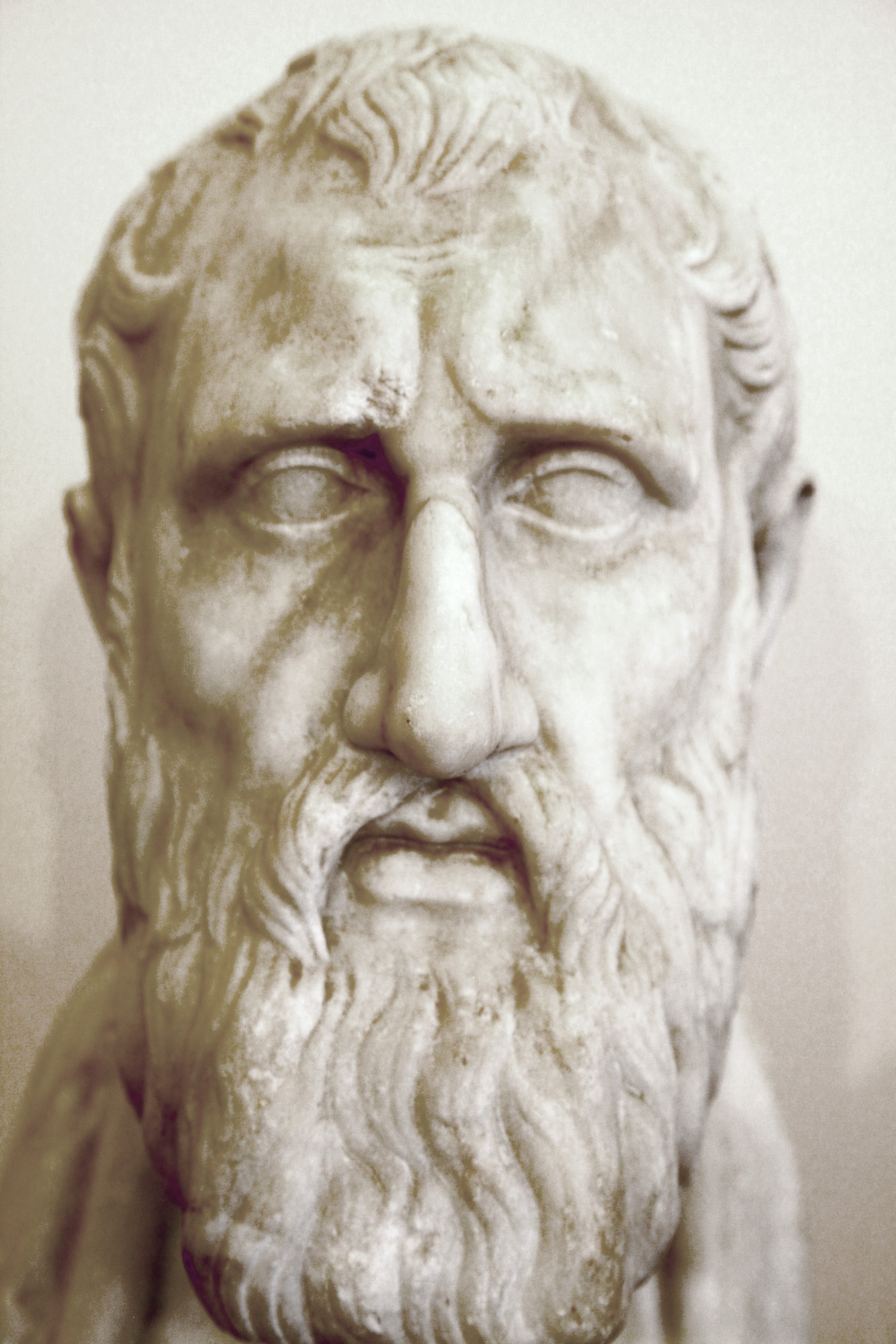
Cicero's generation
By the lifetime of Marcus Tullius Cicero (106–43 BCE) the transmission was complete and intimate. When the Academic scholarch Philo of Larissa fled Athens for Rome in 88 BCE, ahead of the armies of Mithridates, the young Cicero heard him lecture and was, by his own account, captured for philosophy. Cicero then went to Greece itself, studying at Athens and at Rhodes, where he attended the lectures of the great Stoic polymath Posidonius. He kept the Stoic Diodotus as a resident philosopher in his own house for years; Diodotus, blind in his last years, died there and left Cicero his estate.1112
This was now the normal shape of an elite Roman education: Greek tutors in childhood, a finishing period at the philosophical schools of Athens or Rhodes, and lifelong access to a Greek intellectual in the household. The schools that had been objects of senatorial suspicion within living memory had become the credential of a serious public man. The transmission had moved from the docks and the slave market into the dinner-table and the study.
Cicero is candid about what this education was for. He did not regard philosophy as a profession or a retreat from public life but as its equipment: the orator and the statesman needed it to reason well, to argue either side of a question, and to bear adversity without collapse. When civil war and then Caesar's dictatorship finally drove him from politics, philosophy became something more — a vocation and a consolation — but its prestige in Rome rested first on its usefulness to men of affairs. That utilitarian framing was itself a Roman adaptation. The Greek schools had prized contemplation as an end in itself; the Romans who imported them tended to justify philosophy by its fruits in conduct and public service, and they reshaped what they received accordingly.2
The books of Aristotle, taken at Athens
The most consequential single library reached Rome as the loot of a sack. When Lucius Cornelius Sulla stormed Athens in 86 BCE during the war with Mithridates, he seized the library of the collector Apellicon of Teos, which contained the manuscripts of Aristotle and Theophrastus — texts that had passed through obscure private hands for two centuries and were, by report, half-ruined by damp and worms. Sulla shipped them to Rome. There the grammarian Tyrannion put them in order, and Andronicus of Rhodes produced, around the middle of the first century BCE, the first systematic edition of Aristotle's school treatises.13
That edition fixed the arrangement and the titles by which Aristotle has been read ever since — including the grouping of the books placed after the Physics that gave the Metaphysics its name. The single most influential body of philosophy in the Western tradition was edited, ordered, and given its canonical shape in Rome, from manuscripts carried there as the spoils of a city Sulla had just bled.1314
What changed, and what was displaced
Cicero builds a language
The deepest change was linguistic, and one man did most of it. To write philosophy in Latin, Cicero had first to build a Latin capable of carrying it — and he was acutely conscious of the task, complaining in the prefaces of his treatises about the egestas, the poverty, of his native tongue in abstract matters, and defending at length his right to philosophize in Latin against Romans who insisted Greek already sufficed.15 So he coined and fixed terms. To render the Greek poiotēs he made qualitas — "quality." From mos, custom, he built moralis to translate the Greek ēthikos, and in doing so created the word "moral" for every European language that would later borrow it. He fixed individuum for the indivisible atom, comprehensio for the Stoic katalēpsis, the grasping of a true impression, and the paired probabile and veri simile for the Academic pithanon, the persuasive-but-not-certain.16
Modern scholars count well over a hundred such coinages or repurposings. The point is not the arithmetic but the consequence: almost every abstract noun a European reaches for to discuss mind, matter, knowledge, or morality descends from a word Cicero either invented or bent to a new philosophical use. He was building the conceptual instrument and the tradition that would use it at the same time.
The difficulty was not only lexical but methodological. As an adherent of the skeptical Academy, Cicero held that certainty was rarely available and that the philosopher's task was to set out the strongest case on every side and follow the most persuasive. This suited both his rhetorical training and his purpose: his dialogues stage the Stoic, the Epicurean, and the Academic each making their best argument, so that a Latin reader could weigh the schools without first mastering Greek. Where he had no Latin word he sometimes used two, pairing near-synonyms to triangulate a Greek term, and sometimes simply transliterated, apologizing as he did so. The Latin philosophical style that resulted was looser and more periodic than the compressed technical Greek of the schools — but it was readable, and readability was the point. A philosophy that had been the property of a Greek-educated few became, in Cicero's Latin, available to any literate Roman.1516
The treatises
The bulk of that construction happened in a single, astonishing burst. Withdrawing from politics under Caesar's dictatorship and crushed by the death of his daughter Tullia in 45 BCE, Cicero produced in roughly eighteen months an entire philosophical curriculum in Latin: the Academica on knowledge; De Finibus Bonorum et Malorum on the competing theories of the highest good; the Tusculan Disputations on death, pain, and the management of the passions; De Natura Deorum and De Divinatione on the gods and fate; and De Officiis, on duty, addressed to his son.17
These were not original systems. Cicero, a professed Academic skeptic, set out the doctrines of the Hellenistic schools — Stoic, Epicurean, Academic, Peripatetic — in dialogue form, weighing them for a Roman readership in the reader's own language. That was precisely their power. For the first time a Roman who knew no Greek could read a careful, fair, idiomatic account of what the schools of Athens actually taught. The treatises became, and remained for two thousand years, the principal channel through which the Latin West met Greek philosophy at all.18
Their survival is the reason the inheritance reached the modern world. When the Greek schools eventually closed and Greek itself became unreadable in the Latin West, Cicero's dialogues remained — copied in monasteries, taught in cathedral schools, quarried by Augustine and Jerome, prized in the Renaissance for their Latin as much as their content. For a thousand years much of what Latin Europe knew of Stoic, Epicurean, and Academic thought it knew through Cicero, because the Greek originals were gone and his Latin was not. The treatises he wrote in eighteen grieving months became the bridge on which Greek philosophy crossed into European history.1618
Epicurus in Latin hexameter
A parallel transmission ran in verse. In the 50s BCE Titus Lucretius Carus cast the physics and ethics of Epicurus into six books of Latin hexameter, De Rerum Natura — atoms and void, a universe with no purpose and no providence, the mortality of the soul, and the consequent argument that death is nothing to us and the fear of the gods a disease to be cured. Lucretius, like Cicero, complained of the patrii sermonis egestas, the poverty of the ancestral tongue, and forged new compounds to carry Greek atomic theory into Latin poetry.19
The achievement was to make a foreign and frankly subversive philosophy — one that denied the gods any interest in human affairs — sing in the most prestigious Roman literary form. Epicureanism never captured the Roman governing class as Stoicism did, but Lucretius's poem fixed Epicurus in Latin permanently, and through its rediscovery in 1417 it would help to detonate early-modern materialism and the scientific imagination of the Renaissance.
Stoicism becomes the Roman working ethic
Of the schools, it was Stoicism that took the deepest hold on the Roman elite, and the reasons were practical. Its doctrines — that virtue is the only true good, that externals are "indifferent," that a rational providence orders the cosmos, that all rational beings share a single community and a single natural law — fitted the self-image and the burdens of a governing aristocracy with uncanny precision. A Stoic could hold office, command armies, and lose everything without ceasing to be, by his own lights, free. Max Pohlenz's history of the movement traces how the Roman Stoa became less a school of metaphysics than a discipline of conduct for men who ruled.20
The doctrine of a universal natural law binding all rational beings also fed directly into Roman legal thought, where it underwrites the developing idea of a ius gentium, a law common to all peoples. A philosophy born in a Athenian colonnade became, in Rome, a theory of empire and a private consolation at once.
This was the most politically consequential of the borrowings. The Stoic doctrine that a single rational law of nature binds all human beings, irrespective of city or status, gave Roman jurists a framework larger than Roman citizenship — a ius gentium, a body of right common to all peoples, that could be invoked where the civil law of Rome did not reach. The idea would echo through the Institutes of Justinian, the medieval theory of natural law, and the early-modern law of nations. A Roman who absorbed Stoicism acquired not only a private ethic but a theoretical justification for governing peoples who were not Roman, on the ground that all rational beings share one community. The philosophy of an Athenian colonnade became, in Roman hands, a jurisprudence of empire.20
What was displaced
The new culture did not enter empty ground. It pressed against and partly overwrote older things. The first casualty was the claim, central to Cato's generation, that the mos maiorum was sufficient — that a Roman needed ancestral custom and nothing more. Once the good could be argued from first principles in Latin, "because our ancestors did so" became one argument among others rather than the end of argument. The older Roman suspicion of Greek otium, of contemplative leisure as a species of idleness, gave way to the ideal of cultivated leisure, otium cum dignitate, in which philosophy was the worthiest use of a senator's time out of office.21
A native, specifically Italic intellectual life was subordinated in the process. The Saturnian metre of early Latin verse yielded to Greek quantitative metres; the annalistic and pontifical learning of the priestly colleges was overtaken by Greek genres of history, ethics, and natural science. Cato had written a Latin encyclopedia for his son precisely to keep him out of the hands of Greek physicians and philosophers; within a century the project read as a quaint antiquarianism. The Roman elite did not lose its identity, but it remade that identity in Greek philosophical terms — and the indigenous alternatives withered for lack of prestige.
Something was genuinely lost in the exchange, even if the loss is hard to mourn because we cannot now read what was lost on its own terms. The indigenous Italic intellectual traditions survive only in fragments preserved by the very Greek-modeled literature that displaced them. The Saturnian verse, the carmina that recorded early Roman religion and law, the oral exemplary tradition of the great houses — these reached us, where they reached us at all, refracted through writers who had already decided that the Greek forms were superior. The transmission did not only add to Rome; it set the terms on which everything before it would be remembered.18
The vocabulary that became Europe's
The most durable consequence outlived the Republic, the Empire, and Latin itself as a living vernacular. Cicero's philosophical Latin became the technical language of Latin Christian theology, then of the medieval universities and scholastic disputation, then of early-modern philosophy — Descartes, Spinoza, and Leibniz all wrote philosophy in a Latin whose abstract vocabulary was, at root, Cicero's. When those words descended into the modern European languages — quality, essence, moral, individual, comprehension, evidence, property, definition, science — they carried the Ciceronian sense with them. The transmission of Greek philosophy to Rome was, in the long run, the transmission of Greek philosophy to the entire Latin-reading and Latin-descended world.
What the cost was
The teachers came in chains
The cost of this transmission is not visible in the act of reading Plato in Latin. It is visible in how the readers acquired their teachers. The Greek who taught a Roman senator's son to read, to scan a line of Homer, or to follow a Stoic argument was, with great frequency, a slave — captured, sold, and set to work in the household of the family whose wealth came in part from the very wars that had enslaved him. The paedagogus, the grammaticus, the philosopher-in-residence: these were prestige possessions, and a substantial number of them were war captives or the children of war captives.622
The institution that delivered Greek thought to Rome was, at its base, the slave market. The most admired Stoic teacher of the Imperial age, Epictetus, had himself been a slave in Rome before he was freed. To read the inheritance honestly is to see, behind the urbane Latin dialogue, the auction block on which many of its first transmitters had stood.
The numbers ran through a single notorious clearing-house. After 167 BCE, when Rome made Delos a free port, the small Aegean island became the central slave market of the eastern Mediterranean; the geographer Strabo repeats the claim — surely exaggerated, but telling in what it assumes — that Delos could receive and sell ten thousand slaves in a single day. Much of that traffic was the human residue of Rome's eastern wars, and it was from this market and others like it that wealthy Romans stocked their households with the Greek-speaking literate slaves who taught their children. The supply of educated Greek tutors and the supply of enslaved Greek bodies were not two markets but one. Behind the cultivated Latin of the Roman schoolroom stood the auctioneer's block at Delos.28
Corinth, 146 BCE
The violence and the borrowing were not merely contemporaneous; they were carried out by the same men. In 146 BCE — the year Panaetius's patron Scipio Aemilianus destroyed Carthage in the west — another Roman army under Lucius Mummius took Corinth in the east. On the Senate's policy the men were killed, the women and children sold into slavery, the city burned, and its accumulated art shipped to Rome in quantities that reshaped Roman taste at a stroke. Polybius, who was present, watched Roman soldiers throw priceless paintings on the ground and play dice on them.23
The looting of Greek art and the patronage of Greek philosophy were not separate Roman activities carried on by different people. The statues that decorated the villas where Latin philosophy was written, and the wealth that paid the Greek teachers who wrote it, came in significant part from cities that Rome had stripped and enslaved. Corinth was rebuilt only a century later, by Julius Caesar, as a Roman colony.
The destruction was a policy choice, not a battlefield accident. Corinth had been the meeting-place of the Achaean League, the confederation that had defied Rome, and the Senate resolved to make an example the Greek world would not forget. Polybius, a leading Achaean himself, recorded the loss with the restraint of a man who had watched his own people's center burned and could not afford to say everything he felt. The works of art that survived the soldiers' carelessness were auctioned or shipped to Rome; the agents of King Attalus of Pergamon and Roman magnates bid for Greek masterpieces while the city that had housed them still smoked. Connoisseurship and devastation arrived together, in the same ships.2223
Epirus, 167 BCE
The scale of the human cost is best measured in a single documented day. In 167 BCE, acting on an explicit Senate instruction, Aemilius Paullus — the same commander who had kept the library of Perseus and prized a Greek education for his sons — sacked seventy towns of Epirus in a coordinated operation and enslaved 150,000 of their inhabitants. The figure comes from Polybius and Plutarch and is among the best-attested mass enslavements of the Republican period.24
The juxtaposition is the whole point and cannot be edited away. The Roman who most clearly embodied the cultivated philhellene — who collected Greek books and hired Greek tutors and saw in Greek learning the mark of a complete man — financed and commanded, in the same years, the largest single act of enslavement in his Republic's history, against Greek-speaking people. The love of the culture and the destruction of its bearers were lodged in one biography.
Epirus had not even been the principal enemy. Its towns were punished for having leaned toward Perseus, and the enslavement was carried out coldly, after the fighting was over, as a calculated distribution of human plunder to the legions in lieu of pay. Polybius gives the round figure of 150,000; whatever the exact total, it emptied a region for generations. The same hands that shelved a Macedonian king's library signed that order.2224
Athens, 86 BCE
The pattern held to the end of the Republic. When Sulla besieged and stormed Athens in 86 BCE, his soldiers killed so many in the Ceramicus quarter that, Plutarch reports, blood flowed through the gate and into the suburb. To build the siege works that took the city, Sulla cut down the sacred groves of the Academy and the Lyceum — the olive-shaded walks outside the walls where Plato and Aristotle had taught, and which had been groves of philosophy for nearly three centuries.25
It was from this same sack that the manuscripts of Aristotle travelled to Rome to be edited into the canonical corpus. The physical infrastructure of Athenian philosophy — its groves, its endowed schools, its libraries — was damaged or carried off in the very campaign that delivered Aristotle's books to their Roman editors. The transmission and the wound were, once again, the same event seen from two sides.
Athens had sided with Mithridates against Rome, and Sulla's vengeance was correspondingly total. He stripped the sanctuaries, melted sacred treasures to pay his troops, and left the lower city a ruin from which it took generations to recover. The schools survived as teaching traditions — philosophy did not die at Athens in 86 BCE — but the physical Academy, the grove planted in Plato's name and tended for nearly three centuries, was felled for timber to throw against the city's own walls. The instrument that carried philosophy to Rome was, in the same act, an instrument of its mutilation.25
The honest reckoning
Why, then, rate the cost of this transmission low rather than catastrophic? Because the borrowing itself, at the level of the individual transaction, was largely consensual and even eager. Romans paid Greek teachers well; the named transmitters of the doctrine — Panaetius, Polybius, Posidonius, Philo, Diodotus — were honored guests and intimates, not victims of the act of teaching; and the philosophy was sought, studied, and loved by the Romans who received it. No Greek philosopher was killed for teaching philosophy to Romans. The deaths and enslavements were the cost of Roman imperial expansion in general, not the price exacted by the philosophical exchange in particular.
But the two cannot be wholly separated, and the record refuses to let them be. The teachers reached Rome because Rome had conquered the places that produced them; a meaningful share arrived as enslaved property; the libraries that anchored the transmission were taken as plunder; and the wealth that endowed the whole enterprise was extracted from the Greek world by force. The honest version holds both truths at once: the gift was real and freely studied, and it travelled to Rome along roads the legions had cut, in the baggage of generals who had enslaved the people who made it.
This is why the atlas rates the cost of the transmission low but refuses to call it zero. To set it at zero would be to accept the comfortable story in which Rome simply admired and absorbed a superior culture, the books arriving as if by post and the teachers as if by invitation. They did not. They arrived because Roman armies had made the Greek world a place from which books and bodies could be extracted, and a meaningful share of the transmitters wore the legal status of property when they began to teach. To set the cost high, on the other hand, would be to charge the philosophy with the entire bill of Roman imperialism, which it did not run up. The transmission rode on the conquest; it did not cause it. The honest figure is small, non-zero, and named.
What the inheritance became
The substrate outlived everyone who paid for it. Within a century the current had fully reversed: a philosophy Cato had tried to bar from the city became the inward discipline of the Roman ruling order itself. Seneca counseled an emperor in Stoic terms; the freed slave Epictetus taught a Stoicism that Roman senators crossed the sea to hear; and around 175 CE the emperor Marcus Aurelius, on campaign against the Germans on the Danube frontier, wrote the most personal Stoic text that survives — the Meditations — to himself, in Greek. The master of the Roman world confided his soul, by free choice, in the language of the conquered.26

The poet Horace had already named the paradox a century earlier, in a line that remains the most exact summary of the whole transmission: Graecia capta ferum victorem cepit et artis intulit agresti Latio — "Captured Greece took captive her savage conqueror, and brought the arts into rustic Latium."27 The philosophy that underlies the Western tradition reached the West because Rome conquered Greece — and the conquered, in the only victory left to them, conquered the minds of the conquerors. The bill for that exchange was paid not by the philosophers who came to dinner in Rome but by the unnamed thousands sold at Corinth, Epirus, and Athens, in the same decades and by the same hands.
What followed
-
-168Aemilius Paullus keeps the royal library of Perseus, 168 BCE: after destroying the Macedonian kingdom at Pydna, the Roman general turns over the plunder but keeps the Antigonid royal library for his household — the first great Greek library carried to Rome, used to educate the future Scipio Aemilianus.
-
-161Senate decree against the philosophers, 161 BCE: the Senate empowers the praetor to expel philosophers and rhetoricians from Rome — the high-water mark of official Roman resistance to Greek systematic thought, recorded by Suetonius and Gellius.
-
-155The embassy of the three philosophers, 155 BCE: Athens sends Carneades (Academy), Diogenes of Babylon (Stoa), and Critolaus (Peripatetics) to Rome; Carneades argues for and against justice on successive days, enthralling Roman youth and alarming Cato the Elder, who urges their swift dismissal.
-
-146Mummius sacks Corinth, 146 BCE: the men killed, the women and children enslaved, the city burned, and its art shipped to Rome in quantities that transform Roman taste — Polybius watches soldiers play dice on looted paintings.
-
-86Sulla storms Athens and seizes Aristotle's library, 86 BCE: Roman troops sack the city and cut down the sacred groves of the Academy and Lyceum for siege works; Sulla carries off Apellicon's manuscripts of Aristotle and Theophrastus to Rome.
-
-45Cicero composes the Latin philosophical curriculum, 45–44 BCE: in roughly eighteen months Cicero writes the Academica, De Finibus, Tusculan Disputations, De Natura Deorum, and De Officiis, creating the Latin vocabulary — qualitas, moralis, individuum — that European philosophy would use for two millennia.
-
-55Lucretius puts Epicurus into Latin verse, c. 55 BCE: De Rerum Natura renders Epicurean atomism, the mortality of the soul, and the removal of the fear of death into six books of Latin hexameter; rediscovered in 1417, it helps ignite early-modern materialism.
-
175Marcus Aurelius writes the Meditations in Greek, c. 175 CE: campaigning on the Danube, the Roman emperor confides his Stoic self-examination to himself — in the Greek of the conquered, the clearest measure of how total the transmission had become.
Where this lives today
References
- Long, A. A., and D. N. Sedley. The Hellenistic Philosophers. 2 vols. Cambridge: Cambridge University Press, 1987. en
- Rawson, Elizabeth. Intellectual Life in the Late Roman Republic. London: Duckworth; Baltimore: Johns Hopkins University Press, 1985. en
- Suetonius. De Grammaticis et Rhetoribus. Edited and translated by Robert A. Kaster. Oxford: Clarendon Press, 1995. See the notice of the senatorial decree of 161 BCE expelling philosophers and rhetoricians. en primary
- Plutarch. Life of Cato the Elder (Cato Maior), 22–23. In: Perrin, Bernadotte (trans.), Plutarch's Lives, Loeb Classical Library, vol. II. Cambridge, MA: Harvard University Press, 1914. en primary
- Plutarch. Life of Aemilius Paullus, 28. In: Perrin, Bernadotte (trans.), Plutarch's Lives, Loeb Classical Library, vol. VI. Cambridge, MA: Harvard University Press, 1918. en primary
- Bonner, Stanley F. Education in Ancient Rome: From the Elder Cato to the Younger Pliny. Berkeley: University of California Press, 1977. en
- Suetonius. De Grammaticis et Rhetoribus, 2 (on Crates of Mallos at Rome). Edited and translated by Robert A. Kaster. Oxford: Clarendon Press, 1995. en primary
- Aulus Gellius. Noctes Atticae (Attic Nights), VI.14 (the embassy of Carneades, Diogenes, and Critolaus, 155 BCE). In: Rolfe, J. C. (trans.), The Attic Nights of Aulus Gellius, Loeb Classical Library. Cambridge, MA: Harvard University Press, 1927. en primary
- Griffin, Miriam, and Jonathan Barnes, eds. Philosophia Togata: Essays on Philosophy and Roman Society. Oxford: Clarendon Press, 1989. en
- Cicero. De Officiis. In: Miller, Walter (trans.), Cicero: On Duties, Loeb Classical Library. Cambridge, MA: Harvard University Press, 1913. (Cicero's De Officiis follows Panaetius's Peri tou kathēkontos.) en primary
- Lévy, Carlos. Cicero Academicus: Recherches sur les Académiques et sur la philosophie cicéronienne. Collection de l'École française de Rome 162. Rome: École française de Rome, 1992. fr
- Cicero. Tusculan Disputations. In: King, J. E. (trans.), Cicero: Tusculan Disputations, Loeb Classical Library. Cambridge, MA: Harvard University Press, 1927. (On Diodotus the Stoic in Cicero's household, V.113; cf. Brutus 309.) en primary
- Plutarch. Life of Sulla, 26 (the seizure of Apellicon's library and the texts of Aristotle). In: Perrin, Bernadotte (trans.), Plutarch's Lives, Loeb Classical Library, vol. IV. Cambridge, MA: Harvard University Press, 1916. en primary
- Barnes, Jonathan. 'Roman Aristotle.' In: Barnes, J. and M. Griffin (eds.), Philosophia Togata II: Plato and Aristotle at Rome. Oxford: Clarendon Press, 1997, pp. 1–69. en
- Cicero. De Finibus Bonorum et Malorum, I.1–12; III.3–5 (Cicero's defence of writing philosophy in Latin and the poverty of the Latin philosophical vocabulary). In: Rackham, H. (trans.), Cicero: De Finibus, Loeb Classical Library. Cambridge, MA: Harvard University Press, 1914. en primary
- MacKendrick, Paul. The Philosophical Books of Cicero. London: Duckworth, 1989. en
- The Cambridge History of Hellenistic Philosophy. Edited by Keimpe Algra, Jonathan Barnes, Jaap Mansfeld, and Malcolm Schofield. Cambridge: Cambridge University Press, 1999. en
- Fantham, Elaine. Roman Literary Culture from Cicero to Apuleius. Baltimore: Johns Hopkins University Press, 1996. en
- Sedley, David N. Lucretius and the Transformation of Greek Wisdom. Cambridge: Cambridge University Press, 1998. See also Lucretius, De Rerum Natura, I.136–139, 830–833 (the patrii sermonis egestas). en
- Pohlenz, Max. Die Stoa: Geschichte einer geistigen Bewegung. 2 vols. Göttingen: Vandenhoeck & Ruprecht, 1948–1949. de
- Astin, A. E. Cato the Censor. Oxford: Clarendon Press, 1978. On Cato's Latin encyclopedia for his son and his stance toward Greek learning. en
- Polybius. The Histories, XXX.15 (the enslavement of Epirus) and XXXIX (the sack of Corinth). In: Paton, W. R. (trans.), Polybius: The Histories, Loeb Classical Library. Cambridge, MA: Harvard University Press, 1922–1927. en primary
- Pausanias. Description of Greece, VII.16 (the sack of Corinth under Mummius). In: Jones, W. H. S. (trans.), Pausanias: Description of Greece, Loeb Classical Library. Cambridge, MA: Harvard University Press, 1933. en primary
- Plutarch. Life of Aemilius Paullus, 29 (the enslavement of 150,000 Epirotes, 167 BCE). In: Perrin, Bernadotte (trans.), Plutarch's Lives, Loeb Classical Library, vol. VI. Cambridge, MA: Harvard University Press, 1918. en primary
- Plutarch. Life of Sulla, 12–14 (the storming of Athens and the felling of the groves of the Academy and Lyceum, 86 BCE). In: Perrin, Bernadotte (trans.), Plutarch's Lives, Loeb Classical Library, vol. IV. Cambridge, MA: Harvard University Press, 1916. en primary
- Marcus Aurelius. Meditations (Ta eis heauton), composed in Koine Greek, c. 170–180 CE. In: Haines, C. R. (trans.), Marcus Aurelius, Loeb Classical Library. Cambridge, MA: Harvard University Press, 1916. en primary
- Horace. Epistles, II.1.156–157 ('Graecia capta ferum victorem cepit'). In: Fairclough, H. R. (trans.), Horace: Satires, Epistles and Ars Poetica, Loeb Classical Library. Cambridge, MA: Harvard University Press, 1926. en primary
- Strabo. Geography, XIV.5.2 (Delos as the great slave market of the eastern Mediterranean after 167 BCE). In: Jones, H. L. (trans.), The Geography of Strabo, Loeb Classical Library. Cambridge, MA: Harvard University Press, 1929. en primary