Europe banned India's chintz in 1686 — then learned to make it
Coromandel dyers fixed fast colour to cotton with mordants, wax and indigo; Europe could not. The Dutch and English companies shipped their painted cloth home by the million, France and England banned it, French investigators wrote down its secrets at Pondicherry, and the print-works of Mulhouse, Jouy and Lancashire industrialised them until the trade ran the other way.
In 1684 the English East India Company shipped home more than 1.5 million pieces of Indian cotton, most of it painted and dyed on the Coromandel coast in colours no European dyer could fix. France banned the cloth in 1686 and England in 1721; French agents at Pondicherry wrote the Indian process down; by the 1780s Lancashire printed it by machine. The price ran from the galleys of Valence to the looms of Bengal.
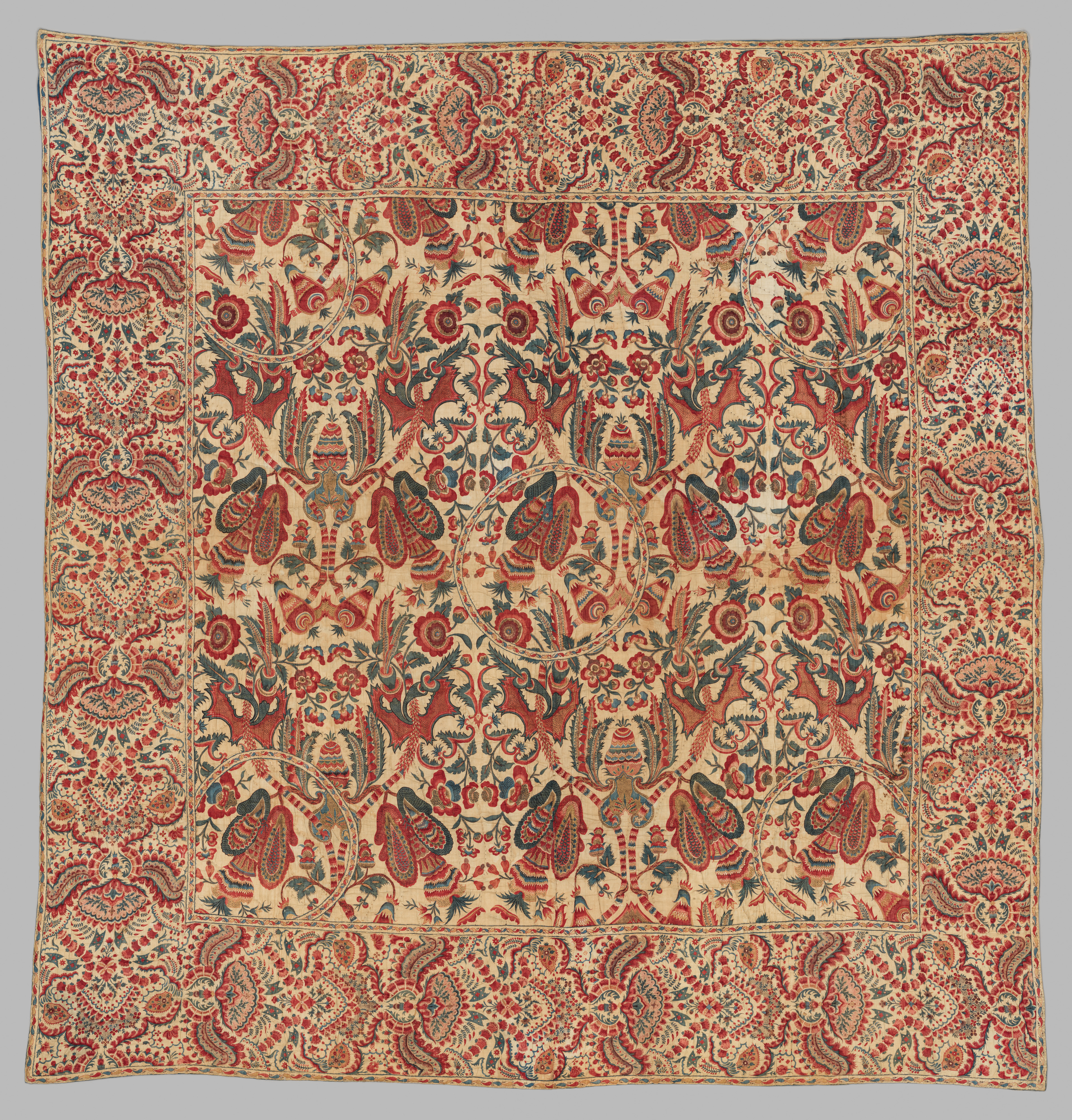
Before: a Europe that could not dye cotton
In 1600, when a group of London merchants received a royal charter on the last day of the year to trade with the East Indies, the clothing of north-western Europe was made from four fibres, and cotton was the least of them. Wool was the great industry of England, Flanders and northern France; linen was the cloth of shirts, shifts, sheets and table-cloths from the Baltic to Brittany; silk was the luxury of courts and the industries of Lyon, Genoa and Florence. Cotton reached Europe chiefly as raw fibre from the Levant, woven into fustians — cloths with a linen warp and a cotton weft — in the towns of southern Germany and Lombardy, a medieval industry this atlas follows in a separate record.233 What Europe did not have was a cloth that was light, cheap, washable and brightly patterned all at once. Giorgio Riello's global history of cotton makes this the starting point: European textiles before the seventeenth century could be fine, or colourful, or cheap, but rarely all three, and the colour that mattered was the colour of wool.2
The reason was chemistry. European dyers had long known how to fix red, blue and yellow to animal fibres — wool and silk take dye readily — and the dyeing trades were organised around them, with guilds that separated dyers of fine colours from dyers of common ones.2 Vegetable fibres were another matter. Linen and cotton resist most natural dyes unless the fibre is first treated with a mordant, a metallic salt that binds the colour to the cloth, and European practice in mordanting plant fibres was limited. Patterned linens existed, but the pattern was usually woven, embroidered, or printed with oil-bound pigments that sat on the surface and faded or washed out.34 A housewife in Amsterdam or London could own a red woollen petticoat or a white linen shift; she could not own a shift printed with red and blue flowers that would survive the wash-tub.
What a north-western European wardrobe held
The household inventories and trade statistics that historians of consumption have worked through give a consistent picture of the wardrobe before the calico trade.6 It was heavy, durable and largely monochrome:
- Wool for outer garments, coats, gowns and petticoats, in the broadcloths of the West Country and the lighter "new draperies" of Norwich and Leiden.
- Linen for everything next to the skin and for the household: shirts, shifts, caps, aprons, bedding and napery, mostly white or unbleached.
- Silk for those who could afford it, and in ribbons and trimmings for those who could afford a little.
- Fustian and other mixed cloths for working dress, typically plain or striped.
Beverly Lemire, whose Fashion's Favourite (1991) remains the standard study of the English cotton consumer, showed that the change that followed was not a change in elite fashion alone: it reached servants, apprentices and labouring women, who had never before been able to buy colour in a form that was both cheap and washable.6 That is what makes the transmission worth following in detail. Before it, colour on the body signalled money. After it, colour was available to anyone with a few shillings.
The protected trades
The textile trades of the three great north-western economies were also political institutions. Wool was the foundation of English customs revenue and the subject of a dense body of protective statute; the silk weavers of Spitalfields, many of them Huguenot refugees after 1685, were organised and vocal; in France, Colbert's regime of manufacture regulation tied the cloth industries to the Crown through inspectors, standards and privileges.710 Eli Heckscher's classic study of mercantilism, published in English in 1935, chose the calico prohibitions as one of its central examples precisely because they show the mercantile state at its most determined — defending an existing industry against an import that consumers plainly preferred.7
The state of the European dyeing trade before the transmission, then, can be stated simply. It was skilled, guild-bound and wool-centred; it had no reliable method for fixing several fast colours to cotton; and it sat inside a political economy that treated textiles as a matter of state. Into that system came a cloth from the other side of the Indian Ocean that did everything European cloth could not.
The transmission: from the Coromandel dye-yard to the European print-works
Painted cloth on the Coromandel coast
On the south-eastern coast of India, from the delta of the Krishna and Godavari rivers south to Pulicat, Madras and Nagapattinam, weaving villages and specialist dyers had for centuries produced cottons painted and dyed in fast colours for markets across the Indian Ocean — in Gujarat, the Persian Gulf, Siam, Java and the Moluccas, where they were the principal currency of the spice trade.2333 The technique, called kalamkari after the kalam, the bamboo pen used to apply it, was not printing in the European sense. It was a sequence of chemical operations, each one fixing or reserving a colour, carried out by hand over weeks. A set of process samples made on the Coromandel coast and now in the Victoria and Albert Museum shows the stages one by one.28 In outline:
- The cotton was bleached and treated with myrobalan, a fruit rich in tannin, and with milk, to prepare it to take the mordants.2827
- The design was pounced onto the cloth through a perforated paper pattern with charcoal dust, and outlined.28
- Mordants were painted on with the kalam: alum where the cloth was to be red, iron where it was to be black or brown.328
- The whole cloth was boiled in a dye bath of chay root (Oldenlandia umbellata), whose red bonded only where a mordant had been applied; further alum and chay baths built up the shades.328
- Everything except the areas meant to be blue was covered in wax, and the cloth was dipped in indigo; the wax was then removed.28
- Yellow was painted over the blue to make green, and the cloth was washed and bleached between colours.28
The result was a cloth on which every colour was chemically fixed. It could be washed repeatedly; it did not fade in the sun as quickly as anything Europe made; and it could carry designs of almost any complexity.3
The companies arrive, 1600–1660
The Portuguese had carried Indian cottons to Lisbon through the sixteenth century, but in small quantities. The decisive change came with the northern companies. The Dutch East India Company (VOC), chartered in 1602, established its Coromandel headquarters at Pulicat in 1610; the English company set up a factory at Masulipatnam, the port of the sultanate of Golconda, in 1611, and in 1639 leased the strip of coast on which it built Fort St George, the core of Madras.130 At first the companies wanted Coromandel cloth for Asian trade: Indian painted cottons bought pepper and cloves in the Indonesian archipelago. Only gradually did they begin to ship them home.
The figures in K. N. Chaudhuri's study of the English company show how gradual the beginning was and how sudden the end. For the VOC, textiles were 14 per cent of the invoice value of return cargoes in 1648–50, against 68 per cent for pepper and spices; by 1698–1700 textiles were 55 per cent.1 The English company's dependence was greater still. Chaudhuri's summary is precise: "In 1664 the total quantities of calico imported by the English Company stood at well over a quarter of a million pieces and their value accounted for 73 per cent of the entire trade of the Company. In two decades the first figure had climbed to more than a million and a half pieces and the relative share of textiles in total value had also increased to 83 per cent."1 In 1682, under Josiah Child, the company ordered 2.8 million pieces.1
In 1664 Surat, the Gujarati port, supplied half of the English company's textiles by quantity, Madras and the Coromandel coast 41 per cent, and Bengal 9 per cent; by value Coromandel led, with 48 per cent, because its painted and dyed cloths were the most expensive.1 The painted chintz was the prestige product of the trade, and its source was the coast between Masulipatnam and Madras.
The European vocabulary of the trade preserves its geography. "Calico" comes from Calicut, the Malabar port where the Portuguese first bought Indian cloth; "chintz" from the Hindi chīṇṭ, spotted or sprinkled cloth; "palampore", the large painted bed-cover, from a Persian-Hindi compound for a bed-sheet.23 The companies' invoices are full of Indian names for Indian cloth types — salampores, percallaes, moorees, longcloth — that European clerks learned to write down because there were no European words for the goods.1 The words outlived the trade. Several of them are still the ordinary names for cloth in English and French, long after the cloth they name stopped coming from India.
The companies themselves were not neutral carriers. They bought through Indian merchants who advanced cash to weavers months before the cloth was due, and they competed with Asian buyers for the same output.120 In the seventeenth century this left considerable power with the makers. A Coromandel weaving village could sell to Gujarati, Armenian, Dutch or English buyers, and the painters and dyers who finished the cloth were specialists whose skill could not be replaced quickly.20 Chaudhuri's ledgers show the English company struggling constantly with delays, short deliveries and rising prices on the coast — evidence, as much as anything, of a market in which the producers could still say no.1
Designing for Europe
What turned a curiosity into a mass fashion was a feedback loop between European buyers and Indian makers. From the 1660s the English and Dutch companies sent samples and paper patterns to their factors on the Coromandel coast and in Gujarat, asking for designs on light grounds, in colours and layouts suited to European beds, walls and gowns.3431 Coromandel painters adapted European, Chinese and Persian motifs into a hybrid that Europe would come to think of as typically Indian: the flowering tree rising from a rocky mound, the large palampore bed-cover with a central field and deep border, the scattered flowers of dress chintz.331 Rosemary Crill's catalogue of the V&A's chintz collection traces this two-way traffic in design: the export chintz was, from the start, an Indian technique serving a European brief.3
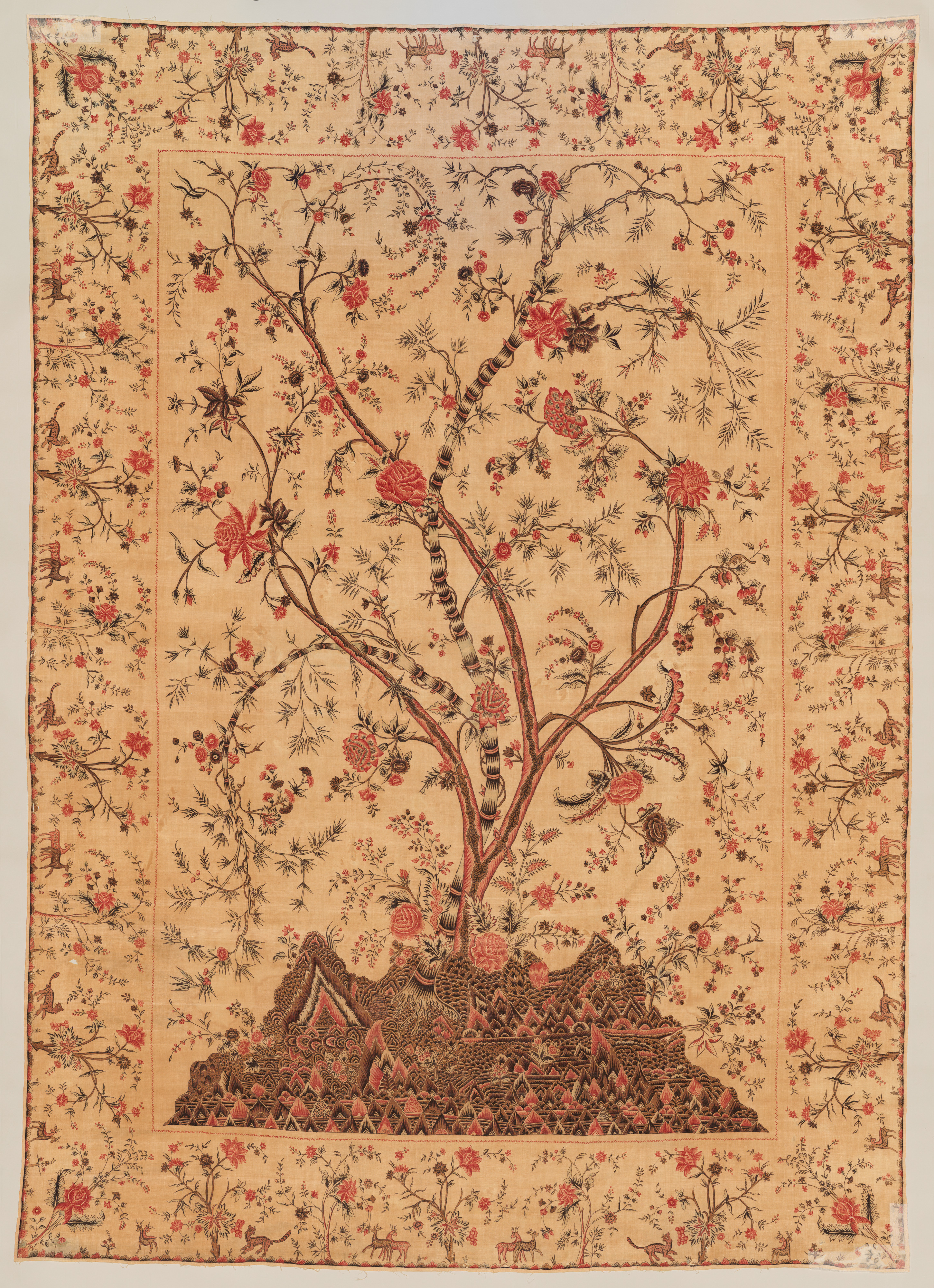
By the 1680s the fashion had reached every level of society. Daniel Defoe, looking back in 1727, described the moment in his campaign pamphlet for the woollen trade: "We saw all our Women, Rich and Poor, cloath'd in Callico, printed and painted; the Gayer and the more Tawdry, the better."1312 He meant it as an accusation. What it records is the first time cheap, patterned, washable cloth had been available to labouring women in north-western Europe.6
Copying the process, 1670–1760
Imitation began almost at once, and it began with printing. Heckscher dates the start of European calico printing to about 1670 in France, the Netherlands and England.7 In Marseille, Armenian craftsmen — the indienneurs — introduced Levantine and Indian printing methods before 1686; London and Amsterdam printers followed in the 1670s.57 The early European prints were crude by Indian standards: a carved wooden block could lay down a mordant, but European printers had not mastered the full sequence of mordants, resists and baths, and their colours were fewer and less fast.27
The gap was closed by a deliberate campaign of technical inquiry, most of it French. Three documents mattered most:527
| Date | Author | Place | What it recorded |
|---|---|---|---|
| 1678 | Georges Roques, agent of the French company | Ahmedabad, Gujarat | Block-printing and dyeing methods of the Gujarati workshops, in a manuscript manual for company employees29 |
| c. 1728–34 | Antoine de Beaulieu, French naval officer | Pondicherry | The Coromandel process stage by stage, with a sample of cloth at each step; published anonymously in Amsterdam in 17605 |
| 1742 and 1747 | Gaston-Laurent Coeurdoux, Jesuit | Pondicherry | Two letters describing the painted cloths and their dyes; the recipes reproduced in Diderot and d'Alembert's Encyclopédie5 |
Coeurdoux's second letter states his purpose openly: "Je ne sais si la lettre que j'écrivis en 1742 sur les Toiles peintes ne pourrait contribuer en Europe à la perfection de l'art des Teinturiers" — he did not know whether his 1742 letter might help perfect the dyers' art in Europe.5 Aziza Gril-Mariotte, who has reconstructed the circulation of these texts, notes that "les recettes données par Cœurdoux dans sa lettre du 18 janvier 1742 … sont intégralement reproduites dans l'Encyclopédie à l'article « Toile peinte des Indes »".5 The knowledge of Coromandel dyers, written down in a French colonial town, became public European knowledge in the most widely read reference work of the century.
Gril-Mariotte also argues that written recipes were only half of the transfer. The other half moved with people: Armenian dyers at Marseille, Huguenot printers expelled from France after 1685, Swiss and Alsatian workmen who carried hand skills between print-works.5 The economic historian Alka Raman makes a similar point about the British case, showing how printers such as Jean Ryhiner in Basel and Edward Bancroft in London studied Indian methods as the benchmark of quality.27
What changed and what was replaced
From the bed to the body
The first Indian chintzes in European houses were furnishings: bed-hangings, quilts, wall-hangings and cushion covers, displayed in the rooms where wealthy households received guests.331 Within a generation the cloth had moved from the wall to the body. Lemire traces how English buyers began to wear chintz and printed calico as gowns, petticoats, aprons, neckerchiefs and linings, and how the fashion travelled down the social scale through the second-hand clothing trade, through pawnbrokers, and through servants who received their employers' cast-off gowns.6
The change was more than a change of taste. Calico altered the economics of dress in four ways:62
- Price: a printed calico gown cost a fraction of a silk one and could imitate its look.
- Washability: a fast-dyed cotton could be laundered with the household linen, so a patterned garment could be worn next to the skin and kept clean.
- Turnover: lighter, cheaper cloth wore out faster and could be replaced sooner, which made fashion seasonal for buyers who had never before followed it.
- Choice: the companies shipped hundreds of patterns, and the buyer could choose.
In the Dutch Republic the same process can be followed in surviving clothes. Women's jackets and long gowns cut from Coromandel chintz were worn across the provinces, and in some communities, such as Hindeloopen in Friesland, chintz became part of regional costume and stayed there into the nineteenth century.30 Ebeltje Hartkamp-Jonxis's 1987 exhibition catalogue Sits: Oost-West relaties in textiel documents this Dutch reception — sits being the Dutch word for chintz — and shows how far beyond the cities and the wealthy the cloth had travelled.30
Prohibition as industrial policy
The European states' first response to Indian chintz was not to copy it but to ban it. The bans differed in scope, and the difference shaped the industries that followed:
| Year | State | Measure |
|---|---|---|
| 1686 | France | Arrêt du Conseil of 26 October prohibits "les toiles de coton peintes aux Indes ou contrefaites dans le Royaume" — both imports and domestic imitation8 |
| 1700 | England | Act prohibiting the use of imported painted, dyed or stained calicoes; import for re-export and plain calico still allowed11 |
| 1719–20 | England | Calico riots in Spitalfields and across London10 |
| 1721 | Great Britain | Act prohibiting the "use and wear" of printed, painted, stained or dyed calicoes; in force from 25 December 172214 |
| 1736 | Great Britain | "Manchester Act" permits printing on linen-warp fustians7 |
| 1759 | France | Prohibition lifted after 73 years78 |
| 1774 | Great Britain | 1721 Act repealed2 |
Heckscher counted the French apparatus: "The prohibitions were in force, on paper, for 73 years, from 1686 to 1759; they were contained in two statutes, some 80 ordinances and an even larger number of administrative orders."7 Edgard Depitre, whose 1912 thesis on la toile peinte is still the fullest study of the French ban, documented its enforcement through special commissions, sentencing without appeal.8
The English bans were narrower and, crucially, they protected a different industry. By prohibiting the use of Indian calico at home while leaving room for plain cotton cloth, and later for printing on fustians, Parliament gave English printers a market emptied of their Indian competitor.7 Heckscher drew the contrast directly: the English prohibition came later, covered imports rather than domestic manufacture, and was enforced less strictly, so that the English printing industry grew under it while the French one was driven abroad.7 Prasannan Parthasarathi has made this the core of a larger argument: the British state's protection against Indian cloth, combined with the competitive pressure of the Indian product itself, was what pushed British manufacturers toward the machinery that would eventually outproduce India.19
The print-works of the diaspora
France's total ban on making as well as importing printed cotton sent its printers abroad. Huguenots and others took the craft to Geneva, Neuchâtel, Basel and Amsterdam.57 In 1746 Jean-Jacques Schmaltzer, Samuel Koechlin, Jean-Henri Dollfus and Jean-Jacques Feer founded the first indiennes print-works in Mulhouse, then a city-republic allied to the Swiss Confederation and outside French jurisdiction; within a generation Mulhouse was one of Europe's great textile-printing centres.16 The Dutch Republic, which never prohibited chintz, both imported it in quantity and printed its own; Dutch provincial dress, from Hindeloopen in Friesland to Zeeland, kept Indian chintz in daily use long after it had ceased to be a novelty elsewhere.30
When France lifted its ban in 1759, the knowledge accumulated abroad flowed back. In 1760 Christophe-Philippe Oberkampf, a printer trained in the print-works of Switzerland and Mulhouse, began printing at Jouy-en-Josas near Versailles; his works became a manufacture royale in 1783 and gave its name to the toile de Jouy.1718 Serge Chassagne's study of the French cotton entrepreneurs, Le coton et ses patrons (1991), follows the generation of printers and spinners who built French cotton industry on this foundation.18
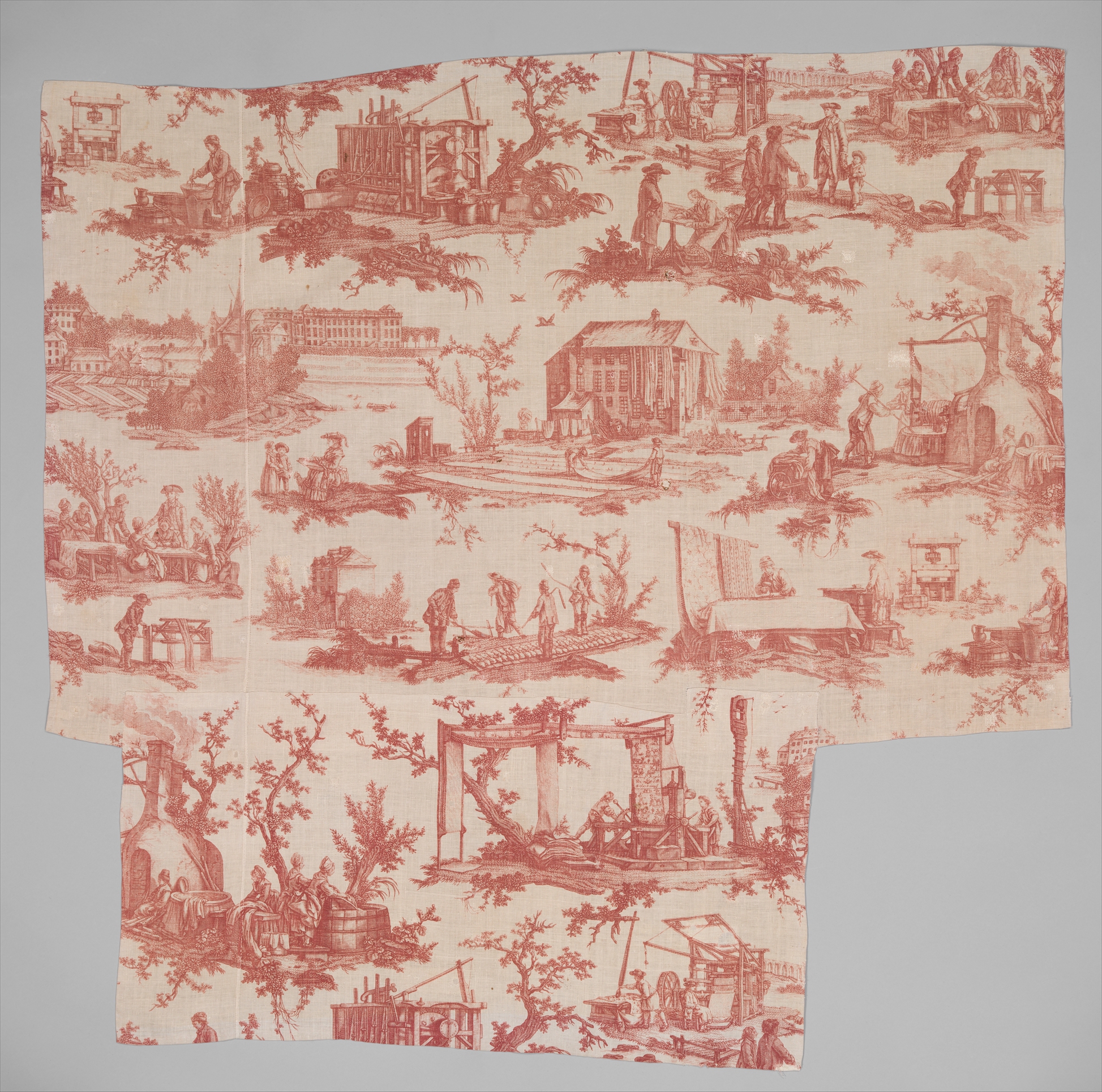
Machines and the reversal of the trade
The English side of the story ends with mechanisation. Lancashire printers such as the Peels, whose firm Stanley Chapman and Serge Chassagne compared with Oberkampf's, moved from wooden blocks to engraved copper plates and then to cylinders.17 Thomas Bell patented engraved-cylinder printing in 1783, and the first machine ran in Lancashire two years later, printing continuous lengths of cloth at a rate no hand-block printer could approach.2 Spinning machinery — Hargreaves, Arkwright, Crompton — supplied the cotton yarn that let British weavers make a calico ground strong enough to print, without Indian yarn.219
What this replaced can be listed precisely:
- On the European side: block printing by hand, and before it the oil-pigment printing and woven patterning that had been the only ways to put a design on cloth; the dyers' guild order in which wool came first.227
- On the Indian side: the export market for painted and printed cloth, first in Europe, then in West Africa and the Americas, and finally in India itself.2325
- In the trade: the direction of flow. Indian piece-goods exports to Britain peaked in value in 1800 and in volume in 1802, then fell sharply; after the East India Company's monopoly on the India trade was ended in 1813, British machine-made cloth entered India in growing quantities.23
The deindustrialisation debate
What happened to Indian textile production after 1800 is the most contested question in this record. The nationalist tradition, from R. C. Dutt onward, argued that British machine cloth, aided by colonial policy, ruined India's weavers.22 Revisionist economic historians, Tirthankar Roy prominent among them, have argued that handloom weaving adapted and survived for the domestic market, and that the losses fell heaviest on fine export goods and on hand spinning.24 David Clingingsmith and Jeffrey Williamson, in a widely cited 2004 paper, place the beginning of decline before 1800 — in the collapse of Mughal authority and in agricultural shocks — with the post-1810 productivity gap with Britain completing it. Their headline: "While India produced about 25 percent of world industrial output in 1750, this figure fell to only 2 percent by 1900."23
These positions disagree about causes and timing, not about the scale of the fall in exports. Joseph Inikori's figures for the West African market show it clearly: Indian cloth made up about 38 per cent of the textiles sold in West Africa in the 1730s, about 22 per cent in the 1780s, and about 3 per cent in the 1840s.2523 India lost the Atlantic market to European imitations before it lost the home market.
What the cost was
The cost of this transmission was paid at both ends of the route and on a third continent. Some of it was the direct work of the states that tried to stop the trade; some of it was the work of the companies that ran it; and some was the consequence of what Europe did with the technology once it had it. The record keeps these separate, because they had different authors.
The war against calico in France
The French prohibition was enforced with the full apparatus of the ancien régime fiscal state. Armed smuggling across the frontiers of Savoy, Switzerland and the Austrian Netherlands was tried by special commissions — Flanders from 1728, Valence from 1733, among others — that sentenced without appeal and carried out sentences within twenty-four hours.8 Depitre records that a person caught carrying two ells of indiennes, who could not pay the 3,000-livre fine, faced three years in the galleys.8 Gillian Crosby's study of the prohibition finds enforcement "frequent and widespread", with poorer women prominent among those prosecuted for wearing the forbidden cloth.34
The human toll is often cited in a single number, and it must be cited carefully. Heckscher wrote that the economic measures "cost the lives of some 16 000 people, partly through executions and partly through armed affrays, without reckoning the unknown but certainly much larger number of people who were sent to the galleys".7 His source was the economist André Morellet, who in 1758 counted from the tax-farm records "seize mille hommes perdus … pendus, envoyés aux galères ou morts les armes à la main" over three leases.98 Morellet's figure covered all contraband — salt and tobacco as well as cloth — and counted men sent to the galleys as well as the dead; he himself proposed that calico might account for a half or a third of it.9 Even on Morellet's reduced estimate, the defence of French wool and silk against Indian cotton cost several thousand men their lives or their liberty.
Valence and Louis Mandrin
The commission at Valence became a byword. Over its existence it condemned 77 smugglers to be hanged, 58 to be broken on the wheel and 631 to the galleys; one was acquitted; none was pardoned.87 These were smugglers of every kind of goods, not of calico alone — but calico was among the most lucrative contraband in the region.8
The most famous of them was Louis Mandrin. In 1754 his band ran a series of armed expeditions out of Savoy into France, selling contraband tobacco and indiennes openly in the market squares of towns such as Rodez and Millau, at prices that undercut the tax farm.815 Michael Kwass's study of Mandrin uses him to show how the global trade in Asian cloth and American tobacco created a vast underground economy in France; Kwass estimates that about 40,000 smugglers were sent to the galleys over the eighteenth century.15 Mandrin was captured in May 1755 and broken on the wheel at Valence on 26 May, before a crowd of thousands.815
Calico madams: the London riots
In England the violence came from below. In 1697 weavers had already rioted at East India House, the crowd shouting that "the Company had not made a Dividend for some years, but they would make one now."11 From 10 June 1719 the Spitalfields silk and wool weavers rioted across London against the wearing of calico, and the attacks continued into 1720. Women wearing calico gowns were seized in the street; their gowns were torn from them or splashed with aqua fortis, nitric acid. Weavers marched on the calico printing works at Lewisham.1011 Abigail Swingen has shown that the riots were tied to the politics of the South Sea crisis, and that Parliament passed the 1721 Calico Act on the same day as its South Sea rescue legislation.10
The pamphlet war that accompanied the riots made the women themselves the target. "Calico madams" — servants and labouring women accused of dressing above their station — were blamed for the unemployment of weavers.12 The 1721 Act then made them liable to prosecution: £5 on the wearer of printed calico, £20 on the seller.14 Chloe Wigston Smith's study of the controversy shows how the policy debate about Indian cloth was conducted as a debate about the bodies and clothes of poor women.12
The weavers of Bengal and Coromandel
At the other end of the route, the companies' demand for cheap cloth was enforced on the weavers. Before the mid-eighteenth century, Parthasarathi has shown for the south Indian weaving villages, weavers could bargain: they took cash advances from several buyers, sold to the highest bidder, and could move between merchants and states.20 Once the English company had political control — in Bengal after Plassey in 1757, on the Coromandel coast in the decades after — it used its agents, the gomastahs, to bind weavers to deliver only to the company, at prices it set.20
William Bolts, a former company servant who broke with it, described the system in 1772: "The assent of the poor weaver is in general not deemed necessary; for the gomastahs, when employed on the Company's investment, frequently make them sign what they please; and upon the weavers refusing to take the money offered, it has been known they have had it tied in their girdles, and they have been sent away with a flogging."21 The company's prices, he wrote, were "at least fifteen per cent. and in some even forty per cent. less" than the cloth would fetch in the bazaar, and its agents would "set his peons over the weaver to watch him, and not unfrequently to cut the piece out of the loom when nearly finished."21 Bolts had his own quarrel with the company, and his account is polemical, but the practices he describes are confirmed by the company's own records studied by later historians.20
Dacca, and what the record cannot say
The collapse of the export trade after 1800 fell hardest on the centres of fine production. In 1840 Charles Trevelyan told a parliamentary select committee that "the population of the town of Dacca has fallen from 150,000 to 30,000 or 40,000, and the jungle and malaria are fast encroaching upon the town. … Dacca, which was the Manchester of India, has fallen off from a very flourishing town to a very poor and small one; the distress there has been very great indeed."22 Dacca's muslins were woven, not painted, but its fate belongs to the same reversal of the cotton trade that the European imitation of Indian cloth set in motion.
The most quoted sentence about this collapse cannot be verified. Karl Marx, in Capital (1867), attributes to "the Governor General" in 1834–35 the words "The bones of the cotton-weavers are bleaching the plains of India."32 Marx gives no source, and no document of Lord William Bentinck containing those words has been identified. The record does not repeat it as fact. Nor does it repeat the widely circulated story that the British cut off weavers' thumbs, for which no contemporary evidence has been produced; the documented coercion, described above, is grave enough without it.2120
Cloth for the slave trade
The third cost was paid in Africa and the Americas. Indian cottons, and then their European imitations, were among the principal goods exchanged for enslaved people on the West African coast. Inikori's figures — about 38 per cent of West African textile imports from India in the 1730s — measure the Indian share; the falling share after that date measures how European imitations took it over.25 Kazuo Kobayashi's study of Indian cloth in West Africa shows that African buyers were demanding consumers whose preferences shaped what was made in India and Europe.26 The consumers' discernment does not alter the use to which the cloth was put. Calico was a currency of the slave trade, and the print-works of Europe, from Lancashire to Nantes, produced for it.2526
Knowledge without payment
One cost is easy to miss because it left no casualty figures. The Coromandel process was the accumulated work of generations of dyers and painters, and it passed to Europe without compensation of any kind. Antoine de Beaulieu collected his samples at Pondicherry; Gaston-Laurent Coeurdoux wrote his letters from the same town; their findings were printed in Amsterdam and Paris and absorbed into the Encyclopédie.5 Gril-Mariotte's reconstruction of the circulation of these texts makes plain that the French state and the French printers regarded the Indian technique as knowledge to be acquired, not as property belonging to its makers.5
Europe at the same time was building a legal order in which technical knowledge could be owned. English patents, French privileges and the guild secrets of the print-works protected the processes that European printers developed from the Indian model.517 The asymmetry is the point. The methods of the Coromandel dyers became public European knowledge; the European improvements to those methods became private European property. When cylinder printing and mechanised spinning reversed the trade, the Indian producers were competing against their own technique, improved, protected and produced at a scale they could not reach.1927
The bill
The bill for this transmission can be set out in four parts:
- Lives and liberty in France: several thousand smugglers killed, executed or sent to the galleys in the defence of the 1686 prohibition, on the most conservative reading of Morellet's figures; the Valence commission's 77 hangings and 58 breakings on the wheel; Louis Mandrin, executed on 26 May 1755.78915
- Women in London: calico-wearing women assaulted and burned with acid in 1719–20, then made subject to fines by the 1721 Act.101214
- Weavers in India: coerced contracts, floggings and depressed prices under company rule after 1757, and the collapse of the fine-cloth export centres after 1800, with Dacca's population falling by three-quarters.202122
- Captives in Africa: Indian and European-printed calico as a principal good exchanged for enslaved people across the eighteenth century.2526
The modern printed cotton — the floral dress, the tablecloth, the curtain — descends from a seventeenth-century Indian technique that Europe first bought, then banned, then copied, and finally manufactured at a scale that turned the trade around. The record's judgement is that each stage carried a cost, and that most of it was paid by people who were neither the Coromandel masters who invented the process nor the European manufacturers who profited from copying it.
What followed
-
1610The Dutch East India Company sets up its Coromandel headquarters at Pulicat; the English follow at Masulipatnam in 1611 and Madras in 1639–40.
-
1684The English East India Company imports more than 1.5 million pieces of Indian cloth in 1684 — 83 per cent of the value of its trade — after ordering 2.8 million pieces in 1682.
-
1686France bans Indian painted cottons and their domestic imitation by the arrêt of 26 October 1686, a prohibition kept for 73 years; French printers emigrate to Switzerland, Alsace and the Netherlands.
-
1719Calico riots in London: weavers strip calico-wearing women in the street and burn their gowns with acid; Parliament passes the 1721 Act banning the use and wear of printed calicoes.
-
1734Antoine de Beaulieu documents the Coromandel dyeing process stage by stage at Pondicherry, with cloth samples; Coeurdoux's letters of 1742 and 1747 follow and enter the Encyclopédie.
-
1746Schmaltzer, Koechlin, Dollfus and Feer found the first indiennes print-works in Mulhouse, beginning one of Europe's great textile-printing centres.
-
1755The smuggler Louis Mandrin, who sold contraband tobacco and indiennes in the towns of southern France, is broken on the wheel at Valence.
-
1757After Plassey, East India Company agents bind Bengal weavers to deliver only to the company at prices 15–40 per cent below the bazaar, enforced with floggings (Bolts, 1772).
-
1759France lifts its prohibition; Oberkampf begins printing at Jouy-en-Josas in 1760, the origin of toile de Jouy.
-
1783Thomas Bell patents engraved-cylinder printing; machine-printed cotton from Lancashire begins to reverse the flow of the trade.
-
1802Indian piece-goods exports to Britain peak in 1800–02 and then collapse; by 1840 Dacca's population has fallen from 150,000 to 30,000–40,000.
Where this lives today
References
- Chaudhuri, K. N. The Trading World of Asia and the English East India Company, 1660–1760. Cambridge: Cambridge University Press, 1978, esp. pp. 96–97, 282, 286–90. en
- Riello, Giorgio. Cotton: The Fabric that Made the Modern World. Cambridge: Cambridge University Press, 2013. en
- Crill, Rosemary. Chintz: Indian Textiles for the West. London: V&A Publishing, 2008. en
- Irwin, John, and Katharine B. Brett. Origins of Chintz, with a Catalogue of Indo-European Cotton-Paintings in the Victoria and Albert Museum, London, and the Royal Ontario Museum, Toronto. London: HMSO, 1970. en
- Gril-Mariotte, Aziza. « "L'art de faire l'indienne", savoir théorique ou savoir-faire dans l'Europe des Lumières ». Revue du Rhin supérieur 4 (2022). fr
- Lemire, Beverly. Fashion's Favourite: The Cotton Trade and the Consumer in Britain, 1660–1800. Pasold Studies in Textile History 9. Oxford: Oxford University Press for the Pasold Research Fund, 1991. en
- Heckscher, Eli F. Mercantilism. Translated by Mendel Shapiro. Vol. 1. London: George Allen & Unwin, 1935, pp. 172–75. en
- Depitre, Edgard. La toile peinte en France au XVIIe et au XVIIIe siècles : industrie, commerce, prohibitions. Paris, 1912, esp. pp. 1–2, 103–04, 139–42. fr
- Morellet, André. Réflexions sur les avantages de la libre fabrication et de l'usage des toiles peintes en France. Geneva and Paris, 1758, pp. 173, 177. Quoted in Depitre 1912, p. 141. fr primary
- Swingen, Abigail L. "Calico Madams and South Sea Cheats: Global Trade, Finance, and Popular Protest in Early Hanoverian England." Journal of British Studies 63, no. 1 (2024): 114–38. en
- Eacott, Jonathan P. "Making an Imperial Compromise: The Calico Acts, the Atlantic Colonies, and the Structure of the British Empire." William and Mary Quarterly, 3rd ser., 69, no. 4 (2012): 731–62. en
- Wigston Smith, Chloe. "'Callico Madams': Servants, Consumption, and the Calico Crisis." Eighteenth-Century Life 31, no. 2 (2007): 29–55. en
- Defoe, Daniel. A Brief Deduction of the Original, Progress, and Immense Greatness of the British Woollen Manufacture. London, 1727, p. 50. Quoted in Wigston Smith 2007, p. 44. en primary
- Great Britain. An Act to preserve and encourage the woollen and silk manufactures of this kingdom, and for more effectual employing the poor, by prohibiting the use and wear of all printed, painted, stained or dyed callicoes in apparel, household stuff, furniture, or otherwise (7 Geo. I, st. 1, c. 7), 1721. en primary
- Kwass, Michael. Contraband: Louis Mandrin and the Making of a Global Underground. Cambridge, MA: Harvard University Press, 2014. en
- Schreck, Nicolas. « Mulhouse ». Dictionnaire historique de la Suisse, version du 30.04.2020. fr
- Chapman, S. D., and S. Chassagne. European Textile Printers in the Eighteenth Century: A Study of Peel and Oberkampf. London: Heinemann Educational Books and the Pasold Fund, 1981. en
- Chassagne, Serge. Le coton et ses patrons : France, 1760–1840. Civilisations et sociétés 83. Paris : Éditions de l'EHESS, 1991. fr
- Parthasarathi, Prasannan. Why Europe Grew Rich and Asia Did Not: Global Economic Divergence, 1600–1850. Cambridge: Cambridge University Press, 2011. en
- Parthasarathi, Prasannan. The Transition to a Colonial Economy: Weavers, Merchants and Kings in South India, 1720–1800. Cambridge Studies in Indian History and Society 7. Cambridge: Cambridge University Press, 2001. en
- Bolts, William. Considerations on India Affairs; Particularly Respecting the Present State of Bengal and Its Dependencies. Vol. 1. London, 1772, pp. 74, 191–92. en primary
- Trevelyan, Charles E. Evidence to the Select Committee on East India Produce, 1840 (answer to Question 1699). Quoted in Romesh C. Dutt, The Economic History of India in the Victorian Age. London: Kegan Paul, 1906, p. 105. en primary
- Clingingsmith, David, and Jeffrey G. Williamson. "India's De-Industrialization under British Rule: New Ideas, New Evidence." NBER Working Paper 10586. Cambridge, MA: National Bureau of Economic Research, 2004. en
- Roy, Tirthankar. "Economic History and Modern India: Redefining the Link." Journal of Economic Perspectives 16, no. 3 (2002): 109–30. en
- Inikori, Joseph E. Africans and the Industrial Revolution in England: A Study in International Trade and Economic Development. Cambridge: Cambridge University Press, 2002, esp. pp. 431–32, 512–17. en
- Kobayashi, Kazuo. Indian Cotton Textiles in West Africa: African Agency, Consumer Demand and the Making of the Global Economy, 1750–1850. Cham: Palgrave Macmillan, 2019. en
- Raman, Alka. "How Did Indian Cottons Influence the Growth of the British Calico Industry in the 18th and 19th Centuries?" Economic History Society blog, 7 April 2021. en
- Victoria and Albert Museum. Chintz process samples, Coromandel Coast, c. 1919. Museum no. T.1-1920. en primary
- Roques, Georges. La manière de négocier aux Indes, 1676–1691 : la Compagnie des Indes et l'art du commerce. Édition de Valérie Bérinstain. Pérégrinations asiatiques. Paris : École française d'Extrême-Orient / Maisonneuve & Larose, 1996. fr primary
- Hartkamp-Jonxis, Ebeltje, ed. Sits: Oost-West relaties in textiel. Zwolle: Waanders, 1987. nl
- Peck, Amelia, ed. Interwoven Globe: The Worldwide Textile Trade, 1500–1800. New York: The Metropolitan Museum of Art, 2013. en
- Marx, Karl. Capital: A Critique of Political Economy. Vol. 1 (1867), ch. 15, §5. English translation, 1887. en primary
- Riello, Giorgio, and Tirthankar Roy, eds. How India Clothed the World: The World of South Asian Textiles, 1500–1850. Leiden: Brill, 2009. en
- Crosby, Gillian. "First Impressions: The Prohibition on Printed Calicoes in France, 1686–1759." PhD thesis, Nottingham Trent University, 2015. en