Indian cloth became Southeast Asia's ancestors (c. 1100) — at a price
Tamil guilds and Gujarati merchants paid for the archipelago's camphor, pepper and mace in cotton the islands could not make. The islanders turned the foreign cloth into the highest thing they owned — court dress, harvest banner, heirloom of the ancestors. The trade was attached to a Chola raid, a slave circuit and, at its end, the destruction of Banda.
In 1088 a Tamil merchant guild calling itself the Five Hundred of the Thousand Directions met at Barus in west Sumatra and fixed the dues it would levy on ships. Its members traded Indian cotton for the camphor and resin of the Sumatran forests. Over the following centuries Coromandel and Gujarati cloth reached every coast of the archipelago, and the islanders made it sacred: in the Toraja highlands of Sulawesi, block-printed cloths from Gujarat, radiocarbon-dated to 1340 and 1400, were kept for six centuries in clan-house roofs and hung for the harvest as the property of the ancestors. The trade had a darker side. In 1025 a Chola fleet sacked Srivijaya and captured its king; cloth and slaves moved through the same eastern ports; and in 1621 the Dutch East India Company, which had come to the Coromandel coast for the cloth the spice islands demanded, conquered Banda and destroyed most of its people.

Before: an archipelago that wove for itself
Bark, fibre and the backstrap loom
Before Indian cotton reached them in quantity, the peoples of the archipelago between Sumatra and the Moluccas dressed themselves from their own forests and their own women's hands. Anthony Reid, whose Southeast Asia in the Age of Commerce remains the starting point for the region's material history, describes a cloth economy with three layers. In "the less-favoured regions of South Sumatra, Borneo, Sulawesi, and the Moluccas", he writes, "a nonlasting cloth akin to Polynesian tapa was made by soaking the inner bark of certain trees and then beating it until it became flat and soft." Further north, the fibre of the abaca plant, Musa textilis, clothed Cebu, Negros, Samar, Leyte, Mindanao and northern Sulawesi. Above both lay woven cloth of cotton and other fibres.8
The order in which these arrived is written into the languages of the islands. John Crawfurd argued in 1820, and Reid accepts, that weaving began with tree fibres, "since the vocabulary of weaving is Austronesian while the terms for cotton and silk production are Sanskritic".8 The loom was Austronesian; the cotton boll, or at least its name, had already come from India. What did not come was the plant's climate. Cotton grew, from the thirteenth century at the latest, in the dry-season zones of the region — Luzon, central Vietnam, eastern Cambodia, east Java and central Burma — but it could not be grown in wet Sumatra, the Malay Peninsula, western Java or Borneo.9 The richest pepper and camphor coasts of the western archipelago were precisely the places that could not grow their own cotton.
Spinning, dyeing and weaving were women's work, done on a narrow backstrap loom tensioned by the weaver's own body. Reid quotes an eighteenth-century Javanese estimate that it took a woman a month to spin a pound of thread and another month to weave a cloth ten yards long.8 Cloth in this world was labour made visible: a household's months, worn.
What cloth already meant
Cloth was also money. "Strips of local cotton cloth," Reid notes, "were even used as currency in parts of Sulawesi and Buton."8 It was given at marriages and funerals, exchanged between kin groups, stored as wealth and displayed as rank. Toraja weavers in the mountains of central Sulawesi made, in Robyn Maxwell's description, "huge warp ikat cottons in bold geometric patterns" — the threads tied and dyed before weaving so that the design emerged on the loom.13 Those ikats wrapped the dead. They were, and are, among the most demanding textiles made anywhere.
Java's written record begins with the charters of the ninth century, and it begins in a culture already marked by India. Jan Wisseman Christie, whose 1993 study of Old Javanese textile vocabulary is the foundation of the field, built it on the sīma charters — royal grants that turned a village into a tax-and-labour freehold for a temple or a lord — from the ninth to the fifteenth centuries. Java, she observed, had by then been "interacting both commercially and culturally with the Indian subcontinent for nearly a thousand years".10 The stone gods of Central Java, carved between about 750 and 928, wear cloths whose repeating small flowers and dots Sandra Pullen reads as imported Indian tie-dye; Jiří Jákl, reviewing her work, notes her comparison of these patterns with Indian block-prints excavated in Egypt.12 Before the Chola centuries, in other words, Indian cloth was already known to the Javanese court. What changed after 1000 was its scale, its reach eastward, and what the islands did with it.
Srivijaya and the camphor coast
The political frame into which Indian cloth arrived was the maritime power of Srivijaya, centred on Palembang on the Musi river in south Sumatra, which from the late seventh century controlled the straits between the Indian Ocean and the South China Sea. Its wealth came from position and from the forests behind it. The camphor of Barus, on Sumatra's west coast, and the aromatic resin called benzoin were known to Arab and Persian merchants from the ninth century; the pepper of Sumatra and the cloves, nutmeg and mace of the Moluccas would follow.5 To Song China, Srivijaya was a great state. Zhou Qufei placed it third among the rich foreign realms, after the Arabs and Java; Zhao Rugua recorded that merchants paid for its goods in "gold, silver, porcelain-ware, silk brocades, skeins of silk, silk gauzes", and listed foreign cotton among the goods it imported.1
That list explains the shape of the exchange. The archipelago sold forest and spice products that grew nowhere else. It bought what it valued and could not make: Chinese silk and porcelain from the north, Indian cotton from the west. The Tamil and Gujarati cloth trade was one half of a double dependence, and Srivijaya's rulers stood at the hinge of both. Their partnership with the Chola court, and their rivalry with it, would determine how the western half of that trade was run.
What the islands did not have
The archipelago's own cloth tradition was rich, but it lacked several things that India possessed in abundance:
- Mordant dyeing. The chemistry by which a metallic salt fixes a vegetable dye to cotton, so that a red survives washing and sun, was India's speciality. Maxwell is explicit that mordant painting and printing "has never been practised in Indonesia".13
- Printed pattern. Indian dyers drew or block-printed repeating designs across the length of a cloth; island weavers made pattern in the loom, thread by thread, at a fraction of the speed.
- Volume. A Javanese weaver's ten yards took a month. The Coromandel and Gujarati workshops produced for markets on three continents.
- Cotton where cotton would not grow. The wet western ports — the pepper and camphor coasts of Sumatra — had to import the fibre or the finished cloth.
- A cloth from outside. In societies where rank was displayed in what one wore and gave, a cloth that no neighbour could weave was a new kind of distinction.
Each of these gaps was filled from India, and each filling changed what cloth meant in the islands.
The transmission: guilds, kings and the Bay of Bengal
Nagapattinam and the Chola coast
The source of the cloth that crossed to the archipelago in the eleventh and twelfth centuries was the Tamil country under the imperial Chola dynasty, which ruled the Kaveri delta from about 850 and dominated southern India under Rajaraja I (985–1014) and his son Rajendra I (1014–1044). Its weaving communities — the Kaikkolar, the Saliyar and the Devanga — are the subject of Vijaya Ramaswamy's study of textiles and weavers in medieval south India, which traces their organisation, their looms and their trade from the tenth century onward through temple inscriptions.7 Cotton cloth was a product of temple towns as well as villages, and its makers appear in the inscriptions as donors, as tax-payers and, in the Chola period, as members of local governing bodies.
The Chola port for the eastern sea was Nagapattinam. Around 1006, in the twenty-first year of his reign, Rajaraja granted the revenues of the village of Anaimangalam to a Buddhist monastery there, the Chudamani vihara. The donor of the building itself was a Southeast Asian king: Mara-Vijayottungavarman of the Sailendra line, ruler of Srivijaya, the Malay maritime power based on the Musi river in Sumatra. The bilingual copper-plate charter — a Sanskrit eulogy and an operative grant in Tamil, the plates held on a ring under the Chola seal — is known as the Larger Leiden plates, after the university that held them until their return to India in 2026.6 A Srivijayan king building a monastery in a Chola port, and a Chola king endowing it, is the clearest single image of the partnership on which the cloth trade rested.
The Five Hundred at Barus
The carriers were the Tamil merchant guilds. The largest of them called itself the Ainnurruvar, "the Five Hundred", or in its fullest form the Five Hundred of the Thousand Directions; it was also known by the name of its home town in the Deccan, Ayyavole. Another, the Manigramam, appears earlier. Their inscriptions mark the eastern edge of the Bay of Bengal like survey stones:
| Date | Place | Guild and content |
|---|---|---|
| c. 826–849 | Takuapa, southern Thai peninsula | A tank dug by Nangur-Udaiyan placed under the protection of the Manigramam and a resident body of troops 6 |
| c. 1006 | Nagapattinam | The Chudamani vihara, built by the king of Srivijaya, endowed by Rajaraja I 6 |
| 1015, 1033, 1077 | Song China | Chola embassies reach the Song court 1 |
| 1088 | Lobu Tua, Barus, west Sumatra | The Five Hundred of the Thousand Directions meet and fix dues on ships 4 |
| 12th century | Neusu, near Banda Aceh | A guild text on lost goods and waived interest naming the Ainnurruvar 45 |
| 1178 | Guangxi, south China | Zhou Qufei describes Chola cotton cloth 1 |
| c. 1225 | Quanzhou | Zhao Rugua lists the cottons of Chola and Gujarat 1 |
The Barus stone is the one that anchors this record. Found at Lobu Tua in 1873 and first reported by E. Hultzsch in 1891–92, it is dated in the month of Masi of Śaka 1010 — 1088 CE. Y. Subbarayalu's re-reading, published in the French-led excavation volume on Barus edited by Claude Guillot, shows the guild meeting at the port it called Varocu and setting the dues it would collect from the ship, the captain and the crew, in gold reckoned against the price of musk.4 E. Edwards McKinnon describes the stone as announcing "the presence of the ticai ayirattu annurruvar – 'The Five Hundred of a Thousand Directions'" at a port known to Arab and Persian traders since the ninth century "as a source of valuable forest products, benzoin and camphor".5 That is the exchange in its simplest form: Tamil cloth for Sumatran camphor and resin, under the regulation of a guild that was neither Chola nor Sumatran but a corporation of the sea.
What the Chinese customs writers saw
The best description of the cloth itself comes not from India or Sumatra but from the Chinese officials who taxed the trade at its far end. Zhou Qufei, writing in 1178, ranked the wealthiest foreign countries known to Song China: "none surpass the realm of the Arabs (Ta-shi). Next to them comes Java (Sho-p'o); the third is Palembang (San-fo-ts'i)."1 Of the people of the Chola country he reported that they "wrap (themselves) in white cotton cloth", and that the country produced "cotton stuffs with coloured silk threads".1
Zhao Rugua, the superintendent of maritime trade at Quanzhou, finished his Zhufan zhi, the "Account of the Foreign Peoples", around 1225. He listed among the products of the Chola country "pearls, elephants' tusks, coral, transparent glass, betel nuts, cardamoms, opaque glass, cotton stuffs with coloured silk threads, and cotton stuffs". Of Gujarat — in what its translators call the earliest mention of the name in Chinese — he wrote that the people "wear close fitting clothes with a cotton sarong wrapped around them", and that the country produced "great quantities of indigo, red kino, myrobolans and foreign cotton stuffs of every colour". Friedrich Hirth and W. W. Rockhill, translating him in 1911, glossed the phrase: those cottons "of every colour" "were probably chintzes".1
Two details in Zhao's account matter for the archipelago. At Palembang, the Srivijayan capital, he found "foreign cotton stuffs" among the goods brought in from the west. And in Java he found not only consumers but weavers: the Javanese, he wrote, "pay attention to the raising of silkworms and the weaving of silk; they have various coloured brocaded silks, cotton, and damasked cotton gauzes".1 Indian cloth entered a region that wove well already. It did not fill a void; it entered a hierarchy.
What the evidence is, and what it is not
Because the cloths of the Chola centuries have not survived in the islands, the transmission has to be reconstructed from four kinds of witness, each partial:
- Stones. The guild inscriptions at Takuapa, Barus and Neusu, and the Chola charters and temple inscriptions in Tamil Nadu, prove the presence of organised Tamil merchants and the political relationship with Srivijaya. None of them, as published, lists cloth among the goods taxed.46
- Chinese customs writers. Zhou Qufei and Zhao Rugua name the cloths and the countries that made them, and Zhao names Indian cloth arriving at Palembang. They saw the trade from its eastern terminus, and they classified what reached them, not what stayed in the archipelago.1
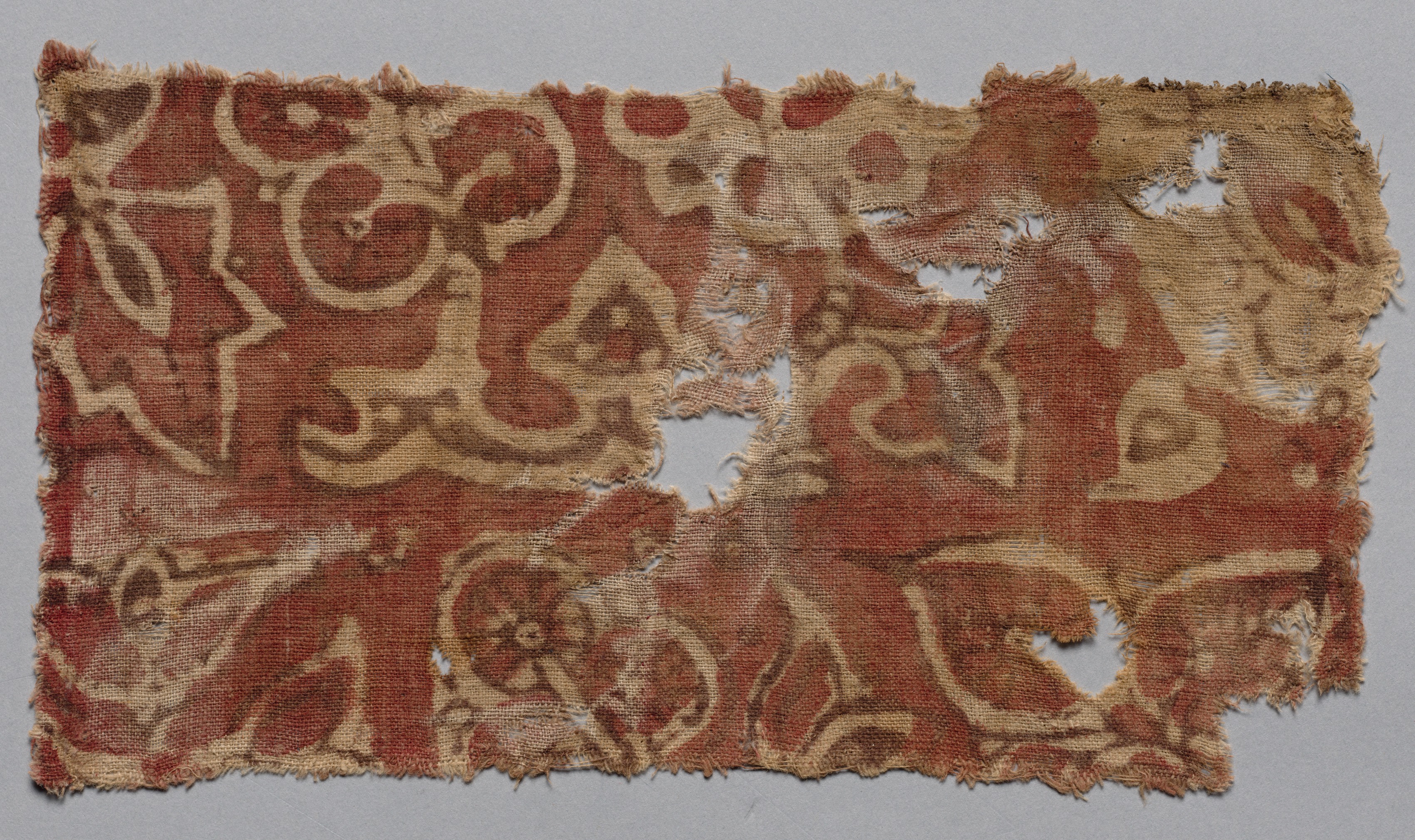
- Matching designs. The Indian block-prints excavated at Fustat, dated by radiocarbon to the eleventh century, share designs with the cloths later preserved in Sulawesi, and show what the Gujarati export workshops were making.1415
- Late observers. Pires in 1512–1515, and the Dutch surveys of the early twentieth century, describe a fully developed system and how it was used. They are evidence of where the trade led, read backward with care.218
The argument of this record rests on all four together. Where they diverge — as on the antiquity of batik, or on the size of Banda's population — the record says so.
Zhao Rugua also shows how far inland the Indian supply reached. Of Malwa, in central India, he wrote that "white cotton cloth is very common", and that "every year two thousand oxen, or more, laden with cotton stuffs are sent over the roads to other countries to barter".1 The cloth that left Cambay for the east was the product of a subcontinental hinterland, carried to the coast by caravan before it was carried across the sea by ship.
Gujarat and the long fourteenth century
From the thirteenth century the balance of the trade shifted west, to the ports of Gujarat — Cambay above all — and to Muslim merchants of Gujarati, Persian and Arab origin who carried Islam into the archipelago alongside their cargoes. The cloths that survive in Indonesia from before 1500 are almost all Gujarati, block-printed and mordant-dyed in red and blue on cotton. By the time the Portuguese apothecary Tomé Pires described the trade at Malacca in 1512–1515, it had become the axis of the whole regional economy. "There used to be a thousand Gujarat merchants in Malacca," he wrote, "besides four or five thousand Gujarat seamen, who came and went. Malacca cannot live without Cambay, nor Cambay without Malacca."2
Reid, working from Pires, estimates that Malacca around 1510 received the cloth of some fifteen large ships a year, worth more than 500,000 cruzados.8 Pires's account of Sumatra is a catalogue of the cloth's reach: the people of Indragiri "bring back Kling and Gujarat cloth, which is valued throughout the island, and red cotton cloth is valued the most in Menangkabau"; in Palembang "they use a large amount of clothing of the coarse [kind] from the Gujaratees and from the Kling"; the island "has so many inhabitants that large quantities of clothes from the Kling and Gujaratees are used there".2 Kling — from Kalinga — was the archipelago's word for the people of India's east coast, and "Kling cloth" was the name the Chola centuries had given to the trade.
The verdict in that pull quote is Reid's.9 It is also, he insists, a verdict about the commercial economy, and he adds a correction that this record keeps: Indian and Chinese cloths "were bought by the wealthier elite", while "the bulk of the population always wore local or regional cloths".8 The volumes were nonetheless enormous for an elite trade. Reid's later estimate, built on Portuguese and Dutch figures, puts Indian cloth entering Southeast Asia at roughly 600,000 Spanish dollars a year around 1510, and at some 1.76 million by 1641.9 Cloth was, in his phrase, "the largest item of luxury expenditure" in the region, and for that reason "the level of imports is a good indicator of the level of prosperity".8 Every rise and fall in the fortunes of the archipelago's ports can be read in the cloth they absorbed. What crossed the Bay of Bengal did not clothe the archipelago. It clothed its rulers, its rituals and its dead.
What changed and what was replaced
From currency to heirloom
The central transformation is the one Robyn Maxwell names in the opening pages of Sari to Sarong, the National Gallery of Australia's survey of five centuries of Indian–Indonesian textile exchange: over time "the importance and meaning of the exotic textiles shifted from essential currency to sacred heirloom".13 A cloth that entered the islands as the price of pepper or mace left the market. It was stored, inherited, displayed at the highest rites and named as part of a lineage's regalia. Maxwell records that the loss or damage of such regalia "was often taken as a sign of a failed leader or an impending disaster".13
The shift ran in a recognisable sequence:
- Payment. Cloth arrives as the medium in which foreign merchants pay for forest and spice produce — camphor at Barus, pepper in Sumatra, mace in Banda.
- Distinction. The best pieces are taken by chiefs and courts, who wear and give what no local loom can make.
- Ceremony. The cloths are hung, spread and carried at harvests, weddings and the installation of rulers.
- Inheritance. The cloths are withdrawn from exchange altogether and kept by kin groups as heirlooms — in Malay and Indonesian, pusaka.
- Ancestry. Over generations their origin is forgotten or mythologised, and they come to be treated as the property, or the presence, of the ancestors.
The last step is what makes this transmission unusual. Many cultures have imported luxury cloth. Few have turned it into the material of the sacred so completely that its foreignness disappeared.
Cloths older than their records
That disappearance created a scholarly problem. For most of the twentieth century it was taken for granted that nothing as perishable as cotton could survive centuries in the humid tropics, and that the Indian cloths kept in Indonesian clan houses were seventeenth- or eighteenth-century imports of the Dutch East India Company. Ruth Barnes, then at the Ashmolean Museum in Oxford, overturned this with radiocarbon dating. "It has so far been assumed," she wrote in 1996, "that no textile surviving in tropical Indonesia could have been earlier than the late 17th or early 18th century."14
The dates told a different story:
| Object | Found | Radiocarbon date |
|---|---|---|
| Newberry fragment, Ashmolean | Fustat, Egypt | 1010 ± 55 14 |
| Newberry fragment, Ashmolean | Fustat, Egypt | 1060 ± 40 14 |
| Ceremonial banner (maa'), V&A IS.96-1993 | Toraja, central Sulawesi | 1340 ± 40 17 |
| Heirloom cloth with geese and rosettes, Ashmolean EA1995.61 | Toraja, central Sulawesi | 1400 ± 40 14 |
| Block-printed cloth with a woman and parrot, V&A IS.95-1993 | Toraja, central Sulawesi | late 14th–15th century, confirmed by radiocarbon 17 |
The Ashmolean's Toraja cloth, with its small geese circling rosettes, matched a fragment in the Newberry collection of Indian block-prints excavated in the rubbish heaps of medieval Cairo — the collection Barnes catalogued in 1997.1415 The same Gujarati workshops, in other words, were printing the same designs for buyers in Egypt and in Sulawesi. The Egyptian fragments reach back to the early eleventh century; the Indonesian survivals to the fourteenth. John Guy, in Woven Cargoes, used the stamped seals on another Toraja cloth to date it to around 1500, in the reign of the Gujarati sultan Mahmud Shah — in Maxwell's words "the earliest inscribed, dated Indian textile recorded in Indonesia".1316
The record must therefore be honest about its own date. Nothing from 1100 survives in the islands. The trade of the Chola centuries is known from stones, from Chinese customs officers and from the matching designs in Cairo; the cloths it brought have rotted. What survives in Sulawesi is the trade's fourteenth- and fifteenth-century continuation, preserved because the people who bought it made it sacred.

Toraja: cloth in the rites of life
In the Toraja highlands the imported Gujarati cloths are called maa' or mawa'. Maxwell's account of their use corrects a common assumption. The Toraja did not use the Indian cloths as shrouds; that role belonged to their own great warp ikats. The maa' belonged instead to the rites of life — planting, harvest and marriage. They were stored in the roofs of the clan houses and brought out to be hung in their hundreds on the bate, the tall ceremonial ladders raised at festivals.13 The Victoria and Albert Museum's record of its fourteenth- or fifteenth-century Toraja cloth describes such pieces serving "as banner hangings and stage-set backdrops for ceremonies, especially harvest festivals and celebrations of rites of passage".17
The cloth at the centre of that record is five metres long. It shows a woman holding a parrot, with female attendants carrying an umbrella — an Indian court image, printed in Gujarat for export, preserved for six centuries in a highland clan house that may never have known where it came from. The image of a foreign court became the image of the clan's own ancestral world.
Courts: cinde, patola and the regents
In the courts of Java and Bali, and in the island polities further east, the highest imported cloth was not printed cotton but the silk double ikat of Gujarat — patola, in which both warp and weft are tie-dyed before weaving. The Javanese called it cinde. Maxwell notes that in Java cinde meant double-ikat silk specifically, not printed chintz.13 In 1912 J. E. Jasper and Mas Pirngadie, in their survey of the textile arts of the Netherlands Indies, recorded tjindé as the fabric officially prescribed for the state dress of Javanese regents.18 They quoted the Dutch scholar G. P. Rouffaer, writing in 1902: "Ontegenzeggelijk hebben de Voor-Indische, echte, zijden tjindé's en patola's sinds oudsher een diepen indruk gemaakt op de volken van onzen Archipel" — "Undeniably the genuine Indian silk cinde and patola have made a deep impression on the peoples of our Archipelago since ancient times."18
The patola's prestige ran through the eastern islands. Reid recounts, from Antonio Pigafetta's account of the Magellan expedition, a king of Maluku presenting another with five hundred patola, the most prized cloths of the region.8 Local weavers imitated them: the patola pattern appears in Sumatran, Balinese and eastern Indonesian ikats, and Alfred Bühler and his colleagues at the Basel Museum für Völkerkunde set the Gujarati patola beside Bali's sacred geringsing double ikat to test how far one descended from the other.1819 The question is still disputed; what is not disputed is that Indian cloth set the standard against which the finest island textiles came to be measured.
Changes and displacements
The cumulative transformation can be stated as a ledger of what the transmission brought and what it pushed aside:
- New: a top tier of dress and ritual made from cloth no local weaver produced, reserved for chiefs, courts and ceremonies.
- New: Indian motifs — geese, trees of life, flowering lattices, court figures, the patola's eight-pointed star — absorbed into island weaving and carving.
- New: stitched garments. Jákl and Tom Hoogervorst trace the Persian-derived word baju, the stitched jacket, in Java to the tenth century, and argue that tailored dress reached the island with the Indo-Persian cloth trade, before Islam.11
- New, possibly: batik. Christie argued that the wax-resist technique was introduced in the Kadiri period (1042–1222); Pullen places the earliest possible evidence in the early fourteenth century. The debate concerns when batik began, not whether it descends from Indian printing, and this record does not claim that it does.1012
- Displaced: the finest local warp ikats, which lost their place at the top of the hierarchy in east Flores and Solor. "The Indian cloths," Maxwell writes, "appear to have displaced the finest and most intricate warp ikat fabrics at the top of the scale."13
- Displaced: the local shroud for the highest dead. In Sumba, Maxwell records, a leader's body "is shrouded in the Indian silk ikat".13
- Retained: the mass of everyday weaving. Reid's evidence is that the bulk of the population kept wearing local cloth, and that when imports were interrupted — as at Banten — "the local looms became busy and there was a rapid reversion to self-sufficiency in cloth".8
The Dutch survey of 1912 drew the same distinction. Jasper and Pirngadie judged that the Indian influence on island weaving "has not worked harmfully" — niet nadeelig — and laid the blame for the decline of weaving in some regions on European imports of yarn and cheap machine cotton.18 The Indian trade reorganised the top of the cloth hierarchy. It did not destroy the looms beneath it.
What the cost was
1025: the raid on Kadaram
The partnership symbolised by the Chudamani vihara did not last two decades. In 1025 Rajendra I sent a fleet across the Bay of Bengal against Srivijaya. His inscription on the walls of the great temple at Thanjavur, translated by Hultzsch, records that he "dispatched many ships in the midst of the rolling sea", "caught Samgramavijayottungavarman, the king of Kadaram, along with (his) vehicles, (viz.) rutting elephants", "took the large heap of treasures" which the king had amassed, and carried off the jewelled arch called the Vidyadhara-torana at the war-gate of his city.36 The inscription names the ports taken: Srivijaya itself, Pannai, Malaiyur, Mayirudingam, Ilamuri-desam, Talaittakkolam and Kadaram among them — by Hermann Kulke's count, Kadaram and twelve other port cities of the Malay Peninsula, Sumatra and the Nicobar Islands.6
Why the Chola attacked their partners is the oldest debate in the field. K. A. Nilakanta Sastri proposed either that Srivijaya was obstructing Chola trade with China or that Rajendra was carrying his conquest of the directions overseas for prestige; George Spencer called it a "politics of plunder"; Tansen Sen has argued that "the possibility of a 'trade war' cannot be completely ruled out", reading the raid as "an ambitious maneuver with a pretext to remove hindrance from the trade route".6 Song sources, Hirth and Rockhill noted, had by then regarded the Chola country as a vassal of Srivijaya — a claim that a Chola king who sent his own embassies to China in 1015 and 1033 had reason to resent.1
The inscription gives no count of the dead, and this record does not supply one. What it documents is a sack of the region's richest ports, the capture of a king, and the seizure of a treasury and a city gate — made by the power whose merchants carried the region's cloth. A guild that met at Barus sixty-three years later to fix the dues on ships was operating in a sea the Chola fleet had shown it could close.
Cloth, slaves and horses
The eastern half of the cloth circuit ran through slaving societies, and the cloth travelled with the captives. Pires, describing Sumbawa around 1512, wrote that its people "go plundering", and that they "bring foodstuffs and cloths of their kind for merchandise, and many slaves and many horses which they take to Java to sell". Of Bima, on the same island, he recorded "a large number of slaves and many horses which they take to Java", and added: "People who are going to Banda and the Moluccas call here, and they buy many cloths here, which sell well in Banda."2
The record is careful about what this shows. Pires does not describe slaves being exchanged for Indian cloth. He describes a single trading circuit in which Javanese and Malay ships bought cloth and captives in the same ports, sold the captives in Java and carried the cloth on to the spice islands. In Banda, he wrote, the traders bought mace with cloth "and Java cashes", and "when the people of Banda had good cloth in their hands it was a great novelty to them".2 The cloth was the currency of the spice frontier; the slave trade was its companion, not its price. Both moved on the same keels.
Ranks made of cloth
The second cost is less visible and more lasting. A cloth that only chiefs could obtain was a cloth that marked everyone else as not chiefs. Reid records that "sumptuary laws frequently reserved certain colours or patterns for various grades of the nobility", and that Malay tradition attributed the ban on commoners wearing yellow to the first Muslim ruler of Malacca.8 He adds, fairly, that the gap between rich and poor in dress was "less marked than in preindustrial Europe".8 But the imported cloth hardened rank where it was scarcest. It placed the most sacred objects of a lineage in the hands of whoever controlled the coast, and it made the standing of a ruler hostage to the safety of his regalia — the cloths whose loss, in Maxwell's words, foretold "a failed leader or an impending disaster".13
It also displaced, at the very top, the work of the islands' best weavers. When the Indian cloth took the place of the finest warp ikat in east Flores and Solor, and of the local shroud in Sumba, the months of a woman's labour that had stood at the summit of a society's values were set below a foreign commodity that could be bought.13 That is a cost measured in esteem rather than in lives, and it fell on the women who wove.
1621: the cloth that bought the nutmeg
The heaviest bill came at the end of the line, when a European company took over a trade the Indian and island merchants had built. Banda, a cluster of small islands in the eastern Moluccas, was the world's only source of nutmeg and mace, and for centuries its people had sold them for cloth. When the Dutch East India Company (VOC) arrived, it had to pay in the currency the islands accepted. In 1610 it made Pulicat, on the Coromandel coast, the headquarters of its trade there; the reason, as the Dutch heritage record of the post puts it, was "the tremendous demand for Pulicat textiles in the Moluccas", where the cloth "could be profitably exchanged … for spices".21
In 1621 the Company's governor-general, Jan Pieterszoon Coen, conquered Banda to make the nutmeg a monopoly. The most numerous deaths, the Atlas of Mutual Heritage records, were among the people who fled to the mountains and died of hunger and hardship; about 800 were deported to Batavia; forty-four of the island's orang kaya, its merchant elders, were "interrogated on the rack, sentenced to death and executed".22 Vincent Loth estimates a population of about 15,000 before the conquest, "of whom only 1,000 survived".20 Frank Dhont, in the Cambridge World History of Genocide, treats the conquest as genocide.23
The numbers are uncertain and should be stated as such. Pires, a century earlier, had estimated "between two thousand five hundred and three thousand persons in these islands" — a figure that may count only the trading towns, and that sits awkwardly with Loth's.220 What is not uncertain is the outcome: the people who had sold their mace for Indian cloth were killed, starved, enslaved or deported, and their islands were divided into plantations worked by enslaved labour for the Company. Reid notes that the VOC's monopolies began with Banda in 1621, but that its "monopoly of the vital supply of Indian cloth was never" achieved.9 The cloth trade outlived the Bandanese.
The bill
The cost of this transmission was not borne by the act of exchanging cloth for camphor, which was voluntary on both sides. It was borne by what the cloth trade was attached to:
- 1025 — the Chola fleet sacks Srivijaya, Kadaram and a dozen ports, captures the king and takes the treasury; no count of the dead survives.36
- c. 1512 — slaves and horses from Sumbawa and Bima move through the same ports and ships as the cloth bound for Banda.2
- Long duration — imported cloth hardens sumptuary rank, makes rulers hostage to their regalia, and displaces the finest women's weaving from the summit of island value.813
- 1610 — the VOC sets up at Pulicat to buy the cloth the spice islands demanded.21
- 1621 — the conquest of Banda: of a population Loth puts at about 15,000, perhaps 1,000 survive; 44 elders tortured and executed; some 800 deported.2022
Against that bill stands what the islands made of the cloth: a ritual culture of extraordinary depth, in which a Gujarati block-print could be hung for the harvest for six hundred years and preserved by people who honoured it as their ancestors' own. Both are the legacy of the Chola centuries, and the record keeps them together.
What followed
-
1006The Srivijayan king Mara-Vijayottungavarman builds the Chudamani vihara at Nagapattinam, and Rajaraja I endows it with the revenues of Anaimangalam: the partnership on which the Bay of Bengal cloth trade rests.
-
1025Rajendra I's fleet sacks Srivijaya, Kadaram and a dozen ports of the Malay Peninsula and Sumatra, captures King Samgramavijayottungavarman and carries off his treasury and jewelled gate.
-
1077The third Chola embassy reaches the Song court, after missions in 1015 and 1033; Chinese officials come to know Chola cotton cloth with coloured silk threads.
-
1088The Five Hundred of the Thousand Directions, a Tamil merchant guild, meet at Barus in west Sumatra and fix the dues they will levy on ships trading for camphor and benzoin.
-
1178Zhou Qufei ranks Java and Palembang as the second and third richest foreign realms known to Song China, and records that the Chola people wrap themselves in white cotton.
-
1225Zhao Rugua, superintendent of maritime trade at Quanzhou, records Gujarat's 'foreign cotton stuffs of every colour' — the earliest Chinese mention of Gujarat — and Indian cloth arriving at Palembang.
-
1340A block-printed Gujarati ceremonial banner, later radiocarbon-dated to 1340 ± 40, reaches the Toraja highlands of Sulawesi, where it is kept as a sacred heirloom for six centuries.
-
1512Tomé Pires records a thousand Gujarati merchants at Malacca and some fifteen cloth ships a year: 'Malacca cannot live without Cambay, nor Cambay without Malacca.'
-
1512Pires describes Sumbawa and Bima exporting slaves and horses to Java while selling cloth to the ships bound for Banda — cloth and captives on the same keels.
-
1610The Dutch East India Company makes Pulicat its Coromandel headquarters, to buy the cloth the Moluccas demanded in exchange for spices.
-
1621The VOC under Jan Pieterszoon Coen conquers Banda, whose people had long sold their mace for Indian cloth: of perhaps 15,000 about 1,000 survive; 44 elders are tortured and executed and some 800 deported.
-
1912Jasper and Pirngadie record Indian silk double ikat, cinde, as the officially prescribed state dress of Javanese regents, the dress of the highest office.
Where this lives today
References
- Hirth, Friedrich, and W. W. Rockhill (trans.). Chau Ju-kua: His Work on the Chinese and Arab Trade in the Twelfth and Thirteenth Centuries, entitled Chu-fan-chï. St Petersburg: Imperial Academy of Sciences, 1911. (Includes passages of Zhou Qufei, Lingwai daida, 1178.) en primary
- Cortesão, Armando (ed. and trans.). The Suma Oriental of Tomé Pires: An Account of the East, from the Red Sea to Japan, Written in Malacca and India in 1512–1515. 2 vols. London: Hakluyt Society, 2nd ser. 89–90, 1944. en primary
- Hultzsch, E. (ed. and trans.). South Indian Inscriptions, vol. II: Tamil Inscriptions in the Rajarajesvara Temple at Tanjavur, no. 20 (inscription of Rajendra I). Madras: Government Press, 1891–1895. en primary
- Guillot, Claude (dir.). Histoire de Barus, Sumatra. I: Le site de Lobu Tua. Études et documents. Cahiers d'Archipel 30. Paris: Association Archipel, 1998. Including Y. Subbarayalu, "The Tamil merchant-guild inscription at Barus: a rediscovery." fr
- Manguin, Pierre-Yves, A. Mani and Geoff Wade (eds). Early Interactions between South and Southeast Asia: Reflections on Cross-Cultural Exchange. Singapore: ISEAS, 2011. Including E. Edwards McKinnon on South Indian involvement in northern Sumatra, pp. 137–160. en
- Kulke, Hermann, K. Kesavapany and Vijay Sakhuja (eds). Nagapattinam to Suvarnadwipa: Reflections on the Chola Naval Expeditions to Southeast Asia. Singapore: ISEAS, 2009. en
- Ramaswamy, Vijaya. Textiles and Weavers in Medieval South India. Delhi: Oxford University Press, 1985; 2nd edn 2006. en
- Reid, Anthony. Southeast Asia in the Age of Commerce 1450–1680, vol. 1: The Lands below the Winds. New Haven: Yale University Press, 1988. en
- Reid, Anthony. "Southeast Asian Consumption of Indian and British Cotton Cloth, 1600–1850." In Giorgio Riello and Tirthankar Roy (eds), How India Clothed the World: The World of South Asian Textiles, 1500–1850. Leiden: Brill, 2009. en
- Wisseman Christie, Jan. "Texts and textiles in 'medieval' Java." Bulletin de l'École française d'Extrême-Orient 80 (1993): 181–211. en
- Jákl, Jiří, and Tom Hoogervorst. "Custom, combat, and ceremony: Java and the Indo-Persian textile trade." Bulletin de l'École française d'Extrême-Orient 103 (2017): 207–235. en
- Jákl, Jiří. Review of Lesley S. Pullen, Patterned Splendour: Textiles Presented on Javanese Metal and Stone Sculptures, Eighth to Fifteenth Century (Singapore: ISEAS, 2021). Bijdragen tot de Taal-, Land- en Volkenkunde 179 (2023): 138–141. en
- Maxwell, Robyn. Sari to Sarong: Five Hundred Years of Indian and Indonesian Textile Exchange. Canberra: National Gallery of Australia, 2003. en
- Barnes, Ruth. "Radiocarbon-14 dates for Indian trade textiles." Oxford Asian Textile Group Newsletter 3 (February 1996): 2–3. en primary
- Barnes, Ruth. Indian Block-Printed Textiles in Egypt: The Newberry Collection in the Ashmolean Museum, Oxford. 2 vols. Oxford: Clarendon Press, 1997. en
- Guy, John. Woven Cargoes: Indian Textiles in the East. London: Thames & Hudson, 1998. en
- Victoria and Albert Museum. Ceremonial banner (maa'), Gujarat for the Indonesian market, radiocarbon-dated 1340 ± 40, IS.96-1993; and block-printed cloth, late 14th–15th century, IS.95-1993. Collection records. en primary
- Jasper, J. E., and Mas Pirngadie. De inlandsche kunstnijverheid in Nederlandsch Indië, II: De weefkunst. 's-Gravenhage: Mouton, 1912. nl primary
- Bühler, Alfred, Urs Ramseyer and Nicole Ramseyer-Gygi. Patola und Gĕringsing: Zeremonialtücher aus Indien und Indonesien. Basel: Museum für Völkerkunde und Schweizerisches Museum für Volkskunde, 1975. de
- Loth, Vincent C. "Pioneers and perkeniers: the Banda Islands in the 17th century." Cakalele 6 (1995): 13–35. en
- Atlas of Mutual Heritage. "Pulicat." Rijksdienst voor het Cultureel Erfgoed / Nationaal Archief. en
- Atlas of Mutual Heritage. "Banda Lontor." Rijksdienst voor het Cultureel Erfgoed / Nationaal Archief. en
- Dhont, Frank. "Genocide in the Spice Islands." In The Cambridge World History of Genocide, vol. II. Cambridge: Cambridge University Press, 2023, 186–214. en