The steppe migration that gave India Sanskrit — and caste (~1500 BCE)
Across the late second millennium BCE, herders driving chariots seeped south from the Eurasian steppe into a post-urban India whose great cities had already failed. They did not conquer the Indus. They did something more lasting: they left behind a language, a liturgy, and a hierarchy the subcontinent has carried for three thousand years.
Beginning around 2000 BCE, Indo-Iranian-speaking herders — descendants of the chariot-building Sintashta culture of the southern Urals — pressed south through the oasis civilizations of Central Asia and into northern India. They arrived not as conquerors of the Indus cities, which had already deurbanized two centuries earlier as the monsoon weakened and the Ghaggar-Hakra river failed, but as a pastoralist minority seeping into a post-urban farming country. Over the following centuries their language became Vedic Sanskrit, their hymns became the Rigveda, and their gods — Indra, Mitra, Varuṇa — became the foundation of Hinduism. Their genes spread modestly; their language, religion, and a new sacred hierarchy of priest, warrior, commoner, and servant spread almost totally. Ancient DNA has now confirmed the migration the older nationalist histories deny — and the dispute over it has become a fault line in modern Indian politics.
The world the chariots rode into
To feel what the Indo-Aryan migration changed, you have to start in a country it did not create and largely did not destroy: the late Indus world, already coming apart on its own. For most of the third millennium BCE, the floodplains of the Indus and the now-dry Ghaggar-Hakra had held the largest civilization on earth by area — more than a thousand settlements across roughly a million square kilometres, larger than Egypt and Mesopotamia combined.13 Its Mature phase, c. 2600-1900 BCE, built grid-planned cities of standardized baked brick, with covered drains, public baths, and a binary weight system so uniform that a merchant's stone cube in Lothal matched one in Harappa eight hundred kilometres away.14 This was the receiving culture's parent civilization, and it is essential to the story precisely because of what it lacked.
A civilization without a face
The Harappans left no kings we can name, no temples we can confidently identify, no battle reliefs, no royal tombs, and a script of some four hundred signs across roughly four thousand short inscriptions that remains undeciphered after a century of effort.14 Where Sumer and Egypt shout their hierarchies — god-kings, war monuments, palace archives — the Indus cities are eerily quiet about power. There are no obvious palaces, no clear pantheon, no monumental statements of a single ruler's will. Jonathan Mark Kenoyer reads this not as the absence of organization but as a different kind of it: an order maintained through craft, commerce, ritual purity, and civic standardization rather than through displayed coercion.14
The reach of that order was continental. Harappan carnelian beads, etched with patterns in a technique no other Bronze Age culture had mastered, have been excavated from the Royal Cemetery of Ur; Akkadian and Sumerian cuneiform tablets name a trading partner called Meluhha that almost all scholars identify with the Indus, and record Meluhhan ships docking at Mesopotamian quays.1413 This was a civilization that ran the earliest documented long-distance maritime trade network on earth, that manufactured steatite seals and chalcedony beads at near-industrial scale, and that fed itself from the double harvest of two great river systems. None of it required, so far as the archaeology shows, a visible warrior aristocracy or a named high god.
This matters because what the steppe newcomers eventually brought was, above all, a system for making power legible — named gods, ranked priests, a hierarchy with a sacred charter. They did not arrive into a vacuum. They arrived, after a long delay, into the dispersed remnant of a sophisticated society that had organized itself, for seven centuries, almost entirely without the categories the newcomers carried. The contrast is the whole point of the record: the migration's deepest gift, and its deepest cost, was a grammar of rank for a civilization that had managed without one.
The unwinding, c. 1900 BCE
Then the Indus world came apart — and, on the present evidence, the Indo-Aryans had nothing to do with it. Beginning around 1900 BCE, well before any plausible date for a steppe presence in the Punjab, the great cities deurbanized. Mohenjo-daro and Harappa lost population; the script fell out of use; the standardized weights and the seal-based long-distance trade with Mesopotamia ceased; the disciplined civic maintenance lapsed.13 The cause now favoured is environmental and gradual, not military and sudden.
Sediment and river studies tell the story. Liviu Giosan and colleagues, mapping the Harappan floodplains in 2012, showed a weakening summer monsoon and the slow disintegration of the Ghaggar-Hakra fluvial system — the loss of the perennial, snow-fed flow that had watered the eastern half of the civilization.12 As the rivers shrank and shifted, the reliable inundation agriculture that had underwritten the cities became erratic and unsustainable. People did not vanish; they decentralized, abandoning the demanding urban infrastructure and dispersing toward smaller, more resilient farming settlements, many of them eastward toward the wetter Ganges-Yamuna country.13 The cities followed the water, and the water was leaving. This is the catastrophe that the older narrative would later mis-assign to invading Aryans — and getting the cause right is the difference between blaming a climate and blaming a people.
What the land looked like when the newcomers came
So the country the Indo-Aryans entered was not the gleaming Mature Indus but its dispersed afterimage. Archaeologists track the survivors through a sequence of post-urban cultures, each a regional descendant of the Harappan world:
- The Cemetery H culture of the Punjab (c. 1900-1300 BCE), with new burial customs and painted pottery, growing directly out of the Harappan substratum at Harappa itself.
- The Painted Grey Ware horizon (from c. 1200 BCE), spreading east across the Ganges-Yamuna doab — the archaeological signature of the very region where the later Vedic texts are set.
- The Gandhara Grave (Swat) complex of the northwestern valleys, where horse remains and new burial forms appear in the second millennium and which many scholars read as an entry-corridor for the incoming pastoralists.6
Populations had thinned in the old urban cores and drifted into these smaller worlds. They spoke languages now entirely lost. The leading reconstruction, principally Michael Witzel's, identifies in the oldest Sanskrit a substrate of perhaps 380 non-Indo-European loanwords — roughly four percent of the Rigveda's vocabulary — drawn from an early Dravidian source and from an unidentified prefixing language Witzel labels 'Para-Munda' or simply 'Harappan'.5 These were the people already on the land: farmers and herders of the post-Indus countryside, speaking the tongues of the subcontinent's deep past, with no chariots, no horses, and — as far as the genome can tell us — none of the steppe ancestry that was about to arrive.23 Into this thinned, decentralized, linguistically alien country, the newcomers came.
The long road from the Sintashta steppe
The newcomers' road began some three thousand kilometres to the northwest and several centuries earlier, in a place as different from the Indus floodplain as the Bronze Age offered: the fortified settlements of the Sintashta-Petrovka culture in the southern Trans-Urals and the northern Kazakh steppe, c. 2100-1750 BCE.1 This is where the thread the Hidden Threads atlas traces in its steppe-chariot record hands off — the chariot-burying, horse-breeding steppe society that David Anthony identifies, "almost certainly," as the ancestral Indo-Iranian-speaking community.1
Chariots, horses, and a funeral that matches the Rigveda
Sintashta produced the earliest known spoke-wheeled chariots, buried whole in graves alongside paired horses and weapons.1 The technology was revolutionary: a light two-wheeled vehicle with spoked wheels, drawn by a trained pair of horses, fast and manoeuvrable enough to transform both warfare and prestige. It is the machine that would, within a few centuries, appear in the war-poetry of the Rigveda, in the Mitanni horse-manuals of Syria, and in the chariot burials of Shang China — a single steppe invention radiating across the Old World.
What makes the linguistic identification more than a guess is the eerie correspondence between what Sintashta did and what the Rigveda, composed many centuries later and many hundreds of kilometres south, describes. Anthony notes that "the details of the funeral sacrifices at Sintashta showed startling parallels with the sacrificial funeral rituals of the Rig Veda" — the horse sacrifice, the chariot, the deposition of weapons in the grave.1 Elena Kuzmina's encyclopaedic survey of the Andronovo cultures that succeeded Sintashta across the Eurasian steppe assembles the same convergence from the archaeological side: a pastoralist, mobile, ritually militarized society whose material signature tracks eastward and then southward toward Central Asia and the Iranian and Indian worlds.89 Her Russian-language work of 1994, written before the genetic revolution, had already argued the case from pottery, metalwork, and burial form alone.9
These were preliterate people. We have not a single word they wrote, because they wrote nothing. Everything we know of their language and religion is reconstructed — backward, from the texts their descendants composed, and sideways, through the comparison of those texts with the Iranian Avesta and with the wider Indo-European family.15 And the reconstruction is startlingly precise on one point: they carried a god-list and a ritual that their two great descendant branches, Indian and Iranian, preserved in mirror image. Set the Rigveda beside the Avesta and the kinship is unmistakable:
- Vedic Mitra ↔ Iranian Mithra (the god of contract and the sun)
- Vedic Varuṇa ↔ the Avestan order of the Ahuras (the keepers of cosmic order)
- Vedic soma, the pressed ritual drink ↔ Iranian haoma
- Vedic Indra, the warrior, surviving in Iranian tradition as a demon of the same name — the two branches dividing over the same god
This is not a borrowing between neighbours. It is the splitting of one inheritance into two, the signature of a common ancestor on the steppe.61
The Mitanni clue: Indo-Aryan gods in a Syrian treaty
The single most precise piece of dating evidence for Indo-Aryan religion does not come from India at all. Around 1380 BCE, a treaty between the Hittite king Šuppiluliuma and the Mitanni kingdom of northern Syria invoked, as divine witnesses, four gods in unmistakably Indo-Aryan form: Mi-it-ra, U-ru-wa-na, In-da-ra, and the Na-sa-at-ti-ya — Mitra, Varuṇa, Indra, and the Nāsatyas (the Aśvins).61 A related Hurrian-language horse-training manual by a Mitanni author named Kikkuli uses Indo-Aryan numeral and colour words — aika ('one'), tera ('three'), panza ('five') — embedded in the technical jargon of chariot horses.
Asko Parpola treats this as decisive: by the fourteenth century BCE, an Indo-Aryan-speaking elite carrying exactly the gods of the Rigveda had reached the Near East as a ruling stratum over a non-Indo-Aryan, Hurrian-speaking population.6 It is the earliest firmly dated attestation of the Indo-Aryan pantheon anywhere — and it sits in Syria, a thousand kilometres from the Punjab. The Mitanni are not the ancestors of the Indians; they are a cousin offshoot, a different band of the same dispersing people who turned west instead of southeast. But their treaty proves, with a precision the Indian evidence cannot match, that these gods and these chariot-people were genuinely on the move across the second millennium BCE, planting the same deities in places as far apart as Anatolia and the Indus.
Two waves, not one
The migration into South Asia was almost certainly not a single event but a long, pulsed process. Parpola, synthesizing the linguistic, archaeological, and textual evidence, argues for two principal waves of Indo-Aryan immigration from the Central Asian world.6 An earlier wave, which he associates with the religious world later preserved in the Atharvaveda, he places as early as c. 1900 BCE — close in time to the Indus deurbanization, though independent of its cause. A second, later wave, the bearers of the specifically Rigvedic religion of Indra and soma, he dates to around 1400 BCE, the same horizon as the Mitanni evidence in Syria. Whatever the exact chronology — and it remains debated — the model matters because it dissolves the false choice the popular argument insists on. The question was never "invasion in 1500 BCE: yes or no?" It was a centuries-long drift of pastoralist bands, in more than one pulse, across a frontier that moved slowly southeast over five hundred years. The Rigveda is the deposit of one phase of that drift, not its beginning and not its end.
There is even a geographical fossil of the journey embedded in the hymns themselves. The Rigveda's most sacred river, the mighty Sarasvatī it praises as flowing "from the mountains to the sea," is widely identified by scholars with the Ghaggar-Hakra — the very river system whose drying drove the Indus collapse.612 The newcomers sang of a great river that was, by their own later testimony, already failing: a memory of water captured at the moment it was running out.
Through the oasis civilization
The route south ran through one of the Bronze Age's most sophisticated societies: the Bactria-Margiana Archaeological Complex, the BMAC, the irrigation-based urban civilization of the oases of southern Central Asia, c. 2300-1700 BCE. The steppe peoples did not pass through an empty land here either. The BMAC had monumental mud-brick architecture, fortified citadels, fine metalwork, and a distinctive religious iconography of its own — including the shaft-hole axes and composite stone figures that fill the world's museums.

Parpola and others argue that the BMAC profoundly shaped Indo-Iranian religion in transit: some scholars derive elements of the soma/haoma cult, and even specific ritual vocabulary, from the absorption of BMAC practice as the steppe peoples settled among the oasis towns.6 The very word for the ritual drink, and the apparatus of pressing and filtering it, may carry a Central Asian rather than a purely steppe pedigree. Genetically, the recent ancient-DNA work shows the steppe ancestry that reached South Asia arriving through exactly this corridor, mixing into the populations of Turan before it appears in the subcontinent — a southward percolation that the archaeology of pastoralist site-expansion had already predicted.2 The BMAC was the funnel. What entered India was not pure steppe but steppe filtered through the oasis world, its inherited gods already entangled with the religion of a settled Central Asian civilization.

The horse, which was not there before
There is a single animal that anchors this whole reconstruction, and it is the horse. The domestic horse, central to steppe life and to the Rigveda — which is saturated with horses, chariots, and the horse sacrifice — is effectively absent from the faunal record of the Mature Indus cities and from the thousands of Harappan seals, which depict bulls, elephants, rhinoceroses, and tigers but not the horse.61 Horses appear in the northwest of the subcontinent in quantity only in the second millennium BCE, in exactly the layers and regions associated with the incoming pastoralists, the Gandhara Grave culture among them. The horse is the migration's fingerprint. This is also precisely why the fabricated 'Indus horse seal' became such a flashpoint: to make the Harappans into Vedic Aryans, the indigenist argument needs a horse in the Indus that the evidence does not supply, and so one has periodically been manufactured.7 The honest record is unambiguous — the animal the Rigveda cannot stop singing about was not there until the steppe brought it.
Not an invasion but a percolation
The older textbook image — fair-skinned charioteer hordes storming the Khyber and burning Harappa — is dead, and it deserved to die. Vasant Shinde's 2019 analysis of the genome of a woman buried at Rakhigarhi, a Mature Harappan city, found a mix of Iranian-related farmer ancestry and the indigenous Ancient Ancestral South Indian lineage — and crucially, no steppe ancestry at all, consistent with the steppe peoples not yet having arrived.3 The steppe signal enters the South Asian gene pool only afterward, across roughly 2000-1500 BCE and continuing later, as the Narasimhan team's analysis of more than five hundred ancient genomes documents a real but gradual demographic infusion from the north.2
The genetic data carry a further detail that fits a migration of mobile pastoralists rather than a settled folk-movement: the steppe ancestry in South Asia is sex-biased, entering disproportionately through the male line, as one would expect of incoming bands of herders taking wives from the resident population.2 The picture that emerges is migration as a centuries-long seep rather than a single armed conquest: bands of pastoralists, chariot-owning and cattle-counting, moving in among a post-urban farming population, intermarrying, and — over generations — passing on their language and their gods far more completely than their genes. The Rigveda itself remembers conflict, cattle-raids, and the breaking of enemy strongholds; it does not remember the conquest of cities, because by the time its hymns were composed the cities were already centuries gone.11 What it remembers is the friction of a frontier, not the sack of a metropolis.
What the newcomers built and what they buried
What the Indo-Aryans transmitted was not, in the end, a population replacement. It was something with far longer reach: a language, a liturgy, and a hierarchy. Across the late second and early first millennia BCE these three together remade northern India into the civilizational template that the subcontinent has carried ever since.
A new language for the plain
The most total of the changes was linguistic. Indo-Aryan — Vedic Sanskrit and the vernacular Prakrits descending alongside it — spread across the Punjab and then the entire Gangetic plain, displacing or absorbing the languages already spoken there.5 The completeness of the replacement is extraordinary. A family of languages that arrived with a minority pastoralist population became, within a millennium, the speech of the whole of northern India and the sacral language of the entire subcontinent. Today nearly all of north India speaks Indo-Aryan languages — Hindi, Bengali, Punjabi, Marathi, Gujarati, Odia, Assamese, Sinhala, and dozens more, the mother tongues of well over a billion people — every one of them descended from that second-millennium intrusion.
The surviving counter-evidence is in the south. The Dravidian language family — Tamil, Telugu, Kannada, Malayalam — represents the branch that was not absorbed, holding the peninsula while the north shifted to Indo-Aryan speech.5 The linguistic map of modern India is, in this reading, a frozen photograph of the migration's reach: Indo-Aryan where the newcomers' language won, Dravidian where it did not. The deep structure of the boundary — a north-Indian Indo-European zone over a southern Dravidian one, with a scatter of older Munda languages surviving in the eastern hills — is the demographic shadow of a transmission that happened three and a half thousand years ago.
The substrate: what Sanskrit swallowed
But a language does not replace another without swallowing some of it. This is Witzel's central evidence, and it cuts directly against any claim that Sanskrit was always native to India. The oldest layer of the Rigveda contains hundreds of words — for plants, animals, agricultural tools, place-names, and ritual objects — that obey none of the rules of Indo-European word-formation and that Witzel traces to the lost languages of the pre-Vedic population.5
The pattern within the text is itself an argument for migration. Witzel observes that the 'Para-Munda' or Harappan substrate is heaviest in the earliest hymns, and that recognizably Dravidian loanwords appear only in the later layers — exactly the sequence one expects if Indo-Aryan speakers first encountered one population in the northwest and met Dravidian-speakers only as they pushed further into the subcontinent.5 The language carries the memory of its own journey: the words for the unfamiliar plants and animals of a new country had to be borrowed from the people who already had names for them. Crucially, there is no comparable substrate of Indian words in the Iranian Avesta, or anywhere else in the Indo-European family — which is precisely what you would predict if Sanskrit, and not the older languages it absorbed, was the thing that arrived. A native language does not need to borrow the names of its own homeland's plants.
A religion of fire and sound
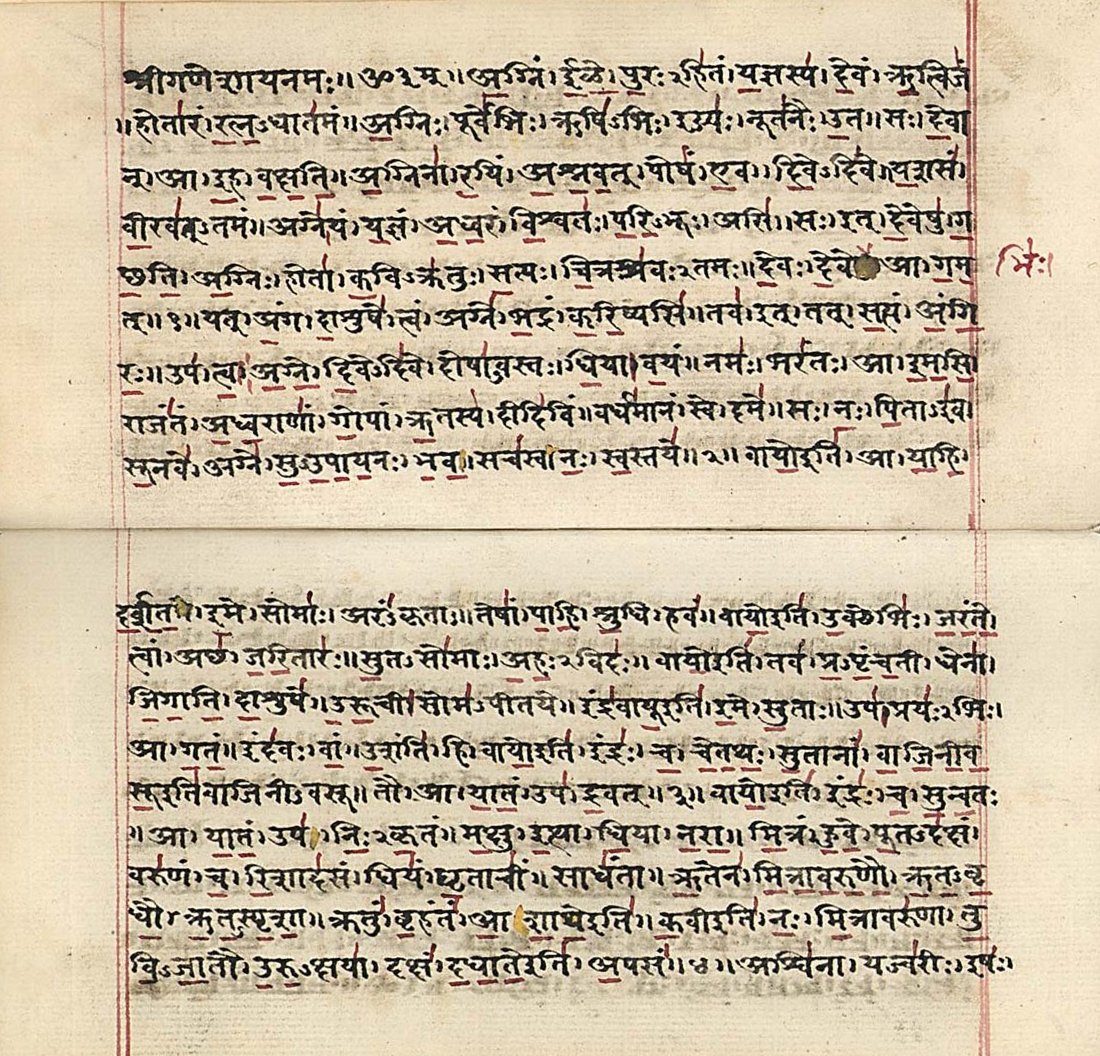
The deepest transmission was religious, and it is the reason this record sits in the 'religion' domain rather than 'language'. The Rigveda — 1,028 hymns in ten books, composed orally between roughly 1500 and 1000 BCE and transmitted by memory with a fidelity that has no real parallel in the ancient world — is the foundation document of the entire later Hindu tradition.11 Stephanie Jamison and Joel Brereton, whose 2014 translation is the standard English one, call it "the culmination of the long tradition of Indo-Iranian oral-formulaic praise poetry and the first monument of specifically Indian religiosity and literature."11
The fidelity of the transmission is itself a marvel of the cost-free kind. For three thousand years, before any of the manuscripts that survive were written, the Rigveda was preserved entirely in trained human memory, through elaborate mnemonic recitation techniques — the word-by-word padapāṭha and the interlocking permutation-recitations — that guarded the exact sound of the hymns against drift. The text was sound before it was ever script.
Its theology is steppe theology, Indianized. The chief god of the early hymns is Indra, the chariot-riding, soma-drinking warrior who smashes the dragon Vṛtra and releases the waters — a figure whose Iranian cousin and whose Sintashta funerary echo are both visible.16 The sacred drink soma, pressed and filtered and offered to the gods, is the Indian form of the Iranian haoma; the fire ritual around which Vedic religion is organized, presided over by the fire-god Agni, has its Iranian mirror; the gods Mitra and Varuṇa correspond to the Iranian Mithra and to the Avestan order of divinity.6 Karl Friedrich Geldner's monumental German translation of the Rigveda, completed in the Harvard Oriental Series and still a scholarly benchmark for the text's meaning, made these parallels with the Iranian material legible to a century of comparative scholars.10 What entered India was a complete inherited religious system — gods, sacred drink, fire altar, and the very metres of the hymns — which then fused with whatever it found on the ground to become something genuinely new: not steppe religion, not Harappan religion, but the Vedic synthesis from which Hinduism would grow.
From the fire altar to a civilization
The Vedic religion the newcomers built was, at its core, a religion of sacrifice — the yajña, the offering made into the consecrated fire, conducted by trained priests reciting the exact metres of the Rigveda and its companion collections. There were no temples and no idols in this early system; the ritual was performative and verbal, its power lodged in the precise sound of Sanskrit and the correct conduct of the fire offering. This is why the priesthood mattered so much, and why its monopoly was so total: the gods were reached only through words that only Brahmins were permitted to speak.
Over the following thousand years this sacrificial core was elaborated, questioned, and transformed from within. The Brāhmaṇa texts systematized the ritual; the Upaniṣads turned the questioning inward, toward the self and the absolute, and seeded the philosophical traditions of Vedānta; the great Sanskrit epics, the Mahābhārata and the Rāmāyaṇa, carried the synthesis into narrative and into popular devotion. By the first millennium CE the austere fire-religion of the steppe had become the temple-and-image Hinduism recognizable today — but it never severed the umbilical cord to its origin. To this day a Hindu wedding is solemnized around a fire, with Sanskrit verses some of which descend directly from the Rigveda, the oldest continuously recited liturgy on earth. The transmission did not merely change a region's religion; it founded one of the world's living traditions, and lodged a Bronze Age steppe inheritance at the centre of the spiritual life of a fifth of humanity.
Varṇa: the birth of a hierarchy
And with the gods came a charter for ranking people. The Rigveda's late tenth book contains the Puruṣasūkta, the hymn of the cosmic man, in which the four varṇas — brāhmaṇa (priest), kṣatriya (warrior), vaiśya (commoner), and śūdra (servant) — are said to issue from the body of a primordial being dismembered in a cosmic sacrifice: the priest from the mouth, the warrior from the arms, the commoner from the thighs, the servant from the feet.11 It is one of the most consequential passages ever composed. A region whose parent civilization had run for seven centuries with no displayed hierarchy now received a religious doctrine that made hierarchy cosmic, original, and sacred — and that reserved the highest rank for the keepers of the very hymns that proclaimed it.
This is the hinge of the whole transmission's cost. The Brahmin priesthood, custodians of the Sanskrit liturgy and the only people permitted to recite it, became a hereditary elite whose authority rested on monopolizing access to the sacred.6 The structure would harden over the following millennium, through the Brāhmaṇas, the law books, and finally the Mānavadharmaśāstra (the 'Laws of Manu'), into the caste order that has stratified South Asian society ever since. The displaced category was the Indus model itself: an urban order that, whatever inequalities it surely contained, had not written rank into the structure of the cosmos. The newcomers did exactly that, and made it scripture.
The bill, and the argument about the bill
What did this transmission cost, and who paid? The honest answer requires separating two things the older narrative fused: the fall of the Indus cities, which the migration did not cause, and the social order the migration installed, which it did.
Who actually fell — and who did not
The single most important correction to the inherited story is that there was no Aryan destruction of the Indus civilization. The deurbanization of c. 1900 BCE preceded any plausible steppe presence in the Punjab by centuries and was driven by monsoon weakening and the failure of the Ghaggar-Hakra river system.1213 The skeletons once read at Mohenjo-daro by Mortimer Wheeler as 'massacre victims' of invading Aryans have been reinterpreted as ordinary burials and disease deaths spread across centuries; there is no archaeological horizon of conquest, no burned-city layer, no mass grave attributable to the newcomers.7 The cities were already empty. This is why the cost severity of this record is held at the middle of the scale and not higher: the catastrophe of the Indus collapse, real and large, is not the migration's bill. It belongs to the climate and the rivers, and to charge it to a people who arrived afterward is precisely the error the older narrative made.
What the migration did cost is subtler and, in its way, longer. The pre-Vedic populations and their languages were progressively absorbed and erased. Entire language families — the 'Para-Munda'/Harappan tongue of the northwest, and the Dravidian languages once spoken across the north — vanished from the Gangetic plain, surviving only as loanwords in the Sanskrit that replaced them and, for Dravidian, as the living speech of a peninsula that held out.5 The Rigveda preserves a vocabulary of antagonism toward the people it calls dāsa and dasyu — words that begin as terms for enemies and end, tellingly, as a word for a slave or servant — that tracks the friction of newcomers displacing and subordinating an existing population.117 There was conflict, and the hymns boast of it: of strongholds broken and dark-skinned enemies driven off. What there was not was a single genocidal event. The cost was distributed across centuries of absorption, the slow disappearance of peoples who left no texts of their own to record their side.
The cost that lasted: caste
The transmission's most enduring cost is not measured in the dead at all. It is measured in a social structure. The varṇa doctrine of the Puruṣasūkta, elaborated over the following two millennia into the caste system codified in the dharma literature, installed a hereditary, religiously sanctioned hierarchy that has shaped — and constrained — South Asian lives for roughly three thousand years and continues to do so today.6 Hundreds of millions of people have lived and died inside a ranking that the Vedic hymns declared to be the very structure of the cosmos, with the descendants of the older substrate populations disproportionately consigned to its lowest rungs and, below the four varṇas entirely, to the condition of untouchability. No other consequence of the migration has touched so many lives so durably, or so harshly. That this cost is structural and slow rather than violent and sudden does not make it small; it makes it the largest single cost the record carries, and the reason the rating sits where it does rather than lower.
It is worth being precise about who has paid this bill, because the payment is not finished. Beneath the four varṇas lie the communities historically branded untouchable — the people who now call themselves Dalits, some 200 million of them in India today — subjected for centuries to enforced segregation, denial of temple and well, and ritualized humiliation justified by the same scriptural logic that the Puruṣasūkta inaugurated. The architect of independent India's constitution, B. R. Ambedkar, himself born into an untouchable community, identified the Vedic-Brahmanical inheritance as the root of that oppression and made its abolition a central project of his life, ultimately rejecting Hinduism altogether. The Indian constitution outlawed untouchability in 1950; the social structure it named has proven far harder to dissolve than the law. A doctrine first sung into a sacrificial fire in the Punjab some three thousand years ago remains, in the twenty-first century, a determinant of whom a person may marry, where they may live, and how they may die. That continuity is the persistence rating of this record made flesh.
The genome and the argument
The migration thesis was, through the twentieth century and into the twenty-first, fiercely contested in India — and the contestation was never only academic. The 'Indigenous Aryanism' or 'Out of India' position holds that the Aryans were native to the subcontinent and that the Indo-European languages radiated outward from India to the rest of the world, with the Harappan civilization itself recast as already Vedic.7 Edwin Bryant's careful survey of 2001 laid out both the Western migrationist consensus and the indigenist case, probing each for weaknesses and treating the dispute, fairly, as a genuine scholarly problem rather than a settled one — a fairness that the years since have partly overtaken.7
The ancient-DNA evidence of 2019 substantially closed the scientific question. The Narasimhan team's analysis of more than five hundred ancient genomes documented steppe-derived ancestry — the same genetic profile found in Bronze Age eastern Europe, the signature of a single dispersing population — entering South Asia from the north across the second millennium BCE, while Shinde's Rakhigarhi genome showed that the Mature Harappans themselves carried none of it.23 A real movement of people from the steppe into South Asia, after the Indus cities had already declined, is now about as well established as questions of this antiquity get.
The convergence of the three independent lines of evidence is what makes the conclusion robust. The linguistics had predicted an intrusive Indo-European language layered over a lost substrate; the archaeology had traced a chariot-and-horse culture moving from the Urals through Central Asia toward the Indus; and the genetics, arriving last and blind to the other two, found exactly the population movement they implied, on exactly the predicted timetable and route.215 When three methods that cannot collude agree, the burden of proof shifts decisively. The steppe migration is no longer the hypothesis to be defended; its denial is now the claim that must explain away the data — and it cannot.
The dead and the disputed
The last cost is a living one. Because the migration thesis bears directly on who counts as 'indigenous' to India, it has become a weapon in contemporary politics. The indigenist position is bound up with Hindutva, the ideology of Hindu majoritarian nationalism, which casts Hindus as the original children of the soil and Muslims, Christians, and others as alien interlopers — a framing for which the rejection of any external Aryan origin is foundational.7 School textbooks in some Indian states have been revised to align with it; fabricated or strained evidence, like the supposed 'horse seal' from the Indus cities, has been deployed to identify the Harappans as Vedic Aryans and so to collapse the migration entirely.7 A reconstruction of the deep past has become a charter for present belonging and present exclusion.
This is the migration's strangest cost, and the one that justifies sending the record to a specialist reviewer. Thirty-five centuries after a band of chariot-driving herders pressed south through the oases into a post-urban farming country, the question of whether they ever came at all has become a fault line in the politics of a nation of more than a billion people. The atlas records the migration as real — the laboratory has settled that much — while marking, plainly, two things the laboratory cannot settle: that the languages and peoples the newcomers absorbed left no record of what their disappearance cost them, and that the fight over whether any of it happened has not stopped, and will not stop, because it was never really a fight about the Bronze Age.
What followed
-
-1900The Mature Indus cities deurbanized as the monsoon weakened and the Ghaggar-Hakra river system disintegrated — a collapse that preceded and was independent of the Indo-Aryan migration.
-
-1700Steppe-derived ancestry, carrying the same genetic profile as Bronze Age eastern Europe, began entering the South Asian gene pool from the north through Central Asia.
-
-1380An Indo-Aryan-speaking elite worshipping Mitra, Varuṇa, Indra, and the Nāsatyas reached northern Syria, recorded as divine witnesses in the Hittite-Mitanni treaty — the earliest dated attestation of the Rigvedic pantheon.
-
-1200The Rigveda was composed orally in the Punjab — 1,028 hymns preserving steppe-Indo-European gods, the soma cult, and the fire ritual, and transmitted by memory for three millennia.
-
-1000Indo-Aryan languages spread across the Gangetic plain, displacing and absorbing the pre-Vedic 'Para-Munda'/Harappan and Dravidian tongues, which survived only as loanwords in the north and as living speech in the south.
-
-900The Puruṣasūkta hymn declared the four varṇas — priest, warrior, commoner, servant — to issue from a sacrificed cosmic being, giving a religiously sanctioned charter to hereditary social hierarchy.
-
-300The Brahmanical caste order crystallized through the Vedic and later law-book traditions into the stratification system that has shaped South Asian society for roughly three thousand years.
-
2019Ancient-DNA studies (Narasimhan et al.; Shinde et al.) confirmed a real steppe migration into South Asia, settling the academic question even as 'Indigenous Aryanism' remained a live weapon in Hindu-nationalist politics.
Where this lives today
References
- Anthony, David W. The Horse, the Wheel, and Language: How Bronze-Age Riders from the Eurasian Steppes Shaped the Modern World. Princeton: Princeton University Press, 2007. en
- Narasimhan, Vagheesh M., Nick Patterson, Priya Moorjani, Nadin Rohland, Rebecca Bernardos, Swapan Mallick, et al. “The formation of human populations in South and Central Asia.” Science 365, no. 6457 (2019): eaat7487. en primary
- Shinde, Vasant, Vagheesh M. Narasimhan, Nadin Rohland, Swapan Mallick, Matthew Mah, Mark Lipson, et al. “An Ancient Harappan Genome Lacks Ancestry from Steppe Pastoralists or Iranian Farmers.” Cell 179, no. 3 (2019): 729–735. en primary
- Witzel, Michael. The Origins of the World’s Mythologies. New York: Oxford University Press, 2012. en
- Witzel, Michael. “Substrate Languages in Old Indo-Aryan (Ṛgvedic, Middle and Late Vedic).” Electronic Journal of Vedic Studies 5, no. 1 (1999): 1–67. en
- Parpola, Asko. The Roots of Hinduism: The Early Aryans and the Indus Civilization. New York: Oxford University Press, 2015. en
- Bryant, Edwin F. The Quest for the Origins of Vedic Culture: The Indo-Aryan Migration Debate. New York: Oxford University Press, 2001. en
- Kuzmina, Elena E. The Origin of the Indo-Iranians. Edited by J. P. Mallory. Leiden and Boston: Brill, 2007. en
- Кузьмина, Е. Е. Откуда пришли индоарии? Материальная культура племён андроновской общности и происхождение индоиранцев. Москва: ВИНИТИ, 1994. ru
- Geldner, Karl Friedrich, trans. Der Rig-Veda: Aus dem Sanskrit ins Deutsche übersetzt und mit einem laufenden Kommentar versehen. Harvard Oriental Series 33–36. Cambridge, MA: Harvard University Press, 1951. de primary
- Jamison, Stephanie W., and Joel P. Brereton, trans. The Rigveda: The Earliest Religious Poetry of India. 3 vols. New York: Oxford University Press, 2014. en primary
- Giosan, Liviu, Peter D. Clift, Mark G. Macklin, Dorian Q. Fuller, Stefan Constantinescu, Julie A. Durcan, et al. “Fluvial landscapes of the Harappan civilization.” Proceedings of the National Academy of Sciences 109, no. 26 (2012): E1688–E1694. en primary
- Possehl, Gregory L. The Indus Civilization: A Contemporary Perspective. Walnut Creek, CA: AltaMira Press, 2002. en
- Kenoyer, Jonathan Mark. Ancient Cities of the Indus Valley Civilization. Karachi and Oxford: Oxford University Press / American Institute of Pakistan Studies, 1998. en
- Mallory, J. P. In Search of the Indo-Europeans: Language, Archaeology and Myth. London: Thames & Hudson, 1989. en