Ships from Meluhha tied up at Akkadian quays (~2500 BCE)
For six centuries, Indus carnelian, weights, and bead-craft crossed the Persian Gulf to Mesopotamia in a multi-civilizational maritime network that named its eastern partner Meluhha. The transmission was peaceful. The luxury surplus on both ends rested on extractive labour the trade did not create but rode on top of.
Around 2500 BCE, long-bicone carnelian beads etched in white linear designs at Indus workshops in Chanhu-daro and Lothal began arriving in the royal tombs of Ur, the warehouses of Kish, and the temples of Lagash. Sargon of Akkad's inscription claims that ships from Meluhha, Magan, and Dilmun tied up at the quay of Agade. The category Meluhha entered the cuneiform record; the Harappan cubical chert weight system spread across the Persian Gulf as the metrological lingua franca of inter-civilizational commerce; a permanent Meluhha village stood at Lagash for generations; and an Akkadian seal in the Louvre names Shu-ilishu, interpreter of the Meluhhan language. The transmission was peaceful between the two civilizations. The bill, on the Mesopotamian end, was paid in extractive labour that the trade did not create but lived on top of. On the Indus end, the bead workers left no names. The network became the structural template for every later inter-civilizational maritime trade.

Mesopotamia before the Indus: the world of late Early Dynastic Sumer around 2600 BCE
In the centuries before the trade we are tracking, Mesopotamia was already old. The alluvial plain between the Tigris and Euphrates had been densely settled since at least the late sixth millennium BCE, and by 2600 BCE — the conventional opening date for the Mature Harappan phase upriver of the Persian Gulf — the southern Mesopotamian city-states were at the height of their Early Dynastic III florescence. Ur, Uruk, Lagash, Umma, Kish, Nippur, and Eridu were walled urban centres of between ten and forty thousand inhabitants each, with monumental temple complexes, palace households running into the hundreds of dependents, and writing systems — cuneiform on clay tablets — that had been in continuous administrative use for roughly five centuries.1 Sumerian was the dominant spoken and written language of the southern marshes; Akkadian, the East Semitic tongue that would soon eclipse it as a lingua franca, was already present in the names of northern dynasties and would be the language of the territorial empire Sargon of Agade founded around 2334 BCE.2
Their material world was structured by stone they did not have. The alluvial plain produces no native stone harder than the soft chalky outcrops at Mukayyar, and it produces no metallic ore at all. Everything semi-precious or hard — copper, tin, silver, gold, diorite, alabaster, obsidian, lapis lazuli, carnelian — arrived through trade.3 By the Early Dynastic period, the routes that supplied these stones were old. Lapis lazuli, the deep-blue stone whose colour the Sumerian language conflated with that of beard, water, and royal cloth, came from the Sar-i-Sang mines in the Hindu Kush of what is now northeastern Afghanistan, distributed westward through Iranian Plateau brokers and through the proto-urban site of Shahr-i Sokhta in Sistan.4 Copper arrived from the Anatolian highlands, from Cyprus, and increasingly from Magan — the Oman peninsula, where the deposits at the present-day Wadi al-Jizzi and Wadi al-Hawasinah were already in heavy exploitation.5 Tin remained the rarest of the metals; its trail by 2600 BCE pointed eastward toward Afghanistan and possibly toward the Indus Valley itself, though the question of Bronze Age tin sourcing remains one of the open problems in Mesopotamian metallurgy.6
The lapis road and its limits
The lapis route is the right baseline. Before the Indus came online as a maritime partner, the Mesopotamian elite's prestige economy was supplied through Iranian-plateau intermediaries — Susa in Elam, Tepe Yahya in the Soghun valley of southeastern Iran, Shahr-i Sokhta in Sistan — who moved high-bulk-value goods west along caravan routes that depended on donkey trains and on the consent of local rulers at each stage. Lapis at Ur was very expensive; the lapis cylinder seals that appear in Early Dynastic III royal tombs reflect a goods chain stretching well over two thousand kilometres on foot.7 Carnelian, the orange-red chalcedony that the Indus would later flood the Mesopotamian market with, was present in Early Dynastic Sumer in small quantities and in unetched form. The dramatic long bicone beads etched with bleached white linear designs — the marker artefact of Harappan craft from c. 2500 BCE forward — were unknown in Mesopotamian deposits before the Akkadian period. Joan Aruz, surveying the third-millennium evidence for the Metropolitan Museum of Art's 2003 catalogue Art of the First Cities, observes that etched carnelian beads of the long biconical Indus type appear suddenly in the Royal Cemetery of Ur and at Kish in horizons securely datable to the mid-third millennium, with no local prototypes preceding them.8
What categories did not yet exist
By 2600 BCE the toponym "Meluhha" had not yet entered the cuneiform record. The earliest secure attestations come from the late Early Dynastic period at Lagash and become numerous under Sargon and his successors.9 The category "ship of Meluhha" — the seafaring vessel from a specific named distant land — was a new conceptual object in the early Akkadian inventory texts. The role "interpreter of the Meluhha language" — eme-bal me-luh-ha-ki, the title borne by Shu-ilishu on his celebrated cylinder seal now in the Louvre — did not yet exist as an occupation. There was no Mesopotamian word for the cubical chert weight in the binary 1:2:4:8:16:32 series that would later turn up at Ur, Susa, and Bahrain in the calibrated Harappan standard; the Mesopotamian weight system was the mina-shekel sexagesimal sequence based on barleycorn fractions, structured by base 60.10 And there was no documented Mesopotamian conception of a port city standing on a tidal river estuary connecting overland networks of the subcontinental hinterland to the open sea — the urban form Lothal would represent. The Indus traders, when they arrived in numbers, brought all of these categories with them.
The transmission: ships from Meluhha at the quays of Agade
Sargon's inscription, preserved on later Old Babylonian copies of his original royal texts, claims credit for what it does not name as innovation. "He made the ships from Meluhha, the ships from Magan, and the ships from Dilmun tie up alongside the quay of Agade," reads the standard translation, drawing on Douglas Frayne's edition of the early Akkadian royal corpus.11 The boast is double-edged. Sargon is claiming to have brought distant traders to his own capital — a political assertion that his consolidation of southern Mesopotamia in the 24th century BCE had made the inland city of Agade, somewhere north of the Sumerian heartland, the new commercial gravity centre of the gulf network. But the inscription also implicitly acknowledges that the three named partner ports were maintaining their own merchant fleets independently of Akkadian agency. The ships from Meluhha were Indus ships; the ships from Magan were Omani; the ships from Dilmun, Bahraini. They came under their own flag and their own command.
The Persian Gulf route
The maritime route is the structural fact. Modern reconstruction, drawing on the ports identified along the Indus delta and on the seasonal monsoon-wind regime of the northern Indian Ocean, runs the route as follows: out of Lothal on the Gulf of Khambhat in the Indian state of Gujarat, or out of the smaller Indus delta sites at Sutkagan-Dor, Sotka-Koh, and Balakot, vessels travelled westward along the Makran coast of present-day Iran and Balochistan, then north into the Persian Gulf, calling at the Omani ports of Ras al-Jinz, Ras al-Hadd, and the inland centre at Maysar — the Magan of the Akkadian texts.12 From Magan they continued north to Bahrain — Dilmun — and from Dilmun north again to the Mesopotamian coast at the head of the Tigris-Euphrates delta, with cargo offloaded for transhipment up the rivers to Ur and onward to Akkad and the northern centres. The round-trip ran two seasons, the outbound leg during the northeast winter monsoon and the return during the southwest summer monsoon, with the long layovers at intermediate ports being themselves a commercial fact — Magan and Dilmun did not merely serve as waystations but as brokerage entrepôts that themselves consumed Indus goods and exported Omani copper.
Massimo Vidale, the Italian archaeologist whose work at sites in Pakistan, Iran, and the Gulf has done much to map this network, argues that the trade was structurally tripartite. The Indus brought carnelian beads, etched chalcedony, ivory ornaments, hardwoods, and possibly tin and gold dust; Magan brought copper and the famous Magan diorite used for Sumerian votive statuary; Mesopotamia exported silver, woollen textiles, sesame oil, and barley.13 The textual record from the Mesopotamian end is rich enough to permit reconstruction of specific cargoes. A 21st-century-BCE tablet from Lagash records the receipt of copper from Meluhha — copper acquired indirectly through Magan but identified by its Indus provenance.14
Named carriers: Shu-ilishu and the Meluhha village at Lagash
The transmission has names. Shu-ilishu, whose Akkadian seal in the Louvre (AO 22310) reads Su-ilisu / eme-bal me-luh-ha — "Shu-ilishu, interpreter of the Meluhhan language" — is the iconic case. He worked in late third-millennium Mesopotamia as a specialist who could translate between the Akkadian of his employers and the language of Meluhhan visitors, and his seal pictures a trade scene: two visitors approach a seated figure of higher status, one of them carrying what may be a goat or antelope. Whether Shu-ilishu was himself ethnically Meluhhan, or a Mesopotamian who had acquired the language through commercial practice, the seal's existence proves that Meluhhan-language proficiency was a recognised and seal-worthy occupation in early Akkadian Mesopotamia.15
Lu-sunzida is another named figure. A cuneiform document from the Ur III period names him "the man of Meluhha" and records his dealings with Mesopotamian authorities; the personal name itself is Sumerian in form, suggesting either a second-generation acculturated descendant of a Meluhhan family or a Mesopotamian functionary who carried the title for administrative reasons.16 More structurally important is the standing "Meluhha village" — me-luh-ha-ki — attested in administrative texts from Lagash under Shulgi and Amar-Sin of the Ur III dynasty (late 22nd to early 21st century BCE). Steffen Laursen and Piotr Steinkeller, whose 2017 reconstruction of the Ur III administrative record argues for a permanent enclave of Meluhhan traders living on the southern Mesopotamian plain, observe that the village was integrated enough into the local economy to pay barley taxes but distinct enough to be administratively flagged as a foreign settlement.17 The Meluhhans in Mesopotamia were not a brief commercial visit; they were a multi-generation diaspora.
The Indus end of the network: Lothal and the dockyard question
On the Indus side, the port has been identified, excavated, and disputed for seven decades. Lothal, on the Bhogavo tributary of the Sabarmati river some thirty kilometres inland from the present Gulf of Khambhat coast in the Indian state of Gujarat, was excavated by S. R. Rao for the Archaeological Survey of India between 1955 and 1962. Rao identified a large baked-brick basin — 217 metres long, 36 metres wide, 4.3 metres deep — as a tidal dockyard, the structural anchor of a port complex that included warehouses, a bead-making workshop, and the residential and craft quarters of a planned Harappan town.18 The dockyard interpretation has been contested over the decades — some scholars argued for an irrigation reservoir — but recent sedimentological and palaeogeographic work led by V. N. Prabhakar and colleagues at IIT-Gandhinagar supports Rao's identification by demonstrating that the Sabarmati's Bronze Age channel ran directly past the site and that the basin's brickwork includes salt-tolerant water-management features consistent with marine use.19 The Lothal bead workshop has yielded thousands of unworked carnelian nodules in transit toward bead production, along with the long-bicone bead drilling technology that was the Indus signature.
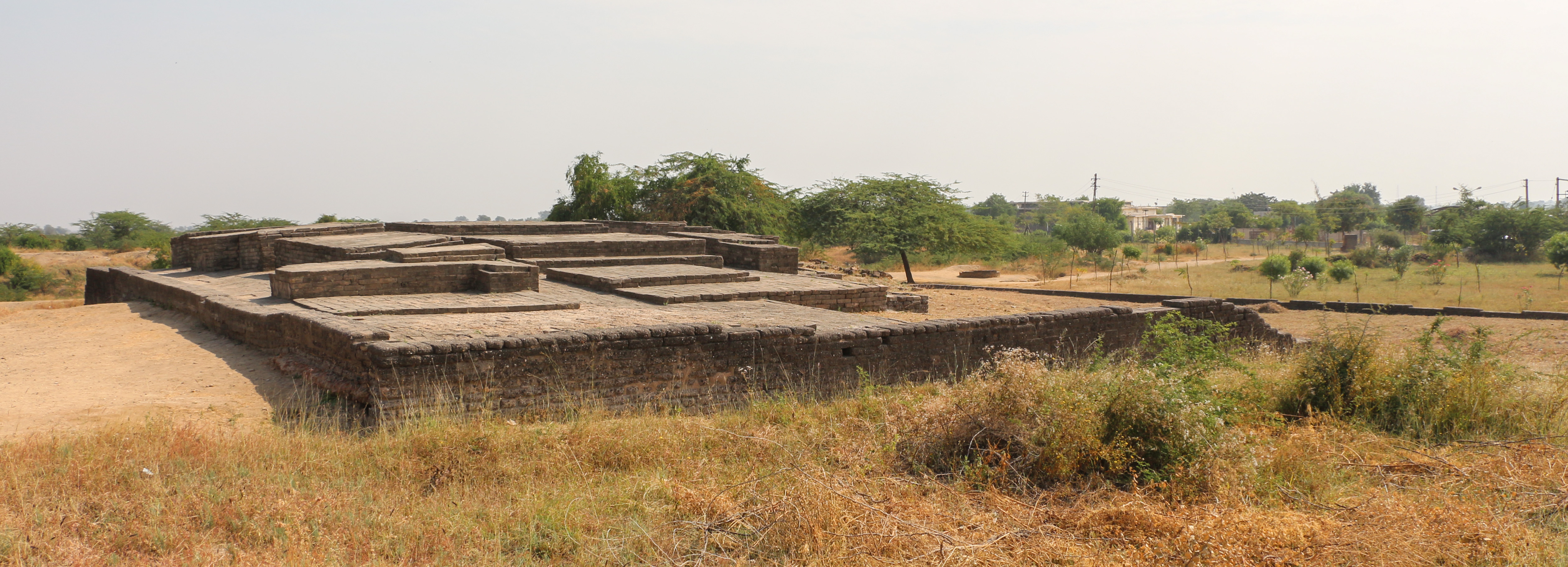
The upstream supply chains are now traceable. The carnelian itself was quarried at the Rajpipla and Ratanpur deposits in the Narmada and Tapi river valleys of central-western India, some 200 kilometres east of the Gulf of Khambhat coast. The chert for the cubical weights came from the Rohri Hills of Sindh, in present-day Pakistan, where industrial-scale quarrying produced the chert blanks the cube-cutting workshops at Mohenjo-daro and Harappa then finished. The cargo was assembled at the Indus delta and coastal sites and then loaded onto vessels whose hull form we have to reconstruct from the Indus-script seal representations and the carved boat plaque from Mohenjo-daro — flat-bottomed reed-and-timber vessels with a single mast and a square sail, capable of coastal-following navigation across the northern Indian Ocean.20
The strontium evidence: traders who lived and died in the other's land
The textual record from Mesopotamia identifies Meluhhans by name and by occupation; the archaeological record from Indus sites shows Mesopotamian-style cylinder seals as exotic imports. But until recently, the question of whether actual human beings travelled and lived between the two civilizations was inferential. Strontium isotope analysis of human tooth enamel — the technique that has rewritten understanding of Bronze Age mobility across Europe and the Mediterranean — has now begun to put physical bodies into the network. A 2013 study by J. M. Kenoyer, T. Douglas Price, and James Burton, drawing on samples from Harappa cemetery R-37 and the Royal Cemetery of Ur, demonstrated that the strontium isotope ratios between the two regions are sufficiently distinct to discriminate local from non-local individuals, and that the Harappa population shows an extremely wide spread of values with nearly half of the sampled individuals identified as non-local to the immediate region. The study did not identify a positively Indus-origin individual at Ur in its preliminary sample, but the methodological foundation has been laid for the future identification of named Meluhhans in the Mesopotamian skeletal record — a step that would move the network from the textual to the biological evidentiary domain.
What changed and what was replaced
The transmission's transformative reach into Mesopotamia ran in three registers: the substrate of elite display, the infrastructure of commercial weighing, and the cognitive category by which the wider world was thought.
Etched carnelian in the royal tombs
The most visible change came first in the burial ground. The Royal Cemetery of Ur, excavated by Leonard Woolley between 1922 and 1934, yielded sixteen royal graves dating to the late Early Dynastic IIIA period (c. 2600–2450 BCE) along with hundreds of subsidiary burials. Among the grave goods of Queen Puabi's intact tomb (PG 800) and adjacent attendant burials were strands of long-bicone etched carnelian beads of unmistakable Indus craft.21 The technique — etching white linear designs into the orange-red carnelian by applying a paste of sodium-bicarbonate and copper compounds before baking at moderate temperature — was a Harappan technological signature; it required a chemistry of alkali compounds and a workshop discipline that was developed at Indus sites such as Chanhu-daro and Lothal and exported as finished bead, never as the workshop technology itself.22 Puabi's burial shroud, as Woolley's notes record, was draped with so much carnelian, lapis, gold, and agate that the bead corpus alone runs into the thousands of pieces. The Indus contribution to that visual abundance — concentrated in the long etched beads and in the use of Indus-style steatite — is what an Early Dynastic IIIA queen wore to her death around 2500 BCE.
What was displaced was the prior chalcedony-and-shell economy of Mesopotamian bead production. Pre-Akkadian Sumerian bead inventories had relied on local and Iranian-sourced chalcedony, lapis from the Hindu Kush, and Persian Gulf shell. The arrival of Indus etched carnelian created a new top tier of luxury display whose specific aesthetic effect — the white-on-orange linear bead, the long bicone, the gold-and-carnelian necklace — became part of the visual vocabulary of Sumerian and Akkadian royalty. Whether the importers understood the technical achievement they were buying is unclear; what is clear is that they paid for it consistently for the next six centuries.

The binary weight system at Ur, Susa, and the Gulf
A second, less visible, transformation ran through the apparatus of commerce. The Harappan cubical chert weight system — a graded series of carefully cut cubes of banded grey chert, calibrated to a base unit of approximately 13.7 grams, increasing in binary ratios of 1:2:4:8:16:32 up to the largest weights of more than ten kilograms — was a uniquely standardised technology of mensuration. The smallest weight in the series, 0.856 grams, is roughly the mass of an emmer grain; the largest weights, weighing more than ten kilograms, were used in port and warehouse contexts. The system has been documented at more than forty Indus sites from Shortughai in Afghanistan to Sutkagan-Dor in Balochistan to Lothal in Gujarat.23
The exported form of this system shows up at Ur, at Susa in Elam, at Bahrain (Dilmun), and at the Omani port of Ras al-Jinz (Magan). Mesopotamian weighing did not adopt the Harappan standard wholesale — the indigenous mina-shekel sexagesimal system continued in administrative use through the second millennium and beyond — but the Mesopotamian merchant trading with the Indus learned to weigh in Harappan units, and a parallel set of chert-cube weights appears in trade-related contexts at the western terminals of the network. The point is not that the Mesopotamians adopted Indus mensuration as their primary system; it is that they could not transact with the Indus without using Indus units, and so the binary system became the metrological lingua franca of the gulf-spanning commerce regardless of whose language the contract was written in.24
The category Meluhha and the cuneiform record
The third transformation was conceptual. Before Sargon's reign, the Mesopotamian conception of the wider world stopped at the Iranian Plateau and the Gulf. Akkadian and Sumerian inscriptions from Sargon's reign forward introduce Meluhha as the third pole of a maritime tripartite — Dilmun close, Magan further, Meluhha furthest — and the toponym persists in the cuneiform record for nearly two thousand years.25 Even when the Indus civilization itself had ceased to be a unified urban polity (the Mature phase ends c. 1900 BCE), the word Meluhha continued to circulate in Old Babylonian and even Neo-Assyrian texts, sometimes designating South Asia generically, sometimes shifting reference to East African coastal lands that came into Mesopotamian contact via the Red Sea route. As Asko Parpola has argued, the persistence of the word is itself evidence of the depth of the original commercial relationship: Meluhha became, in the cuneiform geographical imagination, the name of an inheritance — the original eastern oceanic pole around which all later eastern trade was conceptualised.26
The Curse of Agade, the Ur III literary composition that elegises the fall of the Akkadian capital, preserves the network's commercial vocabulary in passing. The text describes Agade in its prosperity as a city to which "the Meluhans, the people of the black land, brought exotic goods" alongside ships from Dilmun and Magan that carried lapis, copper, ivory, and gold.27 The Sumerian-language composition was copied in scribal schools as a piece of moral instruction about the wrath of the gods, but its incidental ethnography is some of the densest surviving evidence for how the Mesopotamian literary imagination placed Meluhha within the world of commerce.
What the Indus did not take in exchange
The asymmetry is striking and worth naming. The transmission ran heavily in one direction: Indus goods flooded the Mesopotamian luxury economy, and Indus traders settled in Mesopotamian cities; but the corresponding Mesopotamian presence at Indus sites is thin. Mesopotamian cylinder seals are present at Indus sites in small numbers — six or seven at most over the Mature phase — and clearly travelled as exotic objects rather than as a transferred technology.28 The Indus did not adopt cuneiform writing. The Indus did not adopt Mesopotamian deities into a visual program. The Indus did not adopt the Mesopotamian palace-economy structure or the temple-centric polity. The Indus did not adopt the sexagesimal weighing system; their own binary cube weights continued in use until the Mature phase's end.
What this asymmetry implies, the archaeologist Rita Wright argues in her Cambridge case-studies survey The Ancient Indus, is that the Indus civilization engaged the Mesopotamian world as a commercial counterpart rather than as a cultural model. The transmission flowed one way in materials and craft outputs and flowed not at all in religious imagery, political structure, or writing — an asymmetry that suggests the Indus elites understood themselves as the senior partner in the commercial relationship, with no need to learn from a cultural other they regarded as merely a market.29 Whether or not Wright's reading of Harappan self-perception is the right one, the empirical asymmetry is robust: the cultural traffic in this trade was structured by what the Indus had that the Mesopotamian world wanted, not the reverse.
The brokerage shift: Dilmun replaces Magan around 2000 BCE
The network had its own internal dynamics, and its centre of gravity shifted over the centuries the Mature Harappan phase lasted. Through the Akkadian period (c. 2334–2154 BCE) and the Ur III period (c. 2112–2004 BCE), Magan — the Omani peninsula — was the central broker, supplying Mesopotamian copper and intermediating much of the Indus traffic. By the early second millennium, after the Ur III collapse and contemporaneous with strain in the Indus urban core, the brokerage centre shifted decisively northwest to Dilmun (Bahrain).30 Old Babylonian texts from c. 1900–1700 BCE refer routinely to "Dilmun copper" and "Dilmun goods" where the actual copper was still being mined in Oman and the actual luxury goods still partly Indus-sourced — but the labels reflect that Dilmun's traders had become the obligatory intermediaries. The Indus end of the network was by then under stress from the climatic and hydrological changes that would soon end the Mature phase. The same hundred years that ended Indus urban life began Dilmun's golden age — the broker outlived the partner.
What the cost was
This is the section the atlas must write carefully, because the temptation to overstate the cost of a peaceful long-distance trade is real, and the temptation to understate the cost of any commerce conducted under imperial Mesopotamian conditions is equally real. The Indus-Mesopotamia network's transmission proper — the act of carnelian moving west, copper moving east, weights crossing — was not extractive between the two civilizations. Neither side conquered the other; neither side enslaved the other's population; neither side exterminated the other's culture. The cost honesty the framework demands does not require us to invent a violence that the historical record does not document. But it does require us to look at the cost the trade rode on top of, on both sides.
The Mesopotamian extractive base
The carnelian beads that ended in Queen Puabi's tomb were paid for by Mesopotamian silver, sesame oil, woollen textiles, and barley. These were produced — and this is the part the standard celebratory account of "early international commerce" elides — by a labour system that included full chattel slavery, debt servitude, war captivity, and corvée labour on temple and palace estates. Seth Richardson's 2018 survey of third-millennium Mesopotamian slavery, drawing on the extant Sargonic, Ur III, and Old Babylonian textual record, demonstrates that trains of prisoners brought back from foreign wars were set to work in large groups on temple and palace estates, while individual chattel slaves of private households performed agricultural and craft labour under coercion.31 Royal inscriptions of the Early Dynastic and Akkadian kings record the parade of bound captives, naked and elbow-bound, led in triumph to the victorious king's town. The numerical magnitude of this captive labour is not recoverable with precision; the textual record yields specific transaction counts (a tablet from Lagash records 304 female captives assigned to a single weaving establishment, for example) but the empire-wide totals are matter of estimation rather than census.32
The Mesopotamian luxury surplus that paid for Indus carnelian was generated by this labour. The trade between the Indus and Mesopotamia did not create that extractive system; it preceded it and exceeded it. But it was a participant. Every long-bicone etched carnelian bead in Queen Puabi's shroud rested on the labour of war captives on temple estates and on the silver-output discipline of an extractive Mesopotamian fiscal apparatus. The transmission's bill, on the Mesopotamian side, was the carrying labour of an already-extractive state.
The Indus side: the anonymity of the workers
On the Indus side the bill is harder to read because the Indus textual record is silent — the script remains undeciphered — and the skeletal record from Mature Harappan sites does not show the patterns of mass coercion that the Mesopotamian record explicitly attests. There are no Indus equivalents of the Akkadian inscriptions parading war captives. The Mature phase's cities show — strikingly, anomalously, for a Bronze Age civilization of this scale — no palaces, no royal tombs, no monumental ruler-glorifying art.33 The carnelian-bead workers of Chanhu-daro and Lothal left behind workshop debris but not their names. Whether they were free craftsmen working for hire, hereditary specialists in a caste-precursor occupational structure, or coerced labour in a system the absence of inscriptions hides from view — these are open questions that the Indus material record does not, and may never, allow us to settle.
What is clear is that the bead workshops were physically demanding. The drilling of a long-bicone carnelian bead — a bead two to ten centimetres long, drilled the long way with a tipped copper drill, taking sometimes a hundred hours of work per bead — was a specialist craft producing for a market the worker would never see, in cities far enough up the production chain that the Mesopotamian queen who eventually wore the bead would never have heard the worker's name. The anonymity of these workers is not the same thing as their absence from history; it is the historical record's failure to preserve them. The carnelian that crossed the gulf to Ur was their work.
The 1900 BCE collapse and what the network severed with it
The Mature Harappan phase ended around 1900 BCE. The cause was structural and largely climatic — a multi-century weakening of the Indian summer monsoon and a corresponding drying of the Ghaggar-Hakra system that drew settlement away from the Saraswati corridor and toward the more reliably watered eastern catchments. Liviu Giosan's reconstruction in PNAS, drawing on sediment cores and palaeohydrological modelling, places the major hydrological shift between 2200 and 1900 BCE.34 The cities of Mohenjo-daro, Harappa, and Dholavira lost their grid-planned coherence and were progressively abandoned over the centuries that followed.
The Mesopotamia trade did not cause the collapse, but it could not survive it. The cuneiform record shows the Meluhha references thinning through the early second millennium, with Dilmun-brokered goods continuing while direct Indus shipping evidently ceased. The Indus end of the network, the bead workshops at Lothal and Chanhu-daro, the dockyards and warehouses — all of these went silent within a few generations of the urban collapse. The structural pattern of inter-civilizational maritime commerce that the Indus-Mesopotamia link had pioneered would be re-instantiated in the late second millennium BCE by the Phoenician network and by the Eastern Mediterranean trade, but the original Bronze Age sea-trade between equally complex Asian polities was not resumed at the same intensity until the Roman and Indian-Ocean networks of the early centuries CE.
What the collapse cost was not just the network. The Mature Harappan civilization itself — its uniform weight system, its urban planning, its writing — did not persist as a continuous tradition into the Iron Age South Asia that succeeded it. The relationship between the post-Harappan Painted Grey Ware cultures of the Indo-Gangetic plain and the prior Mature Harappan urban system remains one of the most contested problems in South Asian archaeology, with the dominant view (drawing on linguistic, genetic, and ceramic evidence) holding that the post-1900 BCE settlement pattern represents a substantial reorganisation rather than a direct continuity.35 The Indus literature — if it ever existed in writing — is lost; the seals' inscriptions have not been deciphered; the language's relationship to later South Asian language families remains disputed.
The precedent
Against these costs sits the precedent the network established. The Indus-Mesopotamia link was the first documented case of large-scale, multi-century, maritime commerce between two civilizations of comparable urban scale and technological sophistication, mediated by specialist intermediaries (Dilmun, Magan), conducted through named human carriers (Shu-ilishu, Lu-sunzida, the Meluhha village at Lagash), and structured around the exchange of high-value luxury and bulk commodities under a shared metrological standard. Every later inter-civilizational sea trade — the Phoenician Mediterranean network, the Indian Ocean monsoon system documented in the Periplus of the Erythraean Sea, the Tang-Abbasid maritime exchange of the eighth and ninth centuries CE, the Portuguese carreira da Índia of the sixteenth century, the British-Indian-Chinese trade of the nineteenth — operated on the structural template the Indus and Mesopotamian traders worked out between 2600 and 1900 BCE.
What that template proved was a single durable fact: that long-distance maritime commerce between equally complex polities is possible, sustainable, and culturally transformative in measurable ways without conquest, colonisation, or cultural homogenisation. The Indus-Mesopotamia link is the historical proof of concept. The Phoenicians built their Mediterranean network on the model. The Tang-Abbasid trade and the Indian-Ocean dhow network ran on the same template, expanded. That later sea trades — the Iberian, the Dutch, the British — operated through conquest and extraction does not mean sea trade must do so; the Bronze Age original ran without it for six centuries.
The atlas's broader argument about transmissions — that the carriage of objects, techniques, and categories across cultural lines is the texture of human history and not its exception — finds in the Indus-Mesopotamia link its earliest large-scale documented case. Two civilizations of comparable urban scale, separated by 2,500 kilometres of sea and operating without a shared writing system, sustained a multi-generational commerce that altered the elite material culture of one and supplied the export markets of the other for six hundred years, then ended not in conflict but in the climatic dissolution of one partner. The carnelian beads in Queen Puabi's tomb, the cubical chert weights at Ur, the Meluhha village at Lagash, and the seal of Shu-ilishu in the Louvre are the surviving documents of that transmission. They are also a baseline. Every later question this atlas asks — what travelled, what was paid for it, who paid, who profited, what was displaced — was first asked, in practice if not in writing, by the Bronze Age traders of the Persian Gulf.
What followed
-
-2500Etched carnelian beads of Indus manufacture deposited in the Royal Cemetery of Ur (c. 2600–2450 BCE), including in Queen Puabi's tomb (PG 800), establishing Indus craft as a fixture of Mesopotamian elite burial display.
-
-2300Sargon of Akkad's inscription (c. 2300 BCE) records ships from Meluhha, Magan, and Dilmun tying up at the quay of Agade — the first textual confirmation of routine maritime traffic between the Indus and Mesopotamia.
-
-2200Shu-ilishu cylinder seal (Louvre AO 22310) attests the formal occupation 'interpreter of the Meluhhan language' in Akkadian Mesopotamia — a sealed-and-credentialed professional role mediating Indus traders and their Mesopotamian counterparts.
-
-2050Standing 'Meluhha village' (me-luh-ha-ki) at Lagash documented in Ur III administrative texts under Shulgi and Amar-Sin (c. 2100–2000 BCE), demonstrating a multi-generation Indus diaspora paying barley tax inside the Mesopotamian fiscal system.
-
-2200Harappan binary cubical chert weight system documented at Ur, Susa, Bahrain (Dilmun), and Ras al-Jinz (Magan), making Indus mensuration the metrological lingua franca of Persian Gulf commerce regardless of contract language.
-
-2400Lothal dockyard and bead workshop functional as the Indus civilization's principal Gujarat-coast port (c. 2500–1900 BCE) — confirmed by 2024 sedimentological and palaeogeographic work demonstrating the Sabarmati's Bronze Age channel ran past the site.
-
-1900Mature Harappan urban collapse c. 1900 BCE driven by monsoon weakening and Ghaggar-Hakra drying; direct Indus shipping to Mesopotamia ceases over the following generations, with Dilmun-brokered goods continuing into the Old Babylonian period.
-
-700The toponym 'Meluhha' persists in cuneiform geographical imagination for two millennia after Indus urban collapse, surviving into Neo-Assyrian texts as a generic name for the eastern oceanic pole around which later eastern trade was conceptualised.
Where this lives today
References
- Postgate, J. N. Early Mesopotamia: Society and Economy at the Dawn of History. London: Routledge, 1992. en
- Hasselbach, Rebecca. Sargonic Akkadian: A Historical and Comparative Study of the Syllabic Texts. Wiesbaden: Harrassowitz, 2005. en
- Moorey, P. R. S. Ancient Mesopotamian Materials and Industries: The Archaeological Evidence. Oxford: Clarendon Press, 1994. en
- Casanova, Michèle. Le lapis-lazuli dans l'Orient ancien: Production et circulation du Néolithique au IIe millénaire av. J.-C. Paris: Éditions du Comité des travaux historiques et scientifiques, 2013. fr
- Weeks, Lloyd R. Early Metallurgy of the Persian Gulf: Technology, Trade, and the Bronze Age World. Boston: American Schools of Oriental Research, 2003. en
- Muhly, James D. 'Tin in the Third Millennium BC.' In Aegean Bronze Age and Mediterranean Connections, edited by R. Laffineur and E. Greco. Aegaeum 25. Liège: Université de Liège, 2005, pp. 343–352. en
- Tosi, Maurizio. 'The Indus Civilization beyond the Indian Subcontinent.' In Forgotten Cities on the Indus: Early Civilization in Pakistan from the 8th to the 2nd Millennium BC, edited by Michael Jansen, Máire Mulloy, and Günter Urban. Mainz: Philipp von Zabern, 1991, pp. 111–128. en
- Aruz, Joan, and Ronald Wallenfels, eds. Art of the First Cities: The Third Millennium B.C. from the Mediterranean to the Indus. New York: Metropolitan Museum of Art / New Haven: Yale University Press, 2003. en
- Heimpel, Wolfgang. 'Das Untere Meer.' Zeitschrift für Assyriologie und Vorderasiatische Archäologie 77 (1987): 22–91. de
- Powell, Marvin A. 'Maße und Gewichte.' In Reallexikon der Assyriologie und Vorderasiatischen Archäologie, vol. 7. Berlin: De Gruyter, 1987–1990, pp. 457–517. de
- Frayne, Douglas R. Sargonic and Gutian Periods (2334–2113 BC). Royal Inscriptions of Mesopotamia, Early Periods, vol. 2. Toronto: University of Toronto Press, 1993. en primary
- Cleuziou, Serge, and Maurizio Tosi. In the Shadow of the Ancestors: The Prehistoric Foundations of the Early Arabian Civilization. Muscat: Ministry of Heritage and Culture, Sultanate of Oman, 2007. en
- Vidale, Massimo. 'Aspects of palace life at Mohenjo-Daro.' South Asian Studies 26, no. 1 (2010): 59–76. en
- Possehl, Gregory L. The Indus Civilization: A Contemporary Perspective. Walnut Creek, CA: AltaMira Press, 2002. en
- Parpola, Simo, Asko Parpola, and Robert H. Brunswig Jr. 'The Meluhha Village: Evidence of Acculturation of Harappan Traders in Late Third Millennium Mesopotamia?' Journal of the Economic and Social History of the Orient 20, no. 2 (1977): 129–165. en
- Steinkeller, Piotr. 'The Question of Marhaši: A Contribution to the Historical Geography of Iran in the Third Millennium B.C.' Zeitschrift für Assyriologie 72 (1982): 237–265. en
- Laursen, Steffen, and Piotr Steinkeller. Babylonia, the Gulf Region, and the Indus: Archaeological and Textual Evidence for Contact in the Third and Early Second Millennia B.C. Mesopotamian Civilizations 21. Winona Lake, IN: Eisenbrauns, 2017. en
- Rao, S. R. Lothal: A Harappan Port Town (1955–1962), 2 vols. Memoirs of the Archaeological Survey of India 78. New Delhi: Archaeological Survey of India, 1979–1985. en
- Prabhakar, V. N., et al. 'New evidence for the maritime function and palaeo-channel context of Lothal, Gujarat.' Indian Institute of Technology Gandhinagar Archaeological Sciences Centre Report. Gandhinagar: IITGn, 2024. en
- Kenoyer, Jonathan Mark. Ancient Cities of the Indus Valley Civilization. Karachi: Oxford University Press in association with American Institute of Pakistan Studies, 1998. en
- Woolley, C. Leonard. Ur Excavations, Vol. II: The Royal Cemetery. London: British Museum and University Museum of the University of Pennsylvania, 1934. en primary
- Mackay, Ernest J. H. Chanhu-Daro Excavations, 1935–36. American Oriental Series 20. New Haven: American Oriental Society, 1943. en primary
- Hendrickx-Baudot, Marie-Paule, and Massimo Vidale. 'Weight metrology in the Harappan Civilization: A reassessment of the cubic chert weight series.' Indus Studies 4 (2019): 41–68. en
- Ratnagar, Shereen. Trading Encounters: From the Euphrates to the Indus in the Bronze Age. New Delhi: Oxford University Press, 2004 (revised and expanded from Encounters: The Westerly Trade of the Harappa Civilization, 1981). en
- Crawford, Harriet. 'Meluhha.' In The Encyclopedia of Ancient History, edited by Roger S. Bagnall et al. Wiley-Blackwell, 2012. en
- Parpola, Asko. The Roots of Hinduism: The Early Aryans and the Indus Civilization. New York: Oxford University Press, 2015. en
- The Cursing of Agade. Translated in The Electronic Text Corpus of Sumerian Literature (ETCSL), text 2.1.5, Oxford: Faculty of Oriental Studies, 2003. en primary
- Chakrabarti, Dilip K. The External Trade of the Indus Civilization. New Delhi: Munshiram Manoharlal, 1990. en
- Wright, Rita P. The Ancient Indus: Urbanism, Economy, and Society. Case Studies in Early Societies 10. Cambridge: Cambridge University Press, 2010. en
- Højlund, Flemming, and H. Hellmuth Andersen. Qala'at al-Bahrain, Vol. 1: The Northern City Wall and the Islamic Fortress. Aarhus: Jutland Archaeological Society, 1994. en
- Richardson, Seth. 'Slavery in Third-Millennium Mesopotamia.' Journal of Global Slavery 3, no. 1–2 (2018): 13–40. en
- Maekawa, Kazuya. 'Female Weavers and Their Children in Lagash: Pre-Sargonic and Ur III.' Acta Sumerologica 2 (1980): 81–125. en
- Possehl, Gregory L. 'The Indus Civilization: An Introduction to Environment, Subsistence, and Cultural History.' In Indus Ethnobiology: New Perspectives from the Field, edited by S. Weber and W. Belcher. Lanham: Lexington Books, 2003, pp. 1–20. en
- Giosan, Liviu, et al. 'Fluvial landscapes of the Harappan Civilization.' Proceedings of the National Academy of Sciences 109, no. 26 (2012): E1688–E1694. en
- Narasimhan, Vagheesh M., et al. 'The formation of human populations in South and Central Asia.' Science 365, no. 6457 (2019): eaat7487. en