Islam reached the Swahili coast by ship (c. 900), not by the sword
From the ninth century, Muslim merchants from the Gulf and Oman wintered on the eastern African coast between monsoons, married into its villages and built small timber mosques there. No army followed. Over six centuries the Bantu-speaking townspeople made Islam their own, in coral mosques, pillar tombs found nowhere else and a Shafiʿi law taught in Arabic and explained in Kiswahili. The same faith drew a line between the Muslim towns and the 'heathen' mainland, and that line decided who could be enslaved.
In the early ninth century, at Shanga on Pate Island off the Kenyan coast, a villager was buried in virgin soil with the head turned towards Mecca. Around 916 the geographer al-Masʿūdī sailed home to Oman from an island whose people were, he wrote, Muslims who spoke the language of the Zanj. Islam came to the eastern African coast with merchants waiting out the monsoon, not with an army, and the Africans who adopted it built a religion of their own: coral mosques, pillar tombs, and a Shafiʿi law. It also drew a line. In 1331 Ibn Baṭṭūṭa watched the sultan of Kilwa raid the 'pagan Zanj' of the mainland and give away captives as alms.

Before: a coast of villages, kings and many gods
Tumbe and the first-millennium villages
In the seventh century CE the eastern African coast between the Lamu archipelago and the Rufiji delta was a line of villages, not towns. On the north-west shore of Pemba, at Tumbe, Jeffrey Fleisher and Adria LaViolette excavated one of them: a settlement occupied between about 600 and 950, whose people fished, farmed, made pottery in the mainland style archaeologists call the Early Tana Tradition, and turned marine shell into beads for exchange 1. Tumbe was already part of the ocean's traffic. Its people handled Persian Gulf pottery and glass beads, and the excavators judged it "heavily engaged in the traffic in exotic materials" 1. But the same report is careful about what that traffic did and did not do: "This activity seems to have flourished within a domestic context in a village setting, however, and does not seem to have stimulated pronounced social stratification nor to have led inexorably towards urbanisation" 1.
The people of these villages spoke Bantu languages. Derek Nurse and Thomas Spear showed in 1985 that Kiswahili descends from the Sabaki branch of north-eastern coastal Bantu and that its speakers were Africans with an African history, not the descendants of Arab colonists the colonial literature had assumed 5. Ancient DNA has since confirmed it from another direction. Individuals buried around 600 CE in Makangale Cave on Pemba and Kuumbi Cave on Zanzibar carry no Eurasian ancestry at all, and imported goods at most coastal sites "typically comprise less than 5% of total assemblages" 2. Crops, animals, crafts and cooking pots show continuity across the first millennium 2. Whatever came later came into a working African society with its own economy, its own languages and its own gods.
What al-Masʿūdī saw: the Waklimi and Maklandjalou
The earliest description of that society's religion comes from al-Masʿūdī, the Baghdad-born historian who sailed the western Indian Ocean in the early tenth century and wrote up what he had seen in Murūj al-dhahab (The Meadows of Gold) in the 940s. His chapter on the Zanj, the Arabic name for the people of the eastern African coast, is hostile in places and second-hand in others, but it is the only account from before Islam took hold 4. In the 1864 French translation of Barbier de Meynard and Pavet de Courteille, he reports a king called the Waklimi, "son of the supreme Lord", who commanded the other Zanj kings and was deposed and killed if he ruled unjustly 4.
He also reports a supreme God. "They give God the name Maklandjalou, which means the sovereign Master," he writes, and local preachers gathered crowds to urge them to please God, recalling "the example of their ancestors and their ancient kings" 4. Then, in the same passage, a judgement from outside: "These peoples have no religious code … Each worships what he pleases, a plant, an animal, a mineral" 4. The two statements do not contradict each other. They describe a religion with a high god, ancestral authority and sacred kingship, practised without a scripture, a priesthood of the book, or a single body of law. Later geographers saw the same thing. Stéphane Pradines summarises Ibn Ḥawqal (967) and al-Masʿūdī as describing Zanj who honoured many gods, and al-Idrīsī in the twelfth century as reporting that most Zanj towns were still pagan and that the people of Barawa venerated standing stones 6.
What the coast had, and what it did not
The coast before Islam was neither empty nor isolated. Its villages had:
- A high god and sacred kingship: Maklandjalou, the "sovereign Master", and a paramount king who answered for injustice with his life 4.
- Ancestors as authority: preachers who invoked the ancestors and the ancient kings as the model of right conduct 4.
- Local cults: plants, animals, minerals and, at Barawa, standing stones, honoured according to choice and place 46.
- Long-distance trade: shell beads, imported glass and Gulf pottery at Tumbe from the seventh century 1.
- A shared Bantu language family: the Sabaki speech from which Kiswahili descends 5.
What they did not have was a written law, a religion that could travel with a contract, a calendar of public prayer shared with their trading partners, or a faith that made a stranger from Sohar and a fisherman from Pemba members of the same community. Those were the things the monsoon brought.
The transmission: merchants, mosques and graves
Sohar to Qanbalū, 916
The route is documented by one of the men who travelled it. Al-Masʿūdī writes that he sailed the Zanj sea from "Sendjar, capital of Oman", which is Sohar, in the company of shipmasters from Sīrāf, and that "my last crossing from the island of Kanbalou to Oman goes back to the year 304", 916–17 CE 3. Qanbalū is most often identified with Pemba. What he says about it is the earliest written evidence for Muslims on the coast: it was "a well-cultivated island, inhabited by Muslims who speak the language of the Zanj" 3. Elsewhere he describes "a mixed population of Muslims and idolatrous Zanj" 3, and in the Zanj chapter "a Muslim population among whom the kingship is handed down" 4.
His account also contains the one early claim of conquest. The Muslims of Qanbalū, he says, had seized the island "by taking captive the whole Zanj population", around the beginning of the ʿAbbāsid dynasty, that is, around 750 3. The atlas's language record for this coast treats that episode in full (see Kiswahili took in the Indian Ocean). For the religion's history it matters as an exception that proves the pattern: the one recorded seizure is of an offshore island, by a small group, and it produced not a Muslim colony speaking Arabic but a community that "speak the language of the Zanj" within a century and a half 3. Everywhere else the evidence points to a slower and quieter process.
That process followed the wind. Ships from the Gulf and Oman came south on the north-east monsoon between November and March and could not return until the south-west monsoon turned. Merchants therefore spent months on the coast every year, lodging with local hosts, trading through local brokers and, as the genetic evidence now shows, marrying local women 2. The mosque and the grave came with the lodging.
Shanga: the graves face north
The decisive evidence comes from the ground. Between 1980 and 1988 Mark Horton excavated Shanga, on the south coast of Pate Island in the Lamu archipelago: a fifteen-hectare site whose stone town covers 6.57 hectares and whose occupation runs from the late eighth to the early fifteenth century 78. Beneath the stone Friday mosque lay a sequence of earlier structures. In the earliest levels the buildings were of timber posts, circular at first and rectangular by the mid-ninth century; coral building appears in the tenth 8. Imported Sasanian-Islamic wares are present from the start of occupation, and Chinese Changsha stoneware from the ninth century 8.
The burials are clearer than the buildings. Horton recorded about 500 tombs, excavated fourteen and analysed the orientation of 259 8. Claire Hardy-Guilbert, reviewing the monograph in 2003, put its central finding in one sentence: "Since people have been buried at Shanga, Muslims have been buried there: the oldest grave, dug into virgin soil, held a skeleton with the head oriented to the north-east, with a qibla of 310°. It would date from the early or middle ninth century" 8. The grave faces Mecca. For Horton, as Hardy-Guilbert summarises, the Shanga community "originated on the African coast and was Muslim from the foundation of the town and through the six centuries of its occupation" 8.
The mosques themselves are more contested. The three earliest timber structures, dated 750–790, "are subject to controversy and are perhaps not mosques but the remains of a domestic unit," Pradines notes; on Horton's radiocarbon dates the first Shanga mosque goes back to 825 6. The mosque was refaced in coral between 1015 and 1035, a mihrab was set into the north wall in the twelfth century, and the building was enlarged five times before it burned in the early fifteenth 68. Horton's general statement of method has held: "Accurate dating for Islam on the East African coast can be obtained through Islamic burials, early mosques, and locally minted coins with Islamic inscriptions from the late eighth century" 9.
Coins, a carved date and a dynasty
The coins are the third kind of evidence, and they too were made on the coast. Small silver pieces with Arabic legends were struck at Shanga between about 800 and 1100, on the coast and for the coast 79. Further south, the Kitāb al-Sulwa, the Kilwa Chronicle, traces Kilwa's ruling house to a prince from Shiraz named ʿAlī, and copper coins in the name of ʿAlī b. al-Ḥasan are the earliest objects the dynasty left 1112. The date of that founder is a long-running debate. Neville Chittick argued in 1965 that the "Shirazi" dynasty arrived about two centuries later than the chronicle's tenth-century date, around 1200, and came from the Banadir coast of Somalia rather than directly from the Gulf 11. Brielle and her co-authors, using more recent coin evidence, place ʿAlī b. al-Ḥasan in the mid-eleventh century 2. Elias Saad showed in 1979 that the chronicle's Arabic and Portuguese versions encode rival dynastic claims 12; the text cannot settle the question alone.
The first carved date is beyond dispute. In the mosque at Kizimkazi, on the southern tip of Zanzibar, bands of floriated Kufic script record the year 500 of the hijra, 1107 CE 10. Samuel Flury published them in 1922, and they remain the oldest dated Arabic inscription known from the coast 10: a Muslim community, four centuries after the first graves at Shanga, putting the date of its piety in stone. Pradines lists it with the inscriptions of Tumbatu as evidence for the trilobed "Shirazi" mihrab, a coastal form, by the early twelfth century 6.
Why convert? Credit, kinship and a shared law
No army imposed any of this. The scholarly consensus, built over forty years, is that the coast converted because Islam was useful and then because it was theirs. Randall Pouwels framed the argument in 1987: monotheism "presented supplementary doctrines and symbols to which local traditions could be adapted", and "'Arabs' were rarely, if ever, in a position to impose change so much that local peoples more frequently adapted to it" 13. "Prior to the nineteenth century, at least," he wrote, "coastal urban culture and religion were uniquely local phenomena essentially dominated by their African physical and intellectual ambience, while remaining open and responsive to transoceanic intellectual stimuli" 13.
The reasons can be listed, and each has evidence behind it:
- Trust in trade. A merchant who would sail away for a year needed a broker he could trust with goods on credit; historians from Pouwels to Horton and Middleton have argued that a shared faith supplied the oath, the law of contract and the community that made such credit possible 1314.
- Kinship. Merchants married into coastal families. The aDNA of 80 people buried at six towns from 1250 to 1800 shows that the Asian ancestry came almost entirely through men and the African through women, and that the mixing began around 1000 CE, "coinciding with the large-scale adoption of Islam" 2.
- Local elites, not colonists. The same study concludes that "the elite inhabitants of Mtwapa and other sites developed from admixed populations and were not foreign migrants or colonists" 2.
- Language stayed African. "The children of immigrant men of Asian origin adopted the languages of their mothers, a common pattern in matrilocal cultures" 2. Islam was learned in Kiswahili and practised in Arabic.
- Time. "Six centuries were therefore needed to achieve the complete Islamisation of the coast," Pradines writes, and that Islamisation "remains closely tied to the use of Arabic as the vehicular language for commercial transactions" 6.
Pradines's summary of the result is the counter-image of conquest: "Swahili Islam, tolerant and syncretic, thus established itself gently through small groups of Arab-Persian merchants and political refugees" 6. The refugees mattered. Yāqūt reported in 1224 that the rulers of Pemba were Shiʿi émigrés from Kufa, and the great mosque at Ras Mkumbuu on Pemba may have been Ibāḍī; the coast's earliest Islam was plural before it was Sunni 6.
Four debates the evidence has not closed
The consensus on how the coast converted is firm. Several details inside it are not, and the record names them rather than choosing among them:
- Settlers or converts? The older literature read the stone towns as foreign colonies. James Kirkman saw Arab colonists at Gede; Neville Chittick saw Shirazi families at Kilwa and Gulf merchants at Manda in the ninth century 811. Horton's Shanga, the Nurse–Spear linguistics and the 2023 genomes have moved the field decisively towards local converts with immigrant in-laws 258.
- Which structures were mosques? The three earliest timber buildings at Shanga, 750–790, may be houses 6. The Muslim graves of the early ninth century are not in doubt 8.
- When did the Shirazi arrive? The Kilwa Chronicle's tenth century, Chittick's c. 1200, and the mid-eleventh century of recent coin studies all have defenders 21112.
- What kind of Islam came first? Ibāḍī traces at Ras Mkumbuu and Yāqūt's Shiʿi émigrés from Kufa suggest that the first Muslims on the coast were often dissenters, and that Sunni Shafiʿi uniformity came later, with the Mahdali in the thirteenth century 6.
None of these debates touches the central finding. On every reading, Islam on this coast came without an army, and the people who adopted it were the people who already lived there.
Persian fathers first, Arabian later
The genomes also date a change in where the coast's Muslim in-laws came from. Brielle and her colleagues found that the Asian ancestry in the medieval towns was overwhelmingly Persian-related, with an Indian component, and that 80–90 per cent of it came from Persian men 2. After about 1500 the source shifted: later individuals carry increasingly Arabian ancestry 2. The religious history runs in parallel. The coast's first Muslims, by their own later traditions and by the Kilwa coins, looked to Shiraz and the Gulf; its later Islam looked to Yemen, Hadramawt and Oman, and to the sharifian scholars who came from them 618. Persian loanwords make up at most about 3 per cent of Kiswahili's vocabulary, Arabic ones 16–20 per cent, and most of the Arabic words entered after 1500 2. The religion's words, in other words, arrived largely with its second wave of teachers, not its first wave of merchants.
The evidence, in order
| Date | Place | Evidence | Source |
|---|---|---|---|
| c. 600–950 | Tumbe, Pemba | Trading village; shell beads, Gulf pottery; no Islam attested | 1 |
| c. 750 | Qanbalū (Pemba?) | Muslims seize the island and enslave its people (al-Masʿūdī) | 3 |
| Early–mid 9th c. | Shanga, Pate | Oldest Muslim grave, qibla 310° | 8 |
| c. 825 | Shanga | First mosque on Horton's radiocarbon dates | 6 |
| c. 800–1100 | Shanga | Locally struck silver coins with Arabic legends | 79 |
| 916–17 | Qanbalū to Oman | Al-Masʿūdī's last crossing; Muslims "who speak the language of the Zanj" | 3 |
| c. 1000 | Coastal towns | Persian–African admixture begins with large-scale adoption of Islam | 2 |
| 1107 | Kizimkazi, Zanzibar | Dated Kufic inscription in the mosque | 10 |
| Late 13th c. | Kilwa | Mahdali dynasty; Kilwa becomes Shafiʿi Sunni | 6 |
| 1331 | Kilwa, Mombasa | Ibn Baṭṭūṭa: "they follow the Shafi'i rite" | 15 |
What changed and what was replaced
A coastal Islam in coral
By the fourteenth century the coast had a religion with a built form of its own. The Friday mosque became the centre of every stone town, and its plan was local: a rectangular prayer hall with a coral mihrab in the north wall, a well and a basin for ablution at the door. Pradines measured the early mosques against each other: Shanga's twelfth-century mosque at 10.28 by 7.23 metres, the first plan of the Great Mosque at Kilwa, built between 1131 and 1170, at 11.8 by 7.8 6. Pradines traces the coastal mihrab from a masonry base at Shanga in the eleventh century to the oldest standing mihrabs of the twelfth, and through the trilobed "Shirazi" type to forms found nowhere else 6. Horton's verdict is that the coast's Muslims "did not simply adopt Islamic forms as slavish copies of Middle Eastern forms but often developed their own styles" 9.
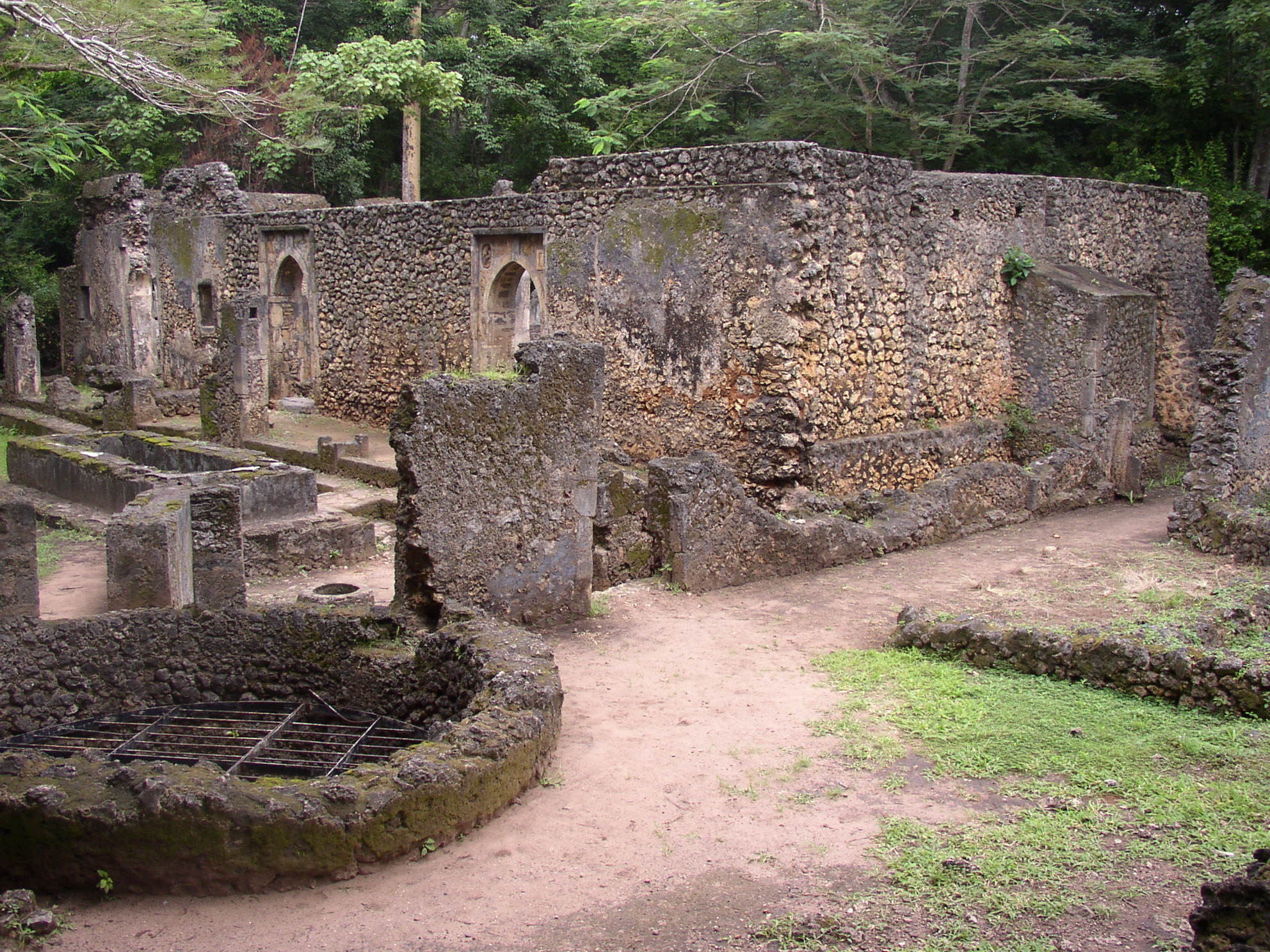
Gede, a stone town south of Malindi excavated in the twentieth century and restudied by Pradines in his 2010 monograph, shows the full kit of a fifteenth-century Swahili Muslim town: a Great Mosque, smaller neighbourhood mosques, wells and cisterns for ablution, and a cemetery of monumental tombs 17. The most distinctive of those tombs is the pillar tomb: a Muslim grave enclosed by walls and crowned with a tall stone column, at Gede in one case fluted. The form is known only on this coast. It is a Muslim burial in its orientation and an African monument in its scale and in the honour it pays to the dead, and it is the clearest single object of the synthesis this record follows.

Law: the Shafiʿi rite and the qadi
The second great change was law. The coast's earliest Muslims were plural, and the Ibāḍī and Shiʿi traces at Pemba show it 6. From the late thirteenth century that plurality narrowed. When the Mahdali dynasty took power at Kilwa, the town became Shafiʿi Sunni; by the fourteenth century, Pradines writes, the Shiʿi groups had been absorbed, and he attributes the spread of Sunnism to Hadrami merchants from Yemen 6. In 1331 Ibn Baṭṭūṭa found the result: at Kilwa "the chief qualities are devotion and piety: they follow the Shafi'i rite" 15. At Mombasa he found the inhabitants "pious, honourable, and upright", with "well-built wooden mosques" 16.
The Shafiʿi school gave the coast a written law of marriage, inheritance, contract and slavery, administered by qadis and taught in Arabic. It survives in the libraries. The Riyadha mosque at Lamu holds about 150 manuscripts, most of them in Arabic, and among them a commentary on Abū Shujāʿ's Shafiʿi manual copied in Zanzibar on 30 August 1860, and a book of law owned by "Khalfān b. Suwā, Bājūnī by tribe, Shāfiʿī by madhhab" 18. Abdallah Saleh Farsy's Swahili-language biographical dictionary of the coast's scholars, translated and edited by Randall Pouwels as The Shafiʿi Ulama of East Africa, records the chains of teachers from about 1830 to 1970 20.
The sharifs and the ʿAlawī way
The third change was a new religious aristocracy. Descendants of the Prophet, the sharifs, carried a prestige no local lineage could match, and Ibn Baṭṭūṭa saw the sultan of Kilwa reserve for visiting sharifs from Iraq and the Hijaz the share of his booty that the Qur'an assigns to the Prophet's kin 15. From the sixteenth century the most influential were the ʿAlawī sayyids of Hadramawt. The Jamal al-Layl family, Anne Bang writes, descended from "early migrants from Ḥaḍramawt, Yemen, who settled in Pate in the late sixteenth century", and branched out to Zanzibar and the Comoros 18. They practised the Sufi path called the ṭarīqa ʿAlawiyya, which "for centuries [was] perpetuated as 'clan Sufism' among the sāda, its spiritual secrets understood to rest within the bloodline of the prophet" 18.
Bang's study of these family networks between 1860 and 1925 shows how the ʿAlawīs "spread, maintained and propagated their particular brand of the Islamic faith" across the western Indian Ocean 19. In the nineteenth century, as Omani rule on Zanzibar opened the caravan routes, other orders followed them: the Qadiriyya and the Shadhiliyya carried Islam inland for the first time on any scale, to the caravan towns and beyond, and in Tanganyika, August Nimtz showed, the orders later became vehicles of mass political mobilisation 22. For eight centuries the religion had been a coastal one. In the nineteenth it became East African.
Riyadha, 1903: the door opened
The ʿAlawī line could close as well as open. Its genealogy made descent from the Prophet the highest form of religious authority, and it sat on top of a coastal society already divided between freeborn townspeople and others. The counter-current came from inside the same lineage. Ṣāliḥ b. ʿAlawī Jamal al-Layl, known as Habib Saleh (1853–1936), was born in Grande Comore and settled in Lamu between about 1875 and 1885, where he began to teach 18. In 1903, Bang writes, "he transformed some of his land in Lamu into a waqf (pious endowment) for the purpose of building the Riyadha" 18. The date has been given variously as 1889 and 1892; the waqf of 1903 is the documented foundation of the mosque, and Iain Walker's date of 1889 is better read as the beginning of the teaching circle 1833.
What the Riyadha changed was who could learn. "The most enduring reformist agenda of the Riyadha was the admittance of students from beyond the stone town itself (Oromo, Giryama, Pokomo and others)," Bang writes. "These groups had until then been considered 'outsiders' by the traditional Lamu aristocracy, and many of them were former slaves" 18. Habib Saleh was, in Walker's words, "anxious to disseminate Islamic knowledge among ordinary people on the coast, often confronting Lamu's established religious order as he did so" 33. The annual Maulidi he made central to the Riyadha's practice, following the rites of the Hadrami scholar ʿAlī al-Ḥibshī, is still celebrated at Lamu every year and draws visitors from across the western Indian Ocean 1833.
What Islam displaced, and what it did not
The transmission replaced some things outright and absorbed others:
- Replaced: the plurality of cults. Al-Masʿūdī's coast, where "each worships what he pleases", gave way within six centuries to towns where public worship meant the mosque 46.
- Replaced: sacred kingship. The Waklimi, killed if unjust, had no successor; Swahili rulers took Arabic titles, sultan and shaykh, and their legitimacy came to rest on Islamic descent and piety 415.
- Replaced: an oral law. Customary law gave ground to Shafiʿi fiqh, written in Arabic and administered by qadis 1518.
- Absorbed: the dead. Ancestral honour moved into the Muslim grave and became the pillar tomb 17.
- Absorbed: the spirits. Spirit-possession cults did not disappear. Linda Giles's fieldwork on Zanzibar, Pemba and the mainland coast between 1982 and 1985 found them not marginal but central to Swahili Muslim society 21. They should not be projected back to the first millennium; their existence today shows that conversion did not empty the older religious world.
- Remade: the meaning of civilisation. The Swahili word uungwana, the quality of the freeborn townsperson, came to mean Muslim, urbane and free; its opposite, ushenzi, meant the unconverted mainland 1332. That distinction is where the cost of this record begins.
What the cost was
The conversion of the Swahili coast to Islam was one of the least violent religious transmissions in the atlas. It ran through trade, residence and marriage, it was led by Africans, and it took six centuries. That is why this record holds the cost at the lower end of the scale. But a religion that defines who is a member also defines who is not, and on this coast the line between Muslim and unbeliever became, in law and in practice, the line between those who could not be enslaved and those who could.
A border drawn by faith: Kilwa, 1331
Islamic law forbade the enslavement of a free Muslim. It did not forbid the enslavement of unbelievers captured in war. On the Swahili coast, where the towns were Muslim and their hinterland largely was not, that rule turned a religious difference into a supply line. Ibn Baṭṭūṭa saw it at Kilwa. "The people are engaged in a holy war, for their country lies beside that of pagan Zanj," reads Freeman-Grenville's translation 15; H. A. R. Gibb's 1929 version gives the same sentence as "constantly engaged in military expeditions, for their country is contiguous to the heathen Zanj" 16.
The sultan, Abū al-Muẓaffar Ḥasan, was called Abū al-Mawāhib, "the Father of Gifts", for his charity. "He frequently makes raids into the Zanj country, attacks them and carries off booty, of which he reserves a fifth, using it in the manner prescribed by the Koran" 15. Ibn Baṭṭūṭa watched the sultan give the clothes off his back to a beggar; the sultan's son took them back and "gave him ten slaves in exchange", and the sultan then added "ten more slaves and two loads of ivory" 15. The people the sultan gave away were the people of the mainland, Bantu speakers like the townspeople themselves, distinguished from them by religion. The atlas's language record follows the same raids as the edge of the Swahili synthesis; here they are its theology.
"Moors" to the Portuguese: Kilwa and Mombasa, 1505
From 1498 the towns met a power that read the same line from the other side. To the Portuguese the Swahili were mouros, Moors, and the crusading frame of the Iberian wars against Islam came with Francisco de Almeida's fleet in 1505. Hans Mayr, a German on board, left the eyewitness account 23. At Kilwa, after the sultan fled, "everyone started to plunder the town", and "only those Moors who did not fight were granted their lives" 23. At Mombasa the town resisted. "The Grand-Captain ordered that the town should be sacked and that each man should carry off to his ship whatever he found"; fire "raged all night long", and "the streets and houses were full of dead, who were estimated to be about 1,500" 23.
Mombasa was sacked again in 1528 and in 1589, after an Ottoman captain, Mīr ʿAlī Bey, had raised the coast in the sultan's name; Ahmet Kavas's entry in the Turkish İslâm Ansiklopedisi records that "after Sofala and Kilwa, the Portuguese fleet also took Mombasa in 1505" and charts the later attacks 24. The Portuguese built Fort Jesus over the harbour between 1593 and 1596 24. For a century the coast's religion was the reason its towns could be sacked without scruple.
Mombasa, August 1631
The line was crossed in both directions. Yusuf b. al-Ḥasan was seven years old when his father, the sultan, was murdered in one of the town's disputes with the Portuguese. Augustinian friars took the orphan to Goa, where he was educated and baptised as Dom Jerónimo Chingulia; in 1626 the Portuguese installed him as their client ruler of Mombasa, a town that by then held about 2,000 Christians 26. On 16 August 1631 he returned to Islam, killed the Portuguese captain with his own dagger and turned on the Christians of the town 26. The sworn evidence collected by the Church between 1631 and 1636 for a cause of martyrdom, edited by G. S. P. Freeman-Grenville in 1980, is the record of what followed 25.
Aylward Shorter's summary of that evidence gives the count: "Of the Portuguese, 47 men died with 39 women and 59 children. Of the Africans, 72 men died together with their wives and children," for a total he gives as 288 26. The African dead were converts, killed for the religion they had taken from the Portuguese. Yusuf abandoned the town in 1632 26. The episode is not the cost of the Islamisation of the coast in the sense that the 1505 sack is not the cost of Christianity; it is what religious difference became once two universal faiths contested the same harbour.
The plantation sultanate, 1840–1909
The heaviest bill fell in the nineteenth century, when the coast's religious boundary met a world market. Oman's rulers, who had taken Fort Jesus from the Portuguese in 1698 after a siege begun in 1696, moved their court to Zanzibar in the nineteenth century 2729. Thomas Vernet has shown that the Swahili city-states first welcomed Oman as an ally against Portuguese imperialism and then resisted it as a new occupier 27. Under the Busaidi sultans, Zanzibar and Pemba became the world's clove islands, worked by enslaved mainlanders, and Zanzibar the entrepôt of a slave trade that reached the great lakes 2930.
The British House of Commons heard the figures in 1871. The Select Committee on the slave trade of the east coast of Africa recorded testimony of "about 20,000 slaves being imported into Zanzibar annually, the great majority of whom are re-exported", a total of 97,203 shipped from Kilwa in five years, and slaves "chiefly brought from the neighbourhood of Lake Nyassa", where witnesses described depopulation 28. Frederick Cooper's study of the plantations found rural life there governed by Islamic law and local custom, including the law of slavery 30. The sea trade was closed by the treaty of 1873, the legal status of slavery abolished on Zanzibar and Pemba in 1897, and concubines, excluded from that decree, freed only in 1909 31. Jonathon Glassman has traced how the language of uungwana and ushenzi organised status, revelry and revolt on the mainland coast in the same decades 32. In a second book he followed the same vocabulary, recast in the twentieth century as a racial division between "Arabs" and "Africans", into the violence of Zanzibar's June 1961 election riots and the revolution of January 1964 34. That later history belongs to colonial politics, not to the medieval conversion, but its terms were older than the colony.
What the sources cannot count
The cost of this record rests on a small number of witnesses, and each of them saw from one side:
- Al-Masʿūdī wrote as an outsider who called the unconverted Zanj idolaters; his report of the seizure of Qanbalū gives no number 34.
- Ibn Baṭṭūṭa admired the sultan of Kilwa. He records the raids as piety and does not count the captives. The two English translations even differ on whether the sultan's wars were "holy war" or "military expeditions" 1516.
- Hans Mayr sailed with the attackers; his figure of about 1,500 dead at Mombasa is an estimate by the side that killed them 23.
- The 1631 inquiry was assembled to support a cause of martyrdom; its count of the dead is precise because it had to be, and it counts only the Christian dead 2526.
- The 1871 Select Committee heard British witnesses, among them the naval officer Sir Leopold Heath, whose purpose was to close the trade; its figures are the best available and also an argument 28.
No source from the mainland survives for any of these centuries. The people on whom the line between believer and unbeliever fell hardest, the "pagan Zanj" of Ibn Baṭṭūṭa and the captives from Lake Nyasa, left no account of it in writing. The record states the documented bill and marks the silence as part of it.
The bill
The record's cost, stated plainly:
- The early exception: Qanbalū's people enslaved by Muslim settlers around 750, the one conquest in the record 3.
- The theology of the raid: Kilwa's fourteenth-century expeditions against the "pagan Zanj", with a Qur'anic fifth of the booty and people given away as alms 1516.
- Crusade against the Muslim towns: about 1,500 dead at Mombasa in 1505, and the town sacked again in 1528 and 1589 2324.
- Mombasa 1631: 288 Portuguese and African Christians killed by a ruler who had returned to Islam 26.
- The clove islands: about 20,000 captives a year imported into Zanzibar by the 1860s, most of them from the interior around Lake Nyasa, under a sultanate that called itself Islamic 282930.
- The counter-current: the Riyadha's admission of former slaves to Islamic learning in Lamu from 1903 18.
The conversion itself has no body count. What it built was a definition of civilised life that was also a definition of who could be owned, and that definition outlived the medieval towns by six hundred years.
What followed
-
750Al-Masʿūdī later records that Muslim settlers seized the island of Qanbalū, probably Pemba, around the start of the ʿAbbāsid dynasty and enslaved its Zanj population: the only conquest in the coast's early Islamic record.
-
840At Shanga in the Lamu archipelago, the oldest grave dug into virgin soil is a Muslim burial facing Mecca, early to mid-ninth century; a timber mosque follows on Horton's dates by about 825.
-
916Al-Masʿūdī makes his last crossing from Qanbalū to Oman (AH 304) and describes its people as Muslims who speak the language of the Zanj.
-
1000Persian and African ancestry begins to mix in the coastal towns, with Asian ancestry carried almost entirely by men and African by women, coinciding with the large-scale adoption of Islam.
-
1107A Kufic inscription in the mosque at Kizimkazi, Zanzibar, is dated 500 AH (1107 CE), the oldest dated Arabic inscription known from the coast.
-
1280The Mahdali dynasty takes power at Kilwa; the town becomes Shafiʿi Sunni, and over the next century the coast's earlier Ibāḍī and Shiʿi communities are absorbed.
-
1331Ibn Baṭṭūṭa finds Kilwa Shafiʿi and pious, its sultan raiding the 'pagan Zanj' of the mainland and reserving a Qur'anic fifth of the booty, including captives given as alms.
-
1450Gede near Malindi flourishes as a Muslim stone town with a Great Mosque and pillar tombs, a funerary form found nowhere else in the Islamic world.
-
1505Francisco de Almeida's fleet sacks Kilwa and Mombasa as towns of 'Moors'; an eyewitness estimates about 1,500 dead at Mombasa.
-
1631Yusuf b. al-Ḥasan, baptised Dom Jerónimo Chingulia, returns to Islam and kills 288 Portuguese and African Christians at Mombasa, according to the sworn evidence of the 1630s.
-
1698Omani forces take Fort Jesus after a siege begun in 1696, ending a century of Portuguese rule at Mombasa and opening the way to a Busaidi sultanate on Zanzibar.
-
1860Zanzibar becomes the hub of a clove economy and slave trade; a British Select Committee hears in 1871 of about 20,000 captives imported each year, most of them from the Lake Nyasa region.
-
1897The legal status of slavery is abolished on Zanzibar and Pemba, after the closing of the sea trade in 1873; concubines are excluded until 1909.
-
1903Habib Saleh endows the Riyadha mosque at Lamu as a waqf, opening Islamic learning to Oromo, Giryama, Pokomo and other students, many of them former slaves.
Where this lives today
References
- Fleisher, Jeffrey, and Adria LaViolette. “The early Swahili trade village of Tumbe, Pemba Island, Tanzania, AD 600–950.” Antiquity 87, no. 338 (2013): 1151–1168. en
- Brielle, Esther S., Jeffrey Fleisher, Stephanie Wynne-Jones, et al. “Entwined African and Asian genetic roots of medieval peoples of the Swahili coast.” Nature 615 (2023): 866–873. en
- al-Masʿūdī. Les Prairies d'or [Murūj al-dhahab], Arabic text and French translation by C. Barbier de Meynard and A. Pavet de Courteille, vol. 1. Paris : Imprimerie impériale, 1861, pp. 205, 232–233. fr primary
- al-Masʿūdī. Les Prairies d'or [Murūj al-dhahab], trad. C. Barbier de Meynard et A. Pavet de Courteille, vol. 3. Paris : Imprimerie impériale, 1864, chap. XXXIII, pp. 5–31. fr primary
- Nurse, Derek, and Thomas Spear. The Swahili: Reconstructing the History and Language of an African Society, 800–1500. Philadelphia: University of Pennsylvania Press, 1985. en
- Pradines, Stéphane. « Le mihrâb swahili : l'évolution d'une architecture islamique en Afrique subsaharienne ». Annales islamologiques 37 (2003) : 355–381. fr
- Horton, Mark. Shanga: The Archaeology of a Muslim Trading Community on the Coast of East Africa. Memoirs of the British Institute in Eastern Africa 14. London: British Institute in Eastern Africa, 1996. en
- Hardy-Guilbert, Claire. Compte rendu de M. Horton, Shanga: The Archaeology of a Muslim Trading Community on the Coast of East Africa (1996). Bulletin critique des Annales islamologiques 19 (2003). fr
- Horton, Mark. “Early Islam on the East African Coast (750–1200).” In Finbarr Barry Flood and Gülru Necipoğlu (eds), A Companion to Islamic Art and Architecture. Hoboken: Wiley-Blackwell, 2017, pp. 250–274. en
- Flury, S. “The Kufic Inscriptions of Kisimkazi Mosque, Zanzibar, 500 H. (A.D. 1107).” Journal of the Royal Asiatic Society 54, no. 2 (1922): 257–264. en primary
- Chittick, H. Neville. “The ‘Shirazi’ Colonization of East Africa.” Journal of African History 6, no. 3 (1965): 275–294. en
- Saad, Elias. “Kilwa Dynastic Historiography: A Critical Study.” History in Africa 6 (1979): 177–207. en
- Pouwels, Randall L. Horn and Crescent: Cultural Change and Traditional Islam on the East African Coast, 800–1900. African Studies Series 53. Cambridge: Cambridge University Press, 1987. en
- Horton, Mark, and John Middleton. The Swahili: The Social Landscape of a Mercantile Society. Oxford: Blackwell, 2000. en
- Ibn Baṭṭūṭa. Tuḥfat al-nuẓẓār, East African section, trans. in G. S. P. Freeman-Grenville, The East African Coast: Select Documents from the First to the Earlier Nineteenth Century, 2nd ed. London: Rex Collings, 1975, pp. 31–32. en primary
- Ibn Baṭṭūṭa. Travels in Asia and Africa 1325–1354. Trans. and ed. H. A. R. Gibb. London: Routledge, 1929, pp. 110–112. en primary
- Pradines, Stéphane. Gedi, une cité portuaire swahilie. Islam médiéval en Afrique orientale. Le Caire : Institut français d'archéologie orientale, 2010. fr
- Bang, Anne K. “Localising Islamic knowledge: acquisition and copying of the Riyadha Mosque manuscript collection in Lamu, Kenya.” In Maja Kominko (ed.), From Dust to Digital: Ten Years of the Endangered Archives Programme. Cambridge: Open Book Publishers, 2015. en
- Bang, Anne K. Sufis and Scholars of the Sea: Family Networks in East Africa, 1860–1925. London: RoutledgeCurzon, 2003. en
- Farsy, Abdallah Saleh. Baadhi ya Wanavyuoni wa Kishafii wa Mashariki ya Afrika [The Shafiʿi Ulama of East Africa, ca. 1830–1970: A Hagiographic Account]. Trans. and ed. Randall L. Pouwels. Madison: University of Wisconsin, 1989. en primary
- Giles, Linda L. “Possession Cults on the Swahili Coast: A Re-examination of Theories of Marginality.” Africa 57, no. 2 (1987): 234–258. en
- Nimtz, August H., Jr. Islam and Politics in East Africa: The Sufi Order in Tanzania. Minneapolis: University of Minnesota Press, 1980. en
- Mayr, Hans. “The Voyage and Acts of Dom Francisco, Viceroy of India” (1505). Trans. in E. Axelson, South East Africa 1488–1530 (London, 1940), pp. 231–238; repr. in G. S. P. Freeman-Grenville, The East African Coast: Select Documents, pp. 105–112. en primary
- Kavas, Ahmet. “Mombasa.” Türkiye Diyanet Vakfı İslâm Ansiklopedisi, vol. 30. İstanbul: TDV, 2020. tr
- Freeman-Grenville, G. S. P. (ed. and trans.). The Mombasa Rising against the Portuguese, 1631, from Sworn Evidence. Fontes Historiae Africanae, Series Varia I. London: Oxford University Press for the British Academy, 1980. en primary
- Shorter, Aylward. “Mombasa Martyrs.” Dictionary of African Christian Biography, 2003. en
- Vernet, Thomas. « Les cités-États swahili et la puissance omanaise (1650–1720) ». Journal des africanistes 72, no. 2 (2002) : 89–110. fr
- House of Commons. Report from the Select Committee on Slave Trade (East Coast of Africa); together with the Proceedings of the Committee, Minutes of Evidence, Appendix and Index. London, 1871. en primary
- Sheriff, Abdul. Slaves, Spices and Ivory in Zanzibar: Integration of an East African Commercial Empire into the World Economy, 1770–1873. London: James Currey; Athens: Ohio University Press, 1987. en
- Cooper, Frederick. Plantation Slavery on the East Coast of Africa. New Haven: Yale University Press, 1977. en
- McMahon, Elisabeth. Slavery and Emancipation in Islamic East Africa: From Honor to Respectability. Cambridge: Cambridge University Press, 2013. en
- Glassman, Jonathon. Feasts and Riot: Revelry, Rebellion and Popular Consciousness on the Swahili Coast, 1856–1888. Portsmouth, NH: Heinemann; London: James Currey, 1995. en
- Walker, Iain. “Understanding a diaspora through Lamu Maulid.” COMPAS, University of Oxford, 6 March 2012. en
- Glassman, Jonathon. War of Words, War of Stones: Racial Thought and Violence in Colonial Zanzibar. Bloomington: Indiana University Press, 2011. en