Japan learned to write itself by wearing Chinese characters down (c. 900)
Two syllabaries with no inventor, no invention date and no decree — one abraded out of the cursive hand, one cut out of the margins of Buddhist sutras — which gave the Heian court the Genji monogatari and a wall running through the middle of its own literacy.
Japan had been writing for four centuries before the kana, all of it in Chinese, a language nobody there spoke. The syllabaries were not designed; they were worn down — hiragana from cursive characters written too fast, katakana cut from the margins of sutras monks were glossing. By 905 the court signed an imperial anthology in kana. It never stopped writing its laws in Chinese.

A court that could write, and could not write itself
By the year 800 the Japanese had been writing for four centuries. This is the fact the popular story of the kana keeps losing, and everything else depends on it. The archipelago was not illiterate before the syllabaries. It was extremely literate — in Chinese.1
The ritsuryō state that moved its capital to Heian-kyō in 794 ran on documents. It had a penal and administrative code modelled on Tang statute, a Ministry of Ceremonial, provincial governors filing tax registers, a university teaching the Chinese classics to the sons of officials, and a Buddhist establishment with a canon of thousands of scrolls. All of it was written in literary Chinese, by Japanese men, for other Japanese men, in a language that none of them spoke.2 Wooden documents — mokkan — recovered by the tens of thousands from Nara-period sites show the same competence running far below the level of the court: tallies, labels, requisitions, practice sheets on which a clerk has copied out a character forty times to get it right.3
So the problem was never that Japan could not write. The problem was narrower and more awkward: Japanese is not Chinese, and a script built for Chinese does not fit it.
What this literacy cost to acquire is worth stating, because it determines who had it. A student at the state university, the Daigakuryō, worked through the Chinese classics under a reading tradition transmitted orally from teacher to pupil; the curriculum assumed years, and the places were reserved by rank. Below that level, the working scribes of the ministries and the provinces learned by copying, and the mokkan preserve their practice sheets. Either way the entry price was the same: several years of sustained instruction in a foreign language, available to men attached to an institution. Literacy in Heian Japan was not a skill a person picked up. It was a position a person occupied.122
Two languages that do not fit each other
Classical Chinese is analytic and largely uninflected. Word order does the grammatical work; a character is a word. Japanese is agglutinative. It builds meaning by stacking suffixes onto stems — tense, negation, causation, politeness, evidentiality — and it marks the role of every noun with a particle that follows it. A Japanese sentence is mostly grammar. A Chinese sentence is mostly vocabulary.
Writing Japanese with Chinese characters therefore means solving a problem Chinese never had to solve: how to write the endings. There is no character for the past-tense suffix -ki, because Chinese does not have one. There is no character for the topic particle wa. The Japanese had inherited a writing system that could record every noun in their language and almost none of the connective tissue between them.1
They solved it the way everyone in that position has solved it: by breaking characters loose from their meanings and using them for their sounds. A character like 安, an, "peace," could be used to write the syllable a — not because the writer meant peace, but because the character sounded approximately right. Modern scholarship calls this practice man'yōgana, after the anthology in which it reaches its fullest development.4
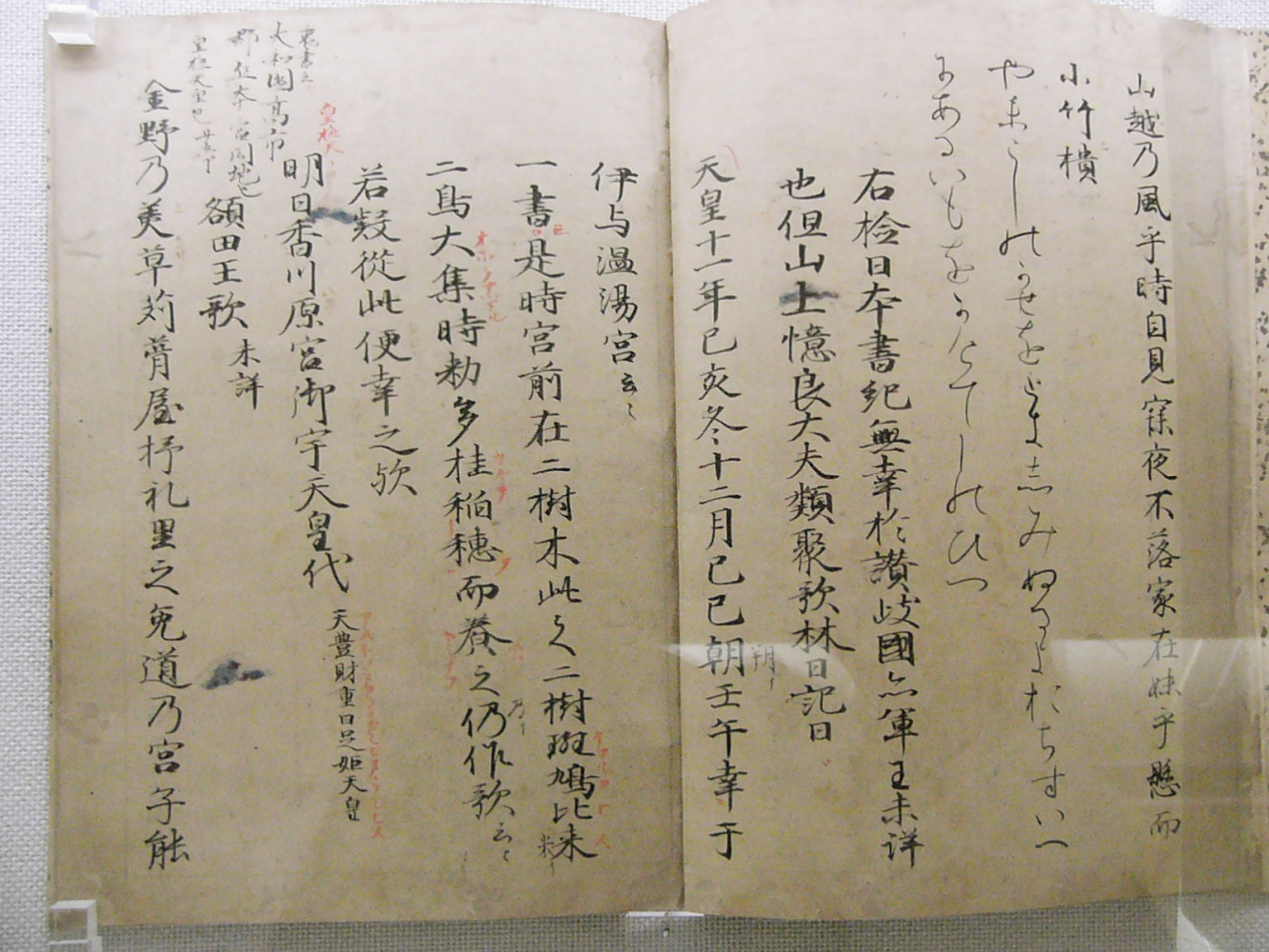
The Man'yōshū solution, and what it cost to use
The Man'yōshū, compiled in stages and containing no poem datable after 759, is the great monument of phonographic writing in Japanese and the best demonstration of why a syllabary eventually had to happen.4 Across its twenty books it uses somewhere in the region of nine hundred and seventy distinct Chinese characters for their sound value alone — often several different characters for the same syllable, chosen for their look on the page, for the meaning they smuggle in, for allusion, or for no recoverable reason at all.7
Consider what this asks of a reader. Opening a poem, you must decide, character by character, whether the graph in front of you is:
- a Chinese character read for its meaning with a Japanese word supplied (kun reading);
- a Chinese character read for its Sino-Japanese sound as part of a compound;
- a Chinese character standing purely for a Japanese syllable, meaning discarded;
- a character playing a visual or riddling game, such as writing the syllable sequence ni-ku-ku with the graph for "eighty-one" because eighty-one is nine times nine, and nine is ku.
All four occur, sometimes in the same line. The Man'yōshū contains poems that have never been read to general satisfaction; the opening of poem 9, the Makukamu crux, has attracted proposed readings for a thousand years and still has no agreed one.47
And consider what it asks of a writer. To write the single mora ka, a scribe might draw 加 (five strokes), 迦 (nine), 賀 (twelve) or 甲 (five). Writing a thirty-one-syllable waka phonographically could easily run to two hundred brush strokes. This is not a system anyone uses to dash off a note.
David Lurie's warning is worth keeping in view here. The textbook sequence — Chinese characters, then man'yōgana, then cursive sōgana, then hiragana — reads like a ladder of increasing efficiency climbed by a nation finding its voice. It was nothing of the kind. Early Japan sustained several literacies at once, used for different purposes by different groups, and they overlapped and competed for centuries rather than succeeding one another.1 Komatsu Hideo makes the same argument from the Japanese side and pushes it harder: the tidy genealogy from man'yōgana to hiragana is a modern reconstruction imposed on evidence that does not support a single line of descent.19
What the eighth century could hear
There is one more thing the "before" state possessed that the "after" state did not, and it is the quietest item on this record's bill.
Eighth-century man'yōgana spellings are not random in their choice among the characters available for a syllable. In about thirteen syllables of Old Japanese — ki, hi, mi, ke, he, me, ko, so, to, no, mo, yo, ro and their voiced counterparts — the scribes divide the available characters into two consistent sets and never mix them. The philologist Motoori Norinaga's student Ishizuka Tatsumaro noticed the pattern in the late eighteenth century; it was rediscovered and systematised in the twentieth, and is known as the kō-otsu distinction.27
The distinction is real. Eighth-century Japanese had vowel contrasts that tenth-century Japanese did not, and its writers could hear them and wrote them down. By the ninth century the contrasts are collapsing; by the tenth they are gone from the language and, crucially, gone from the script, because a syllabary with one sign per mora has nowhere to put them.2 The kana are a better instrument than man'yōgana in every practical respect and a worse one in this respect: they can no longer write a distinction their predecessor could.
The transmission: attrition, glossing, and a court that stopped importing
There is no founding moment here, and the absence is the point. The kana have no inventor, no invention date, no promulgating edict and no explanatory volume. Set beside the Korean case three centuries later — a named king, a documented year, a book that explains the shape of every letter — the Japanese script is an orphan. It was not designed. It was worn.
The embassies stop
The political frame changed first. Japan had sent official embassies to the Tang court since 630 — the kentōshi, missions of hundreds of men crossing the East China Sea in ships that frequently did not arrive, carrying students and monks who stayed for years and came back with manuscripts, relics, instruments and vocabulary. Kūkai and Saichō, who between them founded the Shingon and Tendai schools, travelled on the embassy of 804.18
A twentieth mission was planned for 894. Sugawara no Michizane — scholar, poet, the most accomplished Chinese stylist of his generation and the man appointed to lead it — advised Emperor Uda to cancel, citing the disorder of the late Tang and the risk of the crossing. Uda cancelled. No further official embassy was sent, and the Tang itself collapsed in 907.18
This did not end Japanese contact with China; merchants and monks kept crossing, and books kept arriving. But it did end the era in which the court's cultural policy was importation on a state timetable. What the ninth century did instead was digest what it already had. The kana emerge in exactly this window.
Wearing the characters down
Chinese characters written quickly lose strokes. This is not a Japanese phenomenon; it is the reason the sōsho or "grass" hand exists in China, and Japanese scribes had inherited it along with everything else. What happened in Japan is that the cursive forms of the characters used phonographically kept eroding past the point where they were still recognisable as the characters they came from — and then stopped, because a mark that has lost all its redundancy cannot lose any more and still be read.
The result is a set of glyphs whose ancestry is visible once pointed out and invisible otherwise:
| Source character | Sound | Cursive result (hiragana) | Abbreviated result (katakana) |
|---|---|---|---|
| 安 an, "peace" | a | あ | — |
| 阿 a | a | — | ア (left element only) |
| 以 i, "by means of" | i | い | — |
| 伊 i | i | — | イ (left element only) |
| 宇 u, "eaves" | u | う | ウ (upper element only) |
| 加 ka, "add" | ka | か | カ (left element only) |
| 幾 ki, "how many" | ki | き | — |
| 呂 ro | ro | ろ | ロ (upper element only) |
| 奈 na | na | な | ナ (upper element only) |
| 留 ru | ru | る | ル (lower element only) |
The two columns on the right are produced by two different operations, and this is the single most important structural fact about Japanese writing. Hiragana is the whole character, run together and abraded. Katakana is a fragment of the character, cut out and kept. They are not two styles of the same script. They come from different practices, done by different people, for different reasons.310
The hiragana side is anonymous. Nobody records doing it. What survives is the product: earthenware excavated in November 2011 from the site of the Kyoto residence of Fujiwara no Yoshimi (813–867), announced by the Kyoto City Archaeological Research Institute on 28 November 2012, carrying running, connected hiragana in continuous lines and making literary allusions. Nishiyama Ryōhei of Kyoto University, who examined the sherds, called the find precious precisely because of the unbroken lines: this is not experimental, it is fluent.12 The pieces date from the middle of the ninth century, pushing mature cursive kana back roughly five decades from the previously secure attestations and into the lifetime of a sitting minister of state.
That detail deserves a sentence of its own. The oldest fluent hiragana we have was thrown away in the compound of one of the most powerful men in the country, in the generation before the Kokin wakashū. Whatever the script's later associations, it was in use at the top of the political order from the beginning.
Reading aloud: katakana out of the margins
Katakana comes from the opposite direction: not from writing Japanese, but from reading Chinese.
A Japanese monk confronting a sutra in literary Chinese did not read it in Chinese. He read it as Japanese, reordering the words as he went, supplying the particles and verb endings Chinese does not write — the practice called kundoku, "reading by gloss." John Whitman has shown that this is not a Japanese eccentricity but a general East Asian technique, attested in Korea and in the Khitan and Tangut spheres as well.10 To do it reliably on a difficult text, and to teach it, a reader needed to write his analysis onto the page: marks showing which character to jump to next, dots placed at fixed positions around a character to indicate which particle followed it (the okototen system), and small phonetic signs for the endings themselves.911
Those signs had to be small, fast, and unmistakable against the columns of the main text. Full man'yōgana characters were none of these. So the glossers cut them down — not by cursive abrasion but by amputation, keeping one identifiable element of the character and discarding the rest. 伊 keeps its left-hand radical and becomes イ. 呂 keeps its top box and becomes ロ. 八 stays as ハ. The angularity of katakana, which looks like a design decision, is a consequence of the brush's behaviour in a two-millimetre gutter.
The oldest substantial witness is the Tōdaiji fujumonkō, a draft of Buddhist sermons composed at Tōdaiji somewhere between about 796 and 830, whose okototen scheme and vocabulary tie it to the Hossō school.89 In July 2003 a Nara research team reported marks resembling イ and リ scratched with a sharpened bamboo stylus into a Nara-period copy of the Kegon-kyō held at Tōdaiji — inscriptions made without ink, which would push the practice back into the eighth century.3
Tsukishima Hiroshi's study of Heian kanbun kundoku established the point that governs everything downstream: the glossing tradition developed its own conventions, its own vocabulary and its own grammar, distinct from the Japanese anyone spoke, and it was transmitted inside institutions — temple lineages, scholarly houses — that had every reason to keep it stable.11 Katakana was therefore born institutional, male, clerical and attached to Chinese. It never had to fight for legitimacy, because it was never presented as a rival to anything.
Putting the letters in order
A set of signs is not yet a script. It becomes one when everybody agrees what the signs are, and — for teaching, for indexing, for reciting — in what order they come. Japan produced two answers to that question, both of them out of Buddhist scholarship, and it still uses both.
The first is the gojūon, the "fifty sounds": a grid, five vowels across and nine or ten consonant series down, in the order a-i-u-e-o and k-s-t-n-h-m-y-r-w. That is not an arbitrary sequence and it is not a Chinese one. It is the Sanskrit order, sorted by where in the mouth the consonant is made — velars, then sibilants, then dentals, then nasals, and so on — reaching Japan through shittan, the study of the Siddhaṃ script in which the esoteric Buddhist mantras were written. Kūkai brought Siddhaṃ materials back from Chang'an in 806.183 The earliest surviving table laid out this way appears in the Kujakukyō ongi, a phonetic commentary on the Peacock Sutra dating from roughly 1004 to 1028.24 Japanese schoolchildren still learn their syllabary in an order that Indian grammarians worked out for Sanskrit and Japanese monks imported to chant it correctly.
The second is the iroha, a poem that uses each of the syllables of the language exactly once — a perfect pangram, and a Buddhist statement about impermanence into the bargain. Tradition attributes it to Kūkai; the attribution is impossible, since the poem's language belongs to a later stage of Japanese than his. It first appears, written in man'yōgana, in the Konkōmyō saishōōkyō ongi of 1079, a reading-guide to the Golden Light Sutra.253
Both orderings, then, are artefacts of reading Buddhist scripture. The syllabary that is remembered as the native, feminine, literary script received its alphabetical order from Sanskrit phonology and its mnemonic from a sutra commentary — and neither of those facts was ever a secret. They are simply not part of the story that gets told.
The dated witnesses
The transmission has no single date, but it has a sequence of surfaces on which it can be caught:
| Date | Witness | What it shows |
|---|---|---|
| 712 | Kojiki | Ō no Yasumaro states the problem outright: Japanese cannot be written in Chinese alone, and writing it phonographically is unbearably long |
| after 759 | Man'yōshū | Phonographic writing at full extent — c. 970 characters in sound use, with kō-otsu distinctions intact |
| c. 796–830 | Tōdaiji fujumonkō | Oldest substantial katakana glossing, with okototen |
| c. 850–867 | Fujiwara no Yoshimi site sherds, Kyoto | Fluent running hiragana with literary allusion, excavated 2011, announced 2012 |
| 894 | Cancellation of the kentōshi | End of state-scheduled importation from the continent |
| 905 | Kokin wakashū | First imperial commission written in kana; Tsurayuki's kana preface beside Yoshimochi's mana preface |
| 935 | Tosa nikki | First sustained literary prose in kana, written by a man in a woman's voice |
| c. 1000 | Makura no sōshi | Court prose as an instrument of judgement and wit |
| c. 1000–1012 | Genji monogatari | The long vernacular novel |
| c. 1008–1010 | Murasaki Shikibu nikki | The settlement described from inside, by someone it constrains |
What changed, and what was replaced
905: the state signs its name in kana
The Kokin wakashū was commissioned by Emperor Daigo and presented in 905, the first of twenty-one imperially ordered anthologies of Japanese poetry.13 Its significance for the script is institutional rather than literary: this is the moment the court puts its seal on a document written in kana. Poems in Japanese had always existed; what had not existed was an official, canonical, imperially commissioned text in the vernacular script.
The anthology carries two prefaces, and the pair is the whole argument in miniature. Ki no Yoshimochi wrote one in literary Chinese — the mana preface, "true-character" preface. Ki no Tsurayuki wrote the other in kana. Tsurayuki's opens:
Japanese poetry has the human heart as its seed and flourishes as myriad leaves of words.13
It is the first sustained piece of literary criticism in Japanese and it has been called the most heavily commented secular prose passage in the tradition.23 But notice what the presence of two prefaces means. The court did not decide that the anthology should be in Japanese. It decided that the anthology should be in Japanese and also properly introduced in Chinese. The Chinese preface was not a courtesy. It was the version that made the book official.
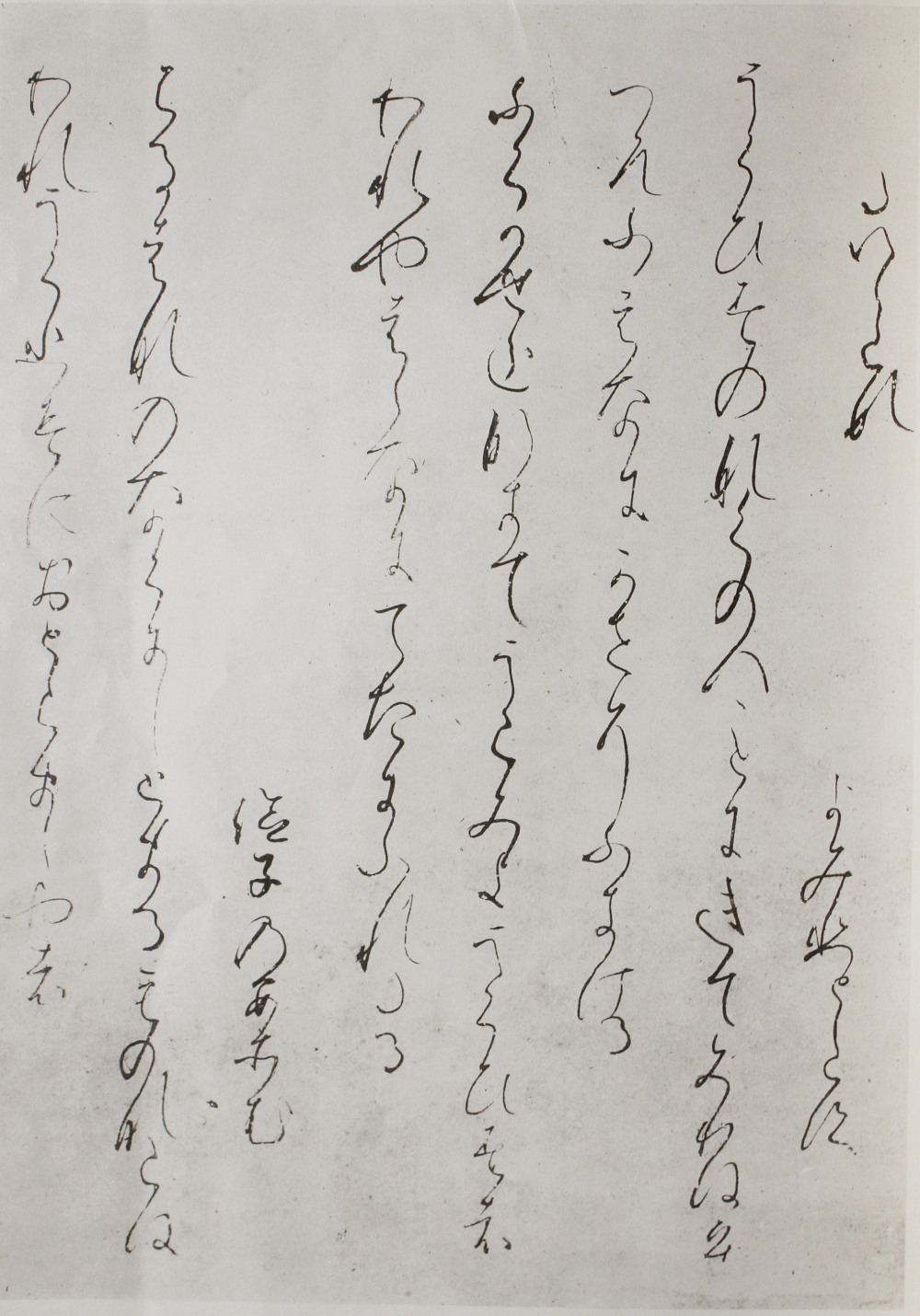
935: Tsurayuki pretends to be a woman
Thirty years later, returning from his term as provincial governor of Tosa, the same Ki no Tsurayuki wrote a fifty-five-day travel diary in kana. He opened it by announcing that diaries are written by men, and that he — writing as a woman — proposed to try one anyway.14
The Tosa nikki is the founding text of Japanese literary prose and it begins with a disguise. The disguise tells you the rule it is evading: nikki meant the dated, official, Chinese-language record a male official kept of court business, and a man who wanted to write something else — something with feeling, in his own language, in his own script — had to step outside his own gender to do it. Tsurayuki was the most distinguished poet of his generation and a senior official. He could have written anything. He wrote this, in this voice, because the alternative was not available in the register he wanted.
What follows in the next seventy-five years is one of the densest concentrations of literary achievement in any language. The Taketori monogatari, the Ise monogatari, the Kagerō nikki, Sei Shōnagon's Makura no sōshi, Murasaki Shikibu's Genji monogatari — a body of vernacular prose fiction and personal writing with, at that date, no counterpart anywhere on earth, and written in substantial part by women.23
The second room
It is tempting, and wrong, to describe this as kana replacing Chinese. Nothing was replaced. What the tenth century built was a division of labour, and it held for nine hundred years.
What stayed in literary Chinese:
- The legal codes and all administrative and tax documentation
- The official histories, through the Nihon sandai jitsuroku of 901
- The entire Buddhist canon and virtually all doctrinal commentary
- Diplomatic correspondence
- The curriculum of the state university and the scholarship attached to it
- The dated official diaries of male courtiers — Fujiwara no Michinaga's Midō kanpakuki, for instance, written in the same years as the Genji
- Medicine, calendrical science, divination
What moved into kana:
- Waka poetry and the imperial anthologies
- Prose fiction — monogatari
- Personal diaries and memoirs, including men's when they were not official
- Private correspondence
- Devotional and popular texts aimed at readers without Chinese
The arrangement was not enforced by anybody. No edict assigned Chinese to law and Japanese to poetry; no office policed the boundary. It held because of what each script was for and who was trained in it, which is a more durable mechanism than a rule. Fujiwara no Michinaga, regent in all but name from 995 and the most powerful man in Japan, kept his official diary — the Midō kanpakuki, of which portions survive in his own hand — in literary Chinese, in the same years in which the women of his daughter's household were producing the Genji. He was not obeying a prohibition. He was writing the kind of document he was writing.23
Peter Kornicki's regional study makes the comparative point sharply: every literary culture in the Sinographic sphere — Korea, Vietnam, the Khitan and Tangut states — built some version of this arrangement, and in every case the vernacular script occupied the space the Chinese one declined to fill rather than displacing it.18 Japan's version was unusual only in how fast and how well the vernacular side was furnished.
The plural letter
One more thing changed, and because it was later undone it is easy to miss. The kana that the tenth and eleventh centuries used were not a closed set of forty-odd signs. They were an open set of several hundred.
Because each glyph descended from a full Chinese character, and because more than one character had been available for most syllables, a scribe inherited a choice: the mora ka could be written from 加, or from 可, or from 閑, each abraded into a different shape. All of them were correct. A practised hand moved between them within a single line, choosing for the shape of the stroke that came before, for the run of the column, for the weight of ink remaining on the brush. The great decorated manuscripts — the Sekido-bon Kokin wakashū, the Sanjūrokunin kashū assembled at Nishi Honganji around 1112 — are beautiful in a way that has no European equivalent precisely because of this: the writing is not the transcription of the poem, it is a performance of it, scattered across dyed and gold-flecked paper in columns that break and resume.2223
Calligraphic judgement, in other words, was built into ordinary literacy rather than reserved to specialists. To write kana at all was to make several dozen aesthetic decisions per line. This is not a small thing to have had, and it is not a small thing to have lost; the losing happens in 1900 and belongs to the cost section below.
The mixed script, and the long career of katakana
The third thing to emerge, and the one that actually won, was neither syllabary alone. Kanji-kana majiribun — Chinese characters for the content words, kana for the grammar — is the form modern Japanese still takes, and it appears early. The Suzuka-bon manuscript of the Konjaku monogatarishū, held at Kyoto University and dating from the twelfth century, is its great early witness: a vast collection of more than a thousand tales from India, China and Japan, written in characters with katakana doing the inflectional work.20

Note which syllabary is doing that job. Because katakana had been born as scholarly apparatus for reading Chinese, it carried none of hiragana's associations with private feeling, and it was therefore the one that could be mixed into a serious text without lowering its register. That inheritance ran a very long way. When the Meiji state began printing statutes, ordinances, military manuals, telegrams and official forms in the late nineteenth century, it printed them in kanji and katakana. The Imperial Rescript on Education of 1890 is in kanji and katakana. Japanese law was written that way until the reforms that followed the Second World War.3
So the popular gloss — hiragana for Japanese words, katakana for foreign ones — describes a settlement barely eighty years old. For its first millennium, katakana was the script of the state, and hiragana was the script of everything the state was not interested in.
What the cost was
No one died for the kana. There is no conquest here, no extraction, no suppressed population, no burned library. The transmission's own bill is small, and the honest thing to do with a small bill is to itemise it accurately rather than inflate it.
The wall inside the court
The clearest cost is the one the Heian court paid to itself, and the best witness to it is the writer with the most to lose.
Murasaki Shikibu, daughter of the provincial official and Chinese scholar Fujiwara no Tametoki, had learned literary Chinese as a child by listening to her brother's lessons and outpacing him. She served in the household of Empress Shōshi from around 1006. In her diary, written about 1008–1010, she records that a lady-in-waiting, Saemon no Naishi, had taken to calling her Nihongi no mitsubone — "Our Lady of the Chronicles" — after the emperor remarked, on hearing chapters of the Genji read aloud, that its author must have read the Nihon shoki. The nickname was not a compliment. It marked her as a woman displaying learning that was not hers to display.15
Her response, in her own words, is that she has since stopped writing even the character 一 — "one," a single horizontal stroke — where anyone might see it. She describes herself avoiding the inscriptions on screens.15 Separately she notes that she had been reading Chinese poetry with the empress in secret, in odd moments when nobody was about, and had thought it best to say nothing about it to anyone.15
This is not a metaphor for a cost. It is a cost: a specific, dated, self-inflicted contraction, imposed by a norm that the two-script settlement made available. The settlement did not create the exclusion of women from public life, which was older and broader. What it did was give that exclusion a notation — a way to mark, in the visible form of a text, which side of the wall its writer stood on.
How much of this is a Heian fact, and how much is modern
Here the record has to be careful, because the version of this story most readers have met is substantially a modern invention, and repeating it uncritically would be its own failure.
The standard account runs: kana was onnade, "women's hand," the feminine native script, set against otokode, "men's hand," the masculine foreign one; women were barred from Chinese; and the glory of Heian literature is the glory of a suppressed native femininity finding its voice. Tomiko Yoda's study traces this account through eighteenth-century nativist philology and into the national-literature departments of the modern Japanese university, and shows how much of it is doing work for a twentieth-century argument about national identity rather than describing tenth-century practice.16 The claim that Heian women were prohibited from Chinese learning does not survive contact with the texts: Sei Shōnagon's Makura no sōshi displays Chinese learning constantly and is rewarded for it within the world of the book, and scholars working on the period have documented enough women's engagement with Chinese to make a flat prohibition untenable.17
The defensible version is narrower and, if anything, more uncomfortable. The constraint was not on competence; it was on display. A woman could read Chinese. She could not be seen to. Murasaki's diary is evidence of exactly this distinction — she is not describing a wall that kept her out, she is describing a performance she has to keep up — and it is the performance, not the prohibition, that the script made legible.
Men, meanwhile, wrote kana constantly, from Tsurayuki to Michinaga, and the sherds from Yoshimi's residence show fluent hiragana inside a minister's household in the 860s. The two-script order was a matter of genre and occasion before it was ever a matter of sex.161
A phonology that could no longer be written
The second item is the kō-otsu collapse described earlier, and it should be stated without either melodrama or dismissal. Eighth-century writers distinguished two series in some thirteen syllables and wrote the distinction consistently; ninth- and tenth-century writers did not, and the kana provide no means of doing so.27 The distinction was disappearing from speech in the same window, so the script did not kill it. But the outcome is that the phonological record of Old Japanese exists only in the system the kana replaced, and that a Japanese reader approaching the Man'yōshū today is reading a language whose sound system their own script cannot represent.
1900: the ordinance that killed the variants
The last item is not the Heian court's doing and the record should say so plainly. But it belongs on the same ledger, because what it destroyed was the thing the kana had been made out of.
Through the whole of their history, the kana had been plural. There was never one hiragana per mora. A tenth-century, or sixteenth-century, or nineteenth-century writer had several accepted forms for most syllables, descended from different source characters, and chose among them for rhythm, for the look of the line, for the connection to the glyph before and after. That plurality is what the Sekido-bon Kokin wakashū and the Nishi Honganji Sanjūrokunin kashū are beautiful because of.
The Third Elementary School Order's enforcement regulations, issued by the Ministry of Education in 1900, fixed one hiragana form per mora for elementary instruction.21 Everything else became hentaigana, "variant kana" — a category that did not need to exist until the moment the standard did. The variants did not go out of use by a decision of writers. They went out of the schools, and then out of the reading public within a generation, and the practical result is that most literate Japanese people today cannot read a handwritten document from before their great-grandparents' time.322 Several hundred letterforms with a thousand years of continuous use behind them were removed from the culture's working memory by one administrative regulation about primary schooling.
The ledger
Set out plainly, the transmission's bill reads:
- Zero deaths, zero conquest, zero extraction. The kana were made by scribes writing quickly. Nobody was displaced, taxed or killed for them.
- A notation for an existing exclusion. The two-script settlement gave the court a visible way to mark who was writing from which position — documented in Tsurayuki's disguise in 935 and Murasaki's self-censorship around 1008.
- A phonological record made unwritable. The kō-otsu distinctions the eighth century wrote cannot be written in the script that succeeded it.
- Nine centuries of split authority. Law, doctrine, history and scholarship stayed in a language nobody spoke until the Meiji vernacularisation movement, with everything that implies about who could participate in them.
- The standardisation of 1900, which ended a thousand years of graphic plurality and severed ordinary readers from the handwritten past.
Against that: a writing system in continuous use for eleven hundred years; the Kokin wakashū, the Tosa nikki, the Makura no sōshi and the Genji monogatari; and the demonstration — rare enough to be worth stating — that a culture can take a script built for a language nothing like its own and, without a designer, a decree or a plan, wear it down into something that fits.
It is worth being clear about why that balance comes out where it does. Most of the writing-system records in this atlas involve a donor and a recipient who are in some kind of political relation, and the bill is usually written in the space between them. Here there is no such space. The Tang did not send the kana; the Tang did not know the kana existed; by the time hiragana was fluent the Tang had fallen. What Japan did with Chinese characters was done at a distance of several thousand kilometres and, after 894, without a diplomatic channel. There was nobody to extract from and nobody to resist.
The consequence is that this record's costs are all internal — they are things the Heian court and its successors did to themselves, and mostly did without noticing. That makes them easy to under-count, because there is no victim with a name in the way that a conquest supplies one. The atlas's answer is to count what can be dated: a disguise in 935, a woman deciding not to write a single horizontal stroke around 1008, a vowel distinction that stops being writable between the eighth century and the tenth, and a ministry regulation in 1900. Four dated items, none of them a death, and together they are a fair statement of what a script costs when it costs almost nothing.
What followed
-
712The Kojiki is presented to the court in 712. In his preface Ō no Yasumaro sets out the problem the kana will eventually solve: writing Japanese entirely with characters read for meaning loses the sound, writing it entirely with characters read for sound makes the text unbearably long. He compromises, and says so.
-
759The Man'yōshū is compiled in stages, its latest datable poem from 759. Some nine hundred and seventy Chinese characters are used for sound alone, and the kō-otsu vowel distinctions of Old Japanese are written consistently for the last time in the history of the language.
-
813The Tōdaiji fujumonkō is drafted at Tōdaiji between about 796 and 830 — the oldest substantial body of katakana glossing, with an okototen dot scheme tying it to the Hossō school. Katakana begins as an apparatus for reading Chinese aloud in Japanese, not as a script for writing Japanese.
-
894Sugawara no Michizane advises Emperor Uda to cancel the twentieth embassy to the Tang in 894, citing disorder in China and the danger of the crossing. No further official embassy sails. The court stops importing continental culture on a state timetable and begins metabolising what it already holds.
-
860Earthenware from the Kyoto residence of the minister Fujiwara no Yoshimi (813–867), excavated in November 2011 and announced by the Kyoto City Archaeological Research Institute on 28 November 2012, carries fluent running hiragana making literary allusions — pushing mature cursive kana back roughly fifty years, and placing it inside the household of a sitting minister of state.
-
905The Kokin wakashū is presented to Emperor Daigo in 905, the first imperially commissioned anthology of Japanese poetry and the first official document in kana. It carries two prefaces: Ki no Tsurayuki's in kana, Ki no Yoshimochi's in literary Chinese. The Chinese one is the version that makes the book official.
-
935Ki no Tsurayuki writes the Tosa nikki in 935, the first sustained literary prose in kana — and opens it by declaring that diaries are written by men, and that he will attempt one as a woman. The founding text of Japanese vernacular prose begins with a disguise.
-
1008Between about 1000 and 1012 Murasaki Shikibu writes the Genji monogatari, and around 1008–1010 records in her diary that after being nicknamed 'Our Lady of the Chronicles' for her Chinese learning she has stopped writing even the character 一 where anyone might see it.
-
1150The Suzuka-bon manuscript of the Konjaku monogatarishū, copied in the twelfth century and now at Kyoto University, preserves more than a thousand tales in kanji-katakana mixed script — the form modern written Japanese still takes, and the ancestor of the script in which the Meiji state would print its laws.
-
1900The Ministry of Education's enforcement regulations for the Third Elementary School Order, 1900, fix one hiragana per mora for elementary instruction. Several hundred variant letterforms with a thousand years of continuous use become hentaigana, leave the schools, and within a generation leave ordinary reading — severing most Japanese readers from the handwritten past.
Where this lives today
References
- Lurie, David B. Realms of Literacy: Early Japan and the History of Writing. Cambridge, MA: Harvard University Asia Center, 2011. en
- Frellesvig, Bjarke. A History of the Japanese Language. Cambridge: Cambridge University Press, 2010. en
- Seeley, Christopher. A History of Writing in Japan. Brill's Japanese Studies Library 3. Leiden: E. J. Brill, 1991; reprinted Honolulu: University of Hawai'i Press, 2000. en
- 万葉集 (Man'yōshū), compiled in stages, no poem datable after 759. Genryaku kōhon manuscript, 11th century, Tokyo National Museum. ja primary
- 古事記 (Kojiki), presented to the court in 712, with the preface of Ō no Yasumaro. ja primary
- 犬飼隆 (Inukai Takashi). 『上代文字言語の研究』. 東京: 笠間書院, 1992; 増補版 2005. ja
- Miyake, Marc Hideo. Old Japanese: A Phonetic Reconstruction. London: RoutledgeCurzon, 2003. en
- 東大寺諷誦文稿 (Tōdaiji fujumonkō), composed c. 796–830. Tōdaiji, Nara. ja primary
- Alberizzi, Valerio Luigi. “An Introduction to Kunten Glossed Texts and Their Study in Japan.” Dossiers d'HEL 7 (2014): 21–30. Société d'Histoire et d'Épistémologie des Sciences du Langage. en
- Whitman, John. “The Ubiquity of the Gloss.” Scripta 3 (2011): 95–121. en
- 築島裕 (Tsukishima Hiroshi). 『平安時代の漢文訓読語につきての研究』. 東京: 東京大学出版会, 1963. ja
- 京都市埋蔵文化財研究所 (Kyoto City Archaeological Research Institute), announcement of 28 November 2012 on ninth-century hiragana-inscribed earthenware excavated in November 2011 from the Fujiwara no Yoshimi residence site, Nakagyō-ku, Kyoto. Comment by Nishiyama Ryōhei, Kyoto University. ja primary
- 古今和歌集 (Kokin wakashū), presented 905, with the kana preface of Ki no Tsurayuki and the mana preface of Ki no Yoshimochi. Translated by Laurel Rasplica Rodd with Mary Catherine Henkenius as Kokinshū: A Collection of Poems Ancient and Modern. Princeton: Princeton University Press, 1984. ja primary
- 紀貫之 (Ki no Tsurayuki). 土佐日記 (Tosa nikki), 935. Textual witnesses include Fujiwara no Teika's 13th-century copy and Fujiwara no Tameie's copy of 1236. ja primary
- 紫式部 (Murasaki Shikibu). 紫式部日記 (Murasaki Shikibu nikki), c. 1008–1010. Translated by Richard Bowring as Murasaki Shikibu: Her Diary and Poetic Memoirs. Princeton: Princeton University Press, 1982. ja primary
- Yoda, Tomiko. Gender and National Literature: Heian Texts in the Constructions of Japanese Modernity. Durham, NC: Duke University Press, 2004. en
- Mostow, Joshua S. “Mother Tongue and Father Script: The Relationship of Sei Shōnagon and Murasaki Shikibu to Their Fathers and Chinese Letters.” In The Father-Daughter Plot: Japanese Literary Women and the Law of the Father, edited by Rebecca L. Copeland and Esperanza Ramirez-Christensen. Honolulu: University of Hawai'i Press, 2001. en
- Kornicki, Peter Francis. Languages, Scripts, and Chinese Texts in East Asia. Oxford: Oxford University Press, 2018. en
- 小松英雄 (Komatsu Hideo). 『日本語書記史原論』. 東京: 笠間書院, 1998; 補訂版 2000. ja
- 今昔物語集 (Konjaku monogatarishū), Suzuka-bon manuscript, 12th century. Kyoto University Library. Facsimile in 『日本古典文学大系』 vol. 25. 東京: 岩波書店, 1962. ja primary
- 小学校令施行規則 (Enforcement regulations for the Third Elementary School Order), Ministry of Education, 1900, fixing one hiragana form per mora for elementary instruction. ja primary
- Kornicki, Peter F. The Book in Japan: A Cultural History from the Beginnings to the Nineteenth Century. Handbook of Oriental Studies. Leiden: Brill, 1998. en
- Shirane, Haruo, Tomi Suzuki, and David Lurie, eds. The Cambridge History of Japanese Literature. Cambridge: Cambridge University Press, 2016. en
- 孔雀経音義 (Kujakukyō ongi), phonetic commentary on the Mahāmāyūrī sutra, c. 1004–1028 — the earliest surviving syllabary table in gojūon order. ja primary
- 金光明最勝王経音義 (Konkōmyō saishōōkyō ongi), 1079 — the first appearance of the iroha pangram, written in man'yōgana in seven lines. ja primary