Edo woodblock prints reach Paris and rewire Western painting (~1870)
Storm-carried as wrapping paper around Edo porcelain, ukiyo-e arrived in Paris in the late 1850s through trade that gunboats had forced open. Within a generation Hokusai and Hiroshige had rewritten how Manet, Degas, Monet, Cassatt, Whistler, and Van Gogh composed a picture. The Edo workshops that made the prints collapsed under combined Western photographic, lithographic, and Meiji-state pressure within forty years; the auction-house wealth the prints generated reached the European and Yokohama dealers but not the woodblock houses.
Edo woodblock prints reached Paris in 1856, partly as wrapping paper around exported porcelain. Within a generation they had rewired Western painting from Manet and Degas to Cassatt and Van Gogh — and the Edo workshops that made them collapsed.

Before — Paris paints by the Renaissance's rules
In the Salon of 1865 the canvases that won medals were still composed under the formulas Western painting had used since Raphael. A central scene, framed by one-point or two-point linear perspective. A horizon at roughly the midpoint of the picture plane. Figures arranged pyramidally around an action. Chiaroscuro modelling that built each face and limb out of half-tone shadow. Reds drawn warm, shadows drawn cool. A varnish that pulled the whole picture into the unifying brown the École des Beaux-Arts called valeur. Alexandre Cabanel, William-Adolphe Bouguereau, and Jean-Léon Gérôme were the painters the state bought. The Salon jury, which Cabanel and Bouguereau sat on, accepted what looked like that and refused what did not 1.
The Académie's grammar was not naïve. It rested on three centuries of Italian, Spanish, and Flemish picture-making and on a pedagogy — the cast hall at the École, the Prix de Rome, the concours — that produced technically formidable painters. What it did not contain was a category for the moment unposed and the angle accidental. A high vantage that cut off the heads of the figures was a mistake. A composition built around an off-centre void was bad design. A figure cropped at the picture's edge was a failure of cadrage. Decorative pattern competing with the figure was a vulgarity to be subordinated. Above all, the depicted subject's seriousness was a function of its hierarchical rank: a senator's portrait was art; a laundress at her tub was, at best, anecdote 14.
What Paris also did not yet have was a name for the body of pictorial decisions the ukiyo-e workshops of Edo had been making since the late seventeenth century — flat fields of saturated colour without modelling; off-centre composition built around carefully placed negative space; subjects taken from the kabuki theatre, the licensed pleasure quarters, the daily life of artisans and street performers; foregrounds dramatically cropped by architecture or umbrellas or rain; integration of text directly into the picture; a vantage that floated above the scene from a position no eye on the ground could occupy. The Académie's grammar called these violations of design. By 1900 the same decisions would be the new grammar of seeing, and the Académie would be a historical sect 23.
The Salon's monopoly
The Salon was not one taste among many. It was, for a French painter in the 1860s, the only way to sell. Cabanel refused Manet's Déjeuner sur l'herbe in 1863; the Emperor Napoléon III, in a gesture half-political, established the Salon des Refusés to display the refusals. The Refusés' public was hostile. Le Figaro called Manet's painting indecent. The actual offences of the picture — flatness, lack of half-tone modelling, a model who looked back at the viewer without classical alibi — were precisely those for which Manet was, three years later, beginning to find a vocabulary in the prints he was buying from the rue de Rivoli shop La Porte Chinoise. The Refusés did not break the Salon's monopoly. The prints, slowly, did 4.
What Paris did not yet have a name for
A vocabulary item is missing until something forces it to be named. In 1860 the French art press had no word for the high-cropped urban subject. Edmond de Goncourt would supply japonaiserie in his diary in 1862; the term japonisme enters print in Philippe Burty's La Renaissance littéraire et artistique in 1872 and is established by the time Siegfried Bing founds Le Japon Artistique in 1888 5. The naming is the moment the receiving culture acknowledges that what is arriving is not curio but system. Bracquemond's Société du Jing-lar met monthly at a restaurant in Sèvres from 1866 onward; its members — Manet, Marc-Louis Solon, Philippe Burty, Henri Cernuschi — gave the receiving discourse its first organised institutional form. The naming and the organising are the two preconditions for everything that follows; both arrive in the same decade, the 1860s, and both run on objects whose flow began under treaty terms imposed at gunpoint a decade earlier.
The transmission — gunboats, wrapping paper, and a Paris print shop
The transmission begins before any French artist sees any Japanese print, and it begins as compulsion.
Gunboats and unequal treaties
On 8 July 1853, four American steam frigates under Commodore Matthew Perry entered Edo Bay. Perry presented President Fillmore's letter and a Whitworth field gun, sailed away, and promised to return in 1854 with more ships. He returned with nine. The Tokugawa shogunate, which had governed Japan in formal seclusion (sakoku) since 1639 and which possessed no warships capable of engaging Perry's, signed the Treaty of Kanagawa in March 1854. The Harris Treaty of 1858 followed, opening Yokohama, Nagasaki, Hakodate, Niigata, and Kōbe to foreign residence, fixing tariffs at five per cent of value, and granting extraterritoriality so that no foreigner could be tried under Japanese law. Britain, France, Russia, and the Netherlands signed parallel treaties. The system Japanese historiography calls the fubyōdō jōyaku — the unequal treaties — was the structural condition for everything that followed 67.
What flowed out under the new tariffs was raw silk, tea, lacquerware, porcelain, and, alongside the porcelain, baled woodblock prints — sometimes as commercial cargo, often as packing material around the ceramics, sometimes as the ballast Japanese exporters used because the prints were domestically cheap and the volume needed by the European trade was high. The Tokugawa state had collapsed in the Restoration of 1868; the Meiji government that succeeded it was, by the early 1870s, actively promoting Japanese decorative arts at European international expositions as part of a broader strategy of cultural recognition and revenue. The prints reached Paris on freight that the treaties had made cheap, on ships that had not existed when Hiroshige was alive 67.
Raw silk became Japan's principal export earner; Yokohama silk, traded against Lyon-bought British and French sterling, financed the Meiji state's imports of railways, telegraph, and naval equipment. The print cargoes rode the same Yokohama-Marseille line. Steven Ericson's quantitative work on the 1858 tariff has demonstrated that the customs revenue the Meiji treasury collected from the fixed five-per-cent regime was a fraction — by his best reconstruction, somewhere between a third and a half — of what a sovereign tariff at European market levels of fifteen to twenty per cent would have collected 7. The cultural flow was an accessory to a larger asymmetric trade architecture, and the architecture was held in place by warships.
Bracquemond at Delâtre's printshop
The Paris-side story has a date and a place. In 1856 the engraver Félix Bracquemond opened a parcel at the printshop of Auguste Delâtre on the rue Saint-Jacques. The paper inside the parcel — wrapping around a consignment of porcelain or contained in the bound-up sample-book Delâtre had received — was the first volume of Katsushika Hokusai's Manga, the sketchbook the Edo master had begun publishing in 1814. Bracquemond was startled. He carried the book under his arm for two years, showing it to every painter he could buttonhole. By 1862 the Manga was circulating through the Paris studios of Whistler, Manet, Fantin-Latour, and Degas. Bracquemond formed the Société du Jing-lar in 1866 — a small dining-club devoted to Japanese decorative culture, meeting monthly at a restaurant in Sèvres — whose members included Manet, the etcher Marc-Louis Solon, the critic Philippe Burty, and the dealer Henri Cernuschi 89.
The Bracquemond episode has been refined at the margins by Phylis Floyd, whose 1983 Michigan dissertation argued that the wrapping-paper story is partly a mise en scène — the printers' shops and the auction houses had access to Japanese material through more orderly channels well before 1856 — but the broader point holds. The prints arrived in Paris in the late 1850s through a mixture of commercial and accidental channels, the cargoes flowed under treaty terms forced on Japan, and the Parisian art world had no organised market for the material before the dealers, beginning in the early 1860s, built one 89. Madame Desoye's shop La Porte Chinoise at 220 rue de Rivoli, opened around 1862, was the first dedicated Paris retailer; Whistler, Manet, Degas, the Goncourts, Zola, Baudelaire, and Manet's circle bought there regularly. By 1875 Bing's much larger operation at 19 rue Chauchat had eclipsed it.
The 1867 Exposition Universelle
The hinge moment was the Exposition Universelle that opened on the Champ de Mars in April 1867. The Tokugawa Bakufu and the rival Satsuma domain each sent independent delegations — a sign of the political fracturing inside Japan in the months before the Restoration. They exhibited ukiyo-e prints, bronzes, lacquerware, ceramics, and a tea house staffed by women from the Yanagibashi licensed quarter. Six million visitors passed through. Henri Cernuschi, Émile Guimet, the Goncourt brothers, and the young Henri Vever bought directly. The Goncourts purchased eight thousand francs' worth of prints from the Tokugawa pavilion's closing-day sale 34.
The 1867 Exposition was the first time a mass European public saw Japanese visual culture as a coherent body of work rather than scattered exotica. The criticism the prints received in Le Moniteur universel and La Revue des deux mondes the following spring praised what Western criticism had until then called bad design — the off-centre placement, the flat colour, the cropped foregrounds — and praised them in the new terms the prints themselves had supplied. The category was naming itself in the act of describing what it now valued 34. The 1878 Exposition reinforced the pattern at larger scale, and the 1889 Exposition (the Eiffel Tower year) gave the new Meiji government's official Japan pavilion the chance to organise the display on its own terms. The official catalogues of these expositions, edited on the Japanese side by Wakai Kanezaburō and the cultural mission Hayashi Tadamasa would join in 1878, are the early bilingual scholarly documents of the transmission.
Bing's gallery and Le Japon Artistique
The dealer Siegfried Bing — a Hamburg-born German who had moved to Paris in 1854 to manage the family porcelain business, and who opened a Japanese-art shop at 19 rue Chauchat in 1875 — was the system's central node. By 1885 his stockrooms held tens of thousands of prints and decorative objects. He bought from Japanese dealers in Yokohama and Kōbe, shipped the material to Paris in volume, and sold it to the painters, the museums, and the wealthy private collectors who had now organised themselves around what they understood as a serious aesthetic system 10.
In May 1888 Bing launched Le Japon Artistique: Documents d'art et d'industrie, a monthly journal published simultaneously in French, English, and German. Thirty-six issues appeared through 1891. Each contained essays by Philippe Burty, Edmond de Goncourt, Louis Gonse, Théodore Duret, and other Paris critics who had built the discourse, and tipped-in colour reproductions of prints, lacquerware, ceramics, and metalwork drawn from Bing's stock and from private collections in Paris, Berlin, Vienna, and London. The journal became the curriculum for a generation of European decorative artists. Gustav Klimt's library contained the complete run 1013. In 1895 Bing renamed his Chauchat establishment L'Art Nouveau, gave the European movement its name from its signboard, and commissioned the architect Henry van de Velde to redesign the interior. The aesthetic continuity Bing organised — from Edo woodblock to Vienna Secession via a Paris dealer's shop — is unique in the modern transmission record.
Hayashi Tadamasa, Paris
The dealer who supplied much of Bing's stock was Hayashi Tadamasa, who arrived in Paris in 1878 as a translator for the Japanese commercial delegation to the second Paris Exposition, stayed, and built a parallel dealership. Hayashi's surviving ledgers, edited by Brigitte Koyama-Richard, record that across his twenty-six years in Paris he handled more than 156,000 ukiyo-e prints, 9,700 illustrated books, 846 lacquerware pieces, and roughly 1,500 paintings sent to European buyers 14. Hayashi was the commissioner-general of the Japanese pavilion at the Paris Exposition of 1900. He encouraged Edmond de Goncourt to write the monographs Outamaro (1891) and Hokousaï (1896), the first European monographs on individual Japanese artists, and supplied the prints reproduced in them. The Edmond-de-Goncourt collection sold at the writer's death in 1896 contained 1,278 ukiyo-e prints; Hayashi had been Goncourt's principal supplier for two decades 111214.
Hayashi's role complicates the simple extraction narrative. There was a Japanese broker actively organising the flow on the Edo side. But his presence does not soften the underlying arithmetic. Hayashi's commissions were paid out of European purses; the woodblock workshops in Edo whose prints were sold in Paris received the original Edo-period wholesale, which the Yokohama dealers were paying by the 1890s in fractions of a yen per print. Bing resold them in Paris for francs, and at the André Portier auction of January 1900 a single Tōshūsai Sharaku actor portrait went for over twelve hundred francs — roughly forty months' wages for an Edo-trained woodblock printer at contemporary rates 1014.
What changed and what was replaced
Within a generation of the 1867 Exposition the prints had rewired the principal categories of Western picture-making. The change is visible in specific cases, not in vague atmosphere; the discipline of looking at the prints alongside the pictures they reshaped is what the scholarship of Berger, Wichmann, Floyd, Weisberg, Lambourne, and Ōshima Seiji has done 1234917.
Cropping, high vantages, and a new picture plane — Degas and Cassatt
Edgar Degas, the most analytic of the group, owned more than a hundred ukiyo-e prints by the late 1880s. The bathers, milliners, and ballet dancers of his major work after 1875 use the high vantage point of Suzuki Harunobu's interiors, the cropping of Kitagawa Utamaro's bijin-ga, and the empty foregrounds of Hiroshige's late landscapes. The Tub (1886) is composed from a vantage six feet above the seated bather, looking down at a flat circular foreground that occupies a third of the picture and contains nothing but a curve. There is no painted French source for that composition. There are several ukiyo-e sources 15. Degas's late monotypes — landscapes built up in single inked impressions, often touched with pastel — borrow directly from the suri-ita monoprint techniques he would have seen in Hayashi's stock.
Mary Cassatt, the American expatriate who had joined the Impressionists in 1879, attended the École des Beaux-Arts exhibition of 725 ukiyo-e prints organised by Hayashi and Bing in April and May 1890 — the largest single display of Japanese prints Paris had yet seen — and walked back to her apartment determined to make colour prints. The series of ten she produced over the next eighteen months, exhibited at Durand-Ruel in April 1891, uses the drypoint outline, aquatint flat colour, and three-plate registration of the Edo woodblock workshop, adapted to a Pittsburgh-born woman drawing French bourgeoises in their interiors. The Letter, The Coiffure, Maternal Caress, and The Bath are the canonical examples; the technical achievement was real and the formal debt was explicit. Cassatt wrote to Berthe Morisot in May 1890 urging her to come and see les couleurs et les estampes japonais que je viens de voir aux Beaux-Arts 16.

Flat colour and the dignified everyday — Manet
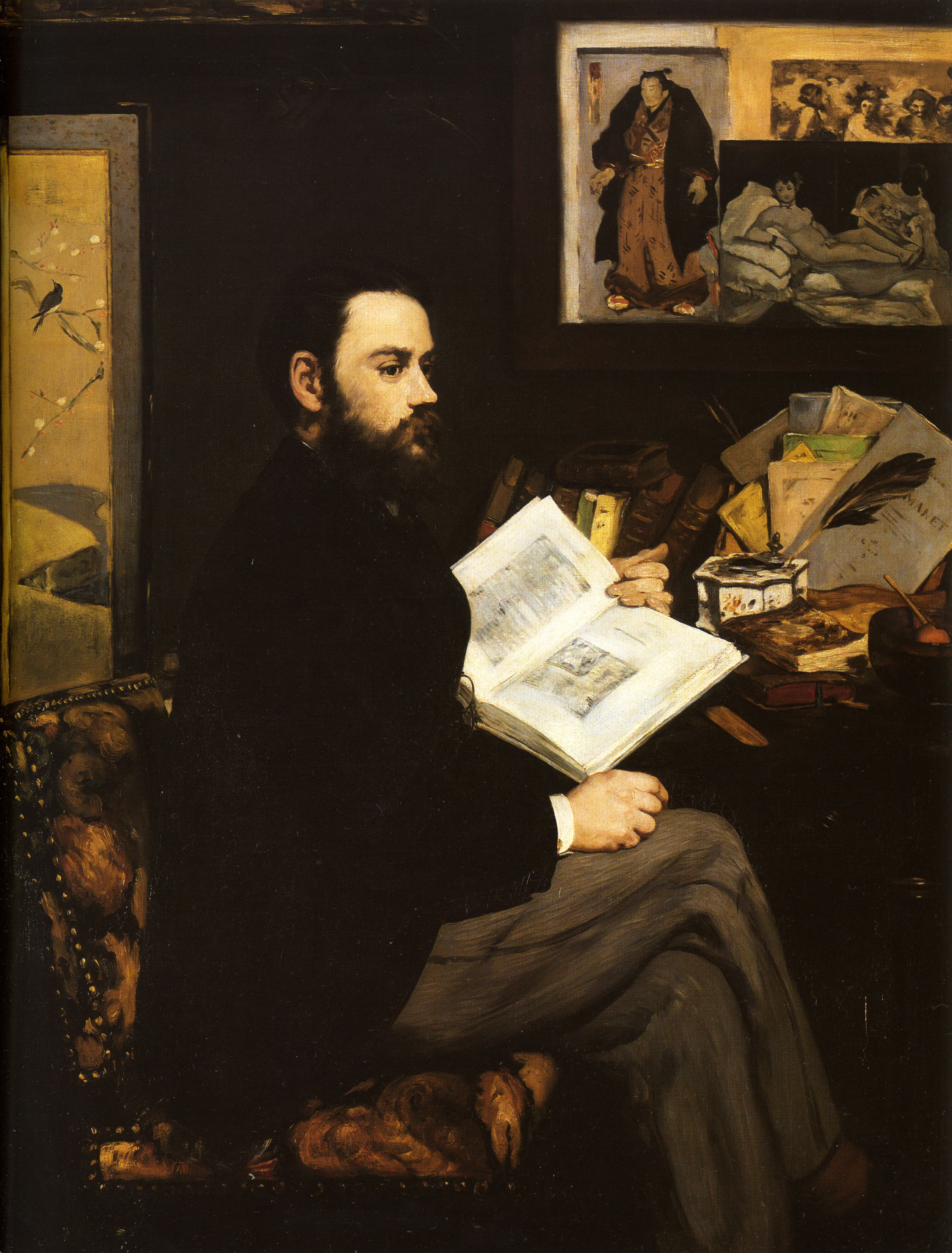
Édouard Manet, who had been making the offending pictures since Olympia in 1863, gave the Japanese system its most public Parisian statement in 1868 in the Portrait of Émile Zola. Pinned to the wall behind Zola's writing-table, in the upper right of the painting, is Utagawa Kuniaki II's print of the sumo wrestler Ōnaruto. To the left, partly visible, is a Japanese folding screen with landscape and bird-on-branch. The wrestler's flat black silhouette against pale paper rhymes with Zola's flat black coat against pale paper. The white border of the print becomes a compositional rectangle that organises the background plane. Manet had made the Japanese system into the Western picture's structural grammar, not its decoration 4.
The print on the wall was a choice. Zola had defended Manet in 1866 in a polemical pamphlet that praised exactly the qualities the Salon refused — the flat planes, the simplified shadows, the modern subjects. Zola had also written one of the first French essays defending Japonisme. The print is Manet's signature on the alliance: I paint what these prints have taught me to see, and I paint it for the writer who will call it modern 4.
Monet's Japonaise and the garden at Giverny
Claude Monet exhibited La Japonaise — his wife Camille modelling, naturally dark-haired, deliberately blonded by the painter, in a heavily embroidered scarlet uchikake, surrounded by sixteen Japanese fans on a tatami-covered floor — at the second Impressionist exhibition of 1876. The painting sold the next year for 2,000 francs, then a record price for a Monet, and Monet later disowned it as a market piece. He was being too modest. What it documents is the depth of the Parisian Japonisme market in the mid-1870s; a 231-by-142-centimetre kimono picture was a commercially rational object to paint. The Giverny garden Monet bought in 1883 and developed across four decades — the bassin aux nymphéas spanned by the Japanese-style arched green bridge of 1893, the wisteria, the iris, the bamboo — is the same artist's slow, lifelong absorption of Edo print landscape composition into actual ground and water. The Water Lilies cycle of the 1900s and 1910s, with its dissolved horizon, suspended viewpoint, and flat coloured field, is what those decades of looking at Hiroshige produced.
Van Gogh's copies and Père Tanguy
In 1887, in his and his brother Theo's apartment at 54 rue Lepic in Montmartre — directly above the Bing Gallery's print rooms — Vincent van Gogh sat down with three Edo prints and copied them onto canvas in oil. The result was three paintings: The Courtesan (after Keisai Eisen), Plum Garden at Kameido (after Hiroshige), and Bridge in the Rain (after Hiroshige's Sudden Shower over Shin-Ōhashi Bridge and Atake, the 1857 print, number fifty-eight of the One Hundred Famous Views of Edo). Van Gogh saturated the colour beyond the original, set the print in a painted Japanese-character border copied from other Bing prints, and signed the canvas — claiming the copy as his own work in the same gesture by which he acknowledged whose work it copied 313.
That December he painted Père Tanguy, the colour-merchant who supplied his pigments, seated in front of a wall hung with six ukiyo-e prints — three Toyokuni III actor portraits, two Hiroshige landscapes, and an anonymous bijin. The portrait is the Parisian Japonisme system condensed into one frame: the European sitter in front of the Edo background, in a painting whose own composition, palette, and flatness derive from the prints behind him.
Whistler, Toulouse-Lautrec, and the printed line
James McNeill Whistler had been in front of the prints earlier than any of the French. He bought blue-and-white at La Porte Chinoise in 1862; he painted Joanna Hiffernan in a kimono examining Hiroshige prints in 1864 in Caprice in Purple and Gold: The Golden Screen. By the time he decorated Frederick Leyland's London dining-room as the Peacock Room in 1876–1877, the integration of Japanese pictorial decisions — flat patterned wall, single high focal painting, restricted blue-and-gold palette, decorative integration of object and architecture — was complete enough that no Parisian art critic of the 1880s would have recognised it as a single coherent style without the prints' precedent. Whistler's Princesse du pays de la porcelaine, originally exhibited at the Salon of 1865 and now in the Peacock Room at the Freer Gallery, places the European model in a kimono among Asian decorative objects exactly as Manet's Zola would place the European writer next to the Kuniaki print three years later 4.
Henri de Toulouse-Lautrec carried the lesson into the printed poster. The Moulin Rouge: La Goulue of 1891, Divan Japonais of 1892, Jane Avril of 1893 — flat fields of strong colour outlined in calligraphic black line, dramatic cropping, foreground figure pushed against an empty rear plane, integrated typography — apply the ukiyo-e yakusha-e grammar to the lithographic poster format. The descendant lineage runs from Toulouse-Lautrec through Alphonse Mucha and Théophile Steinlen to the entire twentieth-century printed-poster vocabulary and on to the commercial graphic design of the 1920s Bauhaus, mid-century Push Pin Studios, and the comic-book and animation lines that would, by the late twentieth century, run back into Japanese visual culture as manga and anime in a second, inverse arc the original transmission could not have predicted.
What the Académie lost
The cumulative result was that the Académie's grammar — the central pyramidal composition, the modelled half-tones, the brown unifying varnish, the hierarchical subjects — lost its monopoly. By 1900 the Salon des Indépendants and the dealers' galleries (Durand-Ruel, Bing, Vollard, Bernheim-Jeune) had organised an alternative market that did not depend on Académie approval. The Cabanel-Bouguereau formula did not vanish at once — the Académie continued to elect them, and academic painting remained a substantial market into the 1910s — but the canon had shifted. The painters the dealers and critics now valued were the painters who had absorbed the Edo lesson. By the time of Cézanne's first retrospective at Vollard in 1895, of the Nabis exhibitions of Bonnard and Vuillard, of Klimt's Vienna Secession in 1897 and Matisse's Fauves in 1905, the new visual grammar was institutionalised. Every one of those painters had grown up looking at the prints 123.
What the cost was
The cost framing is the part of the record the celebratory literature on Japonisme has tended to soften. The framework demands the bill be specified.
Treaty arithmetic
The prints reached Paris because Japan had been opened by force. The Treaty of Kanagawa was signed under the guns of Perry's second squadron; the Harris Treaty of 1858 was negotiated in the explicit understanding that refusal would trigger further military escalation. The British bombardment of Kagoshima in 1863 and the Allied (British, French, Dutch, American) bombardment of Shimonoseki in 1864 demonstrated that the threat was credible. The treaty system that followed — fixed five per cent tariffs that Japan could not raise without foreign consent, extraterritoriality that placed all foreign residents outside Japanese law, most-favoured-nation chains that automatically extended any concession to all Western powers — held until partial revision in 1894 and complete revision in 1911. Japan paid for the right to be a sovereign state with its sovereignty 67.
The economic arithmetic followed. The 1858 tariffs, set by Western negotiators at a level designed to favour European manufactured imports against Japanese domestic production, were a substantial drag on the early Meiji economy. The fixed tariff cost the Meiji treasury, on the best estimates available, the majority of the customs revenue a sovereign tariff would have collected 7. The flow of Edo prints to Paris was one current within that larger asymmetry: the export goods Japan could send were the goods Westerners would buy at the prices Westerners would pay, and the cultural cargo travelled on the same terms.
The workshop economy collapses
The ukiyo-e workshop economy that had produced Hokusai's Manga, Hiroshige's One Hundred Famous Views of Edo, and the thousands of bijin-ga, kabuki-e, and yakusha-e flooding Paris had been a substantial Edo industry. By mid-nineteenth-century estimates, several hundred publishers and several thousand carvers and printers in Edo, Osaka, and Kyoto supplied a domestic market that consumed prints by the hundred-thousand annually 18. By 1900 the industry was a wreck. The reasons were several and the Western export market was only one of them, but it sat alongside the others.
Photographic studios opened in Yokohama in the 1860s and in Tokyo by the early 1870s. By 1890 a Tokyo middle-class portrait that would once have been a Toyohara Kunichika print of a kabuki star was a Kazumasa Ogawa photograph. Lithographic printing, introduced from Europe in the 1870s, undercut woodblock for newspaper and government work. The Meiji government's Westernising cultural programmes — the new official painting categories at the Naichi Kangyō Hakurankai industrial exhibitions, the founding of the Tokyo School of Fine Arts in 1887 — explicitly elevated oil painting and Western-style draughtsmanship over the woodblock tradition. The print industry, displaced from journalism by lithography, from portraiture by photography, and from official aesthetic legitimacy by the Westernising academy, shrank to a small specialty trade by 1900 18.
The Western export market masked the decline for a while — Yokohama dealers organised the supply of prints to Bing and Hayashi, and older Edo blocks were re-pulled to meet Parisian demand — but it did not save the workshops. The export market valued the Edo-period prints. It did not commission new Meiji-era ones at a scale that could sustain the trade. By the death of Hayashi in 1906 the surviving woodblock houses in Tokyo numbered fewer than a dozen, working chiefly for an export tourist market in lacquered souvenir albums. The shin-hanga movement under Watanabe Shōzaburō after 1915 is the small surviving descendant of what had once been one of the largest visual-print industries on earth 18.
Auction-house wealth, Edo silence
The wealth differential is the part that needs specifics to turn the moral claim into evidence. A standard nishiki-e print — full polychrome, multiple blocks, sold at retail in Edo bookshops in the 1830s — cost roughly the price of two bowls of soba noodles, well within the reach of an Edo artisan. The publisher's wholesale to the Yokohama dealer by 1880 ran at a few sen per print — a hundredth of a yen. Bing's retail price in Paris by 1890 for the same Hokusai Manga sheet ran two to five francs. By 1900 a fine Hokusai single-sheet in good condition could fetch fifty francs, and a Sharaku above a thousand. The arithmetic transferred wealth from Paris to Yokohama-side intermediaries — Hayashi, Wakai Kanezaburō, the Hamburg-based importer Philippe Sichel — and from those intermediaries onward to a small number of Tokyo dealers. The Edo woodblock workshops, who had received the original wholesale a generation earlier, received nothing from the secondary market that built Bing's fortune and inflated the Goncourt collection 101418.
The cumulative numerical case is easiest to make on Hayashi's books and on the Goncourt collection sale. Hayashi sold to Bing and to private collectors more than 156,000 prints over twenty-six years. The Edmond-de-Goncourt sale at Hôtel Drouot in 1897 dispersed the 1,278 ukiyo-e prints and 700 illustrated books in his collection for roughly 165,000 francs total — sums that, transferred to Edo at any point in their journey, would have built Hokusai a Tokyo townhouse. The 1900 Hayashi collection sale at the American Art Association in New York and the 1902–1903 Drouot Hayashi sales totalled, in the best modern estimates, more than three million francs. No woodblock workshop in Japan saw any of that money 101214. By comparison, the surviving records of the Edo publisher Tsutaya Jūzaburō — Hokusai's and Sharaku's principal publisher in the 1790s — show wholesale revenues of a few hundred ryō a year at peak, which would have converted at the 1880s exchange to perhaps two thousand francs annually. The Goncourt single-collection sale, in other words, totalled roughly eighty years of Tsutaya's lifetime peak revenue, on prints Tsutaya had originally pulled and sold for centimes apiece.
Why this is a counter-arc
The Tanegashima record (1543) documents the West's introduction of matchlock firearms to Japan and the religious massacres the same trade carried in its wake. This record is the inverse arrow. In the sixteenth century the West sent Japan guns; in the nineteenth Japan sent the West a way of seeing. The arrows are not equivalent in their costs — the Edo-side cost of Japonisme was structural-economic rather than directly violent — but they are paired in the larger ledger the atlas asks readers to keep. The frame matters. Japan did not give the prints to Paris; Paris took them under terms Japan had been compelled to accept. The takers' cultural debt to the prints was substantial; the takers' material debt to the makers was paid only in the form of Yokohama-dealer commissions on the export side of the trade. The dealers, Japanese and European alike, grew rich. The Edo woodblock workshops, by 1906, did not exist.
The honesty the editorial framework asks of the atlas is not to deny the aesthetic transformation. Western painting was changed, decisively and permanently, by the prints. The change runs through every subsequent stage of twentieth-century visual culture — Klimt's gold, Bonnard's intimate interiors, the flat colour of Matisse, the printed-poster line of Toulouse-Lautrec, and, later, the entire commercial-graphic vocabulary of advertising and animation. To call this debt mutual, however — to call the trade a fair exchange — is to repeat the asymmetry of the original transaction. The prints arrived in Paris because Japan had been opened by force, and they arrived without the workshops attached.
The second arrow, after 1945
The arc continues, and the second half of the arc partly repairs the first. After 1945 the commercial-graphic vocabulary that Western printers and animators had built out of nineteenth-century Japonisme — the line of Toulouse-Lautrec, the layout of European cinema posters, the flat colour of mid-century Hanna-Barbera and Disney animation cels — returned to Japan as one of the formative inputs to post-war manga (Tezuka Osamu's Astro Boy, 1952) and post-war animation (Tōei Animation founded 1956, Studio Ghibli 1985). The Japanese visual culture exported worldwide since the 1980s, in other words, is partly the great-grandchild of its own nineteenth-century export — the line of Hiroshige absorbed by Toulouse-Lautrec, refracted through Walt Disney, and returned to Tokyo by way of post-war cultural exchange. The closed circuit is a tidy formal grace-note in a transmission record whose first half was extractive. It does not undo the asymmetry. It only suggests how cultural debts, once incurred, eventually circulate enough that no one can quite remember whose grammar started which sentence.
What followed
-
1854Treaty of Kanagawa, 31 March 1854: signed under the guns of Perry's second squadron, opens Shimoda and Hakodate to American shipping and ends Japan's formal sakoku seclusion.
-
1856Bracquemond opens the Hokusai Manga at the printshop of Auguste Delâtre on the rue Saint-Jacques, Paris, 1856: the canonical (and partly mise-en-scène) origin scene of French Japonisme.
-
18671867 Exposition Universelle, Paris: six million visitors see the Tokugawa Bakufu's and Satsuma's pavilions; the Goncourts buy eight thousand francs of prints at the closing sale.
-
1868Manet, Portrait of Émile Zola, 1868: Kuniaki II's sumo print and a Japanese folding screen are placed in the picture's structural composition, not its decoration. Now Musée d'Orsay, Paris.
-
1875Siegfried Bing opens the Japanese art gallery at 19 rue Chauchat, Paris, 1875: the central node of the European Japonisme market for the next quarter-century.
-
1878Hayashi Tadamasa arrives in Paris, 1878, as translator to the Japanese Exposition delegation; over twenty-six years handles 156,000+ ukiyo-e prints to European buyers.
-
1887Van Gogh paints Bridge in the Rain (after Hiroshige) and Père Tanguy in the Montmartre apartment above the Bing print rooms, 1887. Now Van Gogh Museum, Amsterdam.
-
1888Bing launches Le Japon Artistique, May 1888 — 36 monthly issues in French, English, and German through 1891; the curriculum for a generation of European decorative artists.
-
1890École des Beaux-Arts exhibition of 725 ukiyo-e prints, April–May 1890: organised by Hayashi and Bing; Cassatt's color-print series begins the next week. Goncourt's Outamaro monograph appears in 1891 and Hokousaï in 1896.
-
1900Hayashi serves as commissioner-general of the Japan pavilion at the 1900 Paris Exposition; Bing renames his Chauchat gallery L'Art Nouveau and gives the European movement its name.
-
1906Death of Hayashi Tadamasa, 1906: surviving Tokyo woodblock houses number fewer than a dozen, working chiefly for an export-tourism souvenir trade. Watanabe Shōzaburō's shin-hanga revival begins after 1915.
Where this lives today
References
- Berger, Klaus. Japonisme in Western Painting from Whistler to Matisse. Translated from the German by David Britt. Cambridge: Cambridge University Press, 1992. en
- Wichmann, Siegfried. Japonisme: The Japanese Influence on Western Art Since 1858. London: Thames and Hudson, 1981. en
- Lambourne, Lionel. Japonisme: Cultural Crossings between Japan and the West. London: Phaidon, 2005. en
- Weisberg, Gabriel P., Phillip Dennis Cate, Gerald Needham, Martin Eidelberg, and William R. Johnston. Japonisme: Japanese Influence on French Art, 1854–1910. Exhibition catalogue. Cleveland: Cleveland Museum of Art, 1975. en
- Burty, Philippe. « Japonisme. » La Renaissance littéraire et artistique, 18 mai – 8 juin 1872. — première occurrence imprimée du terme japonisme dans la critique d'art française. fr primary
- Auslin, Michael R. Negotiating with Imperialism: The Unequal Treaties and the Culture of Japanese Diplomacy. Cambridge, MA: Harvard University Press, 2004. en
- Ericson, Steven J. "The 'Bargain' That Wasn't: Tsuda Mamichi, the 1858 Treaty, and the Question of Tariff Reform in Bakumatsu Japan." Journal of Japanese Studies 40, no. 2 (Summer 2014): 393–425. en
- Floyd, Phylis A. Japonisme in Context: Documentation, Criticism, Aesthetic Reactions. PhD diss., 3 vols. Ann Arbor: University of Michigan, 1983. en
- Floyd, Phylis. "Documentary Evidence for the Availability of Japanese Imagery in Europe in Nineteenth-Century Public Collections." The Art Bulletin 68, no. 1 (March 1986): 105–141. en
- Weisberg, Gabriel P. Art Nouveau Bing: Paris Style 1900. New York: Smithsonian Institution / Harry N. Abrams, 1986. en
- Goncourt, Edmond de. Outamaro, le peintre des maisons vertes : L'art japonais au XVIIIe siècle. Paris : G. Charpentier et E. Fasquelle, 1891. fr primary
- Goncourt, Edmond de. Hokousaï : L'art japonais au XVIIIe siècle. Paris : G. Charpentier et E. Fasquelle, 1896. fr primary
- Bing, Siegfried (dir.). Le Japon Artistique : documents d'art et d'industrie. 36 livraisons mensuelles. Paris : 1888–1891. Reprint: New York: Garland, 1981. fr primary
- Koyama-Richard, Brigitte. Tadamasa Hayashi, marchand japonais à Paris : collectionneur et passeur. Paris : Hermann, 2002. Inclut les livres de comptes de Hayashi et leur reconstitution quantitative. fr
- Ives, Colta Feller. The Great Wave: The Influence of Japanese Woodblock Prints on French Prints. New York: Metropolitan Museum of Art, 1974. en
- Mathews, Nancy Mowll, and Barbara Stern Shapiro. Mary Cassatt: The Color Prints. New York: Williams College Museum of Art / Harry N. Abrams, 1989. Includes Cassatt's letters to Berthe Morisot and to her family on the 1890 École des Beaux-Arts ukiyo-e exhibition. en
- 大島清次『ジャポニスム —— 印象派と浮世絵の周辺』東京:美術公論社、1980年。 jp
- Marks, Andreas. Japanese Woodblock Prints: Artists, Publishers and Masterworks, 1680–1900. Tokyo: Tuttle Publishing, 2010. en