The Lapita-to-Polynesian colonisation of the Pacific (~1500 BCE–1300 CE)
From a beachhead in the Bismarck Archipelago around 1500 BCE, dentate-stamped pottery makers and their Austronesian-speaking heirs built the canoe and navigation technology that filled the largest empty habitat on Earth. The Polynesian world that resulted spans a quarter of the planet's surface. The bill was paid in birds, in forests, and in flightless ground-dwelling fauna that had evolved without mammalian predators.
Around 1500 BCE, in the Bismarck Archipelago off northern New Guinea, the Lapita cultural complex coalesced: distinctive dentate-stamped pottery, double-hulled and outrigger canoes capable of crossing four thousand kilometres of open ocean, and a transportable agricultural package — taro, breadfruit, banana, pig, chicken, dog — that allowed self-sustaining colonisation of remote islands. Over the next twenty-eight centuries their Austronesian-speaking descendants seeded Vanuatu, Fiji, Tonga, Samoa, the Marquesas, the Society Islands, Hawaiʻi, Rapa Nui, and finally Aotearoa around 1280 CE — colonising a quarter of the planet's surface using non-instrumental celestial navigation that European mariners would not match for another five centuries. The transmission was largely peaceful in its giving. The bill was paid in flightless birds: roughly fifty Hawaiian endemic species extinguished, the moa of Aotearoa hunted out within a hundred and fifty years, and the avian fauna of every Pacific island restructured by introduced rats and direct human pressure.

Before: a Pacific without crossings
In 1500 BCE, the Pacific Ocean held a cartographic anomaly. West of a line that ran roughly from the Philippines down through New Guinea to the Solomon Islands, the islands were inhabited — Papuan-speaking populations had been settled in New Guinea for some 50,000 years, with smaller and less continuous occupation of the archipelagoes immediately to its east. East of that line, across more than ten thousand kilometres of open ocean and across thousands of habitable islands ranging from the volcanic peaks of Hawaiʻi to the coral atolls of the Tuamotus to the temperate forests of Aotearoa, there were no humans at all. The largest empty habitat on Earth was empty because the technology required to cross it did not yet exist.1
Near Oceania at the edge of habitation
The archipelago at the edge of human reach in the late second millennium BCE was the Bismarck — the chain of large volcanic islands stretching east of New Guinea, including New Britain, New Ireland, and the Admiralty Islands. People had lived there for tens of thousands of years; obsidian from Talasea on New Britain had been moved more than two thousand kilometres along Pleistocene-era exchange networks, by some of the longest-attested deep-time trade routes on Earth. But the populations that lived there were horticulturalists in small communities, speaking languages of the deeply diversified Papuan family, with watercraft adequate for short inter-island crossings but not for the open-ocean leaps that would have been required to reach the Solomons — a couple of hundred kilometres further east — let alone Vanuatu, Fiji, or the void beyond.2
The cartographic distinction archaeologists draw — between Near Oceania, settled by humans for tens of millennia, and Remote Oceania, the empty east — is not a modern projection. It maps onto the actual reachable distances of the watercraft that existed before the Lapita synthesis. The Solomons are visible-from-the-next-island for most of their length; New Britain to the Admiralties to Manus is a similar chain. East of the southeastern Solomons, the inter-island distances grow. The first major leap — from the Reef-Santa Cruz Islands across to northern Vanuatu — is roughly four hundred kilometres of open water with no intermediate landfall. Without a vessel that could be confident of finding land at the end of such a leap, no one made it.
What was not yet there
What did not yet exist anywhere in the Pacific in 1500 BCE: ocean-going double-hulled canoes capable of sustained voyages of several weeks. Outrigger stabilisers that gave a single-hulled craft the seakeeping ability of a much larger vessel. The systematic transport of agricultural plants and domestic animals as a package across open water. Non-instrumental celestial navigation good enough to find a small island at the end of a thousand-kilometre passage. The dentate-stamped earthenware pottery — the most diagnostic single material trace of Lapita identity — that would, within five centuries, be deposited in domestic middens from the Bismarcks to Tonga.3
The eastern half of the Pacific, accordingly, was empty: New Caledonia, Vanuatu, Fiji, Tonga, Samoa, the Cooks, the Society Islands, the Marquesas, the Tuamotus, Hawaiʻi, Rapa Nui, Aotearoa. No humans had ever set foot on any of them. The forests, the coral reefs, the volcanic peaks, the megafaunal birds — the moa of Aotearoa, the giant flightless rails and goose-sized ducks of Hawaiʻi, the great storm-petrel colonies of the equatorial central Pacific — had evolved without mammalian predators larger than the occasional fruit bat. The arrival of humans, when it eventually came, would constitute the most rapid biotic restructuring of any of these ecosystems since the Pleistocene.
The pre-Lapita Bismarcks
The communities the Austronesian newcomers would meet and partly absorb in the Bismarck Archipelago around 1500 BCE were not technologically primitive. They had been making sago, harvesting nuts and tubers, working pigs, and trading obsidian for thirty thousand years. They had been gardening — the New Guinea highland yam-and-taro complex is one of the world's independent centres of plant domestication — for at least nine thousand. What they did not yet have was the canoe technology that could carry a population beyond the visible-island chain. When the Austronesian newcomers arrived with that technology, the cultural synthesis that followed was not a replacement of the Papuan substrate but a hybrid: linguistic and material elements from both lineages, recombined into the package that archaeologists now call Lapita.3
The transmission: pottery, canoes, navigation
The Austronesian expansion out of Taiwan
The Lapita complex did not emerge in the Bismarck Archipelago from local Papuan substrate alone. It emerged at the easternmost edge of a population movement that had begun roughly 3000 BCE on the island of Taiwan and the adjacent coast of southern China, and that had moved southward through the Philippines, eastern Indonesia, and into the western Pacific over the course of fifteen hundred years.4
The carriers of this movement spoke languages of the Austronesian family — a family whose descendant languages today are spoken from Madagascar in the west to Rapa Nui in the east, the largest geographical span of any non-Indo-European language family on Earth. The Austronesian expansion is one of the most rigorously documented prehistoric population movements in archaeology. Linguistic reconstruction (the Proto-Austronesian and Proto-Malayo-Polynesian protoforms have been recovered with high confidence by Andrew Pawley, Robert Blust, and Malcolm Ross), archaeological sequence (the spread of red-slipped pottery from Taiwan southward through the Philippines and eastern Indonesia), and ancient DNA converge on a single pattern: a population originating in the Taiwan-Philippines region carried agricultural livelihood and an Austronesian language, mixing variably with Papuan-speaking populations as it advanced.5
The 2016 Skoglund et al. analysis of three Lapita-era genomes from Vanuatu and one from Tonga sharpened the picture. The Lapita-period individuals carried close to 100% East Asian ancestry, with little or no Papuan admixture — meaning that the founding Lapita populations of Vanuatu and Tonga had not yet absorbed Papuan-speaking neighbours, and that the present-day mixed Papuan-East Asian ancestry of those populations resulted from later admixture, after the initial Lapita expansion was complete. The Polynesian populations farther east descend from this initial East-Asian-ancestry-dominant wave, with comparatively limited Papuan admixture filtered through the Western Polynesian homeland.5
By around 1500 BCE this movement reached the Bismarck Archipelago. There it stopped — for a time — and underwent the cultural synthesis that produced Lapita.
The Lapita synthesis
The Lapita cultural complex is named after a site at Foué Peninsula on Grande Terre, New Caledonia, where the New Zealander Edward Gifford and the American Richard Shutler conducted the foundational excavation in 1952. The diagnostic find at that site — dentate-stamped earthenware pottery decorated with intricate geometric motifs, applied with toothed stamps in repeating bands around the vessel's shoulder and rim — has since been recovered from over two hundred sites across an arc that runs from the Bismarck Archipelago through the Solomons, Vanuatu, New Caledonia, Fiji, Tonga, and Samoa.1 Christophe Sand's La Nouvelle-Calédonie pendant la période Lapita (1999), the most extensive French-language synthesis of the Southern Lapita Province, documents the New Caledonian sequence in particular: 1100 BCE for the earliest dentate-stamped horizons, with a regional cultural elaboration that would diverge from the Western Polynesian sequence over the following centuries.6

The pottery is the diagnostic — a Lapita site is a site with Lapita pottery — but the pottery is one element of a larger cultural package. Lapita communities also produced polished stone adzes for woodworking, shell ornaments (Conus and Trochus shells worked into rings, beads, and gorgets), elaborate decorated earrings, and obsidian tools whose source could be traced by chemical analysis to specific volcanoes — much of it from the Talasea source on New Britain, distributed eastward to sites two thousand kilometres away. They lived in stilt-house villages built over shallow lagoons or on raised beach terraces. They buried their dead, sometimes in ceramic urns, sometimes with the skull removed for separate ritual disposition.7
They almost certainly tattooed: the dentate-stamping technique on pottery is most plausibly read as an inscriptional analogue of skin tattooing, with the same toothed instruments adapted to two media. When Cook's surgeons three thousand years later catalogued the elaborate body-tattoos of Polynesian chiefs in Tahiti and the Marquesas, they were documenting the ethnographic descendant of a Lapita-era practice continuous through the Western Polynesian homeland.7
The canoe
The single piece of Lapita technology that mattered most for what came afterward was the canoe.
The Lapita expansion's archaeological signature is the pottery, but the pottery's distribution — across the largest body of water on Earth, with sites separated by hundreds and thousands of kilometres of open ocean — is itself evidence for a vessel type capable of sustained voyaging. No examples of a Lapita-era canoe survive; the wood does not preserve in tropical deposits. But the indirect evidence is substantial: the rapid spread of an unmistakably uniform pottery tradition across thousands of kilometres in a few centuries, the maintenance of obsidian exchange networks linking widely separated communities, and the comparative ethnography of historical Polynesian voyaging canoes — all converge on a single conclusion. The Lapita built ocean-going double-hulled and outrigger canoes capable of weeks-long voyages out of sight of land.8
The vessel form that became the basis of historical Polynesian voyaging — two parallel hulls of similar size, lashed to a connecting platform that supported a sail and crew — was not a Lapita invention in any narrow sense; the basic architecture has Austronesian-deeper origins, with antecedents in the Taiwan and Philippines maritime sequence. What the Lapita perfected was the integration: hull shapes optimised for both speed and seaworthiness; lashed plank construction using sennit cordage that allowed the hulls to flex in heavy seas rather than fracture; lateen-style triangular crab-claw sails whose closer point of sail let the vessel work to windward; and provisioning regimes for voyages of several weeks. By around 1000 BCE, Lapita-derived populations were operating watercraft that European mariners would not match for any open-ocean distance for at least another two and a half millennia.
A 2014 PNAS analysis of a fourteenth-century Polynesian canoe hull plank recovered from a New Zealand swamp — the Anaweka canoe — confirmed both the lashed-plank construction technique and the use of a hull form recognisable across the Polynesian dispersal. The plank was 6.08 metres long, fitted with cleats and lashing holes for attachment to other planks, and dated to roughly 1400 CE. It is the oldest surviving piece of an East Polynesian voyaging canoe, and it confirms that the Lapita-derived shipbuilding tradition had retained continuity across two and a half millennia and ten thousand kilometres of dispersal.9
The navigation
The other essential technology was non-instrumental celestial navigation. The historic Polynesian navigators who survived into the twentieth century — and the small number of Micronesian master navigators who preserved the technique unbroken into the modern era, of whom Mau Piailug of Satawal in the Caroline Islands was the last great master — used a system based on a memorised "star compass" of named rising and setting positions, combined with reading of swell patterns, cloud formations, the flight paths of land-finding birds, and the colour and luminosity of the water.10
The system did not require any instrument beyond the navigator's eyes and his trained memory. A specific course was held by sailing toward a star at a known rising or setting position; when the star rose too high to use, a successor star with the same azimuth was substituted. The navigator's mental model treated the canoe as stationary and the heavens as moving past it; landfall was reckoned by changing star configurations, by the pattern of swells that wrapped around an unseen island, and by the appearance of land-roosting birds at dawn and dusk. The Marquesas-to-Hawaiʻi passage — roughly 3,800 kilometres, of which the last 600 are made under the Hawaiian high-pressure ridge with characteristic cloud formations over the islands — could be navigated reliably by an expert.
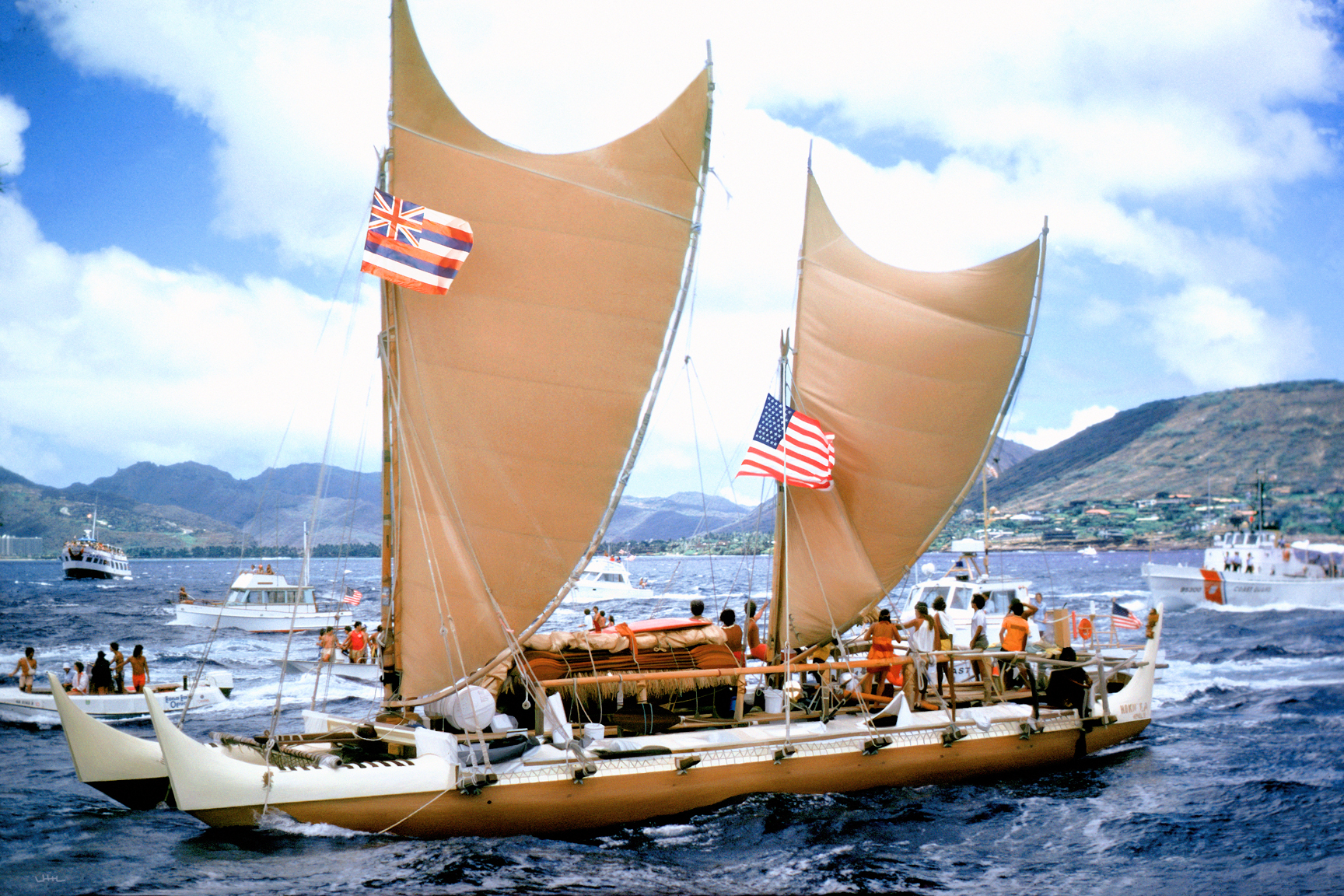
When the Polynesian Voyaging Society relaunched the practice in 1976 with the double-hulled canoe Hōkūleʻa, no living Hawaiian retained the unbroken tradition. Mau Piailug was brought from Satawal to navigate the maiden voyage to Tahiti, and the modern revival of the discipline — now extending to multiple voyaging canoes operating across the Pacific, including Hikianalia, Hōkūalakaʻi, and the Aotearoa-built Te Aurere — descends from the techniques he taught. Piailug, who said before his death in 2010 that he had transmitted the knowledge specifically because he feared its extinction in his own home culture, made the modern Polynesian voyaging revival possible. The system he taught is the same system, in its essentials, that Lapita navigators used three thousand years before.10
The package
The Lapita carried not just technology but an entire transportable subsistence base. The diagnostic Lapita agricultural package included taro, yams, breadfruit, bananas, sugarcane, paper mulberry (for bark cloth), and several greens; the diagnostic animal package included pigs, chickens, and the Polynesian dog. They carried, less deliberately, the Pacific rat (Rattus exulans), which would become a major factor in the ecological consequences of every Lapita and post-Lapita arrival.11
This package allowed the colonisation of essentially any Pacific island with rainfall sufficient to support a tropical horticultural regime. An island that was empty when the first canoe arrived could, within a generation or two, support a self-sustaining village of horticulturalists. The cargo manifest of a Lapita colonisation canoe was a transplantable civilisation in miniature.
The waves
The Lapita expansion proper — the eastward spread from the Bismarck Archipelago into Remote Oceania — happened fast, by archaeological standards. The earliest Lapita sites in the Bismarcks date to around 1500–1350 BCE. By 1100 BCE Lapita pottery is in the Solomon Islands; by 1000 BCE in Vanuatu, New Caledonia, and Fiji; by 950 BCE in Tonga; by 900 BCE in Samoa.1 The Lapita arc — Bismarcks to Samoa — was traversed in roughly five centuries.
Then there was a long pause. From around 800 BCE to around 200 CE, the descendants of Lapita Austronesians remained in Western Polynesia (Tonga, Samoa, ʻUvea, Futuna) without expanding further east. The dentate-stamped pottery tradition declined and disappeared; the proto-Polynesian language differentiated from the broader Oceanic Austronesian substrate; chiefdoms developed; a distinct Polynesian cultural identity formed.12
The second wave began later than was once supposed and accelerated through the early second millennium CE. Recent radiocarbon work — most consequentially the Wilmshurst, Hunt, Lipo and others 2011 PNAS chronology and a 2022 update by Jacomb and colleagues — has substantially compressed the Eastern Polynesian colonisation timeline.13 Around 1000–1150 CE the Marquesas and the Society Islands are settled from Western Polynesia; from there, fanning outward, came Hawaiʻi (initial settlement around 1000–1100 CE), the Tuamotus, the Cooks, the Australs, and Mangareva. Around 1150–1250 CE Polynesians reached Rapa Nui, the most isolated inhabited place on Earth. The last great voyage was to Aotearoa around 1280 CE, on which the 2022 PNAS chronology converged with high precision.13
By 1300 CE every habitable island in the Polynesian triangle had been settled. The largest empty habitat on Earth had been filled in by a single language family, descended from a single material-cultural complex, in roughly twenty-eight centuries — perhaps fifty-six generations.
What changed and what was replaced
The Lapita-derived languages
The Polynesian languages — about forty distinct named languages, mutually intelligible to varying degrees, all descending from Proto-Polynesian which itself descended from the Oceanic branch of Austronesian — are spoken today by approximately two million people across the Pacific.[12, 14] Their continuity from the Lapita expansion is documented at every level.
Proto-Polynesian was spoken in the Tonga-Samoa-ʻUvea-Futuna region around 500–300 BCE, after the Lapita pottery tradition had passed but while the population descended from the Lapita expansion was still confined to Western Polynesia. From it descend Tongan and Niuean (the Tongic branch), and Nuclear Polynesian, the latter giving rise to Samoan, the Outliers (Polynesian-language enclaves in Melanesia and Micronesia), and the Eastern Polynesian languages — Marquesan, Tahitian, Hawaiian, Māori, Rapanui, Mangarevan, and the rest. The Bayesian phylogenetic methods of the past two decades, applied to the lexical data assembled in the POLLEX database initiated by Bruce Biggs in 1965, have confirmed the basic shape of this tree with greater precision than the older comparative method alone allowed.14
The Polynesian languages are not just descendants. They are still the languages of the great-great-many-greats-grandchildren of the Austronesian Lapita coloniser. A Hawaiian speaker, a Samoan speaker, and a Māori speaker can identify cognates across their languages with a few hours of conversation. The unity is, by historical-linguistic standards, recent and dense — comparable, in its time depth, to the unity of the Romance languages, but with a far larger geographical span.
The cultural elaboration
What the Polynesians did with the Lapita inheritance was elaborate it. The same agricultural package — taro, yam, breadfruit, banana, sugarcane, pig, chicken, dog — was adapted to ecologies as different as Hawaiian volcanic high islands, Tuamotuan coral atolls, Aotearoa's temperate forests, and the increasingly arid Rapa Nui. Where the package could not run (Aotearoa was too cold for breadfruit and bananas; Rapa Nui's tree cover collapse made many crops difficult), the Polynesian colonisers improvised: in Aotearoa, the kūmara (sweet potato) was cultivated alongside introduced fern root and locally hunted moa and seal; on Rapa Nui, a carefully managed stone-mulched gardening system maintained productivity in degraded soils.
The kūmara is itself a piece of evidence that Polynesian voyaging extended further than even the Polynesian triangle. Sweet potato is a South American cultigen; its diffusion into Eastern Polynesia by around 1000–1100 CE — with a Polynesian cognate (kūmara, ʻumara, kuala) tracing to the Quechua-Aymara kʼumar/kʼumara — is the strongest evidence for a pre-Columbian Polynesian voyage to the South American mainland and back.15 The voyage happened before sustained European contact; the cultigen and the loanword arrived together; the sweet potato was being cultivated in Aotearoa, in Hawaiʻi, and across Eastern Polynesia centuries before Columbus crossed the Atlantic.
The political institutions elaborated from a Lapita-derived chiefdom substrate also varied. Hawaiʻi developed the most stratified Polynesian society — a god-descended high chiefdom with elaborate kapu (taboo) systems, a priestly class, hereditary commoners, and corvée labour for the construction of the great heiau temples. Tahiti, Tonga, and Samoa developed ranked chiefdoms with substantial ritual and military function. The Marquesas, in some periods, dissolved their chiefdoms entirely under demographic pressure and reverted to warlord regimes. Aotearoa's Māori, encountering an ecological setting more like the temperate forests of Korea or Japan than the tropical island ecologies of their voyaging ancestors, adapted to a cooler, harder environment by inventing the fortified pā village and developing a warrior-focused culture different in important ways from any other Polynesian society.
The transmission of rats and the transformation of forests
The Polynesian rat (Rattus exulans) reached every settled Polynesian island either deliberately as a food source or accidentally as a stowaway. It is a small rodent that climbs well and can swim, but more relevantly is an opportunistic omnivore that eats everything from seeds and fruits to bird eggs and chicks to the chitin of small crabs. Its arrival on islands whose evolutionary history had not selected for defence against ground-mammalian predation produced the most rapid faunal change of any of the post-Lapita biological introductions.11
Janet Wilmshurst's 2008 PNAS analysis of rat-gnawed seeds and rat-bone radiocarbon dates from Aotearoa fixed Polynesian arrival there to within a 50-year window around 1280 CE — earlier estimates of an arrival as early as 200 CE collapsed under the new chronology.13 Throughout the Polynesian triangle, the same approach has tightened the colonisation chronology and confirmed the same pattern: the rat arrives essentially with the first canoe. Within a generation, ground-nesting birds disappear. Within several generations, the soils show forest clearance and the bone middens fill with the bones of birds and turtles taken in numbers their populations cannot sustain.
The substrate becomes the canon
Three thousand years after the first dentate-stamped pottery sherds were fired in the Bismarck Archipelago, the cultural lineage that descended from them now defines a quarter of the planet's surface and a population of perhaps two million.1 The Polynesian languages are the languages of those islands. The Polynesian voyaging tradition, broken in most places by the early nineteenth century under missionary pressure and reasserted in the late twentieth via the Hōkūleʻa programme and its successors, is still navigable by the methods Mau Piailug taught — and is now actively retaught in Hawaiʻi, Aotearoa, Rarotonga, Tahiti, and Sāmoa. The marae and heiau ceremonial complexes of Western Polynesia, Tahiti, and Hawaiʻi, the wharenui meeting houses of Aotearoa, the tatau tattoo traditions of Sāmoa and Tonga, the moai of Rapa Nui — these are the inheritance of an Austronesian Lapita expansion that began on a beach in the Bismarck Archipelago a hundred and fifty generations ago.
The transmission was a continuous one. There is no point at which the Lapita ended and the Polynesian began; the language tree, the material-cultural sequence, and the genetic lineage are all continuous. The conventional break point — Western Polynesia after roughly 800 BCE, when the dentate-stamped pottery tradition is no longer being made — is a stylistic shift within a single cultural lineage, not a discontinuity between two. The people are the same people. The boats are the same boats, evolving. The stars are the same stars.
What the cost was
The avian apocalypse of Hawaiʻi
The most thoroughly documented Polynesian-arrival ecological transformation is Hawaiʻi's. Before Polynesian settlement around 1000–1100 CE, the Hawaiian avifauna comprised at least 113 endemic species — products of more than thirty million years of speciation in isolation, including a remarkable radiation of flightless ground-dwelling birds whose ecological niche was, in the absence of mammalian browsers, that of the small herbivores and insectivores that fill comparable niches on continents.16
Smithsonian palaeornithologists Storrs Olson and Helen James, whose excavations across the Hawaiian Islands from the 1970s onward revealed a fossil avifauna previously unknown to science, documented the loss. Before Polynesian arrival there were flightless ibises in the genus Apteribis. There were goose-sized ducks of the genus Thambetochen. There were at least seven species of giant flightless rails. There were two large flightless ducks. There were innumerable smaller species — finches, honeyeaters, drepanidines (Hawaiian honeycreepers), thrushes — many of which left the fossil record without ever having been documented by nineteenth-century naturalists.16
The losses, by Olson and James's accounting, totalled at least fifty endemic species extinguished before European arrival in 1778, with most of those losses concentrated in the first several centuries of Polynesian occupation. The drivers were habitat conversion as Polynesians cleared lowland forest for agricultural terraces and pig forage; introduction of the Polynesian rat, dog, and chicken, all of which ate eggs and chicks; and direct hunting of the larger and more conspicuous species, which would have offered a calorie-rich and easily caught food source for newly settled communities. The lowland dry forests of the leeward Hawaiian islands, in which most of the flightless avifauna lived, had been substantially converted by the time Captain Cook's ships sighted Kauaʻi in 1778. The species he and his naturalists recorded were the survivors of a four-century extinction event already nearly complete.
The moa of Aotearoa
Aotearoa's experience was, if anything, even more concentrated. The two main islands of the New Zealand archipelago supported, at the time of Polynesian arrival, nine species of moa (large flightless ratites of the genera Dinornis, Anomalopteryx, Megalapteryx, and others), the largest reaching three metres in standing height and 230 kilograms in body mass. Moa had been the dominant terrestrial herbivores of the forest for tens of millions of years; the only previous large terrestrial fauna in the absence of mammals was the giant Haast's eagle (Hieraaetus moorei), which preyed on moa from the air.17
Atholl Anderson's Prodigious Birds (1989) and a generation of subsequent moa-hunting site excavations established the chronology. The first Polynesian arrivals around 1280 CE began an intensive moa-hunting phase. Within roughly a hundred and fifty years — a period whose end Holdaway et al.'s 2014 Nature Communications radiocarbon analysis of moa eggshell pinpointed at around 1430–1450 CE — every species of moa was extinct.18 The Haast's eagle, which had depended on moa as prey, went with them. So did several other species of large flightless and ground-nesting birds, including the New Zealand swan, the giant gallinule of the genus Aptornis, and the Eyles' harrier.
The hunting was not gentle and it was not slow. Moa kill sites in the South Island show concentrations of butchered birds in single occupation horizons, with the lower legs and upper-body bones culled and the rest abandoned, suggesting hunting for prime cuts at population densities the moa could not sustain. The South Island human population that participated in this hunt was, on Holdaway's modelling, never more than a few thousand people across the entire island — but it took only that to drive the moa to extinction in five generations.18
The other Pacific extinctions
The Hawaiian and Aotearoa cases are documented in unusual depth, but the pattern is general. Across the Pacific, the work of David Steadman and others — building on Olson and James's Hawaiian baseline and on parallel programmes in the Marquesas, Mangaia, Easter Island, Henderson Island, and elsewhere — has estimated that between several hundred and as many as two thousand species of birds, depending on assumptions about the true endemic fauna of small islands whose pre-human biota was never recorded, were extinguished as a consequence of Polynesian and Lapita-era arrival.19 The pattern repeats: ground-nesting and flightless species first; large-bodied species second; smaller and more cryptic species variably; the surviving populations are the lineages whose evolutionary history had selected for behavioural traits — flight, nest concealment, predator avoidance — that the rats and pigs and humans could not easily defeat.
The Pacific extinction event is, by some measures, the largest avian extinction event of the Holocene. It was not concentrated. It was distributed across thousands of islands and centuries of human movement. But cumulatively, the Lapita-Polynesian colonisation of the Pacific was the largest single biotic transformation of any region's avifauna in the past ten thousand years — larger than any of the better-known continental Holocene extinction events, larger than the European arrival in the Americas would later effect on a faster timescale.
Rapa Nui and the deforestation question
The Rapa Nui case is the textbook example — in Jared Diamond's 2005 Collapse and in much of the popular literature derived from it — of a Polynesian society that destroyed its own ecological base and suffered demographic and political collapse as a consequence.20 The narrative as Diamond set it: Polynesian settlers arrive on Rapa Nui around 1100 CE in a forested landscape supporting a population that grows over four hundred years to perhaps fifteen thousand; the forest is cut for the production and transport of moai (the great stone statues); deforestation is complete by around 1500 CE; soil erosion, agricultural collapse, and starvation precipitate inter-clan warfare and a population crash; by 1722 when the Dutch first sight the island, the population has fallen to perhaps two or three thousand.
The revisionist position — most extensively developed by Terry Hunt and Carl Lipo in The Statues That Walked (2011) and a series of subsequent papers — challenges the trajectory at most points.21 Hunt and Lipo argue that the deforestation was driven primarily not by moai construction but by the Polynesian rat, which eats palm-tree seeds and prevents forest regeneration; that Rapa Nui's pre-1722 population was much smaller than Diamond's narrative supposes; that the moai construction continued long after deforestation rather than driving it; and that the catastrophic population crash on Rapa Nui happened after European contact and was driven primarily by introduced disease, by the Peruvian slave raids of 1862–63 that abducted or killed approximately half the surviving population, and by the colonial-era depredations that followed.
The current scholarly position is unsettled. The Hunt–Lipo revisionism has shifted the field; the Diamond synthesis is no longer the consensus. But the general fact of pre-contact deforestation is not in dispute — the question is what drove it and what its demographic consequences were. The cost of the Polynesian arrival on Rapa Nui includes the deforestation, the loss of the endemic palm (Paschalococos disperta), and the displacement of every nesting seabird species from the main island; whether it includes a Diamond-style ecocidal collapse, separate from the catastrophe European contact later inflicted, is the question of the field. The honest reading of the evidence at present is that Rapa Nui's pre-contact ecological transformation was substantial, that its pre-contact human cost was real but smaller than the older synthesis claimed, and that the bulk of the demographic catastrophe Europeans found in 1722 had not yet occurred — the catastrophe Europeans found was the one Europeans were about to inflict.
Inter-island and intra-island violence
The picture of Polynesian colonisation that comes from late ethnography and oral tradition is not one of peaceful village life. Tongan dynasties projected naval power across Western Polynesia for centuries; the Tuʻi Tonga maritime imperium briefly extended its reach to ʻUvea, Futuna, and parts of Samoa. Tahitian and Hawaiian inter-chiefdom warfare during the centuries before European contact involved fortified positions, large-scale battles, and ritualised human sacrifice. Aotearoa's Māori built fortified pā villages by the thousand from at least 1500 CE onward, and the great pre-European Māori inter-tribal wars of the seventeenth and eighteenth centuries produced casualty and displacement totals that, while never well counted, are generally reckoned in the tens of thousands across the period.
These costs were borne by Polynesians on other Polynesians. They are not the cost of the Lapita-Polynesian transmission to a third party — there was no third party — but they are the cost of the institutions and the population pressures that Polynesian society generated as it filled the empty habitat. The Lapita and their heirs were, in the colonisation, doing something humans had never done before. They were taking land that was unowned because no human had ever stood on it. The cost was paid by the species that lived there before the canoes arrived: the moa, the Hawaiian flightless rails and ducks, the giant gallinules, the seabird colonies of the central Pacific, the endemic palm of Rapa Nui, the lowland dry forests of every leeward archipelago. These species had no claim that any human institution had yet learned to recognise. The cost was cashed against them and entered, irreversibly, in the ledger of the islands.
What survived, and what did not
What survived: the deep-forest endemics, the cryptic species, the high-altitude refuges. What did not: the megafauna, the flightless ground species, the seabird colonies of accessible-shore islands, the lowland dry forests. The pattern is the pattern of every human colonisation of an empty habitat in deep time, but compressed in the Pacific into the briefest interval and clearest documentation of any of the global cases. Aurignacian Europe required forty thousand years to lose its mammoth steppe. Late-Pleistocene North America required two thousand years to lose its sloth-and-mammoth megafauna. Aotearoa lost the moa in a hundred and fifty years; Hawaiʻi, in the four centuries following 1000 CE, lost a third to a half of every endemic bird lineage that had evolved across thirty million years.
The Lapita and their heirs gave the Pacific an inhabited civilization. They paid for it in birds, in forests, in soils, and in ecosystems that had never before encountered a primate or a rat. The bill was paid by life-forms whose names, in many cases, the colonisers never had a chance to learn — because by the time linguists or naturalists arrived to record what was there, what was there was already gone.
The transmission stands: a Polynesian world spanning a quarter of the planet, descended in straight cultural and demographic line from a Bismarck Archipelago beachhead three thousand years ago, the largest single sustained ocean-spanning cultural sphere in the human record. So does the cost.
What followed
-
-1400Earliest dentate-stamped Lapita pottery fired in the Bismarck Archipelago, c. 1500–1350 BCE: the diagnostic ceramic horizon of the Austronesian colonisation wave begins.
-
-1050Lapita arrival in Vanuatu, New Caledonia, and Fiji, c. 1100–1000 BCE: the first humans set foot on previously uninhabited Remote Oceanian archipelagoes.
-
-900Lapita arrival in Tonga and Samoa, c. 950–900 BCE: the eastern terminus of the first Lapita expansion wave; the Western Polynesian homeland forms.
-
-400Proto-Polynesian language differentiates from Oceanic Austronesian substrate, c. 500–300 BCE: the linguistic ancestor of the forty modern Polynesian languages forms in the Tonga–Samoa region.
-
1100Marquesas and Society Islands settled from Western Polynesia, c. 1000–1150 CE: the Eastern Polynesian dispersal begins after a thousand-year pause.
-
1050Hawaiʻi colonised, c. 1000–1100 CE: the northernmost corner of the Polynesian triangle settled across roughly 3,800 km of open ocean from the Marquesas.
-
1200Rapa Nui colonised, c. 1150–1250 CE: the most isolated inhabited place on Earth reached by Polynesian voyagers from Eastern Polynesia.
-
1280Aotearoa / New Zealand colonised, c. 1280 CE: the southwesternmost corner of the Polynesian triangle settled — the latest major Polynesian landfall, fixed to within a fifty-year window by rat-bone and rat-gnawed-seed radiocarbon analysis.
-
1440Moa of Aotearoa hunted to extinction, c. 1430–1450 CE: nine species of large flightless ratite eliminated within roughly 150 years of human arrival; the Haast's eagle that preyed on them goes with them.
-
1976Hōkūleʻa launched, 1975, and sails from Hawaiʻi to Tahiti under traditional non-instrumental navigation, 1976: the modern Polynesian voyaging revival inaugurated, navigated by Mau Piailug of Satawal.
Where this lives today
References
- Kirch, Patrick V. *On the Road of the Winds: An Archaeological History of the Pacific Islands before European Contact*. Revised and Expanded Edition. Berkeley: University of California Press, 2017. en
- Spriggs, Matthew. *The Island Melanesians*. The Peoples of South-East Asia and the Pacific. Oxford: Wiley-Blackwell, 1997. en
- Kirch, Patrick V. *The Lapita Peoples: Ancestors of the Oceanic World*. The Peoples of South-East Asia and the Pacific. Cambridge, MA: Wiley-Blackwell, 1997. en
- Bellwood, Peter. *First Migrants: Ancient Migration in Global Perspective*. Chichester: Wiley-Blackwell, 2013. Chapters on the Austronesian expansion synthesise the Taiwan-out-of-Asia archaeological and linguistic evidence. en
- Skoglund, Pontus, Cosimo Posth, Kendra Sirak, Matthew Spriggs, Frederique Valentin, Stuart Bedford, et al. "Genomic insights into the peopling of the Southwest Pacific." *Nature* 538 (2016): 510–513. en primary
- Sand, Christophe. *La Nouvelle-Calédonie pendant la période Lapita: synthèse archéologique des sites du sud de la Grande Terre*. Les Cahiers de l'Archéologie en Nouvelle-Calédonie 12. Nouméa: Service des Musées et du Patrimoine de Nouvelle-Calédonie, 1999. fr
- Sand, Christophe. "The specificities of the 'Southern Lapita Province': the New Caledonian case." *Archaeology in Oceania* 35.1 (2000): 20–33. en
- Irwin, Geoffrey. *The Prehistoric Exploration and Colonisation of the Pacific*. Cambridge: Cambridge University Press, 1992. en
- Johns, Dilys A., Geoffrey J. Irwin, and Yun K. Sung. "An early sophisticated East Polynesian voyaging canoe discovered on New Zealand's coast." *PNAS* 111.41 (2014): 14728–14733. en primary
- Howe, K. R., ed. *Vaka Moana: Voyages of the Ancestors — The Discovery and Settlement of the Pacific*. Honolulu: University of Hawaiʻi Press, 2007. Includes Ben Finney's chapter on ocean sailing canoes and Geoffrey Irwin's chapter on navigation. en
- Athens, J. Stephen, Timothy M. Rieth, and Thomas S. Dye. "A Paleoenvironmental and Archaeological Model-Based Age Estimate for the Colonization of Hawaiʻi." *American Antiquity* 79.1 (2014): 144–155. Documents the Bayesian model that places initial Hawaiian settlement at AD 940–1130 and the role of *Rattus exulans* in deforestation chronology. en primary
- Pawley, Andrew. "Polynesian Languages: A Subgrouping Based on Shared Innovations in Morphology." *Journal of the Polynesian Society* 75.1 (1966): 39–64. The foundational paper of modern Polynesian historical linguistics, distinguishing the Tongic and Nuclear Polynesian branches. en
- Wilmshurst, Janet M., Terry L. Hunt, Carl P. Lipo, and Atholl J. Anderson. "High-precision radiocarbon dating shows recent and rapid initial human colonization of East Polynesia." *PNAS* 108.5 (2011): 1815–1820. Updated by Jacomb et al., "A new chronology for the Māori settlement of Aotearoa (NZ) and the potential role of climate change in demographic developments," *PNAS* 119.46 (2022): e2207609119. en primary
- Greenhill, Simon J., Robert Blust, and Russell D. Gray. "The Austronesian Basic Vocabulary Database: From Bioinformatics to Lexomics." *Evolutionary Bioinformatics* 4 (2008): 271–283. Documents the Bayesian phylogenetic methods now standard in Austronesian and Polynesian historical linguistics, building on the POLLEX comparative database initiated by Bruce Biggs in 1965. en
- Roullier, Caroline, Laure Benoit, Doyle B. McKey, and Vincent Lebot. "Historical collections reveal patterns of diffusion of sweet potato in Oceania obscured by modern plant movements and recombination." *PNAS* 110.6 (2013): 2205–2210. en primary
- Olson, Storrs L., and Helen F. James. "Prodromus of the fossil avifauna of the Hawaiian Islands." *Smithsonian Contributions to Zoology* 365 (1982): 1–59. The foundational catalogue of pre-contact Hawaiian endemic bird species, since extended in Olson and James, "Descriptions of Thirty-Two New Species of Birds from the Hawaiian Islands," *Ornithological Monographs* 45–46 (1991). en primary
- Anderson, Atholl. *Prodigious Birds: Moas and Moa-Hunting in Prehistoric New Zealand*. Cambridge: Cambridge University Press, 1989. en
- Holdaway, Richard N., Morten E. Allentoft, Christopher Jacomb, Charlotte L. Oskam, Nancy R. Beavan, and Michael Bunce. "An extremely low-density human population exterminated New Zealand moa." *Nature Communications* 5 (2014): 5436. en primary
- Steadman, David W. "Prehistoric Extinctions of Pacific Island Birds: Biodiversity Meets Zooarchaeology." *Science* 267.5201 (1995): 1123–1131. Synthesises bird-extinction data across the Polynesian, Micronesian, and Melanesian Pacific. en
- Diamond, Jared. *Collapse: How Societies Choose to Fail or Succeed*. New York: Viking Press, 2005. Chapter 2 lays out the conventional Rapa Nui ecocidal-collapse synthesis, against which Hunt and Lipo's revisionist position has been developed. en
- Hunt, Terry L., and Carl P. Lipo. *The Statues That Walked: Unraveling the Mystery of Easter Island*. New York: Free Press, 2011. The principal book-length statement of the Hunt–Lipo revisionist case against the Diamond ecocide model. en