The Mongols made Eurasia one road after 1250 — and it ran both ways
A relay network, a metal safe-conduct tablet, a state-merchant partnership and a continental census turned twelve hostile polities into a single licensed commercial circuit. Silver moved in step from London to Bengal. Chinese medicine became legible in Persian. And the same protected corridor delivered Yersinia pestis to the Black Sea.
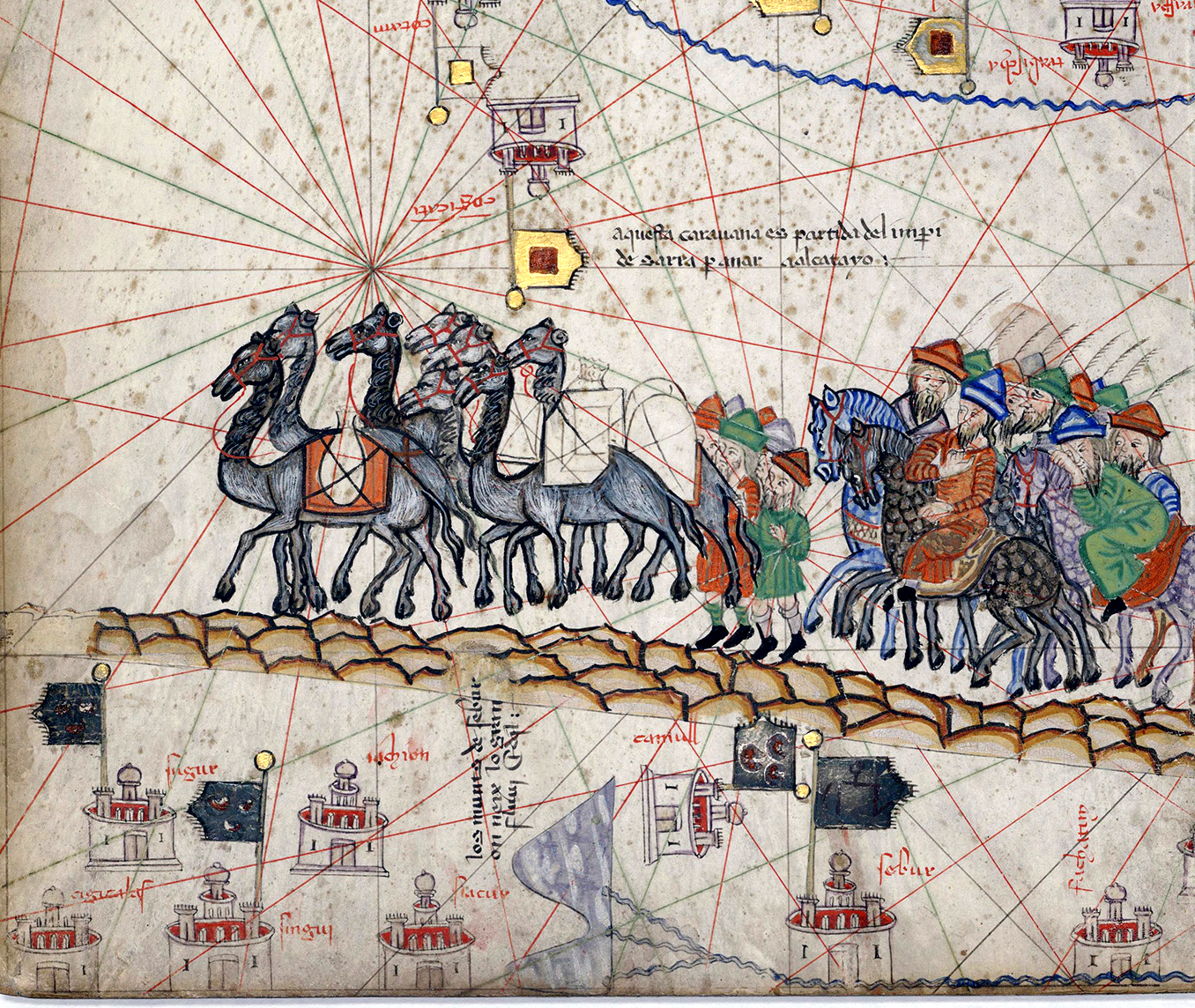
In 1218 the governor of Otrar seized a Mongol-financed caravan of some four hundred and fifty merchants and killed them, and the campaign that followed destroyed the cities of Khorasan. Within a generation the empire that had emptied those cities was selling safety along the roads between them: relay stations every twenty to forty miles, iron tablets warning that “he who has not respect shall be guilty”, and the khans' own silver invested in merchant syndicates. For roughly a century a Florentine factor could be paid in Tabriz and a Persian astronomer salaried in Dadu, and silver output at the London mint tracked the Bengal rupee. The corridor carried gunpowder west and astronomy east. In 1346 it carried plague to Caffa.

Before: a Eurasia that traded in segments
In the year 1200 no one had ever crossed Eurasia end to end under a single authority, and nobody expected to. Goods did travel from the Yellow River to the Rhine — Chinese silk reached Cairo, Baltic amber reached Samarkand, Indian pepper reached Novgorod — but they travelled the way water travels through a chain of buckets. A Sogdian or Uyghur caravaneer carried a load from Turfan to Kashgar and sold it. A Khwarazmian merchant carried it to Nishapur and sold it. A Baghdadi factor moved it to Aleppo; a Venetian took it from Acre. Each transfer was a sale, each sale carried a margin, and each border carried a toll, a bribe, or a risk of confiscation. Janet Abu-Lughod's reconstruction of the thirteenth-century world economy describes not one system but eight overlapping circuits, joined at the seams by intermediaries who guarded their positions and knew nothing certain about what lay two links up the chain 19.
The seams were political. Between Latin Europe and China lay, in 1200, the Song and Jin dynasties in mutual hostility, the Tangut Xia, the Qara-Khitai, the Khwarazmian empire, the Qipchaq confederations, the Rus' principalities, the Ayyubid and Seljuq lands, the Byzantine remnant, and the Crusader states — each with its own coinage, its own customs regime, its own idea of who counted as a protected merchant. There was no legal instrument enforceable across two of them, let alone twelve.
The relay that stopped at every border
Every organised state in the region ran messengers, and every such system stopped at the frontier. The Abbasid and later Islamic barīd, whose history Adam Silverstein traces from its Persian and Roman antecedents, was a genuine achievement of pre-modern communication: stations, remounts, a chief postmaster who doubled as an intelligence officer, and a legal fiction that the roads belonged to the caliph 16. But the barīd served the caliph and no one else. So did the Song courier system in China, and so did the messenger arrangements of the Rus' principalities. A merchant could not use any of them. A merchant with urgent news sent his own man on his own horse, and paid for the horse, and accepted that the man might not arrive.
The consequence was a specific kind of ignorance. Prices could not be arbitraged across the continent because prices could not be known across the continent. Contracts could not be enforced at a distance because there was no distant authority obliged to enforce them. Partnerships stopped where the partners' personal networks stopped — the Jewish and Karimi merchant families of the Indian Ocean and the Genoese commenda both worked precisely because they substituted kinship and reputation for a legal order that did not exist above the level of the individual state.
What a merchant could and could not do in 1200
It is worth being exact about the pre-transmission condition, because the change is otherwise invisible.
- Could: form a partnership under Islamic qirāḍ or Italian commenda terms, with an investor's capital and a travelling partner's labour, valid within one legal culture.
- Could: buy protection from a specific ruler for a specific journey, revocable at that ruler's pleasure and worthless one frontier away.
- Could not: obtain a credential that obliged strangers in a foreign polity to feed his animals, replace his mounts, and guarantee his life.
- Could not: transmit a commercial letter across the continent at any predictable speed.
- Could not: expect any authority to investigate his murder or recover his goods more than a few weeks' travel from home.
- Could not: settle accounts against a unit of value that a counterparty four thousand kilometres away would recognise.
The last of these mattered most and is the least intuitive. There was no continental unit of account. Silver circulated everywhere, but as bullion of varying fineness under local names and local assay conventions; Chinese payments ran increasingly on paper and copper, Islamic lands on the dinar-dirham pair, Latin Europe on a pullulating mass of local silver pennies. Value could be converted at every seam, at a cost, by someone who made his living from the conversion.
The maritime alternative, and why it mattered
The overland picture is only half the pre-transmission condition. By 1200 the more dynamic long-distance system in Eurasia was not the caravan road at all but the sea: the Song dynasty's maritime bureaus at Quanzhou and Guangzhou, the Indian Ocean network of Gujarati, Tamil, Arab and Persian shippers running to Aden and Kilwa, and the Karimi merchants who moved Indian pepper through the Red Sea into Mamluk Egypt and thence to the Italians. Abu-Lughod's model gives the sea circuits precedence for exactly this reason: they carried more, more cheaply, and they were not hostage to a single frontier's politics 19.
The sea also had its own protection problem, but it was solved differently. Maritime states sold anchorage and safe harbour rather than transit. A shipper needed a relationship with the port authority at each end, not with everyone in between. That is why the maritime system could function across mutually hostile polities while the land system could not: an ocean has no toll gates.
This matters for reading what followed. The Mongol integration did not create long-distance Eurasian trade — that already existed and was growing. What it created was a land alternative competitive with the sea for the first time in centuries, and it did so by supplying, on the road, the one thing the road had never had: a single guarantor. When the guarantor failed in the 1360s, traffic did not vanish. It went back to the water, where it had been going anyway, and Europe's fifteenth-century obsession with finding a sea route to the Indies is in part the memory of a land route that had briefly worked and then closed.
Categories that did not yet exist
Three ideas that would be commonplace by 1300 had no institutional existence in 1200. The first was transit as a licensed status — the notion that a traveller might carry, on his person, a portable warrant of imperial protection valid across thousands of kilometres and multiple subject peoples. The second was the state as commercial partner — not as taxer, protector, or occasional monopolist, but as a silent investor taking equity risk in private caravans. The third was continental fiscal legibility — a register of households, adult men, fields, herds, vineyards and orchards compiled to a common standard from the Yellow Sea to the Caucasus.
Each of these arrived within fifty years. None of them arrived as a gift.
The transmission: how an empire manufactured, and then sold, safety
Otrar, 1218: the caravan that started it
The integration of Eurasia began with a commercial atrocity. In 1218 Chinggis Khan, having subdued the Qara-Khitai lands and reached the Khwarazmian frontier, sent a trading caravan of roughly four hundred and fifty merchants — Muslims, financed with Mongol capital — to the city of Otrar on the Syr Darya. Inalchuq, the governor, seized the caravan, accused its members of espionage, and killed them. Chinggis sent envoys demanding redress; they too were executed, one killed outright and the others sent back with their beards burned off. ʿAṭā-Malik Juvaynī, writing a generation later as a Persian administrator in Mongol service, understood exactly what had been set in motion: the Khwarazmshah Muḥammad, he records, had "opened a door of which a thousand thousand would not suffice to close" 13.
The Khwarazmian campaign of 1219–1221 followed. What is worth noticing, and what the standard telling of the Pax Mongolica usually leaves out, is that the Mongol imperial interest in trade did not begin after the conquests as a policy of reconstruction. It preceded them, and it was the pretext for them. The empire that would later guarantee merchants had first gone to war over merchants.
The jam: a nervous system laid over conquered ground
The instrument of integration was the relay network the Mongols called the jam and the Turkic-speaking world called the yam. Ögödei ordered its systematic construction in 1234 and Möngke extended it; by the end of Qubilai's reign in 1294 the network in China alone comprised, according to the Yuan registers as summarised in modern scholarship, more than fourteen hundred stations supported by roughly fifty thousand horses, fourteen hundred oxen, eighty-five hundred mules and donkeys, fifty-seven hundred camels, four hundred carts, and some seven thousand dogs for sledge haulage in the north 5.
Stations stood at intervals of roughly twenty to forty miles — a day's hard ride. Each was obliged to hold remounts, fodder, provisions, and lodging in readiness. Crucially, the stations were not funded from the imperial treasury. They were funded by a levy in kind and in service on the settled cultivators of the district through which the road ran, who supplied the horses, the grain, and the labour. This is the first cost of the integration and it was continuous rather than dramatic: a peasant in Khorasan or Shanxi paid for the merchant's remount every year of his working life, and never used the road.
The jam was not built for merchants. It was built for despatches, tax convoys, army movement, and the circulation of the imperial family's own agents. Merchants were beneficiaries of a military communications system, which is a different thing from being its purpose — and it is the reason the benefits could be, and eventually were, withdrawn.
The paiza: authority you could carry in your hand
The credential that converted imperial favour into portable, enforceable protection was the paiza, known in Mongolian as the gerege: an inscribed tablet in iron, silver, or gold, worn on a cord and produced on demand. The Metropolitan Museum of Art holds a late-thirteenth-century example in iron with silver inlay, eighteen centimetres high, its openwork inscription in the Phakpa script devised by the Tibetan monk Phakpa (1235–1280), imperial preceptor at Qubilai's court. The text is not a request. It reads: "By the strength of Eternal Heaven, an edict of the Emperor. He who has not respect shall be guilty."
That sentence is the entire governance transmission in twelve words. It does not describe a right the bearer possesses; it describes a punishment awaiting anyone who fails to honour him. Protection under the Pax Mongolica was not a legal entitlement enforceable by a court. It was the shadow of a threat, delegated to a private person, and it worked precisely as well as the threat behind it remained credible.
Ranks of paiza were graded by metal and by the beast's head cast at the top — tiger, gerfalcon, plain. Ghazan's reforms in Iran after 1300 cancelled all tablets more than thirty years old, reduced them to two ranks, and had the bearer's name inscribed on the tablet itself to stop the resale of imperial authority as a commodity 15. That reform is evidence of the abuse it corrected: for decades, paiza had been trafficked, and men who had bought them had been requisitioning horses and provisions from villages that had no means of refusal.
The ortogh: the khan as silent partner
The commercial arm of the system was the ortogh — from the Turkic ortaq, "partner" — the institution through which the Mongol aristocracy became the capital partner of merchant syndicates. Elizabeth Endicott-West's study of the ortogh in Yuan China describes an arrangement in which princes, empresses, and imperial sons-in-law advanced silver from their appanage revenues to merchant associations, who traded it and returned a share; the state added tax exemptions, paiza, access to the relay stations, and, when a caravan was robbed, compensation from the treasury 9.
The economic effects were precise:
| Instrument | What it changed | Who bore the cost |
|---|---|---|
| Jam relay stations | Predictable transit speed and remounts | Settled cultivators along the route, by levy |
| Paiza tablets | Portable, cross-border protection | Districts obliged to supply bearers on demand |
| Ortogh partnership | Pooled capital, socialised caravan risk | Appanage populations whose silver was lent out at interest |
| Imperial compensation for robbery | Removed the tail risk of long-distance trade | The treasury, and therefore the taxed |
| Möngke's census, 1252–59 | Made taxation legible across the empire | Everyone counted |
Möngke's census is the least visible and most consequential item on that list. Thomas Allsen's study of Möngke's policies shows the enumerators registering not merely households but adult men between fifteen and sixty, fields, livestock, vineyards, and orchards, across north China, Iran, the Caucasus, and the Rus' lands, to a common imperial standard 2. A state that knows what its subjects own can tax them at a fixed rate rather than by extortionate demand. It can also find them.
The western hinge: the Jochids and the Black Sea
The road had to end somewhere a Latin merchant could reach, and it ended in the territory of the Jochid ulus — the khanate that Russian and later Western historiography came to call the Golden Horde. Marie Favereau's reconstruction of that polity argues against reading it as a predatory tributary state living off Rus' silver: the Jochid khans, on her account, ran a deliberate and sophisticated commercial policy, farming out the Black Sea ports to Italian operators, taking a cut of the traffic, and pursuing a diplomatic alignment with Mamluk Egypt against the Ilkhans that had the effect of keeping the northern and southern routes in competition rather than under one hand 10.
The concessions were specific and dated. Genoa took Caffa in the Crimea from the 1260s; Venice took Tana at the mouth of the Don; both operated under grant, both paid, and both could be — and periodically were — expelled. The Mongol khans were not passive landlords of a trade they did not understand. They were licensors who knew exactly what the licence was worth, and Jean-Paul Roux's synthesis of the empire's political history makes the point that the fiscal logic of the Chinggisid state ran on precisely this kind of farmed, delegated extraction rather than on direct administration 20.
Prajakti Kalra's survey of the period's commercial institutions notes the consequence for the merchants themselves: their status was not a right but a franchise, and it made them, in every khanate, dependent clients of a court 11. That dependency is the reason the Pax Mongolica has no afterlife as an institution. When the courts went, nothing was left standing that the merchants owned.
The men who made it work were not Mongols
The empire had no bureaucratic tradition of its own and no embarrassment about that fact. Its chanceries were staffed with Uyghur scribes, Khitan and Chinese administrators, Persian financiers, and Muslim tax farmers, and the resulting administrative culture was a composite that belonged to none of its contributors. Thomas Allsen's central argument in Culture and Conquest in Mongol Eurasia is that the Mongols were not passive conduits through which other people's ideas happened to pass, but active and interested sponsors who moved specialists deliberately, in both directions, because they wanted what those specialists knew 1.
The paradigm case is Bolad Aqa — Pūlād Chīngsāng in the Persian sources — a Mongol of the Dörben tribe raised in Qubilai's household administration, sent west to the Ilkhanate in 1285 as the Great Khan's resident representative, and never recalled. He remained in Iran until his death in 1313. It was Bolad who supplied Rashīd al-Dīn with the Mongol dynastic material for the Jāmiʿ al-tawārīkh, and Bolad who carried Chinese agronomic, medical, and administrative practice into Persian discussion 4. In the other direction came the astronomer Jamāl al-Dīn, who arrived at Qubilai's court in 1267 with a set of instruments and a calendar, and who was given charge of an Islamic astronomical bureau in 1271 1.
What changed, and what was displaced
One unit of account from London to Bengal
The most startling measurable effect of the integration is monetary, and it was only fully described in this century. Akinobu Kuroda, examining mint output across the landmass, found that between 1276 and 1359 silver became abundant "across the Eurasian continent, from England to Korea", and then scarce again in the 1360s — and that "the annual silver output from the London mint and the yearly silver rupee issued in Bengal moved virtually in tandem, arguably as a result of the Mongol empire lifting silver out of the lower tiers of the market and maintaining its flow along the highways of long-distance trade" 6.
Two mints, nine thousand kilometres apart, in polities with no diplomatic relationship, moving together. Kuroda's conclusion is that the empire, by lowering commercial barriers and driving silver upward into a high-level settlement circuit, "created a horizontal unity that, on the surface, was continent-wide" 6. In his later synthesis for the Cambridge History of the Mongol Empire he puts the mechanism more plainly still: the Mongol regime established "a common unit of account denominated in silver for long-distance exchanges across the Eurasian landmass" 5.
The qualification in that sentence — for long-distance exchanges — is the whole of the argument's honesty. Kuroda is explicit that the shared silver accounting "did not seriously affect the methods of exchange at ground level" 5. A villager in Fars or Fujian went on paying in copper, in grain, in labour. The integration was real and it was thin. It joined the top of every market it touched and left the bottom exactly where it was.
Tabriz and Dadu: two libraries facing each other
The knowledge exchange that followed the commercial and postal integration was not diffuse. It ran between a small number of institutions with named patrons and datable products.
At Marāgha in Azerbaijan, Hülegü founded an observatory in 1259 under Naṣīr al-Dīn al-Ṭūsī, staffed with astronomers drawn from across the Islamic world and — the Persian sources record — at least one Chinese specialist. At Dadu, Qubilai's Islamic astronomical bureau ran alongside the Chinese one, and Guo Shoujing's Shoushi calendar, promulgated in 1281, fixed the tropical year at 365.2425 days, a value not bettered in Europe until the Gregorian reform three centuries later. At Tabriz, Rashīd al-Dīn built the Rabʿ-i Rashīdī, a suburb-sized foundation with hospital, madrasa, scriptorium, and library, staffed with scholars recruited from Egypt, Syria, Anatolia, and China 21.
Out of the Rabʿ-i Rashīdī came the Tansūqnāma-yi Īlkhān dar funūn-i ʿulūm-i khatāʾī — "The Treasure Book of the Ilkhan on the Sciences and Techniques of Cathay" — completed in 1313: the earliest substantial account of classical Chinese medicine produced anywhere west of China, containing translated tracts on pulse diagnosis and Chinese pharmacology rendered into Persian by a team working with Chinese informants 21. Out of the same milieu came Rashīd al-Dīn's description of Chinese block printing, the earliest such notice by a non-Chinese author 15.
Religions on the imperial road
Nothing travelled the corridor more freely than religion, because the empire had no doctrinal position to defend and a positive interest in collecting clergy of every kind. Mongol rulers exempted religious professionals of all confessions from taxation and corvée, patronised them competitively, and staged formal debates between them for entertainment and information. The result was a half-century in which missionaries and monks moved along a road built for tax convoys.
The traffic ran in both directions and the names are recoverable:
- John of Plano Carpini, Franciscan, reached Güyük's enthronement at Sira Ordu in 1246 as Innocent IV's envoy and came back with a letter demanding the pope's submission.
- William of Rubruck, Franciscan, reached Möngke's court at Karakorum in 1254 and left the most acute European ethnography of the century, including his account of the debate the khan staged between Christians, Muslims and Buddhists.
- Rabban Bar Ṣawma, a Nestorian monk of Öngüt origin born near Dadu, travelled the other way as the Ilkhan Arghun's ambassador in 1287–88, celebrated the Eucharist before Philip IV in Paris, met Edward I of England in Gascony, and received communion from the hands of Pope Nicholas IV in Rome.
- John of Montecorvino, Franciscan, reached Khanbaliq in 1294, built churches there, and was appointed its archbishop by Clement V in 1307 — a Latin see in the Mongol capital of China.
The traffic reshaped the rulers as much as the ruled. Qubilai made the Tibetan monk Phakpa his imperial preceptor and gave the Sakya order authority in Tibet, embedding Tibetan Buddhism in the Yuan court and, through it, in the political history of Inner Asia for six centuries. In the west the movement went the other way: Ghazan converted to Islam on his accession in 1295, and Öz Beg carried the Jochid ulus into Islam in the 1320s. Peter Jackson's argument about that conversion is worth stating precisely — it did not resolve the tensions between Mongol customary law and the sharīʿa, and infidel rule remained a live grievance in the Muslim sources, but the conversion of the Chinggisid successor states is nonetheless one of the largest single expansions in the history of Islam 7.
Timothy May's summary of the period's transfers puts religion alongside gunpowder and printing as a category the empire moved without intending to, precisely because the imperial posture toward doctrine was indifference rather than tolerance 22. Indifference is a weaker thing than tolerance and it lasted exactly as long as it was useful; but for two generations it was the most permissive religious environment on the landmass.
The Italians on the Black Sea
At the western end, the Genoese and the Venetians took concessions from the Jochid khans — Caffa in the Crimea from the 1260s, Tana at the mouth of the Don — and from those footholds their factors moved inland. Nicola Di Cosmo's reassessment insists on a distinction the romantic version elides: the maritime republics as governments had limited and cautious interests in Mongol Asia, while it was private merchants, dependent on Mongol favour rather than on Genoese or Venetian power, who actually travelled and traded in Central Asia and China 8.
The best-known European document of the integration was written by a man who never made the journey. Francesco Balducci Pegolotti, a factor of the Bardi bank of Florence, compiled his Pratica della mercatura between about 1335 and 1343 as a working handbook, and opened his account of the eastern route with a sentence that has been quoted ever since: "The road you travel from Tana to Cathay is perfectly safe, whether by day or by night, according to what the merchants say who have used it" 14.

Read the whole entry and the reassurance narrows considerably. Pegolotti goes on to warn that if a merchant dies en route or in Cathay, everything he carries falls to the local lord unless a brother or a close companion is present to claim it — and that in the interval between the death of one lord and the proclamation of his successor, the roads become unsafe for Franks 14. That is not a description of a legal order. It is a description of a personal one, in which safety is an attribute of a living ruler and lapses when he does.
What the integration displaced
New systems do not fill a vacuum; they take a place that something else was occupying. The Mongol commercial order displaced a good deal, and the displaced parties were rarely the ones who benefited.
- The intermediary trading peoples. The chain-of-buckets model had sustained a whole class of specialist middlemen — Sogdian, Uyghur, Khwarazmian, Armenian — whose living came from controlling one link. Direct transit under imperial licence removed the rent on several links at once. Some of those communities converted themselves into imperial servants and prospered; others simply lost their function.
- The Islamic legal frame for commerce. Qirāḍ partnership and the qāḍī's enforcement did not vanish, but in Mongol territory they were subordinated to the yasa and to the khan's licence, and Muslim merchants who wanted the road took their protection from a non-Muslim ruler on that ruler's terms 7.
- Urban self-government in Iran and Central Asia. Cities that had negotiated with sultans as corporate bodies dealt now with a tax-farming apparatus backed by a garrison, and their bargaining position never recovered.
- The old caravan cities themselves. Otrar, Balkh, Merv and Nishapur were not restored to what they had been. Traffic moved along routes the empire chose to police, and the cities the empire did not choose went into a decline from which several never emerged 12.
- The Song maritime alternative. Chinese long-distance trade had been shifting decisively toward the sea before the conquest. The Yuan reoriented a share of it inland toward the imperial road network, an artificial redirection that lasted exactly as long as the empire did.
Gaykhatu's paper money: the transmission that failed
The clearest evidence that this was a transmission of governance — and not a general levelling of Eurasian culture — is the case where the transmission was attempted and refused.
The Yuan ran on paper. The Zhongtong notes issued from 1260 were denominated in silver, initially backed by a reserve, and legally enforced as the medium of tax payment; by the 1280s Qubilai's administration had gone further toward a pure fiat system than any state in the world would go again for six hundred years. In September 1294 the Ilkhan Gaykhatu, facing an empty treasury after a cattle plague and heavy court spending, ordered the wholesale importation of the model: notes printed on the Chinese pattern, carrying both Chinese characters and the Muslim profession of faith, declared legal tender in Tabriz on pain of death.
The Tabriz market simply closed. Merchants shuttered their premises rather than accept the notes; food disappeared from the bazaar; within roughly two months the experiment was abandoned entirely. Gaykhatu was deposed and killed on 24 March 1295. The institutional package that had transferred so successfully — relay, tablet, partnership, census — stopped dead at fiat currency, because paper money is the one instrument on the list that requires the holder to believe in the state's future rather than merely to fear its present.
What the cost was
Khorasan, 1220–1221
The road through eastern Iran was policed by an army that had emptied the cities along it, within living memory of the merchants who used it.
The Khwarazmian campaign that followed the Otrar killings destroyed the urban civilisation of Khorasan in eighteen months. Merv surrendered in February 1221 and its population was led out onto the plain and killed; Nishapur was stormed in April 1221 after Chinggis's son-in-law Toquchar was killed by an arrow from the walls, and the killing there was systematic and total, extended to cats and dogs by the chroniclers' account. Herat, Balkh, Bamiyan, Gurganj: the same.
The medieval numbers are enormous and are not demographic statements. Juvaynī gives 1,747,000 dead at Nishapur; Ibn al-Athīr gives 700,000 at Merv 13. Modern scholarship treats these as literary constructions — the largest cities of the region held perhaps 150,000 to 200,000 people at their height, and the figures function in the chronicles as an idiom of incomprehensible loss rather than a count. Vasily Barthold's foundational study of Turkestan under the Mongol invasion, published in 1900 and still the starting point for the region's historiography, established both the scale of the urban destruction and the unreliability of the numbers used to express it 12.
Correcting the arithmetic is not the same as reducing the event. The honest statement is this: several of the largest cities in the eastern Islamic world were destroyed with most of their inhabitants inside them, over about two years, and their irrigation systems — the qanats and canal networks on which Khorasani agriculture depended and which required continuous skilled maintenance — went unrepaired because the people who maintained them were dead. The region's agricultural carrying capacity fell and stayed down for centuries. That is a slower and larger cost than the massacres, and it has no body count at all.
Baghdad, February 1258
Hülegü's army reached Baghdad in January 1258 and took it in February. The caliph al-Mustaʿṣim was executed on 20 February — by the usual account rolled in a carpet and trampled by horses, so that royal blood would not touch the ground — ending the Abbasid caliphate of Baghdad after five centuries. The city's libraries, canal head-works, and much of its built fabric were destroyed. The death toll appears in the sources at figures from ninety thousand to eight hundred thousand and cannot be recovered; Peter Jackson's assessment of the whole body of evidence is that the Mongol impact on the Islamic world was neither the civilisational annihilation of the older literature nor the benign integration of the revisionist one, and that the sources do not permit the precision either camp wants 7.
What can be stated precisely is institutional. The office that had provided the Sunni world's formal centre of legitimacy for five hundred years ceased to exist in a fortnight. The eastern Islamic world was governed thereafter, for two generations, by a non-Muslim dynasty that taxed the ʿulamāʾ like everyone else and extended the same protection to Nestorian Christians, Buddhists, and Jews — a policy of even-handed indifference that contemporaries experienced as the loss of a world.
The bill the roads themselves presented
Even in the peaceful decades the system extracted continuously, and the extraction fell on people who did not travel.
- The relay levy. Every station's horses, fodder, carts, and staff came from the surrounding district as a service obligation, not a purchase.
- Requisition by paiza holders. Envoys and licensed merchants could demand mounts and provisions; the volume of abuse is measurable from the scale of Ghazan's corrective legislation after 1300 15.
- Tax farming. Ortogh merchants who had lent silver to princes recovered it by buying the right to collect taxes, then collecting more.
- The qubchur poll tax, assessed on the census rolls, payable in silver by populations whose economies were not monetised at the household level.
- Forced relocation of specialists. Craftsmen — weavers above all — were deported wholesale from Central Asia and Iran to workshops in Mongolia and north China. Allsen's study of Mongol textile production traces entire communities of Persian and Central Asian weavers resettled at Xunmalin and elsewhere to produce the gold-brocaded nasīj the court demanded 3.
Item five deserves emphasis because it is the transmission mechanism made visible: some of the cultural exchange the Pax Mongolica is celebrated for consisted of skilled people being marched two thousand miles under guard.
The Tian Shan, 1338
The last cost is the one the integration is least often charged with, and it is the largest.
In 2022 a team led by Maria Spyrou published genomes recovered from bodies in two cemeteries in the Chüy valley of northern Kyrgyzstan — Kara-Djigach and Burana — where an unusual cluster of tombstones is dated to 1338 and 1339 and several inscriptions name pestilence as the cause of death. The recovered Yersinia pestis strain is the most recent common ancestor of the great diversification that produced the Second Plague Pandemic, and comparison with modern reservoirs in the wider Tian Shan supports a local emergence 18. These were not isolated pastoralists. The Chüy valley sat on the northern caravan road, and the community buried there was a trading one, with Syriac-inscribed stones and merchant names.
Monica Green's argument runs earlier and further. She holds that the pathogen's key diversification belongs to the thirteenth-century Mongol military expansion rather than to the peaceful commerce of the fourteenth, and that the pandemic's proper frame is not European but Eurasian and Indian Ocean-wide; her 2014 essay calls for a framework that "draws on new archeological, genetic, and historical researches to look for the presence of plague in the premodern Indian Ocean basin and East Africa, areas where it has previously not been suspected" 17. Green and the Spyrou team are not fully reconcilable — one dates the critical branching to the conquests, the other dates the immediate ancestor of the pandemic strain to the 1330s — and the honest position is that the disagreement is live.
What both accounts share is the mechanism. Plague is endemic in Central Asian rodent populations and had been for millennia without becoming a world event. What was new in the thirteenth and fourteenth centuries was a continuous, high-volume, protected, animal-borne transport system running from those reservoirs to the Black Sea, and from the Black Sea to every port in the Mediterranean. In 1346 the Jochid army besieging the Genoese colony of Caffa carried the disease to the Crimean coast; in October 1347 Genoese galleys carried it into Messina; within six years between twenty-five and fifty million people were dead in Latin Europe alone, with comparable mortality across the Islamic Mediterranean.
1360: the road closes
The integration lasted roughly a century and then came apart quickly, and the failures were mutually reinforcing.
| Date | Event | Effect on the circuit |
|---|---|---|
| 1335 | Death of Abū Saʿīd; Ilkhanate fragments | Western terminus loses a single authority |
| 1338–39 | Plague deaths in the Chüy valley | Pathogen enters the caravan corridor |
| 1346 | Plague at Caffa during the Jochid siege | Disease reaches the Black Sea emporia |
| 1347–53 | Black Death across the Mediterranean and Europe | Demand and merchant populations collapse |
| 1350s | Yuan Zhizheng note issue; hyperinflation | Eastern terminus loses monetary credibility |
| 1351 | Red Turban rebellions in China | Interior routes become unsafe |
| 1360s | Silver contraction across Eurasia 6 | Settlement mechanism fails |
| 1368 | Yuan expelled from Dadu | The imperial licensing system ends |
By the 1370s the overland route was no longer a going commercial concern, and European merchants who wanted eastern goods bought them, once again, from intermediaries at Mediterranean ports. The circuit had dissolved back into its segments. What remained were the things that could not be un-transmitted: gunpowder weapons and blast-furnace metallurgy moving west, Persian astronomical method and Islamic mapping moving east, printing described in Persian, Chinese medicine legible in Tabriz, a European geographical imagination that now included Cathay as a real place with a real road to it — and a plague ecology that would return to European and Middle Eastern cities in waves for the next three hundred and fifty years.
The Mongol integration is the atlas's clearest case of a transmission whose benefits and costs cannot be separated into columns, because they moved along the same roads, under the same licences, at the same time. The merchant who reached Tabriz and the flea that reached Caffa were both travelling under the protection of Eternal Heaven, and neither of them was asked to choose.
What followed
-
1294The jam relay network reached more than fourteen hundred stations in Yuan China alone by 1294, supported by roughly fifty thousand horses, with the fodder, mounts, and labour levied from the cultivators of each district it crossed.
-
1252Möngke's census of 1252–59 registered households, adult men aged fifteen to sixty, fields, livestock, vineyards, and orchards to a common standard from north China to the Caucasus — the first continental-scale fiscal enumeration in Eurasian history.
-
1260The ortogh system made the Mongol aristocracy the silent capital partner of merchant syndicates, pooling caravan risk and compensating losses from the treasury, and so cut the cost of long-distance trade to a level not seen again until the age of marine insurance.
-
1276Silver output moved in near-synchrony between the London mint and the Bengal rupee between 1276 and 1359 — two mints nine thousand kilometres apart with no diplomatic relationship — before contracting together in the 1360s.
-
1313Rashīd al-Dīn's Tansūqnāma, completed at Tabriz in 1313, became the earliest substantial account of classical Chinese medicine produced west of China, and his Jāmiʿ al-tawārīkh carried the first non-Chinese description of block printing.
-
1221The Khwarazmian campaign of 1219–21 destroyed Merv, Nishapur, Herat, Balkh and Gurganj with most of their inhabitants, and left the qanat and canal networks of Khorasan without the skilled labour needed to maintain them; agricultural capacity in the region fell for centuries.
-
1258The Abbasid caliphate of Baghdad ended on 20 February 1258 with the execution of al-Mustaʿṣim, removing the Sunni world's formal centre of legitimacy after five centuries.
-
1294Gaykhatu's attempt to import Yuan paper money into Tabriz in September 1294 closed the city's markets within days and was abandoned within about two months; the Ilkhan was deposed and killed on 24 March 1295.
-
1347Yersinia pestis reached the Black Sea emporia along the protected caravan corridor, appearing at Caffa in 1346 and at Messina in October 1347; between twenty-five and fifty million people died in Latin Europe in the following six years.
-
1240Craft communities — Persian and Central Asian weavers above all — were deported wholesale to imperial workshops in Mongolia and north China to produce the gold-brocaded nasīj demanded by the court.
Where this lives today
References
- Thomas T. Allsen. Culture and Conquest in Mongol Eurasia. Cambridge Studies in Islamic Civilization. Cambridge: Cambridge University Press, 2001. en
- Thomas T. Allsen. Mongol Imperialism: The Policies of the Grand Qan Möngke in China, Russia, and the Islamic Lands, 1251–1259. Berkeley: University of California Press, 1987. en
- Thomas T. Allsen. Commodity and Exchange in the Mongol Empire: A Cultural History of Islamic Textiles. Cambridge: Cambridge University Press, 1997. en
- Thomas T. Allsen. “Biography of a Cultural Broker: Bolad Ch‘eng-Hsiang in China and Iran.” In The Court of the Il-khans 1290–1340, edited by Julian Raby and Teresa Fitzherbert. Oxford: Oxford University Press, 1996. en
- Akinobu Kuroda. “Economic Exchange: Money, Markets, and Taxation in Mongol Eurasia.” In The Cambridge History of the Mongol Empire, edited by Michal Biran and Hodong Kim, 488–524. Cambridge: Cambridge University Press, 2023. en
- Akinobu Kuroda. “The Eurasian silver century, 1276–1359: commensurability and multiplicity.” Journal of Global History 4, no. 2 (2009): 245–69. en
- Peter Jackson. The Mongols and the Islamic World: From Conquest to Conversion. New Haven: Yale University Press, 2017. en
- Nicola Di Cosmo. “Black Sea Emporia and the Mongol Empire: A Reassessment of the Pax Mongolica.” Journal of the Economic and Social History of the Orient 53, nos. 1–2 (2010): 83–108. en
- Elizabeth Endicott-West. “Merchant Associations in Yüan China: The Ortoǧ.” Asia Major, 3rd ser., 2, no. 2 (1989): 127–54. en
- Marie Favereau. The Horde: How the Mongols Changed the World. Cambridge, MA: Belknap Press of Harvard University Press, 2021. en
- Prajakti Kalra. “Pax Mongolica: Trade and Traders in the Mongol Empire.” Oxford Research Encyclopedia of Asian History. Oxford: Oxford University Press, 2020. en
- В. В. Бартольд. Туркестан в эпоху монгольского нашествия. Санкт-Петербург, 1900. [V. V. Barthold. Turkestan in the Epoch of the Mongol Invasion.] ru
- ʿAlāʾ al-Dīn ʿAṭā-Malik Juvaynī. The History of the World-Conqueror. Translated by John Andrew Boyle from the text of Mirza Muhammad Qazvini. 2 vols. Manchester: Manchester University Press / UNESCO Collection of Representative Works, 1958. fa primary
- Francesco Balducci Pegolotti. La pratica della mercatura, c. 1335–43. Translated in Henry Yule, Cathay and the Way Thither, vol. 3, revised by Henri Cordier. London: Hakluyt Society, 1914. it primary
- Rashīd al-Dīn Fażallallāh Hamadānī. Jāmiʿ al-tawārīkh. Translated by W. M. Thackston as Rashiduddin Fazlullah’s Jamiʿu’t-tawarikh: A History of the Mongols. Cambridge, MA: Harvard University, Department of Near Eastern Languages and Civilizations, 1998–99. fa primary
- Adam J. Silverstein. Postal Systems in the Pre-Modern Islamic World. Cambridge Studies in Islamic Civilization. Cambridge: Cambridge University Press, 2007. en
- Monica H. Green. “Taking ‘Pandemic’ Seriously: Making the Black Death Global.” The Medieval Globe 1, no. 1 (2014): article 4. en
- Maria A. Spyrou et al. “The source of the Black Death in fourteenth-century central Eurasia.” Nature 606 (2022): 718–24. en
- Janet L. Abu-Lughod. Before European Hegemony: The World System A.D. 1250–1350. New York: Oxford University Press, 1989. en
- Jean-Paul Roux. Histoire de l’Empire mongol. Paris: Fayard, 1993. fr
- Vivienne Lo, Persia Berlekamp, and Yidan Wang. “Administering Art, History, and Science in the Mongol Empire.” In Pearls on a String: Artists, Patrons, and Poets at the Great Islamic Courts. Baltimore and Seattle: Walters Art Museum and University of Washington Press, 2015. en
- Timothy May. The Mongol Conquests in World History. London: Reaktion Books, 2012. en