A Subarctic language walked south (c. 1400) and became Navajo
Some time after the ninth century, small bands of Athabaskan speakers left the forests of Alaska and north-western Canada and walked some 3,000 kilometres south into the Pueblo Southwest. From the Pueblos the ancestors of the Diné took maize, the loom, painted pottery and clans; other Apachean peoples took far less. Their descendants paid a heavy bill to Spanish slavers and an American army, and their language is still the most spoken Native tongue in the United States.
Around 1400, families of Athabaskan speakers whose relatives still hunted caribou in the Yukon reached the Pueblo Southwest, 3,000 kilometres from home. Their Navajo descendants named maize "enemy food", then made it sacred; by 1630 a Spanish friar called them "very great farmers". From the Pueblos they took the loom, pottery and clans, and became the Diné and the Apache peoples. The migration itself has no documented bill of conquest. Their descendants paid one later: the captive trade, the Long Walk of 1864 in which nearly a third of the prisoners died, the Chiricahua held 27 years as prisoners of war, and children punished for speaking the language that 161,174 people still speak.
Before: a Southwest of towns, and no one who spoke Athabaskan
A country emptied and refilled
In the middle of the thirteenth century the central Mesa Verde region, in the canyon country where Colorado, Utah, Arizona and New Mexico now meet, held a dense population of farmers living in cliff dwellings, canyon-head villages and great masonry towns. Then it emptied. A 2017 study led by Brian Kemp summarises the archaeological consensus: the population "peaked in the mid-1200s, was decreasing by no later than 1260 CE, and declined to zero by about 1280 CE".1 The causes are still argued over. Drought, the exhaustion of soils and wood, and violence among the farmers themselves all figure in the literature, and none is sufficient alone. What is not in doubt is where the people went. They moved south and east, to the Rio Grande valley, to the Zuni and Acoma country and to the Hopi mesas, where their descendants still live.12
The Southwest that resulted, between about 1300 and 1450, was a country of towns. Pueblo communities aggregated into large plaza villages of hundreds of rooms, built of stone or adobe around open courts and underground ceremonial chambers. They farmed maize, beans and squash on floodplains and terraces, grew cotton, kept turkeys, and made painted pottery in regional styles that archaeologists can date almost by the decade. Pueblo men wove cotton cloth on the upright loom.26 Trade ran east to the Plains, through towns such as Pecos, for bison hides and meat.223
Who was not there
What the Southwest of 1300 did not contain, as far as any evidence shows, was anyone who spoke an Athabaskan language. The peoples of the region spoke languages of several unrelated families: Uto-Aztecan (Hopi, and the O'odham to the south), Tanoan (Tewa, Tiwa, Towa), Keresan, and Zuni, which has no proven relatives at all. The language that would one day be spoken by more people than any other Native language in the United States had not yet arrived.
This absence matters to the record because an older explanation of the Four Corners collapse blamed it on the newcomers. In the early twentieth century it was common to imagine nomadic raiders, the ancestors of the Navajo and Apache, descending on the cliff dwellings and driving the farmers out. The chronology no longer allows it. The Crow Canyon Archaeological Center, which has excavated in the Mesa Verde region for four decades, states that "Athabaskan speakers arrived in the Southwest after A.D. 1450 and were in the Mesa Verde region by at least the early 1500s."2 That is some 170 years after the last Pueblo farmers left. Whatever emptied Mesa Verde, it was not the people this record follows.
The northern homeland
The people who would arrive belonged to a language family whose centre of gravity lay some 3,000 kilometres to the north-west. Athabaskan (also spelled Athapaskan; many of its speakers today call themselves Dene) is the largest family of the Na-Dene group, and most of its languages are spoken in interior Alaska and north-western Canada, from the Yukon and Mackenzie basins to the Hudson Bay drainage. Michael Krauss and Victor Golla, in the Smithsonian's Handbook of North American Indians, located the greatest internal diversity of the family in Alaska, which is the usual linguistic sign of a homeland.3
The northern Dene way of life was that of the western Subarctic: small, mobile bands that hunted caribou and moose, fished for salmon and whitefish, and moved across a landscape of spruce forest, muskeg and mountain. A 2020 review by Briana Doering and colleagues describes the long-term Athabaskan trajectory in the north as "a gradual shift toward resource specialization", centred on salmon and caribou.4 These were not farmers and had no reason to be. They had snowshoes, toboggans, birchbark and skin technologies, and a detailed knowledge of northern animals. The table below sets the two worlds side by side as they stood around 1300.
| Northern Dene, c. 1300 | Pueblo Southwest, c. 1300 | |
|---|---|---|
| Settlement | Mobile bands, seasonal camps | Aggregated towns of hundreds of rooms |
| Subsistence | Caribou, moose, salmon, whitefish | Maize, beans, squash, cotton, turkeys |
| Cloth | Tanned hides and furs | Cotton woven on the upright loom |
| Pottery | Little or none | Painted wares in dated regional styles |
| Language families | Athabaskan (and Eyak, Tlingit nearby) | Uto-Aztecan, Tanoan, Keresan, Zuni |
| Ceremony | Band-level ritual and healing | Organised societies, underground chambers |
What the Southwest lacked
Against this background the shape of the coming change is visible. The Pueblo world had towns, fields, looms and an elaborate ceremonial calendar; it had no large population of mobile hunters living between and around its towns, except on the southern Plains to the east, where bison hunting was spreading. The northern Dene had none of the Pueblo apparatus. When the two met, the traffic in ideas and goods would run overwhelmingly one way, from towns to newcomers. The traffic in people, raided, traded, adopted and married, would run in every direction, and it would end by binding the Southwest's peoples to one another and, later, to the colonial states that arrived after them.
The transmission: a northern language walks south
The proof is in the words
The Navajo and Apache peoples have no written record of a migration, and Diné tradition does not describe one. The case for a northern origin was first made from the languages themselves. In 1936 Edward Sapir, the foremost American linguist of his generation, published a short paper in American Anthropologist titled "Internal Linguistic Evidence Suggestive of the Northern Origin of the Navaho".5 Sapir looked for words in Navajo whose meanings had shifted in ways that only made sense if the speakers had once lived in a different environment. The most famous example is the word for maize. As Joseph Wilson summarises Sapir's argument, "the Navajo word for corn or maize ... now the most sacred plant in the Navajo cosmos, originally meant 'alien-food' or 'food of the enemy'".65 The people who would make corn pollen the centre of their ritual life named the plant, on first meeting it, as the food of strangers.
Harry Hoijer, Sapir's student, gave the southern languages their classification. In 1938 he divided them into a western group (Navajo, Western Apache, Chiricahua, Mescalero) and an eastern group (Jicarilla, Lipan and Plains Apache), and he later set Plains Apache apart on its own.76 All seven are closely related to one another and form a single branch within Athabaskan, which means they descend from one language spoken by one group of migrants, or by a few closely connected groups, not from several separate movements south.

Hoijer also tried to date the split. Using the method of glottochronology, now largely abandoned, he wrote in 1956: "It is somewhat surprising to find how little time is involved in the break-up of the Athapaskan languages--the earliest time of divergence is only about 1300 years ago. ... The movement of the Apachean languages southward appears to have begun somewhat later, about 1000 years ago and, if our dating is accurate, was not entirely complete until about 600 years ago."8 The anthropologist Alfred Kroeber responded that "Hoijer's 13 centuries thus comes as a shock", and Krauss later preferred a longer chronology of about two thousand years for the break-up of the family.63 Hoijer's numbers are no longer trusted, but his conclusion, that the southern languages left the north late and recently, has survived every revision.
The case for a northern origin now rests on four independent lines of evidence, each with its own weaknesses:
- Linguistic: the seven Apachean languages form one tight branch of a family whose greatest diversity lies in Alaska and north-western Canada, and Navajo vocabulary preserves northern meanings bent to southern objects;357
- Archaeological: moccasins, bows and bison-hunting assemblages with northern parallels appear in the intermontane West in the thirteenth century, at Promontory Caves in Utah;13
- Genetic: Southern Athabaskan populations show the signature of a small founding group that grew by absorbing its neighbours;19
- Documentary: Spanish observers describe Apachean peoples from 1541 onward, first as Plains bison hunters and then, by 1630, as farmers in the Dinétah.2325
Further back: the Siberian question
Since 2008 the linguist Edward Vajda has argued that the Na-Dene languages are related to the Yeniseian languages of central Siberia, of which only Ket survives.9 If he is right, the Navajo and Apache languages belong to a family whose two ends lie on opposite sides of the Bering Strait. The proposal has been widely discussed and sharply criticised. George Starostin, writing in the Moscow Journal of Language Relationship in 2012, concluded that "only a part of these comparisons stands proper historical criticism, and that this part, by itself, is insufficient to prove a specifically 'Dene-Yeniseian' link beyond reasonable doubt".10 The question does not affect this record directly. The southward migration happened inside North America, more than ten thousand years after any Siberian ancestors crossed into it.
Why they left
The cause of the migration is unknown, and the most famous explanation is now contested. Around 833–850 CE a volcano in the Wrangell–St Elias mountains of eastern Alaska erupted and spread what geologists call the White River Ash across a vast area of the southern Yukon. A 2014 study by Britta Jensen and colleagues traced the same eruption to ash layers in Greenland ice and northern Europe, more than 7,000 kilometres away.11 In 1974 the archaeologist William Workman proposed that the ashfall, which smothered the lichen and plants on which caribou and other animals fed, pushed Athabaskan groups out of the affected area. "Eventually," he wrote, "at the southern periphery of the Athabaskan world, some groups would have been detached to the south into the domain of alien peoples."126
The hypothesis is attractive because it supplies an event, a date and a mechanism. Its critics point out that there is no direct evidence of anyone leaving because of the ash. Wilson's 2011 review found "no firsthand evidence of migration in the wake of the volcano",6 and Doering and her colleagues argued in 2020 that the movement south was not a flight from catastrophe but "the result of demographic pressures" building over centuries.4 The most cautious summary is that the ash may have been one push among several, and that the decision to move was made many times over, by many small groups, across several generations.
The route: mountains or plains
How the migrants travelled is the oldest argument in Apachean archaeology. One school favours the Plains: a route down the eastern flank of the Rockies, through the bison country, entering the Southwest from the north-east. The other favours the intermontane West: a route down the corridor between the Rockies and the Great Basin, entering the Southwest from the north-west. The most important new evidence of the past decade comes from the second route.
In 1930–31 the anthropologist Julian Steward excavated two caves on Promontory Point, a peninsula on the north shore of the Great Salt Lake in Utah. He found a remarkable assemblage of moccasins, bison bone, gaming pieces, bows and arrows that did not resemble the Fremont farmers who had lived in the region before. In 2014 John Ives and colleagues published 45 new radiocarbon dates on the collections, mostly on moccasins. All the dates fall within a calibrated range of 1166–1391 CE, and statistical modelling concentrates the occupation into one or two generations, "centering on the interval running from ca. A.D. 1250–1290".13 A companion study of moccasin sizes found that "a relatively large proportion of children and subadults occupied the Promontory caves",14 the profile of families on the move rather than a hunting party.
Ives believes the Promontory people were ancestral Apacheans, on the evidence of their moccasin construction, their bows and their hunting practices, all of which have northern parallels. "These people were extremely effective large game hunters, specifically with bison," he told the Natural History Museum of Utah in 2016. "They were the cream of the crop."15 If he is right, Athabaskan speakers were in northern Utah by the 1250s, already living as bison hunters, a century or two before they appear in the Southwest proper. The two routes need not exclude each other. The eastern Apachean languages, spoken by peoples of the southern Plains, may reflect a Plains route; the western ones may reflect an intermontane route; and bands may have moved between them.
When they arrived
The date of arrival in the Southwest is as disputed as the route. The positions can be set out as a timeline:
| Date | Evidence | Source |
|---|---|---|
| 833–850 CE | White River Ash eruption in the Yukon; proposed trigger | Jensen et al. 2014; Workman 1974 |
| c. 950 | Start of the southward movement by glottochronology | Hoijer 1956 |
| 1250–1290 | Probable Apachean ancestors at Promontory Caves, Utah | Ives et al. 2014 |
| c. 1300 | Claimed Apache presence in the southern Southwest | Seymour 2012 |
| after 1450 | Athabaskan speakers in the Southwest | Crow Canyon |
| 1500s–1700s | Intensive Navajo occupation of the Dinétah | Towner 2008 |
| 1541 | First written description of Apachean people | Castañeda |
Deni Seymour, who has worked for decades on early Apache sites in southern Arizona and New Mexico, argues from dated hearths, roasting pits and storage platforms that Apachean bands were present from about 1300, two centuries earlier than the conventional date.1617 Her claim is contested, and the dated features are not universally accepted as Apache. In the Dinétah, the canyon country of north-western New Mexico that the Diné regard as their ancestral heartland, Ronald Towner's tree-ring work puts it plainly: "The date of the Navajo entry into the area remains the subject of debate, but there is abundant evidence of an intensive and extensive Navajo occupation of the area in the 1500s-1700s."18 The year this record uses, 1400, is a midpoint in a window that runs from the 1250s to the 1540s, not a dated event.
A small people that grew by taking others in
Genetics has added a third line of evidence. A 2003 study of mitochondrial DNA in Southwestern populations led by Ripan Malhi found that "the distribution of haplogroups in the Southwest is structured more by archaeological tradition than by language", and concluded that "Southern Athapaskans probably experienced a bottleneck followed by extensive admixture during the migration to their current homeland in the Southwest".19 In plain terms, the migrants were few, and they grew by marrying, adopting and capturing people from the populations they met. The Athabaskan language survived; much of the ancestry did not. At the continental scale, a 2019 ancient-DNA study in Nature by Pavel Flegontov and colleagues found that "Palaeo-Eskimo-related ancestry is ubiquitous among people who speak Na-Dene and Eskimo–Aleut languages", tying the deep ancestry of the Na-Dene family to the far north.20
The Diné account
This reconstruction is not the Diné one. In Diné tradition the people emerged through a succession of underworlds into the present Glittering World, and were placed by the Holy People within the four sacred mountains that bound their homeland. The creation narrative, the Diné bahaneʼ, translated by Paul Zolbrod in 1984, is the charter of Diné identity, ceremony and law.22 Jennifer Nez Denetdale, the first Navajo to earn a doctorate in history, has argued that Western scholarship on Navajo origins framed the Diné as late-arriving borrowers without a culture of their own.21 The atlas follows the linguistic and archaeological evidence for a northern origin, which is strong. It does not follow the inference that a people who learned from their neighbours were therefore less than their neighbours. Every people in this atlas learned from someone.
The first written sightings
The Apacheans enter the written record in 1541. Pedro de Castañeda de Nájera, who rode with Francisco Vázquez de Coronado's expedition onto the southern Plains, described a people his countrymen called querechos:
"a otras diez jornadas dieron en unas racherias de gente alarabe que por alli son llamados querechos ... esta gente biuen en tiendas de cueros de uacas adobados andan tras las uacas haciendo carne"
In George Parker Winship's 1896 translation: "After ten days more they came to some settlements of people who lived like Arabs and who are called Querechos in that region. ... These folks live in tents made of the tanned skins of the cows."23 They travelled, Castañeda added, "with their tents and troops of dogs loaded with poles", and wintered near the pueblo of Pecos, where they traded hides. Patricia Giménez-Eguíbar and Sonia Kania, in a 2021 study in Al-Qanṭara, show how the Castilian word alárabe turned these Plains hunters into Arabs for a Spanish reader, and identify the querechos as Plains Apaches.24 The first description of an Apachean people in any language is therefore a description of bison hunters with dog travois, trading with a pueblo: exactly the relationship the archaeology predicts.
What Castañeda's account fixes, for the first time in writing, can be listed:
- A name: querechos, applied by the Pueblos' neighbours and adopted by the Spanish;2324
- A dwelling: tents of tanned bison hide, carried from camp to camp;23
- A transport system: pack dogs dragging poles, the dog travois, in a world that did not yet have horses;23
- An economy: hunting bison and drying the meat, with hides and meat traded at Pecos for maize and cloth;23
- An outsider's frame: the comparison with Arabs, which tells a reader more about Castilian categories than about the people described.24
What changed and what was replaced
Enemy food becomes sacred food
By 1630 one group of Apacheans had changed beyond recognition. Fray Alonso de Benavides, the Franciscan custodian of New Mexico, reported to Philip IV of Spain on the peoples of the province and described a group he called the Apaches de Nauajó:
"...se topa con la Prouincia de los Apaches de Nauajó, que aunque son de la misma nació Apache que la antecedente, estan sugetos, y subordinados a otro Capitán mayor, y tienen distinto modo de viuir, porque los de atrás no sembrauan ... y estos de Nauajo son muy grandes labradores, que esso significa Nauajo, sementeras grandes."
That is: although they were of the same Apache nation as the others, they lived differently, "because those before did not sow", and these of Navajo were "very great farmers, for that is what Navajo means, great planted fields".25 Whatever the true origin of the name, Benavides recorded the essential fact. Within a few generations of their arrival, the ancestors of the Diné had adopted the maize agriculture of the Pueblos. Benavides also noted that they lived in earth-covered dwellings and kept shelters for their harvests, and that their province was "the most warlike of the whole Apache nation".25
Benavides's account of 1630 records, in a few lines, the distance the Diné had travelled from their northern origins:
- they were still counted as Apaches, "of the same Apache nation" as the hunters of the Plains;25
- they sowed, where the other Apaches "did not sow" and lived by hunting;25
- they were "very great farmers", and their name, he believed, meant "great planted fields";25
- they lived in dwellings dug into the earth and kept shelters for their crops;25
- they had their own war leader, distinct from that of the neighbouring Apache groups.25
The word Sapir analysed completes the circle. The plant the migrants had named as the food of enemies became, in Diné ceremony, the source of corn pollen, sprinkled in blessing and prayer. Crow Canyon summarises the scholarly view that "the Navajos learned farming and weaving from their Pueblo neighbors".2
The loom
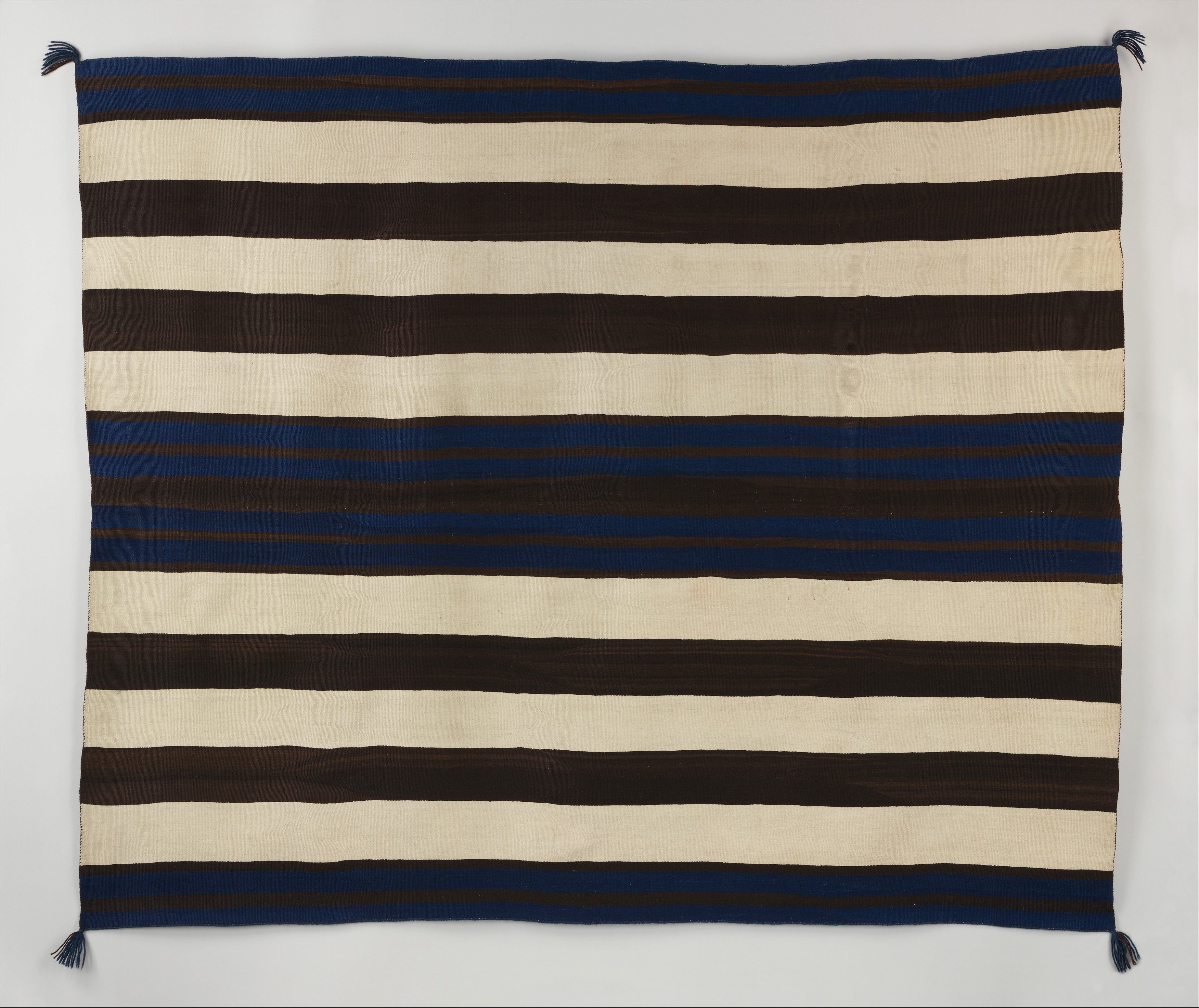
The second great transfer was weaving. Pueblo men had woven cotton on the upright loom for centuries. Diné women took up the same loom and, with the wool of the churro sheep that Spanish colonists brought into New Mexico after 1598, created one of the great textile traditions of the Americas. Kate Peck Kent's history of Navajo weaving dates the start of the tradition to about 1650, when loom processes were learned from the Pueblos, well before the Pueblo Revolt of 1680 that older accounts credited with the transfer.26 The hero image of this record shows the result two centuries later: a wool wearing blanket of 1840–60, in the banded style later called the "first phase" chief blanket, woven wider than long, in the undyed white and brown of the sheep and the indigo of colonial trade.
The weaving transfer can be laid out step by step:
- The tool: the upright loom, from Pueblo weavers, by about 1650;26
- The fibre: wool from churro sheep, brought by Spanish colonists, replacing Pueblo cotton;26
- The weavers: women, where the Pueblo weavers had been men;
- The market: by the eighteenth and nineteenth centuries, Diné blankets were trade goods valued across the Southwest and the southern Plains;26
- The form: banded and later terraced designs that became a Diné idiom distinct from any Pueblo source.
Pottery, clans, ceremony
Painted pottery followed the same path. Gobernador Polychrome, the characteristic painted ware of the Dinétah, was long assumed to have been made by Pueblo refugees fleeing the Spanish after 1680. The New Mexico Office of Archaeological Studies now records that "it has since been demonstrated that this type was first produced by Navajo potters at least 60 years prior to the Pueblo revolt".27 Crow Canyon notes that Navajo pottery of the period "was decorated with Pueblo-style designs".2
The Diné clan system, matrilineal and exogamous, absorbed outsiders as whole clans. A Franciscan missionary writing in 1911, Anselm Weber, recorded that "exogamous marriages ... especially with the neighbouring Pueblo Indians, captured or enslaved and eventually adopted into the tribe, are responsible for a number of clans".28 Ceremony borrowed as well. In 1909 the anthropologist Alfred Tozzer observed that "although the Navajos borrowed the idea of sand-paintings from the Pueblo peoples, they have successfully developed them into an elaborate and fixed ritual of their own".29 Whether the masked Holy People of Diné ceremony owe anything to Pueblo katsina practice is still debated, and the atlas takes no position.
1680 and the pueblitos
On 10 August 1680 the Pueblos rose against Spanish rule in what is arguably the most successful Indigenous revolt in North American history. The Penn Museum's account records that "Four hundred and one settlers and 21 friars lost their lives in the uprising", and that the Pueblo people acted "along with their Navajo and Apache allies".30 The Spanish were driven out of New Mexico for twelve years. When Diego de Vargas returned in 1692, some Pueblo families fled their towns, and older histories described a mass migration of Pueblo refugees into the Dinétah, where they supposedly built the stone towers and small fortified houses called pueblitos and taught the Diné their crafts.
Towner's dendrochronology, based on more than a thousand tree-ring samples, overturned that story. The pueblitos were built by Navajos, in the late seventeenth and eighteenth centuries, as defences against Ute raiders, and are "neither temporally nor spatially related to Puebloan immigration or the Spanish Reconquest".31 The borrowing from the Pueblos was real, but it was the work of a century and more of neighbourly contact, trade, intermarriage and captivity, not of a single refugee wave. By the 1750s and 1760s Ute and Spanish raiding had forced most Navajos out of the Dinétah, westward into the country around Canyon de Chelly and the Chuska mountains that became the heart of the later Navajo Nation.218
Seven languages, many ways of life
The Athabaskan migrants did not become one people. The seven Apachean languages correspond to peoples who took different amounts from their neighbours and lived in different ways:
| People | Branch | Way of life by the 1700s |
|---|---|---|
| Navajo (Diné) | Western | Farming, herding sheep and goats, weaving; Pueblo-influenced clans and ceremony |
| Western Apache | Western | Some maize, beans and squash, but gathering and hunting dominant |
| Chiricahua | Western | Hunting, gathering, limited agriculture, raiding |
| Mescalero | Western | Hunting, gathering, mescal roasting, raiding |
| Jicarilla | Eastern | Mixed farming and Plains bison hunting |
| Lipan | Eastern | Plains and Texas bison hunting, later horse raiding |
| Plains Apache | Separate | Plains bison hunting, allied with the Kiowa |
The National Park Service describes the Chiricahua as having "subsisted mainly by hunting large game, gathering plant foods, and practicing a limited amount of agriculture".32 The difference between the Diné and the Chiricahua is the difference that contact with the Pueblos made. Both spoke closely related languages carried from the same northern source; one became a nation of farmers, herders and weavers, the other remained a people of hunters and raiders.
What the transmission displaced
The record of what was displaced runs in two directions.
- For the migrants: the subarctic toolkit of caribou fences, snowshoes and birchbark gave way to maize fields, sheep and the loom; Athabaskan words were bent to name a new world, so that "enemy food" became corn;56
- For the Pueblos: the towns were no longer alone. Seymour's formula is that "Instead of thinking about the Southwest as a world of sedentary farmers, we should think about these Pueblo communities existing in a sea of nomadic peoples";17
- For the region's language map: an entirely new family was added to the four already present, and it would become the largest;
- For Pueblo trade: the Plains trade in hides and meat, already old, now ran through Apachean hands, at fairs in Pecos and Taos;2333
- For Pueblo security: neighbours who traded at one season could raid at another, and Pueblo towns became participants in a regional economy of raiding and ransom.
What the cost was
The bill of the migration itself
The southward movement of Athabaskan speakers has no documented bill of conquest. No source, archaeological or documentary, shows the newcomers destroying Pueblo towns, and the chronology clears them of the thirteenth-century collapse with which they were once charged.12 The migrants were few, as the genetic bottleneck shows, and they grew by absorbing others.19 Some of that absorption was marriage and adoption. Some was capture. The early relationship between Apacheans and Pueblos combined trade and raiding in proportions that varied with the season, the harvest and the band, and the sources do not allow those proportions to be counted.
The cost of this record therefore lies mostly downstream, in what happened to the peoples the transmission created once they were caught between Spanish, Mexican and American states. That cost was very large, and it fell on the descendants of the migrants, not on those they met. It was inflicted by colonial states, not by the transmission. The atlas lists it here because the record would be dishonest without it, and rates the transmission's own bill accordingly.
The captive economy
In colonial New Mexico, human beings were a currency. Spanish governors licensed trade fairs at Taos and Pecos where Plains and mountain peoples exchanged hides, meat and captives for horses, metal and cloth; Edward Flagler's study of these ferias de trueque traces their history from the late seventeenth century to the early nineteenth.33 Captives purchased at the fairs, or seized in raids, entered Hispanic households as criados, servants whose status lay somewhere between adopted child and slave. James Brooks's prize-winning study Captives and Cousins reconstructs this economy, in which, in the publisher's words, "a flourishing captive exchange economy within and among native American and Euramerican communities" ran from the Spanish colonial era to the end of the nineteenth century.34
Apacheans were on both sides of the trade. Navajo and Apache bands raided Pueblo and Hispanic settlements for livestock and captives; Navajo and Apache women and children were the commonest captives in Hispanic households. Brugge's compilation of Catholic parish records documents Navajo baptisms in New Mexico across almost two centuries, from 1694 to 1875.47 Within Navajo society, according to Jennifer Spear's summary of Brooks, "a slaveholding class emerged, with some headmen owning thirty or more slaves".35 Weber recorded in 1911 that "The number of Navajo captives in Mexican [families] in 1862 has been estimated between 1500 and 3000".28 Andrés Reséndez, whose The Other Slavery places the Southwest in a continental history of Indigenous bondage, estimates that "between 2.5 and 5 million Native Americans were enslaved between the time of Columbus and 1900".36
Canyon de Chelly and Hwéeldi
The American conquest of New Mexico in 1846 changed the scale of the violence. In 1863, after years of raiding and reprisal, the US Army under James Carleton ordered the Navajo removed to a reservation at Bosque Redondo, on the Pecos River in eastern New Mexico, which the Diné call Hwéeldi. Christopher "Kit" Carson led a scorched-earth campaign through the Navajo country. On 6 January 1864 he left Fort Canby with nearly 400 soldiers for Canyon de Chelly, the Navajo stronghold.37 In the same year, troops under Captain John Thompson destroyed the canyon's orchards, more than 3,000 mature peach trees by his own report.37 By March some 5,000 Navajos had surrendered, starving.37

The marches that followed are remembered as the Long Walk: some 300 miles on foot, in winter and early spring, in successive convoys, with hundreds dying on the road.39 About 9,000 Navajos reached Fort Sumner, where several hundred Mescalero Apaches were already held.39 The New Mexico Department of Cultural Affairs records that "More than 10,000 Navajo and Mescalaro Apache prisoners suffered here from 1863 to 1868" and that "Nearly one-third of the captives died during incarceration", in a camp of hunger, disease and bad water.38 The Mescalero, about 450 people, escaped in 1865.38 Howard Gorman, whose account was published in the 1973 collection Navajo Stories of the Long Walk Period, said simply: "As I have said, our ancestors were taken captive and driven to Hwééldi for no reason at all."39
The sequence of the campaign and the captivity can be set out year by year:
| Date | Event |
|---|---|
| 1863 | Carleton orders the Navajo removed to Bosque Redondo; Carson's scorched-earth campaign begins |
| 6 January 1864 | Carson leaves Fort Canby with nearly 400 soldiers for Canyon de Chelly |
| March 1864 | Some 5,000 Navajos have surrendered; the Long Walk convoys begin |
| Summer 1864 | Captain Thompson's troops cut more than 3,000 peach trees in Canyon de Chelly |
| 1864–1865 | About 9,000 Navajos held at Hwéeldi with several hundred Mescalero |
| 1865 | The Mescalero, about 450 people, escape the reservation |
| 1 June 1868 | Treaty signed at Fort Sumner; the Diné return to part of their homeland |
The camp failed on its own terms, and on 1 June 1868 the United States signed a treaty at Fort Sumner allowing the Diné to return to a reservation within their homeland.40 Denetdale, describing the choices her ancestors faced in the camp, put it as a question: "Will I die far away from my homeland or will I flee and go back to my homeland and die?"48
The Apache wars
The Apache peoples, who had taken least from the Pueblos and remained raiders, paid a different bill. On 30 April 1871 a party of Americans, Mexican Americans and Tohono O'odham attacked a camp of Aravaipa and Pinal Apaches who had settled under army protection near Camp Grant, Arizona, and killed 144 people, overwhelmingly women and children. Karl Jacoby's history of the massacre, Shadows at Dawn, follows the trial that followed, in which the attackers were swiftly acquitted.41
The Chiricahua were destroyed as a free people. The National Park Service records that "At the time of Chief Cochise, the Chiricahua Apache had numbered 1,200. At the end of the war, in 1886, they numbered 500. By their release they numbered only 261."42 After Geronimo's surrender in 1886 the Chiricahua were shipped as prisoners of war to Florida, then Alabama, then Fort Sill in Oklahoma. Many died of malaria and tuberculosis; children sent to the Carlisle Indian School died there. "In 1913," the Park Service continues, "after twenty seven years of imprisonment the Chiricahua were finally set free".42
The language punished and conscripted
The language that had walked south from the Yukon was the last thing taken. In the boarding schools of the late nineteenth and twentieth centuries, Navajo children were punished for speaking it. Dillon Platero, the first director of the Navajo Division of Education, described a pupil he called Kee who "was punished for speaking Navajo", "lost contact with his family", and became "non-lingual--a man without a language".43
The same language was then conscripted. In 1942 the Marine Corps recruited 29 Navajo men to build a code from Diné bizaad; "approximately 400 Americans became their nation's secret weapon during World War II – the Navajo Code Talkers", speaking on American radio nets in the Pacific a language that schools had punished children for using.44 Navajo remains the most widely spoken Native language in the United States, with 161,174 speakers in the 2017–2021 American Community Survey, roughly half of all speakers of Native North American languages, though Native-language use as a whole fell by 6 per cent between 2013 and 2021.45 In December 2024 the Navajo Nation made Diné bizaad its official language, and an executive order of January 2025 required that every written document of the Nation include at least one word or phrase in it.46
The ledger
The bill, set out plainly, with the transmission's own share distinguished from the costs that colonial states imposed on its descendants:
- The migration itself, c. 1250–1500: no documented conquest; the thirteenth-century Pueblo collapse predates the arrival;12
- Raiding and captivity, 1600s–1860s: a regional economy of raid and ransom in which Apachean, Pueblo and Hispanic communities took captives from one another, and in which Navajo and Apache women and children became the commonest captives in Hispanic households;343528
- Canyon de Chelly and the Long Walk, 1863–1868: thousands of peach trees cut, about 9,000 Diné marched to Hwéeldi, nearly a third of the captives dead;373839
- Camp Grant, 30 April 1871: 144 Aravaipa and Pinal Apaches killed, the killers acquitted;41
- The Chiricahua, 1886–1913: a people reduced from 1,200 to 261, held 27 years as prisoners of war;42
- The language, twentieth century: children punished for speaking it, then conscripted to fight in it.4344
Who paid
The transmission's own cost was modest, and its gains were large: a new language family in the Southwest, a people that made the Pueblos' corn, loom and clans its own, and a weaving tradition that is one of the glories of the continent. The people who paid the heavier bill were the descendants of the migrants, and they paid it to Spanish slavers, Mexican raiders and an American army, not to the Pueblos whose world they had entered. The Navajo who learned to farm from their neighbours had their peach trees cut down by soldiers who called them nomads. The Chiricahua who kept the older life of the hunter were imprisoned for a generation. And the language Sapir used to prove the northern origin, which named corn as the food of enemies, was beaten out of children in school and then asked to win a war. It is still spoken, by more people than any other Native language in the United States, and since 2024 it is the law of the Navajo Nation.
What followed
-
850An eruption in the Wrangell–St Elias mountains spreads the White River Ash across the southern Yukon (833–850 CE); archaeologists have proposed it as one push behind the southward movement of Athabaskan bands, a hypothesis now contested.
-
1270Families of bison hunters, probably ancestral Apacheans, occupy the Promontory Caves on the Great Salt Lake (c. 1250–1290), leaving moccasins, many of them children's, that place Athabaskan speakers in the intermontane West.
-
1280The central Mesa Verde region is emptied of its Pueblo farmers by about 1280, some 170 years before Athabaskan speakers reach it, ruling out the old theory that Apachean raiders caused the collapse.
-
1541Riding with Coronado onto the southern Plains, Pedro de Castañeda describes the querechos, Apachean bison hunters with hide tents and pack dogs who trade at Pecos: the first written account of an Apachean people.
-
1630Fray Alonso de Benavides reports to Philip IV on the Apaches de Nauajó, "very great farmers" who sow maize where other Apaches do not, after making peace with them from Santa Clara pueblo in 1629.
-
1650Diné weavers take up the Pueblo upright loom and, with the wool of Spanish churro sheep, begin one of the great textile traditions of the Americas; Gobernador Polychrome pottery is already being made in the Dinétah.
-
1680The Pueblos rise against Spanish rule with Navajo and Apache allies on 10 August 1680, killing 401 settlers and 21 friars and driving the colony out of New Mexico for twelve years.
-
1760Ute and Spanish raiding drive most Navajos out of the Dinétah, where they had built defensive pueblitos, westward to Canyon de Chelly and the Chuska mountains.
-
1864Kit Carson's campaign reaches Canyon de Chelly in January 1864; troops cut more than 3,000 peach trees, and starving Navajos surrender and are marched some 300 miles on the Long Walk to Hwéeldi (Bosque Redondo).
-
1868After nearly a third of the captives have died at Hwéeldi, the Treaty of 1 June 1868, signed at Fort Sumner, allows the Diné to return to a reservation within their homeland.
-
1871On 30 April 1871 Americans, Mexican Americans and Tohono O'odham attack an Aravaipa and Pinal Apache camp near Camp Grant, killing 144 people, overwhelmingly women and children; the attackers are acquitted.
-
1886After Geronimo's surrender the Chiricahua are shipped to Florida as prisoners of war; reduced from 1,200 to 261 people, they are held for 27 years, until 1913.
-
1942Twenty-nine Navajo recruits leave Fort Defiance for Marine Corps training in May 1942; about 400 Navajo Code Talkers will use Diné bizaad, a language schools had punished children for speaking, as a military code.
-
2024The Navajo Nation makes Diné bizaad its official language in December 2024; with 161,174 speakers in 2017–2021 it remains the most widely spoken Native language in the United States.
Where this lives today
References
- Kemp, Brian M., et al. “Prehistoric mitochondrial DNA of domesticate animals supports a 13th century exodus from the northern US southwest.” PLoS ONE 12, no. 7 (2017): e0178882. en
- Crow Canyon Archaeological Center. “Peoples of the Mesa Verde Region: Post-Puebloan — Navajo” and “Post-Puebloan Overview.” Cortez, Colorado. en
- Krauss, Michael E., and Victor K. Golla. “Northern Athapaskan Languages.” In Handbook of North American Indians, vol. 6, Subarctic, edited by June Helm, 67–85. Washington: Smithsonian Institution, 1981. en
- Doering, Briana N., Julie A. Esdale, Joshua D. Reuther, and Senna D. Catenacci. “A Multiscalar Consideration of the Athabascan Migration.” American Antiquity 85, no. 3 (2020): 470–491. en
- Sapir, Edward. “Internal Linguistic Evidence Suggestive of the Northern Origin of the Navaho.” American Anthropologist 38, no. 2 (1936): 224–235. en primary
- Wilson, Joseph Andrew Park. Material Cultural Correlates of the Athapaskan Expansion: A Cross-Disciplinary Approach. PhD dissertation, University of Florida, 2011. en
- Hoijer, Harry. “The Southern Athapaskan Languages.” American Anthropologist 40, no. 1 (1938): 75–87. en
- Hoijer, Harry. “The Chronology of the Athapaskan Languages.” International Journal of American Linguistics 22, no. 4 (1956): 219–232. en
- Vajda, Edward J. “A Siberian Link with Na-Dene Languages.” In The Dene–Yeniseian Connection, edited by James Kari and Ben A. Potter, Anthropological Papers of the University of Alaska, n.s. 5, nos. 1–2 (2010): 33–99. en
- Starostin, George. “Dene-Yeniseian: A Critical Assessment.” Journal of Language Relationship / Вопросы языкового родства 8 (2012): 117–152. en
- Jensen, Britta J. L., et al. “Transatlantic distribution of the Alaskan White River Ash.” Geology 42, no. 10 (2014): 875–878. en
- Workman, William B. “The Cultural Significance of a Volcanic Ash Which Fell in the Upper Yukon Basin about 1400 Years Ago.” In International Conference on the Prehistory and Paleoecology of Western North American Arctic and Subarctic, edited by Scott Raymond and Peter Schledermann, 239–261. Calgary: University of Calgary, 1974. en
- Ives, John W., Duane G. Froese, Joel C. Janetski, Fiona Brock, and Christopher Bronk Ramsey. “A High Resolution Chronology for Steward's Promontory Culture Collections, Promontory Point, Utah.” American Antiquity 79, no. 4 (2014): 616–637. en
- Billinger, Michael, and John W. Ives. “Inferring demographic structure with moccasin size data from the Promontory Caves, Utah.” American Journal of Physical Anthropology 156, no. 1 (2015): 76–89. en
- Natural History Museum of Utah. “This was the Place: Athabaskans Gambling on a New Life in the South” (interview with John W. Ives). 23 August 2016. en
- Seymour, Deni J., ed. From the Land of Ever Winter to the American Southwest: Athapaskan Migrations, Mobility, and Ethnogenesis. Salt Lake City: University of Utah Press, 2012. en
- Powell, Eric A. “Tracking the Ancient Apache.” Archaeology, January/February 2014. en
- Towner, Ronald H. “The Navajo Depopulation of Dinétah.” Journal of Anthropological Research 64, no. 4 (2008): 511–527. en
- Malhi, Ripan S., et al. “Native American mtDNA prehistory in the American Southwest.” American Journal of Physical Anthropology 120, no. 2 (2003): 108–124. en
- Flegontov, Pavel, et al. “Palaeo-Eskimo genetic ancestry and the peopling of Chukotka and North America.” Nature 570 (2019): 236–240. en
- Denetdale, Jennifer Nez. Reclaiming Diné History: The Legacies of Navajo Chief Manuelito and Juanita. Tucson: University of Arizona Press, 2007. en
- Zolbrod, Paul G., trans. Diné bahaneʼ: The Navajo Creation Story. Albuquerque: University of New Mexico Press, 1984. en primary
- Castañeda de Nájera, Pedro de. Relación de la jornada de Cíbola (MS copy, Seville, 1596). Spanish text and English translation in George Parker Winship, “The Coronado Expedition, 1540–1542,” Fourteenth Annual Report of the Bureau of Ethnology, part 1. Washington: Government Printing Office, 1896. es primary
- Giménez-Eguíbar, Patricia, y Sonia Kania. “El retrato de la otredad en la Relación de la jornada de Cíbola: recursos léxicos para la arabización del indígena.” Al-Qanṭara 42, no. 2 (2021): e16. es
- Benavides, Alonso de. Memorial que fray Iuan de Santander de la Orden de San Francisco, comissario general de Indias, presenta a la Magestad Catolica del Rey don Felipe Quarto nuestro Señor. Madrid: Imprenta Real, 1630. es primary
- Kent, Kate Peck. Navajo Weaving: Three Centuries of Change. Santa Fe: School of American Research Press, 1985. en
- New Mexico Office of Archaeological Studies. “Gobernador Polychrome.” Pottery Typology Project (citing Reed and Reed 1996). en
- Weber, Anselm. “Navajo Indians.” In The Catholic Encyclopedia, vol. 10. New York: Robert Appleton Company, 1911. en
- Tozzer, Alfred M. “Notes on Religious Ceremonials of the Navaho.” In Putnam Anniversary Volume: Anthropological Essays Presented to Frederic Ward Putnam, 299–343. New York: G. E. Stechert, 1909. en
- Aguilar, Joseph R. “Researching the Pueblo Revolt of 1680.” Expedition 55, no. 3 (2013). Penn Museum. en
- Towner, Ronald H. Defending the Dinétah: Pueblitos in the Ancestral Navajo Homeland. Salt Lake City: University of Utah Press, 2003. en
- National Park Service, Fort Bowie National Historic Site. “The Chiricahua Apache.” en
- Flagler, Edward K. “Comercio y ferias de trueque: España y los indios de Nuevo México.” Revista Española de Antropología Americana 37, no. 1 (2007): 51–65. es
- Brooks, James F. Captives and Cousins: Slavery, Kinship, and Community in the Southwest Borderlands. Chapel Hill: Omohundro Institute and University of North Carolina Press, 2002. en
- Spear, Jennifer M. “Borderlands Bondage” (review of Brooks, Captives and Cousins). Common-place 3, no. 2 (January 2003). en
- Reséndez, Andrés. The Other Slavery: The Uncovered Story of Indian Enslavement in America. Boston: Houghton Mifflin Harcourt, 2016; estimate quoted from his interview with Robin Lindley, History News Network, 8 January 2017. en
- Sumrak, Dennis. “Navajos Will Never Forget 1864 Scorched-Earth Campaign.” HistoryNet (originally Wild West), 15 August 2017. en
- New Mexico Department of Cultural Affairs. “Bosque Redondo Memorial at Fort Sumner: Facts.” en
- National Library of Medicine. “1864: The Navajos begin ‘Long Walk’ to imprisonment.” Native Voices timeline, quoting Howard Gorman in Navajo Stories of the Long Walk Period (Tsaile: Navajo Community College Press, 1973). en primary
- Zeender, Jim. “The Navajo Treaty Travels to the Navajo Nation.” Pieces of History, US National Archives, 1 August 2018. en
- Jacoby, Karl. Shadows at Dawn: A Borderlands Massacre and the Violence of History. New York: Penguin Press, 2008. en
- National Park Service, Chiricahua National Monument. “Post Apache Wars.” en
- Reyhner, Jon. “Cultural Rights, Language Revival, and Individual Healing.” Language Learner, November/December 2005. en
- Vazquez, Alexandra. “America's secret weapon: Navajo Code Talkers.” Marine Corps Air Station Miramar / DVIDS, 4 November 2011. en
- Griffiths, Adrienne, and Daniela Mejía. “In Some States, Native North American Languages Were Among the Most Spoken Languages Other Than English.” US Census Bureau, America Counts, 3 June 2025. en
- Navajo Nation, Office of the President and Vice President. Executive Order No. 01-2025, “Diné Bizaad Official Language of the Navajo Nation,” 14 January 2025, implementing Resolution CD-52-24. en primary
- Brugge, David M. Navajos in the Catholic Church Records of New Mexico, 1694–1875. Window Rock: Navajo Tribe Research Section, 1968; 3rd ed., Santa Fe: SAR Press, 2010. en
- Morales, Laurel, and Jackie Hai. “Changing Woman, Part Two: The Historian” (interview with Jennifer Nez Denetdale). KJZZ Fronteras Desk, 7 September 2018. en