The olive came out of the Levant and reorganized a sea (~2000 BCE)
A single Levantine trick — cloning a bitter wild shrub into a generous tree by cutting and graft — gave the Mediterranean its cooking fat, its lamplight, its medicine, and its holy oil. The transmission was peaceful. The orchard it created rewarded those who already owned the land, and the oil that fed an empire was pressed, at its base, by the enslaved.
Around 5000 BCE, on a drowned beach off the Carmel coast at Kfar Samir, Levantine farmers crushed olives for oil — the earliest such evidence on Earth. From that southern Levantine cradle the cultivated olive travelled by ship to Crete by 3500 BCE and, with Phoenician and Greek colonists, across the whole Mediterranean. It became the sea's cooking fat, lamp fuel, medicine, and sacrament — and the slow tree that entrenched who owned the land.

A sea that had the tree but not the olive
Around 3000 BCE, the people of Crete and the wider Aegean lived in a world that possessed the olive tree without possessing the olive. The wild oleaster — Olea europaea subsp. europaea var. sylvestris — grew across the Mediterranean littoral, a thorny, small-leaved shrub that had been part of the regional flora since the Pleistocene; its pollen sits in lake and marsh cores from Iberia to the Levant reaching back hundreds of thousands of years.1 But the wild tree is a poor provider. Its fruit is small, fiercely bitter with the glucoside oleuropein, sets irregularly from year to year, and yields little oil. To gather oleaster fruit was possible; to live on it was not. The communities of Early Minoan Crete — farming barley and emmer, herding sheep and goats, burying their dead in the circular tholos tombs of the Mesara plain — knew the wild olive as firewood, browse, and the occasional pickled mouthful, not as the foundation of a cuisine.6
This is the calibration the rest of the record depends on. The olive that would become the structural fat of Mediterranean civilization — the cooking medium, the lamp fuel, the soap, the medicine, the athlete's dressing, the sacramental anointing — did not yet exist as a usable thing in the receiving Aegean. What existed was a stubborn shrub and the human knowledge of how to burn it. Between that and the orchard lay a technology, and the technology came from somewhere else. The distance between a hillside of oleasters and a hillside of olives is the distance this record measures.
A tree nobody had planted
The gap between the wild oleaster and the cultivated olive is not a matter of degree but of kind, and the archaeobotanist Evi Margaritis has spent a career insisting on the distinction. Exploitation — gathering what grows wild — is not cultivation; cultivation is not domestication; and none of these is production at scale.6 In her study of the third-millennium Aegean she draws the line precisely: "Small scale exploitation is detectable in the Neolithic, and is widespread by the Early Bronze Age."6 Detectable, widespread — but still exploitation, still the harvesting of trees that grew where they chose to grow. The oleaster had been a companion species to Mediterranean humans for tens of thousands of years before anyone made it a crop; its wood was burned, its branches browsed by goats, its bitter fruit occasionally cured in brine or ash.
The wild olive resists domestication in a specific way. Grown from a stone, an olive does not breed true: the seedling reverts toward the wild type, bitter and ungenerous, and it may take many years to fruit at all. A grove of seed-grown oleasters is not an orchard; it is a thicket with a long wait and a poor harvest. The genetic work of Guillaume Besnard and his colleagues has shown that the Mediterranean olive carries deep lineages that survived the Ice Ages in scattered refugia, and that the cultivated tree was selected out of this wild diversity in the eastern basin rather than springing from a single ancestral grove.4 Until someone learned to propagate the good tree without going through the seed, the olive could not be made into a reliable crop. The receiving cultures of the Aegean had the raw material — the oleaster was everywhere — and lacked only the method. That absence is the shape of the thing that was about to be transmitted.
What the eastern Mediterranean ran on instead
A world without olive oil was not a world without fat, and it helps to be concrete about what the olive would eventually displace. In the third millennium BCE the cooking and lighting fats of the eastern Mediterranean came from a handful of sources, none of them the olive:
- Animal fats — tallow, lard, and the dairy fats of sheep and goats, the everyday fats of the Aegean and Anatolian uplands, won at the cost of slaughtering or milking the herd.
- Sesame oil — in Mesopotamia the dominant plant oil was pressed not from a tree but from a field crop, šamaššammū in the cuneiform record, an annual that had to be resown each year.
- Egyptian tree and field oils — moringa (ben oil), balanos, castor, and linseed, used for cooking, lamps, and the cosmetic and funerary industries of the Nile.
- Imported luxury olive oil — where it appeared at all in Bronze Age Egypt and Mesopotamia, olive oil arrived as a high-value import from the Levantine and Aegean coasts, not as a local staple.
Each of these worked; none of them did everything. The olive's eventual advantage was that it collapsed many categories into one cheap, storable substance. A single tree, once mature, produced for centuries with little labor between harvests; the oil kept for a year or more in a sealed jar; and the same liquid lit a lamp, dressed a wound, softened skin, fried a fish, and anointed a king. No fat in the pre-olive Mediterranean did all of that at once. The category of a perennial, plant-derived liquid that was simultaneously food, fuel, cosmetic, medicine, and sacrament simply did not exist in the receiving Aegean. It had to be imported, and with it a new way of organizing land, labor, and time.
Crete before the orchard
The Crete that received the olive was a pre-palatial society in motion. Through the Early Minoan period (roughly 3100–2100 BCE) the island's communities lived in nucleated villages and buried their dead communally in the round tholoi of the Mesara and the house-tombs of Mochlos and Gournia. Bronze metallurgy had recently arrived from Anatolia and the Cyclades, and with it the first stirrings of a prestige economy of daggers, gold diadems, and seal-rings — the subject of a related transmission in this atlas. But land on Early Minoan Crete was not yet organized around the slow capital of the tree. There were no palace magazines lined with oil jars, no administrative tablets counting trees, no amphora trade carrying liquid wealth across the sea.
Those categories — orchard arboriculture as heritable wealth, the storable-liquid commodity, oil as tribute and ration — were exactly what the olive would bring into being. The pre-palatial Cretans had a flexible, broadly horizontal society in which advantage was real but not yet deeply entrenched. The arrival of the cultivated olive, alongside the domesticated vine, would help supply the economic substrate on which Knossos, Phaistos, and Mallia built the first palaces of Europe around 1900 BCE. To feel what changed, hold this picture: a society with the tree, the bronze, and the sea, but without the jar of oil that would soon define it.
It is worth being precise about the diet the olive entered. The Early Minoans ate barley and emmer, pulses, figs, the meat and milk of sheep and goats, fish and shellfish from the coast, and the fruit of the wild vine; their fats were the fats of animals. The olive and the cultivated grape arrived together as the two great Mediterranean tree crops, and together they would define the regional cuisine for the next four thousand years — but in 3000 BCE that future was not legible. What the archaeology shows for the third millennium is a society beginning to experiment with the olive, accumulating its stones in domestic deposits, and slowly learning the craft of the orchard from the eastern neighbours who already had it.6 The transformation was gradual, and that gradualness is part of why it was peaceful: no one had to be conquered for a Cretan farmer to plant a Levantine cutting.
The orchard comes out of the Levant
The Levantine cradle and the first oil
The olive was domesticated in the southern Levant, and the evidence for it is not a theory but a layer of crushed stones on a drowned beach. The earliest substantial traces cluster on and near the Carmel coast of the modern southern Levant:
- Kfar Samir (c. 5000 BCE) — a Pottery Neolithic site now submerged off the Carmel coast, where thousands of crushed olive pits and the residues of oil extraction give the earliest evidence anywhere on Earth for the production of olive oil.2
- Hishuley Carmel (c. 4700–4500 BCE) — large quantities of olive stones in stone installations, pointing to the pickling and preservation of the fruit, the oldest such indication known.2
- Teleilat Ghassul (Chalcolithic, c. 4400 BCE) — above the Dead Sea, morphological analysis of the stones indicates cultivation rather than gathering.2
- Tel Tsaf (Chalcolithic) — in the central Jordan Valley, olive remains well outside the tree's natural distribution, the signature of deliberate planting.2
Reviewing the palynological record across the whole basin, Dafna Langgut and her colleagues reach a flat conclusion: "The southern Levant served as the locus of primary olive cultivation as early as ~6,500 years BP."1 The genetic and palaeobotanical work points the same way. Daniel Zohary's foundational synthesis placed the primary domestication of the olive in the eastern Mediterranean, and the molecular reviews of David Kaniewski and of Guillaume Besnard and his collaborators have refined rather than overturned that picture: a primary domestication event in the eastern basin, a mild population bottleneck during the early cultivation period, and then repeated admixture with wild populations as the tree spread west.345 The cultural weight of the tree in its homeland is hard to overstate. As Oz Barazani, Arnon Dag, and Zachary Dunseth observe, "The olive tree is mentioned numerous times in the Hebrew and Christian bibles, demonstrating its cultural importance to the southern Levant."2 The olive was a Levantine invention before it was a Mediterranean one.
The Chalcolithic Levant that accomplished this was not a primitive backwater but a sophisticated agricultural world. Its communities smelted copper at Wadi Faynan and in the Beersheba valley, carved ivory, and built the ossuary cemeteries and sanctuaries of the Ghassulian culture; olive oil features among their valued goods, burned in lamps and very probably poured in ritual. The domestication of the olive belongs to the same horizon as the domestication of the other "Mediterranean" tree and vine crops — the grape, the fig, the date, the pomegranate — a horticultural revolution that followed the cereal-and-pulse revolution of the Neolithic by several thousand years and depended on the same hard-won understanding of vegetative propagation. To plant an orchard is to make a bet on a place: it commits the planter, and the planter's heirs, to staying. The olive is thus also a marker of a settled, propertied, inheriting society, and its appearance in the Levantine record tracks the deepening of exactly those institutions.
The grafter's trick
The decisive technology was not a tool but a method: vegetative propagation. Because the olive will not breed true from seed, the only way to fix a good tree is to clone it — and the early Levantine cultivators learned to do exactly that. They rooted truncheons, the severed limbs of a chosen tree; they transplanted the suckers that spring from its base; they raised new trees from the woody knobs, the ovuli, that form at the root crown; and in time they grafted cultivated scions onto hardy wild rootstock.511 Each method produces a genetic copy of the parent. A cultivated olive grove is, in the most literal sense, a single chosen individual repeated across a hillside and maintained by human hands for centuries.
This is what made the olive transmissible. A farmer carrying seeds carries a gamble; a farmer carrying cuttings carries the tree itself, intact, along with the guarantee of its fruit. The domesticated olive could therefore travel as a package — the living scion plus the knowledge of how to root and graft it — in a way that a seed crop never could. The method also explains a long scholarly argument: because the cultivated olive is a maintained clone rather than a genetically transformed species, the line between a tended wild tree and a true cultivar is genuinely blurry, which is why Margaritis insists on separating exploitation, cultivation, and production as distinct stages rather than a single event.6 Jean-Pierre Brun's archaeology of ancient oil and wine technology and Lin Foxhall's study of Greek olive cultivation both stress how much specialized craft sat behind the orchard: propagation, the discipline of pruning, the timing of the harvest, the engineering of the press.911 The orchard was not a thing you found. It was a thing you brought, and taught.
Across the sea to Crete and beyond
The cultivated olive moved by ship, in two great waves separated by two millennia. The first wave carried it out of the Levant across the eastern Mediterranean in the fourth and third millennia BCE. By around 3500 BCE the cultivated tree and its oil had reached Cyprus and Crete, and in the third-millennium Aegean the olive crossed Margaritis's threshold from exploitation toward genuine production.16 The carriers were the seaborne traders of the eastern basin — Levantine, Canaanite, and Cypriot mariners moving oil, technique, and living cuttings along the same routes that brought copper, tin, and the distinctive Canaanite transport jars. Stone-shape analysis of olive pits from Late Bronze Age Ugarit on the Syrian coast has been used to track how cultivated varieties radiated outward from this eastern hub.1 The olive arrived on Crete as part of a wider eastern package, and over the following centuries the Minoans turned it from an exotic into a staple.
The scale of Late Bronze Age maritime exchange that carried such goods is best seen in the wreck excavated off Uluburun on the southern Anatolian coast, which went down around 1300 BCE carrying copper and tin ingots, Canaanite jars, ebony, ivory, and resin from at least seven cultures around the eastern basin. Oil and the knowledge of the orchard moved along exactly these arteries. The cultivated olive was not a single heroic introduction but a slow saturation: cuttings carried on trading voyages, grafted onto local oleasters, tended by farmers who learned the craft from eastern partners and passed it to their children. By the time of the Cretan and Mycenaean palaces the olive was no longer a Levantine import but a Cretan institution, and the direction of transmission would soon reverse, with Aegean oil and Aegean varieties travelling on westward and southward in their turn.
The second wave was colonial, and it was carried by the descendants of the same coast. From roughly the ninth century BCE, Phoenician and Greek colonists planted the olive across the central and western Mediterranean:
- Carthage and the North African coast — Phoenician settlers established olive estates that the Romans would later inherit and vastly expand into the oil-exporting heartland of Africa Proconsularis and Tripolitania.
- Sicily and southern Italy — the Greek colonies of Magna Graecia, where the olive joined the vine as a marker of Hellenic settlement.
- Iberia — Phoenician footholds such as Gadir (Cádiz) on the southern coast became centers of oil and wine production; Baetica would become Rome's greatest oil province.
- Southern Gaul — the Phocaean Greeks who founded Massalia around 600 BCE brought the olive to what is now Provence.
Langgut's pollen sequences register these westward arrivals as rising olive curves in cores from Italy, Spain, and the south of France, lagging the Levant by thousands of years.1 The olive, in short, was a colonist's crop — it followed the keel, and it marked the places its carriers chose to stay. Where the tree took root, a particular way of eating, lighting, washing, and worshipping took root with it.
What changed and what was replaced
Oil as nearly everything
When the cultivated olive took hold, it did not add one item to the Mediterranean larder; it reorganized daily life around a single substance. Olive oil became the load-bearing material of classical civilization, and its uses ran across nearly every domain of life:
- Food — the basic dietary fat, eaten with bread, used to cook and to preserve, the third member of the Mediterranean triad alongside grain and wine.
- Light — clean-burning lamp fuel that lit houses, workshops, and temples far more steadily and with less smoke than animal fat or resin.
- The body — rubbed on the skin before and after exercise and scraped off with the strigil; the indispensable medium of Greek gymnasium and athletic culture.
- Perfume — the neutral carrier base into which aromatics were infused, the foundation of an entire ancient cosmetics industry.
- Medicine — a carrier and remedy in its own right, prescribed across the Hippocratic and later pharmacological tradition.
- Ritual — the substance of anointing, poured over altars, athletes, kings, brides, and the dead.
- Industry — a lubricant, a wool-dressing, and the raw material for soap.
Pliny the Elder, cataloguing the tree in Book XV of his Natural History, treated the olive and its oil as among the most valuable products of the civilized world, ranking the olive second only to the vine among trees and devoting pages to the grades of oil and the regions that produced the best.14 The point is not that any one of these uses was new — animal fat had lit lamps, other oils had dressed skin — but that the olive supplied all of them at once, cheaply, from a tree that asked little once established. A whole economy of light, hygiene, diet, athletics, and worship reorganized itself around the contents of a jar.
The light economy alone repays attention. A terracotta lamp burning olive oil gives a steady, near-smokeless flame, and cheap oil made artificial light abundant in a way that tallow and resin never had. Households, workshops, mines, and sanctuaries could extend the working and waking day; the small clay lamp becomes one of the most common finds on any classical Mediterranean site precisely because the olive made its fuel ordinary. The athletic and bodily uses were just as embedded. Greek men exercised naked in the palaistra, anointed with oil that was scraped off afterward with the curved strigil along with the day's dust and sweat; the oil bottle, the aryballos, and the strigil hung together from every athlete's wrist. Oil was, in other words, not a condiment but an infrastructure — it touched the body, lit the room, and dressed the wound of nearly everyone in the olive zone, rich and poor alike, even where the orchards that produced it did not belong to them.
The palace on a jar of oil
Nowhere was the reorganization more visible than in the Bronze Age palace.

At Knossos the West Magazines held rows of giant storage jars — pithoi standing taller than a person, the largest capable of holding on the order of a tonne of liquid — and behind them an administration that counted what they contained. The Linear B tablets of the later palaces record olive trees, oil, and allocations: the Knossos archive lists oil disbursed to sanctuaries and personnel, while the Pylos tablets document an entire palace-run perfumed-oil industry, with oil issued to named workshops to be boiled with aromatics.78 Frank Riley's analysis of Bronze Age Cretan oil concluded that Minoan olive oil was, in quality, the equal of a modern cold-pressed virgin oil — a genuinely valuable, tradeable, storable commodity, not a subsistence afterthought.7
Yannis Hamilakis has argued that wine and oil were not merely stored at the Cretan palaces but were instruments of power: the capacity to accumulate, withhold, and redistribute oil through feasts and rations was itself a technology of authority.8 A society that can fill a magazine with a year's oil and dole it out has invented a lever that a society of annual grain harvests does not possess. The olive, storable and concentrated, was unusually suited to this. The sealed jar, the inventory tablet, and the guarded storeroom form a single apparatus, and that apparatus is what we mean when we call these societies "complex." The first literate administrations of Europe were, in a real and material sense, built on the accounting of jars — counted, sealed, and guarded — and the palace bureaucracies of Crete and the mainland grew up in part to manage the surplus that the orchard made possible.
The Mycenaean palace of Pylos on the Greek mainland makes the point with unusual clarity. Its Fr-series tablets record olive oil issued, often perfumed with coriander, sage, rose, or cyperus, to deities and shrines — Potnia, Poseidon, the "Mistress of the house" — as well as to the unguent-boilers who processed it. Oil here is simultaneously a ration, an offering, and a manufactured luxury, all tracked in the same clay archive. When the palaces burned around 1200 BCE in the wider Late Bronze Age collapse, the tablets were accidentally fired hard enough to survive, freezing a single year's oil accounts for us to read three thousand years later. The administrative machinery did not outlast the palaces, but the crop did: the olive slipped easily from a palace-controlled commodity back into the hands of ordinary farmers, and re-emerged in the Iron Age polis as the smallholder's tree and the city's pride.
The tree of the city
Further west and later, the olive grew into something more than an economic staple: it became civic and sacred infrastructure, nowhere more than at Athens. The Athenians held that the olive on the Acropolis was the literal gift of Athena, won in her contest with Poseidon for the city, and from that sacred tree they traced the moriai, the scattered sacred olives of Attica that were treated as state property. To uproot one was a capital matter, tried before the Areopagus and punishable by death or exile.9 When Solon reorganized Athenian law in the early sixth century BCE, he is reported to have banned the export of every Attic agricultural product except one — olive oil — a measure that recognized oil as the city's premier surplus and tradeable wealth.9 The oil pressed from the sacred groves filled the great painted Panathenaic amphorae, each holding about 39 litres, awarded by the dozen to victors in the city's games — prizes that doubled as licensed exports of a controlled commodity.
The olive thus became a marker of identity, not just of diet. The victor's crown at Olympia was the kotinos, a wreath of wild olive cut from a sacred tree; the branch was the sign of supplication and of peace; Herodotus has the Ionian envoy Aristagoras arrive at Sparta carrying one. The owl of Athena on the Athenian silver coinage shares the field with a sprig of olive. This is the persistence rating made visible: the olive did not merely feed the classical Mediterranean, it furnished the symbolic vocabulary — peace, victory, sanctity, civic belonging — that the cultures of the basin have drawn on ever since. The tree that came out of the Levant became, in the receiving cultures, a way of saying who you were.
What the olive pushed aside
Every transmission displaces something, and the olive's gains had a shadow. In the olive zone the everyday animal fats and the field-grown oils receded from the center of cooking and lighting; the olive became the default, and the older fats became the alternatives. More consequentially, the orchard reorganized the relationship between people and land. An annual cereal field returns its harvest in months; an olive orchard is a different kind of property altogether. As Lin Foxhall has shown, the olive is a daunting long-term investment — a newly planted tree may give no real crop for decades, and full bearing comes later still — so the orchard rewards those who already hold secure land and can afford to wait a generation for the return.9
That structural fact quietly reshaped Mediterranean society. Tree capital favors continuity, inheritance, and prior wealth; it disfavors the poor, the indebted, and the newly arrived, who cannot plant what they cannot wait to harvest. Foxhall argues that olive cultivation in Greece was disproportionately the business of wealthier households, the ones with the land reserves and the labor to carry the long wait — which made the orchard not a ladder for the poor but a moat for the rich. The shift from a landscape of annual crops toward one studded with multigenerational orchards was a shift toward an economy in which advantage compounded across generations. The olive did not invent inequality, but the orchard was an efficient machine for converting time and prior wealth into more wealth — and for excluding those who had neither.
What the cost was
The brief rates this transmission's cost at the low end, and rightly. No city was sacked in the spread of the olive; no people was conquered or enslaved by the act of planting a tree; no language was suppressed, no temple burned. The olive moved through ordinary channels of trade, gift, and settlement, and the receiving cultures embraced it freely. The cost of this transmission is therefore not the violence of conquest but something quieter and more diffuse — distributive, structural, and, at the far end of the story, genuinely brutal in the specific setting of the Roman estate. It is worth tracing because it is the kind of cost that a triumphant history of the "gift of Athena" usually leaves out.
The thirty-year tree
The first cost is the one the previous section opened: the orchard entrenched inequality by rewarding those who could wait. In archaic Attica the consequences were sharp enough to threaten civil war. By the early sixth century BCE much of the Attic peasantry had fallen into the status of hektemoroi, the "sixth-parters," bound to hand over a portion of their produce to a creditor and, when they failed, liable to be sold into slavery for debt — themselves and their children. Mortgage stones, the horoi, stood in their fields as markers of the obligation. The crisis that Solon's seisachtheia, the "shaking off of burdens," addressed in 594 BCE — cancelling debts, freeing the enslaved, and pulling up the horoi — grew out of an agrarian regime in which secure tree-bearing land concentrated in few hands while the laborers on it owned neither the trees nor, increasingly, themselves.9 The olive was not the sole cause of that crisis, but the orchard economy — slow, capital-hungry, heritable — was exactly the kind of system in which the land-rich pull away and the land-poor sink into bondage. The cost here is paid in the freedom of the indebted.
The bill at the press
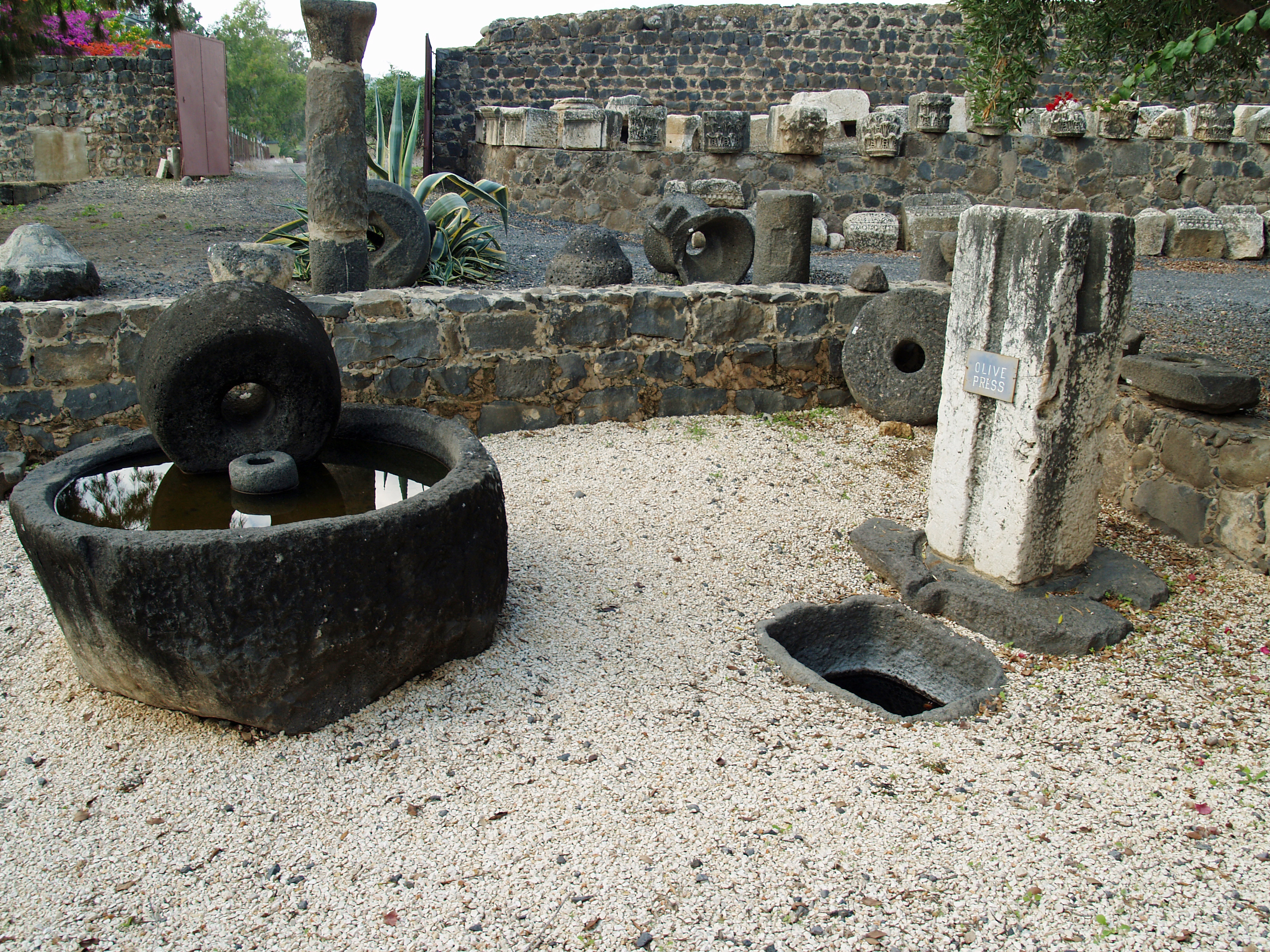
The second cost is labor, and it grows heavier as the story moves toward Rome. Olive cultivation is work — the harvest beaten and hand-picked from the branches, the fruit crushed in the trapetum or mill and then squeezed under the beam press — and oil at scale meant labor at scale.1011 On the great olive estates of the Roman west, that labor was largely unfree. Cato the Elder's De Agricultura, written around 160 BCE, lays out the model olive farm as a cold accounting of slave management: rations calibrated to the season, tasks assigned by the overseer, and — in one notorious instruction — the advice that the master sell off the worn-out oxen, the old tools, and "the old or sickly slave" together, as so much depreciated equipment.13 Columella's later handbook continues the genre. David Mattingly's quantification of Roman oil production for export shows the scale this reached: whole provinces — Baetica in southern Iberia, Africa Proconsularis, Tripolitania — were turned over to olive monoculture feeding the imperial market, with single Tripolitanian estates equipped with dozens of presses.12
The monument to that appetite still stands in Rome. Monte Testaccio is a hill some 35 metres high and a kilometre around, built entirely of the smashed remains of perhaps 25 million oil amphorae — overwhelmingly the globular Dressel 20 from Baetica, each holding around 70 litres — discarded over roughly two and a half centuries of the imperial annona, the state oil and grain supply. The hill represents on the order of six billion litres of olive oil delivered to a single city.1215 Behind that mountain of broken pots lies a corresponding quantity of coerced labor: the enslaved and tied workers of the Spanish and African estates who picked, crushed, and pressed the oil that Rome burned, ate, and rubbed on its skin. The olive itself is innocent; the system that the Roman economy built on it was not.
The labour cost and the inequality cost are, in the Roman case, the same story told twice. The great oil-exporting estates rose as free smallholders were squeezed off the land — the agrarian crisis that the Gracchi tried and failed to address in the late second century BCE — and the consolidated latifundia that replaced them were precisely the units that could carry the olive's long investment and absorb its heavy harvest labour, because they were worked by slaves taken in Rome's wars of conquest. The orchard that had favoured the land-rich household in archaic Attica now favoured the slave-stocked estate in imperial Baetica. The same property logic that made the olive a moat rather than a ladder operated at both ends of the Mediterranean and across a thousand years; the Roman version simply added the violence of mass enslavement to the structural advantage of those who could afford to wait for a tree.
The grove as hostage
The third cost is structural vulnerability. Precisely because an olive grove takes a generation to mature, it became a strategic target in war: to ravage an enemy's olives was to inflict a wound that would outlast the campaigning season by decades. In the Peloponnesian War the Spartan strategy of the Archidamian years was built on annual invasions of Attica to cut and burn its trees, and Thucydides records the Athenians watching their countryside destroyed from behind the city walls. Yet the olive's stubborn capacity to resprout from a surviving stump blunted the damage, and modern scholarship judges the long-term harm to mature groves to have been far less than the terror of the tactic implied — the grove was as much a psychological hostage as an economic one. A landscape committed to the slow tree also carried its own fragility: monocropped hillsides were exposed to bad years and to the volatility of a cash crop, and the terracing and clearance that olive cultivation demanded reshaped the Mediterranean slope into the human artifact Cyprian Broodbank calls a made sea.15 These are real costs, but they are the costs of dependence and of landscape, not of atrocity.
The environmental ledger deserves its own line. Turning a hillside into an orchard means clearing the existing scrub and woodland, cutting terraces to hold soil on the slope, and committing that ground to a single long-lived crop. Across three millennia this remade the physical Mediterranean: the terraced olive slope that reads today as timeless landscape is in fact an artifact of sustained human labour, built and rebuilt by generations of cultivators. The olive is, to its credit, a frugal and drought-hardy tree that holds thin soils against erosion better than annual tillage does, so the environmental cost is ambiguous rather than simply destructive. But it is a cost nonetheless: a reduction of the wild mosaic to a managed monoculture, and a landscape whose productivity depends on the continuous labour that maintained the terraces. When that labour faltered — through war, plague, or depopulation — the terraces decayed and the hillsides washed, and the made sea showed how much making it had taken.
What endures
Held against all of this is a persistence almost without parallel. Four thousand years after the cultivated tree reached Crete, the olive is still the defining fat of the Mediterranean diet; oil is still pressed from the same domesticated lineages; the chrism of Christian sacrament and the consecrated oils of Judaism and Islam descend directly from ancient anointing; and the olive branch still means peace, carried onto the flag of the United Nations. Spain, Italy, Greece, Tunisia, and Turkey — the modern heirs of the Phoenician and Greek plantings — still grow the great majority of the world's olives, and the basin still produces well over two million tonnes of oil in a good year. The brief's persistence rating of 5 is, if anything, conservative. A single Levantine technique for cloning a bitter shrub into a generous tree remade a sea's diet, economy, religion, and self-image, and the remaking held longer than any empire that profited from it.
What followed
-
-5000Earliest known olive-oil production: thousands of crushed olive pits and extraction residues at the submerged Pottery Neolithic site of Kfar Samir on the Carmel coast.
-
-4400Chalcolithic communities at Teleilat Ghassul and Tel Tsaf handle olives well outside the tree's natural range — the signature of deliberate planting and cultivation in the southern Levant.
-
-3500The cultivated olive and its oil reach Cyprus and Crete by seaborne exchange; Early Minoan communities begin moving from gathering wild oleaster toward genuine olive production.
-
-1900The first palaces of Europe rise at Knossos, Phaistos, and Mallia, their West Magazines lined with giant pithoi storing oil, wine, and grain as administered surplus.
-
-1400Linear B tablets at Knossos and Pylos record olive trees, oil quantities, and a palace-run perfumed-oil industry — a Bronze Age economy running on stored fat.
-
-800Phoenician and Greek colonists carry the cultivated olive west to Carthage and North Africa, Sicily, southern Italy, and Iberia, marking Mediterranean settlement with the tree.
-
-600Phocaean Greeks bring the olive to southern Gaul at Massalia, extending Mediterranean oleiculture into what is now Provence.
-
-594Solon's reforms ban the export of every Attic agricultural product except olive oil; the sacred moriai groves are protected by penalty of death or exile before the Areopagus.
-
-160Cato's De Agricultura codifies the slave-run Roman olive estate, instructing owners to sell off worn-out tools and the old or sickly slave together as depreciated equipment.
-
150Baetican olive oil in Dressel 20 amphorae dominates the imperial annona; the discarded jars accumulate into Monte Testaccio, a 35-metre hill of roughly 25 million broken vessels.
-
2019Palynology, archaeobotany, and genetics converge: studies by Zohary, Kaniewski, Besnard, Langgut, and others fix the olive's primary domestication in the eastern Mediterranean / southern Levant.
Where this lives today
References
- Langgut, Dafna, Rachid Cheddadi, José S. Carrión, et al. 'The Origin and Spread of Olive Cultivation in the Mediterranean Basin: The Fossil Pollen Evidence.' The Holocene 29, no. 5 (2019): 902–922. en
- Barazani, Oz, Arnon Dag, and Zachary C. Dunseth. 'The History of Olive Cultivation in the Southern Levant.' Frontiers in Plant Science 14 (2023): 1131557. en
- Kaniewski, David, Elise Van Campo, Tom Boiy, Jean-Frédéric Terral, Bouchaib Khadari, and Guillaume Besnard. 'Primary Domestication and Early Uses of the Emblematic Olive Tree: Palaeobotanical, Historical and Molecular Evidence from the Middle East.' Biological Reviews 87, no. 4 (2012): 885–899. en
- Besnard, Guillaume, Jean-Frédéric Terral, and Amandine Cornille. 'On the Origins and Domestication of the Olive: A Review and Perspectives.' Annals of Botany 121, no. 3 (2018): 385–403. en
- Zohary, Daniel, Maria Hopf, and Ehud Weiss. Domestication of Plants in the Old World: The Origin and Spread of Domesticated Plants in Southwest Asia, Europe, and the Mediterranean Basin. 4th ed. Oxford: Oxford University Press, 2012. en
- Margaritis, Evi. 'Distinguishing Exploitation, Domestication, Cultivation and Production: The Olive in the Third Millennium Aegean.' Antiquity 87, no. 337 (2013): 746–757. en
- Riley, Frank R. 'Olive Oil Production on Bronze Age Crete: Nutritional Properties, Processing Methods and Storage Life of Minoan Olive Oil.' Oxford Journal of Archaeology 21, no. 1 (2002): 63–75. en
- Hamilakis, Yannis. 'Wine, Oil and the Dialectics of Power in Bronze Age Crete: A Review of the Evidence.' Oxford Journal of Archaeology 15, no. 1 (1996): 1–32. en
- Foxhall, Lin. Olive Cultivation in Ancient Greece: Seeking the Ancient Economy. Oxford: Oxford University Press, 2007. en
- Frankel, Rafael. Wine and Oil Production in Antiquity in Israel and Other Mediterranean Countries. JSOT/ASOR Monograph Series 10. Sheffield: Sheffield Academic Press, 1999. en
- Brun, Jean-Pierre. Le vin et l'huile dans la Méditerranée antique: Viticulture, oléiculture et procédés de fabrication. Collection des Hespérides. Paris: Éditions Errance, 2003. fr
- Mattingly, David J. 'Oil for Export? A Comparison of Libyan, Spanish and Tunisian Olive Oil Production in the Roman Empire.' Journal of Roman Archaeology 1 (1988): 33–56. en
- Cato, Marcus Porcius. On Agriculture (De Agri Cultura). Translated by William Davis Hooper, revised by Harrison Boyd Ash. Loeb Classical Library 283. Cambridge, MA: Harvard University Press, 1934. la primary
- Pliny the Elder. Natural History, Volume IV: Books 12–16. Translated by H. Rackham. Loeb Classical Library 370. Cambridge, MA: Harvard University Press, 1945. la primary
- Broodbank, Cyprian. The Making of the Middle Sea: A History of the Mediterranean from the Beginning to the Emergence of the Classical World. London: Thames & Hudson, 2013. en