The Olmec template that built Monte Albán and Teotihuacan
A Gulf-Coast ceremonial inheritance — calendar, ballgame, rain-god, and the idea of a sacred capital — moved into the Oaxaca highlands around 500 BCE and was relayed north to the largest city the Americas had yet seen. It also carried a template of conquest, captive sacrifice, and the monument that advertises both.
Around 500 BCE, roughly two thousand people abandoned the Oaxaca valley village of San José Mogote and built a new capital on a waterless ridge four hundred metres above the valley floor. Monte Albán had no farmland and no reason to exist but power. The Cloud People who raised it had absorbed, over six centuries of trade with the Gulf-Coast Olmec, a ceremonial package — a 260-day calendar, the rubber ballgame, a rain-and-lightning god, the pyramid-and-plaza city — and elaborated it into writing, conquest, and a militarized state. That template was relayed north to Teotihuacan, the largest city the pre-Columbian Americas would ever know. Its bill was paid in subjugated towns and sacrificed captives.

Before the mountain: the Valley of Oaxaca without a capital
A world of ranked villages
Around 1150 BCE the southern Mexican highlands held no cities, no kings, and no states. In the Valley of Oaxaca — a Y-shaped basin where three arms of flat, fertile land meet at roughly 1,500 metres' elevation — people lived in farming villages of pole-and-thatch houses, growing maize, beans, squash, and chili on the alluvium and storing the surplus in bell-shaped pits beneath their floors.1 The largest of these villages, San José Mogote in the northern Etla arm, had grown by this date into a community of perhaps a thousand people with public buildings, craft workshops, and a ranked social order in which some lineages claimed descent-based precedence over others.1 It was not yet a capital. It governed no one beyond its own satellites, extracted tribute from no conquered town, and left no inscription naming a ruler.
Joyce Marcus and Kent Flannery, who excavated San José Mogote across fifteen field seasons between 1966 and 1980, describe a society of hereditary rank without hereditary office — a chiefly world, not a state.1 More than thirty residences and thirty public buildings came out of those excavations, enough to reconstruct a community that was already unequal but not yet governed.1 This is the calibration the rest of the record depends on. The Cloud People — Be'ena'a, the Zapotec name for themselves — already possessed many of the elements that later civilizations would weld into kingship, but they possessed them in loose, unconsolidated form. The genius of what followed was not invention. It was assembly.
What the Cloud People had, and what they lacked
The Formative Zapotec inheritance was real and deep. They had intensive maize agriculture and pot-irrigation in the drier valley arms. They had ranked lineages and an ancestor cult that buried elite dead beneath house floors and fed them offerings.1 They had public ritual architecture — at San José Mogote a stone-faced platform supported a temple, and Monument 3, set in a corridor between two buildings, would soon carry the valley's first writing.2 They had craft specialists working magnetite mirrors and shell ornaments, and trade ties that reached the Gulf Coast, the Basin of Mexico, and the Pacific.1
What they lacked is what makes the change legible:
- No primate centre — no single settlement dominating the whole valley politically.
- No monumental writing — no script deployed in public to name rulers, dates, and conquests.
- No standing apparatus of conquest — no state that annexed neighbours and recorded the annexation.
- No disembedded capital — no city deliberately founded on neutral ground to govern a region from above.
- No state cult — no religion administered by a priesthood distinct from the household and its ancestors.
Each of these the Zapotec would possess within a few centuries; each, in the form they took it, bore the fingerprint of a ceremonial complex first made monumental five hundred kilometres to the east.
Naming children for the days: the calendar before the capital
One inheritance the highland peoples already shared with the Gulf Coast deserves its own attention, because it is the thread that runs unbroken through the whole chain. By the Middle Formative the 260-day ritual calendar — the piye in Zapotec, the tonalpohualli of the later Aztecs — was in use across Mesoamerica, interlocking twenty day-names with the numbers one through thirteen.4 Children were named for the day of their birth: "1 Earthquake," "8 Deer," "6 Water." A person's calendrical name was at once an identity and a horoscope, fixing them in a cosmological order older than any state.
The calendar mattered politically because it made the captive nameable. When Mesoamerican writing emerged, its first and most persistent function was to attach a calendrical name to a depicted person — and the earliest persons so named, in Oaxaca, were the sacrificed.4 The count was not an Olmec invention handed to passive recipients; like the pottery, it was shared property of an interacting Formative world.6 But it was the institutional armature on which the later script, the dynastic record, and the public naming of the dead would all be built. The Cloud People had the calendar before they had a king. What the transmission gave them was the apparatus that turned the calendar into a tool of rule.
The Olmec goods that arrived first
The first contact was commercial and reciprocal. By 1150 BCE craftsmen at San José Mogote were grinding and polishing mirrors of magnetite and ilmenite — iron ores — and these mirrors travelled east to the Olmec centres of the Gulf Coast, where elite families wore them as pectorals.1 In return, the highland valley received pottery, iconography, and ideas. Vessels at San José Mogote carry incised Olmec-style motifs that scholars read as cosmological: the cleft-headed "fire-serpent" or sky-dragon, and the "were-jaguar" associated with earth and rain.5 For decades these motifs anchored the "mother culture" model, in which the Gulf-Coast Olmec were the singular fountainhead from which all later Mesoamerican civilization flowed.
That model has been tempered. A 2005 petrographic study by James Stoltman, Joyce Marcus, Kent Flannery and colleagues sectioned pottery from five Formative sites and showed that vessels moved both ways between the Gulf lowlands and the highlands — San José Mogote exported pots to the Olmec heartland, not only the reverse.7 The current synthesis, articulated by Christopher Pool, treats the Olmec not as a mother who bore passive daughters but as the most precocious node in a network of interacting peers, the first to monumentalize a shared symbolic vocabulary.6 The distinction matters for cost as much as for credit: what spread was not a finished civilization imposed by conquest but a template adopted, by people who already had the raw materials, because it conferred power. The Gulf Coast did not colonize Oaxaca. Oaxaca's emerging elites reached for what the Gulf Coast had built, and used it on each other.
The transmission: an inheritance carried into the highlands
The Olmec ceremonial complex
By the time La Venta reached its apogee around 900–500 BCE, the Olmec had assembled and made monumental a package of institutions that no earlier Mesoamerican society had held together in one place: a pyramid-and-plaza ceremonial centre on a deliberate axis; colossal portraiture of rulers; the 260-day ritual calendar and the bar-and-dot numerals that would later carry the Long Count; the rubber ballgame with its permanent masonry courts; and a theology of were-jaguar, maize god, and feathered or fire serpent that bound rulership to agricultural fertility.5 Richard Diehl calls this the achievement that "subsequent Mesoamerican civilizations all built on" — not a single invention but a working synthesis of statecraft and cosmology.5
The package was portable precisely because it was abstract. A calendar, a ball court, a deity, and a plan for a sacred city can be carried in the heads of traders, priests, and intermarrying elites; they do not require an army. The route into Oaxaca ran through the Mixe-Zoquean–speaking country of the Isthmus and highland Chiapas — the same corridor along which, Marcus and Flannery argue, the architectural idea of the main plaza with elite residences on each side reached the Zapotec, "probably from La Venta or highland Chiapas."1 Michael Coe and Rex Koontz describe the Middle Formative as the period when this Gulf-Coast synthesis became the common grammar of Mesoamerican elite life, legible from the Pacific coast to the central highlands.19
The ballgame and the calendar: two portable institutions
Two of the transmitted institutions are worth isolating, because they show how an abstract template becomes a concrete instrument of power. The rubber ballgame — played on a masonry court with a solid latex ball, sometimes to the death of the losing side — was an Olmec elaboration of a practice that reached back to the earliest Formative.5 It moved into the highlands as both sport and rite, a contest that could stand for cosmic struggle, settle disputes between elites, and supply captives for sacrifice. Courts appear across Oaxaca and, later, at Teotihuacan, where the game's imagery and the associated cult of the rubber ball persisted even where a formal court has been harder to identify.8
The calendar was the other. In its developed Long Count form — a linear tally of days from a fixed mythical zero — it appears first in the epi-Olmec and Isthmian zone, on monuments such as Stela C at Tres Zapotes bearing a date equivalent to 32 BCE.5 The highland Zapotec used the 260-day count monumentally from the founding of Monte Albán; the central Mexicans carried the same count into Teotihuacan's planning, where the symmetry of the city's sacrificial deposits is keyed to calendrical numbers.10 A ballgame and a calendar are not, in themselves, instruments of domination. But a state that controls the court and reads the count controls who plays, who is named, and who is killed — and that is what the highland heirs built.
Monte Albán: a capital on an empty ridge
Around 500 BCE something happened in the Valley of Oaxaca that has no local precedent. At the end of the Rosario phase, San José Mogote and its satellite villages lost roughly two thousand people more or less at once. Those people went up — to the summit of a steep ridge rising some 400 metres above the valley floor at the exact junction of the three valley arms, a place with no permanent water, no farmland, and no prior occupation.13 There they founded Monte Albán, and almost immediately began building a defensive wall, eventually three kilometres long, across the gentler slopes.1
Richard Blanton, who directed the first full settlement-pattern survey of the site, named what they had made: a disembedded capital, a seat of government placed deliberately on neutral ground above the competing communities it was meant to rule, owing allegiance to none of them.3 It is one of the clearest cases in the archaeological record of a state founded by deliberate act — a drawing-together of population onto chosen ground — rather than by the slow swelling of a single town. Within two centuries Monte Albán held perhaps five thousand people and dominated a valley that had never before answered to one centre.1
The Olmec inheritance is visible in the bones of the new city: the great levelled Main Plaza, the platform temples ranged along its edges, the orientation and the ceremonial logic. But the Zapotec did not copy. They took a Gulf-Coast template for a ceremonial centre and turned it into something the Olmec had never built — an artificial capital whose first major public monument was a gallery of the dead.
Writing as a caption for the slain
The earliest securely dated writing in the Valley of Oaxaca is a threshold stone. Monument 3 at San José Mogote, carved around 500 BCE, shows a sprawled naked man, eyes closed, a stylized stream of blood scrolling from his opened chest; between his feet are two glyphs that spell a calendrical name, read as "1 Earthquake" — almost certainly the name of the dead man, taken from the 260-day count.4 It is among the oldest inscriptions in the Americas, and it is an epitaph for a sacrificed captive, laid as a step where every person entering the building would tread on the defeated.
At Monte Albán the practice became monumental. The earliest large structure on the Main Plaza, Building L, was faced with a gallery of more than three hundred carved stone slabs — the Danzantes, the "dancers," so called in the eighteenth century for their contorted limbs.1 They are not dancing. They are dead or dying captives, many shown nude with closed eyes, several with blood-scrolls or genital mutilation, a number captioned with glyphs naming them.4 Joyce Marcus's reading is now standard: Mesoamerican writing did not begin as accountancy or literature but as political propaganda — the public naming of rulers, dynasties, and above all conquered enemies.4

A century or two later the Zapotec added a second monument of the same kind. Building J, an arrowhead-shaped structure pierced by tunnels and set askew to the plaza grid, carries some forty to fifty "conquest slabs," each combining a place-sign — a hill glyph topped by an emblem — with an inverted human head, the standard Mesoamerican sign for a defeated, decapitated lord and the town he had ruled.14 The slabs are, in effect, a stone gazetteer of Monte Albán's expansion. The Zapotec state announced itself to its own subjects in the only literate medium it had built, and the message was a list of the conquered.
The relay north: Teotihuacan inherits
While Monte Albán consolidated the southern highlands, a second and ultimately larger heir was forming three hundred kilometres to the north. Around 100 BCE the Basin of Mexico was reorganized by catastrophe: eruptions in the southern basin — the volcano Xitle would eventually bury the rival town of Cuicuilco — displaced populations northward toward a spring-fed valley near a set of natural caves.8 There, over the following two centuries, a planned city rose with a speed and scale that still has no full explanation: Teotihuacan.
The new city absorbed the entire accumulated inheritance — the Olmec ceremonial package as elaborated by intervening highland cultures, and the Zapotec demonstration that a sacred capital could be planned from nothing on chosen ground. By about 150 CE its builders had laid out the Avenue of the Dead, a ceremonial spine more than two kilometres long, and aligned the whole city to a grid some 15.5 degrees east of north, anchored by the colossal Pyramids of the Sun and the Moon.89 René Millon's mapping project documented a metropolis of perhaps twenty square kilometres and, eventually, some two thousand walled apartment compounds — a degree of deliberate urban planning unmatched anywhere in the contemporary Americas.9
What Teotihuacan inherited it transformed in scale. The pyramid-and-plaza of La Venta and the 400-metre ridge of Monte Albán became, in the Basin of Mexico, the largest city the pre-Columbian hemisphere would ever contain — a population approaching one hundred thousand at its second-century peak.8 George Cowgill, who studied the city for half a century, stresses that this was urbanism without precedent in the region: not a swollen town but a designed thing, imposed on the landscape by a planning authority of formidable and still-mysterious power.8
A city of foreigners
Teotihuacan's scale was built partly out of other people's cities. The metropolis drew migrants from across Mesoamerica and settled them, or let them settle, in identifiable ethnic neighbourhoods: a Oaxaca barrio of Zapotec immigrants on the west; a "Merchants' barrio" with Gulf-Coast and Maya ceramics on the east; and other enclaves whose pottery and burial customs mark them as foreign.815 Linda Manzanilla calls the result a multiethnic corporate society — a city whose unity was administrative and religious rather than ethnic, holding together populations that kept their homeland identities for generations.13
This is the human form of the transmission. The relay from Oaxaca to the Basin of Mexico was not a disembodied movement of motifs; it was carried by Zapotec families who walked five hundred kilometres and rebuilt their tombs and their gods in a foreign capital. The same multiethnic openness that made Teotihuacan the great clearing-house of Classic Mesoamerican culture — the place where Gulf, Oaxacan, and Maya traditions met and recombined — also concentrated, in one city, the populations whose labour and whose dead would pay for its monuments.
The enclaves are also the best evidence that the transmission ran in a genuine line rather than by independent invention at each node. A Zapotec barrio inside Teotihuacan, maintaining Monte Albán urns and tomb forms for centuries, is a direct material link between the second node of the chain and the third — proof that the people who had received the Olmec template in Oaxaca were physically present in the city that would carry it to its Classic apogee. The atlas treats such enclaves as the connective tissue of Mesoamerican history: not metaphors of influence but actual communities, with their own dead, holding two cultures together across five hundred kilometres of mountain and plain.
What changed and what was replaced
The unification of a valley
For the Zapotec, the transmission's first effect was the end of the village world as an autonomous order. Before Monte Albán, the Valley of Oaxaca was a mosaic of chiefly centres — San José Mogote, San Martín Tilcajete, Yegüih, and others — that competed, raided, and occasionally burned one another's temples but recognized no common sovereign.1 Within a few generations of the founding, Monte Albán had subordinated the whole valley and pushed beyond its rim. The Building J slabs name some forty places, several plausibly identified with towns dozens of kilometres outside the valley, brought under tribute or military threat.4
The political category that replaced the chiefdom was the territorial state, and with it came institutions the village world had not possessed: a four-tiered settlement hierarchy with the capital at the apex; a priesthood servicing a state cult distinct from household ancestor worship; a corvée system that raised the Main Plaza's monumental platforms; and a literate elite who recorded all of it in the new script.116 Arthur Joyce frames the period as the emergence, in southern Mexico, of the first societies in which the institutions of rule were detached from kinship and made permanent — and contested, since the same monuments that proclaim Monte Albán's power also hint at the resistance of valley communities like Tilcajete that held out against incorporation.16
The Classic city as a machine
At Teotihuacan the transformation was sharper still, because the city seems to have suppressed the very institution — personal dynastic kingship — that Monte Albán had monumentalized. Teotihuacan left no royal portraits, no named rulers, no dynastic king-lists of the kind the Maya carved obsessively. George Cowgill characterized it as a place whose rulers were extraordinarily powerful yet deliberately anonymous, their authority expressed through the corporate institutions of the state rather than the cult of a named individual.8
What the Classic city replaced was the human scale of everything before it. In place of the pole-and-thatch village it built standardized apartment compounds of stone and concrete, each housing perhaps sixty to a hundred people in corporate groups.8 In place of the small chiefly centre it built a planned metropolis with neighbourhoods, marketplaces, and foreign enclaves. Annabeth Headrick has argued that the city's art and architecture worked precisely to subordinate the individual to corporate orders — military, lineage, and priestly sodalities — rather than to a single royal person, a sociopolitical structure she calls the "Teotihuacan trinity."18 Linda Manzanilla describes the same city as an exceptional case among ancient states, a society in which the social group consistently outranked the individual, organized from the apartment compound up through the neighbourhood to the city as a whole.13 The cost of that order, as we will see, was loaded into its foundations.
Cociyo, the Feathered Serpent, and the persistence of rain and blood
The religious continuity across the chain is the clearest single thread. The Olmec were-jaguar — cleft-headed, snarling, associated with rain and the earth — is the ancestor of a highland rain-and-lightning deity who appears at Monte Albán as Cociyo, the Zapotec god of rain, lightning, and the life-giving and life-taking storm.14 Alfonso Caso, who excavated Monte Albán through the 1930s and opened the famous Tomb 7, catalogued the funerary urns in which Cociyo's buccal mask, forked tongue, and headdress recur for a thousand years.14
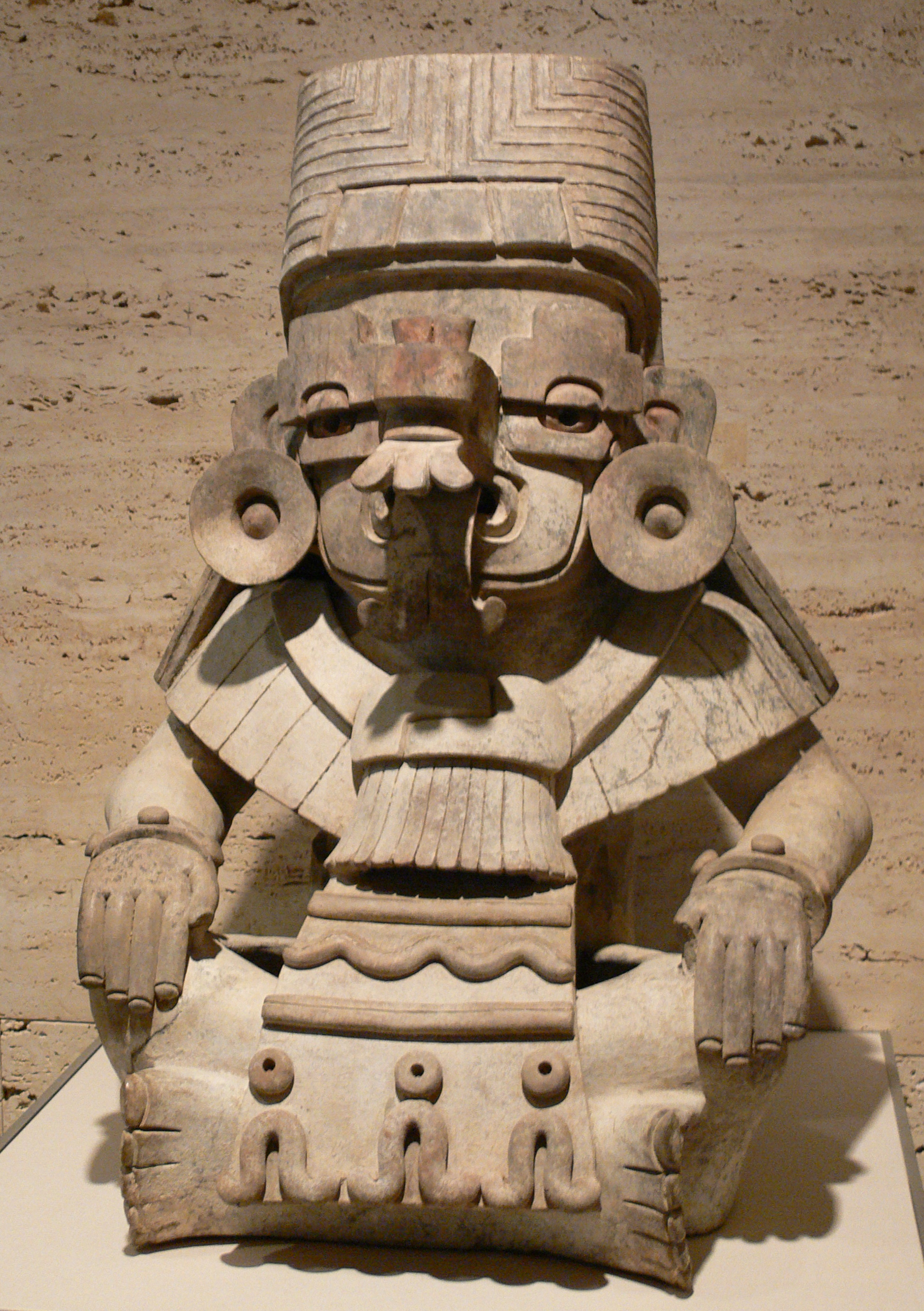
At Teotihuacan the same complex appears as the Storm God and, in monumental form, as the Feathered Serpent whose stone heads — alternating with a second cleft-faced deity usually read as a war or fire serpent — sheathe the facade of the pyramid that bears his name.810 The theology that bound rulership to rain and rain to blood passed down the whole line: an Olmec earth-and-rain spirit became a Zapotec storm god became the Teotihuacan serpent on whose dedication, as the next section records, some two hundred people died. What looks like iconographic continuity is also a continuity of cost.
What the village world lost
It is easy to read the chain as ascent — village to capital to metropolis, motif to script to monumental theology. The atlas does not read it only that way. What the transmission displaced is specific and recoverable:
- Household autonomy, dissolved into corvée and tribute obligations to a capital most subjects never saw.
- The local ancestor cult, subordinated to a state priesthood and a state pantheon.
- Dispersed settlement, replaced by nucleation — at Teotihuacan, by an apparent forced concentration that emptied much of the surrounding basin into the city.8
- Communal autonomy, surrendered by towns like Tilcajete that resisted Monte Albán and were eventually absorbed.16
- The defeated polities themselves, whose names survive only as the inverted heads on Monte Albán's conquest slabs.
The categories the highland peoples gained — state, king, script, sacred capital — were built, materially, out of the categories they lost.
What the cost was
The conquest slabs: a state that advertised its violence
The first instalment of the bill is carved on the monuments themselves, which is unusual: most early states left their violence to be inferred. Monte Albán inscribed it. The Building L gallery presents, in stacked rows, somewhere between three and four hundred slain and mutilated captives — the largest display of its kind in Formative Mesoamerica, raised within a century or two of the city's founding.14 Heather Orr's study of the Danzantes reads them as a deliberate rhetoric of intimidation aimed at the valley's subject populations and visiting elites: the new capital made the bodies of its enemies the literal facing of its first great building.17
Building J extended the rhetoric from bodies to towns. Its forty-odd conquest slabs pair each subjugated place-sign with the inverted head of its slain lord — a public ledger of decapitated rulers and annexed communities.14 We cannot count the dead behind those glyphs; the Zapotec recorded the fact of conquest, not its demographic price. But the monuments establish the character of the state the Olmec template helped produce: militarized from its founding, and proud of it. The script that the atlas elsewhere celebrates as one of humanity's great inheritances entered the Oaxaca highlands as an instrument of terror.
It is worth holding both of those truths at once, because the temptation is to choose. The same writing system that named "1 Earthquake" on a sacrificed captive also recorded genealogies, calendars, and the agricultural year; the same calendar that ordered the killing at Teotihuacan also governed the planting of maize. The Olmec template was not a weapon disguised as a civilization, nor a civilization spoiled by a weapon. It was a single integrated apparatus in which cosmology, agriculture, rulership, and violence were the same machine — and the highland heirs adopted the whole of it, because in the world they were building, the parts could not be separated.
The Feathered Serpent Pyramid: the dedicatory dead
At Teotihuacan the cost can, exceptionally, be counted in bodies. When the Feathered Serpent Pyramid was raised around 200 CE, its construction was consecrated by the largest documented mass sacrifice in the city's history. Excavations led by Rubén Cabrera, Saburo Sugiyama, and George Cowgill recovered the remains of a planned offering of perhaps two hundred to two hundred and sixty people — at least 137 individuals were archaeologically documented — interred in symmetrical graves keyed to calendrical and cosmological numbers beneath and around the pyramid.1011
Many were laid in groups of nine, eighteen, or twenty — counts drawn from the ritual calendar — with their hands bound behind their backs.10 At least seventy-two were males dressed as soldiers, several wearing necklaces strung with real and imitation human maxillae, the jaws of earlier victims worn as trophies.10 Sugiyama reads the whole deposit as the materialization of state ideology: militarism, sacrifice, and rulership fused into the foundation of the city's central monument, the dedicatory dead made permanent in the building they consecrated.10 This is the template at full extension — the Olmec synthesis of rulership and cosmology carried, at Teotihuacan, to the deliberate killing of two hundred people to inaugurate a single pyramid.
Tikal, 378 CE: the template carried abroad
The militarized template did not stay in the highlands. On a date that the Maya themselves recorded as 16 January 378 CE, a figure named in the inscriptions as Siyaj K'ak' — "Born of Fire" — arrived at the great Maya city of Tikal; on the same day Tikal's king died, and a new dynasty with explicit Teotihuacan affiliations took the throne.19 The event, often called the "entrada," is one of the best-documented cases of Teotihuacan's reach into the Maya lowlands, and it is marked across the region by Teotihuacan-style war imagery, the atlatl spear-thrower, and the goggle-eyed Storm God adopted as a patron of conquest.19 Whatever its precise mechanism — invasion, coup, or the arrival of an overwhelming foreign legitimacy — it shows the inherited package functioning as the Maya already understood it to function: as a charter for war and rule. The Classic substrate the Cloud People had assembled was, by the fourth century, projecting violence a thousand kilometres from where it was forged.
The Oaxaca barrio: a diaspora measured in urns
Not all of the cost was killing. Some of it was distance. On the western edge of Teotihuacan, in a neighbourhood archaeologists call Tlailotlacan — the "Oaxaca barrio" — a community of Zapotec migrants lived for centuries, roughly five hundred kilometres from their homeland, keeping their dead in Oaxaca-style tombs and their gods in Oaxaca-style urns.15 Michael Spence's excavations found Monte Albán–style funerary urns, Zapotec tomb architecture, and even Zapotec glyphs in the heart of the central-Mexican metropolis.15
Stable-oxygen-isotope analysis of the barrio's dead shows that the enclave kept its Zapotec identity across generations — first-generation migrants born in Oaxaca buried alongside locally born descendants who still maintained the homeland's mortuary customs.15 The relay this record traces was not an abstraction moving between cultures; it was carried by people who left one valley for another and lived out their lives as a minority in someone else's capital, returning to their tombs over generations to burn incense and pulque and blood for ancestors five hundred kilometres from where those ancestors had lived.15 The transmission's human texture is a diaspora.
The burning of 550 CE
The template outlived the cities that carried it, but the cities themselves died hard. Around 550 CE the monumental core of Teotihuacan was destroyed in a single coordinated event: the temples and elite residences along the Avenue of the Dead were deliberately burned, and the sculptures inside palatial compounds such as Xalla were smashed.812 The burning was selective — it concentrated on the state-religious and administrative buildings of the centre, not on the ordinary apartment compounds — which has persuaded most specialists that this was not a foreign sack but an internal rupture.12
Linda Manzanilla argues that the destruction was a revolt: that the tension between Teotihuacan's corporate base and the increasingly competitive, exclusionary "intermediate elite" who ran its neighbourhoods finally broke, and the city's own people burned the apparatus of the state that had ruled them.12 If she is right, the last cost of the template was paid by the institution that had imposed it. Monte Albán, too, would be largely abandoned as a political capital by about 800 CE, its plaza and its galleries of the dead left to the rain.1
Yet the inheritance did not burn. The Classic template — the planned sacred city, the rain-and-sacrifice theology, the calendar and script, the fusion of rulership with cosmology — passed to Tula, to Cholula, and finally to the Mexica, who walked through the ruins of Teotihuacan eight centuries after its fall, named it Teotihuacan, "the place where the gods were made," and made it the origin myth of their own empire.8 The Olmec template the Cloud People carried up an empty ridge around 500 BCE became, by way of Monte Albán and Teotihuacan, the substrate of everything the Spanish would find — and set out to destroy — in 1519.
The bill, totalled
The cost of this transmission is held at a moderate rating, and the reasons are worth stating plainly. The diffusion itself — Olmec to Zapotec, and Zapotec and Olmec to Teotihuacan — was overwhelmingly peaceful: trade, intermarriage, prestige emulation, and the slow movement of priests and ideas across six centuries, not conquest. No army carried the calendar into Oaxaca; no fleet imposed the ballgame on the Basin of Mexico. The transmission line proper has no battles in it.
But the template that moved was a template for hierarchy, conquest, and dedicatory killing, and the highland states that received it built their grandeur on subjugated towns, galleries of carved captives, and the two hundred bound dead beneath a single pyramid. The transmission did not force those costs; it made them possible, and the receiving cultures chose them, elaborated them, and exported them as far as Tikal. That is why the rating sits where it does — above the floor, because the inheritance was an inheritance of organized violence as well as of cities and calendars, and below the catastrophic, because the killing was the deliberate act of the heirs and not a property of the gift. The Cloud People did not receive a curse. They received a set of tools, and chose what to build with them — and what those tools built, again and again, was a state that announced its power by displaying its dead.
What followed
-
-1150Around 1150 BCE, Olmec-style fire-serpent and were-jaguar motifs appear on pottery at San José Mogote, while iron-ore mirrors polished there are exported east to the Olmec Gulf Coast — reciprocal exchange, not one-way diffusion.
-
-500Around 500 BCE, Monument 3 at San José Mogote depicts a sacrificed captive captioned “1 Earthquake” in the 260-day calendar: among the earliest writing in the Americas, and an epitaph for the slain.
-
-500Around 500 BCE, roughly two thousand people abandon San José Mogote and found Monte Albán on a waterless ridge 400 metres above the valley floor, beginning a three-kilometre defensive wall — a capital created by deliberate act.
-
-350By about 350 BCE, the gallery of Building L at Monte Albán displays more than three hundred carved “Danzantes”: slain and mutilated captives forming the facade of the city's first great monument.
-
-100Around 100 BCE, Building J at Monte Albán carries some forty conquest slabs naming subjugated towns under inverted heads of their decapitated lords — a stone ledger of expansion.
-
-100Around 100 BCE, Teotihuacan consolidates in the Basin of Mexico as volcanic eruptions in the southern basin displace populations northward, beginning the largest planned city of the pre-Columbian Americas.
-
150By about 150 CE, the Avenue of the Dead and the Pyramids of the Sun and Moon are laid out on Teotihuacan's grid, fixing the Classic Mesoamerican template of the planned sacred city.
-
200Around 200 CE, the dedication of the Feathered Serpent Pyramid at Teotihuacan is consecrated with roughly two hundred bound sacrificial victims interred in calendrically ordered graves — state ideology made permanent.
-
378On 16 January 378 CE, the figure Siyaj K'ak' arrives at the Maya city of Tikal as its king dies; a Teotihuacan-affiliated dynasty takes the throne, projecting the highland template a thousand kilometres into the Maya lowlands.
-
550Around 550 CE, the monumental core of Teotihuacan is destroyed in a coordinated burning of the temples along the Avenue of the Dead — most likely an internal revolt against the city's ruling elite.
Where this lives today
References
- Marcus, Joyce, and Kent V. Flannery. Zapotec Civilization: How Urban Society Evolved in Mexico's Oaxaca Valley. London: Thames & Hudson, 1996. en
- Flannery, Kent V., and Joyce Marcus, eds. The Cloud People: Divergent Evolution of the Zapotec and Mixtec Civilizations. New York: Academic Press, 1983. en
- Blanton, Richard E. Monte Albán: Settlement Patterns at the Ancient Zapotec Capital. New York: Academic Press, 1978. en primary
- Marcus, Joyce. Mesoamerican Writing Systems: Propaganda, Myth, and History in Four Ancient Civilizations. Princeton: Princeton University Press, 1992. en
- Diehl, Richard A. The Olmecs: America's First Civilization. London: Thames & Hudson, 2004. en
- Pool, Christopher A. Olmec Archaeology and Early Mesoamerica. Cambridge: Cambridge University Press, 2007. en
- Stoltman, James B., Joyce Marcus, Kent V. Flannery, James H. Burton, and Robert G. Moyle. “Petrographic evidence shows that pottery exchange between the Olmec and their neighbors was two-way.” Proceedings of the National Academy of Sciences 102, no. 32 (2005): 11213–11218. en primary
- Cowgill, George L. Ancient Teotihuacan: Early Urbanism in Central Mexico. Cambridge: Cambridge University Press, 2015. en
- Millon, René. Urbanization at Teotihuacan, Mexico, Volume 1: The Teotihuacan Map. Austin: University of Texas Press, 1973. en primary
- Sugiyama, Saburo. Human Sacrifice, Militarism, and Rulership: Materialization of State Ideology at the Feathered Serpent Pyramid, Teotihuacan. Cambridge: Cambridge University Press, 2005. en primary
- Cabrera Castro, Rubén, Saburo Sugiyama, and George L. Cowgill. “The Templo de Quetzalcoatl Project at Teotihuacan: A Preliminary Report.” Ancient Mesoamerica 2, no. 1 (1991): 77–92. en primary
- Manzanilla, Linda R. “Cooperation and tensions in multiethnic corporate societies using Teotihuacan, Central Mexico, as a case study.” Proceedings of the National Academy of Sciences 112, no. 30 (2015): 9210–9215. en
- Manzanilla Naim, Linda Rosa. Teotihuacan, ciudad excepcional de Mesoamérica. México: El Colegio Nacional, 2017. es
- Caso, Alfonso. Las estelas zapotecas. Monografías del Museo Nacional de Arqueología, Historia y Etnografía. México: Talleres Gráficos de la Nación, 1928. es primary
- Spence, Michael W. “Tlailotlacan, a Zapotec Enclave in Teotihuacan.” In Art, Ideology, and the City of Teotihuacan, edited by Janet Catherine Berlo, 59–88. Washington, DC: Dumbarton Oaks, 1992. en
- Joyce, Arthur A. Mixtecs, Zapotecs, and Chatinos: Ancient Peoples of Southern Mexico. Malden, MA: Wiley-Blackwell, 2010. en
- Orr, Heather S. “Danzantes of Building L at Monte Albán.” Foundation for the Advancement of Mesoamerican Studies (FAMSI) Report, 2002. en
- Headrick, Annabeth. The Teotihuacan Trinity: The Sociopolitical Structure of an Ancient Mesoamerican City. Austin: University of Texas Press, 2007. en
- Coe, Michael D., and Rex Koontz. Mexico: From the Olmecs to the Aztecs. 7th ed. London: Thames & Hudson, 2013. en