Chinese papermaking reached the Islamic world after Talas (751 CE)
A defeated Tang army left papermakers in Abbasid hands; within fifty years a paper mill was running in Baghdad. The substrate of the Islamic Golden Age was carried west by people who had not chosen the journey.
In July 751 CE, on the Talas River in what is now Kyrgyzstan, a Tang Chinese army under Gao Xianzhi was defeated by an Abbasid-Karluk coalition. According to the 11th-century historian al-Thaʿālibī, papermakers were among the prisoners taken west; within a generation, a paper mill was running at Samarkand, and by 794 CE another in Baghdad under Hārūn al-Rashīd. From there paper spread to Damascus, Cairo, and al-Andalus, where the Xàtiva mill (c. 1056) became the first in Europe. The technology made the al-Maʾmūn translation enterprise scalable and ended the Egyptian papyrus industry within two centuries. Recent scholarship has questioned whether Talas was really the moment of transmission, but the broad fact is undisputed: the writing surface that carried the Islamic Golden Age came from China, and the first hands that worked it in Samarkand were prisoners of war.

Before paper, an empire was running out of writing surfaces
In the middle of the eighth century, the Abbasid caliphate ruled from the Indus to the Atlantic. Its chancery wrote on parchment in the Levant, on papyrus in Egypt and Syria, on palm leaves in the southern hinterlands, on potsherds and bone when nothing else was at hand. The empire's administrative ambition — to tax, to register, to record judgement — outran its writing surfaces. Parchment was made from the skin of calves, kids, and lambs, scraped, stretched, treated with lime; a single Qurʾān codex might consume the hides of a hundred animals1. Papyrus was an Egyptian state monopoly, manufactured in the Nile delta for two and a half millennia and exported across the Mediterranean, but its quality had declined and its supply was constrained by the labour and water economy of the delta itself2. Both surfaces were expensive enough that, in the early Abbasid century, books were the property of caliphs and their court astronomers, not of merchants or madrasa students.
The Abbasid court at Baghdad, founded by al-Manṣūr in 762 CE and inherited by his grandson Hārūn al-Rashīd (r. 786–809), had begun to organise the largest translation enterprise the world had yet attempted. Greek philosophy, Sanskrit mathematics, Persian astronomy, Syriac medicine — all were being rendered into Arabic at a pace that would, within a century, make Baghdad the unrivalled centre of scholarship from the Pyrenees to the Hindu Kush3. But the substrate on which this knowledge was being written was the bottleneck.
Parchment, papyrus, and what they would not allow
Parchment had specific virtues — durability, resistance to insects, the ability to be scraped and reused — that made it the preferred surface for sacred and legal texts. The earliest Qurʾāns were written on parchment; the Mashhad and Sanaa manuscripts that survive from the seventh and eighth centuries are testaments to a sacred-text economy that ran on animal skin1. But parchment's costs were structural: a livestock economy could only produce so many usable hides per year, and the labour to convert them — a skilled craft of several weeks per skin — meant that parchment scaled only with herds and tanners, not with readers.
The physical limits of parchment shaped what could be written on it. A jurist composing a legal commentary, a translator working through a Galenic treatise, a copyist transcribing a Hadith collection — each was constrained by the available skin. The cost was passed on in the price of finished books, which the early Abbasid sources suggest ran to tens of dinars for a substantial codex, well beyond the means of any but the wealthiest patrons1. Lending libraries and book copying networks existed in the eighth century, but they were small, palace-adjacent, and self-limiting. A culture of reading at any scale beyond the court required a substrate the court could not yet supply.
Papyrus had different limits. The plant grew only in Egypt and a few related habitats; its processing required immersion, pressing, sun-drying, and burnishing, all labour-intensive and water-dependent. The Egyptian state had administered the industry since pharaonic times, and by the eighth century it remained an export commodity for the Abbasid treasury, sold to the Frankish chancery and to Byzantine clerks until at least the 11th century2. But papyrus did not fold; codices made of it were unstable; and its supply was limited by the agricultural rhythm of the delta. The historian Maya Shatzmiller has shown, working from price data preserved in legal documents, that ninth-century papyrus in Egypt was priced at roughly five times the cost of paper would later be — and that the difference is what changed when paper arrived4.
There were further surfaces in everyday administrative use across the Abbasid territories. Ostraca — broken potsherds — served for short receipts and tax notes in rural Egypt and Iraq. Wooden tablets coated with wax or gesso were used for school exercises and provisional accounts. Linen and silk were occasionally written on for ceremonial purposes. Palm leaves were the substrate of the Indian-influenced south. But none of these surfaces could carry the volume of administrative paperwork that the early Abbasid chancery was generating, and none could carry the bound-codex form that the new scholarly culture wanted. The empire had inherited the writing surfaces of late antiquity and had begun to outgrow them.
The Sogdian intermediaries
Paper was not entirely unknown in Central Asia before 751 CE. The Sogdian merchant cities of Transoxiana — Samarkand, Bukhara, Panjikent — sat on the trade routes between Tang China and the Iranian world, and Chinese paper had been circulating along those routes since at least the early seventh century. The letters of Devashtich, the last independent ruler of Panjikent, written in 722 CE on fine pale-grey Chinese paper and recovered from his Mount Mug archive after his execution by the Arab general Saʿīd ibn ʿAbd al-ʿAzīz, demonstrate the surface's presence in the region a full generation before Talas5. Buddhist monastic networks reaching east into Khotan and west into Sogdiana had been using paper for sutra-copying since perhaps the fourth century CE6.
What the Sogdians did not have, before the mid-eighth century, was the manufacture of paper. Sheets arrived as Chinese imports, used and reused, but the craft of pulping, sheet-forming, sizing, and burnishing was a Tang state secret — and the Tang had every reason to keep it so. Paper was the substrate of Tang imperial administration; the Tang chancery had institutionalised it under Cai Lun's recipe (c. 105 CE) and refined it for six centuries6. Releasing the craft to foreigners would not have served Chang'an's interests, and the records of Tang frontier administration suggest the technology remained an inside-the-Pass affair until the moment it ceased to be one.
The Battle of Talas and what came after
In the summer of 751 CE, two empires that had never directly fought collided on the upper reaches of the Talas River in modern Kyrgyzstan. The Tang general Gao Xianzhi — himself ethnically Goguryeo Korean, a career frontier commander who had won spectacular campaigns across the Pamirs and into Tukharistan — led an army westward to assert Tang influence over the Ferghana valley7. Against him stood the army of the Abbasid governor of Khurasan, Abū Muslim, under his field commander Ziyād ibn Ṣāliḥ, allied with the Karluk Turkic confederation. The forces engaged in late July; the Karluks, who had been nominal Tang allies, defected mid-battle to the Abbasid side, and the Tang army was broken7.
Tens of thousands killed; the surviving prisoners taken west
The sources do not agree on numbers. Modern reconstruction places Tang forces at perhaps thirty thousand, with Abbasid coalition forces at twenty to forty thousand, and Tang casualties of around twenty thousand killed or captured7. The Tang general escaped with a few thousand survivors. The Abbasid coalition took prisoners back to Samarkand, then onward to Khurasan and Iraq. Among them — according to the 11th-century historian Abū Manṣūr al-Thaʿālibī, writing in his Laṭāʾif al-maʿārif roughly two and a half centuries after the battle — were craftsmen with the skill of papermaking8.
al-Thaʿālibī's account is brief and emphatic. He writes that paper, which was a Chinese craft, was brought to Samarkand by Chinese captives in the entourage of Ziyād ibn Ṣāliḥ, and that the craft was established there and superseded the Egyptian papyrus and the parchment of Khurasan8. The passage is the only ancient source to name the Talas papermakers explicitly. It was the basis on which Joseph von Karabacek, the Viennese papyrologist who in 1887 published Das arabische Papier, built the modern scholarly account of the technology's transmission9.
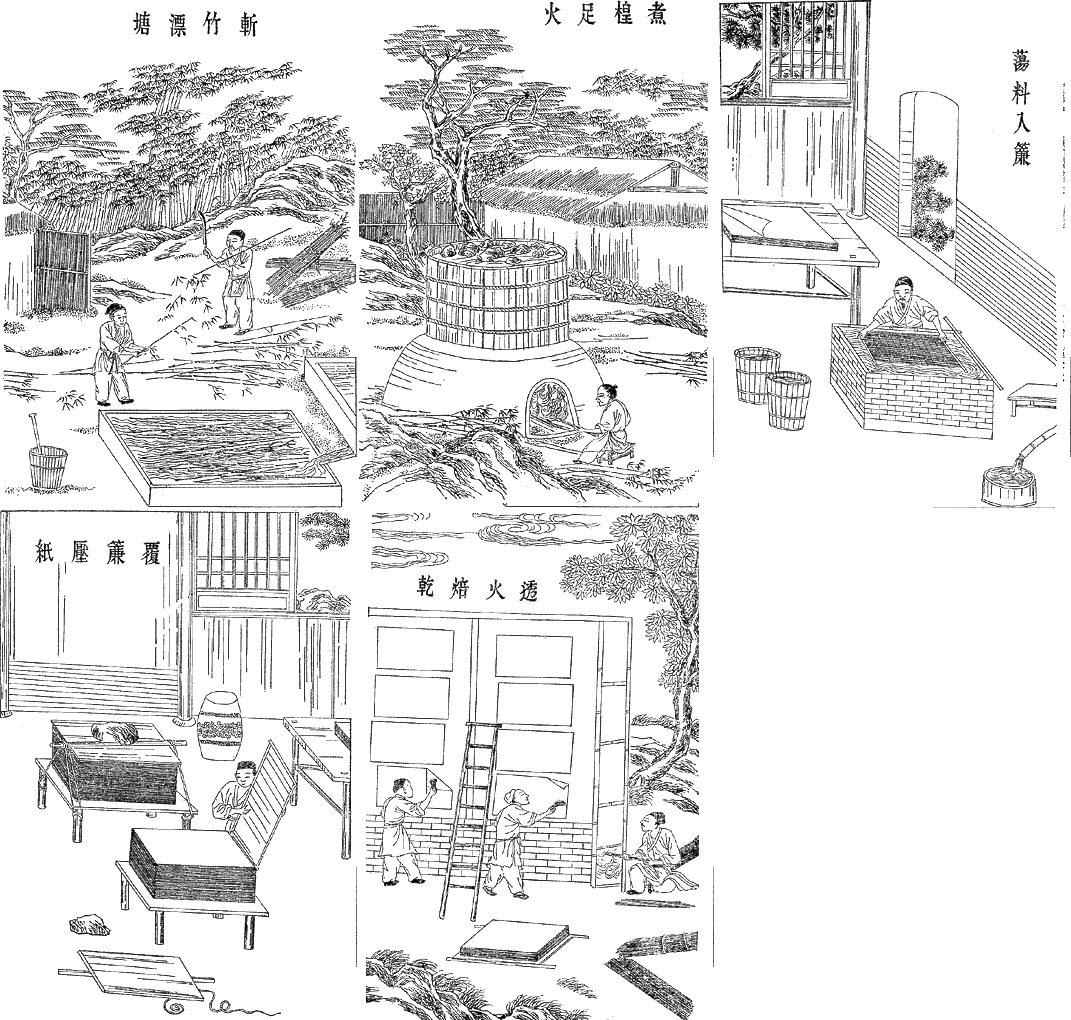
Jonathan Bloom's revision — the story as metaphor
The Talas-papermaker tradition has been challenged in recent scholarship. Jonathan Bloom's Paper Before Print (Yale, 2001) is the principal revisionist account. Bloom marshalls evidence that paper was already present and probably being made in Central Asia before 751: the Sogdian-language paper documents at Mount Mug, the seventy-six paper texts in Sogdian, Arabic, and Chinese recovered near Panjikent likely predating the Arab conquest of Transoxiana, the Buddhist monastic paper traditions of the Tarim Basin10. In Bloom's reading, the Tha'ālibī story is a foundation myth — historically useful for marking when paper became Islamic-world property, but not literally true as a single event of technology transfer.
Bloom's case is plausible and now widely accepted by specialists. But the broader fact — that papermaking became an institutional Islamic-world craft in the second half of the eighth century, that Samarkand was its first major manufacturing centre, and that the timing tracks closely with the political defeat of the Tang in Central Asia — is undisputed1011. Whether the technology arrived through captured craftsmen, through Sogdian merchants who had quietly been making paper for decades, or through some combination, the institutional fact is the same: a substrate that had been Chinese for six centuries became Islamic in the eighth.
Samarkand, Baghdad, and the spread west
By the 760s, Samarkand was producing paper at scale. The city's mill — drawing on the abundant flax and hemp of the Zerafshan valley, the water power of the river itself, and the technical knowledge resident in Transoxiana — produced sheets that were quickly recognised across the Abbasid world as superior to the available alternatives12. The 10th-century Persian geography Ḥudūd al-ʿālam records that Samarkand was famous for its paper; the historian al-Muqaddasī, writing around 985 CE, lists it among the city's principal exports12.
The Samarkand product had specific technical characteristics that distinguished it from later Islamic-world papers. It was made from linen rags rather than mulberry bark or hemp — a substitution the Central Asian craftsmen made because flax and hemp were the abundant local fibres, where the Tang craft had used bark and bamboo. The substrate was thicker and more durable than later papers; it took ink without bleeding; it could be burnished with an agate stone to a high polish that the eastern Kufic script benefited from11. The technical innovations belonged to the receiving culture: the Talas papermakers, whoever they were, carried the principle; the Sogdian and Khurasani craftsmen who absorbed them adapted it to local materials.
The technology moved to Baghdad within a generation. A paper mill is attested in the Abbasid capital by 794 CE, under the vizirate of the Barmakids during the reign of Hārūn al-Rashīd13. The Barmakid family, of Iranian Buddhist origin and intimately familiar with Transoxianan affairs, are the most likely conduit. Within another century, paper mills were operating at Damascus (the kāghidh dimashqī that European traders would call charta damascena), at Tiberias, at Cairo, and at Fez10. By the 11th century, the technology had crossed the Mediterranean: Abū Masāʾifa established a paper mill at Xàtiva in the Andalusi Taifa of Valencia around 1056 CE, the first paper manufacture in Europe10. The 12th-century geographer al-Idrīsī, writing under Norman patronage in Sicily, recorded that Xàtiva paper "cannot be found anywhere else in the civilised world, and is sent to the East and to the West"14.
The transmission was complete. A craft that had been a Tang state secret in 750 CE was, by 1150, a Mediterranean-wide industry under Islamic technical leadership. From al-Andalus, it would pass to Christian Italy in the late 13th century — but that is a separate record in this atlas.
What paper made possible — and what it displaced
The Bayt al-Ḥikma and the translation enterprise
The most consequential effect of paper's arrival was institutional. The Abbasid translation movement, which the caliph al-Maʾmūn (r. 813–833) formalised in the Bayt al-Ḥikma (House of Wisdom) at Baghdad, depended on a substrate that did not yet exist when his great-grandfather al-Manṣūr founded the city15. The Bayt al-Ḥikma was less a single building than an administrative enterprise: state-funded translators, copyists, binders, and scholars working under the patronage of the caliphal court, rendering Greek, Sanskrit, Persian, and Syriac texts into Arabic at a scale and pace without precedent in late antiquity1516.
The translation movement's scope was extraordinary. Within a century of the Baghdad paper mill's first attestation, the principal works of Aristotle, Plato, Galen, Hippocrates, Ptolemy, Euclid, and Archimedes were available in Arabic; so were the principal Sanskrit mathematical and astronomical works, including the Brahmagupta's Brāhmasphuṭasiddhānta and the Indian numerical system that al-Khwārizmī would systematise; so were the Persian astronomical and administrative texts inherited from the Sasanian chancery, and the Syriac medical compilations that the Christian translators of Hunayn ibn Ishaq's school carried into Arabic315. The translators worked in a small number of households — the Banū Mūsā, the Hunayn circle, the Thābit ibn Qurra school — each functioning as a state-subsidised research workshop. They were paid in dinars per folio translated, and the dinars came from a treasury that found the investment worth making.
The enterprise required books — bought, copied, translated, recopied, distributed to provincial scholars, sent to the libraries of regional governors. A parchment economy could not have sustained the volume. The first generation of the translation movement was already operating on Samarkand paper; by the second generation, Baghdad's own paper mills were supplying the copyists. al-Khwārizmī's Kitāb al-jabr wa-l-muqābala (c. 825 CE), the foundational text of algebra and the work that carried the Indian-numerical system into the Arabic-speaking world, was composed and copied on paper from the start17. The Hidden Threads atlas documents elsewhere the transmission of the numerals from India to the Arabic world; that record is what made the present one institutionally consequential. Paper was the platform; the numerals — and Greek philosophy, and Indian medicine, and Persian astronomy — were the content.
The bound codex and the explosion of book production
Paper enabled the bound paper codex — a folded, sewn, leather-covered book that became the standard form of the Islamic manuscript tradition. The earliest dated paper codex in Arabic is Gharīb al-ḥadīth by Abū ʿUbayd al-Qāsim ibn Sallām, completed in 252 AH / 866 CE and preserved at Leiden University Library, less than a century after the Baghdad paper mill is first attested18. By the 10th century, the form was ubiquitous: legal commentaries, medical handbooks, astronomical tables, devotional collections, all on paper, all in bound codices, all reproducible at a marginal cost that was, by the standard of antiquity, vanishingly small.
The production economy reorganised around the new substrate. Specialist crafts emerged that had no parchment-era precedent: paper merchants (warrāqūn), who supplied the substrate; copyists (nussākh) and their guilds; binders (mujallidūn), who developed the distinctive Islamic-world flap binding; and the sizers and burnishers who finished sheets to the high gloss required for the careful naskhī and thuluth scripts that succeeded the older Kufic forms19. By the 10th century the warrāqūn of Baghdad's Sūq al-Warrāqīn, the paper market, were a recognisable urban guild — booksellers and stationers in a single trade.
A short list of what paper made possible at scale, in the four centuries after Talas:
- Multi-volume encyclopedias (Ibn al-Nadīm's Fihrist, 988 CE; the Rasāʾil Ikhwān al-Ṣafāʾ, 10th century)
- Mass-circulated Hadith collections (al-Bukhārī, d. 870 CE; Muslim ibn al-Hajjāj, d. 875)
- Legal commentaries spanning hundreds of folios per madhhab
- Medical compendia of clinical use (al-Rāzī's al-Hāwī, c. 920; Ibn Sīnā's al-Qānūn fī al-ṭibb, 1025)
- Astronomical tables (zīj) for working observatories at Marāgha, Samarkand, Toledo
- The cookbook genre (al-Warrāq's Kitāb al-ṭabīkh, 10th century — note the author's name itself: al-Warrāq, the paper-seller)
None of this corpus would have been impossible on parchment. None of it would have been scalable on parchment. The difference is that paper let medieval Arabic learning reach an audience of madrasa students, court officials, provincial physicians, and literate merchants — not just the caliphal library.
The death of papyrus
The Egyptian papyrus industry, two and a half millennia old at the time of paper's arrival, did not survive the competition. The transition was gradual: papyrus was still being manufactured in the Nile delta into the late 10th century, and the Fatimid chancery continued to issue some documents on it into the 11th220. But the cost differential was decisive. By the early 11th century, paper had displaced papyrus across the Egyptian administrative system; by the late 12th, the papyrus plant itself was disappearing from cultivated stands in the delta, and within another generation it was effectively extinct as an Egyptian crop20.
The industry that ended had been one of the longest-running export economies in human history. Egyptian papyrus had supplied the Pharaonic, Ptolemaic, Roman, Byzantine, and early Islamic worlds; the Greek mathematical and philosophical corpus survived in part because Alexandria's papyrus industry made copies cheap enough to spread2. Its collapse was driven not by conquest or environmental change but by the arrival of a better substrate. The Nile delta papyrus-makers, whose specialist skills had passed from father to son for a hundred generations, lost their trade within three.
The transition also re-routed the geographic centre of writing-surface production. Where the Roman and Byzantine world had been substrate-dependent on Egypt, the Abbasid and post-Abbasid world had multiple supply nodes — Samarkand, Baghdad, Damascus, Cairo, Fez, Xàtiva — each producing paper for its regional market and exporting surplus. Egypt remained a paper-consuming centre, but the substrate it consumed was now made elsewhere, and the value-added flowed accordingly. The fiscal consequence is hard to disentangle from the broader Fatimid-Mamluk economic story, but it was real: a writing-surface monopoly that had supported the Egyptian treasury for two millennia ceased to be a monopoly within four generations of the Baghdad paper mill's first attestation24.
The death of parchment in the Islamic Mediterranean
Parchment did not die as completely as papyrus, but it retreated. In the Islamic world, parchment continued in use only for the most sacred or formal texts — certain Qurʾān manuscripts, certain caliphal decrees, certain treaty originals — and even there paper was steadily eroding its territory110. The economics were straightforward: a paper sheet cost a fraction of a parchment sheet of comparable size, and could be produced at industrial rather than artisanal scale.
In Christian Europe, parchment held on longer because paper arrived later and was treated with suspicion: the 13th-century chancery of the Holy Roman Empire prohibited paper for official documents, partly on theological grounds (Christian books should be on Christian substrate, not on Muslim-Spanish paper)10. But the prohibition was unenforceable in commerce. By the 14th century, paper had displaced parchment across the European notarial and mercantile economy; by the 15th, even chanceries and universities had given in. The technology that Gutenberg would use in 1450 was paper imported via the Iberian and Italian channels — the descendants of Xàtiva and Fabriano — not parchment. Without the prior Islamic-world transmission and refinement, the printing press would have had no substrate to print on at the scale it printed.
Forward into Christian Europe
The onward transmission of papermaking from al-Andalus to Christian Europe is documented elsewhere in this atlas. For the present record, the relevant fact is that the technology arrived in Italy through Sicily (under Norman rule from 1091) and through the Iberian channel, with the first Christian-controlled paper mill attested at Fabriano in the Marches around 1276 CE10. Fabriano paper added watermarks and a more refined sizing technique, but the basic craft — pulping, sheet-forming on a wire mesh, pressing, drying, sizing, burnishing — was the same craft that had been carried west from Tang China five centuries earlier.
The European universities of the 13th century — Bologna, Paris, Oxford — and the scholastic and Renaissance scholarship they enabled, all ran on this substrate. So did the Reformation pamphleteers, the early modern correspondence networks, the printers and chartists and bureaucrats of the European state. The substrate had become invisible by the time it became universal.
The cost the substrate carried
The dead at Talas, the lost frontier
The Battle of Talas itself was a small battle by Tang standards — perhaps fifty to seventy thousand troops engaged across both coalitions, with Tang losses in the order of twenty thousand killed or captured7. The political consequences, however, were not small. The Tang never recovered its position in Central Asia. Within four years of Talas, the An Lushan Rebellion (755–763 CE) erupted in the empire's northeastern military commands, driven in part by frontier general discontent and Sogdian-Turkic ethnic politics that the Tang military system had not learned to manage21. The rebellion consumed the dynasty's strategic reserves: the Anxi Protectorate, the Tang's westernmost garrison administration in the Tarim Basin, was stripped of troops and lost piecemeal to the Tibetan Empire and to Uyghur expansion through the late eighth century21.
Gao Xianzhi, the defeated commander at Talas, was recalled to defend Chang'an against An Lushan's advancing army in 755 and was executed in early 756 by his own emperor on charges of cowardice — a political execution amid the panic of the rebellion's early months. The Tang dynasty would continue for another century and a half, but never again as a Central Asian power. The cost of the broken frontier is hard to count in lives, but the demographic catastrophe of the An Lushan rebellion is well documented: contemporary tax census records suggest population losses on the order of fifteen million across the rebellion's eight years, almost certainly an overestimate driven by displacement and registration collapse rather than literal mortality, but a real demographic shock by any measure21.
The captive craftsmen
If the Tha'ālibī tradition is right, the papermakers who carried the craft west were prisoners of war — captive specialists, settled in Samarkand under Abbasid administration as enslaved technical labour. Their names are not recorded. Their working conditions, their families, their lives after the transmission are not recorded. The 11th-century historian who first names them does so in a paragraph; the modern scholarship that has built on his account has not been able to recover anything more.
This is a recurrent pattern in the technological history of the medieval world. Specialist craftsmen — papermakers, silk weavers, glassmakers, ceramicists — were moved across imperial borders by capture, by deportation, by enslavement, with their crafts treated as imperial property and their persons as imperial assets. The Sasanian Empire had captured Roman quarrymen at Edessa in 260 CE and deported them to Khūzistān; the Byzantines had moved Syrian silk-weavers to Constantinople in the sixth century; the Mongols would do the same on a continental scale in the 13th. The Talas papermakers fit the pattern.
If Bloom's revisionist account is right — if the technology reached Central Asia gradually through Sogdian merchant networks before Talas crystallised its Islamic-world adoption — then the captive-craftsman framing softens. But it does not vanish. The Sogdian merchants who carried Chinese paper west in the 7th and 8th centuries were operating within a slave-trading and indentured-labour economy in Central Asia, and the institutional shift from paper-as-import to paper-as-domestic-craft happened under Abbasid administration, which made extensive use of enslaved technical labour throughout the eighth and ninth centuries22. The substrate of the Golden Age was not built by free hands.
The enslaved-craftsman economy of the early Abbasid administration is documented in the chronicles of Samarra, the new caliphal capital built by al-Muʿtaṣim in the 830s, where Turkish military slaves, Slavic palace officials, and skilled craftsmen of every origin worked together under a system that the Arab historian al-Yaʿqūbī describes with the detachment of a chancery clerk and the Greek bishop al-Marwazī describes with the alarm of an observer22. Papermakers do not appear by name in those sources, but the institutional pattern — captured or purchased specialist labour, settled in imperial workshops under fixed administrative oversight, paid in maintenance rather than wages — is consistent with what the Tha'ālibī passage implies for the Talas craftsmen. The labour regime was not unique to paper; it was the standard regime under which the technological substrate of the Abbasid state was produced.
The Egyptian Nile delta after papyrus
The papyrus industry's collapse, two centuries after Talas, ended a Nile delta economy that had supported tens of thousands of workers across the cycle: cultivators of Cyperus papyrus in the wetland fields north of Memphis, pithers and slicers, soakers and pressers, drying-yard labourers, burnishers, packers, traders. The trade had been administered through the Ptolemaic and Roman periods as a state monopoly; under the early Islamic dispensation it had become a tax-farmed industry, but the rural employment base remained intact220.
When paper displaced papyrus, the displacement was not violent — no city was sacked, no population was deported — but it was thorough. The papyrus stands disappeared from the cultivated landscape, and the labour that had maintained them dispersed into other agricultural and craft trades, or into urban migration. The rural economy of the Egyptian delta in the 11th and 12th centuries was visibly thinner than it had been in the 9th, and the loss of the papyrus export trade was a factor — not the only factor, but a contributing one — in the Fatimid-era weakening of Egyptian fiscal capacity that the Mamluks would inherit220. The cost of paper's spread was borne, in part, by Egyptian rural labour over the long 11th century.
Whose labour built the Golden Age
The Islamic Golden Age is conventionally narrated as a story of scholars: al-Khwārizmī's algebra, Ibn Sīnā's medicine, al-Bīrūnī's astronomy, al-Kindī's philosophy. The substrate that carried that scholarship is not usually part of the narrative. But the substrate had to be made, by people who did the physical work of stripping bark, retting fibres, beating pulp, dipping moulds, pressing sheets, drying, sizing, burnishing — work that is hot, wet, repetitive, and skilled. The paper that the Bayt al-Ḥikma scholars wrote on was made by Samarkand and Baghdad papermakers whose names do not appear in the scholarly bibliography.
A short ledger of who paid the cost of the transmission, in approximate order of magnitude:
- The Tang dead at Talas and after: twenty thousand killed or enslaved in July 751; perhaps millions displaced or dead in the An Lushan Rebellion of 755–763 to which Talas was prologue.
- The captive Chinese craftsmen: an unknown small number — tens, perhaps hundreds — of papermakers and related specialists carried west and settled at Samarkand under Abbasid administration as enslaved technical labour.
- The Egyptian papyrus economy: tens of thousands of delta workers across the 11th and 12th centuries, displaced as the industry collapsed under paper competition. No deaths, but a long, slow loss of livelihood across three generations.
- The parchment industry of the Islamic Mediterranean: a smaller specialist craft, marginalised rather than eliminated, surviving in Qurʾān production and certain formal contexts.
The ledger is not catastrophic on the scale of an Antonine Plague or a Mongol sack. The cost severity of this record is held at 2 — moderate but real. The transmission killed people, enslaved people, and ended a millennia-old industry. It also produced the substrate on which the most consequential intellectual culture of the medieval world was built. Both clauses are true at once, and a cost-honest atlas should not let the second clause silence the first.
A coda: the cross-reference
This record links cleanly to the Hidden Threads atlas record on the Indian numerals reaching the Arabic-speaking world (c. 825 CE). Paper made the translation enterprise scalable; the translation enterprise made the numerals move; the numerals reached Christian Europe through the same Iberian channel that carried paper itself. The two records are best read together: the substrate and the content, the platform and the cargo. Without the Talas-era transmission of papermaking, the Bayt al-Ḥikma's reception of Indian mathematics would have remained an elite curiosity. With it, the mathematics became universal property — first across the Islamic world, then across Christian Europe, then, in time, across the planet.
The atlas's longer view is that no major intellectual transmission of the medieval period is independent of its physical substrate. The numerals needed paper to spread; algebra needed paper to be commented on; medical compendia needed paper to be carried by travelling physicians. The Talas transmission is, in this sense, an enabling condition for a substantial fraction of the records that follow it chronologically in the atlas. Readers who came to this record for the Battle of Talas and the captive-craftsman story should leave it understanding that the substrate they are reading on now is, in technical lineage, the same substrate Abū Masāʾifa's Xàtiva workshop produced in 1056. The persistence rating of 5 is not rhetoric. It is, by a tight chain of craft inheritance, simply true.
The substrate has survived. Most paper made on Earth today, including the paper this atlas record will eventually be printed on by some reader, descends in unbroken technical lineage from the craft that was carried west after Talas. It is one of the few transmissions in this atlas whose persistence rating is genuinely a 5 — still load-bearing, twelve and a half centuries later, with no successor in sight.
The Talas transmission is also, perhaps, a useful reminder of how technological inheritance works in human history. The craft did not travel in a book or a diagram. It travelled in the hands and memories of people — specific, named or unnamed, free or unfree — who knew how to pulp fibre and lift a sheet from a mould and press water out and burnish a dry surface to take ink. Every paper mill in the contemporary world contains, in its mechanised form, those gestures. The bill that was paid for the substrate, at Talas and after, deserves to be remembered alongside the scholarship the substrate carried.
What followed
-
751Battle of Talas, July 751 CE: a Tang army under Gao Xianzhi is defeated by an Abbasid-Karluk coalition on the upper Talas River; Tang casualties of approximately 20,000 killed or captured; Karluk defection mid-battle decides the outcome.
-
765First Samarkand paper mill, ~760s CE: within a decade of Talas, Samarkand is producing paper at scale, drawing on the flax and hemp of the Zerafshan valley and on Sogdian and Chinese technical knowledge.
-
794Baghdad paper mill attested, 794 CE: the technology reaches the Abbasid capital under the Barmakid vizirate during the reign of Hārūn al-Rashīd; paper begins to replace papyrus in caliphal chancery use.
-
755An Lushan Rebellion, 755–763 CE: erupting four years after Talas, the rebellion collapses Tang military power in Central Asia and produces demographic registration losses of approximately fifteen million across the rebellion's eight years.
-
866Earliest dated Arabic paper codex, 866 CE: Abū ʿUbayd al-Qāsim ibn Sallām's Gharīb al-ḥadīth, completed in 252 AH and preserved at Leiden University Library, is the oldest surviving paper-bound Arabic book.
-
820Bayt al-Ḥikma translation enterprise institutionalised, c. 813–833 CE: under al-Maʾmūn the Baghdad House of Wisdom translates Greek, Sanskrit, Persian, and Syriac scholarship into Arabic on paper, at a pace and scale impossible on parchment.
-
1056Xàtiva paper mill, c. 1056 CE: in the Andalusi Taifa of Valencia, Abū Masāʾifa establishes the first paper mill in Europe, drawing on the Albaida River and the linen fields of the Iberian southeast.
-
1100Egyptian papyrus industry effectively extinct, ~1100 CE: after a 2,500-year history of Nile delta cultivation and Mediterranean export, the papyrus stands disappear from the cultivated landscape; the trade ends within three generations of paper's spread.
-
1276Fabriano paper mill, c. 1276 CE: the first Christian-administered paper mill in Italy begins producing watermarked sheets; the technology that will print Gutenberg's 1450s Bible is in place along the European-Iberian-Sicilian channel.
-
1154al-Idrīsī's Tabula Rogeriana, 1154 CE: writing under Norman patronage in Sicily, the geographer records that Xàtiva paper 'cannot be found anywhere else in the civilised world, and is sent to the East and to the West'.
Where this lives today
References
- Bloom, Jonathan M. Paper Before Print: The History and Impact of Paper in the Islamic World. New Haven: Yale University Press, 2001. Chapters 1–2 on writing surfaces in the pre-paper Islamic world. en
- Bagnall, Roger S. Egypt in Late Antiquity. Princeton: Princeton University Press, 1993. On the longue durée of the papyrus industry; see also Bloom 2001, ch. 1. en
- Gutas, Dimitri. Greek Thought, Arabic Culture: The Graeco-Arabic Translation Movement in Baghdad and Early ʿAbbāsid Society (2nd–4th/8th–10th centuries). London and New York: Routledge, 1998. en
- Shatzmiller, Maya. "The Adoption of Paper in the Middle East, 700–1300 AD." Journal of the Economic and Social History of the Orient 61, no. 3 (2018): 461–490. en
- Livshits, Vladimir A. Sogdian Epigraphy of Central Asia and Semirech'e. Trans. Tom Stableford. Corpus Inscriptionum Iranicarum II/III. London: School of Oriental and African Studies, 2015. On the Mount Mug archive and Devashtich's paper correspondence. en primary
- Tsien Tsuen-Hsuin. Paper and Printing. Volume 5, Part 1 of Joseph Needham, Science and Civilisation in China. Cambridge: Cambridge University Press, 1985. en
- Bosworth, C. E. "The Appearance of the Arabs in Central Asia under the Umayyads and the Establishment of Islam." In: History of Civilizations of Central Asia, Volume IV: The Age of Achievement, A.D. 750 to the End of the Fifteenth Century, Part One. Paris: UNESCO Publishing, 1998, pp. 21–40. Includes detailed discussion of the Battle of Talas. en
- al-Thaʿālibī, Abū Manṣūr ʿAbd al-Malik ibn Muḥammad. The Laṭāʾif al-maʿārif of Thaʿālibī: The Book of Curious and Entertaining Information. Translated with introduction and notes by C. E. Bosworth. Edinburgh: Edinburgh University Press, 1968. The 11th-century primary source naming Chinese papermakers among the Talas prisoners. en primary
- Karabacek, Joseph von. Das arabische Papier: Eine historisch-antiquarische Untersuchung. Mittheilungen aus der Sammlung der Papyrus Erzherzog Rainer, II/III. Vienna: Hof- und Staatsdruckerei, 1887. The foundational 19th-century scholarly study, in German; English translation by Don Baker and Suzy Dittmar published as Arab Paper (London: Archetype Publications, 2001). de
- Bloom, Jonathan M. Paper Before Print, op. cit. Chapters 3–5 on the Talas tradition, the spread of paper mills across the Islamic world, and the transmission to Christian Europe via al-Andalus and Sicily. en
- Loveday, Helen. Islamic Paper: A Study of the Ancient Craft. London: The Don Baker Memorial Fund / Archetype Publications, 2001. Technical study of surviving Islamic-world paper, based on systematic analysis of over a hundred dated samples. en
- Ḥudūd al-ʿālam min al-mashriq ilā al-maghrib ('The Regions of the World'), anonymous Persian geography, c. 982 CE. Trans. V. Minorsky as Ḥudūd al-ʿĀlam: The Regions of the World, a Persian Geography 372 A.H.–982 A.D. London: Luzac, 1937. Section on Samarkand and its paper industry. en primary
- Hill, Donald R. Islamic Science and Engineering. Edinburgh: Edinburgh University Press, 1993. On the Baghdad paper mill of 794 CE and Barmakid administrative innovation. en
- al-Idrīsī, Abū ʿAbd Allāh Muḥammad. Nuzhat al-mushtāq fī ikhtirāq al-āfāq (Tabula Rogeriana), 1154 CE. Modern critical edition: Opus Geographicum, ed. E. Cerulli et al. Naples and Rome: Istituto Universitario Orientale di Napoli, 1970–1984. The Xàtiva paper passage is in the Iberian section. ar primary
- Lyons, Jonathan. The House of Wisdom: How the Arabs Transformed Western Civilization. New York: Bloomsbury, 2009. Popular but well-sourced; for the institutional history see Gutas 1998 and al-Khalili 2010. en
- al-Khalili, Jim. The House of Wisdom: How Arabic Science Saved Ancient Knowledge and Gave Us the Renaissance. New York: Penguin Press, 2010. en
- Rashed, Roshdi. Al-Khwārizmī: The Beginnings of Algebra. London: Saqi Books, 2009. On the textual transmission and material substrate of the Kitāb al-jabr wa-l-muqābala. en
- Abū ʿUbayd al-Qāsim ibn Sallām. Gharīb al-ḥadīth. Manuscript, copied 252 AH / 866 CE, Leiden University Library, Or. 298. The earliest dated codex on paper in Arabic. ar primary
- Déroche, François. Islamic Codicology: An Introduction to the Study of Manuscripts in Arabic Script. London: Al-Furqan Islamic Heritage Foundation, 2005. On the warrāqūn trade, the bound codex form, and the technical crafts that emerged around paper. en
- Wang Juhua 王菊華 et al. Zhongguo gudai zaozhi gongcheng jishu shi 中国古代造纸工程技术史 [History of Ancient Chinese Papermaking Engineering Technology]. Taiyuan: Shanxi Jiaoyu Chubanshe, 2006. Standard Chinese-language technical reference for the craft as it left Tang China. zh
- Pulleyblank, Edwin G. The Background of the Rebellion of An Lu-shan. London Oriental Series 4. London: Oxford University Press, 1955. The standard English-language study of the An Lushan Rebellion and its relation to Tang frontier policy. en
- Gordon, Matthew S. The Breaking of a Thousand Swords: A History of the Turkish Military of Samarra (A.H. 200–275/815–889 C.E.). Albany: SUNY Press, 2001. On enslaved technical and military labour in the early Abbasid administration. en