After 1514, Persia's court carpet was woven in Istanbul and Lahore
In sixteenth-century Tabriz the Safavid court turned the knotted carpet into a drawing. The Ottomans took its designers as spoils of war after Chaldiran; the Mughals hired its weavers for Agra and Lahore. The prestige floor of three empires was made by artisans moved by force and paid by the day.
In 1514, after defeating the Safavid shah at Chaldiran, the Ottoman sultan Selim I marched the court artists of Tabriz to Istanbul. Eighty years later the Mughal emperor Akbar had Persian-trained weavers knotting carpets in Agra, Fatehpur and Lahore, and his historian declared the carpets of Iran 'no more thought of'. The Safavid court carpet — a design drawn on paper and knotted to the drawing — became the prestige floor of three empires. Its makers were moved as plunder, paid five or six copper coins a day, and, in the Punjab four centuries on, bonded as children to the loom.
Before: floors without the knotted carpet
In 1526 a Timurid prince from the Ferghana valley defeated the last Lodi sultan of Delhi at Panipat and took possession of northern India. Babur, the first Mughal, recorded his new kingdom in the memoir he kept in Chaghatay Turkish, and his verdict on it is famous: "Hindustan is a country of few charms."4 The list of what he missed reads like an inventory of the Persianate good life he had been raised in at Samarkand, Kabul and Herat — good horses, grapes and melons, cold water, baths, colleges, bread in the market.4 Carpets are not on the list, but the omission is telling in another way. Babur's world, the world of the late Timurid courts, sat on knotted-pile carpets; the Indian world he conquered, for the most part, did not. The floors of the Delhi sultans and of the Rajput courts were covered with woven cotton: flat-woven darī (dhurrie) rugs, quilted spreads, and the plain white floor-cloths on which a host and his guests sat, with bolsters against the wall.1 These were fine things, made in an economy that already led the world in cotton cloth, but they were not the dense wool pile of the Iranian plateau and the Central Asian steppe.
Daniel Walker, whose Flowers Underfoot (1997) is the standard catalogue of Mughal carpets, framed the question with care: the evidence for knotted-pile weaving in India before the second half of the sixteenth century is thin, and the evidence that it became a substantial industry only under Akbar is strong.1 The Mughal court's own historian says so. Writing in the 1590s, Abuʾl Fazl recorded that before the emperor's intervention the best carpets came from abroad, and that "merchants still import carpets from Goshkan, Khuzistan, Kirman, and Sabzwar" — four Iranian sources, named as the benchmark of quality.2 The prestige floor of north India, in other words, was an imported object.
The four names repay attention, because they map the Iranian carpet economy that the Mughal court would set out to copy. Goshkan is Jowshaqan, a weaving town in the mountains between Kashan and Isfahan; Kerman lies on the south-eastern edge of the plateau and was a royal weaving centre under the Safavids; Sabzevar is in Khurasan, on the road from Nishapur to the west; Khuzistan is the lowland province at the head of the Gulf.27 Abuʾl Fazl's merchants were buying, in other words, from the whole breadth of Safavid Iran and its borderlands, and they were doing it because nobody in Hindustan could yet make the same thing. A court that measured its splendour against the Safavids and the Uzbeks — and the Mughals did, constantly, in their chronicles, their architecture and their diplomacy — could not leave the floor of its audience hall to foreign suppliers for long.112 The carpet, in that sense, was not only a furnishing. It was one of the visible tests of whether the new dynasty could sustain a Persianate court on Indian soil.
What a north Indian floor held in 1550
Set out plainly, the categories of floor-covering available to a court in Agra or Delhi in the mid-sixteenth century looked like this:1212
- The darī — a flat-woven cotton rug, often striped, made across north India for palace, mosque and household.
- The white floor-cloth (chāndnī) — plain cotton sheeting spread over a padded base, the standard seat of an audience or a meal.
- Quilted and embroidered spreads — the high-status version of the same, worked in silk or cotton, part of a textile culture that made India the world's great exporter of cloth.
- Mats of grass and reed — the everyday floor of the majority.
- Imported pile carpets — Iranian and Central Asian, bought through merchants, rare and expensive.
Nothing in that list was a designed pile carpet made in India to a court pattern. Within forty years of Babur's verdict there would be imperial carpet workshops in three Indian cities, and within a century Lahore would be selling carpets to the livery companies of London.1212 That is the measure of the transmission on its eastern side.
The western side began from a different place. Anatolia had been a carpet country for three hundred years before the Safavids. The pile fragments found in the Alaeddin Mosque at Konya, attributed to the Seljuk thirteenth century, show geometric designs in the symmetrical "Turkish" knot, and by the fifteenth century the looms of western Anatolia — the region later identified with Uşak — were exporting the geometric carpets that Italian and Flemish painters put under their Madonnas and merchants, and that dealers still call "Holbeins" and "Lottos" after the painters.8 Kurt Erdmann, the Berlin museum director whose Siebenhundert Jahre Orientteppich (1966) laid the foundations of modern carpet history, placed these Anatolian carpets at the root of the whole Western knowledge of the "oriental" carpet.8 Before 1514, then, the Ottoman floor was not empty. It was covered by an older, geometric, symmetrically knotted tradition that owed nothing to Safavid design.
Anatolia and Cairo before the court carpet
In Egypt, the Mamluk sultans had their own manufactory. Mamluk carpets, woven in Cairo in the later fifteenth and early sixteenth centuries, are among the most distinctive in the Islamic world: kaleidoscopic geometric compositions of octagons and stars in a narrow palette of red, green and blue, knotted with the asymmetrical knot on a foundation of S-spun wool.817 They were a court art, but a geometric one, and they had no medallion-and-arabesque floral language at all.
Three pre-transmission traditions, then:
| Region | Knot | Design language | Status before 1514 |
|---|---|---|---|
| Western Anatolia (Uşak and its region) | Symmetrical ("Turkish") | Geometric — star, medallion and lattice in repeat | Major export industry to Europe since the 1400s |
| Mamluk Cairo | Asymmetrical | Geometric — octagons and stars, limited palette | Court and export manufactory |
| North India (Delhi, Agra, Rajput courts) | — (little knotted pile) | Cotton flatweave and floor-cloth | Pile carpets imported from Iran and Central Asia |
What none of them had was the thing the Safavid court was about to make: a carpet whose whole field was drawn first on paper by a court artist, as one unified curvilinear design, and then reproduced knot by knot.67
The transmission: conquest, exile and the hired loom
The Safavid court carpet was itself new in 1500. The Iranian plateau had woven pile for centuries, and the Timurid painters of Herat had shown carpets with arabesque borders in their miniatures; but the surviving court carpets of the sixteenth century represent something else — what the Encyclopaedia Iranica's survey calls "the high point in Persian carpet design and manufacture," the result of "royal patronage, the influence of court designers at all levels of artistic production, the wide availability of locally produced and imported materials and dyes, and commercial acceptance, particularly in foreign markets."7 The decisive word in that list is designers. Under the first two Safavid shahs, the patterns of the book workshop — the medallions of bookbinding, the arabesques and cloud-bands of illumination, the animals and hunters of painting — moved onto the loom.67
Tabriz, 1501–1540: the carpet becomes a drawing
Ismaʿil I took Tabriz in 1501 and made it the capital of a new state that imposed Twelver Shiʿism on a largely Sunni population.6 In 1510 he took Herat from the Uzbeks, and the artists of the last Timurid court — the most admired book painters and illuminators of the Persianate world — were brought west to serve the new dynasty; by the 1520s the painter Bihzad was working in Tabriz.6 That was the first forced movement of artisans in this story, and it is worth registering, because the Ottoman one that followed it was built on top of it.
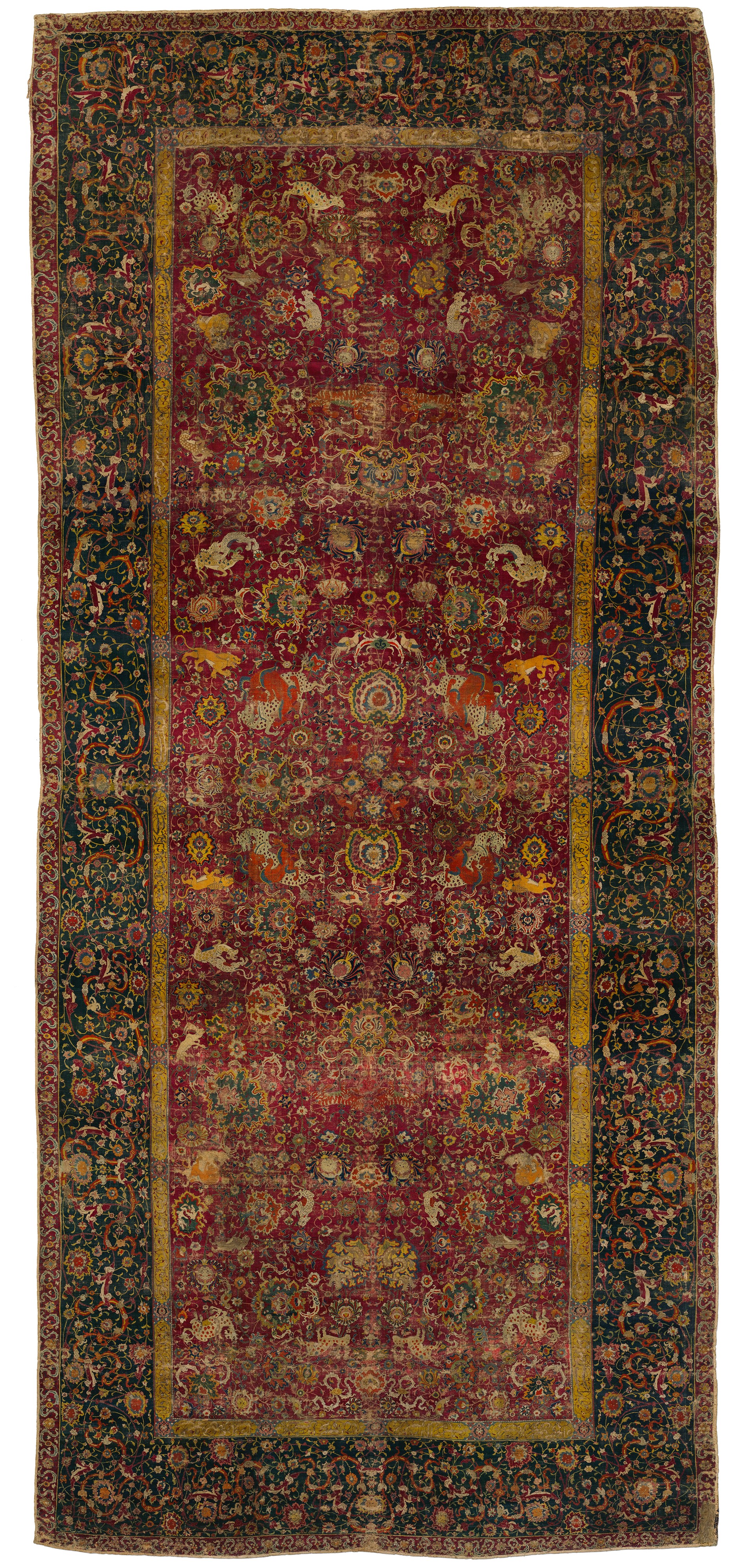
At Tabriz, and in royal workshops at Kashan and Kerman, the Safavid court produced carpets in which a single designer's cartoon governed the whole field.711 The technical base made this possible. The asymmetrical knot, open to one side, packs more densely and renders curves more smoothly than the symmetrical knot of Anatolia; silk warps and wefts allowed knot counts high enough for a drawn line to survive translation into pile.78 The result could carry anything the court painters could draw — a central medallion with pendants, quarter-medallions in the corners, a field of scrolling arabesques, or a hunting park full of riders, lions and deer. Jon Thompson and Sheila Canby's Hunt for Paradise (2003), the catalogue of the first exhibition devoted to Safavid court art of the period 1501–1576, made the case for reading carpets, manuscripts, textiles and metalwork as the products of one courtly design system.6
The fixed point of the whole tradition is a pair. The two Ardabil carpets, now in the Victoria and Albert Museum in London and the Los Angeles County Museum of Art, carry a cartouche with a couplet of Hafiz and a signature: "I have no refuge in the world other than thy threshold. There is no protection for my head other than this door. The work of the servant of the threshold Maqsud of Kashan in the year 946."19 The year 946 of the hijra corresponds to 1539–40. The carpets are reported to have come from the shrine of Shaykh Safi al-Din at Ardabil, the dynasty's ancestral sanctuary; they were made, that is, for the holiest place of the Safavid house, under Tahmasp I.19
What the knot allowed
The technical difference between the traditions is easy to state and decisive in its consequences. Every knotted-pile carpet is built on a foundation of warps (the threads running the length of the loom) and wefts (the threads passed across between rows of knots); the pile is made by tying short lengths of dyed yarn around pairs of warps and cutting them. The way the yarn is tied governs what can be drawn:78
- The symmetrical knot — the yarn is wrapped around both warps and both ends emerge between them. It is sturdy, and it suits angular, geometric drawing; it is the knot of Anatolia and the Caucasus.
- The asymmetrical knot — the yarn is wrapped fully around one warp and only passes under the other, so one end emerges free. It allows denser knotting and smoother curves; it is the knot of the Safavid court, of Mamluk Cairo, and later of Mughal India.
- Silk foundations — warps and wefts of silk, finer and stronger than wool, allow more knots to the inch and a sharper line.
- The cartoon — a full-scale or squared-up drawing of the design, which the weavers follow knot by knot, so that the designer's line, not the weaver's memory, governs the field.
The combination of the second, third and fourth elements is what made the Safavid court carpet a different object from its predecessors. It is also exactly the package that travelled: the Ottoman court carpet adopted the asymmetrical knot even though Anatolian weavers had used the symmetrical one for centuries, and the Mughal carpet began with it and never used anything else.117
Chaldiran and the road to Istanbul
The Ottoman leg of the transmission began on a battlefield. On 23 August 1514 Selim I's army, with its artillery and Janissary musketeers, destroyed Ismaʿil's Qizilbash cavalry at Chaldiran, north-west of Lake Urmia; Selim then made a ceremonial entry into Tabriz, where the Friday sermon was read in his name.1018 He did not hold the city. What he took from it was people. The Oxford survey of Iznik ceramics records that he "rounded up merchants, artists and notables from Khurasan whom Ismaʿil had forcibly settled in Tabriz and despatched them to Istanbul."18 The same artists who had been brought from Herat to Tabriz were now moved again, from Tabriz to the Ottoman capital.
The Ottoman palace's own payroll registers make the event legible. The ehl-i hiref salary books, the registers of the palace artists' corporation, record their names, wages, workshops and dates of entry. Murat Uluskan's study of these registers for the reign of Süleyman (1520–1566), published in Belleten in 2021, traces the Tabriz artists one by one: following Chaldiran, he writes, "the Sultan employed famous artisans from Tabriz who previously worked either in the private service of the Shah or as freelancers," who were held at Amasya over the winter and then, on reaching Istanbul, "assigned to the relevant art classes in the Ehl-i hiref organization of the palace."9 Gülru Necipoğlu, whose 1990 study in Muqarnas followed the change in Ottoman court taste from an "international Timurid" style to a distinctively Ottoman one, showed how this émigré group carried the Tabriz design repertory into the Ottoman palace studio (nakkaşhane).10
One of them reshaped the Ottoman decorative arts. Şahkulu, a Tabriz-trained designer recorded in the palace workshop from the 1520s until his death in 1556, is credited with the saz style — long serrated leaves sweeping through blossoms and fantastic birds — that spread from Ottoman manuscripts to tiles, textiles and carpets.1017 Under Süleyman the nakkaşhane became the design office of the empire, producing patterns that potters at Iznik, velvet weavers at Bursa and carpet weavers could all follow.10
Cairo's looms change masters
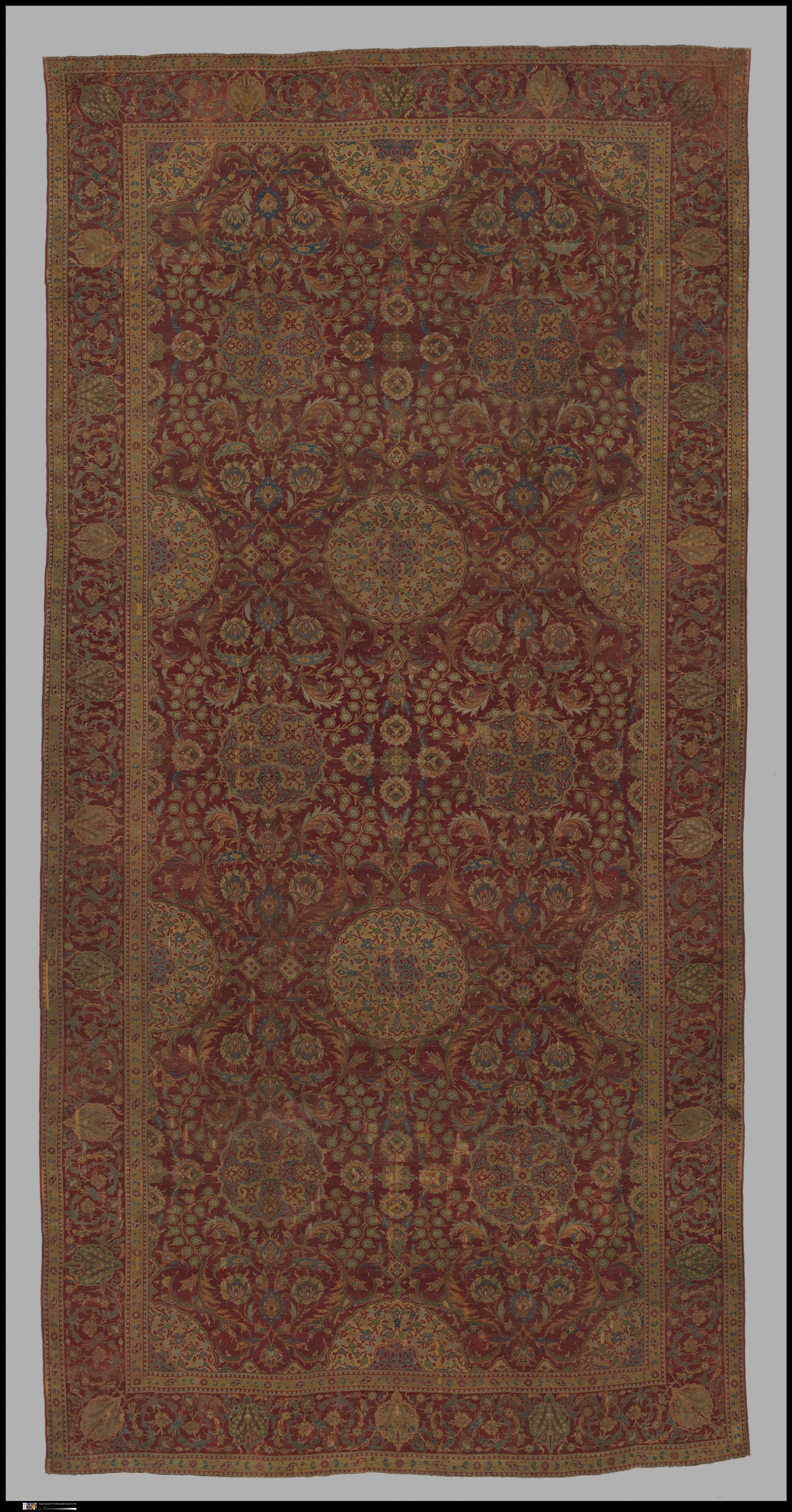
The second Ottoman conquest supplied the looms. In January 1517 Selim destroyed the Mamluk army outside Cairo and annexed Egypt and Syria. The Cairo carpet manufactory survived the change of masters and changed its designs: in place of the Mamluk octagons it began to weave the new Ottoman court floral style — medallions, lancet leaves, tulips, carnations, hyacinths — using the same asymmetrical knot and the same fine, lustrous Egyptian wool.17 The Ottoman court carpet that resulted combined three inheritances: the Safavid design idea of a drawn medallion field, the Istanbul nakkaşhane's floral vocabulary, and the Mamluk weavers' technique and materials.1017
Then the Ottoman state moved the weavers too. The Metropolitan Museum's catalogue of its Ottoman court carpet records that in 1585 Murad III requested Cairene weavers, together with a quantity of Egyptian wool, to be brought to Istanbul, and that eleven weavers and their supplies duly came.17 Art historians still disagree over whether particular court carpets were woven in Cairo, Istanbul or Bursa; the 1585 transfer is the documentary fact around which that debate turns.17 Either way, the floral court carpet of the Ottomans was a hybrid that existed because two conquered cities' craftsmen had been made to work for the victor.
Humayun's exile and Akbar's workshops
The Mughal leg began with defeat. In 1540 Babur's son Humayun lost Hindustan to the Afghan Sher Shah Sur and spent the next years as a fugitive. In 1544 he reached the Safavid court and was received by Tahmasp I, who gave him troops on terms.6 With Persian help he took Kandahar and then Kabul, and at Kabul he gathered Persian artists: the painters Mir Sayyid ʿAli and ʿAbd al-Samad, trained in Tahmasp's workshop, joined him around 1549 and went with him to Delhi when he recovered it in 1555.16 He died the following year. The atelier he had founded passed to his thirteen-year-old son.
Akbar (r. 1556–1605) turned a Persian painting studio into an imperial production system. His kārkhānas — royal workshops for everything from arms to perfume — included carpet workshops, and Abuʾl Fazl's Āʾīn-i Akbarī, the administrative gazetteer of the reign completed in the 1590s, describes them in the chapter on the imperial furnishing department:2
"His Majesty has caused carpets to be made of wonderful varieties and charming textures; he has appointed experienced workmen, who have produced many masterpieces. The gilims of Iran and Turan are no more thought of… All kinds of carpet weavers have settled here, and drive a flourishing trade. These are found in every town, especially in Agra, Fathpur and Lahor."
The passage is a claim of substitution, made in the language of a court that knew exactly what it was replacing: the carpets of "Iran and Turan" — Safavid Persia and Uzbek Central Asia — were "no more thought of" because the emperor had brought the weavers to India.2 Abuʾl Fazl even gives a price. In the imperial workshops a single carpet twenty gaz long and more than six broad cost 1,810 rupees to make, "which those who are skilled in the business have valued at 2715 rupees."2 The workshop was a cost centre as well as an art studio, and the court's accountants were measuring its margin.
Who carried the knot
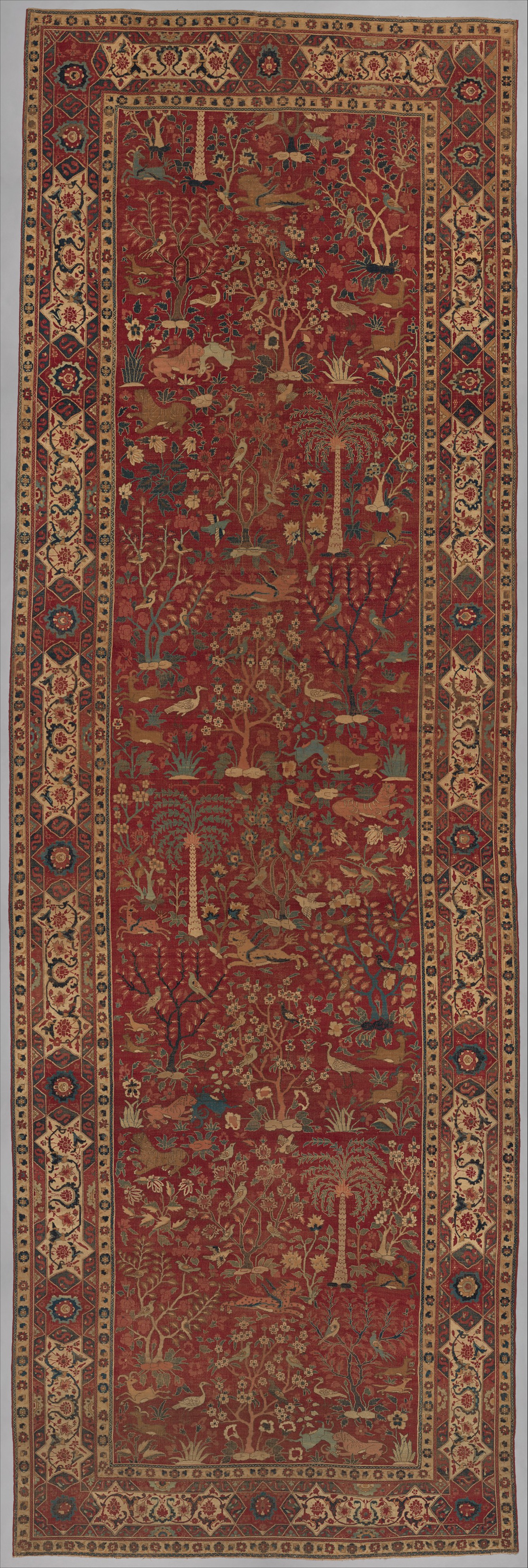
The weavers' names are not recorded. What the surviving carpets record is their training. The earliest group of Mughal carpets, attributed to Lahore and dated to the late sixteenth and early seventeenth centuries, uses the asymmetrical knot on cotton foundations, the Safavid layout of field and borders, and Safavid motifs — animals in combat, cloud-bands, palmettes — alongside things no Iranian carpet showed: Indian palm trees, elephants, rhinoceroses, Chinese-derived qilin.1 Walker reads them as the work of Persian-trained weavers and Persian-style designers working for a court with its own visual appetite; the many carpets that dealers and older scholarship labelled "Herat" or "Indo-Persian" sit precisely on that boundary, and their attribution to Iranian or Indian looms is still disputed piece by piece.18 The transmission ran, in sum, along four channels:
- Exiled court painters — Mir Sayyid ʿAli and ʿAbd al-Samad, who brought the Safavid design repertory into the Mughal atelier.16
- Recruited weavers — the "experienced workmen" Abuʾl Fazl says the emperor appointed and the "carpet weavers of all kinds" who settled in Agra, Fatehpur and Lahore.2
- Imported carpets as models — the carpets of Goshkan, Khuzistan, Kerman and Sabzevar that merchants went on bringing in.2
- The asymmetrical knot itself — a technique, not a style, and the one element that never changed.17
What changed and what was replaced
Two empires, one carpet language
By 1600 the designed court carpet existed in three empires at once. The chronology runs as follows:12791719
| Year | Event | Place |
|---|---|---|
| 1501 | Ismaʿil I takes Tabriz; the Safavid state is founded | Tabriz |
| 1510 | Herat taken; Timurid court artists moved west | Herat → Tabriz |
| 1514 | Chaldiran; Tabriz artists sent to Istanbul | Tabriz → Amasya → Istanbul |
| 1517 | Ottoman conquest of Cairo; Mamluk looms turn to the Ottoman floral style | Cairo |
| 1539–40 | The Ardabil carpets, signed by Maqsud of Kashan | Ardabil shrine |
| 1544 | Humayun at Tahmasp's court | Safavid Iran |
| c. 1549 | Mir Sayyid ʿAli and ʿAbd al-Samad join Humayun | Kabul |
| 1570s–1590s | Akbar's carpet workshops in Agra, Fatehpur and Lahore | North India |
| 1585 | Murad III brings eleven Cairene weavers and Egyptian wool to Istanbul | Cairo → Istanbul |
| 1601 | Sigismund III Vasa orders carpets at Kashan | Kashan |
| 1634 | Robert Bell's carpet for the Girdlers' Company woven at Lahore | Lahore → London |
| c. 1650 | Pashmina carpets of Kashmir and Lahore at their finest | Kashmir, Lahore |
In the Mughal case the change was total, because there was nothing to graft onto. Within two generations of Akbar's workshops, Mughal carpets had moved away from their Safavid models toward a distinctively Indian naturalism. The great pashmina-wool carpets of around 1650, attributed to Kashmir or Lahore — the Metropolitan Museum holds a carpet with irises, tulips and other flowering plants, and fragments of lattice-and-blossom carpets knotted in goat-down wool on silk at densities few Iranian looms ever matched — set individual flowering plants in rows, each drawn as a botanist might draw it.1 That floral naturalism ran through the whole Mughal decorative system under Jahangir and Shah Jahan, from the inlaid marble of the Taj Mahal to the borders of album pages, and Walker treats it as the moment the Indian carpet stopped being Persian.112
The Lahore carpet and its European clients
The Mughal carpet also became an export. Lahore — Akbar's capital from 1585 to 1598 and the principal market for carpets in the empire — sold to Iranian, Central Asian and, increasingly, European buyers.112 In 1634 Robert Bell, a director of the English East India Company and a member of the Worshipful Company of Girdlers, had a carpet woven at Lahore for his livery company, its field patterned with the Girdlers' arms; it still belongs to the Company in London.1 Francisco Pelsaert, the Dutch East India Company's factor at Agra, noted in 1626 that carpets were woven "in moderate quantities" at Agra and Fatehpur and that Lahore was a market for them.3 Sylvia Houghteling's The Art of Cloth in Mughal India (2022), drawing on royal inventories and chronicles, shows how such textiles moved as diplomatic gifts and political instruments between the Mughal court, the Rajput and Deccan kingdoms and the British Isles.12
The Safavid court, meanwhile, made the carpet a diplomatic export in its own right. In 1601 Sigismund III Vasa of Poland sent the Armenian merchant Sefer Muratowicz to Kashan to order silk carpets, at least one of them with the royal arms; the silk-and-metal-thread carpets of that type, several of which passed by marriage to the Wittelsbachs and survive in Munich, were mistaken in nineteenth-century Paris for Polish work and are still called "Polonaise."16 Shah ʿAbbas I, who moved his capital to Isfahan in 1598, established royal workshops there, and the French jeweller Jean Chardin, in Iran in the 1660s and 1670s, described the royal manufactories that wove carpets of silk, gold and silver for the court.11
Istanbul's floral carpet
In the Ottoman case the change was a split rather than a replacement. The court carpet — floral, curvilinear, asymmetrically knotted, designed in the nakkaşhane and woven in Cairo and probably in Istanbul and Bursa — became the floor of the palace, the imperial mosques and the great households.1017 The prayer rugs of the court style, with their arched niches filled with flowers and hanging lamps, are its most widely copied form. But the older Anatolian tradition did not die. Uşak went on weaving its own medallion and star carpets in the symmetrical knot for the export market, increasingly influenced by the court designs but never replaced by them.8 Two carpet cultures existed side by side: a court one that descended from Tabriz and Cairo, and a provincial one that descended from Konya.
What was displaced
The transmission did not only add. It displaced, and the displacements are the less told half of the story:
- The Indian cotton floor as the top of the hierarchy. The darī and the white floor-cloth went on being made in vast quantities, but the prestige floor of the Mughal court and its imitators became the knotted wool carpet. The category "fine carpet" in north India acquired a Persian definition.12
- The Mamluk geometric carpet. Cairo's octagon-and-star style, a court art for perhaps a century, was replaced at its own looms within a generation of 1517.17
- The independence of the weaver from the design. In the court system the weaver executed a cartoon drawn by someone else. The knowledge that had lived in the weaver's memory — the repertory of geometric patterns knotted from habit — became subordinate to the paper design, and the designer, not the weaver, signed: Maqsud of Kashan at Ardabil was almost certainly the designer, not the hand at the loom.719
- The court workshop's own continuity in Iran. The Safavid royal workshops ended with the dynasty. The Afghan siege and capture of Isfahan in 1722 brought down the Safavid state, and the court carpet workshops of Isfahan and Kashan did not resume production on the old scale until the late nineteenth century.11
The last of these is an irony worth stating directly. By 1722 the Persian court carpet survived more securely in Lahore, Kashmir and the Ottoman lands than in Iran itself.
What the cost was
The cost of this transmission is not counted in battle dead. Chaldiran killed thousands, but Chaldiran was fought over territory and faith, not carpets, and its dead are not the bill of the transfer of a design tradition. The bill was paid in a different currency: the bodies, time and freedom of the people who carried the knot.
Artisans as spoils of war
The first entry is the treatment of artisans as movable property of the state. Twice in four years, the same community of court artists was relocated by a victorious ruler: from Herat to Tabriz after 1510, and from Tabriz to Istanbul after 1514.918 Uluskan's reading of the ehl-i hiref registers shows that the Ottoman palace had done this before — after Otlukbeli in 1473 Mehmed II brought scholars and artists from the defeated Akkoyunlu court — and that it treated the practice as a normal fruit of victory.9 The registers record wages and careers; they do not record what the artists' families lost when they were marched from Tabriz to Amasya and wintered there before reaching Istanbul.9 In 1585 the same logic was applied by administrative order rather than conquest, when eleven Cairene weavers were sent to Istanbul with their wool.17 Whether they went willingly is not recorded. What is recorded is that the state could require it.
Five or six tankas a day
The second entry is the wage. The Mughal court boasted of the price of its carpets; it did not boast of what it paid the people who made them. Pelsaert, who was in a position to know — he was buying textiles at Agra for the Dutch company — set the two side by side in his Remonstrantie of 1626:3
"Goldsmiths, painters, embroiderers, carpet-makers, cotton or silk-weavers, blacksmiths, coppersmiths, tailors, masons, builders, stone-cutters, a hundred crafts in all … any of these by working from morning to night can earn only 5 or 6 tackas."
Pelsaert then names the second burden. A workman could be taken by "the Governor, the nobles, the Diwan, the Kotwal, the Bakhshi, and other royal officers" to work for them without his consent, "well beaten if he should dare to raise any objection, and in the evening paid half his wages, or nothing at all."3 The carpet-maker is in his list by name. François Bernier, the French physician who lived at the Mughal court a generation later, described the imperial workshops as halls where craftsmen came each morning and left each evening, and drew the same conclusion about their prospects: "in this quiet regular manner, their time glides away; no one aspiring for any improvement in the condition of life wherein he happens to be born."5
Set against Abuʾl Fazl's figure of 1,810 rupees for one large carpet, the arithmetic is stark. A tanka in Pelsaert's usage was a copper coin, a small fraction of a rupee; a weaver earning five or six a day, every day, would need years to earn the cost of the carpet he knotted.23 That gap is not unique to Mughal India — it is the structure of every court luxury economy — but it is the economic fact that the transmission carried with it, and the Mughal sources are unusually precise about both sides of it.
The jail and the bonded child
The third and heaviest entry comes later, and its attribution to the sixteenth-century transmission has to be argued rather than assumed. The knotted-pile industry that Akbar seeded in Agra and Lahore outlived the Mughal court. In the nineteenth century the colonial state found it a use. Abigail McGowan, in her 2013 study in the Journal of Asian Studies, shows how carpet weaving in late colonial India was "centered in jails where convicts produced high-quality rugs using historic designs in prison factories that served as laboratories for redefining penal labor and traditional design under the eyes of the colonial state."13 The jails of Agra and Lahore — the two Mughal carpet cities — were among the producers of the finest pieces, and the "historic designs" they copied were the Mughal and Persian court patterns.1314 The colonial classification of the carpet as an Indian "art industry," set out in George Birdwood's Industrial Arts of India (1880), gave the jail product its market.14
When the jails stopped, the looms moved to villages, and the labour moved to children. The carpet belt of eastern Uttar Pradesh around Bhadohi and Mirzapur, and the carpet workshops of Pakistani Punjab, grew in the late twentieth century into major export industries for European and American buyers. In 1996 Human Rights Watch's report The Small Hands of Slavery documented bonded child labour in seven Indian industries, of which hand-knotted wool carpets were one, and estimated that at least fifteen million children worked as bonded labourers in India overall.15 The structure was debt: a family took an advance, and a child repaid it at the loom.
The record permits one name. Iqbal Masih, born in 1983 in Muridke, a town on the Grand Trunk Road a few miles from Lahore, was bonded at the age of four to a carpet-loom owner against a family loan.20 He escaped at about ten, after Pakistan's Bonded Labour System (Abolition) Act of 1992, joined the Bonded Labour Liberation Front, and spoke against the carpet industry in Pakistan, Europe and the United States.20 On 16 April 1995, at the age of twelve, he was shot dead while riding a bicycle near Muridke. Who killed him, and why, has never been settled: the police said a local farm labourer; his campaign said the carpet interests he had exposed.20 He was killed within an hour's drive of the city where Robert Bell's carpet was knotted.
The response
The exposure produced a response, and it too came out of the carpet belt. Kailash Satyarthi's Bachpan Bachao Andolan ("Save the Childhood Movement"), founded in 1980, carried out raids on carpet looms in Mirzapur and Bhadohi to free bonded children, and in 1994 helped found the RugMark label (later GoodWeave), which certified carpets as made without child labour for importers in Germany, the United States and elsewhere. Satyarthi shared the Nobel Peace Prize in 2014.1521 Neither the abuse nor the remedy is finished business. What is clear is that the industry's modern reckoning began in the same two regions — the Gangetic plain east of Agra and the Punjab around Lahore — where Akbar's weavers had settled four centuries before.215
Weighing the bill
Three things need saying about this bill.
- The direct costs are documented but limited. Two forced relocations of court artists (1510, 1514), one compulsory transfer of weavers (1585), and a Mughal wage regime that Pelsaert recorded as five or six tankas a day with forced service on top.391718
- The heavy costs are downstream. Colonial convict labour and late-twentieth-century bonded child labour belong to an industry the transmission created, in the same cities, copying the same designs; but they were produced by colonial penal policy, by debt bondage, and by Western consumer demand, not by the sixteenth-century transfer itself.1315
- The weaver was always the cheapest input. From Pelsaert's tankas to the child at the loom in Muridke, the economics of the court carpet assumed that the hand which knotted it could be paid almost nothing — an assumption that the court system created, and that the export market inherited.31520
The last word belongs to the object. The Ardabil carpet's inscription is a line of devotion: "I have no refuge in the world other than thy threshold."19 The men who knotted its millions of knots are not named on it. Only the servant who drew it signed.
What followed
-
1514After Chaldiran, Selim I takes artists and craftsmen from Tabriz — including Khurasani masters Ismaʿil had moved there from Herat — winters them at Amasya and enrols them in the Istanbul palace workshops.
-
1517The Ottoman conquest of Cairo turns the Mamluk carpet manufactory from geometric octagons to the floral court style designed in Istanbul, woven in the asymmetrical knot on Egyptian wool.
-
1540The Ardabil carpets are completed for the Safavid dynastic shrine, signed by Maqsud of Kashan and dated 946 AH — the fixed point of the Persian court carpet.
-
1549The Safavid-trained painters Mir Sayyid ʿAli and ʿAbd al-Samad join the exiled Humayun at Kabul, bringing the Persian court design repertory into the Mughal atelier.
-
1585Murad III orders eleven Cairene carpet weavers and a supply of Egyptian wool to Istanbul, moving the court carpet's technique to the capital by administrative order.
-
1598Abuʾl Fazl's Āʾīn-i Akbarī records imperial carpet workshops at Agra, Fatehpur and Lahore and declares the carpets of Iran and Turan 'no more thought of'.
-
1601Sigismund III Vasa sends Sefer Muratowicz to Kashan to order silk carpets with the Polish royal arms — the 'Polonaise' carpets of Safavid diplomacy.
-
1626Pelsaert records at Agra that carpet-makers and other craftsmen earn five or six tankas for a day's work and can be pressed into officials' service unpaid.
-
1634Robert Bell of the East India Company has a carpet with the Girdlers' arms woven at Lahore; it still belongs to the Girdlers' Company in London.
-
1722The Afghan capture of Isfahan ends the Safavid state; the royal carpet workshops of Isfahan and Kashan cease production on the old scale for some 150 years.
-
1880Colonial jail factories at Agra, Lahore and elsewhere weave carpets in historic Mughal and Persian designs with convict labour for the export market.
-
1995Iqbal Masih, bonded at four to a carpet-loom owner and freed at ten, is shot dead at twelve near Muridke, outside Lahore, after campaigning against child labour in the carpet industry.
Where this lives today
References
- Walker, Daniel. Flowers Underfoot: Indian Carpets of the Mughal Era. New York: The Metropolitan Museum of Art, 1997. en
- Abuʾl Fazl ʿAllami. The Āʾīn-i Akbarī, vol. 1. Translated by H. Blochmann; 2nd ed. revised by D. C. Phillott. Calcutta: Royal Asiatic Society of Bengal, 1927. Book 1, Āʾīn 21 (The Farrāsh Khāna). Persian original completed c. 1598. en primary
- Pelsaert, Francisco. Jahangir's India: The Remonstrantie of Francisco Pelsaert. Translated from the Dutch by W. H. Moreland and P. Geyl. Cambridge: W. Heffer & Sons, 1925. (Remonstrantie, Agra, 1626.) en primary
- Babur, Zahir al-Din Muhammad. The Bābur-nāma in English (Memoirs of Bābur). Translated from the Turki by Annette Susannah Beveridge. London: Luzac, 1922. en primary
- Bernier, François. Travels in the Mogul Empire, A.D. 1656–1668. Translated by Archibald Constable. Westminster: Archibald Constable and Co., 1891. en primary
- Thompson, Jon, and Sheila R. Canby, eds. Hunt for Paradise: Court Arts of Safavid Iran, 1501–1576. Milan: Skira; New York: Asia Society, 2003. en
- "Carpets ix. Safavid Period." In Encyclopaedia Iranica, online edition. New York: Encyclopaedia Iranica Foundation. en
- Erdmann, Kurt. Siebenhundert Jahre Orientteppich: Zu seiner Geschichte und Erforschung. Edited by Hanna Erdmann. Herford: Bussesche Verlagshandlung, 1966. de
- Uluskan, Murat. "Ehl-i Hiref Maaş Defterlerinde Kayıtlı Tebrizli Sanatkârlar (1526–1566)." Belleten 85, no. 304 (2021): 849–887. tr
- Necipoğlu, Gülru. "From International Timurid to Ottoman: A Change of Taste in Sixteenth-Century Ceramic Tiles." Muqarnas 7 (1990): 136–170. en
- Floor, Willem. The Persian Textile Industry in Historical Perspective, 1500–1925. Moyen-Orient et Océan Indien 11. Paris: Société d'Histoire de l'Orient / L'Harmattan, 1999. en
- Houghteling, Sylvia. The Art of Cloth in Mughal India. Princeton: Princeton University Press, 2022. en
- McGowan, Abigail. "Convict Carpets: Jails and the Revival of Historic Carpet Design in Colonial India." The Journal of Asian Studies 72, no. 2 (2013): 391–416. en
- Birdwood, George C. M. The Industrial Arts of India. London: Chapman and Hall, 1880. en primary
- Human Rights Watch. The Small Hands of Slavery: Bonded Child Labor in India. New York: Human Rights Watch, 1996. en
- "Poland ii. Persian Art in Poland." In Encyclopaedia Iranica, online edition. New York: Encyclopaedia Iranica Foundation. en
- The Metropolitan Museum of Art. "Ottoman Court Carpet," late 16th–17th century, attributed to Egypt, accession no. 41.190.257. Collection catalogue entry. en
- Ashmolean Museum. "A.9. Selim I (1512–1520)." In Islamic Ceramics: Iznik Pottery. Oxford: Ashmolean Museum, online resource. en
- Los Angeles County Museum of Art. "The Ardabil Carpet," Iran, 1539–40. Collection record (companion to the Victoria and Albert Museum carpet). en
- "Death Spotlights Plight of Child Laborers." The Christian Science Monitor, 1 May 1995. en
- The Nobel Prize. "Kailash Satyarthi – Facts." NobelPrize.org, 2014. en