The Phoenicians taught the Mediterranean to sail (~700 BCE)
Celestial navigation by the Little Bear, the locked-mortise hull, and the engineered harbour passed from Tyre to its Greek rivals and its Punic heirs. The knowledge outlived the cities that made it.
In the eighth century BCE the Greeks could sail competently within sight of home and almost nowhere else. The Phoenicians of Tyre and Sidon, who had run a trade network from the Levant to Atlantic Iberia for three centuries, had what the Aegean lacked: a deep-water hull locked with mortise-and-tenon joints, harbours engineered as enclosed basins, and a method of steering by the Little Bear, the constellation the Greeks called “the Phoenician.” Through shared ports at Cyprus, Al Mina, and Pithekoussai, Greeks absorbed the whole maritime competence and built their colonizing, blue-water civilization on it. So did Carthage, the Punic heir that kept the craft. The borrowing was peaceful. The contest it created was not: it ran through the Battle of Alalia, a century of Sicilian sieges, and the Roman annihilation of Carthage in 146 BCE, which burned a thousand years of sea-knowledge with the archives.
The sea before the rivals
An Aegean of short hops and beached hulls
In the eighth century BCE the Greek-speaking world was not yet a sea power. It was a scatter of communities around the Aegean rim and the western edge of Anatolia, still emerging from the long depopulation that had followed the collapse of the Mycenaean palace centres around 1200 BCE. The script, the centralized economy, and the long maritime reach of the Bronze Age had all been lost; what remained were villages relearning the sea from a low base. Their ships were small, open, single-banked galleys built for the daylight passage and the short hop. A Geometric-period captain navigated by eye from one headland to the next, drew his vessel up onto a beach at dusk rather than riding at anchor in open water, and kept to harbour through the winter months, roughly November to March, when the Mediterranean's weather effectively closed the sea to navigation.1
The mental world of the Homeric poems, fixed in writing in exactly these decades, matches what the archaeology shows. Open water out of sight of land is a place of dread; the sea is repeatedly named hostile and devouring; a captain blown off the coastline is a captain who may not come home. Odysseus, the most resourceful sailor in the Greek imagination, spends much of his epic shipwrecked, becalmed, or terrified, and when he does steer by the stars the poet frames it as the act of a man pushed to the edge of survival. The Greeks of 800 BCE had ships, sailors, and courage. What they did not have was a technology of the open sea.
What the Aegean lacked
The gap between Greek and Phoenician seafaring was specific rather than vague, and it can be itemized. Archaic Greek maritime culture around 800 BCE lacked at least four things the eastern Mediterranean already possessed and used as routine:
- A precise method of night navigation. Greek crews steered by the conspicuous Great Bear (Ursa Major), a large, bright constellation that circles well away from true north and therefore yields an imprecise heading. They had no disciplined technique for holding an accurate course after dark on the open sea.12
- A true deep-water hull. Early Greek vessels descended from the older sewn-boat tradition, their planks stitched and lightly edge-joined: adequate for coastal work, but not built to take the sustained pounding of long open-sea or Atlantic-facing voyages.115
- The engineered harbour. Greek ships were beached on open shores; the purpose-built, enclosed, often artificial basin with quays and ship-sheds was a Levantine institution the Aegean had not yet adopted.24
- A standing long-range trade network. No Greek community in 800 BCE operated a permanent commercial route to the distant metal sources of the far west, to the silver of Iberia or the tin that reached the Atlantic seaboard from the north.26
These four absences are the calibration for everything that follows. To feel the weight of what the Phoenicians transmitted, one has to hold in mind a Greek world that could sail competently within sight of home, and almost nowhere else.
The people who already owned the sea
The Phoenicians were the Iron Age inhabitants of a narrow, mountain-backed strip of the Levantine coast, organized as independent city-states — Tyre, Sidon, Byblos, Arwad — rather than as a single nation. With little farmland behind them, they turned to the sea out of necessity and made it their domain. By the eighth century BCE, three centuries before the Greeks took up open-water sailing in earnest, Tyrian and Sidonian crews were running a trade system that reached Cyprus, the North African coast, Sardinia, Sicily, Malta, and the silver-rich river estuaries of southern Iberia around Gadir, modern Cádiz.23 The archaeologist María Eugenia Aubet, whose Tiro y las colonias fenicias de Occidente is the standard study of this expansion, frames it as a deliberate, Tyre-directed commercial enterprise rather than a folk migration: a network of trading posts strung along the routes to metal.3
The Phoenicians possessed, as an integrated system, everything the Greeks lacked: the celestial method, the deep-water hull, the engineered harbour, and the long-range network to put them to use. What this record traces is not the gift of a single tool but the passage of that whole maritime competence from the culture that held it to two cultures that would carry it forward — the Greek rivals who competed with it across the western sea, and the Carthaginian heirs who preserved it. And it traces what that passage cost, which was not paid in the transmission itself but in the crowded, contested sea the transmission made possible. The Greeks learned to find north from the very people they would later help to destroy.
The transmission: contact, copied hulls, and a borrowed star
The contact zones
The transfer of maritime knowledge did not happen at a frontier or across a battle line. It happened in shared ports, over generations, through proximity. From the late ninth century BCE, Greeks and Phoenicians lived, worked, and traded side by side in a string of mixed coastal settlements that functioned as exchange zones for goods, techniques, and people.
On Cyprus, Greek and Phoenician communities occupied the same island and at times the same towns, Kition among them, for centuries. At Al Mina, on the north Syrian coast, Euboean Greek pottery accumulates in the same archaeological strata as Levantine wares, marking a port where Aegean and eastern traders met as a matter of routine.6 Most vividly, at Pithekoussai — the island of Ischia in the Bay of Naples, the earliest Greek settlement in the western Mediterranean, founded around 750 BCE on the metal-trading routes — Greek, Phoenician, and broader Levantine names and objects turn up together in a single shared cemetery.6 The settlement that produced the "Cup of Nestor," one of the oldest Greek alphabetic inscriptions, was demonstrably multicultural and maritime.
This is the texture of the transmission: not conquest, not a treaty, not a school, but decades of Greek sailors watching Phoenician crews rig sail, lay a course, build a hull, work an enclosed harbour, and read the night sky, and gradually learning to do the same. John Boardman's classic survey of the early Greek colonies treats these contact zones as the crucible in which Greeks acquired both the alphabet and the deep-sea seafaring that made their own westward expansion possible.6 The two great transmissions — letters and ships — traveled the same routes, often through the same ports, in the same generations.
The bireme and the Phoenician joint
The most concrete inheritance was the ship itself, and it came in two layers: one visible above the waterline, one hidden below it.
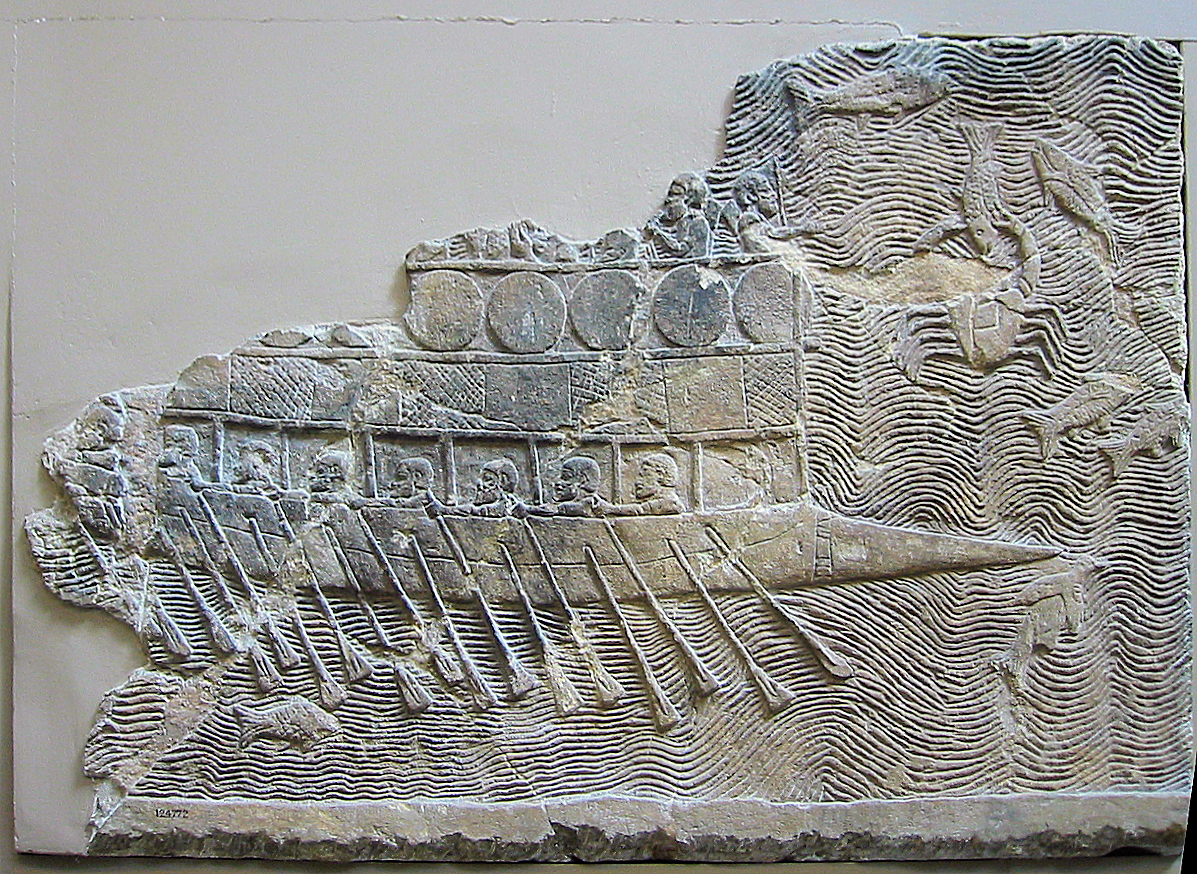
Above the water was the bireme. By the end of the eighth century BCE the Phoenicians had developed a galley with two staggered banks of oars on each side, the upper bank's oars clearing the lower, roughly doubling the number of rowers — and thus the speed and ramming power — without lengthening the hull to the point of structural failure.1 The earliest unambiguous depiction of such a ship is an Assyrian palace relief from Nineveh dated to about 700 BCE, which shows a Phoenician two-banked warship with a pointed ram at the bow and round shields fixed along the rail above the rowers. Lionel Casson, whose Ships and Seamanship in the Ancient World remains the standard reference, treats the bireme as a Phoenician innovation that the Greeks then took up; the trireme, the warship that would decide the classical Aegean, is a further development of the same two-banked principle.116
Below the water lay the more important transfer: the locked mortise-and-tenon joint, the technique Roman writers later called coagmenta punicana, "Punic joints."15 Phoenician shipwrights cut matching sockets into the edges of adjoining hull planks, slotted hardwood tenons into them, and pinned each tenon with a dowel, producing a rigid, watertight, shell-first hull strong enough for the open sea. Greek builders abandoned their older sewn-and-laced construction and adopted the joint wholesale. Its superiority was decisive enough that, early in the First Punic War, Roman shipwrights are reported to have reverse-engineered a wrecked Carthaginian warship and built a fleet of a hundred quinqueremes in roughly two months by copying its numbered, pre-cut, jointed planks.13 The Phoenician hull is, quite literally, the substrate of every Mediterranean navy that followed.
Two hulls: the round ship and the long ship
The Phoenicians transmitted not one vessel but a whole typology, and the Greeks took the distinction along with it. Phoenician shipwrights built two fundamentally different hulls for two different purposes. The merchant gaulos — the "round ship," broad-beamed, deep-bellied, and sail-driven — was the workhorse of the trade network: it carried cargoes of wine, oil, metal, and Tyrian purple across open water under a single square sail, keeping oars only for harbour work. The long ship, by contrast, was the oared warship: narrow, fast, and ram-armed, built for speed and battle rather than capacity.1 Greek shipbuilding adopted exactly this division between the sail-driven merchantman, the holkas, and the oared warship, the naus makra or "long ship" — a functional split that would organize Mediterranean fleets down to the Roman period.
The transmission of the round ship mattered as much as that of the warship, because it was the merchantman that made the trade network economically real. A culture that could move bulk cargo cheaply across open sea, rather than portaging it overland or hugging the coast, could knit distant markets into a single system. When the Greeks acquired the deep-hulled sailing merchantman, they acquired the physical means of the colonial economy that followed: grain from the Black Sea, metal from the west, pottery and oil and wine flowing both ways across hundreds of miles of water. The warship decided who controlled the sea; the merchantman decided what the sea was worth controlling. The Phoenicians handed over both halves of the equation, and the Greeks built a civilization in the space between them.
Steering by the Little Bear
The subtlest inheritance was a star. Phoenician navigators held their night course not by the bright, sprawling Great Bear that Greek sailors used, but by the tighter, truer circle of Ursa Minor — the Little Bear — which turns much closer to the celestial pole and so gives a far more accurate indication of north. Greek tradition remembered the debt without embarrassment: the Greeks called the constellation Phoinikē, "the Phoenician," and credited the practice of steering by it to Phoenician teaching.12
The philosopher Thales of Miletos — described in several ancient sources as himself of Phoenician descent — was said to have introduced the method to Ionian sailors in the early sixth century BCE. The Hellenistic poet Callimachus, quoted by Diogenes Laertius in his life of Thales, praised him as the man
The point is not merely poetic. A heading held on the smaller, closer constellation is measurably more reliable than one held on the larger one, especially on the open sea where a degree of error compounds over a night's run. This was a genuine piece of applied astronomy, transmitted as practical craft from one seafaring culture to another, and it is exactly the kind of knowledge that lets a ship leave the coast with confidence. The Greeks did not just copy hulls and oar-banks; they copied the sky-reading that made deep-water voyaging survivable. That the receiving culture kept the Phoenician name for the constellation is, in its quiet way, an admission of who had taught whom.
The proof of the open sea: Necho's Phoenicians
How far Phoenician deep-water sailing could reach is captured in a single famous report. Around 600 BCE the Egyptian pharaoh Necho II, having abandoned his attempt to cut a canal from the Nile to the Red Sea, is said to have commissioned Phoenician crews to attempt something extraordinary: to sail clean around the African continent. According to Herodotus, they set out from the Red Sea, sailed south, and each autumn put ashore to sow grain and wait for the harvest before sailing on; in the third year they rounded the western end of Libya, passed the Pillars of Heracles, and returned to Egypt.7
Herodotus then records the one detail that later convinced scholars the voyage was real and convinced him it was false. The returning sailors claimed "that in sailing round Libya they had the sun upon their right hand." Herodotus adds: "I for my part do not believe them, but perhaps others may."7 The sun on the right hand is exactly what a crew sailing westward around the southern tip of Africa, below the equator, would observe — a phenomenon no Mediterranean writer of the fifth century could have invented, and the single best ancient evidence for the reality of Phoenician circumnavigation. Whether or not the full circuit was completed, the passage measures the scale of open-sea voyaging the Phoenicians were credibly believed capable of — precisely the competence the Greeks were, in these same centuries, in the act of acquiring.
Carthage: the heir that kept the craft
Greece was not the only inheritor of the Phoenician sea. The Phoenicians had also seeded their own daughter cities across the west, and the greatest of these, Carthage — Punic Qart-ḥadašt, "New City," founded from Tyre by tradition in 814 BCE on the Gulf of Tunis — grew into the full successor of the Phoenician maritime tradition.24 As the Levantine homeland fell under one foreign empire after another, Carthage preserved, organized, and extended the navigation, the shipbuilding, and the metals-trade network of its founders, becoming the dominant naval and commercial power of the western Mediterranean.
Carthaginian seamanship pushed further than the Phoenicians of the homeland had dared. Punic captains routinely passed the Pillars of Heracles into the Atlantic, working the trade in tin and other goods along the European and African coasts. Around 500 BCE the Carthaginian admiral Hanno led an expedition of sixty ships, reportedly carrying thousands of colonists, down the West African coast to plant settlements and explore; he recorded the voyage in a periplus, a written sailing account, which survives today only because Greek writers translated the Punic original from a stele set up in the temple of Baal Hammon.10 The detail is telling: even the Carthaginians' own record of their greatest voyage reached posterity through the hands of their Greek rivals.
So the same body of accumulated sea-knowledge ran down two branches at once. One went to the Greek competitors, who built it into a literate civilization that survived. The other went to the Punic heirs, who guarded and extended it until Rome destroyed them and most of their records with them. The transmission, in other words, had two futures, and they were already on a collision course.

What changed and what was replaced
From beachers to a blue-water culture
Within roughly two centuries of absorbing the Phoenician maritime package, the Greek world remade itself from a coastal society into a Mediterranean-wide one. The great colonizing movement of the eighth to sixth centuries BCE — Greeks founding cities from the shores of the Black Sea to southern Italy, eastern Sicily, southern France, North Africa, and the Spanish coast — was made structurally possible by the new capacity to cross open water reliably and to build, crew, and maintain seagoing fleets.6 This was not migration creeping along a coast; it was the projection of whole communities across hundreds of miles of sea to chosen sites, an enterprise that presupposes exactly the deep-water competence the Phoenicians had monopolized.
The scale of the movement is itself the measure of the new competence. Over roughly two and a half centuries, Greek communities founded something on the order of several hundred settlements around the Mediterranean and Black Sea coasts, from Trapezus in the far northeast to Emporion on the Spanish shore. Each foundation meant loading colonists, livestock, seed, and tools aboard ship and carrying them, often across open water, to a site that might be a thousand kilometres from the mother city. None of it was conceivable for the beaching, daylight-hopping seafarers of 800 BCE. The colonial Greek world was, in a real sense, a Phoenician hull's worth of distance wider than the Greek world that preceded it.
The boldest of the colonizers were the Phocaeans, the Ionian Greeks of the Anatolian coast, who specialized in long voyages in fast fifty-oared galleys. Around 600 BCE they founded Massalia, modern Marseille, and from it ran the long commercial route to the metal markets of the western sea and up the Rhône valley into the European interior.6 The Greek thalassocracy — sea-power as the organizing principle of a state, the idea that command of the sea could underwrite wealth and security — was built on a hull, a harbour, and a navigational practice that were not originally Greek at all. The Greeks took a competence learned by watching Phoenician crews and made it the foundation of their classical civilization. What had been a Levantine monopoly became a shared Mediterranean inheritance — and, very quickly, a shared Mediterranean contest.
The trireme and the displacement of the older fleet
The clearest single replacement happened in the warship, and it reshaped politics as much as naval tactics. The Phoenician-derived two-banked galley evolved, in Greek and Phoenician hands alike during the sixth century, into the trireme: three staggered banks of oarsmen, around 170 rowers driving a hull some thirty-seven metres long with a bronze-sheathed ram at attack speed. The trireme displaced the penteconter — the older single-banked, fifty-oared galley — as the standard ship of the line across the Mediterranean.1
This was not merely a technical upgrade; it dragged a whole social order behind it. A trireme required some two hundred men, the overwhelming majority of them rowers, and in Athens those rowers were drawn from the thetes, the poorest citizen class. The Lenormant relief from the Athenian Acropolis, carved around 410 BCE, preserves the image: the oarsmen of such a ship packed in their tiers along the hull. When the Athenian fleet of these ships broke the Persian navy at Salamis in 480 BCE, the thousands of poor citizens who had pulled the oars converted their military indispensability into political leverage, and the radical democracy of fifth-century Athens deepened accordingly. A direct line of descent runs from the Phoenician bireme depicted at Nineveh around 700 BCE, through the Greek adoption of multi-banked construction, to the trireme — and from the trireme to the assembly of citizen-rowers who governed classical Athens. The borrowed ship helped reorganize the borrowing society.

The Atlantic, the silver, and Tartessos
The engine of the whole maritime system was metal, and the competition the transmission seeded was, at bottom, a competition for it. The Phoenicians had built their western network around the silver of southern Iberia — the ores of the Río Tinto and the Sierra Morena, funnelled through the kingdom the Greeks called Tartessos and the Phoenician colony at Gadir.23 Beyond the Pillars of Heracles ran the longer routes to Atlantic tin, the metal that, alloyed with copper, made bronze, and that reached the southern coasts from sources as far away as the European northwest.
Once the Greeks had the ships to follow, they followed the silver. The Phocaeans of Massalia and their colonies pressed into the same Iberian markets the Phoenicians had opened, and Greek goods began to appear along the Spanish coast. The Carthaginian response was to militarize the trade: as the dominant Punic power, Carthage worked to close the Strait of Gibraltar to Greek shipping and to keep the Atlantic routes a Punic monopoly. The competence the Greeks had absorbed had made them rivals for the very resource that had justified the Phoenician sea in the first place. The transmission of know-how and the contest over markets were two faces of one process: the same skills that let the Greeks reach the far west guaranteed they would arrive as competitors, not guests.
New words, new institutions
The transmission left its tracks in language and institutions as well as in timber and rope. As the maritime competence spread, so did the structures and the vocabulary built around it:
- The engineered harbour. Greek and then, spectacularly, Carthaginian ports adopted the artificial enclosed basin. Carthage's circular military harbour, the cothon, ringed with covered ship-sheds for well over two hundred warships, was the monumental endpoint of a harbour-building tradition that began on the Levantine coast.4
- Coastal pilotage in writing. The periplus — a written sailing itinerary listing harbours, landmarks, anchorages, and the distances between them along a coast — became an established Greek genre. It was the literate codification of exactly the practical route-knowledge that long-distance Phoenician and Punic sailors had carried, with Hanno's translated account among its ancestors.10
- A vocabulary of the sea and of trade. The commercial Greek of the archaic Aegean absorbed Semitic loanwords for goods, vessels, and measures that traveled physically with the ships, moving through the same Greco-Phoenician contact zones that had, a little earlier, carried the alphabet itself.
None of these arrived as a sudden import. Each was adopted piecemeal, adapted to local needs, and then naturalized so thoroughly that the classical Greeks and Romans came to think of seafaring, harbours, and sailing-directions as simply their own. The Phoenician origin survived mainly in fossils: a constellation still called "the Phoenician," joints still called "Punic," a star-method credited to a philosopher of Phoenician descent.
The map of the western sea, redrawn
The deepest change was geopolitical, and it set the terms of the cost. Once Greeks could sail and colonize the far west, they collided directly with the Phoenician and Carthaginian network already established there. The western Mediterranean of the sixth and fifth centuries BCE became a contested board: Greek Massalia and the Phocaean colonies against Carthaginian Sardinia, western Sicily, and the southern Iberian coast; Greek eastern Sicily against Punic western Sicily along a frontier that ran down the middle of the island.
The irony is exact. The very competence the Greeks had absorbed from the Phoenicians — the deep-water hull, the celestial navigation, the harbour engineering — was what now made them the Phoenicians' and Carthaginians' rivals for the same silver, the same tin, the same anchorages and markets. A monopoly that had been peaceful because it was uncontested became, once shared, a source of conflict. Two cultures sailing the same kind of ship, reading the same stars, building the same harbours, and chasing the same metals could not indefinitely share a finite sea. The transmission produced neither gratitude nor partnership; it produced a competition for the western Mediterranean that would run, with intervals, for more than three centuries — and that competition is where the cost of this otherwise peaceful transfer was finally paid.
What the cost was
Competition becomes war: Alalia and Himera
The maritime rivalry turned lethal within a few generations. Around 540 BCE, off Alalia on the eastern coast of Corsica, a fleet of Phocaean Greeks — refugees who had fled the Persian conquest of their Anatolian homeland — met a combined fleet of Carthaginians and Etruscans determined to keep the western sea closed to new Greek settlement. The Greeks held the field in the so-called Battle of Alalia, but at ruinous cost: they lost two-thirds of their ships, and the survivors abandoned Corsica altogether and withdrew to the Italian mainland.8 It was the first major collision of the two maritime worlds, and it was fought with the same kind of hull on both sides — Phoenician naval technology turned against the heirs of those who had transmitted it.
The pattern hardened in Sicily, where Greek colonies in the east and Phoenician-Carthaginian colonies in the west had divided the island. In 480 BCE — by tradition the very year of Salamis — the Carthaginian general Hamilcar landed a large army to support the Punic cities and their allies against the Greek tyrants Gelon of Syracuse and Theron of Akragas. At the Battle of Himera the Greeks won a crushing victory: Hamilcar himself died, Carthaginian losses were enormous, and the defeat drove Carthage out of Sicilian affairs for roughly seventy years.8 Diodorus Siculus presents Himera and Salamis as twin deliverances of the Greek world, west and east, in a single year. For the western Greeks it was a triumph; for the shared maritime world it was the opening of a long account written in blood.
The Sicilian Wars: a century of sieges
When Carthage returned to Sicily at the end of the fifth century, it returned to destroy, and the Sicilian Wars that followed were among the most savage conflicts of the ancient Mediterranean. The figures the ancient sources preserve, principally Diodorus Siculus, are specific and grim:
- 409 BCE — Selinus. The Carthaginian army stormed the Greek city of Selinus after a nine-day siege; Diodorus reports roughly 16,000 of its inhabitants killed and 5,000 taken prisoner, the city sacked and never fully recovered.8
- 409 BCE — Himera. The city that had humiliated Carthage in 480 was captured and razed; some 3,000 male prisoners were reportedly executed on the spot where Hamilcar had died seventy years earlier, a deliberate blood-payment across three generations.8
- 406 BCE — Akragas. One of the wealthiest Greek cities in the world was besieged for eight months and then abandoned in a desperate winter evacuation; the Carthaginians plundered its art and treasure and burned what remained.8
- 405–397 BCE — Gela, Camarina, Motya, Syracuse. The war ground on across decades, with the Greek tyrant Dionysius I of Syracuse storming the Punic stronghold of Motya in 397, mass enslavements and massacres on both sides, and plagues that repeatedly devastated the Carthaginian camps.8
This was the recurring bill of the shared maritime world: two cultures that had inherited the same ships and the same sea, locked for more than a century in sieges and counter-sieges across the islands and straits between them, paying in tens of thousands of dead and enslaved. The technology that had let both leave the coast had also let both reach each other's cities with armies.
The homeland's separate fate: Tyre, 332 BCE
While the western heir fought the Greeks in Sicily, the Phoenician homeland that had first held the maritime knowledge was being conquered piecemeal from the east. Tyre, the mother city of both the alphabet and the western colonies, endured a thirteen-year Babylonian siege under Nebuchadnezzar II in the sixth century, then Persian overlordship, and finally the catastrophe of 332 BCE, when Alexander of Macedon besieged the island city for seven months, built a causeway out to its walls, and took it by storm. The ancient accounts record roughly 8,000 Tyrians killed in the sack, 2,000 of the surviving men crucified along the shore, and some 30,000 inhabitants sold into slavery.2
These costs must be set down carefully, because they are not the cost of the maritime transmission proper. Alexander did not destroy Tyre in order to take its navigation; he destroyed it as a strategic obstacle in his war against Persia. But the homeland's serial conquest is the reason the knowledge survived chiefly through its heirs and rivals rather than through its originators. The people who first read the Little Bear were, generation by generation, conquered, scattered, and silenced by powers that had nothing to do with the borrowing of their craft — and so the record of that craft passed almost entirely into Greek hands.
The bill paid by Phoenicia's heirs: Carthage, 146 BCE
The single largest payment came at the very end, and it fell on the Punic heirs of Phoenicia rather than on the Greeks. After the long series of Roman-Carthaginian wars, the Roman Senate resolved to remove Carthage from the world entirely. In 149 BCE Rome laid siege to the city; in the spring of 146 BCE, after three years, the army of Scipio Aemilianus broke in and fought its way through the streets for six days.
The ancient figures are contested, as such figures always are, but uniformly catastrophic. Appian, our fullest source, describes a great city reduced over a week of street fighting and fire. Of a population that may have stood near several hundred thousand before the war, the sources record tens of thousands dead in the final assault and 50,000 survivors — those who came out under terms on the last day — sold into slavery.9 The city was burned for many days, then systematically demolished, its harbour and walls dismantled, and its territory annexed as the Roman province of Africa. Modern scholars have debated whether the destruction amounts, in substance, to the deliberate erasure of a people; the scale and the intent recorded by the sources are why the question is asked at all.
The cultural loss compounded the human one. Carthage held the accumulated maritime and commercial archive of the western Phoenician world: sailing directions, route-knowledge, the records of the Atlantic voyages, the agronomy that fed the trading cities. When the city burned, the Roman Senate gave most of its libraries away to allied African kings and preserved, by deliberate exception, only the twenty-eight books of the agronomist Mago, translated into Latin. The rest was dispersed or lost. A thousand years of sea-knowledge ended in a week.
The ledger of the contest
Set end to end, the documented cost of the three-century maritime contest the transmission seeded reads as a single long bill, paid in cities and in the people inside them:
- ~540 BCE — Alalia. A Phocaean fleet wins the battle but loses two-thirds of its ships and abandons Corsica to the Carthaginians and Etruscans.8
- 480 BCE — Himera. The Carthaginian army is destroyed and Hamilcar killed; Greek tradition counts the dead in the tens of thousands and the captives in vast numbers sold into slavery.8
- 409 BCE — Selinus and Himera. Roughly 16,000 killed and 5,000 enslaved at Selinus; some 3,000 prisoners executed at Himera in deliberate reprisal.8
- 406 BCE — Akragas. One of the richest cities in the Greek world is abandoned and plundered after an eight-month siege.8
- 146 BCE — Carthage. Tens of thousands dead, some 50,000 sold into slavery, the city razed and its maritime archive dispersed.9
No single one of these is the cost of teaching a rival to sail. Together they are the cost of a sea that two peoples had learned to cross and could not agree to share. The same generations that produced Greek lyric poetry, Sicilian temple-building, and Carthaginian Atlantic exploration also produced, on the same ships, the longest-running naval bloodletting of the pre-Roman Mediterranean.
Who paid, and what was lost
The cost of this transmission has to be stated precisely, because it is easy to misattribute, and the precision is the point. The act of transmission itself — Greeks and Carthaginians learning to sail from the Phoenicians — was peaceful. It was a matter of shared ports, copied techniques, and a borrowed star. No one was killed or enslaved in the adoption of the bireme, the Punic joint, or the Little Bear. The bill came downstream, generated not by the transfer but by the world the transfer made possible: a western Mediterranean crowded with rival fleets built on the same Phoenician hull, competing for the same finite metals and markets, until competition curdled into a century of Sicilian sieges and, at last, the annihilation of Carthage.
The deepest loss is harder to count than the dead, and it is a loss of authorship. Phoenician and Punic maritime science was largely an oral and archival tradition — knowledge carried in the working memory of pilots and in the records of the great trading houses, not in a widely copied literature. When the cities that held it were destroyed, the homeland by Babylon, Persia, and Alexander and the western heir by Rome, the knowledge mostly died with them. The Greeks had taken what they could use and built it into a literate civilization that survived to transmit itself onward; the Phoenicians and Carthaginians who had first read the Little Bear, first locked a hull with Punic joints, and first sailed past the Pillars of Heracles left almost no books of their own. The beneficiaries of the transmission wrote the history. Its authors survive mainly in the words of the rivals and conquerors who outlived them — and in a constellation that still, faintly, carries their name.
What followed
-
-700Greek colonization of the western Mediterranean (8th–6th c. BCE) — from Pithekoussai and Cumae to Massalia and the Iberian coast — became possible once Greeks could reliably cross open water in seagoing fleets.
-
-650Greek and later Roman shipwrights abandoned sewn-and-laced construction for the Phoenician locked mortise-and-tenon hull (the coagmenta punicana), the structural basis of every Mediterranean navy that followed.
-
-580Night navigation by Ursa Minor — the “Phoenician star” — entered Greek practice, credited to Thales of Miletos, giving ships a reliable bearing on the open sea after dark.
-
-540The Battle of Alalia (~540 BCE) checked Greek expansion in the western sea: a Phocaean fleet won the field but lost two-thirds of its ships and abandoned Corsica to the Carthaginians and Etruscans.
-
-480The trireme, developed from the Phoenician two-banked galley, displaced the penteconter and underwrote Athenian naval power and the political rise of its citizen-rowers after Salamis (480 BCE).
-
-409The Sicilian Wars — Himera (480 and 409), Selinus, Akragas, Motya — turned the shared maritime world into a century of sieges, with tens of thousands killed and enslaved on both sides.
-
-146The Roman destruction of Carthage in 146 BCE killed tens of thousands, enslaved some 50,000 survivors, and dispersed the accumulated maritime and commercial archive of the western Phoenician world.
Where this lives today
References
- Casson, Lionel. Ships and Seamanship in the Ancient World. Princeton: Princeton University Press, 1971 (repr. Baltimore: Johns Hopkins University Press, 1995). en
- Aubet, María Eugenia. The Phoenicians and the West: Politics, Colonies and Trade. Trans. Mary Turton. 2nd ed. Cambridge: Cambridge University Press, 2001. en
- Aubet, María Eugenia. Tiro y las colonias fenicias de Occidente. Edición ampliada y puesta al día. Barcelona: Edicions Bellaterra, 1994. es
- Markoe, Glenn E. Phoenicians. Peoples of the Past series. Berkeley: University of California Press, 2000. en
- Bonnet, Corinne. Les enfants de Cadmos: le paysage religieux de la Phénicie hellénistique. De l'archéologie à l'histoire 63. Paris: Éditions de Boccard, 2015. fr
- Boardman, John. The Greeks Overseas: Their Early Colonies and Trade. 4th ed. London: Thames and Hudson, 1999. See the chapters on Al Mina, Pithēkoussai, and the western colonies. en
- Herodotus. Histories, IV.42 (the Phoenician circumnavigation of Libya) and VII.165–167 (Himera). In: Godley, A. D. (trans.), Herodotus, Loeb Classical Library, vols. II–III. Cambridge, MA: Harvard University Press, 1921–1922. Quoted English from the public-domain translation of G. C. Macaulay (London: Macmillan, 1890). en primary
- Diodorus Siculus. Library of History, XI.20–26 (Himera, 480 BCE) and XIII.54–114 (the Sicilian Wars of 409–405 BCE). In: Oldfather, C. H. (trans.), Diodorus of Sicily, Loeb Classical Library, vols. IV–V. Cambridge, MA: Harvard University Press, 1946–1950. en primary
- Appian. Roman History, Punica VIII.116–135 (the destruction of Carthage, 146 BCE). In: White, Horace (trans.), Appian's Roman History, Loeb Classical Library, vol. I. Cambridge, MA: Harvard University Press, 1912. en primary
- Hanno the Carthaginian. The Periplus of Hanno (Greek text of the Punic original). In: Müller, Karl (ed.), Geographi Graeci Minores, vol. I. Paris: Firmin-Didot, 1855, pp. 1–14. grc primary
- Strabo. Geography, I.1 and III.5 (Phoenician navigation, Gadir, and the Pillars of Heracles). In: Jones, H. L. (trans.), The Geography of Strabo, Loeb Classical Library, vols. I–II. Cambridge, MA: Harvard University Press, 1917–1923. en primary
- Diogenes Laertius. Lives of the Eminent Philosophers, I.23 (Thales; Callimachus on the Little Bear “whereby Phoenicians sail the main”). Trans. R. D. Hicks, Loeb Classical Library, vol. I. Cambridge, MA: Harvard University Press, 1925. en primary
- Polybius. The Histories, I.20–21 (Roman copying of a wrecked Carthaginian quinquereme in the First Punic War). In: Paton, W. R. (trans.), Polybius, The Histories, Loeb Classical Library, vol. I. Cambridge, MA: Harvard University Press, 1922. en primary
- Basch, Lucien. Le musée imaginaire de la marine antique. Athènes: Institut hellénique pour la préservation de la tradition nautique, 1987. fr
- Frost, Honor (ed.). Lilybaeum (Marsala): The Punic Ship — Final Excavation Report. Atti della Accademia Nazionale dei Lincei, Notizie degli Scavi di Antichità, Suppl. to vol. 30. Rome: Accademia Nazionale dei Lincei, 1981. en
- Lloyd, Alan B. “Were Necho's Triremes Phoenician?” The Journal of Hellenic Studies 95 (1975): 45–61. en