Yangtze rice spread south and remade Southeast Asia (~3000 BCE)
Asian rice was domesticated in the valley of the Yangtze and carried south over two thousand years by farmers who outbred the foragers they met — laying the caloric foundation of every civilisation from Angkor to Java, at a cost paid not in blood but in the quiet disappearance of a way of life.
Asian rice, Oryza sativa, was domesticated in the Yangtze valley of central China from a wild marsh grass — one of only a handful of times in history that farming was invented from scratch. Over more than two thousand years, the crop and the flooded-paddy system that grew it moved south with the farmers who carried it, down the Mekong, the Red River, and the Chao Phraya into mainland Southeast Asia and, by way of the Austronesian expansion, out into the islands. It came not by conquest but by fertility: rice farmers raised more children than the foragers they met, and valley by valley they came to predominate. Rice became the foundation of Angkor, Đại Việt, Siam, and Java, and it still feeds a third of humanity.
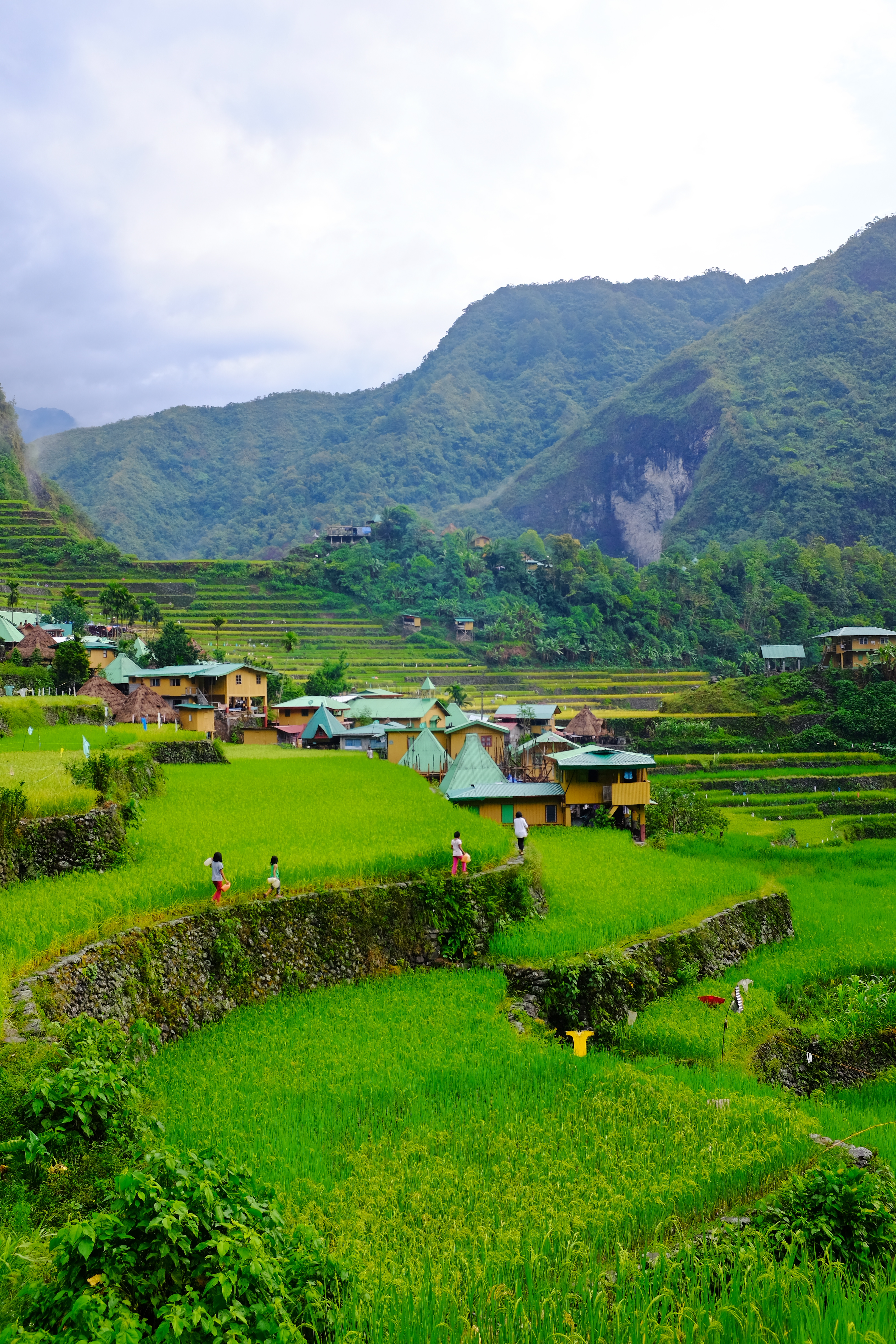
Before rice: the foragers of the Southeast Asian forests
The Hòabìnhian world
For tens of thousands of years before any grain was planted in it, mainland Southeast Asia belonged to hunter-gatherers. Archaeologists call the long foraging tradition of the region the Hòabìnhian, after a province in northern Vietnam, and its people had occupied the tropical forests, river valleys, and coasts of what are now Thailand, Vietnam, Cambodia, Laos, and Myanmar since the late Pleistocene.511 They were not a marginal or impoverished population. The wet tropics they lived in are among the most biologically generous places on Earth, and the Hòabìnhian foragers had built up, over millennia, a detailed working knowledge of which of the forest's thousands of plants and animals could be eaten, when each came into season, and how the dangerous ones could be rendered safe.5
The material signature of the Hòabìnhian is a distinctive kit of flaked river-cobble tools — unifacially worked pebbles, short axes, and the so-called sumatraliths — found in caves and rock-shelters from southern China through Vietnam, Laos, and Thailand down into the Malay Peninsula, alongside thick middens of freshwater shell, the debris of a people who lived hard by the rivers and ate what the water gave.5 These were not crude implements but the efficient toolkit of a way of life refined over millennia, and the people who made them buried their dead, sometimes flexed and sprinkled with ochre, in the same shelters they lived in.
Ancient DNA has now given these foragers a sharp genetic identity. The Hòabìnhian hunter-gatherers carried a deeply diverged eastern-Eurasian ancestry, distinct from the East Asian farming populations that would later arrive, and their lineage survives today in pockets — among the Andamanese, among some Negrito groups of the Malay Peninsula and the Philippines, and as a substratum in many mainland populations.1112 When the first farmers came down out of the north, they did not enter an empty land. They entered a land already long inhabited by people with their own languages, their own technologies, and their own way of being at home in the forest. The story of rice in Southeast Asia is, from its first page, a story of two peoples — and what happened when one came to live among the other.
A larder without a calendar
What that foraging world did not have is the thing that makes the change legible. There were no fields and no harvests in the agricultural sense — no sown stock held back from eating, no land cleared and diked and planted, no year organised around the ripening of a crop.58 Food was taken as the forest offered it and was largely eaten as it came. The Hòabìnhian diet was broad-spectrum by necessity and by design: fish and shellfish from the rivers and coasts, the meat of forest game, and a wide range of gathered plants — wild tubers, fruits, nuts, and the seeds of grasses, including, at the wetland margins, the seeds of wild rice.56
A broad-spectrum diet is a resilient one. A people who draw food from dozens of sources are buffered against the failure of any single one, and the Hòabìnhian foragers paid for that resilience with mobility: they moved across territories they knew intimately, returning to particular places as particular foods came into season.5 There was no stored agricultural surplus, and therefore none of the social machinery that stored surplus would later make possible — no granary standing as a visible measure of wealth, no village permanently fixed to one patch of ground, no ranked hierarchy of those who controlled the harvest. The whole apparatus of rice-farming civilisation lay on the far side of a threshold no one in these forests had yet crossed.
Where the foraging life did approach permanence, it did so on the coast rather than in the field. At places such as Khok Phanom Di, on what was once the estuarine shore of the Gulf of Thailand, communities of marine foragers in the centuries around 2000 BCE grew dense and sedentary on the sheer richness of the shellfish, fish, and estuary, building up deep shell middens and elaborate cemeteries without ever becoming dependent on a cultivated grain.5 Khok Phanom Di is the proof that, in the right place, Southeast Asians could settle and prosper without farming at all — and that the foraging world was not a poverty waiting to be relieved by rice, but a working way of life that rice would, over time, displace. The threshold that mattered was not the discovery that food could be abundant; it was the discovery that food could be planted, stored, and owned.
The wild grass at the edge of the map
Wild rice grew in mainland Southeast Asia, but it was a minor food, not a foundation. Stands of wild and weedy Oryza fringed the marshes and slow rivers, and the foragers gathered its grain as one resource among many.68 Crucially, the deliberate making of rice into a crop — the patient, multi-generational selection that turns a shattering wild grass that scatters its seed into a plant that holds its grain for the harvester — did not happen here.12 The wild rice of Southeast Asia stayed wild. The transformation that mattered happened far to the north, in the valley of another river entirely, and would take two thousand years and more to arrive.
There is a deep irony in this. The wet tropics were, if anything, too generous to push their people toward farming. The Chinese archaeologist Yan Wenming, who first argued in the 1980s for the Yangtze as the cradle of rice agriculture, suggested that domestication is spurred not by plenty but by pressure — that it was precisely because the Yangtze lay at the cooler northern margin of wild rice's range, where the grain was abundant enough to matter but precarious enough to be worth securing against bad years, that its people were driven to take the plant in hand.2 In the lush forests and rich estuaries of Southeast Asia, where food was reliably various, that pressure was weaker, and the wild rice stayed wild. The crop had to be invented somewhere harder, and then carried to the easier land.
This is the central fact against which the whole record must be read. Southeast Asia did not invent rice farming; it received it. The grain that would come to define the region — that would feed its kingdoms, organise its calendars, and underwrite its art and its gods — was a crop made by other people, in another climate, and carried south into the tropics by the slow movement of the farmers who grew it. To understand what arrived, one has first to go to where it was made.
The transmission: a Yangtze crop walks south
Where rice was made: the Yangtze hearth
Asian rice, Oryza sativa, was domesticated in the valley of the Yangtze River in central China, from the wild perennial grass Oryza rufipogon.123 The process was among the slowest and best-documented domestications in the archaeological record. At Shangshan, in the lower Yangtze, people were already harvesting and using wild rice by around 9000 BCE; over the following four to five millennia, across the Kuahuqiao, Hemudu, Majiabang, and Liangzhu cultures, the proportion of domesticated, non-shattering rice in the deposits climbed steadily until rice was the staple of a fully agricultural society.1814 A landmark study by Dorian Fuller and colleagues, working at the waterlogged site of Tianluoshan, was able to watch this happen grain by grain: between roughly 6900 and 6600 years ago the share of non-shattering — that is, domesticated — rice spikelet bases rose from about 27 per cent to about 39 per cent, the signature of selection caught in the act.1
This places rice domestication among the small handful of independent inventions of agriculture in human history. Farming was created from scratch, owing nothing to any other hearth, in only a few places on Earth:
- The Fertile Crescent of southwest Asia (wheat, barley, pulses)
- The Yangtze and Yellow River basins of China (rice; broomcorn and foxtail millet)
- Mesoamerica (maize, beans, squash)
- The central Andes (potato, quinoa)
- The New Guinea highlands (taro, banana)
- The savanna and forest belt of West Africa (yam, oil palm, pearl millet)
The Yangtze rice hearth is one of these originals.24 The genetic evidence, from the whole-genome study of Xuehui Huang and colleagues onward, confirms that the japonica rice that would spread across East and Southeast Asia descends from a single domestication of O. rufipogon in southern China, the foundational event from which every later dispersal flows.3
What the archaeology adds to the genetics is the dimension of time, and the lesson is that this domestication was extraordinarily slow. The textbook image of a single farmer planting the first seed is wrong for rice. At Shangshan, the bulliform phytoliths — the microscopic silica bodies that rice leaves behind — already lean toward the domesticated form by the start of the Holocene, yet fully non-shattering, fully committed crop rice does not dominate the Yangtze deposits until several thousand years later.1 Across that long interval, people were tending, harvesting, and increasingly relying on a plant that was neither fully wild nor fully tame: a protracted domestication, measured in millennia rather than generations, in which the line between gathering and farming was blurred for longer than the whole of recorded history since.
This is why the date in this record's title is a horizon, not an event: by roughly 3000 BCE the crop was made and beginning to move, but the making had taken an age.

From gathered grass to diked field
The decisive Yangtze invention was not merely the tame grain but the system that grew it: the wet-rice paddy. Rice is unusual among cereals in that it thrives standing in water, and the Yangtze farmers learned to give it what it wanted, building bunded, flooded fields that suppressed weeds, stabilised yields, and could be cropped year after year on the same ground.68 By the time of the Hemudu culture, in the fifth millennium BCE, the lower Yangtze farmers were living in stilt houses above the wetland, digging wooden wells, and storing rice in quantity; the Hemudu deposits famously yielded a great mass of preserved rice husks and the bone-tipped spades, the si, used to work the heavy wet soil.14
Excavation at the waterlogged lower-Yangtze sites has even recovered the fields themselves. At Tianluoshan and contemporary settlements, archaeologists have traced the small bunded plots, the ditches, and the residues of standing water that mark deliberate paddy cultivation by the fifth millennium BCE — the physical proof that the Yangtze farmers had not merely a tame grain but a managed wetland agriculture, with all the earthmoving and water-control that implies.16 The paddy is a piece of social as well as agricultural technology: a field that must be flooded and drained in common, on a shared schedule, knits its cultivators into a cooperative discipline that dryland farming does not require.
What the Yangtze hearth produced, then, was not a single crop but a complete portable package: a domesticated grain, the paddy technology to grow it intensively, the tools and storage that went with it, and — above all — the demographic surplus that intensive farming allows. A people who could wring far more calories from a patch of ground than foragers could feed far more children on it, and it was this surplus of people, as much as the grain itself, that would carry rice south. The transmission to Southeast Asia was not the export of an idea. It was the movement of farmers.
The long walk south: river valleys and farming peoples
The spread of rice out of the Yangtze was a slow, multi-millennial demic process — a movement of farming populations, not a postal delivery of seed.48 From the central and lower Yangtze, rice farming pushed outward in stages: south toward the Lingnan region and the Pearl River, southwest into Yunnan, and ultimately down the great river systems — the Mekong, the Red River, the Chao Phraya — that drain from the Chinese highlands into mainland Southeast Asia.8 Charles Higham, the leading archaeologist of the region, has long argued that incised-and-impressed pottery, polished stone adzes, and the rice they accompanied mark the southward movement of Neolithic farming communities along these river corridors, reaching mainland Southeast Asia in the centuries around 2000 BCE.5
A key waypoint on the overland route was Yunnan, the high country where temperate China, the eastern Himalaya, and tropical Southeast Asia meet. Archaeobotanical work at sites such as Baiyangcun has shown rice and millet arriving together in Yunnan in the third millennium BCE, brought down from central China, and then the farming frontier pushing on southward down the Mekong and Salween corridors toward the lowlands.5 Yunnan was the hinge between the temperate hearth and the tropical destination, the place where a northern crop complex was staged before its descent into the monsoon lands.
The timing in the lowlands is now well constrained. Rice and farming reached southern China by the third millennium BCE, and the first Neolithic rice-farming villages of mainland Southeast Asia — at sites such as Ban Chiang and Non Pa Wai in Thailand, and Man Bac and Phùng Nguyên in northern Vietnam — date to roughly 2500–1500 BCE.589 At Man Bac, the early farmers' skeletons tell the story directly: ancient DNA shows them to be a mixture of East Asian (southern Chinese agriculturalist) ancestry and the older Hòabìnhian forager ancestry, exactly the genetic signature expected where incoming farmers met and mixed with a resident foraging population.1112 In northern Vietnam, recent work has found rice grown together with foxtail millet — a northern Chinese crop — by about 2000 BCE, confirming that what came south was the whole East Asian farming kit, not rice alone.9 The grain found in these early southern fields was, the archaeogenetic work of Cristina Castillo and colleagues has shown, of the japonica type — the very subspecies domesticated in the Yangtze — closing the circle between hearth and destination.9
Not one road but several
It is important not to flatten the transmission into a single tidy line. The movement of rice into and around Southeast Asia happened by several routes and in several waves, carried by speakers of different language families.41112
| Wave | Approximate date | Route and carriers |
|---|---|---|
| Mainland Neolithic | c. 2500–1500 BCE | Down the Mekong, Red, and Chao Phraya valleys; Austroasiatic-speaking farmers from the south China–Yangtze zone |
| Island Neolithic | c. 2200–1000 BCE | Out of the Yangtze via the south China coast and Taiwan into the Philippines and Indonesia; Austronesian-speaking farmers |
| Bronze Age pulse | c. 1500–500 BCE | A second influx of East Asian ancestry and new crops and metallurgy into mainland Southeast Asia |
Ancient-DNA studies published in 2018 by Hugh McColl, Mark Lipson, and their respective colleagues independently confirmed this layered picture: at least two major pulses of migration from southern China into Southeast Asia, the first associated with the Neolithic spread of farming and Austroasiatic languages, the second a Bronze Age movement, each leaving its mark on the genomes of living Southeast Asians.1112 The grain that the foragers had gathered as a minor food was thus reintroduced to the same forests, but now as a domesticated crop in the hands of farming peoples who would, valley by valley and island by island, replace the foraging world entirely.
The Pearl River puzzle, and the limits of certainty
The record should not pretend the picture is settled in every particular, and one genuine tension deserves naming. The whole-genome study of Huang and colleagues located the wild O. rufipogon population most closely related to cultivated japonica not in the Yangtze valley at all, but further south, around the middle reaches of the Pearl River.3 Yet the archaeobotanical sequence of domestication — the slow rise of non-shattering rice, the managed paddies, the storage — is clearest and earliest in the Yangtze.12 How to reconcile a southern genetic signal with a central-Chinese archaeological one is an active scholarly question, with answers ranging from the movement of wild populations over time to the limits of using modern wild rice to locate an ancient event.
The atlas resolves this not by overclaiming but by being precise about what is and is not known. The Yangtze is, beyond reasonable doubt, the place where rice became a crop — where the long archaeological labour of domestication can actually be watched.12 The exact wild population from which the first tame seeds were drawn, and the precise geography of the genetic origin, remain debated. Both things are true at once, and the honest formulation is that rice agriculture — the crop and the system together — was made in the Yangtze basin and from there carried south, whatever further refinements the genetics may yet add to the map of where the very first wild ancestors grew. It is for this reason, among others, that the record holds its confidence at four rather than five.
What changed and what was replaced
The paddy and the remaking of the land
The most immediate change rice brought to Southeast Asia was to the land itself. To grow rice in quantity is to rebuild the surface of the earth: to clear and level ground, to raise the low earthen bunds that hold water in a paddy, to cut channels that bring and drain it, and — where the land slopes — to carve the hillside into the stepped, water-holding terraces that are among the most dramatic agricultural landscapes humans have ever made.68 The foraging world had lived inside its environment; the rice world rebuilt it.
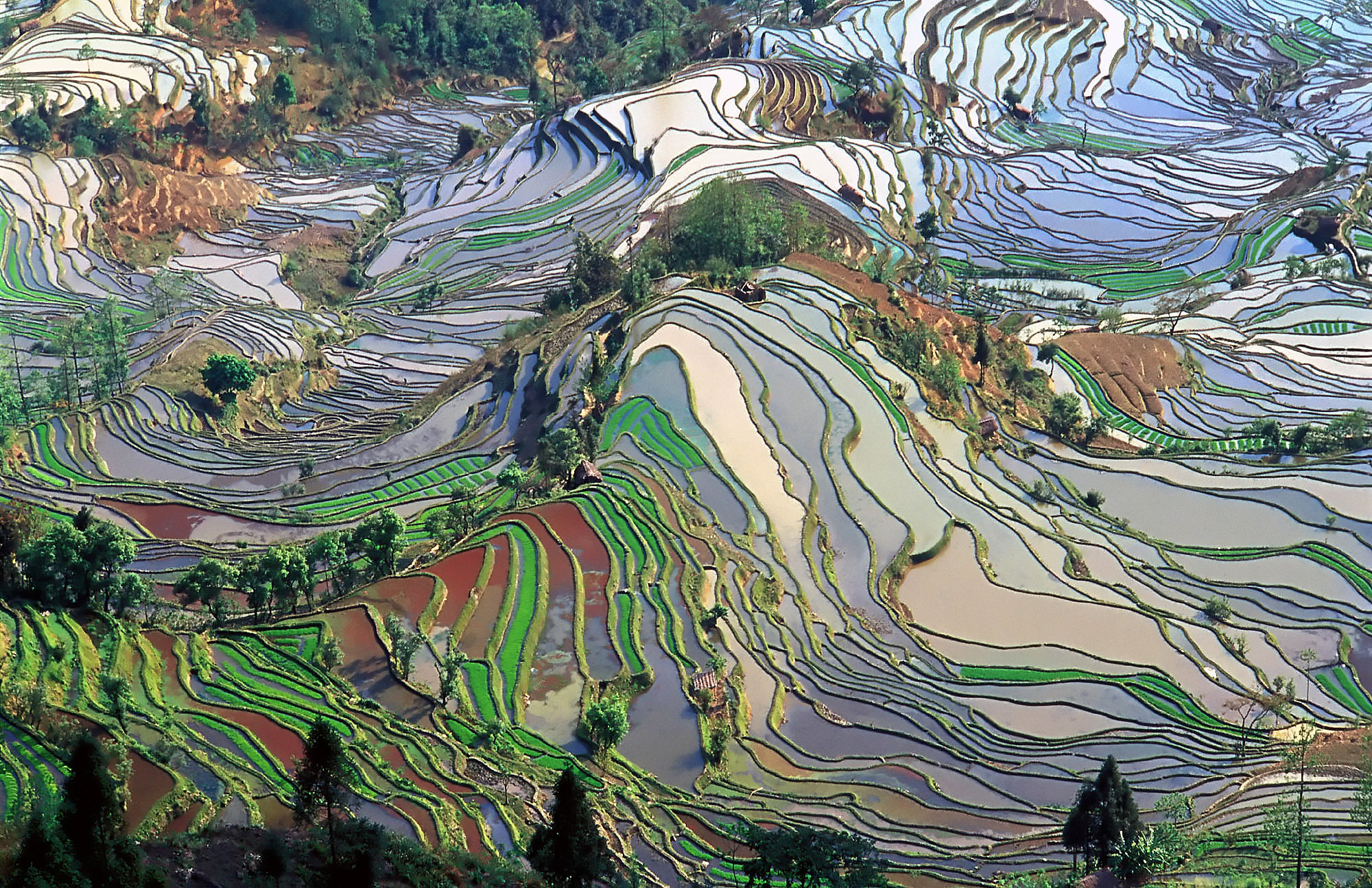
A walk you once took gathering became a field you now engineered, flooded, transplanted, weeded, and drained on a fixed annual schedule.
This was a profound and one-directional shift in the human relationship to the land, and it came at the price of labour. Wet-rice farming is among the most labour-intensive subsistence systems ever devised: the bunds must be built and maintained, the seedlings raised in nurseries and transplanted by hand into the flooded field, the water managed through the season, the crop harvested, threshed, and stored.6 In exchange, the paddy is extraordinarily productive and, unusually, sustainable on the same ground indefinitely, because the flooding renews the soil's fertility and suppresses the weeds that would otherwise exhaust a dryland field. The paddy could feed dense populations permanently fixed in one place — and dense, fixed populations are the raw material of everything that followed.
The control of water that rice demanded became, over the centuries, a political technology in its own right. A single household can tend a small paddy, but a landscape of terraces or a delta of diked fields requires the coordinated management of water across many fields and many families — who gets the water, when, and in what order — and the institutions that grow up to manage it can become the institutions that govern the society.56 In Bali the temple networks that allocated irrigation water were the backbone of the island's social order; in the Cambodian lowlands the vast reservoirs and channels of Angkor were at once an agricultural and a sacral-political system. The flooded field, in other words, did not merely feed the state. In many places it helped to build it, because the discipline of shared water is a discipline of shared rule.
Surplus, the village, and the chief
A stored crop changes a society from the inside. Unlike the gathered tuber or the netted fish, the harvested paddy could be kept, counted, owned, and accumulated — and accumulation is the seed of hierarchy.58 The archaeological record of Southeast Asia tracks this transformation across the second and first millennia BCE: permanent villages replace seasonal camps; cemeteries appear in which some burials are far richer than others; pottery, ornament, and eventually bronze cluster in particular graves.5 At sites such as Ban Non Wat in northeast Thailand, excavated over many seasons by Higham and his colleagues, the graves of the later Neolithic and Bronze Age show, in the differential wealth of the dead, the rise of ranked societies built on the rice surplus.5
The rice surplus also underwrote the first metal. From the second millennium BCE the farming communities of mainland Southeast Asia took up copper and then bronze, and the evidence from sites like Ban Non Wat and the copper-working centres of central Thailand shows metallurgy embedded in settled, rice-growing societies that could feed specialists and support long-distance exchange in ores, tin, and finished goods.5 A foraging band cannot easily spare hands to mine and cast metal; a rice village with full granaries can. The grain thus stands behind not only the population and the hierarchy but the craft economy and the trade networks of the emerging Bronze Age — the whole thickening of social and material life that the storable surplus made affordable.
From these ranked farming villages, over the following two millennia, grew the great rice states of Southeast Asia. The wet-rice surplus of the Cambodian floodplain underwrote Angkor and its temples; the diked fields of the Red River delta underwrote Đại Việt; the rice of the Chao Phraya underwrote the Siamese kingdoms; the irrigated terraces of Java and Bali underwrote the Javanese courts and the temple-state of Bali.54 None of this was possible in the foraging world, which had nothing to store and so nothing to concentrate. The rice that came south from the Yangtze was, in the long run, the caloric foundation of every classical civilisation of the region.
A new people: the farmer over the forager
The deepest change was demographic and linguistic. The spread of rice into Southeast Asia was not, in the main, a case of foragers adopting a new food; it was a case of farming populations expanding into forager territory and, over time, demographically overwhelming them.411 This is the mechanism Peter Bellwood and Colin Renfrew called the "farming/language dispersal": agriculture lets a population grow faster than the foragers around it, so that farming peoples — and the languages they speak — expand at the foragers' expense.4
The languages of Southeast Asia carry the fingerprints of this process. The deepest layer, the Austroasiatic family (Khmer, Mon, Vietnamese, and dozens of others), is widely held to have spread with the first rice farmers out of the Yangtze zone, and Austroasiatic languages share an inherited vocabulary for rice and its cultivation.411 The later Austronesian expansion carried rice and farming out of the south China coast through Taiwan and into the islands.412 The peoples who speak these languages today — the overwhelming majority of mainland and island Southeast Asians — are, to a large degree, the descendants of the farmers who brought the rice, carrying in their genomes the mixture of East Asian farming ancestry and older Hòabìnhian forager ancestry that the ancient DNA reveals.1112
The rice calendar and the rice cultures
Because rice has a season — sown with the coming of the rains, transplanted, and harvested as the dry season returns — it imposed a calendar, and around that calendar an entire ritual and social order crystallised across East and Southeast Asia.613 The agricultural year became the sacred year. Sowing, transplanting, and above all the harvest were marked by rites; the first rice of the new crop was hedged with ceremony; rice was offered to ancestors and to the powers of the soil and the rain.13 In Japan, as Sato Yo-Ichiro has traced in detail, the rice harvest became bound into the deepest structures of the calendar and even of kingship, with the emperor's first-fruits rite, the Niiname-sai, descending from the same agrarian order.13 Across Southeast Asia, rice acquired a soul: the rice goddess and the rice mother appear, under many names, from the Cambodian and Thai courts to the Javanese fields, and the harvest is hedged everywhere with rites meant to keep her favour.
The same crop, moving north and east out of the Yangtze rather than south, remade other worlds in parallel. Rice farming crossed into the Korean peninsula and, by the first millennium BCE, into the Japanese archipelago, where the Yayoi transformation — the arrival of wet-rice agriculture from the mainland — replaced the long foraging Jōmon order and laid the foundation of the Japanese state and its rice-centred ritual calendar, a story Sato Yo-Ichiro has reconstructed from the DNA of the grain itself.13 The Hidden Threads atlas treats those northern transmissions in their own records; the point here is that the Yangtze domestication was the single root from which a whole family of rice civilisations grew, in every direction the crop could be carried.
The cultural apparatus that rice created has proved astonishingly durable. The wet-rice paddy and the hillside terrace are still built and worked across the region; the rice granary still stands; the harvest is still marked by festival; and rice remains so central to the diet that in several Southeast and East Asian languages the words for "rice" and for "a meal," or even "to eat," are the same.513 Few transmissions in the entire atlas can show their consequence so plainly, in the daily bread and the living festivals of a third of humanity.
What the foraging world lost
Every gift of this kind has a shadow, and honesty requires naming what the rice economy pushed aside even where it shed no blood. The mobile, broad-spectrum foraging life of the Hòabìnhian — varied, resilient, and light on any single resource — was marginalised and, across most of the region, eventually extinguished as farming spread.511 It was not, in the main, destroyed by violence. It was outnumbered. Settled rice farmers, able to feed more children from the same ground, simply came over centuries to outnumber and absorb the foragers around them, until the foraging way of life survived only in the uplands and forests that rice could not easily reach.411
The varied wild diet narrowed toward the staple; the broad ecological knowledge of dozens of gathered foods contracted toward the deep cultivation of one. There were costs to health and autonomy that the bones sometimes record — denser settlement brought a denser disease environment, and a diet centred on a single grain can be less varied than a forager's.5 And the landscape itself was permanently remade: forest cleared, wetland diked, rivers channelled. None of this approaches the scale of harm the atlas records for transmissions carried by conquest, and none of it was inflicted on anyone by an army. But the discipline of this atlas is to count even the quiet costs, and the quiet cost of rice was a foraging world subtracted and a tropical landscape engineered.
What the cost was
A transmission with no army
The central fact of this record's cost accounting is the simplest: the spread of rice into Southeast Asia was not carried by conquest. There was no invading state, no campaign of subjugation, no documented massacre or enslavement attached to the arrival of the crop.511 The transmission was a slow demographic and agricultural process, spread over two thousand years and more, in which farming communities expanded into new valleys, planted rice, raised more children than the land had fed before, and gradually came to predominate. The mechanism was fertility, not force.
This is why the record holds the cost severity at zero — not as a failure to look, but as the considered result of looking. The atlas does not perform balance; it does not manufacture a cost where none exists in order to seem even-handed. Where a transmission's direct bill is genuinely close to nil, the discipline is to say so plainly. The careful work here is to be precise about why the figure is so low, and to distinguish the genuine absence of an extractive transmission cost from the diffuse, non-extractive costs that any shift to agriculture brings to the people who make it.
The Neolithic bargain in the tropics
That said, the record does not pretend that becoming agricultural was free of consequence, only that its consequences were not, in the main, extractive. The shift from foraging to rice farming was the Southeast Asian instance of the universal Neolithic bargain, and it came with the universal Neolithic costs.45 Settled farmers worked harder than foragers, not less: wet-rice cultivation is brutally labour-intensive, and the transplanting and water-management it demands tie a whole community to a relentless annual round. They tied their wellbeing to the fortunes of a narrow set of crops, trading the foragers' broad resilience for the farmers' productive but more precarious specialisation. And the denser settlement that rice allowed brought, here as everywhere, a denser burden of disease.5
There is bioarchaeological evidence for some of this in the bones of the people themselves. Across many parts of the world the transition to a cereal-based diet left traces of nutritional stress — more dental caries from the starchy staple, episodes of arrested growth, the marks of a less varied diet — and the skeletal record of early Southeast Asian farming communities has been read by some researchers for exactly these signs of the costs of the new regime.5 The picture is not uniform, and the rich, well-watered tropics may have softened the bargain compared with drier farming frontiers; but the general truth holds that the first farmers did not, on the whole, live easier or healthier lives than the foragers they succeeded. They lived in greater numbers. That is a different thing.
These are real costs, but they are costs of a particular kind. They are the price a people pays to itself, over many generations, for the power to feed more of its own children — not a bill rendered by anyone to anyone. They bought, in exchange, the entire subsequent flourishing of Southeast Asian civilisation: its cities and temples, its courts and arts, its dense and complex societies, and the demographic strength that carried whole language families across a subcontinent. The Neolithic bargain is not a crime with a perpetrator and a victim; it is a trade a society makes with its own future. The atlas notes it for honesty's sake, and files it apart from the column of transmitted harm.
The foragers absorbed, not slaughtered
The nearest thing to a genuine cost in this record is the fate of the Hòabìnhian foragers — and here precision matters most. The arrival of rice farming did, in the long run, bring the end of the foraging world across most of Southeast Asia. But the ancient DNA is clear that this was, overwhelmingly, a story of mixture and absorption rather than extermination.1112 The early farmers at Man Bac carry forager ancestry in their own bodies; the genomes of living Southeast Asians are blends of farming and foraging lineages. The foragers were not, by and large, killed. They were married, outnumbered, and absorbed, their descendants becoming part of the farming populations that succeeded them, their distinct way of life fading rather than being struck down.1112
This is a real loss — a whole mode of human existence, mobile and broad and intimate with the forest, was quietly closed off by the success of the paddy — but it is a loss of a particular and gentle kind, the kind that leaves the people themselves alive in their descendants. The atlas declines either to inflate it into a genocide it was not or to erase it as no loss at all. A way of living on the land ended; the people who had lived that way did not. That is the honest shape of the only real cost the record carries, and it is why the figure is held at the floor rather than below it.
Holding the line near zero
So the accounting comes to rest, deliberately, at zero — and the reasoning is the point. The transmission proper was the movement of a crop and the farmers who grew it into a new land, an act carried by fertility rather than force, that took nothing from anyone by extraction and gave a subcontinent its caloric foundation, its agrarian calendar, and the staple that still feeds it.58 The diffuse costs that attended it — the harder labour, the narrowed diet, the marginalised foragers, the remade landscape — were real but were not extractive: they were the price a people paid to itself for agriculture.
It would be possible to trace, from the rice surplus, a long chain forward into later violence — the wars of Angkor and Ayutthaya, the hierarchies and bondage that the great rice states maintained — but the discipline of this atlas is to refuse that bill-shifting. A crop that makes surplus possible is not the author of the uses to which surplus is later put. The rice handed Southeast Asian societies the capacity for stored wealth and dense population; those societies, like every human society given that capacity, built both splendour and domination upon it. The capacity is rice's gift; the empires are humanity's recurring choice. What is left, when the accounting is honest, is something the atlas does not often record without heavy qualification: a transmission whose direct moral ledger is very nearly blank, and whose consequence is the daily bread of a third of the living world.
The scale of that consequence is hard to overstate. The grain made tame in a Chinese river valley around the dawn of the Holocene, and walked south into the tropics over the following five thousand years, is today the staple food of more people than any other crop on Earth, the foundation of the diets, economies, and ritual calendars of the most populous region of the planet. The terraces of Banaue and the deltas of the Mekong and the Red River are the living far end of a thread that runs back to a forager at the edge of a Yangtze marsh, choosing which seed-heads to keep. The transmission cost almost nothing and gave almost everything — a rare entry in this atlas, and one worth recording plainly: the quiet, unforced spread of a crop that fed a third of humanity, and asked, in the end, for so little in return.
What followed
-
-7000Domestication of Asian rice (Oryza sativa subsp. japonica) from wild Oryza rufipogon in the Yangtze River valley of central China — one of the world's few independent inventions of agriculture, documented from Shangshan (c. 9000 BCE) through the steadily rising proportion of non-shattering rice.
-
-4800At Tianluoshan and across the Hemudu culture of the lower Yangtze (c. 5000–4500 BCE), fully developed wet-rice paddy farming, stilt villages, wooden wells, and large-scale rice storage — the complete portable farming package that would later move south.
-
-3000Rice farming reaches southern China — the Lingnan region and the Pearl River basin — by the third millennium BCE, the staging ground from which the crop and its farmers would disperse into the tropics.
-
-2000The first Neolithic rice-farming villages of mainland Southeast Asia (Ban Chiang and Non Pa Wai in Thailand; Man Bac and Phùng Nguyên in northern Vietnam), c. 2500–1500 BCE, where ancient DNA shows incoming East Asian farmers mixing with resident Hòabìnhian foragers.
-
-2000Rice grown together with foxtail millet in northern Vietnam by about 2000 BCE, confirming that the whole East Asian farming kit — not rice alone — moved south into Southeast Asia.
-
-1500The Austronesian expansion carries rice and farming out of the south China coast through Taiwan into the Philippines and island Southeast Asia (c. 2200–1000 BCE), spreading the wet-rice and terrace complex across the archipelagos.
-
800The rice surplus becomes the caloric foundation of the classical rice states — Angkor on the Cambodian floodplain, Đại Việt in the Red River delta, the Siamese kingdoms on the Chao Phraya, and the terraced kingdoms of Java and Bali.
-
2026Living continuity into the present: wet-rice paddies and hillside terraces from the Yangtze to Banaue are still built and worked, rice is still hedged with harvest ritual, and rice remains the staple of East and Southeast Asia — feeding roughly a third of humanity.
Where this lives today
References
- Fuller, Dorian Q., Ling Qin, Yunfei Zheng, Zhijun Zhao, Xugao Chen, Leo Aoi Hosoya, and Guo-Ping Sun. "The Domestication Process and Domestication Rate in Rice: Spikelet Bases from the Lower Yangtze." Science 323, no. 5921 (2009): 1607–1610. en primary
- Gross, Briana L., and Zhijun Zhao. "Archaeological and genetic insights into the origins of domesticated rice." Proceedings of the National Academy of Sciences 111, no. 17 (2014): 6190–6197. en
- Huang, Xuehui, Nori Kurata, Xinghua Wei, Zi-Xuan Wang, et al. "A map of rice genome variation reveals the origin of cultivated rice." Nature 490 (2012): 497–501. en primary
- Bellwood, Peter. First Farmers: The Origins of Agricultural Societies. Oxford: Blackwell Publishing, 2005. en
- Higham, Charles. Early Mainland Southeast Asia: From First Humans to Angkor. Bangkok: River Books, 2014. en
- Fuller, Dorian Q., Jacob van Etten, Katie Manning, Cristina Castillo, Eleanor Kingwell-Banham, Alison Weisskopf, Ling Qin, Yo-Ichiro Sato, and Robert J. Hijmans. "The contribution of rice agriculture and livestock pastoralism to prehistoric methane levels: An archaeological assessment." The Holocene 21, no. 5 (2011): 743–759. en primary
- Silva, Fabio, Chris J. Stevens, Alison Weisskopf, Cristina Castillo, Ling Qin, Andrew Bevan, and Dorian Q. Fuller. "Modelling the Geographical Origin of Rice Cultivation in Asia Using the Rice Archaeological Database." PLoS ONE 10, no. 9 (2015): e0137024. en primary
- Zhang, Chi, and Hsiao-Chun Hung. "The emergence of agriculture in southern China." Antiquity 84, no. 323 (2010): 11–25. en
- Cobo Castillo, Cristina, Katsunori Tanaka, Yo-Ichiro Sato, Ryuji Ishikawa, Bérénice Bellina, Charles Higham, Nigel Chang, Rabindra Kumar Mohanty, Mukund Kajale, and Dorian Q. Fuller. "Archaeogenetic study of prehistoric rice remains from Thailand and India: evidence of early japonica in South and Southeast Asia." Archaeological and Anthropological Sciences 8, no. 3 (2016): 523–543. en primary
- Castillo, Cristina Cobo, Bérénice Bellina, and Dorian Q. Fuller. "Rice, beans and trade crops on the early maritime Silk Route in Southeast Asia." Antiquity 90, no. 353 (2016): 1255–1269. en
- McColl, Hugh, Fernando Racimo, Lasse Vinner, Fabrice Demeter, et al. "The prehistoric peopling of Southeast Asia." Science 361, no. 6397 (2018): 88–92. en primary
- Lipson, Mark, Olivia Cheronet, Swapan Mallick, Nadin Rohland, Marc Oxenham, et al. "Ancient genomes document multiple waves of migration in Southeast Asian prehistory." Science 361, no. 6397 (2018): 92–95. en primary
- 佐藤洋一郎『稲の日本史』東京:角川ソフィア文庫、2018年。 jp
- 浙江省文物考古研究所『河姆渡:新石器時代遺址考古発掘報告(上下)』北京:文物出版社、2003年。 zh primary