A thousand years of Chinese rule (111 BCE–939 CE) built Vietnam
Han armies annexed the Red River delta in 111 BCE and Chinese dynasties held it for a millennium. They abolished its aristocracy, melted its drums, and left behind the script, the register, the law and the theory of office out of which an independent Vietnamese state was assembled in 939 — and which it then kept for nine hundred more years.
In 111 BCE armies sent south by Emperor Wu of Han destroyed the kingdom of Nanyue and pushed imperial administration into the Red River delta, a bronze-casting, wet-rice society of hereditary Lạc lords centred on the ramparted site of Cổ Loa. For 150 years the Han ruled through those lords. Then, after the rising of Trưng Trắc and Trưng Nhị in 40 CE, the general Ma Yuan abolished the lordships, made Han statute binding over Yue custom, and had the great bronze drums of the defeated chiefs melted down and cast into a horse for the emperor. What replaced them — the household register, Chinese characters, the Confucian school, the commandery grid — lasted a thousand years, and then outlasted the empire that brought it.

The delta before the commanderies
In the second century BCE the Red River delta was one of the most productive pieces of ground in eastern Asia and one of the least legible to the empire to its north. Twice a year the river came out of the highlands carrying silt from Yunnan and laid it across a plain the size of a small country. On that silt, communities had been growing wet rice, casting bronze, and burying their dead with grave goods for four hundred years. Archaeologists name the culture Đông Sơn, after a site excavated on the Mã River in Thanh Hóa from 1924. The officials of the Han court who later wrote about the same people called them the Lạc, and filed them under the very large and very imprecise category Yue — a word imperial writers applied to almost everyone living south of the Yangtze.4
That category is the first thing a reader has to put down. Erica Brindley's study of the southern frontier shows that Yue was a Chinese act of classification rather than anyone's self-description: a name given from outside to peoples who had no reason to think of themselves as one thing, and who left no writing in which to say otherwise.4 The Lạc of the Red River did not call themselves a nation, did not have a word for the territory they would later be said to have defended, and did not write. Everything known about their politics before 111 BCE comes either from the ground or from Chinese texts composed centuries after the fact and with an interest in the answer.
What they spoke can be recovered a little further than what they thought. The delta's population was Vietic — a branch of Austroasiatic, related at a distance to Khmer and to the Mon languages of Burma, and quite unrelated to Chinese. Mark Alves has argued from the reconstructed vocabulary that the Đông Sơn material culture and the Vietic speech community overlap: the words for the wet-rice cycle, for bronze, for the boat and the house on piles are inherited Austroasiatic, not borrowed.13 This is worth stating before anything else happens, because a great deal of what follows consists of a Sinitic vocabulary settling on top of that layer without ever displacing it. Modern Vietnamese still counts, farms, eats, and names its body parts in Austroasiatic words. It administers, legislates, philosophises, and writes poetry in Chinese ones.
The drum world
What the ground gives is bronze, and above all drums. The Đông Sơn bronze drum — a cast vessel with a flat tympanum, a bulging shoulder, and a flaring foot, the largest of them near a metre across and weighing upwards of seventy kilograms — is the signature object of the culture and the closest thing it has to a document. The Ngọc Lũ drum, found at Bình Lục in Hà Nam and now in Hanoi, stands 63 centimetres high with a tympanum 79.3 centimetres across. Around its central sunburst run concentric bands of figures in plumed headdresses, houses raised on piles, men beating drums exactly like the one they are cast on, deer, and long-beaked water birds.1
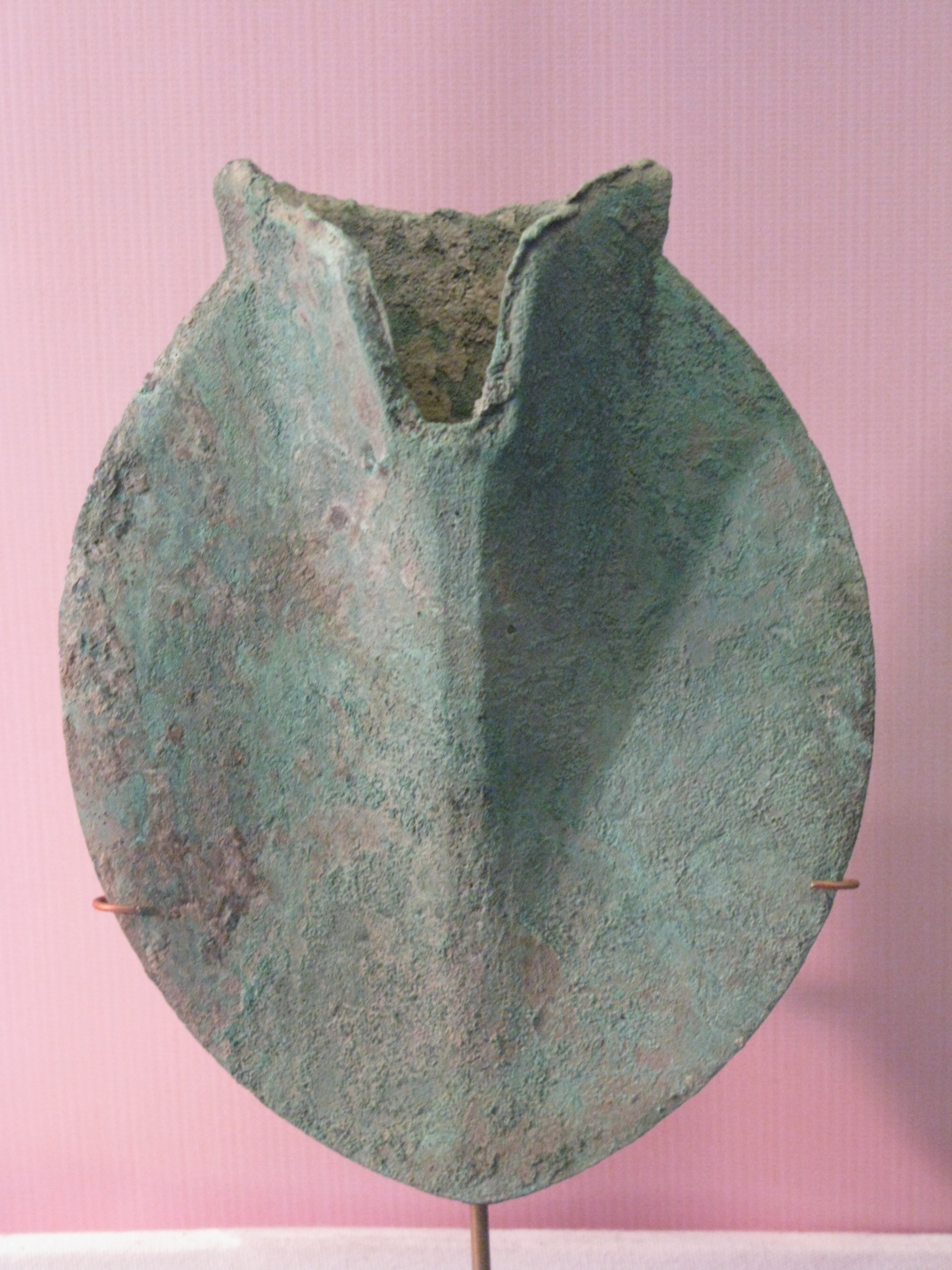
Casting a drum of that size in a single pour required a furnace, a piece-mould, an alloy recipe, and a workshop's worth of coordinated labour. It was not a thing an ordinary household could commission. The drums functioned as the insignia of authority — the visible claim that whoever owned one could command the metal, the labour, and the ceremony. Chinese sources register this precisely, because it is the aspect of Lạc society they had an administrative reason to understand: a drum was a throne you could carry.
They also travelled. Đông Sơn drums and their local imitations turn up across an enormous arc: in Yunnan and Guangxi, down the Thai-Malay peninsula, and out into the islands — Java, Bali, Sumatra, Sulawesi, and as far east as the Kai Islands and western New Guinea. Whatever moved along those routes, the drums went with it, and the delta sat at the northern hinge of a maritime exchange system that predated the Han conquest by centuries and outlived it.22 This is the second thing to fix in mind before the empire arrives: the Red River was not a cul-de-sac that China opened onto the world. It was already a node, and part of what the Han wanted was the node.
Cổ Loa: a state before the conquest
What the ground also gives is Cổ Loa, seventeen kilometres north of modern Hanoi — three concentric earthen ramparts with moats fed from the Hoàng River, the outer enclosure taking in some 600 hectares. Excavation has put the material moved to build the whole complex at around two million cubic metres.2 The investigation published by Nam C. Kim, Lại Văn Tới and Trịnh Hoàng Hiệp in Antiquity in 2010 dated the middle circuit's main rampart by radiocarbon and stratigraphy and concluded that it was built, in their words, in "the later centuries BC, before the coming of Han Imperial China."2 The rampart also proved not to be the first fortification on the site; Cổ Loa had defensive phases behind it.
This matters more than it sounds. Vietnamese tradition assigns Cổ Loa to An Dương Vương, the king of Âu Lạc, a figure whose historicity has been argued over since Léonard Aurousseau and Henri Maspero disagreed about it in print in the 1920s.1617 The archaeology does not settle who An Dương Vương was. It settles something more useful: that before any Chinese army arrived, the Red River plain contained a political authority capable of organising the movement of two million cubic metres of earth, of storing bronze in bulk — the Mả Tre deposit inside the ramparts produced a drum weighing about 72 kilograms packed with other bronze objects — and of arming men with mass-produced bronze crossbow bolts, several thousand of which came out of a single hoard at Cầu Vực.3
What the Lạc order had, and what it did not
The clearest description of how that authority was organised survives, awkwardly, in a Chinese geography quoted inside a Chinese commentary: the Guangzhou ji passage preserved in the Shui jing zhu, which describes the Lạc people cultivating fields watered by the tide, under Lạc marquises and Lạc generals who held bronze seals on green ribbons.1 The seals and ribbons are a Han detail — this is a Chinese observer translating an unfamiliar aristocracy into terms his readers would recognise — but the underlying arrangement is consistent with the archaeology: hereditary lords, a landscape of fortified settlements, wealth measured in bronze, and no apparatus above the lords that could tax them in a regular way.
There is a second thing the Guangzhou ji description gets right, and it is the hinge of the entire millennium: the Lạc lords stood on their own ground. A marquis held his people because his father had held them, in a district he knew, with a drum in his house and armed men within a day's walk. Nothing sat above him that could remove him. An empire cannot operate that way for long, because an aristocracy of that kind is not an instrument — it is a rival. The Han would rule through the Lạc lords for a century and a half, and then, in a single campaign, abolish them.
So the delta in 112 BCE had metallurgy, monumental earthworks, irrigated agriculture, standing military technology, long-distance exchange reaching into what is now Indonesia and southern China, and a hereditary ruling class with an unmistakable visual language of legitimacy. What it did not have was, in a list:
- writing of any kind
- a currency
- a land survey
- a register of households
- a written legal code
- any institution that outlived the man who held it
Those six absences are the whole subject of this record. Every one of them was filled within two centuries, by an empire, at gunpoint.
How the empire arrived
111 BCE: the destruction of Nanyue
The Han did not march into the Red River from the north. They came through Panyu, on the Pearl River, because the delta was already a dependency of somebody else. Since about 179 BCE the Lạc country had been attached to Nanyue, a kingdom founded by Zhao Tuo, a former Qin commander who had made himself king in the far south and ruled the Lạc through two resident commissioners while leaving the Lạc lords in place.
In 112 BCE the Nanyue chancellor Lü Jia killed the pro-Han queen dowager and the Han envoy at court. Emperor Wu, who had spent twenty years annexing everything in reach, sent armies south. Panyu fell in 111 BCE and Nanyue ceased to exist. The Han court divided the conquest into nine commanderies; three of them — Jiaozhi (Giao Chỉ) covering the Red River plain, Jiuzhen (Cửu Chân) to its south, and Rinan (Nhật Nam) on the central coast — were the delta and the country below it.57
Why an emperor in Chang'an wanted a river plain 2,000 kilometres away is not a mystery, and it is not a story about civilisation. The south produced things the north could not: pearls from the beds off Hepu, rhinoceros horn, elephant ivory, tortoiseshell, aromatic woods, and the iridescent feathers of the kingfisher, which the court used by the bale. Beyond the delta lay the sea road to the Nanhai trade and, past it, to India. Jiaozhi was the empire's landfall on that road for the next five hundred years, until the silting of its approaches and the rise of Guangzhou moved the business east.22 The commandery was a customs house as much as a province.
The distance was the constraint that shaped everything else. An official posted to Jiaozhi travelled either over the Lingnan passes and down the Zuo and Red River valleys, or by coastal shipping around the gulf — weeks either way, through country in which Chinese authority was a line drawn along a river. Đào Duy Anh's reconstruction of the administrative geography of the successive occupations shows how narrowly the commandery seats and their districts hug the navigable water and the delta's raised ground.18 The empire held the plain, the ports, and the roads between them. It did not hold the hills, and the hills are most of the country.
Ruling through the Lạc lords, 111 BCE to 40 CE
For the first century and a half almost nothing visible changed in the villages. The Han kept the Lạc lords, kept their seals, and governed the delta the way Nanyue had: at a distance, through the existing aristocracy, extracting tribute rather than administering households. This was not generosity. It was the standard imperial economy of effort on a frontier 2,000 kilometres from the capital, reachable only by a long coastal route, in a climate that killed northern officials.
The register nonetheless arrived, and it is the single most revealing document of the period. The geographical treatise of the Han shu records the census taken in 2 CE: Jiaozhi returned 92,440 households and some 746,000 people; Jiuzhen 35,743 households and 166,013 people; Rinan 15,460 households and 69,485 people.5 Nearly a million registered people in three southern commanderies — Jiaozhi alone larger than most commanderies in the Yellow River heartland. Whatever the Han thought they were conquering, it was not an empty jungle.
The literary record from the same period says something else, and the difference is instructive. The Hou Han shu credits two governors of the early first century CE, Xi Guang in Jiaozhi and Ren Yan in Jiuzhen, with teaching the southerners to plough with oxen, to forge iron tools, to marry according to rite, and to read. Ren Yan's biography states that the people of Jiuzhen hunted with bow and arrow, did not know how to plough their fields, and bought their grain from Jiaozhi.6
That account is a Han literary convention doing its work. The museums of Hanoi hold Đông Sơn bronze ploughshares from the delta datable to the five centuries before the conquest, and the Mả Tre deposit at Cổ Loa produced ploughshares alongside socketed axes.3 A society that raised Cổ Loa and cast the Ngọc Lũ drum was not waiting for instruction in agriculture. What Ren Yan plausibly did was introduce iron tooling, northern marriage law, and schools. What the Hou Han shu wrote down was a civilising mission. Both things are in the same sentence, and separating them is most of the work of reading this millennium honestly.
The Trưng rising and Ma Yuan's settlement
The indirect arrangement broke in 40 CE. Trưng Trắc, daughter of the Lạc lord of Mê Linh, and her sister Trưng Nhị raised the delta against Su Ding, the Han governor of Jiaozhi; the Hou Han shu says the rising took sixty-five fortified settlements and that Trưng Trắc was proclaimed queen.6 Vietnamese tradition, which acquired the story only much later, attaches the revolt to the killing of Trưng Trắc's husband Thi Sách, the Lạc lord of Chu Diên.19 Stephen O'Harrow's reading of the episode treats it less as a national uprising than as the Lạc aristocracy's last defence of its own hereditary standing against an administration that had begun to encroach on it.8
In 42 CE the court sent Ma Yuan, the Wave-Subduing General, with troops drawn from Changsha, Guiyang, Lingling and Cangwu. The campaign ended in 43 CE. The Hou Han shu records that the Trưng sisters were taken and beheaded and their heads sent to Luoyang; the fifteenth-century Đại Việt sử ký toàn thư has them drown themselves in the Hát river instead, which is the version Vietnamese memory kept.619 Ma Yuan then pursued the Jiuzhen leader Đô Dương, and deported more than three hundred households of the southern chiefly class north to Lingling.6
Then he did three things that ended the Lạc order as a system rather than as a rebellion. He abolished the hereditary lordships and replaced them with commandery and district officials appointed from outside. He memorialised the throne that Yue customary law differed from Han statute on more than ten points, and had the Han statutes made binding.6 And he collected the bronze drums of the defeated lords and had them melted down and cast into a bronze horse, which he presented to Emperor Guangwu.
Each of the three is worth holding separately. The first removed a class: after 43 CE there is no hereditary Lạc aristocracy in the Chinese record, and the men who administer the delta are appointees with careers elsewhere. The second removed a legal order: customary law that had been the accumulated practice of the delta became, at a stroke, a list of deviations from a written code drafted in another language for another society. The third removed a symbol, and it is the one the Vietnamese remembered. Melting the drums was not incidental vandalism. It was the correct administrative act, on Ma Yuan's own logic, because the drum was the physical form of the authority he had come to abolish.
He also built. The Hou Han shu credits his settlement with walled district towns, dredged channels and irrigation works, and a set of bronze pillars erected to mark the southern limit of Han authority — pillars that nobody has ever found, and that turn up for the next fifteen hundred years in Chinese and Vietnamese texts as a boundary marker whose location moves according to what the writer wants it to prove.617 Ma Yuan left the delta with a functioning administrative grid, a code of law, no aristocracy, no drums, and a legend.
Refugees, governors, and the Jiaozhi of Shi Xie
After 43 CE the delta was administered directly, and the transmission stopped being a policy and became a demography. Three times the north emptied southward: after the collapse of Wang Mang's regime, after the Yellow Turban wars from 184 CE, and again after the fall of Luoyang in 311. Each wave deposited literate families, officials without posts, and landowners into a province that was safe precisely because it was far away.710
The high point of that process has a name. Shi Xie (137–226) — Sĩ Nhiếp in Vietnamese — inherited the administratorship of Jiaozhi in the 180s and held the south together for four decades while the Han empire disintegrated behind him. He had studied the Zuo Commentary at Luoyang; the Sanguo zhi account of his rule describes hundreds of northern scholars taking refuge with him.910 His seat at Luy Lâu, in what is now Bắc Ninh, became a place where Chinese classical learning, Indian and Central Asian Buddhism, and the maritime trade of the southern sea were all present at once. Vietnamese tradition later made him the father of learning in the country, which is a generous way of describing a Chinese governor, and an accurate one.
The Shi were not unique, only early. Over the following centuries the delta produced a class that Jennifer Holmgren's administrative study traces in the sources with some precision: families of northern origin, settled for generations, holding land and local followings, intermarried with whatever remained of the indigenous elite, and increasingly disinclined to take orders from a capital they had never seen.7 Their loyalty ran to the province. When a northern dynasty was strong they served it and rose through its offices; when it was weak they governed for themselves and waited. Lý Bí, who declared an independent state called Vạn Xuân in 544, came from a family that had been in the delta for seven generations and was, by descent, Chinese. Khúc Thừa Dụ, who took the province for himself in 905, was doing what men of his kind had done for six hundred years — except that this time no dynasty recovered.
That is the mechanism nobody designed. The empire imported a governing class in order to hold the delta; the governing class took root in the delta; and what eventually threw the empire out was, in significant part, the descendants of the people it had sent.
What changed and what was replaced
The register, and what it could see
The most consequential Han export to the Red River was not a belief or a technology. It was the household register: a list of names, ages, and holdings, against which a head-tax and a labour levy could be assessed. A register is a claim that the state can see individual people. Nothing in the Lạc order had that ambition; a Lạc lord commanded his own following, and what lay outside it was not his business.

Coinage came with it. Han wuzhu cash circulates in delta sites from the first century CE onward, and the excavated tombs of the period contain it in quantity. A delta that had measured wealth in bronze drums began measuring it in a unit minted 2,000 kilometres away and denominated in the emperor's reign.
The register's limits are as revealing as its reach. By the Tang period the delta's registered population had fallen through the floor: the Jiu Tang shu gives the Annan Protectorate 17,523 households and 88,788 residents, rising to 24,230 households and 99,652 residents in the Tianbao era of 742–756 — roughly an eighth of what the Han had counted in 2 CE.15 The delta had not lost nine-tenths of its people. Nine-tenths of its people had stopped being visible to the register: absorbed into the estates of powerful local families, or living in uplands and margins the protectorate never reached. Vi An Lu's study of the protectorate puts it plainly — beneath the higher administrative levels, "a parallel sphere of indigenous life, deeply rooted in traditional practices, persisted."15
The script, the school, and the state
Chinese characters entered the delta as the medium of administration and stayed as the medium of everything. For roughly 1,200 years — from the commandery offices of the first century CE to the maturing of the vernacular script chữ Nôm in the thirteenth — every document produced in Vietnam was written in literary Chinese: land records, judgments, letters, genealogies, poems, temple inscriptions, and eventually the national chronicles that narrated resistance to China.
The school came with the script, and behind the school came a theory of the state. Confucian classical education produced a specific kind of official: recruited by examination on texts rather than by birth, loyal to an office rather than to a lineage, interchangeable and transferable. That was the exact opposite of the Lạc lord, whose authority was hereditary, local, and embodied in a drum. When the independent Vietnamese state held its first classical examination in 1075, it was not borrowing a foreign institution. It was using the one it had been built out of. The examinations ran, with interruptions, until 1919.
The cost of a script is easy to state and easy to underestimate. Literary Chinese is not a transcription of anybody's speech; it had to be learned as a separate language, by memorisation, over years, from teachers, with texts. In the delta that meant literacy was available to the sons of families with land and leisure and to nobody else, and it meant that for twelve centuries there was no way to write down what people in the delta actually said. Songs, oaths, contracts between neighbours, the names of fields, the arguments in a village dispute: all of it happened in Vietnamese and none of it could be recorded in Vietnamese. When a solution finally came — chữ Nôm, built by using Chinese characters for their sound or their sense to write Vietnamese words — it was a solution constructed out of the problem. Nôm requires a reader who already knows Chinese. The script that finally wrote the vernacular presupposed a thousand years of the script that had silenced it.
The change reached the grave as well. Đông Sơn burials placed the dead with bronze and, on the coast, in boat-shaped coffins. From the first century CE the delta's elite are buried in brick chamber tombs furnished with terracotta models of the world they wanted to keep: houses, granaries, wells, stoves, stables, fortified farm compounds. The model house is a Han idea about what death is for, made in Vietnamese clay.

The language that came out of the contact
The deepest change is the one nobody chose. John D. Phan's Lost Tongues of the Red River, published in 2025, reconstructs a Sinitic language that was spoken in the delta as a native vernacular for centuries — not the classical written language, but a living local Chinese, which Phan calls Annamese Middle Chinese. Its speakers were the descendants of the soldiers, refugees, and officials who had been arriving since 111 BCE. Phan's argument is that Vietnamese as we have it emerged from the death of that language: from a large population of Annamese Middle Chinese speakers shifting, around the Tang–Song transition, to a Vietic variety, and carrying their phonology and a vast amount of their vocabulary across with them.11
If that reconstruction holds, the consequence is uncomfortable for every nationalism in the story. Vietnamese is not a language that survived Chinese domination. It is a language that came out of Chinese domination — an alloy formed at the seam. Mark Alves's lexical work supports the same period from the other side, identifying more than sixty Chinese loans in Vietnamese datable specifically to the Eastern Han and Western Jin, clustered in exactly the semantic fields an occupation reorganises: administration, metallurgy, agriculture, kinship, and measurement.1213 Depending on how the count is done, something between a quarter of the core wordlist and seventy per cent of the dictionary is Sino-Vietnamese.
The drums stop, and what went north instead
Drum casting in the delta declines after the first century CE and effectively ends. It does not end everywhere: Catherine Churchman's study of the peoples between the Pearl and the Red Rivers follows a bronze drum culture that persisted in the uplands until about 750 CE, beyond the reach of the registers.14 In the delta itself, the object that had meant authority stopped being made, because authority no longer looked like that.
Religion changed shape in the same way, and here the replacement was partial rather than total. The delta's own cults were local and territorial — spirits of a particular mountain, a particular stretch of river, a particular founding ancestor — and they did not vanish. What happened instead is that they were registered. Chinese officials inscribed local deities into the state cult, gave them ranks and titles and prescribed sacrifices, and thereby made the spirit of a village into a subordinate officer of an imperial religious bureaucracy. The village kept its god. The god acquired a superior.
Traffic in the other direction was real and is regularly forgotten. Jiaozhi was the empire's southern port before Guangzhou eclipsed it, and things arrived through it. In 166 CE the Hou Han shu records envoys claiming to come from Andun, ruler of Daqin — Marcus Aurelius, if the claim is worth anything — making landfall in Rinan.6 Buddhism reached the Chinese south along the same route: Kang Senghui, whose Sogdian merchant father had settled in Jiaozhi, carried Buddhist texts and practice from the delta to the Wu capital at Jianye in 247 CE.20 The Mouzi lihuo lun, the earliest Chinese apologetic for Buddhism, is set in Jiaozhi during the Han collapse — though Erik Zürcher argued the surviving text is centuries later than its setting, and K. W. Taylor has since read the founding legend of Vietnamese Buddhism as something other than Buddhist at all, calling it "a tale of thaumaturgy, the worship of trees and of rocks, and rainmaking."2021
What the thousand years cost
A calendar of risings
The bill starts with the conquest and never closes. After 43 CE the delta and the coast below it rebelled roughly once a generation, and each rebellion was put down.
| Year | Rising | Outcome |
|---|---|---|
| 40–43 | Trưng Trắc and Trưng Nhị, Jiaozhi | Crushed by Ma Yuan; leaders executed; 300+ chiefly households deported |
| 100, 137, 144, 157 | Risings in Rinan and Jiuzhen | Suppressed; garrisons reinforced |
| 178–181 | Lương Long, Jiao province | Suppressed after three years |
| 248 | Lady Triệu (Triệu Thị Trinh), Jiuzhen | Crushed by the Wu governor Lục Dận |
| 541–547 | Lý Bí; the Vạn Xuân state declared 544 | Destroyed by Liang forces |
| 687 | Lý Tự Tiên and Đinh Kiến | Protector general Liu Yanyou killed; rising suppressed |
| 713 or 722 | Mai Thúc Loan | Destabilised Annan for nearly a decade before suppression |
| 791 | Phùng Hưng | Brief control of the protectorate centre |
| 819 | Dương Thanh, prefect of Huanzhou | Protector general Li Xianggu and his family killed |
The 819 entry survives in the Jiu Tang shu in a sentence worth quoting whole, because it is the tone the sources use for the whole millennium: "In the tenth month of the fourteenth year of the Yuanhe era, the Annan army rebelled, killing the protector general Li Xianggu along with his family, and injuring more than 1,000 people."15
Two things about that table deserve saying out loud. The first is that its entries are almost entirely Chinese documents: with the partial exception of the later Vietnamese chronicles, which were compiled centuries afterwards from the same Chinese sources, we know about a thousand years of Vietnamese resistance only because the people it was directed against wrote it down, and wrote it down as disorder. Every rebel in the list is named in a Chinese graph, dated by a Chinese reign era, and described in a vocabulary in which rebellion is a category of administrative failure. The second is that the interval is remarkably steady. Roughly once every thirty to forty years, for nine hundred years, the delta tried. That is not the record of a pacified province, and it is not the record of a successful one either.
Extraction, itemised
What the delta paid is unusually well documented, because the Tang institutional compendium Tongdian itemises it. The Annan Protectorate's annual tribute ran to:15
- ten pieces of plantain cloth
- two thousand betel nuts
- twenty jin of fish skin
- twenty python gallbladders
- two hundred measures of kingfisher feathers
That list is worth reading twice. The delta was not being farmed for grain by the capital; it was being farmed for exotica — for the feathers that went onto court headdresses, for the animal parts that went into the pharmacopoeia, for the small strange luxuries by which a court in the north demonstrated that it reached the south. Two hundred measures of kingfisher feathers is a very great many kingfishers, taken every year, for centuries, out of one river system. And this was only the formal tribute, assessed on top of the land tax, the head tax, and the labour levy.
Alongside the tribute ran the private extraction of the officials themselves. The Hou Han shu preserves the story of Hepu, the pearl commandery on the coast east of the delta, whose oyster beds were said to have migrated away under the rapacity of successive administrators and to have returned only when an honest one, Meng Chang, was appointed. The Chinese language kept the episode as a set phrase. The historians kept it as an admission: the south was where officials went to get rich, and everyone knew it. The risings of 157 and 178 were provoked by exactly this.67
The third layer of cost is the one with no documents at all. A head-tax and a labour levy are collected from households, and a household that cannot pay in grain pays in bodies: men sent to dig the canals and raise the walls of the district towns, to haul tribute over the passes, to garrison the frontier with Lâm Ấp in the south. None of that labour is itemised anywhere. What the sources record instead is its shadow — the steady disappearance of registered households across the Tang centuries, as families attached themselves to powerful local patrons who could shelter them from the levy, or walked into the hills where the protectorate's writ ran out. When the eighth-century registers show fewer than 100,000 people in a delta that the Han had counted at three-quarters of a million, they are not describing depopulation. They are describing a population in flight from its own government.15
Nanzhao, 863 to 866
The worst single episode in the millennium was not inflicted by China. In the 850s the kingdom of Nanzhao, in what is now Yunnan, began raiding Annan through the north-west, with the collaboration of upland groups that the protector general Li Zhuo had alienated by his own cruelty. In the first month of 863 the citadel of Tống Bình — the protectorate's centre, on the site of modern Hanoi — fell; the protector general Cai Xi was killed in the fighting; Nanzhao left a garrison of 20,000.15 By the sixth month the Tang court had formally abolished the Annan Protectorate and moved the prefectural seat to Haimen in Guangxi. Gao Pian retook the delta in the autumn of 866, and the court reconstituted it that winter as the Jinghai Military Command.
The Zizhi tongjian and the Vietnamese chronicles agree that across the two Nanzhao invasions about 150,000 people were killed or carried off.15 Against a registered population that the Tang put at under 100,000 — and a real population certainly several times that — it was a catastrophe of a scale the delta had not seen since Ma Yuan. The empire's response to it was to leave.
938, and what independence kept
The Tang dissolved. In 905 a local magnate, Khúc Thừa Dụ, took the title of jiedushi for himself and the court, having nothing to send, confirmed him. Thirty-three years later the Southern Han, one of the successor states in Guangdong, sent a fleet up the Bạch Đằng estuary to reassert the claim. Ngô Quyền had iron-tipped stakes driven into the riverbed below the waterline, drew the fleet in on the flood tide, and destroyed it on the ebb; the Southern Han commander Liu Hongcao died in the water. In 939 Ngô Quyền proclaimed himself king.919
He established his capital at Cổ Loa — the ramparted site of the kings before the conquest, abandoned for a thousand years. It is the most eloquent gesture in Vietnamese history and also the least literal. The state Ngô Quyền founded there kept the Chinese administrative vocabulary, the Chinese script, the commandery-and-district geography, the Confucian theory of office, the lunar calendar, and eventually the examination system. It corresponded with the Song in classical Chinese. Its chronicles, written in Chinese characters, narrated a thousand years of resistance to China.
That is the honest shape of this transmission, and it refuses both of the stories usually told about it. It is not a case of a nation preserving itself through occupation: the thing preserved was substantially assembled during the occupation, out of the occupier's materials. Nor is it a case of successful assimilation: the delta rebelled in every century it was held, and in the end it left. What happened was stranger and more permanent than either. An empire spent a thousand years building an administrative machine in somebody else's river valley, and at the end of it the people in the valley took the machine, kept it, and used it to be a different country.
What followed
-
-111The Red River plain enters the Chinese household register and begins paying head-tax and labour levy to a capital 2,000 kilometres away; the census of 2 CE counts 92,440 households in Jiaozhi alone.
-
43Ma Yuan abolishes the hereditary Lạc lordships, imposes Han statute law over Yue custom on more than ten points, and has the bronze drums of the defeated chiefs melted into a horse presented to Emperor Guangwu.
-
100Chinese characters become the only written medium in the delta. Literary Chinese remains the sole language of record in Vietnam for roughly twelve hundred years, until the vernacular script chữ Nôm matures in the thirteenth century.
-
166Jiaozhi and Rinan become the empire's landfall on the southern sea road; in 166 CE envoys claiming to come from Andun, ruler of Daqin, arrive by way of Rinan.
-
247Buddhism travels north out of the delta rather than into it: Kang Senghui, son of a Sogdian merchant settled in Jiaozhi, carries Buddhist texts and practice to the Wu capital at Jianye.
-
544Lý Bí, from a family seven generations settled in the delta and Chinese by descent, declares the independent state of Vạn Xuân — the first time the apparatus of the occupation is turned against it.
-
679The Tang reconstitute the territory as the Annan Protectorate — 'the pacified South' — a name that survives in European usage as Annam into the twentieth century.
-
863Nanzhao takes the protectorate's centre at Tống Bình; the Tang abolish the protectorate and withdraw to Guangxi. Chinese and Vietnamese sources put the dead and captured of the two Nanzhao invasions at about 150,000.
-
938Ngô Quyền destroys the Southern Han fleet at Bạch Đằng on a falling tide, ending the thousand years — and establishes his capital at Cổ Loa, the citadel of the kings before the conquest.
-
1075The independent Vietnamese state holds its first Confucian classical examination at Thăng Long. The examination system it inherits from the occupation runs until 1919.
-
1300Chữ Nôm, the vernacular script built from Chinese characters used for sound and sense, reaches maturity as a literary medium — a solution to the script problem constructed entirely out of the script that caused it.
-
1919The last Confucian examination is held at Huế, closing an institution 844 years old in its Vietnamese form and descended directly from the commandery schools of the first century CE.
Where this lives today
References
- Keith Weller Taylor, The Birth of Vietnam (Berkeley: University of California Press, 1983). en
- Nam C. Kim, Lai Van Toi and Trinh Hoang Hiep, 'Co Loa: an investigation of Vietnam's ancient capital', Antiquity 84, no. 326 (2010): 1011–1027. en
- Nam C. Kim, The Origins of Ancient Vietnam (Oxford: Oxford University Press, 2015). en
- Erica Fox Brindley, Ancient China and the Yue: Perceptions and Identities on the Southern Frontier, c. 400 BCE–50 CE (Cambridge: Cambridge University Press, 2015). en
- Ban Gu 班固, Han shu 漢書, 'Dili zhi' 地理志 (Beijing: Zhonghua shuju). zh primary
- Fan Ye 范曄, Hou Han shu 後漢書 (Beijing: Zhonghua shuju), biographies of Ma Yuan and Ren Yan and the treatise on the southern barbarians. zh primary
- Jennifer Holmgren, Chinese Colonisation of Northern Vietnam: Administrative Geography and Political Development in the Tongking Delta, First to Sixth Centuries A.D. (Canberra: Australian National University, Faculty of Asian Studies Oriental Monograph Series, 1980). en
- Stephen O'Harrow, 'From Co-loa to the Trung Sisters' Revolt: Viet-Nam as the Chinese Found It', Asian Perspectives 22, no. 2 (1979): 140–164. en
- Keith Weller Taylor, A History of the Vietnamese (Cambridge: Cambridge University Press, 2013). en
- Charles Holcombe, The Genesis of East Asia, 221 B.C.–A.D. 907 (Honolulu: University of Hawai'i Press, 2001); and 'Early Imperial China's Deep South: The Viet Regions through Tang Times', Tang Studies 15/16 (1997–1998). en
- John D. Phan, Lost Tongues of the Red River: Annamese Middle Chinese and the Origins of the Vietnamese Language, Harvard East Asian Monographs 476 (Cambridge, MA: Harvard University Asia Center, 2025). en
- Mark J. Alves, 'Identifying Early Sino-Vietnamese Vocabulary via Linguistic, Historical, Archaeological, and Ethnological Data', Bulletin of Chinese Linguistics 9, no. 2 (2016): 264–295. en
- Mark J. Alves, 'The Đông Sơn Speech Community: Evidence for Vietic', Crossroads 19, no. 2 (2022): 138–200. en
- Catherine Churchman, The People between the Rivers: The Rise and Fall of a Bronze Drum Culture, 200–750 CE (Lanham: Rowman & Littlefield, 2016). en
- Vi An Lu, 'The Annan Protectorate in northern Vietnam during the Tang period (679–907)', Journal of the Royal Asiatic Society 35, no. 3 (2025): 657–677. en
- Léonard Aurousseau, 'La première conquête chinoise des pays annamites (IIIe siècle avant notre ère)', Bulletin de l'École française d'Extrême-Orient 23 (1923): 137–264. fr
- Henri Maspero, 'Études d'histoire d'Annam', Bulletin de l'École française d'Extrême-Orient 16 (1916): 1–55; and 'Le Protectorat général d'Annam sous les T'ang: essai de géographie historique', BEFEO 10 (1910): 539–584, 665–682. fr
- Đào Duy Anh, Đất nước Việt Nam qua các đời: Nghiên cứu địa lý học lịch sử Việt Nam (Hà Nội: Nhà xuất bản Hồng Đức, 2016 [1964]). vi
- Ngô Sĩ Liên et al., Đại Việt sử ký toàn thư 大越史記全書 (1479; printed edition of 1697), Ngoại kỷ III–V. vi primary
- Erik Zürcher, The Buddhist Conquest of China: The Spread and Adaptation of Buddhism in Early Medieval China, 3rd ed. (Leiden: Brill, 2007 [1959]). en
- K. W. Taylor, 'What Lies Behind the Earliest Story of Buddhism in Ancient Vietnam?', The Journal of Asian Studies 77, no. 1 (2018): 107–122. en
- Nola Cooke, Li Tana and James A. Anderson, eds., The Tongking Gulf Through History (Philadelphia: University of Pennsylvania Press, 2011). en