Movable type: Chinese in idea, Korean in metal, Mainz in name (1450)
Bi Sheng cut characters in baked clay in the 1040s, Goryeo Korea cast them in bronze in the 1230s and printed the Jikji in 1377, and Mainz assembled the punch, the matrix and the adjustable mould in the 1440s — three solutions to one problem, separated by four centuries and four thousand miles, of which Europe named only the last and only after a man.
The oldest surviving book printed with movable metal type was made at a Buddhist temple in Cheongju in 1377, seventy-eight years before the Gutenberg Bible, and it is in Paris. The idea is older still: a commoner named Bi Sheng cut characters in sticky clay in the 1040s, and the only reason anyone knows is that Shen Kuo wrote it down. Korea took the decisive metallurgical step under Mongol siege in the 1230s and by 1403 was running a permanent state type foundry. What Mainz added in the 1440s was real — a punch, a matrix, an adjustable hand mould — and it was the last step in a sequence, not the first. No document links Gutenberg to Asia. Paper, block printing and eyewitness descriptions of Chinese printing had all made the journey west before him, and the gap between what crossed and what he built is where the myth of a single European invention lives.
What Latin Europe had instead of a press
The arithmetic of the copied book
In 1450, in the Rhineland, a book was a quantity of animal skin with a human being's time written on it. That is not a metaphor about labour; it is the cost structure. A complete Latin Bible required the prepared hides of something on the order of two hundred calves or sheep, and then a trained scribe working in ruled columns for the better part of a year. Eltjo Buringh and Jan Luiten van Zanden, who reconstructed European book production across thirteen centuries from surviving manuscript counts, found a book trade that was genuinely dynamic — an average long-run growth of roughly one per cent a year from the sixth century onward — and absolutely bounded by the number of literate hands available to hold a pen 15. Latin Europe in 1450 was producing more books than it ever had. It was producing every one of them singly.
The institutions had adapted to that bound rather than trying to break it. From about 1200 the universities at Bologna, Paris and Oxford ran the pecia system. An approved exemplar was broken into numbered quires of fixed size — sixteen columns of sixty-two lines, in the standard Parisian measure — and a licensed stationer rented the quires out one at a time, so that forty copyists could work on forty different parts of one text at once instead of forty men queuing for a single volume 15. It was a real industrial innovation, and it was an innovation in scheduling. It did not change what a copy was: a fresh act of handwriting, with fresh opportunities for error, made by someone who had to be housed and paid for the months it took.
The consequence was a book world with a particular shape, and it is worth naming the features precisely, because every one of them was about to be inverted:
- Books were commissions, not inventory. A manuscript was generally made because a named person had asked for it and agreed a price. Nobody speculatively produced two hundred copies of anything.
- No two copies were identical. Every transmission through a hand introduced variants, and a scholar comparing two manuscripts of the same text was comparing two different texts.
- Correction ran backwards. An error entered a copy and then propagated into its descendants; there was no mechanism by which a mistake found in one copy could be pulled out of the others.
- The trade was concentrated where the readers already were — the cathedral and monastic scriptoria, and the university stationers of Paris, Bologna and Oxford. A town with no university and no chapter had no book trade.
- Scale was linear. Two hundred copies cost two hundred times one copy. There was no threshold beyond which the marginal book got cheaper.
That last point is the one that determined everything else. Because there was no economy of scale, there was no reason for anyone to make books for a market that did not yet exist, and so the geography of the book followed the geography of institutional demand exactly. A monastery, a cathedral chapter, a court, a university: these had books because they had a reason to commission them and an income to pay for them. A prosperous Rhineland market town with neither had, at most, a parish missal and whatever a local notary kept in a chest. There was no such thing as a book you might buy because it happened to be there. The idea of walking into a shop and finding a text you had not gone looking for — the entire mechanism by which reading changes what a society thinks about — did not exist in Latin Europe in 1450, and could not, because nothing was ever made in advance of a buyer.
What Europe did have: paper, and pictures cut in wood
Two of the three things needed for printing were already in place in Latin Europe by 1450, and both of them had come from the east.
Paper first, because without it nothing else matters. Paper is a Chinese invention of the first centuries CE; it reached the Islamic world in the eighth century, was being made in al-Andalus by the middle of the eleventh — the mills around Xàtiva are the earliest in the peninsula — and crossed into Latin Christendom through Iberia and then Italy, where the Fabriano mills were operating by 1276 124. From Fabriano the craft moved into France, the German lands and the north. By the 1450s a Rhineland printer could buy linen rag paper in quantity from Italian mills. Roughly 145 of the 160 to 185 copies of the 42-line Bible were printed on Italian rag paper; the remaining thirty-five or so were on vellum 9. Europe's first printed book was printed, in the main, on a Chinese material that had taken a thousand years and four thousand miles to arrive, and nobody in Mainz thought of that as a foreign import.
Block printing second. Europe had been printing from carved wooden blocks well before 1450 — first onto textiles, then, once paper was cheap enough to waste, onto playing cards and cheap devotional images, and then onto the short picture-and-text block books whose surviving examples cluster in the 1460s and later 1214. The engraver known as the Master of the Playing Cards was working in the middle Rhine in exactly the years and place that matter; one of his lion motifs was copied by an illuminator into a surviving copy of the Gutenberg Bible. The block books are worth being careful about. They were long assumed to be typography's ancestors, but the datable survivors are mostly typography's contemporaries. What they prove is not descent. They prove that a European market existed for a cheap, repeatable, printed sheet before anyone in Europe had a press.
The thing Europe did not have
The missing piece was not the idea of printing, and it was not the press. Screw presses had been squeezing grapes and linen in Europe for centuries; converting one to press paper against an inked surface is not the hard part.
The missing piece was the repeatable letter. A piece of type is a manufacturing problem before it is a printing problem. To set one page of a Latin Bible in two columns of forty-two lines you need something over two and a half thousand individual sorts, and to keep several formes standing while others print you need tens of thousands, every one of them identical in height-to-paper and precisely graded in body width, or the line will not lock up and the impression will not be even. Casting them one at a time by hand, as a goldsmith would, is possible and ruinous. What Europe eventually had — and the date at which it had it is contested, as this record will come to — was a system: a steel punch cut with the letter in relief, struck into a softer copper blank to make a matrix, the matrix clamped into a hand mould with an adjustable body that could be opened, filled with molten lead alloy, snapped apart and reset in seconds.
Europe's problem in 1450 was never how to print. It was how to make forty thousand identical letters, which is a metallurgy problem rather than a printing one, and the answer had to work in an alloy soft enough to cast crisply and hard enough to survive thousands of impressions — lead, with tin and antimony in it.
That is the European contribution, and it is real. It is also a solution to the last problem in a sequence whose earlier problems had been solved four hundred years earlier, four thousand miles away.
Two inventions and a corridor
Bi Sheng's baked clay, 1041–1048
Some time in the Qingli reign period of the Northern Song, between 1041 and 1048, a commoner named Bi Sheng made movable type. Everything anyone knows about him comes from a single passage in the Mengxi bitan, the notebook the retired Song official and polymath Shen Kuo compiled around 1088 2. Shen Kuo describes the method exactly:
He took sticky clay and cut in it characters as thin as the edge of a coin. Each character formed, as it were, a single type. He baked them in the fire to make them hard.
The rest of the passage is a workshop manual. An iron plate was coated with a mixture of pine resin, wax and paper ash; the types were set in an iron frame on the plate; the plate was warmed so the coating softened, a flat board pressed the type faces level, and when it cooled the forme was rigid enough to print. Two plates were used in alternation, one printing while the other was being set. Common characters were kept in multiple copies; rare ones were cut fresh in clay and baked on the spot. Shen Kuo notes that Bi Sheng held no office, and that after his death the types passed into the hands of Shen Kuo's own nephews, who still had them 12.
That is the entire documentary basis for the invention of movable type: a paragraph about a man with no title, in the private notebook of a man who thought it interesting. No printed product of Bi Sheng's types survives.
Movable type did not displace woodblock in China, and the reason is not backwardness. Joseph McDermott's account of the Chinese book makes the case that woodblock was, for the Chinese market, the better technology, and it is worth stating the argument rather than the conclusion 22. A cut block is a permanent printing plate. It can be stored for decades, reprinted on demand in exactly the number of copies wanted, and requires no compositor able to find one character among thirty thousand sorts. A set of type, by contrast, must be composed, printed, and then broken up, so a reprint means recomposing the whole book. For a market that wanted many titles in small, repeated impressions, the block won on economics. It is a mistake to read that as failure. It is a different answer to a different question.
Wang Zhen's wood, and the revolving tables, 1298
In 1298 an official named Wang Zhen, serving in Jingde county in what is now Anhui, printed roughly a hundred copies of the county gazetteer with wooden movable type in about a month, working from a stock of some sixty thousand cut characters. He described the whole method — the cutting, the sawing apart, the trimming to a common size, and above all the two large revolving tables that held the type, one arranged by rhyme and tone according to the official rhyme book, the other holding the characters used most — in his agricultural encyclopaedia, the Nong Shu, completed in 1313 15.
Wang Zhen's system solves the retrieval problem that is invisible until you try it. With an alphabet, finding a letter is trivial. With thirty thousand characters, finding the one you want is the whole job, and the revolving table is an indexing machine: the compositor sits still and the type comes to him. It is the clearest possible demonstration that Chinese printers were not stumbling towards European practice and failing. They were solving a harder version of the problem and solving it well.

Korea casts it: 1234, 1377, 1403
The decisive step — type in cast metal rather than fired clay or cut wood — happened in Korea, and it happened under conditions of extreme duress.
Goryeo Korea in the 1230s was being invaded. The Mongols came in 1231; the court withdrew to Ganghwa Island; and in 1232 the woodblocks of the first Tripitaka Koreana, cut in the eleventh century as a votive defence against the Khitan, were burned. The Goryeo response was to start again. From 1236, at the Tripitaka Supervising Office on Ganghwa, the canon was recut onto what would become 81,258 woodblocks, a labour of sixteen years, and those blocks survive today at Haeinsa. That is the context to hold: the same court, in the same decade, under the same siege, was cutting eighty thousand woodblocks and casting movable type in metal.
The record of the casting is a postface by the official and poet Yi Gyu-bo, preserved in his collected works, describing the printing of the Sangjeong gogeum yemun, a compilation of court ritual, with cast type — twenty-eight copies, distributed to the offices that needed them 3. The date falls between 1234 and 1241. It is the earliest documentary record of metal movable type anywhere on earth 16, and it is worth noticing what it was for: not the diffusion of knowledge, but the replacement of a ritual code the court had lost in the flight to Ganghwa. Twenty-eight copies. For officials.
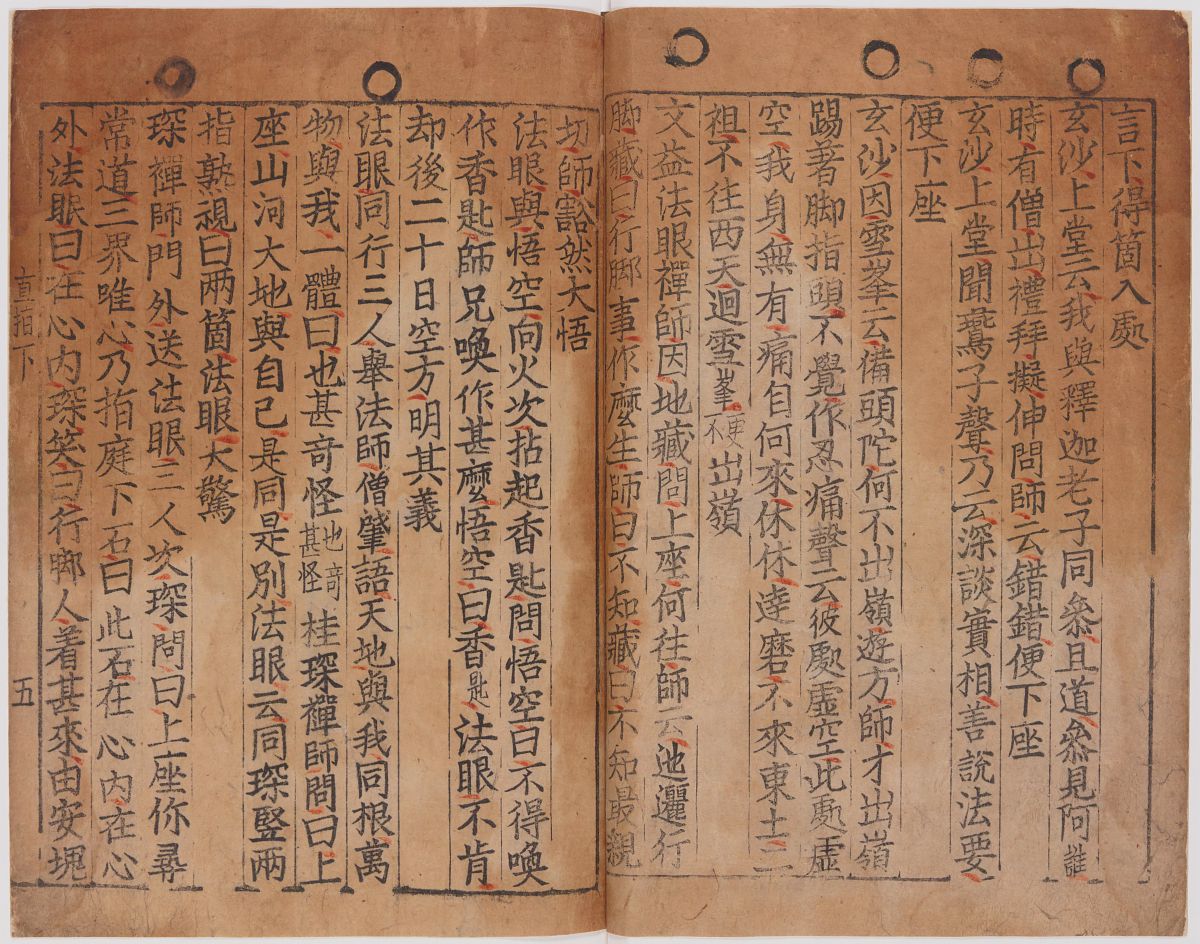
The earliest surviving product of metal type is the Jikji — properly the Baegun hwasang chorok buljo jikji simche yojeol, an anthology of Seon teachings compiled by the monk Baegun (1298–1374) and printed at Heungdeoksa temple in Cheongju in the seventh month of 1377 4. Only its second volume survives, and it survives in Paris. It predates the Gutenberg Bible by seventy-eight years.
The Joseon court that overthrew Goryeo in 1392 inherited the technique and industrialised it. In 1403 King Taejong established the Jujaso, a permanent government type foundry, and ordered the casting of the gyemi type in bronze — the court's own account describes an initial casting on the order of a hundred thousand pieces 6. The gyeongja type followed in 1420 and the gabinja, the most admired of them, in 1434 under Sejong, with six further castings after that. By the time Johannes Gutenberg was borrowing money in Mainz, Korea had been running a state type foundry with a recasting programme for two generations.
Korea, in other words, did not merely beat Mainz to metal type. It beat Mainz to the type foundry, to the state typeface and to the periodic recasting programme, by half a century. What it did not build was a market, and the difference is the whole of what follows.
The corridor, and what actually crossed it
Between Cheongju in 1377 and Mainz in the 1440s lies the part of this record that cannot be closed. What can be established is what the corridor was and what it carried.
The corridor is not hypothetical. It is the same road that carried gunpowder west in the thirteenth century, and it was busier in the fourteenth than at any time before or since: Mongol relay stations from north China to the Black Sea, Franciscan and papal envoys going east from the 1240s, Genoese and Venetian merchants at Tana and Caffa, and Korean tribute embassies moving into the Yuan capital at a court where Goryeo had become a son-in-law state. Korean metal type existed for a century and a half inside a political system whose western terminus was a Genoese trading post in the Crimea. That is not evidence that anything travelled. It is a statement of the conditions under which it could have, and the conditions were as favourable as they would be again before the age of sail.
It carried alphabetic movable type. In 1908 Paul Pelliot removed from the cave-temple complex at Dunhuang some 960 pieces of wooden movable type cut for the Uyghur alphabetic script, now in the Musée Guimet in Paris; recent study places their manufacture between the end of the twelfth century and the beginning of the thirteenth, and traces of ink confirm that they were used 1. This matters more than its obscurity suggests. It is movable type, adapted to an alphabet rather than a character set, in Central Asia, before 1300 — the exact conceptual object that European accounts assume could only have been arrived at in Europe, sitting on the road between the two.
It carried printed paper. Block-printed Yuan paper currency was the first Chinese printing that Europeans actually handled, and Thomas Carter's survey of the westward course of block printing established that paper money is the one form of Chinese printing described independently by a series of pre-Renaissance European writers 24. The Franciscan William of Rubruck was at Möngke's court in 1253–55; Marco Polo described Khubilai's issue in detail, with enough accuracy about denominations and the death penalty for forgery that the description has since been used as evidence he was really there. Europeans knew, in the fourteenth century, that somewhere east of them a state was mass-producing identical printed sheets and enforcing their value.
What the corridor cannot be shown to have carried is any piece of Asian type, any Asian craftsman, or any manual.
What the sources say, and what they do not
Because this record's whole subject is a disputed lineage, the positions are worth separating rather than blending.
What is certain. Movable type was invented in China in the 1040s. Metal movable type was invented in Korea in the 1230s and survives from 1377. The European system appears at Mainz in the 1440s and is documented in products from 1454. No serious scholar in any of the relevant fields disputes any of these dates, and the Chinese, Korean and European scholarly traditions agree on all of them 1569.
What is strongly supported. Paper, block printing and eyewitness European descriptions of Chinese printing all reached Latin Europe before 1450. The route existed, was in continuous use, and demonstrably carried both the material and the information 124.
What is contested. Whether any knowledge of East Asian type reached Mainz. Albert Kapr, whose 1986 biography remains the standard German life of Gutenberg, allows the possibility that printing with separate characters was prompted by the comparable processes known centuries earlier in the Far East 8. Thomas Christensen has assembled the circumstantial case at length, arguing that the absence of a smoking gun is not the absence of influence 20. Pan Jixing's 1997 comparative study of early printing in China, Korea and Europe presses the technical parallels 5.
What is not supported. Any documented contact. No letter, no inventory, no deposition, no passage in the Strasbourg litigation of the 1430s or the Mainz proceedings of 1455 names an Asian source, an Asian object or an Asian informant. Circumstantial evidence of a possible channel is not evidence that anything went through it.
What complicates the European side. In 2001 Paul Needham and Blaise Agüera y Arcas compared individual letterforms across Gutenberg's early type and concluded that the sorts had not come from a single fixed matrix at all — that the punch-matrix-hand-mould system every textbook credits to Gutenberg may postdate him, and that his own types were produced by some cruder, more variable process 10. The finding remains argued over. Its relevance here is bracing: the European step that the standard story treats as the definitive break may not be Gutenberg's step.
What the press changed, and what it displaced
October 1454: the first dated thing
The earliest firmly dated product of European typography is not a book. It is a form.
In the late summer of 1454 the Cypriot envoy Paulinus Chappe contracted for the printing of an indulgence — a plenary remission granted by Pope Nicholas V to contributors to the defence of Cyprus against the Ottomans. The 31-line edition was set in a small type made for the purpose, and one surviving copy carries a filled-in record of issue at Erfurt on 22 October 1454: the earliest precise date we possess for printing in Europe. Forty-six copies of that edition survive. A 30-line edition followed at Mainz, whose titling type is that of the Gutenberg Bible, with the earliest recorded issue on 27 February 1455 9. Thousands of these forms were run off, at a rate no body of scribes could have matched, each with a blank space for the purchaser's name.
The Bible, and the arithmetic reversing
The 42-line Bible was in production alongside the indulgences. Our earliest witness to it is a letter of 12 March 1455 from Enea Silvio Piccolomini — the future Pius II — to Cardinal Juan de Carvajal, reporting what he had seen at the Frankfurt fair the previous October. Piccolomini had not seen a finished Bible, only quires of it, and he was struck by the legibility: the script, he wrote, was so neat and clear that his correspondent would be able to read it without effort and without spectacles. He added that witnesses told him 158 copies had been completed, though others said 180 9.
Modern bibliography puts the edition at somewhere between 160 and 185 copies, roughly 145 on paper and 35 on vellum. Forty-nine survived into the twentieth century, of which twenty-one are complete 9. A copy sold for something like thirty florins — on the order of three years' wages for a clerk 9.
Three years' wages is not cheap. But it is a price, quoted by a producer who had made a batch and needed to move it, and that is the whole reversal. The manuscript Bible was a commission: someone ordered it, and it was made. The printed Bible was inventory: it was made, and then someone had to be found who would buy it. Every consequence of printing that anyone has ever attributed to it follows from that inversion, not from the ink.

The count
By 1500 presses were operating in something like 282 European towns. The Incunabula Short Title Catalogue records over thirty thousand editions, of which some 27,460 are true incunabula. Lucien Febvre and Henri-Jean Martin, working from an average of about five hundred copies per edition, put the total output of the European press before 1501 at around twenty million volumes 12.
Set that against the receiving culture. Latin Europe had perhaps eighty million people, of whom a small minority could read. In fifty years it produced more books than the previous thousand years of copying had accumulated, and it produced them in towns that had never had a book trade at all, because a press needed a market and a paper supply rather than a cathedral chapter 121514. Andrew Pettegree's account of the first printing generation is largely a commercial history for exactly this reason: the men who mattered after 1460 were not inventors, they were publishers, and the ones who failed failed at distribution 14.
What was displaced
The list of what printing pushed aside in the receiving culture is longer than the usual account of it:
- The professional copyist as a trade. Not instantly, and not everywhere — but the secular scriptoria that had served the university towns had no product to sell once an edition of five hundred existed.
- The illuminator's default place in the book. Early printed books left space for hand rubrication and initials, and for a generation that space was filled by hand. Then the woodcut initial absorbed the job.
- The pecia stationers. The rental of exemplar quires had no function once the exemplar could be bought outright.
- Textual variance as the normal condition of a text. Elizabeth Eisenstein's case is that the durable change was not speed but the possibility of an identical edition — that scholars in different cities could, for the first time, argue about the same page 13. The claim has been pressed too hard by others since: an identical edition was made possible by print, not made inevitable, and early printed texts are full of errors faithfully reproduced five hundred times. But the direction is right, and it is the opposite of the manuscript direction.
- Latin's practical monopoly on serious text. Printers needed volume, volume meant readers, and there were not enough Latinists. The vernacular presses followed the money.
- The local orthography. A printer setting a vernacular text had to choose spellings and then repeat them across an edition, and then across every edition after it. Standardised written languages are, to a considerable degree, a side effect of typesetting.
The trade that vanished, in its own words
In 1492 Johannes Trithemius, abbot of Sponheim, wrote De laude scriptorum — in praise of scribes — defending the copying of manuscripts as a devotional labour and arguing that parchment outlasts paper. In 1494 he had it printed 16.
He was not a fool and the irony was not lost on him. He called printing a marvellous art, used it to build his abbey library, and saw some thirty editions of his own writings printed in his lifetime. That is precisely what makes the book worth citing: it is the sound of a trade being told it is finished, written by a man who understood exactly what had finished it and could not stop using the thing.
The bill
6 November 1455: the man who lost the machine
On 6 November 1455 Johann Fust filed suit against Johannes Gutenberg in the court of the Archbishop of Mainz, to recover money advanced from 1450 onward for the work of the books. The record of the proceeding — drawn up by Ulrich Helmasperger, notary, and preserved at Göttingen — sets the principal at 1,600 guilders and the total claimed, with six per cent interest, at 2,026 11. The court found substantially for Fust. The types and equipment passed to him, and to his son-in-law Peter Schöffer, who had been Gutenberg's own workman.
The Mainz Psalter of 1457 is the first European printed book with a colophon naming its printers. The names on it are Fust and Schöffer.
This is a small item on the bill and it belongs there anyway, because it establishes the shape of everything that follows: the European press was capital from the first week. It was expensive to build, it required an investor, and the investor's claim on it was legally superior to the maker's.
1475, Trent: a pogrom with a distribution system
On Easter Sunday 1475 the body of a two-year-old boy named Simon was found in a cellar in Trent. A Franciscan preacher had spent the preceding weeks denouncing the town's Jews from the pulpit. The magistrates arrested the entire Jewish community — eighteen men and one woman — extracted confessions of ritual murder under judicial torture, and burned fifteen of the men at the stake. R. Po-chia Hsia reconstructed the case from the trial record the authorities themselves compiled to justify what they had done 17.
What makes Trent belong in an atlas record about printing is what happened next. The accusation did not stay in Trent. Broadsides and chapbooks published during the trial and in the months after it carried the story out across the German-speaking lands, and it was those cheap contemporary printed sheets — more than the famous woodcut in Hartmann Schedel's Nuremberg Chronicle of 1493, which came eighteen years later — that fixed the visual vocabulary of the ritual-murder libel: the child, the knife, the circle of Jews 17. A local judicial atrocity acquired, for the first time in European history, a reproduction system.
The cult of Simon of Trent was venerated for four hundred and ninety years. Paul VI removed him from the Roman Martyrology in 1965, and on 28 October of that year — the day Nostra aetate was promulgated — the archbishop of Trent abolished the cult and suppressed the annual procession of the relics.
1487, Speyer: the manual
Heinrich Kramer, a Dominican inquisitor whose conduct of a witch trial at Innsbruck in 1485 had been repudiated by the local bishop, wrote the Malleus maleficarum. Peter Drach printed it at Speyer around 1487; some copies carry an approbation dated 19 May 1487. A second edition appeared before August 1490, a third in the early 1490s, two more in 1494 from Koberger at Nuremberg and Koelhoff at Cologne, and something like twenty-eight editions in all down to the middle of the seventeenth century 18.
Brian Levack's revised estimate for the whole European witch-hunt, 1450–1750, is on the order of 45,000 executions, of which between 20,000 and 25,000 in the German lands, and the great majority of the dead were women 19.
The causal claim has to be made carefully, because the sensational version is false. Print did not cause the witch-hunts; the hunts had legal, confessional, agrarian and demographic drivers that ran independently of any book, and many of the worst German panics drew on local procedure rather than on Kramer. Levack's own work is a sustained argument against monocausal explanations. What print did was specific and sufficient: it took a text that the inquisitorial establishment of its own day had rejected as extreme, and made it permanently available, cheap, citable and physically present in every jurisdiction with a bookseller, for a hundred and fifty years. A rejected manuscript dies with its author. A rejected printed book goes into its twenty-eighth edition.
What the invention cost the people who made it
The Korean side of this record has its own bill, and it is not the bill of a victim of Europe. It is the bill of a technology that a state kept.
Metal type in Chosŏn was a royal instrument. The Jujaso was a government foundry; the type was crown property; the books it produced were court editions of ritual, law, agriculture, medicine and the Confucian classics, printed in the dozens and low hundreds and distributed to officials and institutions rather than sold. Si Nae Park's argument about the Chosŏn book world states the outcome flatly: for the whole five centuries of the dynasty, Korea remained a manuscript culture, in which handwritten copying — not printing — was how texts actually reached readers 7. Sohn Pow-key made the same point in 1959 from the technical side, and drew the moral that a monopoly on knowledge held by and for a limited group does not benefit a people 6.
The monopoly was defended explicitly, and in the same decade Gutenberg was building his press. When Sejong promulgated a phonetic script that a commoner could learn in a morning, the objection came at once: in the second month of 1444 Choe Manri and six colleagues of the Hall of Worthies submitted a memorial against it, arguing that only barbarians invent their own scripts, that Korea's standing in the Sinographic world depended on the Chinese character, and that a script the unlettered could use would let them forge documents and circulate vulgar writing 23. Sejong dismissed Choe Manri, reinstated him the following day, and promulgated the Hunminjeongeum in 1446 anyway. The memorial is worth reading beside the Mainz indulgence of 1454. Both are about who gets to hold a reproducible text, and the two societies answered differently.
Then the Korean apparatus was taken by force. Toyotomi Hideyoshi's invasions of 1592–98 stripped Chosŏn of metalwork, of movable type and of the artisans who made and used it, along with the potters whose descendants founded the Kyushu ceramic industry; the seized type and the deported printers fed directly into the printing boom of the early Tokugawa decades 21. Sixty years after gunpowder had travelled west out of Kaifeng with deported artisans, printing travelled east out of Korea the same way. The mechanism was identical and it was not metaphorical: the technology moved because the people who knew it were moved at spearpoint.
And the Jikji left. Victor Collin de Plancy, French chargé d'affaires at Seoul in the last decades of the Joseon dynasty, acquired several hundred Korean books, the Jikji among them. It passed at his 1911 sale to the collector Henri Vever, who bequeathed it to the Bibliothèque nationale de France, which received it in 1950. It sat unrecognised until 1972, when the Korean researcher Park Byeong-seon identified it in the collections and it was shown at the International Book Year exhibition — and it was not publicly displayed again until 2023, when the BnF brought it out for an exhibition on Gutenberg's Europe and set it beside a Gutenberg Bible. Korean requests for its return have not succeeded; the BnF's position is that the acquisition was lawful and the object is a treasure of humanity. The oldest surviving book printed with metal movable type has been visible to the public, in the century since it entered a French national collection, twice.
What is billable here, and what is not
The transmission itself killed no one. There is no siege in this record, no deportation at the moment of transfer, no epidemic. Records like this one are where the temptation to inflate is strongest, so the accounting should be explicit.
Billed here. The industrialisation of the indulgence, which is what the press did first. The print-amplified persecutions that followed within a generation and are directly attributable to the reproduction system rather than to the underlying hatred: Trent in 1475 and the ritual-murder iconography the broadsides carried out of it; the Malleus after 1487 and the standing authority that twenty-eight editions conferred on a text its own profession had rejected. The displacement of the scribal and stationer trades. The dispossession of Gutenberg in 1455. On the Korean side: a monopoly that kept the invention from the people who lived under it for five centuries, the 1592–98 seizure of the type and the artisans, and the removal of the Jikji.
Not billed here. The Reformation and the wars that followed it. It is true that Luther was the first mass-market author in history and that the pamphlet made 1517 possible in a way 1415 was not; it is also true that booking the Thirty Years' War to a Mainz workshop is the kind of causal chain that makes cost framing meaningless. The witch-hunt as a whole is likewise not billed here — only the specific amplification a printed manual provided. The atlas's rule is that a transmission pays for what it did, not for everything that happened afterwards in its vicinity.
Why the rating is 3 and not lower. Because the first industrial product of the European press was the sale of salvation; because the first pogrom with a distribution network followed within twenty years; because a rejected manual for killing women stayed in print for a hundred and fifty years on the strength of the same machine; and because on the other side of the corridor, the people whose ancestors cast the first metal type could not read the books their own state printed, and then lost the foundry to an invading army.
What followed
-
10481041–1048: Bi Sheng cuts characters in sticky clay and bakes them hard, making the world's first movable type. No printed product of it survives; the invention is known only because Shen Kuo recorded the method in the Mengxi bitan around 1088.
-
12341234–1241: Goryeo officials, sheltering on Ganghwa Island from the Mongol invasions, print twenty-eight copies of the ritual code Sangjeong gogeum yemun with cast metal type — the earliest documentary record of metal movable type anywhere on earth.
-
12511251: the second Tripitaka Koreana is completed after sixteen years, 81,258 woodblocks cut to replace the canon the Mongols burned in 1232. The same court that cut them was casting metal type in the same decade.
-
12981298: Wang Zhen prints about a hundred copies of the Jingde county gazetteer in a month with wooden movable type, retrieving sorts from two revolving tables holding some 60,000 characters; he publishes the method in the Nong Shu of 1313.
-
13771377: the Jikji is printed with metal movable type at Heungdeoksa temple in Cheongju — the oldest surviving book printed with metal type, seventy-eight years before the Gutenberg Bible. Only its second volume survives.
-
14031403: King Taejong founds the Jujaso, a permanent state type foundry at the Joseon court, and orders the casting of the gyemi type in bronze on the order of a hundred thousand pieces. The gabinja follows in 1434.
-
14441444: Choe Manri and six colleagues of the Hall of Worthies memorialise against Sejong's new phonetic script, arguing that only barbarians invent their own writing and that a script commoners could read would let them forge documents. Sejong promulgates it in 1446 anyway.
-
145422 October 1454: an indulgence for the defence of Cyprus, printed at Mainz in the 31-line setting, is issued at Erfurt — the earliest precisely dated product of European typography. The first industrial use of movable type in Europe was the mass sale of remission of sin.
-
145512 March 1455: Enea Silvio Piccolomini reports to Cardinal Carvajal that he has seen quires of a printed Bible at Frankfurt, legible without spectacles, and that witnesses put the edition at 158 copies, though others say 180.
-
14556 November 1455: Johann Fust sues Gutenberg for 2,026 guilders and takes the types and equipment. The first European printed book to name its printers in a colophon, the Mainz Psalter of 1457, names Fust and Schoeffer.
-
14751475: fifteen Jewish men are burned at Trent after a blood-libel trial. Broadsides and chapbooks printed during and just after the trial carry the ritual-murder iconography across the German lands — the first pogrom with a reproduction system behind it.
-
14871487: Peter Drach prints Heinrich Kramer's Malleus maleficarum at Speyer. Rejected as extreme by Kramer's own inquisitorial colleagues, it runs to some twenty-eight editions into the seventeenth century.
-
1500By 1500: presses in roughly 282 European towns and over 27,000 recorded incunable editions — on Febvre and Martin's estimate some twenty million volumes, more books than the previous thousand years of copying had accumulated.
-
15931592–1598: Hideyoshi's armies strip Joseon of metalwork, movable type and the artisans who used it. The seized type and the deported printers feed the printing boom of the early Tokugawa decades — the technology moving east by force, as gunpowder had moved west.
-
19501950: the Bibliotheque nationale de France receives the Jikji by the bequest of Henri Vever. Identified in the collections by Park Byeong-seon in 1972, it has been publicly displayed twice since — in 1972 and in 2023. Korean requests for its return have not succeeded.
Where this lives today
References
- Tsien Tsuen-Hsuin. Science and Civilisation in China, Volume 5: Chemistry and Chemical Technology, Part 1: Paper and Printing. Cambridge: Cambridge University Press, 1985. en
- 沈括《夢溪筆談》(Shen Kuo, Mengxi bitan / Dream Pool Essays), c. 1088, juan 18, the Bi Sheng passage. zh primary
- 李奎報《東國李相國集》(Yi Gyu-bo, Dongguk Yi Sangguk jip), incl. 「新印詳定禮文跋尾」, c. 1234–1241. ko primary
- 白雲和尚抄錄佛祖直指心體要節 (Jikji), Heungdeoksa temple, Cheongju, 1377. Bibliothèque nationale de France, Coréen 109. ko primary
- 潘吉星《中国、韩国与欧洲早期印刷术的比较》北京:科学出版社,1997。 (Pan Jixing, A Comparative Study of Early Printing in China, Korea and Europe. Beijing: Science Press, 1997.) zh
- Sohn Pow-key. “Early Korean Printing.” Journal of the American Oriental Society 79, no. 2 (1959): 96–103. en
- Park, Si Nae. “Manuscript, not Print, in the Book World of Chosŏn Korea (1392–1910).” In The Routledge Companion to Korean Literature, edited by Heekyoung Cho. London: Routledge, 2022. en
- Kapr, Albert. Johannes Gutenberg: Persönlichkeit und Leistung. Leipzig: Urania-Verlag, 1986. English edition: Johann Gutenberg: The Man and His Invention, trans. Douglas Martin. Aldershot: Scolar Press, 1996. de
- White, Eric Marshall. Editio princeps: A History of the Gutenberg Bible. Harvey Miller Studies in the History of Culture. London: Harvey Miller / Brepols, 2017. en
- Agüera y Arcas, Blaise. “Temporary Matrices and Elemental Punches in Gutenberg's DK Type.” In Incunabula and Their Readers: Printing, Selling and Using Books in the Fifteenth Century, edited by Kristian Jensen, 1–12. London: The British Library, 2003. en
- Helmaspergersches Notariatsinstrument, Mainz, 6 November 1455. Niedersächsische Staats- und Universitätsbibliothek Göttingen. de primary
- Febvre, Lucien, and Henri-Jean Martin. L'apparition du livre. Paris: Albin Michel, 1958. fr
- Eisenstein, Elizabeth L. The Printing Press as an Agent of Change: Communications and Cultural Transformations in Early-Modern Europe. 2 vols. Cambridge: Cambridge University Press, 1979. en
- Pettegree, Andrew. The Book in the Renaissance. New Haven: Yale University Press, 2010. en
- Buringh, Eltjo, and Jan Luiten van Zanden. “Charting the ‘Rise of the West’: Manuscripts and Printed Books in Europe, A Long-Term Perspective from the Sixth through Eighteenth Centuries.” Journal of Economic History 69, no. 2 (2009): 409–445. en
- Trithemius, Johannes. De laude scriptorum. Written 1492; printed Mainz: Peter von Friedberg, 1494. English edition: In Praise of Scribes, trans. Elizabeth Bryson Bongie. Vancouver: Alcuin Society, 1977. la primary
- Hsia, R. Po-chia. Trent 1475: Stories of a Ritual Murder Trial. New Haven: Yale University Press, 1992. en
- Institoris (Kramer), Heinrich. Malleus maleficarum. Speyer: Peter Drach, c. 1487. la primary
- Levack, Brian P. The Witch-Hunt in Early Modern Europe. 4th ed. London: Routledge, 2016. en
- Christensen, Thomas. “Did East Asian Printing Traditions Influence the European Renaissance?” Arts of Asia 37, no. 6 (2007). en
- Kornicki, Peter. The Book in Japan: A Cultural History from the Beginnings to the Nineteenth Century. Handbuch der Orientalistik 5.7. Leiden: Brill, 1998. en
- McDermott, Joseph P. A Social History of the Chinese Book: Books and Literati Culture in Late Imperial China. Hong Kong: Hong Kong University Press, 2006. en
- 訓民正音 (Hunminjeongeum), 1446; and the memorial of Choe Manri and colleagues against the new script, second month of 1444, in the Sejong sillok (世宗實錄), Veritable Records of the Joseon Dynasty. ko primary
- Carter, Thomas Francis. The Invention of Printing in China and Its Spread Westward. 2nd ed., revised by L. Carrington Goodrich. New York: Ronald Press, 1955. en