An Indian medicine became the Atlantic's slave crop by 1500
The technique of boiling cane juice into sugar left India before the seventh century. The Islamic world made it an industry, the Crusaders and Venetians made it colonial property, and on Madeira and São Tomé the Portuguese added the last element: workforces bought entire from the African coast.
Cane is first recorded on São Tomé in 1506. By the 1530s the island out-produced Madeira as Europe's sugar supplier, worked by enslaved Africans from Benin, Kongo and Angola.

Before: an Atlantic world without sugar
In 1400 the sugar a Portuguese household might know came from somewhere else and arrived by the ounce. It was sold by apothecaries and spice merchants, weighed out on small scales, and classed in the medical handbooks of Latin Europe as a warm, moist substance good for the chest, the kidneys and the bladder. Most of it had been grown and refined in Egypt, Syria, Cyprus, Sicily or the kingdom of Valencia, and it reached Lisbon through Venetian, Genoese and Catalan merchants who bought it in Alexandria, Famagusta and Palermo.14 Sweetness in an ordinary Iberian kitchen meant honey, boiled grape must, dried figs and raisins. Sugar was a luxury and a drug, not a food.
The Atlantic itself had no sugar at all. Madeira, five hundred kilometres off the Moroccan coast, was uninhabited and so thickly forested that the Portuguese who reached it around 1420 named it simply "wood". The Canary Islands were home to the Guanches and their island neighbours, Berber-descended farmers and herders who had lived without metals, wheeled vehicles or contact with the mainland for perhaps a thousand years. São Tomé, on the equator in the Gulf of Guinea, had never been settled by anyone. On the West African coast between the Senegal River and the Niger delta, kingdoms and trading towns grew their own crops, worked iron and gold, and bought and sold captives within African systems of dependency and war; none of them grew cane for export, and none sold people to Europeans across the sea.1024
What Latin Europe knew about sugar
The medical sorting of sugar was an inheritance, not an invention. The illustrated health handbooks called Tacuinum sanitatis, copied in Lombard workshops in the late fourteenth century, were Latin versions of the eleventh-century Arabic Taqwīm al-ṣiḥḥa of Ibn Buṭlān of Baghdad. Their entry on sugar — zuccarum — recommended the white, clear kind as a purifier of the body, and illustrated it at a shop counter, sold by weight.423 Sidney Mintz, whose Sweetness and Power (1985) remains the classic account of how sugar entered European life, describes this as sugar's first European identity: a spice and a medicine, ranked beside pepper and ginger, its use a mark of rank and its price a measure of distance.23
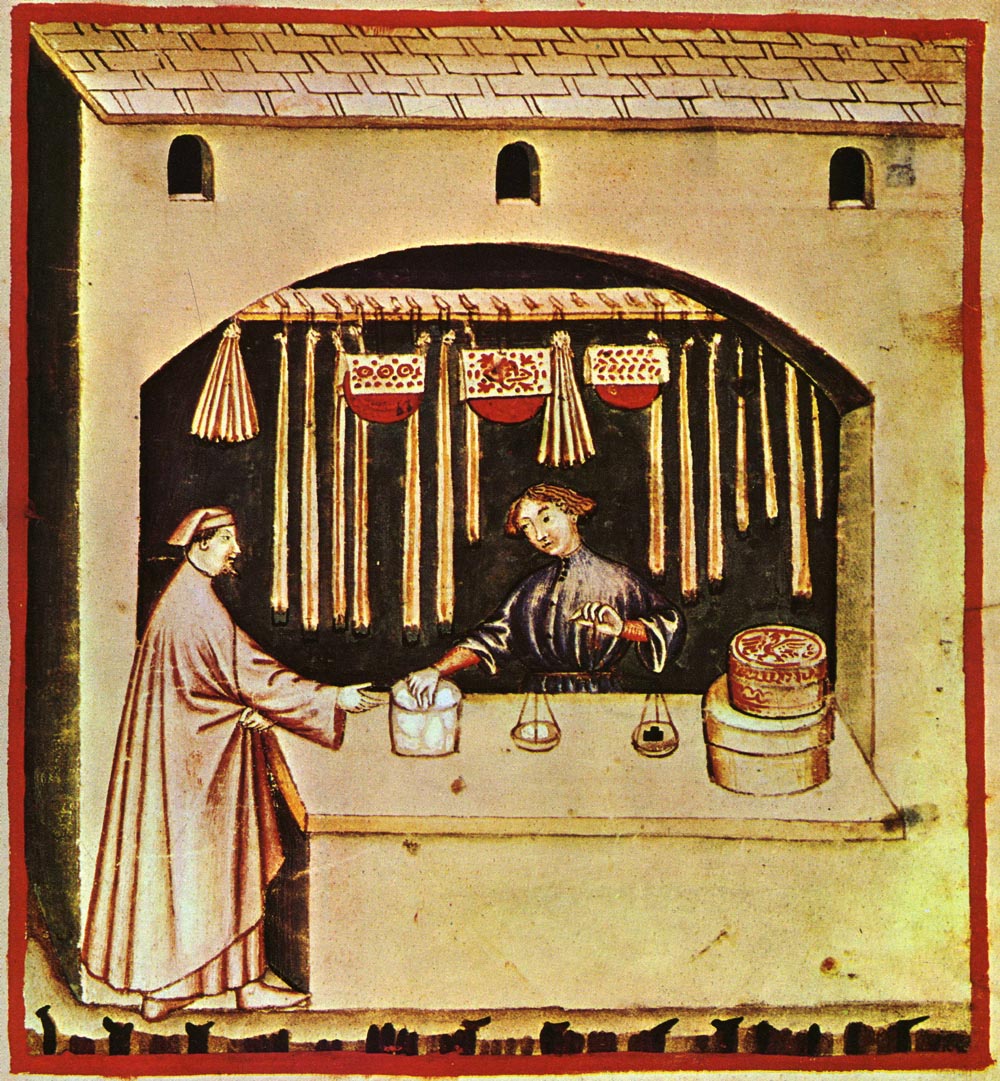
The categories themselves are worth noting, because the transmission destroyed them. In 1400 Europeans had:
- Honey, the common sweetener, produced on peasant and monastic holdings across the continent.
- Fruit sweetness — boiled must (defrutum, sapa), figs, raisins, dates for the rich.
- Sugar as spice, used in small quantities in the cooking of courts and great households, often with saffron and cinnamon.
- Sugar as medicine, compounded by apothecaries into syrups, electuaries and lozenges, and prescribed for coughs, fevers and digestion.
There was no category of sugar as a daily calorie for working people. Mintz's argument is that this category was created — not discovered — between the sixteenth and the nineteenth centuries, and that the plantation made it possible.23
The long road behind the Mediterranean sugar loaf
The sugar on a Lisbon apothecary's counter had a longer pedigree than anything else in his shop. Sugar cane, Saccharum officinarum, was domesticated in New Guinea and carried across island Southeast Asia into India, where it was grown for millennia as a plant to chew and to press for its juice.1 What made sugar a portable commodity, however, was not the plant but a technique: boiling the juice until it thickened and set into solid grains that could be stored, shipped and traded across thousands of kilometres. That technique was Indian. Sanskrit texts distinguish grades of cane product — guḍa, the dark boiled mass still made today as jaggery; khaṇḍa, a coarser crystalline sugar, whose name became the Arabic qand and the English candy; and śarkarā, a word meaning grit or gravel, which became Persian shakar, Arabic sukkar, Italian zucchero and English sugar.12 The vocabulary travelled with the method, which is why nearly every language of Europe still names sugar with a Sanskrit word.
The date at which Indian producers first made true crystalline sugar is uncertain. Popular histories place it in the Gupta period, around 350 CE; the scholarly evidence, reviewed by J. H. Galloway and by Christian Daniels in the Science and Civilisation in China volume on sugarcane technology, establishes that solid sugar was being made and exported from India well before the seventh century, without supporting a precise date.12 By then India's reputation in the technique was such that a foreign emperor sent for it. In 647, according to the Tang dynastic histories, the emperor Taizong sent envoys to Magadha, the kingdom on the Ganges whose capital had been Pāṭaliputra, to learn the method of boiling sugar, and then ordered the cane growers of Yangzhou to process their juice by the Indian recipe; the result, the histories claim, surpassed in colour and flavour the sugar China had been buying from Central Asia.2
The transmission: from Indian technique to Atlantic plantation
Sugar did not move from India to the Atlantic in one step. It moved in at least four, and at each step the receiving society added something to it. The Islamic world added irrigation, scale and a commercial market. The Crusader states and their Italian partners added Latin capital and the habit of running sugar estates as colonial property. The Mediterranean islands under Latin rule added the mill complex financed by merchant credit and worked by a mixture of serfs, wage labourers and slaves. The Atlantic islands added the last element: a labour force bought, entire, from the African coast.
| Stage | Approximate dates | What the stage added |
|---|---|---|
| India | before c. 600 CE | the boiling technique and the vocabulary (śarkarā, khaṇḍa) |
| Sasanian and Abbasid Iraq and Iran | 6th–9th centuries | irrigated cane estates in Khuzistan; early use of enslaved labour |
| Islamic Egypt, Syria, Sicily, al-Andalus | 8th–14th centuries | mass production, urban refineries, an export market |
| Crusader Levant and Latin Cyprus | 1099–15th century | Latin ownership; Italian and Catalan capital; colonial estates |
| Sicily, Valencia, Granada coast | 14th–15th centuries | merchant-financed mills under Christian rule |
| Madeira and the Canaries | 1450s–1530 | Atlantic soil, Genoese credit, enslaved Guanche, Berber and African labour |
| São Tomé | 1495–c. 1600 | the first plantation economy in the tropics, worked by enslaved Africans |
| Brazil, then the Caribbean | 1530s–1650 | the plantation as a colonial society; the Atlantic slave trade at scale |
The Islamic sugar belt
From India the technique moved west to Sasanian Iran, where cane was grown on the irrigated plains of Khuzistan around Gondeshapur, and after the Arab conquests of the 640s it spread across the caliphate. Andrew Watson made sugar cane one of the central crops of his "agricultural revolution" of the early Islamic world, in which Indian and eastern plants spread westward with irrigation and summer cropping between 700 and 1100.3 Watson's thesis has been criticised for overstating novelty, but for sugar the outline holds: by the tenth century cane was grown and processed in lower Iraq, the Jordan Valley, the Syrian and Palestinian coast, the Nile valley, Sicily and the irrigated coast of al-Andalus around Almuñécar and Motril.13
Mohamed Ouerfelli's Le sucre (2008), the fullest study of the medieval Mediterranean sugar economy, traces the technology from India through Iraq, where the earliest operations used enslaved labour before shifting to sharecropping, and then west.4 Egypt became the great producer. Tsugitaka Sato's Sugar in the Social Life of Medieval Islam (2015) follows sugar through the Fatimid and Mamluk centuries, from the cane fields of Upper Egypt to the refineries of Fustat and Cairo, to the sultans' banquets, Ramadan sweets and hospital pharmacies; by the eleventh century, Sato and Ouerfelli agree, Egyptian sugar was cheap enough to reach well below the level of princes.45 The industry was capitalised, specialised and partly state-owned. The Mamluk sultans, emirs and great merchants owned their own refineries, and in the 1420s the sultan Barsbay made sugar a state monopoly. Eliyahu Ashtor's classic article of 1977 read the fifteenth-century contraction of Egyptian and Syrian sugar as "an example of technological decline", in which the Levant lost its lead to Cyprus, Sicily and then the Atlantic; later scholarship, Ouerfelli's included, has attributed more of the decline to plague, fiscal predation and competition than to technical failure.64
The Crusaders and the colonial estate
When the armies of the First Crusade reached the Syrian coast in 1098–99, they found cane growing in the fields around Tripoli and chewed it during the famines at Maʿarra and ʿArqa; the Latin chroniclers recorded the sweet reed the locals called zucra as a marvel.4 In the decades that followed, the Frankish lords of the Kingdom of Jerusalem took over the sugar estates of the coastal plain and the Jordan Valley and ran them. Judith Bronstein, Edna Stern and Elisabeth Yehuda have shown from the archaeology of the plain of Acre that Frankish production continued and adapted the pre-Crusader works, with local Muslim and Christian specialists supplying the skill and Latin landlords, military orders and Italian merchants supplying ownership and markets.7 The excavations at Tawahin es-Sukkar and Khirbet Sheikh ʿIsa in the southern Jordan Valley recovered the mills, aqueducts, refining furnaces and thousands of conical sugar moulds of an industry that ran from the eleventh century into the fifteenth.8
The Levant gave the sugar trade its first Latin owners. It also gave Europe, for the first time, a reason to treat an overseas sugar estate as property to be acquired, fought over and managed from afar. Venice held villages around Tyre whose revenues came in part from cane; the Hospitallers and Templars held sugar lands; Pisan, Genoese and Venetian merchants shipped the product home. When Acre fell in 1291, the industry moved with its Latin owners to Cyprus.47
Cyprus, Sicily and Valencia: the mill complex under Latin rule
On Cyprus, under the Lusignan kings, sugar became a colonial enterprise of the kind the Atlantic would later copy. Marie-Louise von Wartburg's excavations at Kouklia-Stavros, the royal sugar works near old Paphos, recovered a complete installation — water mill, press, boiling house, refining furnace and store — in use from the late thirteenth to the late sixteenth century.9 The great producers were the crown, the Knights Hospitaller at Kolossi, the Catalan Ferrer family and, from the fifteenth century, the Venetian Cornaro family at Episkopi, whose estates were worked by local serfs (paroikoi), hired labour and some slaves bought in the eastern Mediterranean.910 Charles Verlinden, the Belgian historian who first argued for the medieval origins of colonial slavery, saw in Cyprus the place where a European family firm first combined imported capital, an export crop, a mill and a servile labour force on overseas land.10
Sicily and Valencia followed. In fifteenth-century Sicily, mills called trappeti around Palermo were financed by Genoese and Tuscan merchants; in the kingdom of Valencia, around Gandia and Oliva, the dukes and the Ravensburg merchant company invested in cane; on the coast of Granada, Muslim growers supplied Genoese buyers.414 Ouerfelli's central finding about all of these is decisive for what follows: medieval Mediterranean sugar was worked predominantly by wage labour and sharecropping, and servile labour appears as the exception rather than the rule.4 The Mediterranean had assembled every element of the plantation but one.
Into the Atlantic: Madeira and the Canaries
The Portuguese settled Madeira in the 1420s. Within a generation they were growing cane there with Mediterranean methods and Mediterranean money. The Infante Henrique, who held the island as a lordship, licensed a water-powered sugar mill in 1452, and Genoese and Florentine merchants, already the financiers of the Sicilian and Valencian trade, moved in as buyers and creditors.14 Alberto Vieira's chapter in Stuart Schwartz's Tropical Babylons (2004) shows Madeira and the Canaries as the laboratory in which the Mediterranean mill met Atlantic land and a new labour supply.14
The scale was unprecedented. Jason W. Moore's reconstruction gives Madeira's sugar exports as 280 tons in 1472, rising to nearly 2,500 tons in 1506.12 To irrigate the cane on an island of ravines, enslaved and indentured labourers — Guanches from the Canaries, Berbers seized on the Moroccan coast, and increasingly West Africans — dug some 2,100 kilometres of irrigation channels, the levadas.12 To boil the juice, they felled the forest that had given the island its name: by Moore's calculation a pound of sugar required no less than fifty pounds of fuelwood. "To say sugar," he writes, "is to say deforestation."12
The Canaries were conquered for Castile in a series of campaigns between 1478 and 1496: Gran Canaria by 1483, La Palma by 1493, Tenerife by 1496. The conquests were financed in part by Genoese and Castilian merchants who were repaid in land and water rights, and sugar mills (ingenios) followed the conquerors onto Gran Canaria, Tenerife and La Palma within a few years.1014 Guanche captives were sold in the markets of Seville and Valencia; on the islands, enslaved Guanches, Moriscos and Africans worked the new mills beside free Portuguese and Castilian labourers.14
São Tomé: the first plantation economy in the tropics
The hinge of the whole transmission is a small volcanic island on the equator. São Tomé was reached by Portuguese navigators around 1470 and settled in 1493 under the captain Álvaro de Caminha. Its first colonists were Portuguese convicts and the children of Jews: in the 1490s, by order of João II, some two thousand Jewish children were taken from their parents, baptised and shipped to the island, where — Robert Garfield's history records — most of them died within a few years.17 Enslaved Africans had been brought to the island since 1495; sugar cane fields are first documented in 1506.16
What happened next made São Tomé, in Gerhard Seibert's phrase, "the first plantation economy in the tropics".15 The island lay a few days' sail from the slave markets of the Bight of Benin, Kongo and Angola, and its planters — Portuguese, and increasingly free people of mixed African and Portuguese descent — bought labour from the mainland trade in quantities no Mediterranean producer had ever used. "By 1517," the archaeologists M. Dores Cruz, Larissa Thomas and M. Nazaré Ceita write, "production had taken off, with two sugar mills in operation and plans to build 10 more"; "by the 1530s, the island had become the largest producer of sugar, surpassing Madeira in supplying the European markets."16 The island was also an entrepôt: captives from the mainland were held there before being shipped on to the Gold Coast, to Portugal and, from the 1520s, across the Atlantic.15
São Tomé completed the plantation. It joined the Mediterranean mill and boiling house, the Genoese and Portuguese credit that financed them, a tropical export crop, and a labour force composed entirely of enslaved Africans bought from an organised coastal trade. Every element that later defined the sugar colonies of the Americas was in place there before 1550.
Across the ocean: Hispaniola, Brazil, Barbados
The complex crossed the Atlantic within a generation. On Hispaniola the first horse-driven mills were built in the 1510s, with technicians brought from the Canaries; by the 1520s the island had a small sugar industry worked by enslaved Africans, after the collapse of the Taíno population under conquest, forced labour and disease.14 In Brazil, the Portuguese crown's captaincy grants of the 1530s were made to men who were expected to build mills; Duarte Coelho in Pernambuco and the settlers of São Vicente and Bahia did so with Madeiran experts, São Tomé models and Lisbon and Antwerp credit.1819 By the 1580s Brazil was the largest sugar producer in the world, and its engenhos — mill, boiling house, purging house, fields, chapel, big house and slave quarters — were the archetype of the plantation for two centuries.18
Stuart Schwartz's Sugar Plantations in the Formation of Brazilian Society (1985) shows the Bahian planters first trying to work their fields with Indigenous labour — enslaved Tupi and Jesuit-mission Indians — and turning to Africans after the epidemics and famines of the 1560s destroyed the Indigenous workforce and the crown restricted Indian slavery.18 Frédéric Mauro's study of Portugal's seventeenth-century Atlantic, Le Portugal et l'Atlantique (1960), reconstructs the commercial circuit that resulted: Brazilian sugar to Lisbon and Amsterdam, European goods to Africa, Angolan and Guinean captives to Brazil.19
The last transfer in the period of this record carried the system from Portuguese Brazil to English Barbados. Richard Ligon, who arrived on the island in September 1647, recorded how it happened:
"Some of the most industrious men, having gotten Plants from Fernamlock, a place in Brasill, and made tryall of them at the Barbadoes; and finding them to grow, they planted more and more … and, by new directions from Brasil, sometimes by strangers, and now and then by their own people … were content sometimes to make a voyage thither."21
Within twenty years Barbados had become the richest colony in English America and the first English society with an enslaved African majority.22
What changed, and what was replaced
The plantation that reached the Americas was no longer a way of growing a crop. It was a social order, and it changed the receiving world in at least four ways at once.
A crop became a factory
The Atlantic sugar plantation was an industrial enterprise before industry had a name. Cane had to be cut at maturity and milled within a day or two, before its sugar content fell; the juice then had to be clarified, boiled down through a battery of copper kettles, struck, poured into conical clay moulds and purged. The work ran around the clock through the harvest season, and any stoppage spoiled the crop. Ligon's description of the Barbados works is a list of the points at which the whole enterprise could fail: if anything in the rollers was "at fault, the whole work stands still; or in the Boyling-house, if the Frame which holds the Coppers … by the violence of the heat from the Furnaces, these Frames crack or break, there is a stop in the work, till that be mended."21
Mintz drew the conclusion that Caribbean sugar plantations were industrial enterprises in their discipline and organisation of labour — time-disciplined, specialised, divided into gangs and shifts — a century before the English textile mill.23 The engraving that the Antwerp workshop of Philips Galle published around 1600 in the series Nova Reperta, "new discoveries", shows the whole sequence in one frame: cutters in the field, men working a mill, others tending boiling kettles, and finished loaves on a table. Its European designer placed the refining of sugar among the inventions that defined the modern age, beside the printing press and the compass.
The Jesuit André João Antonil, writing on the Bahian mills in 1711, described the furnace house as "mouths that truly devour forests, a prison of fire and perpetual smoke, a living image of volcanoes, Vesuvius, Etna — and, I almost said, of purgatory or of hell". The furnaces, he added, did not lack their condemned: enslaved men set there as punishment.20
Land, forest and island ecologies
The plantation consumed land and wood on a scale nothing in the Mediterranean had matched. On Madeira the cycle took less than a century: forest cleared, channels dug, cane planted, fuel exhausted, exports collapsing by nearly 90 per cent between 1506 and 1530, the industry moving on to São Tomé and Brazil.1213 Moore calls this the first great commodity frontier of emerging capitalism — a pattern in which a commodity exhausts a place and moves to the next one.13 The Canary forests, the Atlantic forest of Pernambuco and Bahia, and the woodland of Barbados followed. Ligon's survey of Barbados assumed that three-fifths of every sugar estate had to be kept as wood, pasture and provision ground to sustain the two-fifths in cane — a ratio that put the forest itself on the plantation's balance sheet.21
A new kind of colonial society
Brazil's sugar zone created a society organised around the mill. At the top stood the senhor de engenho, the mill owner, whose title, Antonil wrote, was one "to which many aspire, because it brings with it being served, obeyed and respected by many"; beside him the lavradores de cana, cane farmers who brought their cane to his mill; below them the overseers, sugar masters, boilers and purgers, some free and some enslaved; and at the base the enslaved field workers who made up the great majority of the population.1820 "The slaves," Antonil wrote, "are the hands and the feet of the mill owner, for without them in Brazil it is not possible to make, preserve or increase an estate, nor to keep a mill running."20
The same order reproduced itself wherever the complex went. In Barbados, Ligon described the 500-acre plantation in which Colonel Thomas Modyford bought a half share in 1647 — the model he offered his readers — as having "96 Negroes, and three Indian women, with their Children; 28 Christians" — the Christians being indentured English, Scots and Irish servants — and costing no less than £14,000 to set up.21 Richard Dunn's Sugar and Slaves (1972) follows the result: a planter class of extraordinary wealth and a population whose mortality made the islands, in Dunn's assessment, the richest and in human terms the least successful colonies in English America.22
What the transmission displaced
The arrival of the plantation displaced:
- Island peoples. The Guanche societies of the Canaries were destroyed as independent peoples by conquest, enslavement and disease within a generation; the Taíno of Hispaniola had largely perished before the first mills turned.1014
- Indigenous labour and land in Brazil. The Tupi-speaking peoples of the coast lost land to cane and lives to slaving raids and epidemics; the planters' turn from Indigenous to African labour was a consequence of that destruction, not an alternative to it.18
- Mixed farming and forest. Madeira's forest, the coastal Atlantic forest of northeast Brazil and the woodland of the small Caribbean islands were replaced by monoculture and fuel cutting.1213
- The Mediterranean industry. Egypt, Syria, Cyprus, Sicily and Valencia lost their markets to cheaper Atlantic sugar in the sixteenth century; the Cypriot and Sicilian mills closed one after another.14
- Honey, and sugar's medical identity. In Europe the transmission made sugar a food. Mintz traces how it "surrendered its place as luxury and rarity and became the first mass-produced exotic necessity of a proletarian working class"; English consumption per head, about four pounds a year in 1700, reached about eighteen pounds by 1800.23
What the cost was
Sugar's cost was paid at the Atlantic end of the road, and it was paid in people. The transmission of a technique from India to the Mediterranean had been peaceful for most of its length; even the Mediterranean plantations, with their serfs and occasional slaves, did not depend on a trade in human beings. What reached the Atlantic in the fifteenth century was a plantation that did.
Lagos, 8 August 1444
The Portuguese slave trade on the West African coast began before sugar needed it. On 8 August 1444 caravels returning from the coast south of Cape Bojador landed their captives in a field outside Lagos in the Algarve, and the royal chronicler Gomes Eanes de Zurara, who wrote the scene down a few years later, described their division in the presence of the Infante Henrique:
"then was it needful to part fathers from sons, husbands from wives, brothers from brothers. No respect was shewn either to friends or relations, but each fell where his lot took him."11
The mothers, Zurara wrote, "clasped their other children in their arms, and threw themselves flat on the ground with them; receiving blows with little pity for their own flesh, if only they might not be torn from them."11 The captives of 1444 were sold into Portuguese households and fields, not onto sugar estates. But the trade they began supplied the islands' mills within a generation, and African captives were working Madeira's cane within a few decades.1214
The islands
The plantation's first victims were the islanders and the first enslaved workers of the Atlantic islands:
- The Guanches, conquered between 1478 and 1496, enslaved in large numbers, and sold in Iberian markets or set to work on the islands; their languages and independent societies did not survive the century.1014
- The Jewish children of São Tomé, some two thousand taken from their parents in the 1490s and shipped to an unsettled equatorial island, where most died within a few years.17
- The enslaved Africans of Madeira and São Tomé, who dug the levadas, cut the forests and worked the mills. On São Tomé they rose repeatedly; in July 1595 a rising led by a man remembered as Amador attacked the town and burned a large part of the island's mills before it was crushed.1516
The São Tomé archaeologists summarise why the island's sugar age ended before 1600: "the poor quality of its sugar, the rise of Brazilian production, and extensive slave insurrections."16 The excavation of the Praia Melão estate, the largest on the island, is now recovering the material record of the people who worked it.16
The Atlantic slave trade
The trade that the plantation drew across the ocean is the largest forced migration in history. The Trans-Atlantic Slave Trade Database, synthesised in David Eltis and David Richardson's Atlas of the Transatlantic Slave Trade (2010), estimates that some 12.5 million Africans were embarked for the Americas between 1501 and 1867, and some 10.7 million landed; the difference — about 1.8 million people — died at sea.24 Brazil, the first great sugar colony, received close to 4.9 million of them, more than any other destination; the Caribbean islands, most of them sugar colonies, received most of the rest.24
| Measure | Figure | Source |
|---|---|---|
| Africans embarked for the Americas, 1501–1867 | c. 12.5 million | Eltis and Richardson 24 |
| Africans landed alive | c. 10.7 million | Eltis and Richardson 24 |
| Deaths in the Middle Passage | c. 1.8 million | Eltis and Richardson 24 |
| Landed in Brazil | c. 4.9 million | Eltis and Richardson 24 |
| Madeira's sugar exports, 1506 | nearly 2,500 tons | Moore 12 |
| Fall in Madeira's output, 1506–1530 | nearly 90 per cent | Moore 1213 |
| Price of "the best man" in Barbados, 1647–50 | £30 sterling | Ligon 21 |
Not all of this bill belongs to sugar. Gold, tobacco, rice, coffee, cotton and domestic service all absorbed enslaved Africans, and the eighteenth-century Brazilian gold rush and the nineteenth-century coffee and cotton booms were among the largest consumers of captives. But sugar created the system and dominated it for its first two centuries. Philip Curtin's The Rise and Fall of the Plantation Complex (1990) makes the sugar plantation the core of the whole Atlantic system: the complex that moved from the Mediterranean to the Atlantic islands to Brazil and the Caribbean set the pattern that later crops followed.25
The plantation regime
On the plantations themselves, the cost was paid in work, violence and death. Ligon, who sympathised with the enslaved more than most of his contemporaries and still described them as property, recorded the market in which they were bought:
"When they are brought to us, the Planters buy them out of the Ship, where they find them stark naked, and therefore can not be deceived in any outward infirmity. They choose them as they do Horses in a Market; the strongest, youthfullest, and most beautifull, yield the greatest prices. Thirty pound sterling is a price for the best man Negre; and twenty five, twenty six, or twenty seven pound for a Woman."21
Ligon also recorded that Barbadian planters built their houses as fortifications against "any uproar or commotion in the Iland, either by the Christian servants, or Negre slaves", and stored water inside "to throw down upon the naked bodies of the Negres, scalding hot".21 Antonil, in Bahia, repeated a proverb that Brazil was "the hell of Blacks, the purgatory of whites, and the paradise of mulattos".20 The sugar colonies were demographically unsustainable: in Brazil and the Caribbean deaths among the enslaved exceeded births for most of the period, so that the plantation's workforce had to be replenished from Africa year after year — the mechanism by which sugar kept the slave trade running.182225

Frans Post, the Dutch painter who accompanied Johan Maurits of Nassau to Pernambuco during the Dutch occupation of northeast Brazil (1630–1654), painted the engenhos for European buyers for the rest of his life. His mills sit in calm green landscapes; the enslaved figures in them are small, and the furnace is out of sight. The paintings are evidence of what the plantation looked like and of how its owners wished it to be seen.
Whose bill, and how long
The question of how far the plantation's profits built Europe's prosperity has been argued since Eric Williams's Capitalism and Slavery (1944), which held that profits from slavery and sugar helped finance British industrialisation and that abolition followed the sugar colonies' economic decline rather than humanitarian conversion.26 Williams's arithmetic has been contested for eighty years and partly vindicated by recent economic history; the demographic and social facts are not contested. Brazil abolished slavery in 1888, the last state in the Americas to do so. The population, land distribution and racial hierarchy of northeastern Brazil, of the Caribbean islands and of São Tomé and Príncipe descend directly from the sugar plantation.1825
The continuity at the centre of this record is itself contested. Verlinden saw a single colonial system running from the Crusader Levant through Cyprus and Sicily to the Atlantic islands and the Americas.10 Ouerfelli's evidence shows that the medieval Mediterranean industry ran mostly on free and sharecropping labour, and that slavery, though present, was not its basis.4 Schwartz and his contributors, and Galloway before them, treat the transfer as a series of adaptations rather than a single export: each place took what it needed and changed it.114 The record follows that reading. What travelled from India to the Atlantic was a technique, a crop and a set of machines. The labour regime that made them lethal was assembled on the way, and its decisive piece — the purchase of entire workforces from the African coast — was added at the Atlantic end, between Lagos in 1444 and São Tomé in the 1500s.
The reckoning
So: what did the Atlantic receive from India? A plant, a way of boiling its juice, and a vocabulary that still names the product in almost every European language. What did it make of them? The most profitable agricultural enterprise of the early modern world, the first consumer staple of the industrial working class, and the principal engine of a trade that carried 12.5 million people across the ocean in chains. The people of Gupta and post-Gupta India who perfected the boiling of cane juice, the Egyptian refiners and Cypriot millers who scaled it up, did not choose what was done with it. The Portuguese, Genoese, Castilian, Dutch and English planters who bought labour on the African coast did. The bill was paid by the Guanches, by the Jewish children of São Tomé, by the Taíno and the Tupi, and above all by the millions of Africans and their descendants who cut, milled and boiled the cane — and by the societies of Brazil, the Caribbean and West Central Africa that still live with what the plantation made of them.
What followed
-
647The Tang emperor Taizong sends envoys to Magadha to learn the Indian method of boiling sugar, then orders the cane growers of Yangzhou to process their juice by it — Indian technique crossing east as well as west.
-
1099Crusaders on the Syrian coast chew sugar cane during the famines at Maʿarra and ʿArqa; within a generation Frankish lords and military orders own the sugar estates of the coastal plain and the Jordan Valley.
-
1300After the fall of Acre in 1291 the industry moves with its Latin owners to Cyprus, where the royal works at Kouklia-Stavros, the Hospitallers at Kolossi and later the Venetian Cornaro at Episkopi run mills with serfs, hired hands and some slaves.
-
1444On 8 August captives from the West African coast are landed and divided in a field outside Lagos in the Algarve — the first public sale of the Portuguese Atlantic slave trade that the sugar islands would soon absorb.
-
1452The Infante Henrique licenses a water-powered sugar mill on Madeira; by 1506 the island exports nearly 2,500 tons of sugar, its forest burned in the boiling houses and some 2,100 km of irrigation channels dug by enslaved and bonded labour.
-
1496Tenerife falls to Castile, completing the conquest of the Canaries begun in 1478; Guanche captives are sold in Seville and Valencia and sugar mills follow the conquerors onto the islands.
-
1506Cane fields are first documented on São Tomé, settled in 1493 and receiving enslaved Africans since 1495; by the 1530s the island has overtaken Madeira as Europe's largest sugar supplier — the first plantation economy in the tropics.
-
1595A rising of the enslaved on São Tomé, remembered as led by Amador, attacks the town and burns a large part of the island's mills before it is crushed; insurrection and Brazilian competition end the island's sugar age.
-
1585Brazil, with Pernambuco and Bahia at its centre, becomes the world's largest sugar producer, its engenhos worked by enslaved Africans after epidemics destroy the Indigenous workforce in the 1560s.
-
1647Richard Ligon lands on Barbados as its planters, using cane plants and know-how from Pernambuco, convert the island to sugar; within two decades it is the richest colony in English America and has an enslaved African majority.
Where this lives today
References
- Galloway, J. H. The Sugar Cane Industry: An Historical Geography from its Origins to 1914. Cambridge Studies in Historical Geography 12. Cambridge: Cambridge University Press, 1989. en
- Daniels, Christian. Science and Civilisation in China, vol. 6, part 3: Agro-Industries: Sugarcane Technology. Cambridge: Cambridge University Press, 1996. en
- Watson, Andrew M. Agricultural Innovation in the Early Islamic World: The Diffusion of Crops and Farming Techniques, 700–1100. Cambridge: Cambridge University Press, 1983. en
- Ouerfelli, Mohamed. Le sucre : production, commercialisation et usages dans la Méditerranée médiévale. Leiden: Brill, 2008. fr
- Sato, Tsugitaka. Sugar in the Social Life of Medieval Islam. Islamic Area Studies 1. Leiden: Brill, 2015. en
- Ashtor, Eliyahu. "Levantine Sugar Industry in the Later Middle Ages: An Example of Technological Decline." Israel Oriental Studies 7 (1977): 226–280. en
- Bronstein, Judith, Edna J. Stern and Elisabeth Yehuda. "Franks, Locals and Sugar Cane: A Case Study of Cultural Interaction in the Latin Kingdom of Jerusalem." Journal of Medieval History 45.3 (2019): 316–330. en
- Photos-Jones, E., K. D. Politis, H. F. James, A. J. Hall, R. E. Jones and J. Hamer. "The Sugar Industry in the Southern Jordan Valley: A Preliminary Assessment of a Pilot Season at the Tawahin es-Sukkar and Khirbet Sheikh 'Isa." Annual of the Department of Antiquities of Jordan (2002): 591–614. en
- von Wartburg, Marie-Louise. "The Archaeology of Cane Sugar Production: A Survey of Twenty Years of Research in Cyprus." The Antiquaries Journal 81 (2001). en
- Verlinden, Charles. The Beginnings of Modern Colonization: Eleven Essays with an Introduction. Trans. Yvonne Freccero. Ithaca: Cornell University Press, 1970. en
- Zurara, Gomes Eanes de. The Chronicle of the Discovery and Conquest of Guinea. Trans. Charles Raymond Beazley and Edgar Prestage. Vol. 1. London: Hakluyt Society, 1896, ch. 25. en primary
- Moore, Jason W. "Madeira, Sugar, and the Conquest of Nature in the 'First' Sixteenth Century, Part I: From 'Island of Timber' to Sugar Revolution, 1420–1506." Review (Fernand Braudel Center) 32.4 (2009): 345–390. en
- Moore, Jason W. "Madeira, Sugar, and the Conquest of Nature in the 'First' Sixteenth Century, Part II: From Regional Crisis to Commodity Frontier, 1506–1530." Review (Fernand Braudel Center) 33.1 (2010): 1–24. en
- Schwartz, Stuart B., ed. Tropical Babylons: Sugar and the Making of the Atlantic World, 1450–1680. Chapel Hill: University of North Carolina Press, 2004. (Including Alberto Vieira, "Sugar Islands: The Sugar Economy of Madeira and the Canaries, 1450–1650," and William D. Phillips Jr., "Sugar in Iberia.") en
- Seibert, Gerhard. "São Tomé and Príncipe: The First Plantation Economy in the Tropics." In Robin Law, Suzanne Schwarz and Silke Strickrodt, eds., Commercial Agriculture, the Slave Trade and Slavery in Atlantic Africa, 54–78. Woodbridge: James Currey / Boydell & Brewer, 2013. en
- Cruz, M. Dores, Larissa Thomas and M. Nazaré Ceita. "Bitter Legacy: Archaeology of Early Sugar Plantation and Slavery in São Tomé." Antiquity 97.395 (2023): e30. en
- Garfield, Robert. A History of São Tomé Island, 1470–1655: The Key to Guinea. San Francisco: Mellen Research University Press, 1992. en
- Schwartz, Stuart B. Sugar Plantations in the Formation of Brazilian Society: Bahia, 1550–1835. Cambridge Latin American Studies 52. Cambridge: Cambridge University Press, 1985. en
- Mauro, Frédéric. Le Portugal et l'Atlantique au XVIIe siècle (1570–1670) : étude économique. Paris: S.E.V.P.E.N., 1960. fr
- Antonil, André João [João Antônio Andreoni, SJ]. Cultura e opulencia do Brasil por suas drogas e minas. Lisbon: Officina Real Deslandesiana, 1711. Livro I, caps. I, VIII–IX. pt primary
- Ligon, Richard. A True & Exact History of the Island of Barbados. London: Humphrey Moseley, 1657. en primary
- Dunn, Richard S. Sugar and Slaves: The Rise of the Planter Class in the English West Indies, 1624–1713. Chapel Hill: University of North Carolina Press for the Institute of Early American History and Culture, 1972. en
- Mintz, Sidney W. Sweetness and Power: The Place of Sugar in Modern History. New York: Viking, 1985. en
- Eltis, David, and David Richardson. Atlas of the Transatlantic Slave Trade. New Haven: Yale University Press, 2010; with the Trans-Atlantic Slave Trade Database, SlaveVoyages. en
- Curtin, Philip D. The Rise and Fall of the Plantation Complex: Essays in Atlantic History. Cambridge: Cambridge University Press, 1990; 2nd ed. 1998. en
- Williams, Eric. Capitalism and Slavery. Chapel Hill: University of North Carolina Press, 1944. en