The first writing system crosses into a second language
Sumerian scribes at Uruk invented cuneiform for one language. When their Semitic-speaking neighbours took the same wedges and made them spell Akkadian, they established the principle — script as a portable, language-independent technology — on which every later borrowed alphabet would be built.
Around 3300 BCE in the southern Mesopotamian city of Uruk, scribes pressed reed styluses into wet clay and produced the world's first writing system. For roughly seven hundred years, that script was used only for Sumerian — the language isolate in which it had been designed. Then, in the mid-third millennium BCE, Akkadian-speaking populations to the north began doing something no literate culture had done before: they used the same signs to write a structurally unrelated Semitic language. Personal names crept into Sumerian tablets first; full Akkadian-language documents followed by 2500 BCE; under Sargon of Akkad after 2334 BCE the script became the chancery instrument of the world's first territorial empire. The transmission itself was undramatic — no royal decree, no shipwrecked sailor, just centuries of bilingual scribes finding the workarounds. But the principle they established is what every later borrowed alphabet, syllabary, and abjad rests on. Writing was no longer the property of one language.

Mesopotamia before the script crossed languages
In the early fourth millennium BCE, the alluvial plain of southern Mesopotamia — the silt-fed flatland between the Tigris and the Euphrates — was the most densely urbanized landscape on Earth. Uruk, near the modern Iraqi village of Warka, was its largest city: by 3200 BCE it covered roughly 250 hectares within its walls, with a population usually estimated at 40,000–80,000 people, served by a temple precinct dedicated to the sky-god An and the love-and-war goddess Inanna whose monumental architecture, built and rebuilt over the Late Uruk period, has no contemporary parallel anywhere in the world.1 No other settlement of the time approached its scale. The city's surrounding territory — irrigated barley fields, date-palm groves, sheep and goat pastures, fishponds — produced an agricultural surplus large enough to support specialist craftsmen, a temple bureaucracy, and a long-distance trade network reaching from the Iranian plateau to the Syrian steppe and the Persian Gulf. The people of this city spoke Sumerian, a language unrelated to any other ever recorded. The few attempts to link Sumerian to Dravidian, Caucasian, or Uralic families have all failed; it is, in the technical term, a language isolate.2
What Sumerian-speakers had not yet had, and what no one else had, was writing. They had a substantial accounting apparatus: clay tokens of various shapes used for at least four thousand years before the Late Uruk period to count units of grain, oil, livestock, textiles, and metal, often sealed inside hollow clay envelopes (bullae) marked on the outside with impressions of the tokens within. Denise Schmandt-Besserat's reconstruction, contested in detail but broadly accepted in outline, traces the development of cuneiform from this token system: the impressions on the envelope were eventually realized to make the tokens themselves redundant, and flat tablets covered with stylized impressed signs replaced the bulla.3 By around 3300 BCE in the Uruk IV stratum, scribes had moved from impressed token-shapes to incised signs made with the cut end of a reed stylus, producing what scholars call proto-cuneiform: about 1,200 distinct signs, mostly pictographic in origin (a head, a bowl, a stalk of barley), arrayed in cells on small clay tablets and used overwhelmingly for accounting — receipts, ration disbursements, livestock inventories, the daily bookkeeping of a temple economy.4
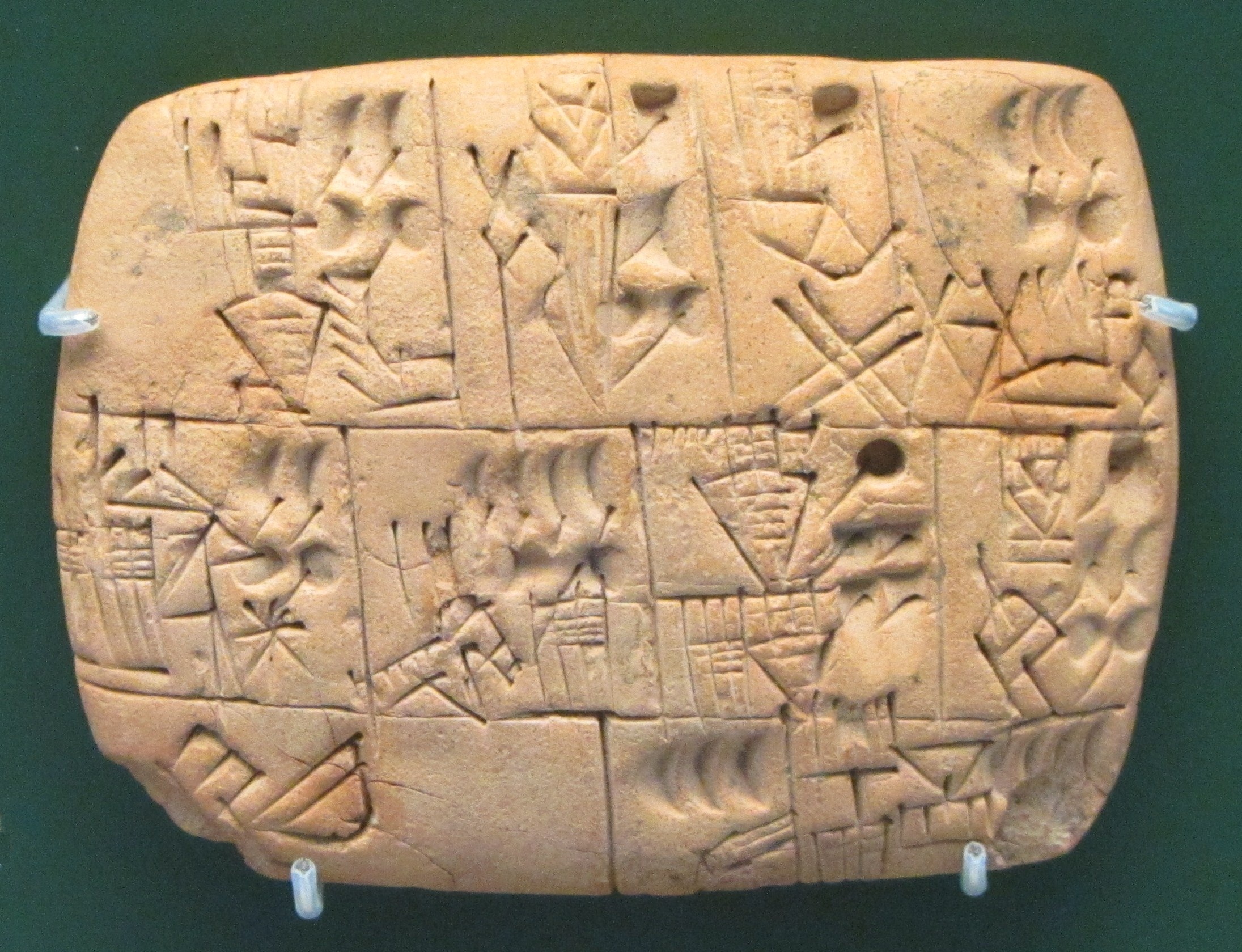
The earliest tablets — perhaps 6,000 of them have survived from the Uruk IV and III phases, mostly from Uruk itself — record almost nothing that a modern reader would call literature. They list quantities. They name officials. They specify commodities. The language behind them is overwhelmingly assumed to be Sumerian, though for a small number of the earliest tablets the language is genuinely uncertain because the writing is so logographic that it does not yet encode the grammatical features that would identify a language family.5 Within a few centuries — by the Early Dynastic I period (~2900–2700 BCE) — the script had developed enough phonetic flexibility to be unambiguously Sumerian, and the corpus had broadened: royal inscriptions on stone, hymns to deities, lexical lists used in scribal training, the first literary texts.
The other peoples in the plain
Sumerian-speakers were not alone in southern Mesopotamia. From at least the Early Dynastic period — and probably much earlier — the same cities and the same countryside were inhabited by Semitic-speaking populations whose language, when it eventually appears in writing, is recognizably the ancestor of Akkadian. The two communities lived intermixed, intermarried, worshipped overlapping pantheons (the Sumerian Inanna and the Semitic Ishtar are the same goddess under different names; Enlil and Ellil; Utu and Shamash), and increasingly served the same political institutions. There is no evidence of a frontier between Sumerian-speaking and Semitic-speaking populations; there is evidence of two languages spoken side by side in the same households, the same temples, the same scribal academies, for as long as the historical record runs.6
The Akkadian-speakers of the third millennium BCE were not, by the standards of the surrounding world, an unsophisticated population. They had agriculture, metalwork, monumental architecture, an organized priesthood, and — at sites like Mari on the middle Euphrates and Ebla in northwestern Syria — long-distance commercial networks reaching to the Mediterranean and the Anatolian plateau. What they did not have, until the script began to be adapted to their language, was a way of fixing their own speech to a portable surface. When a Semitic-speaker in mid-third-millennium Mesopotamia needed to record something — a deed of sale, a marriage contract, a ration disbursement — he or she went to a Sumerian-trained scribe, who wrote it in Sumerian. The scribe might or might not be Sumerian-speaking himself; what mattered was that the text was Sumerian. The act of writing was, for several centuries, an act of translation into a language some of its users did not natively speak.
The consequences of this asymmetry are easy to underestimate. A Semitic merchant who needed a contract enforced in Sumerian script could be at the mercy of the scribe's accuracy, and could not check the document himself. A petitioner before a court that kept its records in Sumerian had to trust someone else's reading of his own deposition. A king who issued royal inscriptions in Sumerian was speaking through an interpreter to his own subjects. None of this was uniquely Mesopotamian — every literate state until the modern period has had populations who could not read its records — but the Sumerian-Akkadian situation in the third millennium BCE is the first time we can see a literate population beginning the work of bringing the script into its own tongue.
How the wedges learned to spell a Semitic language
The transmission has no single moment. There was no founding episode in which an Akkadian scribe sat down and said we will now write our language. What there was instead was a slow, four-century accretion of workarounds, beginning with the easiest cases and proceeding to the harder ones, until what had started as Sumerian script with Akkadian intrusions had become Akkadian script with Sumerian inheritances.7
The earliest Akkadian intrusions into the cuneiform record are personal names. A Semitic-speaking individual — a debtor, a witness, an official — could not have his name written meaningfully in Sumerian logograms; his name was a combination of Semitic morphemes that had no direct Sumerian equivalent. So the scribes used the cuneiform signs for their phonetic value rather than their meaning, treating each sign as a syllable rather than a word. Lugal, the Sumerian sign for "king," could be borrowed for its sound — lu-gal — and combined with other syllabic signs to spell Semitic names. The earliest such Semitic personal names appear in Sumerian-language tablets at sites like Abu Salabikh, Fara (ancient Shuruppak), and Kish in the Early Dynastic IIIa period (~2600–2500 BCE).8 The signs are still Sumerian; the names embedded in them are Semitic. The writing system has discovered that it can carry a name from one language into a text in another.
From names, the technique extended to other inserted Semitic words: terms for goods that had no Sumerian equivalent, place-names from the Semitic-speaking north, and grammatical particles. By the mid-third millennium BCE the syllabic value of Sumerian signs had been worked out comprehensively enough that an entire Akkadian-language document could in principle be written. The earliest known is — depending on which scholar one credits — either a small group of Old Akkadian inscriptions from the Diyala region predating Sargon, or the great archives of Ebla in northern Syria. Old Akkadian proper is preserved on tablets from c. 2500 BCE onward; one of the earliest substantial inscriptions, on a bowl from Ur, was commissioned by the queen Gan-saman, herself thought to have come from the city of Akkad, for the pre-Sargonic king Meskiagnunna of Ur (~2485–2450 BCE).9
Ebla and the proof of concept
The most spectacular evidence of the early transmission lies four hundred kilometers northwest of the southern Mesopotamian heartland, at the Syrian site of Tell Mardikh — ancient Ebla. In 1974–75 the Italian archaeologist Paolo Matthiae excavated the burned palace archive of an Eblaite king destroyed around 2300 BCE. The archive yielded approximately 1,800 complete tablets, 4,700 fragments, and tens of thousands of chips, the largest cuneiform corpus then known from any single third-millennium site.10 About 80 percent of the tablets were written in the conventional Sumerian system, with logograms supplemented by phonetic signs. The remaining 20 percent — roughly 360 substantial tablets — were written in a previously unknown Semitic language, Eblaite, using the same cuneiform script with a more thoroughly phonetic approach.
What made Ebla decisive for the historical question was the presence of bilingual word-lists: tablets that paired Sumerian terms with their Eblaite equivalents, the world's first known dictionaries. The Eblaite scribes who wrote them were trained in southern Mesopotamian scribal traditions — their lexical lists copy or closely parallel Sumerian originals from sites like Fara and Abu Salabikh — but they used the script for a Semitic language closely related to, though distinct from, Akkadian. Ebla establishes that by 2400 BCE at the latest, the technique of writing a Semitic language in cuneiform was an exportable skill: Sumerian-trained scribes carried the system hundreds of kilometers and adapted it for a different Semitic vernacular.11
Sargon and the imperial chancery
The transmission's institutional culmination came under the kings of Akkad. Sargon (r. ~2334–2279 BCE), a Semitic-speaking king from a city whose ruins have never been located, founded what historians conventionally call the world's first territorial empire: a polity stretching from the Persian Gulf through the Sumerian south, the Akkadian center, and the upper Tigris and Euphrates as far as the Mediterranean and the Iranian plateau.12 He governed it in Akkadian. The royal inscriptions of Sargon and his successors — the Akkadian Empire's official self-presentation on stone, in clay, and in the captions to victory monuments like the Bassetki statue and the Naram-Sin victory stele — are in Akkadian, the king's spoken language and the language of the dynasty's homeland.
Sargon's administration installed Akkadian-speaking officials in the conquered Sumerian cities; the chronicle later called the Sumerian King List records that he placed his own people as governors over the southern centers, sometimes alongside or in place of Sumerian incumbents.13 The chancery began producing parallel-text inscriptions in Sumerian and Akkadian. Sargon's grandson Naram-Sin (r. ~2254–2218 BCE) — who deified himself as "god of Akkad," the first Mesopotamian ruler to claim divinity in life, and who took the title King of the Four Quarters — left royal inscriptions in both languages, sometimes on the same monument.14 By the end of the Akkadian period, around 2200 BCE, cuneiform was decisively a two-language script. Sumerian remained the older, more prestigious tongue for liturgical and literary use; Akkadian was the language of imperial governance, of royal proclamation, of the merchant networks that the Sargonic state secured.

The transmission was not friction-free even at this stage. Sumerian and Akkadian belong to entirely different language families — Sumerian a language isolate, Akkadian an East Semitic language — and the script's design assumptions did not transfer cleanly. Sumerian morphology is agglutinative, building words by stacking grammatical particles; Akkadian morphology is templatic, weaving consonantal roots through vowel patterns to generate inflected forms. A sign system designed to spell out Sumerian's particle stacks had to be retasked to indicate Akkadian's vowel patterns, which Sumerian scribes had previously had little reason to mark. The result was a script that retained Sumerian logograms (which an Akkadian reader simply pronounced as the Akkadian word for the same thing — what later Assyriologists call Sumerograms), supplemented these with phonetic syllables for Akkadian-specific vocabulary and grammar, and added a category of phonetic complements: small syllabic signs appended to a logogram to indicate which Akkadian grammatical form was meant.15 The system was hybrid, redundant, and difficult to learn — a literate Akkadian scribe needed to know perhaps 600 signs in regular use, with thousands more in specialist contexts — but it worked.
What changed and what was replaced
The transmission did not produce Akkadian literacy out of nothing. It produced a literate empire — and, more durably, it produced the principle that a script could be detached from the language that had birthed it.
Sumerian displaced from administration; preserved as scholarship
By the late third millennium BCE, Akkadian had displaced Sumerian as the everyday administrative and commercial language of Mesopotamia. The shift was not instantaneous and was not engineered by any single ruler: it had begun before Sargon, accelerated under his dynasty, and was effectively complete by the end of the Third Dynasty of Ur around 2000 BCE.16 After 2000 BCE, Sumerian was no longer the native language of any community; it survived as a learned language, taught in scribal schools (the eduba) alongside Akkadian and used for liturgical, scholarly, and ritual texts in the same way medieval European scholars used Latin a millennium after it ceased to be the spoken vernacular of any region.
The Sumerian-speaking scribal class that had monopolized literacy in the Early Dynastic period was displaced. Its institutional position was taken over by Akkadian-speaking scribes; its language became one of two that any educated Mesopotamian needed to know, with Akkadian the working tongue and Sumerian the older, more learned one. The displacement was not violent in any single moment — there is no recorded purge of Sumerian scribes — but its cumulative effect over four or five generations was the conversion of the country's literate elite from a Sumerian-speaking guild to an Akkadian-speaking one with Sumerian as a learned second language. Sumerian-speaking lineages that did not cross over disappeared from the record by attrition.
What survived, remarkably, was Sumerian itself as a scholarly language. The bilingual lexical lists — Sumerian word, Akkadian gloss — became the backbone of scribal training across the Old Babylonian, Middle Babylonian, Neo-Assyrian, and Neo-Babylonian periods. A trainee scribe in 1700 BCE, in 700 BCE, even in 200 BCE was still memorizing Sumerian-Akkadian vocabularies whose form went back to the third-millennium adaptation.17 Sumerian outlived its native speakers by roughly two thousand years because the technology of writing the script had transmitted to Akkadian carried Sumerian forward as a fossil of itself.
Cuneiform becomes a transferable technology
The more consequential change was conceptual. Once the cuneiform script had been demonstrated to work for a language structurally unrelated to Sumerian, it became — in a way no preceding script had been — portable. Over the following two thousand years it was successively adapted for Eblaite (already in the third millennium), Elamite (in southwestern Iran from the late third millennium onward), Hurrian (in northern Mesopotamia and Anatolia from the early second millennium), Hittite (the Indo-European language of central Anatolia, from roughly 1650 BCE), Luwian, Palaic, Urartian (in the Armenian highlands from the ninth century BCE), Old Persian (Achaemenid royal inscriptions from the sixth century BCE, in a heavily simplified version of the script), and Ugaritic (in the form of a 30-sign cuneiform alphabet at the Late Bronze Age Syrian port of Ugarit).18 The script had become not the property of any one language but a recognized adaptable technology — something the Mesopotamian scribal tradition could pass to neighbouring cultures, who could in turn modify it for their own phonologies and grammars.
This is the principle on which every subsequent script-borrowing rests. When Phoenician traders developed a consonantal alphabet from older West Semitic prototypes in the late second millennium BCE, and when Greek-speakers in the eighth century BCE then borrowed that alphabet and added vowel letters, they were following — at three thousand years' remove and on the opposite side of the Mediterranean — the precedent the Akkadian scribes had set: that a script invented for one language could be used to write another, with whatever modifications the new language required. The same precedent governs Brahmi's adaptations across South and Southeast Asia, the Aramaic script's spread across the late-antique Near East and into Central Asia, the Chinese script's adaptation for Korean (hanja, then hangul) and for Japanese (kanji and the kana syllabaries), the Cyrillic adaptation of Greek for Slavic, and the Latin alphabet's universalization through European colonialism. None of these later transmissions cite the Sumerian-Akkadian case as a model, because none of their participants knew of it; cuneiform had been forgotten and would not be deciphered until the 1830s and 1840s. But the principle, established once on the Mesopotamian alluvium in the mid-third millennium BCE, has not had to be re-discovered.
A literate state on a new scale
The Akkadian Empire was the first political formation in human history that could give administrative orders in writing across a thousand-kilometer distance. Sargon's regime governed perhaps sixty-five cities through Akkadian-speaking governors and Akkadian-language correspondence; tax assessments, military requisitions, judicial decisions, and royal decrees moved on clay tablets carried by official messengers between the capital at Akkad and the provinces.19 The combination — a script abstract enough to be read by anyone with the training, a language that the political class natively spoke, an administrative class educated in both, and the physical durability of clay (which survives fire, burial, and casual breakage in ways papyrus and parchment do not) — made possible a kind of governance that earlier polities had not attempted at this scale.
The institutional consequence persisted. The Old Babylonian (~1900–1600 BCE), Middle Assyrian (~1400–1050 BCE), Neo-Assyrian (~900–612 BCE), and Neo-Babylonian (~625–539 BCE) empires that succeeded Akkad were all literate, all multilingual, and all governed in cuneiform Akkadian. The Akkadian lingua franca spread through diplomatic correspondence: the Amarna letters of the fourteenth century BCE — the diplomatic archive of the Egyptian pharaohs Amenhotep III and Akhenaten — preserve correspondence in Akkadian cuneiform between Egypt and Babylon, Assyria, Mitanni, Hatti, Cyprus, and a network of Levantine vassal cities. For roughly two millennia Akkadian was the language of long-distance state communication across the Near East, much as Latin was for medieval Christendom or French for nineteenth-century European diplomacy.20 The mathematical, astronomical, divinatory, medical, and legal corpora that the cuneiform tradition compiled — Eleanor Robson has shown how mathematics in particular was an integral part of Babylonian scribal training and a tool of statecraft — were the working knowledge of Near Eastern intellectual life until the Hellenistic period.21
The scribal school and the technology of teaching
The institution that carried this transmission across generations was the eduba, the Sumerian-language term — literally "tablet house" — for the scribal school that trained the literate class of Old Babylonian Mesopotamia and its successor states. The eduba's curriculum, reconstructed from thousands of student exercise tablets recovered from sites like Nippur, Sippar, and Ur, was bilingual from the beginning of the Old Babylonian period: trainees memorized Sumerian sign-lists, copied Sumerian literary compositions, and were drilled on the Akkadian translations of every Sumerian word they wrote. The exercises that have survived include simple sign-by-sign copies, model contracts, mathematical problems with their working shown, and the cycle of literary and proverbial texts that constituted what we would now call a literary canon. A student in 1700 BCE memorizing the Hymn to Nisaba — the Sumerian goddess of writing and grain — was performing a ritual that bound the Akkadian-speaking present to the Sumerian-speaking past through the medium of a script that had crossed languages a thousand years earlier. The eduba's pedagogy is the longest-running institutional teaching tradition for which we have direct documentary evidence; it ran, with adjustments, from approximately 2000 BCE to the early centuries CE, transmitting the doubled language-and-script inheritance the Sargonic chancery had institutionalized.
What the cost was
The transmission of the script itself was peaceful. Scribes adapted signs over centuries; merchants and bureaucrats found uses for the new flexibility; no one was killed for adopting a syllabic interpretation of aleph-equivalent. The cost of the transmission lies in what the script enabled — the literate state — and in the institutions of the empire that institutionalized it. Both the older Sumerian city-states and the Sargonic and post-Sargonic empires they were absorbed into ran on conquest, deportation, tribute, and an economy in which a substantial fraction of the population was unfree.
The Akkadian conquests
Sargon's career, as the chronicles preserve it, was a sequence of military victories. The Sumerian King List credits him with thirty-four battles. His own surviving inscriptions claim conquests of Lugalzagesi of Uruk (the previous would-be hegemon of the Sumerian south), of Ur, of Lagash, of E-Ninmar, of Umma; campaigns into the Iranian highlands against Awan and Susa; expeditions to the cedar forests of the upper Euphrates and to Anatolia.22 At each conquered city, the Sargonic chancery installed Akkadian-speaking governors, redirected tribute to Akkad, and integrated the local economy into a single tax-collecting state. The mechanisms of this integration — confiscation of temple lands, deportation of skilled craftsmen, forced labor on royal building projects — were the standard operating procedures of Mesopotamian imperial administration for the next two thousand years.
Naram-Sin's reign brought the same mechanisms to bear against an internal challenge. Roughly halfway through his reign — the date is not securely fixed but lies in the 2230s or 2220s BCE — a wide coalition of Mesopotamian cities revolted against Akkadian rule. The contemporary inscriptions and the later literary tradition (the Great Revolt against Naram-Sin, Naram-Sin and the Enemy Hordes) name the leaders: Iphur-Kish king of Kish, Amar-Girid king of Uruk, Enlil-nizu of Nippur, with the cities of Kutha, Sippar, Kazallu, Kiritab, and Apiak joining the rising and "Amorite highlanders" providing additional manpower.23 Naram-Sin crushed the revolt in nine pitched battles, according to his own inscriptions; the southern cities were retaken, the rebel kings executed or dispossessed, the city walls of the worst offenders pulled down, and the survivors brought to heel. Naram-Sin's deification of himself as the god of Akkad in the wake of the revolt was a calculated assertion that the rebels had not just risen against a king but against the divine order itself.
The specific casualty figures are not preserved. Mesopotamian royal inscriptions from this period boast of bodies piled in heaps and skulls used as building material — the rhetorical conventions of the Sargonic chancery, repeated and intensified by Naram-Sin and inherited by every Assyrian king down to the seventh century BCE — but they do not give the kind of demographic accounting that later Assyrian or Roman annals occasionally do. What is recoverable is the order of magnitude of the affected populations and the persistence of the practice. The conquered cities of the Sumerian south had populations in the tens of thousands; the routine practices of Mesopotamian conquest included executions of resisting elites, deportation of skilled labor, and the seizure of women and children as war captives who were absorbed into temple and palace households as forced laborers and slaves. This was not unusual for the period; it was the standard cost of empire in third-millennium-BCE Mesopotamia, and the Akkadian regime's distinction was that it imposed it on a larger geographic scale than any predecessor.
The hereditary slavery the literate state catalogued
The institutional basis of the Sargonic and post-Sargonic states was an agricultural surplus extracted from a mostly rural and partly unfree population. Mesopotamian society from the Early Dynastic period onward had three broad strata: the awīlum (free persons with full legal standing), the muškēnum (legal dependents of the palace, often translated "commoners" but with restricted standing), and the wardum / amtum (male and female slaves).24 Slavery had three principal sources: war captivity (particularly significant under the Sargonic regime, with its expansion-driven campaigns), debt bondage (a free person could pledge himself, his wife, or his children against an unpaid loan and become the creditor's slave on default), and birth (slave parents produced slave children).
The scribal apparatus that the Akkadian transmission enabled — the contracts, the loan documents, the tax lists, the temple accounts — is also the apparatus that catalogued and enforced this system. The earliest legal corpus to survive in continuous form, the Code of Ur-Nammu from the Third Dynasty of Ur (c. 2100 BCE, written in Sumerian on tablets that draw on the Sargonic chancery's bureaucratic conventions), includes provisions on the recovery of fugitive slaves, on the legal status of children born to mixed slave-free unions, and on the compensation owed for injury to slaves.25 These provisions did not invent the system they regulated; they bring into the formal language of law a set of relationships that had been operating, undocumented, through every preceding century of Mesopotamian state formation. The Sargonic empire and its successors collected silver in part by taxing the productivity of slave-worked fields and slave-staffed workshops; the Akkadian-language tablets that record these transactions are the documentary infrastructure of an extractive economy.
The specific scale of Mesopotamian third-millennium slavery is contested. The best-documented archive — the Garshana texts of the Ur III period (c. 2050 BCE), several centuries after the Sargonic transmission — reveals a building project employing hundreds of slaves alongside hired free workers, with detailed accounts of rations, work assignments, and births and deaths in the slave population. Scholars working from such archives estimate that slaves comprised perhaps 5 to 15 percent of Ur III southern Mesopotamian populations, with substantially higher concentrations in palace and temple workshops.26 The proportions in the earlier Sargonic period are less well documented but are unlikely to have been much smaller; if anything the Sargonic conquests pumped large numbers of new captives into a system that absorbed them.
Whose voices the literate state did not preserve
One quiet asymmetry runs through the entire third-millennium documentary record. The cuneiform corpus that lets us reconstruct the transmission was produced by, for, and about the literate elite — kings and their officials, temple administrators, merchants of substance, scribal teachers and their students. The agricultural laborers whose surplus fed the cities, the women who wove the textiles that paid for long-distance trade, the slaves who built the canals and walls and palaces, the rural populations whose conscripted manpower filled Sargon's and Naram-Sin's armies — these are present in the tablets only as accounting line-items, ration recipients, names in a labor roster. Their inner lives, opinions, songs, languages, and grievances are not in the record because the script was not, in this period, used to record them. The bilingual scribal tradition that the Akkadian transmission produced was a tool of the state and the temple; its silences are as historically real as its surviving texts. The estimate that 5–15 percent of southern Mesopotamian populations were enslaved is itself recoverable only because the slaveholders' documentary apparatus was thorough, not because the enslaved themselves wrote.
The collapse of Akkad and the Curse of Agade
The Akkadian Empire itself did not survive much past Naram-Sin's reign. By the 2150s BCE the empire was unraveling: peripheral provinces seceded, the city of Akkad lost control of the southern Sumerian heartland, and the Gutian highland confederation pushed south through the Diyala. By approximately 2154 BCE the Akkadian dynasty had effectively ended, and Akkad itself — the imperial capital that had given its name to the language and the dynasty — was abandoned and lost. Its location is still unknown, despite a century and a half of searching by Iraqi, French, German, American, and Italian archaeological teams.
The collapse was processed in Sumerian literary memory as a divine punishment for Naram-Sin's hubris. The Curse of Agade, a Sumerian-language literary composition probably first written down in the Ur III period and copied throughout the Old Babylonian scribal tradition, attributes the empire's destruction to Naram-Sin's sack of the temple of Enlil at Nippur and to the high god's calling-down of the Gutian onslaught as retribution.27 The poem describes Akkad's depopulation in the harshest available terms: the streets emptied, the harbours where boats had docked from a thousand miles away returned to swamp, the city's name forgotten. The literary memory is vivid and mostly hostile; the historical reality, recoverable from the archaeological record, is also catastrophic: Akkad's central provinces show population collapse, abandoned settlements, and a marked discontinuity in the material record at the end of the Sargonic period.
But the script the Sargonic state had catalysed had moved past the state. Cuneiform did not collapse with Akkad. The Gutian rulers who briefly held the south used Sumerian and Akkadian alongside one another; the Sumerian renaissance under the Third Dynasty of Ur (~2112–2004 BCE) under Ur-Nammu and Shulgi continued and refined the bilingual scribal tradition the Sargonic chancery had established; the Old Babylonian dynasty of the early second millennium under Hammurabi (r. ~1792–1750 BCE) carried it forward into a period of unprecedented Akkadian-language literary, mathematical, legal, and religious production. The transmission of the script outlived the empire that had institutionalized it by, eventually, more than two thousand years. The last datable cuneiform tablet — an astronomical almanac calculated for the year 75 CE — was written in Akkadian, in a Babylonian temple-school whose lineage reached back, with no real break, to the Sargonic chancery.28
The transmission's full bill, then, has two parts. The first is the conquest, the deportation, and the slavery that the Akkadian state, like every other Mesopotamian state, ran on — a cost that was not caused by the script's borrowing but was inseparable from the polity that institutionalized it. The second is what this transmission gave: not just two literate languages where there had been one, but the proof that writing was a tool independent of any particular tongue. Every script that has ever been borrowed since — every language whose first written form was in someone else's signs — descends, conceptually, from the centuries during which Sumerian wedges learned to spell Akkadian words on the floor of a Mesopotamian scribe's lesson tablet.
The Akkadian scribes who solved that problem did not know they were establishing a principle. They were trying to write a contract, a name, a tax assessment in a language their patron could speak. The principle is what we, looking back four and a half thousand years through every borrowed alphabet that has carried our own languages, can see they made.
What followed
-
-2600Earliest Semitic personal names embedded in Sumerian tablets, ~2600 BCE: at sites like Abu Salabikh, Fara, and Kish, scribes spell Akkadian names by treating Sumerian signs as syllables — the first crossing of the script into a second language.
-
-2470Old Akkadian inscriptions on the bowl of Gan-saman, ~2470 BCE: the queen of pre-Sargonic king Meskiagnunna of Ur commissions one of the earliest substantial Akkadian-language inscriptions, herself thought to have come from Akkad.
-
-2350Ebla palace archive, ~2400–2300 BCE: roughly 1,800 cuneiform tablets at Tell Mardikh in Syria preserve Sumerian-Eblaite bilingual word-lists — the world's first known dictionaries — proving the script had become an exportable technology four hundred kilometres from its homeland.
-
-2334Sargon of Akkad's empire, ~2334 BCE onward: the world's first territorial empire is governed in Akkadian cuneiform, with parallel Sumerian and Akkadian royal inscriptions and Akkadian-speaking governors installed in the conquered Sumerian cities.
-
-2230The Great Revolt against Naram-Sin, ~2230s BCE: a coalition of Sumerian cities led by Iphur-Kish of Kish and Amar-Girid of Uruk rises against Akkadian rule. Naram-Sin crushes the revolt in nine pitched battles and deifies himself as 'god of Akkad' — the first Mesopotamian ruler to claim divinity in life.
-
-2154Collapse of the Akkadian Empire, ~2154 BCE: peripheral provinces secede, Gutian highlanders push south, and the imperial capital Akkad is abandoned and lost. Its location remains unknown despite a century and a half of archaeological searching.
-
-2100Code of Ur-Nammu, ~2100 BCE: the oldest extant law code, written in Sumerian on tablets shaped by Sargonic chancery conventions, formalizes a legal system that distinguishes free persons, palace dependents, and slaves — and details rules for fugitive slaves, debt bondage, and slave-free intermarriage.
-
-2000Sumerian extinct as a spoken language, ~2000 BCE: by the end of the Third Dynasty of Ur no community speaks Sumerian natively, but it survives as a learned liturgical and scholarly tongue taught in Akkadian-language scribal schools for the next two millennia.
-
-1650Hittite cuneiform, ~1650 BCE onward: the script is adapted in central Anatolia for the Indo-European language of the Hittite empire — the same principle of phonetic-logographic adaptation the Akkadians established, applied to a structurally different language family.
-
-1360Amarna correspondence, ~1360 BCE: the Egyptian pharaohs Amenhotep III and Akhenaten conduct diplomacy with Babylon, Assyria, Mitanni, Hatti, and Levantine vassals in Akkadian cuneiform — a Mesopotamian language and script become the lingua franca of Late Bronze Age Near Eastern statecraft.
-
75Last datable cuneiform tablet, 75 CE: an astronomical almanac calculated in Akkadian in a Babylonian temple-school — the final dated product of a continuous scribal lineage reaching back, without break, to the Sargonic chancery three thousand years earlier.
Where this lives today
References
- Liverani, Mario. Uruk: The First City. Translated by Zainab Bahrani and Marc Van De Mieroop. London: Equinox, 2006. en
- Michalowski, Piotr. "Sumerian." In: Woodard, Roger D. (ed.), The Cambridge Encyclopedia of the World's Ancient Languages. Cambridge: Cambridge University Press, 2004, pp. 19–59. en
- Schmandt-Besserat, Denise. How Writing Came About. Austin: University of Texas Press, 1996. (Abridged edition of Before Writing, 2 vols., 1992.) en
- Englund, Robert K. "Texts from the Late Uruk Period." In: Bauer, Josef; Englund, Robert K.; Krebernik, Manfred. Mesopotamien: Späturuk-Zeit und Frühdynastische Zeit. Orbis Biblicus et Orientalis 160/1. Freiburg / Göttingen: Universitätsverlag / Vandenhoeck & Ruprecht, 1998, pp. 15–233. de
- Cooper, Jerrold S. "Babylonian Beginnings: The Origin of the Cuneiform Writing System in Comparative Perspective." In: Houston, Stephen D. (ed.), The First Writing: Script Invention as History and Process. Cambridge: Cambridge University Press, 2004, pp. 71–99. en
- Cooper, Jerrold S. "Sumerian and Akkadian." In: Daniels, Peter T. and Bright, William (eds.), The World's Writing Systems. New York: Oxford University Press, 1996, pp. 37–57. en
- Walker, C. B. F. Cuneiform. Reading the Past, vol. 3. London / Berkeley: British Museum Publications / University of California Press, 1987. en
- Krebernik, Manfred. "Die Texte aus Fāra und Tell Abū Ṣalābīḫ." In: Bauer, Josef; Englund, Robert K.; Krebernik, Manfred. Mesopotamien: Späturuk-Zeit und Frühdynastische Zeit. Orbis Biblicus et Orientalis 160/1. Freiburg / Göttingen: Universitätsverlag / Vandenhoeck & Ruprecht, 1998, pp. 235–427. de
- Hasselbach, Rebecca. Sargonic Akkadian: A Historical and Comparative Study of the Syllabic Texts. Wiesbaden: Harrassowitz, 2005. en
- Matthiae, Paolo. Ebla: An Empire Rediscovered. Translated by Christopher Holme. London: Hodder and Stoughton, 1980. en
- Archi, Alfonso. Ebla and Its Archives: Texts, History, and Society. Studies in Ancient Near Eastern Records 7. Boston / Berlin: De Gruyter, 2015. en
- Liverani, Mario (ed.). Akkad, the First World Empire: Structure, Ideology, Traditions. History of the Ancient Near East / Studies V. Padova: Sargon, 1993. en
- Frayne, Douglas R. Sargonic and Gutian Periods (2334–2113 BC). The Royal Inscriptions of Mesopotamia, Early Periods, vol. 2. Toronto: University of Toronto Press, 1993. en primary
- Westenholz, Aage. "The Old Akkadian Period: History and Culture." In: Sallaberger, Walther and Westenholz, Aage. Mesopotamien: Akkade-Zeit und Ur III-Zeit. Orbis Biblicus et Orientalis 160/3. Freiburg / Göttingen: Universitätsverlag / Vandenhoeck & Ruprecht, 1999, pp. 17–117. en
- von Soden, Wolfram. Grundriss der akkadischen Grammatik. 3rd revised edition by Werner R. Mayer. Analecta Orientalia 33. Rome: Pontificio Istituto Biblico, 1995. de
- Michalowski, Piotr. "The Lives of the Sumerian Language." In: Sanders, Seth L. (ed.), Margins of Writing, Origins of Cultures. Oriental Institute Seminars 2. Chicago: Oriental Institute of the University of Chicago, 2006, pp. 159–184. en
- Veldhuis, Niek. History of the Cuneiform Lexical Tradition. Guides to the Mesopotamian Textual Record 6. Münster: Ugarit-Verlag, 2014. en
- Daniels, Peter T. and Bright, William (eds.). The World's Writing Systems. New York: Oxford University Press, 1996. See chapters on cuneiform-derived scripts (Elamite, Hurrian, Hittite, Urartian, Old Persian, Ugaritic). en
- Foster, Benjamin R. The Age of Agade: Inventing Empire in Ancient Mesopotamia. London / New York: Routledge, 2016. en
- Moran, William L. (ed. and trans.). The Amarna Letters. Baltimore: Johns Hopkins University Press, 1992. en primary
- Robson, Eleanor. Mathematics in Ancient Iraq: A Social History. Princeton: Princeton University Press, 2008. en
- Sargon of Akkad, royal inscriptions. In: Frayne, Douglas R., Sargonic and Gutian Periods (2334–2113 BC), Royal Inscriptions of Mesopotamia, Early Periods 2, Toronto: University of Toronto Press, 1993, pp. 7–218. en primary
- Wilcke, Claus. "Amar-girids Revolte gegen Naram-Su'en." Zeitschrift für Assyriologie und Vorderasiatische Archäologie 87 (1997), pp. 11–32. de
- Roth, Martha T. Law Collections from Mesopotamia and Asia Minor. 2nd edition. Society of Biblical Literature Writings from the Ancient World 6. Atlanta: Scholars Press, 1997. en primary
- Code of Ur-Nammu, c. 2100 BCE. Translation in: Roth, Martha T., Law Collections from Mesopotamia and Asia Minor, 2nd ed., Atlanta: Scholars Press, 1997, pp. 13–22. en primary
- Adams, Robert McC. "Slavery and Freedom in the Third Dynasty of Ur: Implications of the Garshana Archives." Cuneiform Digital Library Journal 2010:2. en
- The Curse of Agade. Sumerian literary composition, attested from the Ur III period and copied throughout the Old Babylonian scribal tradition. Translation in: Cooper, Jerrold S., The Curse of Agade, Baltimore: Johns Hopkins University Press, 1983. en primary
- Geller, Markham J. "The Last Wedge." Zeitschrift für Assyriologie und Vorderasiatische Archäologie 87 (1997), pp. 43–95. en