Hammurabi didn't write the first law code — Ur-Nammu did (c. 2100 BCE)
The Code of Ur-Nammu priced an eye at half a mina of silver three and a half centuries before Hammurabi carved 'an eye for an eye' in diorite. Written law was Mesopotamia's gift to governance — and it made the price of a person, set by rank, permanent and citable.
Around 2100 BCE at Ur, the Sumerian king Ur-Nammu published the oldest law collection humanity has recovered: a prologue promising that the orphan would not be handed to the rich, followed by a schedule of what each wrong would cost — an eye, half a mina of silver. Over the next 350 years the genre passed through Isin and Eshnunna, switched from Sumerian to Akkadian, and culminated around 1754 BCE in Hammurabi's diorite stele at Babylon, which hardened compensation into talion: eye for eye. The transmission was peaceful and textual, copied in scribal schools for a thousand years. Its cost was quieter than conquest: written law took the ranks of Mesopotamian society — free man, dependent, slave — and made a person's price by rank permanent, public, and forever citable.

Before the written law: how Mesopotamia settled a dispute
By the twenty-second century BCE, the cities of southern Mesopotamia — Ur, Uruk, Lagash, Nippur, Eridu — had been settling quarrels for a thousand years without a law code. This is the fact the phrase "the first law code" tends to erase. Sumerian society was dense, litigious, and relentlessly bureaucratic. The Third Dynasty of Ur, the state Ur-Nammu founded around 2112 BCE, ran one of the most document-heavy administrations of the ancient world: the redistribution centre at Puzriš-Dagan alone has yielded tens of thousands of accounting tablets, tracking sheep, silver, and labour down to the fraction of a shekel. This was a civilisation that already kept receipts, sealed contracts in clay, and hauled neighbours before judges over fields, dowries, loans, and runaway slaves. 1
What it did not yet have, before Ur-Nammu's reign (c. 2112–2095 BCE), was a single written text that announced, in the king's own voice, what justice was and what a specific wrong would cost. The paradox is exact: the most literate, most audited society yet to exist had written down almost everything except its law. 1
The court in the gate
Justice happened in public, usually at the city gate or in the temple forecourt. A dispute was heard by a panel that might combine the mayor, the city elders, temple officials, and one or more professional judges (dayyānū), with a commissioner (maškim) to manage the case. The surviving records of these hearings — the Sumerian ditilla ("case concluded") tablets from Third-Dynasty Lagash, which were archived by the hundred, and the later Old Babylonian trial memoranda — describe a procedure that was oral, adversarial, and dependent on two instruments the modern courtroom has abandoned: the oath and the ordeal. 2
There is a deeper irony in the timing. Cuneiform was not young when Ur-Nammu reigned; it was roughly twelve centuries old, invented at Uruk around 3300 BCE to count sacks of grain and herds of sheep. For more than a thousand years writing had served the granary, the temple storehouse, and the tax roll before any king thought to turn it on justice. The technology that would eventually make law public had spent its first millennium making property legible. That a book-keeping script became the medium of the first published law is not a footnote to the story; it is the story's hinge. 1
A litigant who could produce neither documents nor witnesses could be "sent to the river." The river ordeal submitted the accused to the current, and the river-god, not the judge, returned the verdict: survival was acquittal. Oaths were sworn by the life of the king and the names of the gods, often before the divine emblems carried out of the temple for the purpose; a false oath was thought to carry its own automatic, divine penalty, discharged without any human court. Under this system the sources of legal authority were three: the gods, the community's memory of precedent, and the king as the gods' appointed guarantor of order. None of the three was written down as a general, consultable rule. Law was a performance, repeated case by case — remembered, sometimes archived, but not a standard one could open and cite.
Reform by decree: Uru-ka-gina and the mīšarum tradition
There was one written antecedent, and it mattered. Around 2350 BCE — two and a half centuries before Ur-Nammu — Uru-ka-gina (also read Uru-inim-gina), the reforming ruler of Lagash, issued what is usually called the earliest social-reform text in the historical record. It is not a law collection. It is a royal proclamation, recorded to advertise that the king had "established freedom" — ama-gi, the first attested word for release from obligation — by cancelling debts, curbing rapacious officials, and shielding widows and orphans from the powerful. 3 Its specific complaints are vivid: overseers who seized the fishermen's boats, priests who charged ruinous fees at a burial, inspectors present at every harvest. Uru-ka-gina claimed to have swept them away and made a covenant with the city-god Ningirsu on the poor's behalf.
The edict set the template the codes would inherit: the king as the gods' agent, intervening to protect the weak against the strong, and publicising the intervention in writing. The kings who followed issued periodic mīšarum ("equity") edicts — administrative acts, usually proclaimed at a king's accession, that cancelled consumer debts, freed people held for debt, and reset economic obligations. These were real, enforceable, time-limited measures; the best-preserved, the Edict of Ammi-ṣaduqa (c. 1646 BCE), survives in full and reads like an emergency decree, clause by clause remitting specific classes of debt. 4 11 The law collections would borrow this rhetoric of protection while doing something categorically different: not cancelling debt once, but publishing a permanent, general schedule of what wrongs cost, and attaching it to the king's name forever.
What did not yet exist
It is worth naming precisely what the pre-code world lacked, because the change is otherwise easy to miss:
- No consultable statute. There was no written text a judge could open to find the rule for a case.
- No citable precedent-in-text. Verdicts were archived as records of what happened, not as general rules for what should happen.
- No public monument of justice. Nothing declared, in casuistic "if a man does X, then Y" form, the schedule of a kingdom's justice for all to see.
- No legal curriculum. Law was not yet a subject — not yet copied, memorised, and examined in the scribal schools alongside sign-lists, grammar, and mathematics.
Each of these was about to be invented, in a single concentrated burst, at Ur — and then carried, over three and a half centuries, to Babylon.
The chain of tablets: Ur-Nammu to Hammurabi
The transmission this record traces is not a single statute passing from one desk to another. It is a genre — royal law as public monument and scribal-school classic — born in Sumerian at Ur and carried, over roughly 350 years and four major recensions, into Akkadian at Babylon. The object that moved was the form itself: the prologue of divine election, the casuistic body, the epilogue of blessing and curse, and the underlying claim that a king proves his legitimacy by publishing justice. The relay ran, in its main surviving stages:
- Laws of Ur-Nammu — Ur, Sumerian, c. 2100 BCE — the oldest recovered collection; injury settled in silver.
- Laws of Lipit-Ishtar — Isin, Sumerian, c. 1930 BCE — the genre continues after the fall of Ur.
- Laws of Eshnunna — Eshnunna, Akkadian, c. 1770 BCE — the form crosses into the Semitic vernacular.
- Laws of Hammurabi — Babylon, Akkadian, c. 1754 BCE — 282 provisions, injury hardened into talion.
Ur-Nammu's code and the prologue of protection (~2100 BCE)
The Code of Ur-Nammu is the oldest law collection humanity has recovered. It was written in Sumerian during the Third Dynasty of Ur, and although it bears Ur-Nammu's name, some scholars assign it to his son and successor Shulgi — the ambiguity itself a reminder that these were dynastic monuments, not personal legislation. 13 The first copy, two fragments from Nippur, was deciphered by Samuel Noah Kramer in 1952 and published two years later; further tablets from Ur and from Sippar filled out the text, so that today roughly forty of an original fifty-some provisions can be read. 2 4 The original monument on which the collection stood has never been found — we know the oldest law in the world only from later scribal copies, which is itself a clue to how the genre travelled.
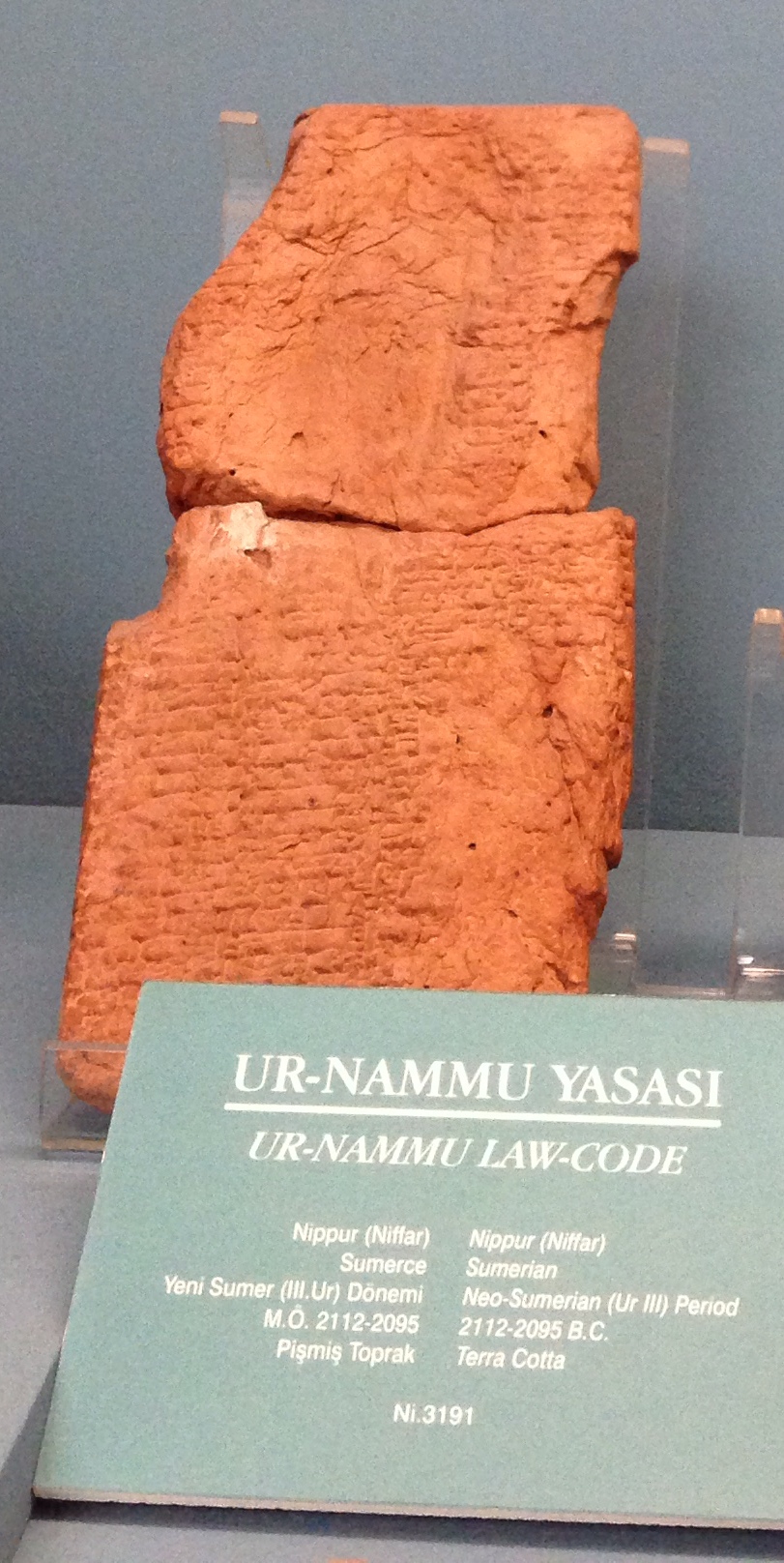
Its structure is the one the whole tradition would keep. A long prologue narrates the king's election by the moon-god Nanna and the sun-god Utu, his defeat of rival cities, and his establishment of honest weights and measures — a standardised copper bariga, a standardised silver mina — as the physical guarantee of fair dealing. Its most quoted lines set the moral register of the genre: in Martha Roth's translation, the king ensured that "the orphan was not given over to the wealthy; the widow was not given over to the powerful; the man of one shekel was not given over to the man of one mina." 1 Then come the provisions, in the flat conditional form that would define cuneiform law for two thousand years: if a man does such a thing, then this is the consequence.
What is striking about Ur-Nammu's provisions, read after Hammurabi, is their restraint about the body. Bodily injuries are settled in silver, not in matching mutilation:
- an eye knocked out — half a mina of silver (thirty shekels);
- a severed foot — ten shekels;
- a nose cut with a copper blade — two-thirds of a mina (forty shekels);
- a knocked-out tooth — two shekels. 1 3
This is compensation, not retaliation: a price list for harm. The collection was not uniformly gentle — homicide, robbery, adultery by a wife, and the rape of another man's virgin slave-girl carried death; a wife accused of adultery and cleared by the river ordeal saw her accuser fined. But for the ordinary violence of ordinary life, Ur-Nammu's answer was a payment, and the schedule of payments was now public and fixed.
Beyond injury, the collection reached into marriage, sex, and belief, and here too it fixed prices where custom had improvised. A man who divorced his first wife paid her one mina of silver; a man who divorced a former widow paid half a mina. A woman accused of witchcraft was sent to the river ordeal, and if the water cleared her, her accuser paid a fine. A slave-woman who set herself equal to her mistress had her mouth scoured with salt. 1 These are not the provisions of a gentle world. But they are provisions — written, general, and fixed — standing where before there had been only the judgement of the particular moment, and it is that shift from judgement to schedule, more than any single penalty, that Ur-Nammu's scribes set in motion.
Lipit-Ishtar and Eshnunna: the genre travels and changes language
The genre did not stop at Ur. When the Third Dynasty fell around 2004 BCE — its last king, Ibbi-Sin, carried off to Elam as the empire starved — its scribal culture dispersed into the successor kingdoms, and the law-collection form travelled with it. Around 1930 BCE, Lipit-Ishtar of Isin issued a collection still in Sumerian: prologue, some thirty-eight readable provisions on hired oxen, boat rentals, orchards, inheritance, and the children of slaves, and an epilogue closing with curses on anyone who would deface the monument or erase his name. 12 The continuity is deliberate; Lipit-Ishtar's prologue echoes Ur-Nammu's language of establishing justice and freeing the people of Sumer and Akkad from their burdens.
Then the language shifted. The Laws of Eshnunna, from the kingdom of that name around 1770 BCE, were written not in Sumerian but in Akkadian, the Semitic vernacular that had become the living speech of Mesopotamia. 1 9 They open not with a grand theological prologue but with a tariff — fixed values for barley, oil, wool, salt, and the hire of a wagon or a boat — and move through some sixty provisions. Several of them anticipate Hammurabi almost verbatim: the goring ox whose owner had been warned and did nothing, the biting dog, the collapsing wall that kills a passer-by. Here, too, the term muškēnum — the middle-ranking dependent whose injuries the later code would price between the free man's and the slave's — comes into legal prominence. By the eighteenth century BCE the transmitted genre had crossed dynasties, cities, and a language boundary while keeping its casuistic spine intact. The form had proven portable in exactly the way that made it durable.
Hammurabi's diorite monument (~1754 BCE)
Hammurabi came to the throne of Babylon in 1792 BCE, the sixth king of an Amorite dynasty ruling a middling city-state hemmed in by larger powers. For most of his reign he was one king among several. Then, in a rapid late campaign, he outlasted and destroyed his rivals: he defeated Rim-Sin of Larsa around his thirtieth regnal year, absorbed Eshnunna, and finally turned on his former ally Zimri-Lim of Mari, sacking the great palace-city and razing its walls. The territorial state he assembled gives the Old Babylonian period its name. 5 Near the end of that reign he had his law collection carved onto a tall stele of hard black stone and set up in a temple, where the public could come before it.
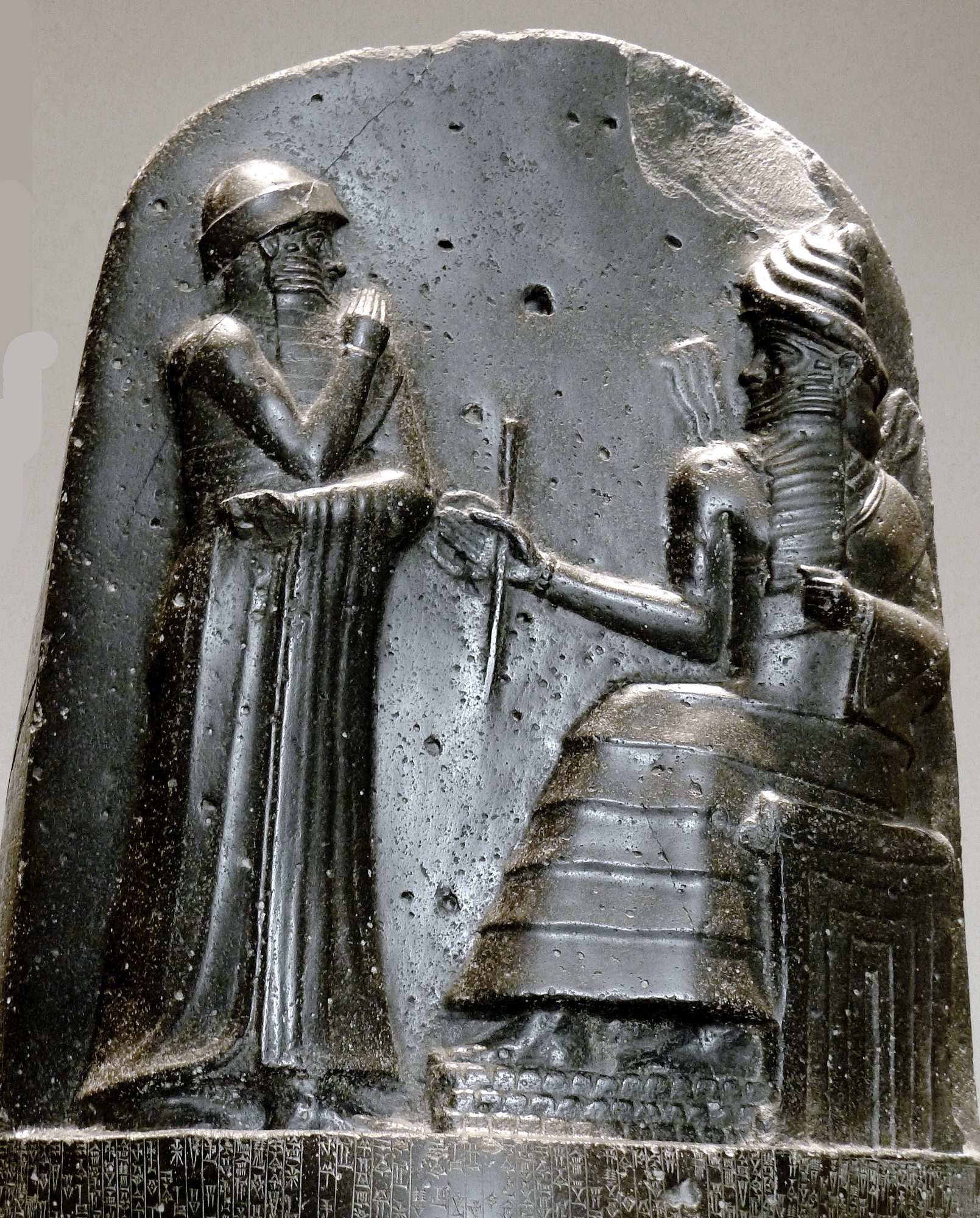
The monument that survives is over two metres tall and carries some 282 provisions between a prologue and an epilogue. 1 At its top, in relief, the sun-god and divine judge Shamash sits enthroned, flames rising from his shoulders, handing Hammurabi the rod and ring — the measuring tools that were Mesopotamia's emblems of just rule. The scene states the genre's whole theology in a single image: justice descends from the god, through the king, to the stone. Whether the stele is diorite or basalt is a question conservators were still debating in a 2026 study of the stone; that it is among the hardest and most permanent materials a sculptor could choose is the enduring point. 5
The text is Akkadian, cut in a consciously archaic monumental script, and it preserves everything the tradition had carried from Ur: the divine-election prologue, the casuistic body, the closing curses that call down Anu, Enlil, Ninlil, and a procession of gods on anyone who would alter the king's words or erase his name. Much of its substance overlaps its predecessors — the same recurring cases of goring oxen, negligent builders, deposited goods, marriage, and inheritance. What Hammurabi changed was the register of punishment. For injuries between men of the free class, he replaced Ur-Nammu's silver payments with talion: eye for eye, bone for bone, tooth for tooth. 1 The most famous principle in the history of law was not the innovation of first written justice but a hardening of it, three and a half centuries in.
The stele's own later history says something about the genre's prestige. Around 1158 BCE the Elamite king Shutruk-Nahhunte carried it off from Babylon to his capital at Susa as war booty, prize enough to haul hundreds of kilometres. There a French archaeological mission under Jacques de Morgan found it, broken in three pieces, in the winter of 1901–1902; the Assyriologist Jean-Vincent Scheil produced the first edition within the year. It has stood in the Louvre (Sb 8) ever since. 5
The scribal school: how the genre outlived its kings
The deepest part of the transmission is the least visible: the classroom. Mesopotamian scribes were trained in the edubba, the "tablet house," by copying canonical texts up a long ladder — sign-lists, syllabaries, model contracts, proverbs, then literary and legal classics — and the law collections became canon near the top of it. Hammurabi's laws in particular were copied and recopied as a school text for more than a millennium; student exercise tablets bearing his provisions were still being written in Neo-Babylonian and later schoolrooms, over a thousand years after the stele was carved, long after the Amorite dynasty and its language of daily speech had vanished. 8 5
This is why the transmitted object is best understood as the genre plus its curriculum, not any single enforceable statute. The collections outlived the kingdoms that produced them because they had become literature — models of how a just verdict should sound, studied by every scribe who would go on to draft a contract or record a trial. Dominique Charpin has shown how far functional literacy and legal writing reached beyond the narrow scribal guild in this period; the law collection sat at the centre of that written culture, teaching not only how to write but what royal justice was supposed to be. 8 The transmission's carriers were not legislators enforcing statutes but teachers and students copying a classic — which is exactly why it lasted longer than any statute could.
What changed and what was replaced
Justice becomes a public object
Before the codes, justice was an event: a hearing, an oath, an ordeal, a verdict spoken and remembered. After them, justice was also a thing — a stele standing in a courtyard, a text lying in a curriculum, a schedule one could point to. This is the transformation, and it holds even though modern scholarship has largely concluded that the collections did not function as binding legislation in the way a modern statute does. 10
The evidence for that conclusion is strong. Thousands of Old Babylonian trial records survive, and they almost never cite Hammurabi's provisions; judges decided by testimony, oath, precedent, and their own sense of equity, much as their predecessors had. F. R. Kraus, in a foundational 1960 essay, asked bluntly what the "Codex Hammurabi" actually was and concluded it was not a legislative act; J. J. Finkelstein reached a similar view, sharpening the distinction between the enforceable mīšarum edicts and the literary law collections. 10 11 Jean Bottéro went further, reading the collection as a treatise in the same intellectual family as the omen and medical compendia — a scholar's catalogue of exemplary cases. His conclusion is worth quoting: the collection "is clearly centered upon the establishment, not of a strict and literal justice, but of an equity that inspires justice but also surpasses it." 6 7
There is one more thing the genre invented that outlasted every dynasty that used it: the figure of the king as author of law. In the prologue and epilogue Hammurabi speaks in the first person as šar mīšarim, "the king of justice," and claims the provisions as his own words, set down so that "the strong might not oppress the weak." 1 Whatever the courts actually did, the idea that a ruler personally issues, in writing, the standard by which his people are judged — and stakes his legitimacy on it — enters the human repertoire here and never leaves it. Every later sovereign who has published a code and signed his name to it is working in a form first perfected on this stone.
But "not binding legislation" is not the same as "not important." Publishing a general schedule of wrongs in the king's voice, in permanent stone, in a form every scribe would learn — that was new, and it was the thing that lasted.
From custom to citation
The casuistic form was the genre's most transmissible cargo. "If a man does X, then Y" is a template, and once a culture possesses it, it applies it to everything. Bottéro noticed that Hammurabi's provisions share their exact sentence-structure with Mesopotamian treatises on divination and medicine: if the exta show this mark, then this is the omen; if a patient presents these signs, then this is the prognosis. 7 Law, medicine, and divination were one intellectual technology — the disciplined listing of cases and outcomes — and written royal law was its most consequential application.
This is what replaced oral custom: not a functioning statute book, but a citable form. A body of justice that could be written, copied, taught, extended, and — eventually — appealed to as a standard. Raymond Westbrook's two-volume comparative history of ancient Near Eastern law traces the same casuistic skeleton forward through the Middle Assyrian Laws, the Hittite Laws, and beyond. 9 The form outran the empire that perfected it.
A professional class of the literate
The transmission had a social consequence the prologues do not advertise. Legal knowledge now lived in writing, and writing lived in the scribes. To know what the king's justice said — to read the stele, to copy the collection, to draft the contract that would hold up in the gate — a person had to have passed through the edubba, and the edubba was small, expensive, and largely closed. 8
The result was an early and durable information asymmetry. The same act that made justice public in principle — carving it in stone where anyone could see it — made its content accessible in practice only to the literate minority who could actually read the stone or afford someone who could. A schedule of justice that most of the governed could not read is a schedule administered on their behalf by those who could. The written law that promised to protect the man of one shekel was itself legible only to the man who could afford a scribe.
Talion replaces the price list
The move from Ur-Nammu's silver payments to Hammurabi's talion is usually told as a step backward into cruelty. It is more precisely a step into status. Talion in Hammurabi's collection is not a universal rule of proportionate retaliation. It applies in full only between men of the free class, the awīlum. When the victim is of lower rank, the law reverts to exactly the silver-payment logic Ur-Nammu had used — but now the payment marks the victim's inferiority rather than settling the harm. 1 14 The eye-for-an-eye was reserved for equals. For everyone else, an eye still had a price, and the price was a measure of the person.
What the cost was
The price of a body, by class
The cost of this transmission is not counted in the dead. The genre moved peacefully, by copying, over centuries; no city was sacked to carry a law collection from Ur to Babylon. The cost is structural, and it is legible in the provisions themselves. Written law took the social hierarchy of Mesopotamia — the three ranks of awīlum (free man), muškēnum (a dependent of lower status), and wardum (chattel slave) — and made it a variable in the arithmetic of justice.
Hammurabi's injury laws state it without embarrassment. The same act, the destruction of an eye, resolves three different ways depending on whose eye it is:
- a free man's eye, destroyed by a free man — the offender's own eye is destroyed (talion);
- a muškēnum's eye, or his broken bone — one mina of silver, paid to the victim;
- a slave's eye — half the slave's market value, paid to the owner, because the slave is property, not plaintiff. 1 14
The graduated logic runs everywhere. Strike a free woman and cause her to miscarry, and the fine is ten shekels; if she dies, it is the offender's own daughter who is put to death. For a muškēnum woman the same act costs five shekels; for a slave woman, two. A physician who successfully opened an abscess earned ten shekels from a free patient, five from a muškēnum, two from a slave's owner — but if the free patient died under the knife, the physician's hand was cut off, while a dead slave was merely replaced with another slave. A house that collapses and kills its owner costs the builder his life; if it kills the owner's son, it is the builder's son who is executed. What a life or a limb was worth depended, at every turn, on whose it was.
Ur-Nammu's earlier code had priced bodies too; every injury schedule does. But the transmission's achievement, and its cost, was to make the pricing durable and citable. Oral custom can quietly soften; a schedule carved in hard stone and copied in every school for a thousand years does not. Codification did not create Mesopotamian inequality. It fixed it, published it, and taught it.
Debt, slavery, and the law that regulated rather than abolished
The clearest gap between the prologues' promises and the provisions' reality is debt. The rhetoric of the genre is protection of the weak; the substance regulates the machinery that ground the weak down. Debt-bondage — pledging oneself, one's wife, or one's children against a loan — was a structural feature of the economy, and the codes accepted it. Hammurabi's collection limited the term of a debt-servant to three years, after which release was due. 1 Against the alternative of permanent enslavement that is a real mercy, and it is often cited as one. But it is regulation, not abolition: the law fixed the length of the bondage rather than questioning the institution that produced it. Elsewhere the same code protects the creditor's interest with matching precision — and in its harshest register applies vicarious talion even here, so that if a distrained debtor's son died of ill-treatment in the creditor's house, the creditor's own son was to be put to death.
The older mīšarum edicts had actually freed debt-slaves, in periodic wholesale cancellations. 11 The law collection did something quieter and more permanent — it normalised debt-bondage as an ongoing, rule-governed part of life, with a term limit written in. The reset that had been an occasional act of royal mercy became, in the code's hands, a standing clause. The difference is the difference between forgiving a debt and scheduling its collection.
Women, priced and partitioned
The schedule ranked by class; it also ranked by sex, and the two rankings compounded. A wife's adultery was a capital matter: caught with another man, the pair could be bound and thrown into the water, and only the husband's decision to spare her could stay the sentence. A husband's adultery went unmarked by the code entirely. 1 14 The asymmetry was not incidental; it was the point of laws written to secure a household's paternity and property. Women appear in the collection above all as the objects of transactions between men — dowries, bride-payments, inheritances — and as pledges that could be handed over for a husband's or father's debt.
Rank cut through the category of "woman" as sharply as through the category of "man." The cloistered priestesses — the nadītum and ugbabtum, women of high birth dedicated to a god and barred from bearing children — were held to their own severe standard: one who so much as entered a tavern was to be burned alive. 1 The miscarriage laws priced a woman's lost pregnancy by her class, from ten shekels for a free woman down to two for a slave; and in their harshest form, when a struck free woman died, the code answered not with a payment but with the death of the offender's own daughter — a life for a life, but a daughter's life, chosen because daughters, too, were counted among a man's assets. To be a woman under the first written law was to be protected and priced in the same clauses: named as a person the king's justice shielded, and scheduled as property the king's justice moved.
The monument as propaganda
The gap is not an accident; it is the genre's purpose. The stele was, in Marc Van De Mieroop's reading and that of many others, a symbolic monument — an advertisement of the king as the just king and of his state as the just state. 5 The epilogue makes the function explicit. Hammurabi invites the wronged subject to come before the stone: let the man who has a case "have my inscribed stele read aloud to him," the king writes, so that he may "understand his case" and "calm his troubled heart." 1 The monument's job was to make the subject feel that justice was available — to stand as a permanent, public image of royal fairness — whether or not any particular provision was ever pulled from it in a courtroom.
This is why the record holds "protection of the weak" and durable inequality in the same hand without contradiction. The prologue's compassion and the provisions' hierarchy were never in tension for their authors. Both served the same end: a portrait of a king through whom the gods' order flowed to the land. That the same code prescribes death for some thirty offences — the housebreaker executed and walled into the breach he cut, the looter thrown into the fire he came to rob, the priestess who entered a tavern burned alive, the wife who conspired against her husband impaled — did not trouble the portrait either. Severity and mercy were both proofs of a king in command of justice. The cost of the transmission is that this portrait, and the priced-by-rank justice it framed, became the permanent, citable, taught model of what written law was.
The long shadow
The genre's persistence is total, and so is the persistence of what it cost. The casuistic form and the very idea of written, royal, public justice ran forward out of Mesopotamia — through the Middle Assyrian and Hittite laws, and, most consequentially for the West, into the legal sections of the Hebrew Bible, whose Covenant Code repeats both the casuistic "if a man" formula and the talion of eye-for-eye and tooth-for-tooth. 9 Every later claim that a ruler's legitimacy rests on published, written justice descends, by long relay, from the stele in the temple courtyard.
One case makes the relay visible. The ox that gores a passer-by appears in the Laws of Eshnunna, where an owner warned about his goring ox who lets it kill a free man pays two-thirds of a mina; it reappears, elaborated, in Hammurabi's provisions on the same negligent beast; and it surfaces again, some thousand years and several languages later, in the Book of Exodus, where "if an ox gore a man or a woman, that they die" the ox is stoned and, if its owner was warned, the owner too is liable. 9 The same hypothetical animal, the same graded liability by the victim's status, the same casuistic sentence — carried from an Amorite kingdom on the Diyala to the scripture of the West. No line runs cleaner from the world's first written law to the legal imagination we still inhabit; and along it travels, intact, the assumption that the value of the gored depends on who the gored was.
What descended alongside it is the harder inheritance: the demonstrated possibility that law can price persons differently by status and make the pricing permanent by writing it down. That is the atlas's reason for holding this record's cost at a real, non-zero level even though not one death can be laid to the transmission itself. The peaceful copying of a genre is not a war; but the model it fixed — justice as a schedule in which a person's worth is a variable of rank — is a cost paid, quietly and for millennia, by everyone the schedule ranked low.
One correction of record belongs here, because popular memory has it backwards. Hammurabi did not write the first law code. Ur-Nammu's is three and a half centuries older, and it was gentler about the body. The stele in the Louvre is not the beginning of written law but a late, magnificent, and consciously archaising monument in a tradition already old when it was carved — the tradition's most famous artefact, mistaken by posterity for its first.
What followed
-
-2100The Code of Ur-Nammu (c. 2100 BCE, Ur): the oldest recovered law collection, in Sumerian, settling bodily injury by fixed payments in silver rather than retaliation.
-
-1930The Laws of Lipit-Ishtar (c. 1930 BCE, Isin) carry the genre forward, still in Sumerian, with prologue, casuistic provisions, and closing curses.
-
-1770The Laws of Eshnunna (c. 1770 BCE) shift the genre into Akkadian and open with a price tariff, proving the form portable across language and dynasty.
-
-1754Hammurabi's stele (c. 1754 BCE, Babylon): 282 provisions on a diorite monument, hardening injury compensation into class-bound talion — eye for eye among equals.
-
-1754Written law fixes the three-rank hierarchy — awīlum, muškēnum, wardum — as a variable in the arithmetic of justice, pricing an injury by the victim's status.
-
-700Scribal schools (edubba) copy the law collections as curricular classics; Hammurabi's laws are still being copied in Neo-Babylonian schoolrooms over a thousand years later.
-
-1150The Elamite king Shutruk-Nahhunte loots Hammurabi's stele to Susa (~1150 BCE), where a French mission rediscovers it in 1901; it now stands in the Louvre (Sb 8).
-
-1400The casuistic 'if a man...' form spreads through later Near Eastern law — the Middle Assyrian Laws and the Hittite Laws inherit the same legal skeleton.
-
-700The Hebrew Bible's Covenant Code (Exodus 21) repeats both the casuistic formula and the talion of eye-for-eye and tooth-for-tooth, carrying the genre into the Western canon.
-
1952Samuel Noah Kramer's 1952 decipherment of the Ur-Nammu tablet corrects the record: Hammurabi's is not the first law code but a late, magnificent monument in an already-old tradition.
Where this lives today
References
- Roth, Martha T. Law Collections from Mesopotamia and Asia Minor. 2nd ed. Writings from the Ancient World 6. Atlanta: Scholars Press, 1997. The standard scholarly edition and English translation of the Sumerian, Babylonian, Assyrian, and Hittite law collections, from Ur-Nammu through the Neo-Babylonian laws; source of the translations quoted here. en primary
- Kramer, Samuel Noah. "Ur-Nammu Law Code." Orientalia, n.s., 23, no. 1 (1954): 40–51. The editio princeps of the Nippur tablet Kramer deciphered in 1952 — the first publication of the oldest known law collection. en primary
- Finkelstein, J. J. "The Laws of Ur-Nammu." Journal of Cuneiform Studies 22, no. 3–4 (1968–69): 66–82. Reconstruction of the Ur-Nammu collection incorporating tablets recovered after Kramer's first edition. en primary
- Yıldız, Fatma. "A Tablet of Codex Ur-Nammu from Sippar." Orientalia, n.s., 50, no. 1 (1981): 87–97. Publication of the Sippar exemplar that extended the reconstructable text of the Ur-Nammu laws. en primary
- Van De Mieroop, Marc. King Hammurabi of Babylon: A Biography. Blackwell Ancient Lives. Oxford: Blackwell, 2005. The standard English-language biography, reading the stele as a symbolic monument to royal justice rather than functioning legislation. en
- Bottéro, Jean. Mésopotamie. L'écriture, la raison et les dieux. Bibliothèque des Histoires. Paris: Gallimard, 1987. Includes the essay "Le 'Code' de Hammu-rabi" (pp. 191–223), arguing that the collection is a scholarly treatise of exemplary jurisprudence, not a legislative code. fr
- Bottéro, Jean. Mesopotamia: Writing, Reasoning, and the Gods. Translated by Zainab Bahrani and Marc Van De Mieroop. Chicago: University of Chicago Press, 1992. English translation of the 1987 French volume; source of the quoted conclusion on equity that "inspires justice but also surpasses it." en
- Charpin, Dominique. Writing, Law, and Kingship in Old Babylonian Mesopotamia. Translated by Jane Marie Todd. Chicago: University of Chicago Press, 2010. On the reach of functional literacy, scribal training, and legal writing in the Amorite-dynasty period. en
- Westbrook, Raymond, ed. A History of Ancient Near Eastern Law. 2 vols. Handbook of Oriental Studies I/72. Leiden: Brill, 2003. The comprehensive comparative reference tracing the casuistic legal form across Mesopotamian, Hittite, and biblical law. en
- Kraus, F. R. "Ein zentrales Problem des altmesopotamischen Rechtes: Was ist der Codex Hammu-rabi?" Genava, n.s., 8 (1960): 283–296. The foundational argument that Hammurabi's "code" was not a legislative act in the modern sense. de
- Finkelstein, J. J. "Ammiṣaduqa's Edict and the Babylonian 'Law Codes.'" Journal of Cuneiform Studies 15, no. 3 (1961): 91–104. Distinguishes the enforceable mīšarum debt-cancellation edicts from the literary law collections. en
- Steele, Francis Rue. "The Code of Lipit-Ishtar." American Journal of Archaeology 52, no. 3 (1948): 425–450. Edition and study of the Sumerian law collection of Isin that bridges Ur-Nammu and Hammurabi. en primary
- Wilcke, Claus. "Der Kodex Urnamma (CU): Versuch einer Rekonstruktion." In Riches Hidden in Secret Places: Ancient Near Eastern Studies in Memory of Thorkild Jacobsen, edited by Tzvi Abusch, 291–333. Winona Lake, IN: Eisenbrauns, 2002. A full reconstruction of the Ur-Nammu code and discussion of its attribution to Ur-Nammu or Shulgi. de
- Roth, Martha T. "Mesopotamian Legal Traditions and the Laws of Hammurabi." Chicago-Kent Law Review 71, no. 1 (1995): 13–39. On how the collections encode social status into penalties and what that reveals about their purpose. en