Japan imported a Chinese state in 701 — and invented a frontier
Nineteen embassies to Chang'an across two and a half centuries, a legal code translated almost whole from Tang law, and a capital laid out on Chang'an's grid. The court kept everything except the examination and the Mandate of Heaven. Then it had to find an edge for its new centre, and went north to make one.
In 701 a commission at Fujiwara-kyō finished the Taihō Code: seventeen volumes of Chinese-modelled law that turned a chieftaincy into a state with registers, provinces, ministries and a sovereign called tennō. It came out of catastrophe — a Japanese fleet destroyed by Tang and Silla at Baekgang in 663 — and it travelled on the kentōshi, nineteen state embassies to Chang'an between 630 and 894, of which fourteen returned. The court took the whole machine and refused two parts: no civil-service examination, and no Mandate of Heaven. Office stayed hereditary and the throne could not be forfeited. The bill was paid at sea, in a smallpox pandemic the new state amplified and then counted, and in four decades of war against the Emishi of the northeast.
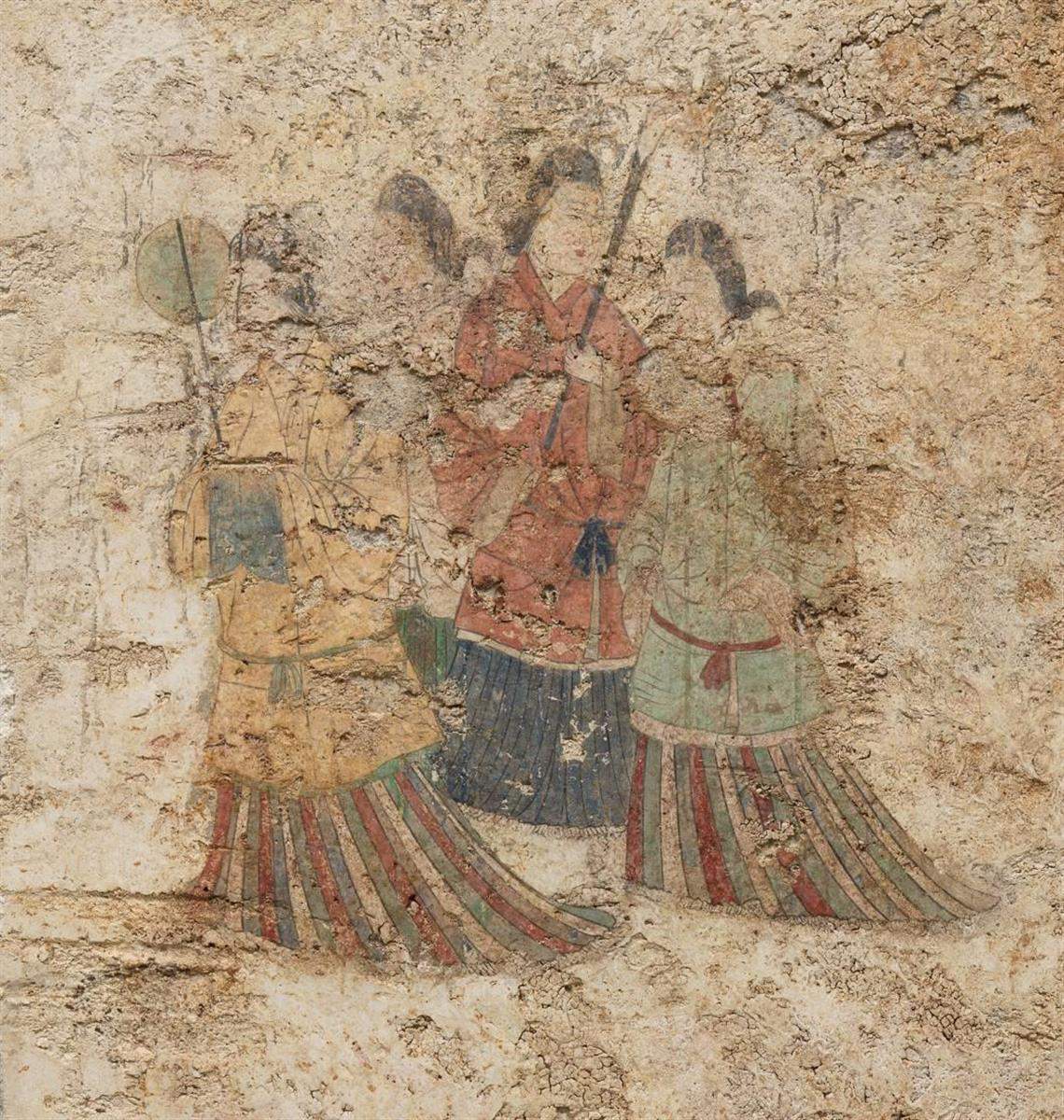
The islands that had everything except a state
In the summer of 701, at the palace of Fujiwara-kyō in the Yamato basin, a commission led by Prince Osakabe and Fujiwara no Fuhito completed a document in seventeen volumes: six of ritsu, penal law, and eleven of ryō, administrative law 1. It was called the Taihō Code after the reign era its promulgation inaugurated, and it was very close to a translation. Its model was the Yonghui code issued by the Tang emperor Gaozong in 651, and where it departed from that model it departed on purpose 14. Within a decade the court would abandon Fujiwara-kyō and build a capital on the plan of Chang'an. Within forty years the state the code created would count its own dead in a pandemic. Within eighty it would be at war in the northeast for four decades.
None of that apparatus existed a century earlier. What existed in the Yamato basin in the year 600 was a paramount chieftaincy of considerable wealth and no bureaucracy — a court that could raise armies, build tombs the size of small hills, and command tribute across western Honshū, but that had no written law, no household register, no salaried officials, no capital city, no calendar of its own, and no vocabulary in which to describe what it was 1.
Rule by name
Authority in the pre-code archipelago ran through the uji and the kabane: descent groups and the hereditary titles the paramount court granted them. An uji was a corporate lineage with its own ancestral kami, its own lands and its own dependent labour groups, the be. A kabane — omi, muraji, kimi, atae — was a rank in a system of names, and it was inherited 1. Office was not a post one held; it was a thing one's family was.
This produced a state of a recognisable kind, and it should not be patronised. The Yamato court of the sixth century administered irrigation, ran mines, moved corvée labour and conducted diplomacy on the Korean peninsula. But its instruments were kinship and gift, not registration and salary. It could not tell you how many people lived in Kibi. It did not need to. When the Chinese chroniclers of the Sui and Tang wrote about the islands they wrote about a country called Wa, 倭, a character whose readings run to "submissive," "bent," and "dwarf" — and the court in Yamato used it of itself, because nobody had yet decided it was worth objecting to 4.
What had already crossed, and by whose hand
The Tang were not the first continental teachers. For most of two centuries the transmission channel into the archipelago had run through the Korean peninsula, and above all through the kingdom of Baekje.
- Writing. Chinese script arrived with scribal lineages of peninsular origin — the Fumi and Fuhito families — and was in administrative use at the Yamato court well before any embassy sailed for Chang'an 1.
- Buddhism. A Baekje embassy presented an image of the Buddha, sūtra copies and a monk to the Yamato court in 552, or 538 depending on which chronicle one follows: the first recorded introduction of Buddhism to the Japanese elite 2.
- Craft. Horse gear, sueki stoneware, iron-working and sericulture came with immigrant artisan lineages, the tojin and kikajin, who were settled by the court and organised as be.
- The first direct embassies. The court sent envoys to the Sui in 600 and again in 607, the second carrying the letter that Chinese officials found insolent, addressed from the Son of Heaven where the sun rises to the Son of Heaven where the sun sets.
So the archipelago in 600 was not culturally isolated. It was politically unfinished. It had continental letters, continental religion and continental technique, arranged inside an institutional order that had none of the continental machinery for holding them together 15.
663: the year the project became urgent
Reform proposals had been circulating at the Yamato court since the Taika edicts of 645. What turned them into a construction programme was a military catastrophe.
In 660 the Tang and Silla destroyed the kingdom of Baekje, Yamato's ally and its principal channel to the continent. Yamato committed itself to the Baekje restoration and sent a fleet. In the eighth lunar month of 663, at the mouth of the Baengma River — Hakusukinoe in the Japanese sources, Baekgang in the Korean — a Japanese armada was annihilated by a Tang and Silla force over two days of fighting. The Nihon shoki reports four hundred ships burned 15. It was the worst defeat in the archipelago's recorded history to that point and it removed Yamato from the peninsula for nine hundred years.
The court then behaved exactly as a state expecting invasion behaves. In 664 it stationed sakimori, frontier guards, and signal-fire posts on Tsushima, Iki and Chikushi, and threw up the mizuki — a water fortress, an earthwork rampart and moat over a kilometre long — across the neck of the plain guarding what would become Dazaifu 815. Korean-style mountain castles went up on the approaches, built to peninsular designs by Baekje refugee engineers in Yamato service 8. One recent reassessment of the archaeology at Ōnojō argues that work there may have begun around 650, before the defeat rather than after it, which would make the fortification programme a response to the Tang–Silla destruction of Baekje rather than to the loss of the fleet 22. Either reading places the building where this record needs it: the archipelago fortifying itself against the continent in the same decade it began systematically importing the continent's institutions. In 667 the capital was moved inland to Ōtsu on Lake Biwa. In 668 Tenji promulgated the Ōmi Code, now lost.
This is the hinge of the whole record. The Japanese state adopted the Tang model because the Tang had just destroyed its fleet. The lesson the court drew from Baekgang was not that China was an enemy to be resisted but that China was a technology to be acquired — and the fastest route to acquiring it was to send embassies to the people who had just sunk four hundred of your ships. When Tenji died in 671 the succession dispute became the Jinshin War of 672, and its winner, Tenmu, spent his reign turning the emergency measures into permanent institutions: the Kiyomihara Code, the census, the chronicle projects, the first grid-plan capital. The Taihō Code of 701 is the settlement of a crisis that began at the mouth of a Korean river thirty-eight years earlier.
The thing that was missing
The gap is easier to see as a list of absences, because each of them is filled by a specific clause of the Taihō Code a hundred years later.
| What Yamato had in 600 | What it had by 720 |
|---|---|
| Hereditary kabane titles | A ladder of thirty court ranks with fixed stipends |
| Tribute in kind through uji heads | The so-yō-chō tax triad assessed on registered individuals |
| No fixed capital; the court moved at each succession | A permanent grid-plan capital at Heijō-kyō |
| Regional chieftains with their own land and labour | Sixty-six provinces and two islands under appointed governors |
| Oral genealogy kept by kataribe reciters | Two written court chronicles, Kojiki (712) and Nihon shoki (720) |
| Continental calendars used ad hoc | The Chinese calendar and the reign-era system as law |
| A paramount chief called ōkimi | A sovereign called tennō, Heavenly Sovereign |
Every row of that table is an import. The last one is the one that mattered most, and it is the one the court modified hardest.
Nineteen appointments, fourteen arrivals
On nineteen occasions between 630 and 894 the Japanese court appointed official envoys to the Tang court. Fourteen of those missions completed the round trip 2. They are known as the kentōshi, and Douglas Fuqua's summary of what they were for is exact: "The kentōshi missions were large, numbering up to six hundred individuals, and among their members were students and monks who restructured Japan's ancient state" 2.
The first sailed in 630 under Inugami no Mitasuki and the physician Kusushi Enichi 3. The last to sail left in 838. A mission was appointed in 894 and never went.
The ships
These were not trading voyages. They were state expeditions, provisioned and crewed at court expense, and by the eighth century the standard establishment was four ships carrying several hundred diplomats, students, monks, interpreters, physicians, painters, musicians and sailors 23. The ambassador received a ceremonial sword, the settō, as the physical token of his commission.
Two routes were used, and the change between them is the single most consequential technical fact in the record 310.
- The northern route, also called the Silla road, followed the west coast of Kyūshū and then the Korean coastline northward before crossing to the Shandong peninsula. It was slow, it kept land in sight, and it depended on the goodwill of the Korean kingdoms.
- The southern island route ran down the Ryūkyū chain and then west — longer, and more exposed.
- The southern route, adopted as relations with Silla deteriorated in the eighth century, ran from Hakata through Hirado and the Gotō islands and then straight across the open East China Sea toward the Yangzi. It was much faster. Crews on it, in Fuqua's phrase, "faced the greatest maritime challenges" 3.
The consequences are legible in the mission records. Of the four ships that sailed in 752, one was lost outright and the ambassador's own vessel never returned to Japan 3. Of the four that sailed in 804, the third was wrecked at Hirado. Of the four that sailed in 838, the third was wrecked with about one hundred and forty people aboard 3. The court knew the odds. It kept appointing missions for two hundred and sixty years.
702: the year the country named itself
The eighth mission left Hakata in the sixth month of 702 under Awata no Mahito, the first embassy dispatched in more than thirty years 3. It reached the court of Wu Zetian, then reigning as emperor of her own Zhou dynasty, and it did something no previous Japanese embassy had done. It asked the Chinese court to stop writing the country as 倭, Wa, and to write it instead as 日本 — Nihon, sun-origin 4.
The request is recorded on the Chinese side, in the treatise on the eastern peoples in the Old Book of Tang 18. It is a small diplomatic act and an enormous political one. A polity that asks to be renamed in another empire's records has understood that it exists in those records — that there is an international order of states with a documentary layer, and that one's position in it is something one can argue about. The Taihō Code had been promulgated the previous year. The name went out with the first embassy that carried the code's state into the world.
It is worth being precise about the asymmetry here. The Tang court did not regard this as an exchange between equals; Japanese envoys were received within a tributary protocol, and the ranking disputes that recur in the mission records — where the Japanese delegation was seated, relative to Silla — are disputes inside somebody else's ceremony 4. What Japan was doing was using that ceremony to accumulate the things a state needs, and simultaneously refusing the theory of subordination the ceremony encoded.

The people who stayed
The missions transmitted institutions because they transmitted people, and some of those people spent their entire adult lives inside the transmission.
- Abe no Nakamaro (c. 698–770) sailed as a student in 717, passed the Tang civil-service examinations, entered Tang service and eventually held the post of protector-general of Annam. He attempted to return with the mission of 753; the ship was blown off course and wrecked on the coast of Annam. He never got home, resumed his Chinese career under the name Chao Heng, kept the company of Wang Wei and Li Bai, and died in China in 770 4.
- Kibi no Makibi (695–775) went out on the same 717 mission, came home in 735 after seventeen years, went back in 752 as vice-ambassador, and ended as Minister of the Right — one of very few men of modest birth to reach the top of the code's own hierarchy 14.
- Kūkai and Saichō both sailed with the four ships of 804, and founded on what they studied in China the Shingon and Tendai schools, which between them organised Japanese Buddhism for the next four hundred years 2.
- Ennin sailed with the last mission in 838 and stayed nine and a half years, keeping a day-by-day diary of Tang officialdom, monasteries, festivals and the Huichang persecution of Buddhism — the earliest sustained foreign eyewitness account of Chinese daily life that survives 1617.
What else came in the holds
Goods travelled too, and the distinction between diplomatic gift, official purchase and private venture on the part of individual mission members is not always drawable — Charlotte von Verschuer's reconstruction of the trade traces all three running simultaneously through the same hulls 12. Outbound the ships carried silver, silk floss, amber, agate and camellia oil. Inbound they carried books above all, and then medicines, musical instruments, mirrors, glass, ceramics, dyestuffs, sutras and Buddhist images 2312.
Some of it survives. The Shōsōin repository at Tōdai-ji, sealed in 756 with the effects of the deceased Emperor Shōmu, still holds Tang lacquer, Persian-form glass, a five-stringed lute of a type otherwise extinct, and Central Asian textiles that reached Nara down the same channel. It is the only eighth-century imperial treasury on earth that has never been looted, and what it demonstrates is that the far end of the kentōshi route was not Chang'an but everything Chang'an was connected to.
This is the mechanism, and it is worth stating plainly because it is unusual. Most transmissions in this atlas move along trade routes or behind armies. This one moved because a state decided to spend money and lives sending its best young men to live in another civilisation for decades, on the explicit understanding that what they brought back would be used to rebuild the sending state from the inside.
What the code built and what it buried
Ritsu and ryō
The Taihō Code of 701 was the third attempt. The Ōmi Code attributed to 668 does not survive; the Asuka Kiyomihara Code was compiled under Tenmu and put into effect under Jitō in 689 1. Taihō was the version that held, and the Yōrō Code compiled in 718 and finally promulgated in 757 was a revision of it rather than a replacement.
What it established, in the architecture Tang administration supplied:
- A Council of State, the Daijōkan, with a chancellor, ministers of the left and right, and eight ministries beneath them — Centre, Ceremonial, Civil Administration, Popular Affairs, War, Justice, Treasury, Imperial Household.
- A Council of Kami Affairs, the Jingikan, ranked alongside the Council of State and responsible for the shrine calendar. This one had no Tang counterpart at all. It is the Japanese court fitting its own ancestral cult into an imported chassis, at the top.
- Provinces and districts: the archipelago cut into kuni under governors appointed from the capital and gun under district chiefs drawn from local gentry, stabilising at sixty-six provinces and two islands.
- A court-rank ladder of thirty grades, each carrying stipend land, stipend households and sumptuary entitlements.
- A state university, the Daigakuryō, in the capital, with provincial schools beneath it, teaching the Confucian classics to the sons of officials 1.
By 833 the code was so central that the court issued an official commentary on it, the Ryō no gige, to settle disputes about what its clauses meant 6. Law had become the medium in which the Japanese state argued with itself.
The two parts they left out
Two components of the Tang system were examined and refused, and the refusals are the record's spine.
The examination. The Daigakuryō taught the classics and administered examinations, but the route into office ran elsewhere. Under the shen'i or "shadow rank" provision, sons of fifth-rank and higher nobles received a starting court rank automatically on reaching adulthood — high enough that the examination track could not compete with it 1. In Tang China the examination was a real, if partial, solvent of hereditary power. In Japan it was a course of study attached to a career ladder that birth had already climbed.
The Mandate of Heaven. The Chinese theory held that Heaven conferred the right to rule on a dynasty and could withdraw it for misgovernment; a successful rebellion was, by definition, evidence of withdrawal. The Japanese court took the title tennō, took the Chinese cosmological vocabulary, took the reign-era system — and did not take the Mandate. Sovereignty rested on unbroken descent from the sun kami, which is a claim no defeat can falsify 14.
Between them these two edits determined a thousand years of Japanese politics. Because the throne could not be lost by losing, actual power could be exercised in its name indefinitely by whoever held it — Fujiwara regents, retired sovereigns, shōguns, imperial loyalists in 1868 — without anyone needing to depose anybody. And because office was hereditary, the aristocratic families the code was supposed to subordinate ended up owning the machine that was built to contain them.
The grid
The imported state needed an imported capital, and the sequence is rapid.
| Capital | Founded | Note |
|---|---|---|
| Fujiwara-kyō | 694 | First grid-plan capital; the Taihō Code promulgated here in 701 |
| Heijō-kyō (Nara) | 710 | Laid out on the plan of Chang'an; palace at the north, Suzaku Avenue on the axis |
| Nagaoka-kyō | 784 | Abandoned after ten years |
| Heian-kyō (Kyoto) | 794 | The same plan again; the street grid is still in use |
Heijō-kyō reproduced Chang'an's north–south axis, its palace enclosure at the head of the grid, its division into left and right capitals, and its named avenues 1. It did not reproduce Chang'an's wall. A Chinese capital was a fortress containing a population; the Japanese version was a ceremonial diagram containing a court, in a country with no land frontier and no steppe cavalry to keep out. The copy was selective at the level of the city plan exactly as it was at the level of constitutional theory.
The register and the rice field
Underneath the ceremony was an accounting system, and it was the most demanding thing the code imported.
- Household registers were to be compiled every six years, listing every person by name, age, sex and relationship to the household head. Eighth-century examples survive in the Shōsōin repository at Tōdai-ji.
- Land allotment, handen shūju, distributed rice land from the state's stock on the same six-year cycle: two tan for an adult male, two-thirds of that for an adult female, reverting to the state at death.
- Tax came in three parts. So, a grain levy on the allotted field. Chō, a levy of local products — textiles, salt, iron, marine goods — carried to the capital. Yō, corvée labour, commutable into cloth.
- Conscription took roughly one adult male in three or four from each household for provincial militia service, with a portion sent as sakimori, frontier guards, to garrison Kyūshū.
This was rule of a kind the archipelago had never experienced. The state now knew names. It is worth pausing on how much that changes: a chieftain can demand tribute from a district, but only a register can find a specific man in a specific village and require him personally to go and stand on a wall two months' walk from his family.
The conscript army is the clearest case of an import that did not take. The Tang fubing militia model, transplanted as the provincial gundan, assumed a registered peasantry that could be rotated through training and left productive in between. Karl Friday's study of the system finds it chronically under-strength, poorly equipped and militarily unimpressive from early on 7. In 792 Emperor Kanmu abolished the provincial conscript regiments across most of the country and replaced them with the kondei — small units of picked men drawn from district-official families who could already ride and shoot 7. That is a state giving up on a mass army of registered subjects and contracting its violence out to armed provincial gentry instead. The line from that decision to the warrior houses of the tenth century, and from them to everything after, is direct. The imported machine broke in exactly the place where it required the state to know and command ordinary people, and the aristocratic remedy became a new hereditary order.
What was buried
The code did not arrive into empty institutional space. It displaced things.
- The uji–kabane order was not abolished but hollowed: hereditary lineage titles were mapped onto the new court-rank ladder, which meant the great houses survived and the small ones lost their standing footing.
- Regional chieftaincy lost its independent land base as provinces were carved across older territorial units and governors were sent out from the capital on fixed terms.
- The be system of hereditary occupational labour groups attached to lineages was dissolved into a population of registered, individually taxed cultivators.
- Oral genealogy kept by kataribe reciters was superseded by written chronicle. The Kojiki (712) and Nihon shoki (720) did not merely record the past; they fixed one version of it and made the others unciteable.
- Female rulership contracted. The seventh and eighth centuries had reigning empresses — Suiko, Kōgyoku-Saimei, Jitō, Genmei, Genshō, Kōken-Shōtoku. Joan Piggott has traced how the last of them, Kōken-Shōtoku, held her throne partly by appropriating a Confucian language of filial virtue 13. After her death in 770 no woman reigned in Japan for eight hundred and fifty-nine years, until Meishō in 1629. The Chinese-derived patrilineal succession norms embedded in the code are not a sufficient explanation for that gap, and Piggott does not offer them as one — the Dōkyō affair and Fujiwara marriage politics do their own work. But the code supplied the vocabulary in which the exclusion could be argued for.
The bill
The sea
The first line of the account is the plainest. The crossing killed people, the court knew it, and it kept sending them.
The southern route that made the missions faster made them lethal: an open-water passage of the East China Sea in vessels that were, as Fuqua's survey of the archaeology and the ship types establishes, coastal composite craft pressed into blue-water work 3. The loss of the third ship of the 838 mission with roughly a hundred and forty people aboard is a single line in a mission table 3. It is also more people than were living at L'Anse aux Meadows and Brattahlíð combined.
Then there are the people the crossing simply kept. Abe no Nakamaro spent fifty-three years in China, was wrecked in 753 within reach of home, and died in Chang'an in 770 4. His poem on seeing the moon rise and thinking of the hills of Mount Mikasa at Kasuga — written, by tradition, on the eve of the voyage that failed — is in every Japanese anthology, which is a way of saying that the culture kept the cost in its literature and read it as beauty.
The gateway and the plague
In the eighth month of 735 smallpox appeared at Dazaifu, the government seat in northern Kyūshū, brought — the Shoku Nihongi records — by a Japanese fisherman who had been shipwrecked on the Korean peninsula and returned infected 514. Dazaifu was not a random landfall. It was the state's single authorised gateway, the place the code required foreign arrivals to be processed, with the Kōrokan guest-house beside it and the road system running from it to the capital 8.
By 736 the tenants of northern Kyūshū were dying or abandoning their fields, and officials returning from Dazaifu carried the disease east along the state's own roads. In 737 it reached Heijō-kyō. In the eighth month of that year the court granted a nationwide tax remission 514.
Smallpox is a disease of density and traffic. It has no animal reservoir and no long latency; it burns through a susceptible population and then dies out for want of new hosts, which is why in island populations below a threshold size it arrives from outside, kills catastrophically, and disappears for a generation 2021. Eighth-century Japan was, on Farris's reconstruction, exactly at the wrong size — populous enough to sustain a devastating outbreak, not yet populous or connected enough for the disease to become endemic and be met, as it later was, in childhood 521.
William Wayne Farris's demographic reconstruction puts adult mortality across the 735–737 epidemic at twenty-five to thirty-five per cent of the entire population — on the order of one to one and a half million people — with some districts far higher 5. In a single year the four Fujiwara brothers who had run the government since their father Fuhito's death — Muchimaro, Fusasaki, Umakai and Maro — all died of it, and the court's political structure had to be reassembled around Tachibana no Moroe 514.
The atlas will not claim the ritsuryō state imported the virus. It did not. What it did was build the conditions that turned a Kyūshū outbreak into a national catastrophe: one authorised port, a road network converging on a single capital, a corvée and tax system that moved provincials to the centre and officials to the provinces on schedule, and a registered population dense enough on allotted land to burn. And it is the state's own chronicle — a Chinese-form dynastic history written because the code required the court to keep one — that lets us count the dead at all.

The state's answer was more of the same. In 741 Emperor Shōmu ordered a provincial monastery and nunnery, kokubunji and kokubunniji, established in every province. In 743 he decreed a colossal bronze Vairocana. The Great Buddha at Tōdai-ji was consecrated in 752, in a ceremony attended by the sovereign, the retired sovereign, the reigning empress and the assembled court, with an Indian monk painting in the eyes 5. It was paid for in corvée and in metal, out of provinces that had just lost a quarter to a third of their people. It is one of the most beautiful objects ever made in Japan, and it is a mortuary monument to a state's own accounting.
The edge that a centre requires
Having learned from Chang'an how to have a centre, the court inherited the logic that goes with one.
At the time Heijō-kyō was founded in 710, Karl Friday notes, "the northeastern third of Honshū still lay beyond the pale of court control" — a region the court called michinoku, the deep interior, inhabited by people it called emishi 6. Two things followed from the imported model. A realm defined by a capital needs a boundary — Bruce Batten's study of premodern Japanese frontiers shows the court moving, across exactly these centuries, from a fuzzy zone of graded influence toward a hard administrative line it could name 9. And a court that has adopted the Chinese vocabulary of civilisation and barbarism has a ready-made description of whoever is outside it. The Tang wrote of the peoples on their peripheries as eastern, western, southern and northern barbarians; Japan had just spent a century being filed under "eastern barbarians" in Chinese records and had gone to some trouble over what it was called 18. It now had the same filing system, and someone had to go in the drawer.
The instrument was not initially the army. It was the ki, the stockade: fortified administrative posts, first in Echigo in 647 and 648 and then across Dewa and Mutsu, around which the government settled transplanted Japanese households from the eastern provinces. "The stockade system," Friday writes, "represented an armed, but mostly nonbelligerent, diffusion of imperial subjects and authority into the northeast" 6. Running the other way was deportation: Emishi who came to terms were classed fushu, "surrendered barbarians," and resettled into interior provinces to break their territorial base. The Shoku Nihongi entry for the intercalary first month of 725 records seven hundred and eighty-two fushu moved from Mutsu to Iyo, Izumi and elsewhere; over the following century they were placed in virtually every province in Japan 614.
Then came the war. From 774 to 811 the court mounted at least ten expeditions north 6. The worst of them is documented in the state's own numbers. In 789 the field marshal Ki no Kosami advanced with a force his own dispatches put at "52,800 or more infantry and cavalry," divided into three armies on the Koromo River. Detachments crossed, attacked the home of the Emishi leader Aterui, met three hundred Emishi fighters, and burned some eight hundred houses in fourteen villages. Then the Emishi counter-attacked and drove them back into the river. Five officers and twenty-five other troops were killed, two hundred and forty-five wounded, and one thousand and thirty-six men drowned trying to cross; another twelve hundred and fifty got out only by throwing away their weapons and armour 6.
What makes this the atlas's kind of evidence is that the court did the arithmetic itself. Emperor Kanmu's edict of the seventh month of 789 replies to Kosami's victory report:
"We calculate the number of rebel heads taken at 189 and the losses by death to the government army at more than a thousand, with the number of injured at nearly 2,000. Enemy heads taken are not even 200 but government losses are nearly 3,000! On the basis of this, what is there to be joyous about? ... The drowned army was thrown away, yet you do not speak of this." 614
The war continued for another twenty-two years anyway. In the fourth month of 802 Aterui and a second leader, More, surrendered to Sakanoue no Tamuramaro with more than five hundred followers. They were taken to the capital in the seventh month. They were executed at Moriyama in Kawachi province, over Tamuramaro's recorded objection, in the eighth month 6. In 811 the court declared the northeast pacified and retired the title sei-i taishōgun — barbarian-subduing generalissimo — which would be taken out of storage three hundred and eighty-one years later and used to name the government of Japan for the next seven centuries.
Friday's assessment of what all this achieved is deflationary and worth quoting: "despite their prominent place in the court's historiography, the wars themselves accomplished little" 6. Where court control did deepen in the northeast, it deepened through the stockades and the settlement programme, not the campaigns.
One caution belongs here explicitly. Whether the Emishi were ancestral to the modern Ainu is a question that has been argued since at least the Edo period and is not settled. Friday sets out the evidence for the identification — Ainu-derived place names across northern Honshū, the same orthography used for emishi and the later ezo, artefact continuities between northernmost Honshū and Hokkaidō — without endorsing it, and other scholars read emishi as a political category the court applied to anyone outside its administration rather than an ethnic one 611. The atlas takes no position. The cost is rated on what the sources record being done to the Emishi, which does not depend on the answer.
The people the code was written on
The heaviest and least visible part of the bill fell on the registered cultivators the whole system rested on.
Book 20 of the Man'yōshū preserves about a hundred sakimori no uta — poems by conscripted frontier guards from the eastern provinces, marched to Naniwa, shipped to Dazaifu and posted to the Kyūshū coast, collected by Ōtomo no Yakamochi when he was in the ministry that administered them. They are about children clinging to a father's robe and about parents left behind. They are the only surviving voice of the population the code counted, and it is preserved because an aristocrat with a literary project happened to be their administrator.
The extraction was not sustainable and the state's own paperwork says so. Farris's reading of the eighth- and ninth-century edicts finds the court complaining continuously about cultivators absconding from allotted land — the officials sent to run handen shūju had neither the staff nor the standing to hold people in place or keep the records straight 5. Land drifted into tax-exempt estates held by temples and aristocratic houses. The last general land allotment on record was ordered in 902. By the middle of the tenth century the registered-cultivator system that the Taihō Code had imported wholesale from Tang practice had ceased to function, while the court ranks, the ministries and the ceremonial calendar it also imported went on operating for another eight hundred years.
That asymmetry is the honest summary of the transmission. The parts of the Tang state that served the aristocracy survived. The parts that constrained it did not.
894, and what the borrowing made possible
In 894 the court appointed Sugawara no Michizane — the most accomplished Chinese scholar of his generation — as ambassador to the Tang. He memorialised against his own appointment. The Tang were in collapse; Chang'an had been sacked in the Huang Chao rebellion a decade earlier; the crossing was lethal; and, as Fuqua argues, private merchants were by then bringing to Japan most of what the embassies had gone for 219. The mission was cancelled. No further embassy was appointed. The Tang fell in 907.
What followed is the part usually told as a story of independence: the tenth and eleventh centuries produce the Kokin wakashū (905), Ki no Tsurayuki's Tosa nikki (935), Sei Shōnagon, and Murasaki Shikibu's Genji monogatari around 1008 — the kokufū, the "national style," written in a phonetic script derived from cursive Chinese characters. It is genuinely a break, and it is worth saying clearly what it was a break from and what it rested on.
It rested on two hundred and sixty years of state-funded Chinese literacy. Kana is Chinese characters used for sound. The court that read Genji dated its letters by Chinese reign eras, held office under a Chinese-derived rank system, and lived in a city laid out on a Chinese plan. The national style was not the alternative to the borrowing. It was what a culture does once it has absorbed a borrowing so completely that it can stop paying attention to it.
The bill for that condition was paid between 630 and 894, in ships lost on the East China Sea, in a pandemic that a centralised state amplified and then counted, in four decades of war against a people the imported vocabulary had made into barbarians, and in the labour of registered cultivators who left about a hundred poems and no other trace.
What followed
-
663A Japanese and Baekje-restoration fleet is destroyed by Tang and Silla forces at Baekgang; the Nihon shoki reports four hundred ships burned. Yamato withdraws from the Korean peninsula for nine centuries and begins building a continental-style state out of fear of invasion.
-
664Frontier guards, signal-fire posts and the mizuki earthwork rampart go up around what becomes Dazaifu, together with Korean-style mountain castles along the Inland Sea built by Baekje refugee engineers — the first fortified frontier the archipelago has ever had.
-
701The Taihō Code is promulgated at Fujiwara-kyō in seventeen volumes — six of penal law, eleven of administrative law — modelled on the Tang Yonghui code of 651, establishing a Council of State, eight ministries, provinces under appointed governors, and thirty grades of court rank.
-
702Awata no Mahito's embassy asks the Tang court to stop writing the country as Wa (倭) and to write it as Nihon (日本); the request is recorded in the Old Book of Tang. The state that had just given itself a constitution gives itself a name.
-
710Heijō-kyō is founded at Nara on the plan of Chang'an — palace enclosure at the north, Suzaku Avenue on the axis, left and right capitals — but without Chang'an's city wall. The grid is repeated at Nagaoka in 784 and at Heian-kyō in 794, where it is still in use.
-
702Household registers, six-yearly land allotment under handen shūju, and the so-yō-chō tax triad make the individual cultivator, rather than the lineage, the unit the state taxes and conscripts. Eighth-century registers survive in the Shōsōin repository.
-
735Smallpox enters at Dazaifu, the state's single authorised gateway, and travels the state's own roads to the capital. Farris estimates one to one and a half million dead by 738 — twenty-five to thirty-five per cent of the population. All four Fujiwara brothers governing the country die in 737.
-
752Emperor Shōmu orders a provincial monastery and nunnery in every province (741) and a colossal bronze Vairocana (743); the Great Buddha of Tōdai-ji is consecrated in 752, paid for in corvée and metal levied on provinces that had just lost a third of their people.
-
789The court begins four decades of subjugation campaigns against the Emishi of the northeast — at least ten expeditions between 774 and 811. In 789 Ki no Kosami's army is broken at the Koromo River: 1,036 men drowned in the retreat, against 189 Emishi heads taken.
-
802Aterui and More surrender to Sakanoue no Tamuramaro with more than five hundred followers, are taken to the capital, and are executed at Moriyama in Kawachi over Tamuramaro's objection. In 811 the court declares the northeast pacified and shelves the title sei-i taishōgun.
-
792Emperor Kanmu abolishes the Tang-modelled provincial conscript regiments across most of the country and replaces them with kondei units drawn from district-official families — the state contracting its violence out to armed provincial gentry, and the institutional seed of the warrior houses.
-
894Sugawara no Michizane, appointed ambassador, memorialises against his own mission: the Tang are collapsing, the crossing is lethal, and private merchants now bring what the embassies went for. The mission is cancelled, no further embassy is appointed, and the Tang fall thirteen years later.
Where this lives today
References
- Piggott, Joan R. The Emergence of Japanese Kingship. Stanford: Stanford University Press, 1997. en
- Fuqua, Douglas. "The Japanese Missions to Tang China, 7th–9th Centuries." About Japan: A Teacher's Resource. New York: Japan Society. en
- Fuqua, Douglas Sherwin. "The Japanese Missions to Tang China and Maritime Exchange in East Asia, 7th–9th Centuries." PhD dissertation, University of Hawai'i at Mānoa, 2004. en
- Wang Zhenping. Ambassadors from the Islands of Immortals: China–Japan Relations in the Han–Tang Period. Honolulu: Association for Asian Studies and University of Hawai'i Press, 2005. en
- Farris, William Wayne. Population, Disease, and Land in Early Japan, 645–900. Cambridge, MA: Council on East Asian Studies, Harvard University, and Harvard-Yenching Institute, 1985. en
- Friday, Karl F. "Pushing beyond the Pale: The Yamato Conquest of the Emishi and Northern Japan." Journal of Japanese Studies 23, no. 1 (Winter 1997): 1–24. en
- Friday, Karl F. Hired Swords: The Rise of Private Warrior Power in Early Japan. Stanford: Stanford University Press, 1992. en
- Batten, Bruce L. Gateway to Japan: Hakata in War and Peace, 500–1300. Honolulu: University of Hawai'i Press, 2006. en
- Batten, Bruce L. To the Ends of Japan: Premodern Frontiers, Boundaries, and Interactions. Honolulu: University of Hawai'i Press, 2003. en
- 東野治之『遣唐使』岩波新書 新赤版1104。東京:岩波書店、2007年。 ja
- 高橋富雄『蝦夷』東京:吉川弘文館、1963年。 ja
- Von Verschuer, Charlotte. Le commerce extérieur du Japon des origines au XVIe siècle. Bibliothèque des Hautes Études Japonaises. Paris: Maisonneuve & Larose, 1988. fr
- Piggott, Joan R. "The Last Classical Female Sovereign: Kōken-Shōtoku Tennō." In Dorothy Ko, JaHyun Kim Haboush and Joan R. Piggott, eds., Women and Confucian Cultures in Premodern China, Korea, and Japan. Berkeley: University of California Press, 2003. en
- Snellen, J. B., trans. "Shoku Nihongi: Chronicles of Japan, Continued, from 697–791 A.D." Transactions of the Asiatic Society of Japan, 2nd ser., 11 (1934): 151–239, and 14 (1937): 209–278. en primary
- Aston, W. G., trans. Nihongi: Chronicles of Japan from the Earliest Times to A.D. 697. London: Kegan Paul, Trench, Trübner, 1896. en primary
- Ennin. Ennin's Diary: The Record of a Pilgrimage to China in Search of the Law. Translated by Edwin O. Reischauer. New York: Ronald Press, 1955. en primary
- Reischauer, Edwin O. Ennin's Travels in T'ang China. New York: Ronald Press, 1955. en
- 『旧唐書』巻一九九上、東夷伝・日本国条。後晉・劉昫等撰、945年。 zh primary
- Borgen, Robert. Sugawara no Michizane and the Early Heian Court. Cambridge, MA: Council on East Asian Studies, Harvard University, 1986. en
- Hopkins, Donald R. The Greatest Killer: Smallpox in History. Chicago: University of Chicago Press, 2002. en
- Suzuki, Akihito. "Smallpox and the Epidemiological Heritage of Modern Japan: Towards a Total History." Medical History 55, no. 3 (2011): 313–318. en
- "Japan's construction of defensive fortifications and its implications for East Asian relations during the Tang dynasty." Humanities and Social Sciences Communications 11, article 696 (2024). en