Tea reached the steppe by 781 — and became China's price for a horse
Chan monks carried tea to north China in the 710s; within a generation Uighur envoys were driving horses to court to buy it, and a Tibetan king was showing a Tang envoy six Chinese teas he already owned. Three dynasties then turned a loved habit into a lever of frontier control.
Around 781 a Tang envoy boiled tea in the Tibetan camp and was shown six Chinese teas the king already owned. By 1074 the Song was trading Sichuan tea for Tibetan horses — a loved drink made a lever of control.

Before: a diet of meat, milk and roasted grain
In the middle of the eighth century the peoples who herded yak on the Tibetan plateau and horses, sheep and camels on the Mongolian steppe did not drink tea. Their diet was built from what their animals gave them. Meat, fresh and dried. Milk in every state it could be brought to: fresh, soured, fermented, churned into butter, pressed and dried into cheese hard enough to carry for weeks. On the plateau, barley roasted and ground into the flour Tibetans call tsampa, eaten by kneading it with liquid in the bowl. On the steppe, millet where it could be traded for, and little else that grew from the ground.123 The Uighur khaganate, which had taken the Mongolian steppe in 744, and the Tibetan empire of the btsan po were the two great powers on the western and northern edges of the Chinese world. Both were horse powers. Both fed their armies and their herds from the same pastoral economy, and neither produced anything that could be boiled into the drink that was then, just then, becoming a craze in the Chinese cities to their east.45
That economy was not deficient, and the record begins by saying so. A diet of meat, milk fat and roasted grain can carry a population through winters at four thousand metres and through a campaign season on the steppe; it had done so for more than a thousand years before tea arrived. What it lacked was variety of plant matter. Fresh vegetables were rare on the plateau and rarer on the steppe, and the one cultivated crop, barley, was eaten roasted. The later Chinese claim that without tea the pastoral peoples fell ill — the premise of a whole frontier policy — describes a gap that the pastoral kitchen had lived with for centuries, not a hunger it had failed to notice; the modern nutritional literature explains why tea, once adopted, filled it so well.16
What the pastoral kitchen held
The pastoral economies of the plateau and the steppe varied by altitude and by animal, but the elements that recur across the sources are few and stable:
- Meat, from sheep, goats, yak and cattle, eaten fresh in the slaughter season and dried or frozen for the rest of the year.
- Milk and its products: fresh milk, soured milk and yoghurt, fermented mare's milk on the steppe, butter churned from yak and cow milk on the plateau, and dried cheese.
- Roasted grain: barley on the plateau, eaten as tsampa; millet and oats on the steppe, obtained largely by trade with farming neighbours.2
- Salt, collected from the lake basins of the plateau and the steppe and carried as a trade good.2
- Almost no cultivated greens, and no hot infused drink comparable to tea.
The Chinese sources that describe this diet do so from outside and with a purpose, and should be read as such. The Ming shi explains the entire frontier tea policy in one sentence that begins with the pastoral kitchen: "The Fan relish milk and cheese" (番人嗜乳酪).1 It is the premise of an argument about control, and the record returns to it. But the premise itself is accurate. The receiving world was a world of dairy.
What tea had been in China before it travelled
On the Chinese side, tea was not ancient as a mass habit. It had been drunk in the south for centuries, in Sichuan and along the Yangzi, as a medicine, a monastic stimulant and a regional drink. North China, where the capitals were, did not take it up until the eighth century. Feng Yan, a Tang official writing in the later decades of that century, is explicit: "Southerners liked to drink it; northerners at first did not drink much" (南人好飲之,北人初不多飲).4
The Tang drink was not the steeped leaf of later centuries. Leaves were steamed, pounded and pressed into cakes; the cake was toasted, ground to powder in a metal or stone mill, and the powder boiled in a cauldron, often with salt. Lu Yu's Classic of Tea (Chajing), completed between the 760s and 780, codified the method and the equipment, and Feng Yan credits Lu Yu's writing with turning the drink into a fashion: "and so the way of tea spread widely; of princes, dukes and court officials, there were none who did not drink it" (於是茶道大行,王公朝士無不飲者).47 This was the drink that crossed the frontier: pressed, portable, boiled, and salted — a form that fitted a herder's cauldron far better than a later scholar's teapot would have.7

The transmission: monks, envoys and a tent in the Tibetan camp
Chan monks and the Kaiyuan fashion, 713–741
The route by which tea reached the frontier ran first through north China itself, and the vector was Buddhist. Feng Yan names the moment and the man. In the Kaiyuan era (713–741), a Chan master called Xiangmo, teaching at Lingyan Monastery on Mount Tai in Shandong, allowed his students to drink tea, because the practice of Chan required them not to sleep and not to eat in the evening. His students carried tea with them and boiled it wherever they went; others imitated them, "and from this it became a custom."4
The passage then traces the spread with a precision unusual for the period:
起自鄒、齊、滄、棣,漸至京邑。城市多開店舖,煎茶賣之,不問道俗,投錢取飲。其茶自江、淮而來,舟車相繼,所在山積,色類甚多。
"It started in Zou, Qi, Cang and Di, and gradually reached the capital. In the cities many shops opened, boiling tea and selling it; whether monk or layman, one put down coins and took a drink. The tea came from the Jiang and Huai regions, boat after cart, piled up like mountains wherever it arrived, in a great many colours and kinds."4
James Benn's history of tea in China makes the Buddhist connection structural rather than anecdotal: monks had long drunk tea in the south, but it was the itinerant Chan monastics of the eighth century, together with Lu Yu's codification, that turned tea into a culture shared across the empire and carried it beyond it.7 The frontier learned of tea from a China that had itself learned to drink it only a generation before.
"It began in the central lands and flowed beyond the passes"
Feng Yan's next sentences are the earliest statement in any language that tea had crossed to the pastoral peoples, and the earliest evidence of the exchange that would define the next thousand years:
始自中地,流於塞外。往年回鶻入朝,大驅名馬市茶而歸,亦足怪焉。
"It began in the central lands and flowed beyond the passes. In past years, when the Uighurs came to court, they drove great herds of fine horses to buy tea and went home — this too is remarkable."4
Three things in this passage matter. First, the direction: Feng Yan understood tea to have moved outward, from the Chinese interior to the steppe, which is what the rest of the evidence confirms. Second, the medium: horses. The Uighurs, the Tang dynasty's indispensable and resented allies after they helped suppress the An Lushan rebellion (755–763), were already selling horses to the court in large numbers; tea joined silk as something those horses bought. Third, Feng Yan's tone. He found it strange — 亦足怪焉. A Chinese official in the 780s or 790s did not yet imagine that a drink could be a strategic commodity. Within three hundred years his successors would imagine little else. Feng Yan's "in past years" (往年) is undated, and no other Tang source fixes the first Uighur tea purchase; the record uses the passage for what it establishes, which is that by the last quarter of the eighth century the trade was established enough to be remembered.4
Chang Lu in the btsan po's tent, c. 781
The Tibetan evidence comes from a single anecdote, and it has become famous because it is so exact. Li Zhao's Supplement to the State History of the Tang (Tang guoshi bu), compiled in the early ninth century, records it:
常魯公使西蕃,烹茶帳中,贊普問曰:「此為何物?」魯公曰:「滌煩療渴,所謂茶也。」贊普曰:「我此亦有。」遂命出之,以指曰:「此壽州者,此舒州者,此顧渚者,此蘄門者,此昌明者,此湖者。」
"When Lord Chang Lu went as envoy to the Western Fan, he boiled tea in his tent. The btsan po asked: 'What is this?' Chang Lu said: 'It washes away vexation and cures thirst; it is called tea.' The btsan po said: 'We have this here too.' He had it brought out and pointed: 'This is from Shouzhou, this from Shuzhou, this from Guzhu, this from Qimen, this from Changming, and this from Hu.'"8
The Old Tang History (Jiu Tang shu) dates the embassy. Chang Lu was the administrative assistant (判官) to the envoy Cui Hanheng, and the history records their return from the Tibetan court in the second year of Jianzhong, 781; Chang Lu went on to attend the Qingshui covenant between Tang and Tibet in 783.5 The embassy therefore took place c. 780–781.
What the anecdote shows is not what it is often said to show. The btsan po was not being introduced to tea. He already owned it — six named varieties, from six different producing districts in the Yangzi basin and Sichuan, identified by origin like a connoisseur's cellar. Tea had reached the Tibetan court as a luxury, almost certainly through the same channels of tribute, gift and trade that carried silk. It is evidence of elite possession at the top of the Tibetan state. It is not evidence that ordinary Tibetans in 781 drank tea, and no Tang source says they did.85
Earlier traces: Gurgyam and the Tibetan tradition
Two other lines of evidence push tea on the plateau earlier, and both need careful handling.
The first is archaeological. In 2016 a team led by Lu Houyuan reported biomolecular traces of tea — caffeine, theanine and characteristic phytoliths — in material from the Gurgyam cemetery in Ngari, far western Tibet, dated to around 1,800 years before present. Their conclusion is stated in their own words: "The earliest physical evidence of tea from both the Chang'an and Ngari regions suggests that a branch of the Silk Road across the Tibetan Plateau, was established by the second to third century CE."9 This is a single study, and what it shows is presence: tea, probably as a luxury, reaching a high-status burial on the far side of the plateau by about 200 CE. It says nothing about daily consumption.
The second is Tibetan historical tradition. The rGya bod yig tshang, a Tibetan chronicle compiled in 1434, places the first tea-drinking at the Tibetan court in the reign of the btsan po 'Dus srong (r. c. 676–704), in a story of an ailing king cured by leaves a bird brings him. Yang Fuquan, who cites it, renders the point as: "In the reign of the Tibetan King Chidusongzan (676–704), the Tibetan aristocracy started to drink tea and use the tea-bowl."10 A fifteenth-century origin story is evidence of how Tibetans later understood tea's arrival — as a royal gift and a medicine — rather than a record of the seventh century. Read together with Chang Lu's anecdote, it points the same way: tea entered the plateau at the top, as a precious thing, before it became anyone's daily bread.
What changed and what was replaced
From a luxury to a necessity
Between the eighth century and the eleventh, tea ceased to be a curiosity in the pastoral world and became a staple. The sources do not allow the transition to be dated precisely, and the record does not pretend otherwise. By the 1070s, however, a Song frontier commander could report as a matter of fact that the peoples of the northwest wanted tea above all things: "The Westerners have begun to bring good horses to the frontier; all they desire is tea" (西人頗以善馬至邊,所嗜唯茶).1112 Yang Fuquan describes the Song as the period in which "the demand for tea would have gradually increased as tea became an important drink in the daily life of the Tibetans."10
What the pastoral peoples made of it was their own. They did not adopt the Chinese literati drink, with its aesthetics of the tea bowl and the whisked froth. They took the coarsest, cheapest pressed tea — old leaves and stems compressed into bricks — and boiled it into the dairy kitchen. The French Lazarist missionary Évariste Huc, travelling through Mongol territory in 1844–1846, left the most exact description of the steppe method:
"Quand les Tartares veulent faire le thé, ils cassent un morceau de leur brique, le pulvérisent, et le font bouillir dans leur marmite, jusqu'à ce que l'eau devienne rougeâtre. Ils y jettent alors une poignée de sel, et l'ébullition recommence. Dès que le liquide est presque noir, on ajoute plein une écuelle de lait."
"When the Tartars want to make tea, they break off a piece of their brick, pulverise it, and boil it in their pot until the water turns reddish. Then they throw in a handful of salt, and the boiling starts again. As soon as the liquid is almost black, a bowlful of milk is added."2
On the plateau the same brick tea was boiled, strained, and churned with butter and salt in a tall wooden cylinder to make the drink Tibetans call po cha — butter tea — which was then drunk by itself or poured over tsampa in the bowl. When butter tea in this form first appeared is not established by any source this record has located, and the record does not date it.

The nutritional logic is real, and should be stated plainly because the cost section depends on not overstating the opposite case. A 2022 study of 5,014 Tibetan adults in Lhasa found that medium and high butter-tea intake was associated with lower odds of metabolic syndrome, and its authors describe the drink as one that "perfectly satisfies the high-energy needs of the human body in high altitudes as a staple of Tibetan cuisine."6 The habit was adopted willingly, it was loved, and it met needs. That is precisely what made it valuable to the states that controlled its supply.
What tea displaced, and what it added
The changes in the receiving kitchen and economy can be set out directly:
- A new daily staple. Tea, boiled with milk, butter and salt, became the base liquid of the pastoral day — drunk many times daily and, on the plateau, the medium in which tsampa was eaten. A Daofu survey in the 1990s recorded Tibetan adults drinking about three litres of milk-and-brick tea a day.3
- An import dependency. For the first time the pastoral kitchen rested on a food it could not produce. Tea grew only in the Chinese south and southwest.
- The displacement of plain liquids. Tea replaced water and plain milk as the everyday drink; the proverb recorded in Daofu — "Tibetans would rather have no food for three days than no tea for a day" — describes the result.3
- A new unit of value. Pressed brick tea, uniform, durable and universally wanted, became money on the steppe (see below).
- A new frontier geography. Horse markets, tea depots and customs posts — Qinzhou, Hezhou, Taozhou, Xining, Ya'an, Dartsedo, Kalgan, Kyakhta — became the hinges of the relationship between the pastoral world and the Chinese state.1111013
The state learns what the steppe wants: Tang taxes, 780s–793
The Tang state noticed tea as revenue before it noticed it as leverage. The Old Tang History's treatise on economy records that in the Jianzhong era the Vice-Director of Public Revenue, Zhao Zan, proposed taxing "bamboo, timber, tea and lacquer," and states flatly: "The taxing of tea began here" (茶之有稅,肇於此矣). The text places the proposal in the fourth year, 783.14 Ten years later, in the first month of Zhenyuan 9 (793), the salt-and-iron commissioner Zhang Pang instituted a regular tea tax of one-tenth, which brought in 400,000 strings of cash a year.14 Tea had become large enough in the Chinese economy to be worth taxing in exactly the decades in which the Uighurs were buying it with horses and the btsan po was collecting it by district. The next step — using the frontier's demand for tea as an instrument — was taken by the Song.
The Song Tea and Horse Agency, 1074
The Song dynasty was a horse-poor empire surrounded by horse-rich neighbours. The Khitan Liao held the northeastern pastures; the Tangut Xi Xia held the northwest corridor; after 1127 the Jurchen Jin held all of north China. Paul J. Smith's study of the period, Taxing Heaven's Storehouse (1991), is built on the consequence: a state that could not breed cavalry horses had to buy them, and the one reliable supplier left to it was the Tibetan tribes of the Gansu–Qinghai frontier, who wanted tea.12
In 1074, under Wang Anshi's New Policies, the court sent Li Qi, an official of the Finance Commission, "into Shu to plan the purchase of tea, to trade for horses at Qin-Feng and Xi-He" (遣三司幹當公事李杞入蜀經畫買茶,於秦鳳、熙河博馬).11 Out of that mission grew the Sichuan Tea Market Agency, later the Tea and Horse Agency: a state monopoly that bought Sichuan's tea, moved it north, and exchanged it for horses at a chain of frontier markets. The Song shi records the quota at the eight markets of Sichuan and Shaanxi as a little over 9,000 horses a year, raised to 12,994 from the Chunxi era (1174–1189) — and adds that "afterwards, purchases never once reached it" (自後所市未嘗及焉).11 Huang Chunyan's study of Song tea law treats the Sichuan tea regime as a distinct system within the Song fiscal state, with its own logic of purchase, transport and exchange.15
Smith's argument, set out below in the cost section, is that the agency worked — for a while — and that its success was the problem.
The Ming system: rates, tallies and a son-in-law
The Ming inherited the Song logic and made it explicit. The Ming shi's treatise on the tea laws opens its account of the frontier trade with the rationale in full:
番人嗜乳酪,不得茶,則困以病。故唐、宋以來,行以茶易馬法,用制羌、戎,而明制尤密。
"The Fan relish milk and cheese; without tea they fall ill. Therefore, since the Tang and Song, the method of exchanging tea for horses has been practised, as a means to control the Qiang and Rong; and the Ming system was especially strict."1
The phrase often quoted in modern Chinese writing as the policy's motto, yi cha yu fan (以茶馭番, "control the Fan with tea"), is a modern historiographical label; the classical wording is the Ming shi's 用制羌、戎, "as a means to control the Qiang and Rong."1 The substance is the same.
The Hongwu emperor (r. 1368–1398) fixed the rates: for a top-grade horse, 120 jin of tea; for a middle-grade horse, 70 jin; for a colt, 50 jin.1 He then bound the tribes to the system with golden tallies — 41 gilt plates inscribed "Imperial Decree" on the top, "Due for requisition" on the left, and "Those who do not keep faith shall be beheaded" (不信者斬) on the right. The tribes received the lower halves; the upper halves were kept in the palace, and every three years an official went out to match them. The tallies assigned quotas:1
| Frontier group (per Ming shi 80) | Tallies | Horses due |
|---|---|---|
| Taozhou: the 火把藏思囊日 and related tribes | 4 | 3,050 |
| Hezhou: Bili Guard, 29 Western Fan tribes | 21 | 7,705 |
| Xining: Quxian, Aduan, Handong and Anding Guards; Bawa, Shenzhong, Shenzang tribes | 16 | 3,050 |
| Total | 41 | 13,805 |
Liping Wang and Geng Tian, in the most detailed recent study of Ming horse procurement, describe the effect: "The Tibetan tribes admitted to trade horses for tea were granted golden plates as trading licenses. … Tea became the only legitimate currency to pay for the horses from the Tibetan tribes. The court counted on receiving approximately 13,800 horses a year from Tibetans."16 Their appendix, drawn from the Ming shilu, records what was actually exchanged in a series of years:16
| Year | Horses received | Tea paid |
|---|---|---|
| 1380 | 2,050 | 58,892 jin (and 98 cattle) |
| 1392 | 10,340 (Hezhou) | c. 300,000 jin |
| 1435 | c. 13,000 (Xining, Hezhou, Taozhou) | c. 1,097,000 jin |
| 1490 | 4,000 | c. 400,000 jin |
| 1508 | c. 9,000 | c. 782,000 jin |
The Ming system was also deliberately selective. Wang and Tian note that the court "reserved tea-horse exchange to Tibetans only, even though Mongols craved tea," and read the choice strategically: "No doubt the Ming politicians expected to use the tea-horse trade to cut off a potential Mongol-Tibetan link."16 Tea was not only the price of horses. It was a wedge between the two pastoral peoples the Ming most feared might combine. Morris Rossabi's classic 1970 article on the Ming tea-and-horse trade established the outlines of this system half a century earlier, and Wang and Tian's work builds on it.17 The tallies lapsed under the Yongle emperor and were reissued in 1435.1 In 1503 Yang Yiqing proposed a revived merchant-supplied system, estimating that 500,000–600,000 jin of tea a year would buy 10,000 horses; the emperor approved.1
The Qing wind-down and the brick-tea economy
The Qing, a dynasty that itself came from beyond the Great Wall and soon controlled the Mongolian pastures directly, needed the exchange less. The Qing shi gao records the early rates — twelve bi (篦, a standard package) of tea for a top horse, nine for a middle, seven for a low — then the abolition of the tea-and-horse censor in 1668, and in 1735 the line "again halted the Gansu horse exchange" (復停甘肅中馬).18 Lai Hui-min's 2024 study of the Gansu tea licences traces the sequence in detail: the trade restored in 1645, suspended in 1674 once the new Inner Mongolian state pastures could supply the army, ended again in 1735, and converted in 1736 to a silver levy, which, in her words, "meant that the tea-horse trade had been abandoned" (意謂茶馬貿易已停廢).19 Lai stresses that official tea kept a political function long after: gifts to the lamas of Xining and the Mongol princes of Qinghai, relief for displaced Mongols, trade with the Zunghars after the truce of 1739.19
The end of the official horse exchange was not the end of tea's hold on the pastoral economy. It was the start of tea's second life as a free commodity and a currency. Yang Fuquan records that in 1661 alone some 30,000 dan — about 1,500,000 kg — of Yunnan tea was sent to Tibet, and that the court allotted 5,000 jin a year to the Dalai Lama and 2,500 to the Panchen Lama.10 On the steppe, Huc found brick tea functioning as money outright. At the Great Kuren (Urga, today's Ulaanbaatar):
"Dans les opérations commerciales, les paiements s'effectuent toujours avec des thés en brique. Qu'on vende un cheval, un chameau, une maison, ou des marchandises de quelque nature que ce soit, la convention du prix se fait en thés. Cinq thés représentent une valeur d'une once d'argent."
"In commercial dealings, payments are always made in brick tea. Whether one sells a horse, a camel, a house, or goods of any kind whatever, the price is agreed in teas. Five teas represent the value of one ounce of silver."2
At Kyakhta, on the Russian border, Huc observed that Russian goods "are ordinarily paid for with brick tea."2 Michal Wanner's study of the Kyakhta trade shows that tea already made up 30 per cent of Chinese exports through the border post in the last quarter of the eighteenth century — "despite its price the tea was highly in demand" — and that the volume rose more than fourteen-fold between the first decade of the nineteenth century and the 1880s; the camel caravans from Kalgan to Urga to Kyakhta carried it across the same steppe on which the Uighurs had first driven horses to buy it.13
| Decade | Chinese tea through Kyakhta (thousand poods) |
|---|---|
| 1801–1810 | 75 |
| 1821–1830 | 143 |
| 1841–1850 | 294 |
| 1861–1870 | 405 |
| 1881–1890 | 1,077 |
The term by which this whole world is now marketed — the "Tea Horse Road," chama gudao (茶马古道) — is itself a modern coinage. Song Shilei has traced it to Mu Jihong and colleagues around 1990, overlaying the historical tea-horse exchange with a heritage and tourism framing.20 Yang Fuquan uses it for the Sichuan–Lhasa route, "some 2350 kilometers long, with fifty-six traveling stages," running from Ya'an through Luding, Kangding (Dartsedo), Batang and Chamdo.10
What the cost was
The transmission was not a conquest and killed no one in the act of borrowing. The bill came later, and it came from the moment a Chinese state understood that a drink the pastoral peoples had chosen could be made into a lever. It was paid in four places: in the tea gardens of Sichuan, on the backs of the porters who carried the bricks, at the execution grounds where smugglers died, and — a thousand years on — in the bones of the people who drink it.
The ruin of the Sichuan growers
Paul Smith's Taxing Heaven's Storehouse is the study of what the Song Tea and Horse Agency did to the region that grew the tea. Before 1074, tea was a prosperous smallholder industry in Sichuan. The agency, created to buy that tea for the horse trade, was highly autonomous and at first remarkably successful: it acquired the horses and turned a profit. But its officials were rewarded for revenue and punished for shortfall, and the agency turned them, in Smith's account, into entrepreneurs with the coercive power of the state behind them. It also turned the Sichuan elite, previously notorious for resisting the capital, into imperial servants eager to tax their own region.12
After the Jurchen conquest of north China in 1127 the markets changed, and the agency did not. Its demands continued while its horse supply shrank. By Smith's analysis it came to ruin the tea farmers it depended on, failed to meet its horse quotas, and ran a deficit — the "destruction of the Sichuan tea industry" in his subtitle. The Song shi's own admission that later purchases "never once reached" the quota of 12,994 horses is the official record of that failure.1112 The growers' cost, in Smith's reading, was paid in forced sales at fixed prices, in the loss of a free market for their crop, and in the long decline of a regional economy that had been one of the most commercialised in the empire.
The porters of the Ya'an road
The tea that reached Tibet from Sichuan did not travel by caravan for its first stage. It went on men's backs, from the tea country around Ya'an over the mountain passes to Dartsedo (Kangding), where it was repacked for yak and mule. In the summer of 1908 the plant collector Ernest Henry Wilson photographed two of these porters near the road and wrote beneath the print: "One man's load weighs 317 lbs. Avoird. the other's 298 lbs. Avoird.!! Men carry this Tea as far as Tachien-lu accomplishing about 6 miles per day over vile roads."21 That is about 144 and 135 kilograms, carried at six miles a day.
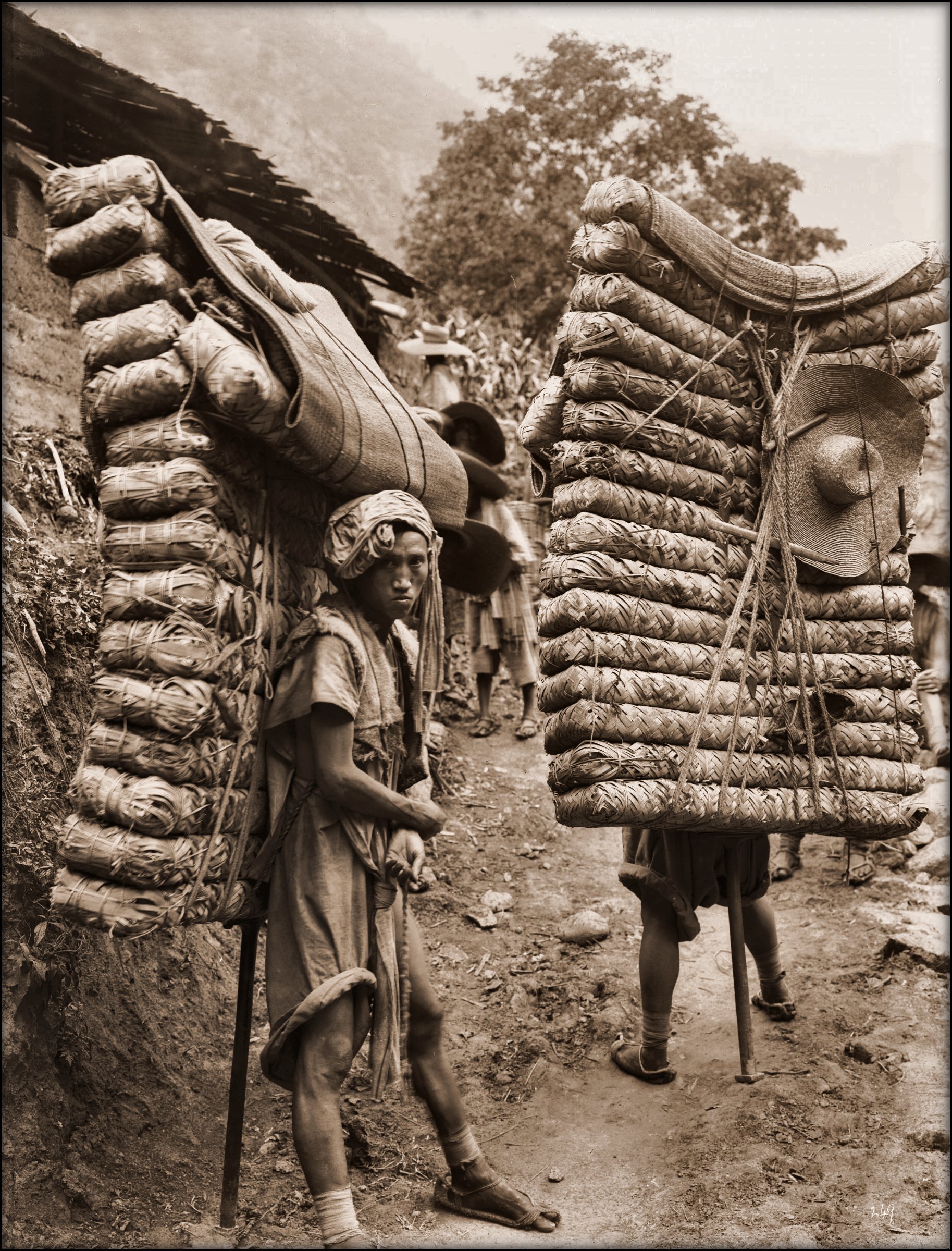
Wilson's figures are an extreme documented case, not an average, and should be read as such; ordinary loads were lighter. But the photograph records the structure of the trade honestly. The Tibetan demand for tea, and the Chinese state's and merchants' profit in meeting it, were connected by a route over which, for centuries, the cheapest available means of transport was a human back. The porters' names were not recorded. The loads were.
Smugglers and the death penalty
A monopoly that works as a lever requires that no one else supply the thing it controls. The Song and the Ming therefore criminalised private tea on the frontier, and the Ming enforced the ban at the top of the social order to make the point. In 1397 the Hongwu emperor had his own son-in-law, the imperial consort-commandant Ouyang Lun, put to death for tea smuggling. The Ming shi records it in twelve characters: 駙馬都尉歐陽倫以私茶坐死 — "The imperial son-in-law Ouyang Lun was condemned to death for private tea."1
The execution of an emperor's son-in-law is remembered because it was exceptional. The ordinary smugglers who died under the same laws are not named anywhere in the record this entry has located. What the sources do make clear is that the policy leaked. Wang and Tian observe that the best horses were more likely to be found in the private markets than in the official exchange: the state's price was low, and the frontier traded around it.16 The punishments were the cost of trying to hold a price that the market would not bear.
Dependency as policy
The deepest cost of the transmission is the one the Ming shi states without embarrassment. The Chinese states did not merely supply a commodity that the pastoral peoples wanted; they built policy on the premise that the pastoral peoples could not do without it, and they calibrated supply to control. The elements of that policy can be listed:
- A stated rationale of dependency: "without tea they fall ill; therefore … to control the Qiang and Rong."1
- A price fixed by the buyer: 120, 70 and 50 jin of tea per horse under Hongwu; 12, 9 and 7 bi under the early Qing.118
- Licences backed by death: 41 golden tallies inscribed "those who do not keep faith shall be beheaded."1
- Selective exclusion: tea sold to Tibetans and withheld from Mongols, to prevent the two from combining.16
- Capital punishment for competition: private tea a capital crime, enforced even on the imperial family.1
This did not work as its designers hoped. Horse quotas were chronically missed under the Song and often under the Ming; smuggling was endemic; the pastoral peoples traded tea privately and on their own terms whenever the frontier allowed.1116 But the attempt shaped the relationship between the Chinese state and the plateau for seven centuries, and it placed a daily necessity of Tibetan and Mongol households under the control of a government that regarded that necessity as a means of rule.
The bones of the drinkers: brick-tea fluorosis
The last part of the bill was not known until the twentieth century, and it falls on the drinkers themselves. The cheap brick tea sent to the plateau was made from old, coarse leaves and stems — exactly the material in which the tea plant accumulates fluoride. W. S. Shu and colleagues showed in 2003 that old leaves, not soil conditions, are "the major contributors" to high fluoride and aluminium in Sichuan brick tea.22 Cao Jin and colleagues measured water-soluble fluoride in brick tea from Sichuan and Yunnan at 533.89–617.32 mg/kg, against 0.06 mg per litre in Tibetan drinking water.23
The 1996 study by Cao Jin and colleagues in Daofu County, Ganzi, in the eastern Tibetan region of Kham, set out the consequences:3
- Tibetan adults drank about 3,000 mL of brick tea with milk a day; children aged 8–15 about 1,500 mL.
- Adult fluoride intake averaged 10.43 mg per person per day, against 2.54 mg for Han residents of the same county.
- 94.4 per cent of adult intake came from brick tea and tsampa made with it.
- 51.2 per cent of Tibetan children had dental fluorosis, against 11.05 per cent of Han children.
- About a third of Tibetans over 16 had skeletal fluorosis; above age 40 the rate was 50 per cent or more, and in the 50–59 age group it reached 81.36 per cent.
The authors were direct: "Brick tea is considered to be one of life's necessities by Tibetans and other minority nationalities in western China," and "Brick tea fluorosis can be considered to be a new type of fluorosis. Brick tea fluorosis occurs in a limited area, but until now, this problem has been ignored."3 A 2015 study of Tibetan, Mongolian, Kazakh, Han and Russian subjects in northwest China found skeletal-fluorosis prevalence highest among Tibetans.24
The causal chain is long, and each link is documented. Tea reached the plateau as a luxury. It became a necessity. The Chinese states built policy on that necessity and supplied it in the cheapest, coarsest form. The pastoral peoples adopted that form as their own and drank it in quantity, three litres a day. The coarse leaves carried fluoride. The fluorosis is not an intended cost, and no one in the Song or Ming could have known of it. But it is a cost of the transmission as it actually happened, and it falls on the same people whose demand the frontier states set out to exploit.
What the bill does not include
Honesty about cost requires stating its limits. The transmission itself was voluntary. No army carried tea to the steppe; the Uighurs drove horses to buy it and the btsan po collected it by district. Butter tea and milk tea are not impositions but achievements of the pastoral kitchen — dishes made by the receivers from a foreign ingredient, and still loved. The Lhasa study that found butter tea associated with lower metabolic syndrome is as much a part of this record as the Daofu fluorosis survey.6 The tea-horse exchange also bought the pastoral peoples something they valued at a price they often negotiated, evaded, or set themselves through the private market. The bill falls where the Chinese states chose to make a loved habit into an instrument: on Sichuan's growers, on the porters, on the smugglers, and on the drinkers whose bones record the grade of tea they were sold.
What followed
-
713In the Kaiyuan era (713–741) the Chan master Xiangmo at Lingyan Monastery on Mount Tai lets his students drink tea to stay awake in meditation. The habit spreads through Shandong to the capital, and tea shops open in the cities of north China — the Chinese north learns to drink tea only a generation before the frontier does.
-
780By the last decades of the eighth century, Feng Yan records that tea has 'flowed beyond the passes' and that Uighur envoys have driven great herds of fine horses to the Tang court to buy it — the first recorded exchange of horses for tea.
-
781The Tang embassy of Cui Hanheng returns from the Tibetan court. Its assistant envoy Chang Lu, having boiled tea in his tent, has been shown six named Chinese teas already in the btsan po's possession — evidence of tea as a luxury at the summit of the Tibetan state.
-
793The salt-and-iron commissioner Zhang Pang institutes a regular Tang tax of one-tenth on tea, bringing in 400,000 strings of cash a year. Tea has become large enough in the Chinese economy to be a fiscal object.
-
1074Under Wang Anshi's New Policies the Song court sends Li Qi into Sichuan to buy tea for exchange with the Tibetans for horses on the northwest frontier. The resulting Tea and Horse Agency makes the Sichuan tea crop a state instrument; Paul Smith traces the subsequent ruin of the region's growers.
-
1174From the Chunxi era the Song quota at the eight Sichuan and Shaanxi horse markets is raised to 12,994 horses a year. The Song shi records that purchases never once reached it.
-
1397The Hongwu emperor has his son-in-law Ouyang Lun put to death for smuggling tea. The Ming tea monopoly on the frontier — rates of 120, 70 and 50 jin of tea per horse, 41 golden tallies inscribed 'those who do not keep faith shall be beheaded' — is enforced at the top of the social order.
-
1435The golden tallies are reissued. In the same year the Ming receives about 13,000 horses at Xining, Hezhou and Taozhou for about 1,097,000 jin of tea; the court reserves the exchange for Tibetans and withholds it from the Mongols.
-
1735The Qing 'again halts the Gansu horse exchange'; in 1736 the official tea levy is converted to silver. The state tea-for-horses system, run intermittently since the Song, ends — but official tea keeps its political role on the frontier.
-
1844Évariste Huc finds that at the Great Kuren (Urga) every price, for a horse, a camel or a house, is set in brick tea, five bricks to an ounce of silver. The frontier commodity has become the steppe's money.
-
1908Ernest Henry Wilson photographs Sichuan porters carrying brick tea for Tibet in loads of 317 and 298 pounds, six miles a day, to Dartsedo.
-
1996A survey in Daofu County, Kham, finds Tibetan adults drinking about three litres of brick tea a day, 51.2 per cent of children with dental fluorosis and about a third of adults with skeletal fluorosis from the fluoride in the coarse leaves of brick tea.
Where this lives today
References
- Zhang Tingyu 張廷玉 et al. Ming shi 明史 [History of the Ming], juan 80, "Shihuo zhi" 食貨志 4, "Cha fa" 茶法. 1739. Wikisource edition. zh primary
- Huc, Évariste Régis. Souvenirs d'un voyage dans la Tartarie, le Thibet et la Chine pendant les années 1844, 1845 et 1846. Vol. 1. Paris: Adrien Le Clère, 1850. fr primary
- Cao, Jin, Xuexin Bai, Yan Zhao, Jianwei Liu, Dingyou Zhou, Shiliang Fang, Ma Jia, and Jinsheng Wu. "The Relationship of Fluorosis and Brick Tea Drinking in Chinese Tibetans." Environmental Health Perspectives 104, no. 12 (1996): 1340–1343. en
- Feng Yan 封演. Fengshi wenjian ji 封氏聞見記 [Record of Things Seen and Heard by Mr. Feng], juan 6, "Yin cha" 飲茶. Late 8th century. Wikisource edition. zh primary
- Liu Xu 劉昫 et al. Jiu Tang shu 舊唐書 [Old History of the Tang], juan 196 xia, "Tufan zhuan" 吐蕃傳. 945. Wikisource edition. zh primary
- Li, Kun, Qian Zhang, Hong Cai, et al. "Association of Tibetan Habitual Food and Metabolic Syndrome Among Tibetan People in China: A Cross-Sectional Study." Frontiers in Nutrition 9 (2022): 888317. en
- Benn, James A. Tea in China: A Religious and Cultural History. Honolulu: University of Hawai'i Press, 2015. en
- Li Zhao 李肇. Tang guoshi bu 唐國史補 [Supplement to the State History of the Tang], juan xia 卷下. Early 9th century. Wikisource edition. zh primary
- Lu, Houyuan, Jianping Zhang, Yimin Yang, et al. "Earliest Tea as Evidence for One Branch of the Silk Road across the Tibetan Plateau." Scientific Reports 6 (2016): 18955. en
- Yang Fuquan. "The 'Ancient Tea and Horse Caravan Road,' the 'Silk Road' of Southwest China." The Silk Road 2, no. 1 (2004). Silkroad Foundation. en
- Toghto 脫脫 et al. Song shi 宋史 [History of the Song], juan 184, "Shihuo zhi" 食貨志 xia 6, "Cha xia" 茶下. 1345. Wikisource edition. zh primary
- Smith, Paul J. Taxing Heaven's Storehouse: Horses, Bureaucrats, and the Destruction of the Sichuan Tea Industry, 1074–1224. Harvard-Yenching Institute Monograph Series 32. Cambridge, MA: Council on East Asian Studies, Harvard University, 1991. en
- Wanner, Michal. "The Russian-Chinese Trade in Kyakhta, Its Organisation and Commodity Structure, 1727–1861." Prague Papers on the History of International Relations 2 (2014): 35–49. en
- Liu Xu 劉昫 et al. Jiu Tang shu 舊唐書 [Old History of the Tang], juan 49, "Shihuo zhi" 食貨志 xia. 945. Wikisource edition. zh primary
- 黄纯艳 Huang Chunyan. 宋代茶法研究 [Studies in Song Tea Law]. 昆明: 云南大学出版社 (Yunnan University Press), 2002. zh
- Wang, Liping, and Geng Tian. "Breaking the Containment: Horse Trade between the Ming Empire and its Northern Neighbors, 1368–1570." Journal of World History 33, no. 1 (2022): 37–71. en
- Rossabi, Morris. "The Tea and Horse Trade with Inner Asia during the Ming." Journal of Asian History 4, no. 2 (1970): 136–168. en
- Zhao Erxun 趙爾巽 et al. Qing shi gao 清史稿 [Draft History of the Qing], juan 124, "Shihuo zhi" 食貨志 5, "Cha fa" 茶法. 1928. Wikisource edition. zh primary
- 賴惠敏 Lai Hui-min. 〈從甘肅官茶引看清前期邊疆統治(1644–1795)〉 [Frontier rule in the early Qing seen through the Gansu official tea licences, 1644–1795]. 中央研究院近代史研究所集刊 Bulletin of the Institute of Modern History, Academia Sinica 125 (2024): 49–98. zh
- 宋时磊 Song Shilei. 〈从“茶马贸易”到“茶马古道”:对一个当代中国原创学术概念的考察〉 [From 'tea-horse trade' to 'Tea Horse Road': an examination of an original contemporary Chinese scholarly concept]. 武汉大学学报(哲学社会科学版) 77, no. 4 (2024): 89–99. zh
- Wilson, Ernest Henry. "Men laden with 'Brick Tea' for Thibet," photograph with manuscript caption, western Sichuan, July 1908. Arnold Arboretum Horticultural Library, Harvard University. en primary
- Shu, W. S., Z. Q. Zhang, C. Y. Lan, and M. H. Wong. "Fluoride and Aluminium Concentrations of Tea Plants and Tea Products from Sichuan Province, PR China." Chemosphere 52, no. 9 (2003): 1475–1482. en
- Jin, C., Z. Yan, L. Jianwei, X. Ruodeng, and D. Sangbu. "Environmental Fluoride Content in Tibet." Environmental Research 83, no. 3 (2000): 333–337. en
- Wu, Junhua, et al. "Modifying Role of GSTP1 Polymorphism on the Association between Tea Fluoride Exposure and the Brick-Tea Type Fluorosis." PLoS ONE 10, no. 6 (2015): e0128280. en
