Tempura, kasutera, pan: the Portuguese food Japan kept (1600)
How bread, sugar sweets and frying in oil came to Japan on the Great Ship from Macau and through the Jesuit mission houses of Nagasaki, why the sweets survived the expulsion of 1639 while beef and bread did not, and what the same ships carried away
In 1569 the Jesuit Luís Fróis gave Oda Nobunaga a gift of konpeitō, sugar-coated Portuguese confeitos. Over the next seventy years the Great Ship from Macau and the mission houses of Nagasaki taught Japanese cooks to bake kasutera and bōro, to boil sugar, to fry fish in oil and to call bread pan. The sweets outlived the expulsion of 1639 and became Japanese. Beef, bound in Hideyoshi's law of 1587 to the Portuguese trade in Japanese captives, did not; neither, for two centuries, did bread.
Before: a table without ovens, sugar or beef (before 1543)
In 675, the Emperor Tenmu, a patron of Buddhism, issued an edict recorded in the Nihon shoki that, in the historian Hans Martin Krämer's summary, "prohibited eating the meat of cows, horses, dogs, monkeys, and roosters" 1. The edict did not end meat-eating in the Japanese islands. Wild boar, deer and birds stayed in the diet through the ancient and medieval centuries, and warrior households hunted and ate them. What the edict and the Buddhist and Shintō ideas behind it did was narrower and more durable: domestic animals were not raised to be eaten, and the killing of a working ox or a horse for food sat outside what a decent household did 12. Nine centuries later, that line was still in place when the first Portuguese ships reached the south of Kyūshū.
Sengoku Japanese cooking, the cooking of the warring-states century, was organised around rice, fish, vegetables, soy and fermentation. Its formal summit was the honzen banquet, a sequence of trays served to warrior and court elites in a fixed order, whose rules were set down by hereditary schools of carving and service 3. Below it lay the everyday diet of rice or millet, pickles, soup, fish and greens. Temple kitchens had their own vegetarian shōjin cuisine, which had absorbed Chinese techniques over the centuries 4. None of this required an oven. Food was boiled, steamed, grilled over charcoal, simmered, salted and fermented.
Purity, pollution and the working animal
The line between game and livestock was not a matter of taste alone. Krämer shows that two systems of thought reinforced each other in keeping domestic meat off the table. Buddhist teaching counselled compassion toward living things and discouraged killing; Shintō ideas of kegare, ritual pollution, attached to blood and death and to those whose work brought them into contact with carcasses 1. Harada Nobuo has argued that rice and meat came to stand for opposite poles of a political and ritual order in which the court and the cultivated field sat on one side and the slaughter of animals on the other, with lasting consequences for the people who did that work 2. The ox and the horse belonged to the field and the road. To kill one for food was not only impious but wasteful, a destruction of the farmer's and the warrior's means of labour. That reasoning, and almost those words, would be put to the Portuguese by the most powerful man in the country in 1587.
What the Sengoku table had, and what it did not
The absences matter for what follows, because they are what the Portuguese loans filled. Before the 1540s, the Japanese kitchen had:
- No baked bread and no oven. Wheat was eaten as noodles and dumplings; there was no leavened loaf and no domestic tradition of baking in an enclosed hot chamber 56.
- Almost no cane sugar. Sugar was a rare import, handled closer to medicine than to food. Sweets were made with mizuame (a malt syrup) and amazurasen (a syrup boiled from vines) 5.
- Confections that were mostly fruit and nuts. Egō Michiko and Yamashita Mitsuo, working from sixteenth-century records of formal visits and tea gatherings, found that the kashi (sweets) served in that century were mostly nuts and fruit; processed and sugar-based sweets increased only later 7.
- No dairy. Milk, butter and cheese played no part in the diet.
- No domestic meat, by custom. Cattle and horses were draught and war animals, not food 1.
The vocabulary of a closed kitchen
None of this was poverty. The honzen banquet was as elaborate as anything served at a European court, and the tea gatherings of the sixteenth century, whose menus survive in tea diaries, were refining an aesthetic of small, seasonal, carefully composed food 37. But Japanese cooking in 1540 was a closed vocabulary in one specific sense. It had no words for the things a Portuguese ship's cook did as a matter of routine: kneading wheat dough with leaven, baking it, beating eggs and sugar into a batter, boiling sugar to the hard crack, deep-frying floured fish in oil, killing a cow.
When those things arrived, they arrived with their names attached. That is why the record of this transmission survives in the Japanese dictionary as much as in the kitchen. Pan is the Portuguese pão. Kasutera is Castela. Konpeitō is confeito, bōro is bolo, karumera is caramelo and aruheitō is alfeloa 5. A people who had not needed these words before needed them now, and took them from the people who brought the things.
The Portuguese in the European eye
The Jesuit Luís Fróis, who lived in Japan from 1563 until his death in 1597, compiled in 1585 a treatise of more than six hundred paired contrasts between European and Japanese customs. Its sixth chapter is devoted to "the Japanese way of eating and drinking" 8. Fróis set the raw seaweed and the tanuki (raccoon dog) eaten by the Japanese against the pastries and the chicken the Portuguese preferred 9, and he reported that the Japanese ate wild dogs, cranes, monkeys and cats 1. Krämer warns that Fróis's "judgments are sometimes dubious and he frequently errs in details" 1. The treatise is best read as evidence of what struck a European as strange, not as a census of Japanese diet. But it records a real divide, and it records it from the European side: the Portuguese thought the Japanese ate oddly, and the Japanese, as the next section shows, thought the Portuguese ate something worse.
The transmission: the Great Ship, the mission house and the port (1543–1639)
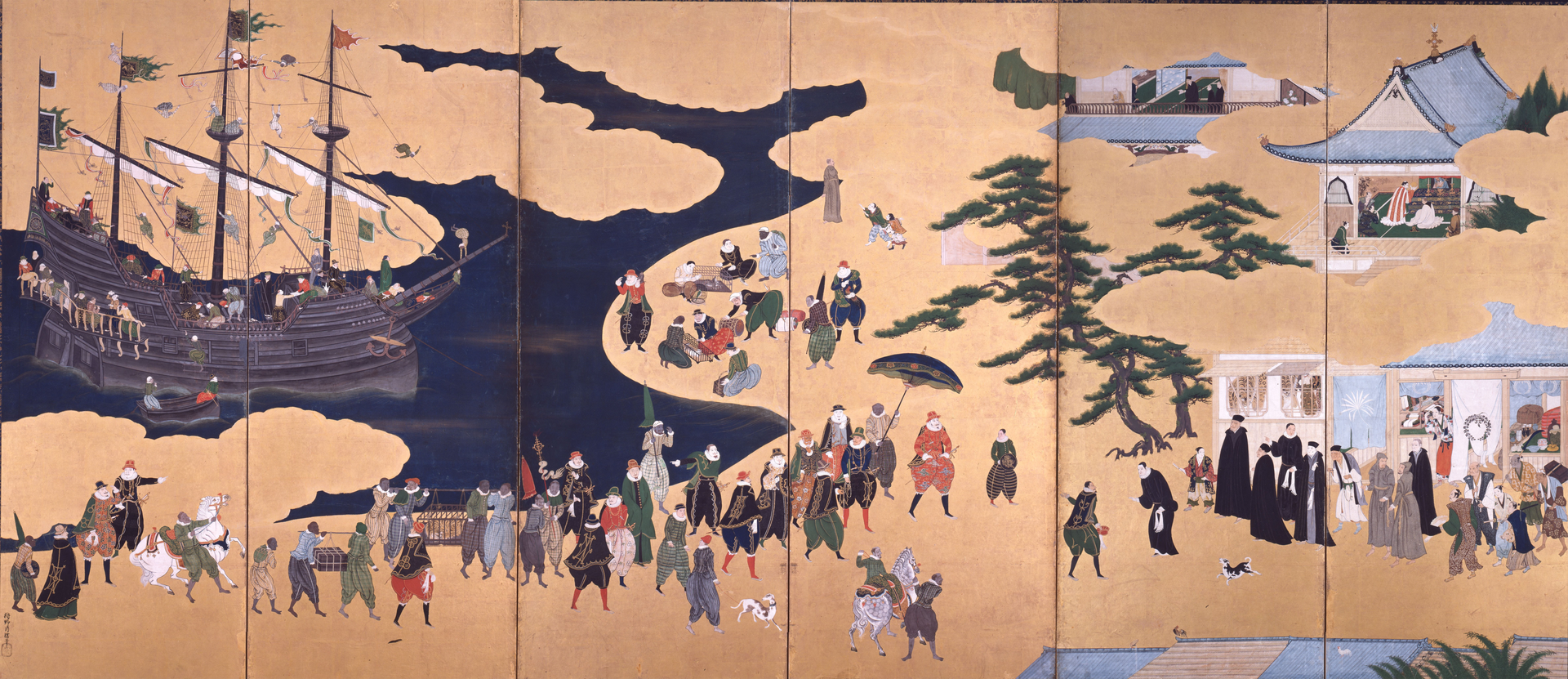
The Portuguese reached the island of Tanegashima, off southern Kyūshū, in or around 1543; the exact date and circumstances of the landing are still debated 10. The Jesuit Francis Xavier landed at Kagoshima in 1549. The historian João Paulo Oliveira e Costa states the span plainly: "The Portuguese sustained contact with the Japanese for nearly a century (1543–1639)" 10. The firearm that the first ships brought is the subject of its own record in this atlas; this record follows what came with the ship's galley and the mission's kitchen.
The Great Ship and the silk-for-silver run
The vehicle of the transmission was commercial. After the Ming court closed direct trade between China and Japan to Japanese ships, Portuguese merchants based at Macau carried Chinese silk to Japan and Japanese silver back to China. The annual voyage of the nau do trato, the Great Ship that the Japanese called the kurofune or black ship, ran from the 1550s until 1639, and C. R. Boxer's annals of the run remain the standard reconstruction of it 11. The ship's company ate as Iberian sailors ate: ship's biscuit and bread, salted and fresh meat when they could get it, wine, oil, eggs, sugar preserves. In port, for months at a time, they needed to be fed.
From 1571 the Great Ship's Japanese terminus was Nagasaki, a fishing village on Ōmura Sumitada's lands that the Christian daimyo opened to the Portuguese and, in 1580, granted to the Society of Jesus 12. By 1611, according to Jesuit sources, Nagasaki had some 25,000 inhabitants, ten churches and eight parishes 10. It was a Portuguese-Japanese town: merchants, mission households, Japanese Christian confraternities, interpreters, cooks, and the farmers and fishermen who supplied them. This is where the food was made, and where Japanese people first made it themselves.

Three kitchens of transmission
The loans did not come through one door. The sources point to three settings, each with its own reasons for cooking Portuguese food and its own Japanese audience:
- The ship and the port. The Portuguese merchants and crews in Hirado and then Nagasaki wanted bread and meat. João Rodrigues, the Jesuit interpreter, recorded that cows, chickens and pigs were bred in some port towns to supply the Portuguese ships, and that some Japanese merchants and nobles took up the habit of eating them 9.
- The mission house. The Jesuits fed their own European members, their Japanese lay assistants (dōjuku) and the students of their seminaries. Matsumoto Nakako, who dated the surviving Nanban ryōrisho (Southern Barbarian Cookbook), concluded that its recipes were probably written for entertaining at Jesuit houses, for feeding the dōjuku and the seminarians, and for serving sweets in the church's own tea rooms 13.
- The audience chamber. Sugar sweets were gifts, and gifts opened doors. The Nihon kokugo daijiten credits the first arrival of konpeitō to a gift Fróis made to Oda Nobunaga in 1569, citing Fróis's letter of 1 June that year 5. A Satsuma record of 1608 notes a padre's New Year present of "one box of southern-barbarian sweets" 5. The encyclopedia Nipponica states plainly that the missionaries used sweets as a means of evangelisation 14.
Sugar, eggs and wheat: what the ships actually carried
The second of these kitchens explains the shape of what survived. Portuguese sweets of the sixteenth century were, above all, sugar-and-egg confections, the convent pastry of Iberia: pão de ló (sponge), fios de ovos (threads of egg yolk boiled in syrup), confeitos (sugar-coated seeds), bolos. Katayose Makiko, who traced the Japanese nanban dishes back through Asia to their Portuguese models, proposed these pairings 15:
- kasutera and pão de ló, the Portuguese sponge;
- konpeitō and confeito, the sugar-coated seed;
- bōro and bolo, the small cake;
- keiran sōmen (egg-thread noodles) and fios de ovos;
- nanbanzuke (fish fried and then pickled in vinegar) and escabeche.
Katayose's second finding is the more important one. The Portuguese who reached Nagasaki had come by way of Goa, Malacca and Macau, and the cooking they brought was already a creole cuisine of the Portuguese Estado da Índia, not the cooking of Lisbon. The Japanese nanban kitchen, she argued, was shaped more by those Asian Portuguese kitchens than by metropolitan Portugal 15. What Nagasaki received was the food of a maritime empire's ports, carried by crews that included Indians, Malays, Africans and Chinese as well as Portuguese.
The Southern Barbarian Cookbook
The fullest document of the transmission is a manuscript held in the Kano Collection of Tohoku University Library, the Nanban ryōrisho, attributed to one Morita Shirōemon 16. It lists kasutera, konpeitō, a dish called tenfurari, egg custards and a range of other sweets and dishes, mixed with Japanese recipes 13. Its date is contested. Earlier scholars placed it between the Kanbun and Kyōhō eras (1661–1736) on the evidence of its recipes, or in the last years of the shogunate on the evidence of its handwriting. Matsumoto, comparing its terms with Fróis, with the Jesuit visitor Alessandro Valignano and with the Jesuits' Japanese-Portuguese Vocabulario of 1603, argued that "同書の成立は1610年代以前ではないかと推論された": the book was composed, she inferred, no later than the 1610s 13. Eric C. Rath, who translated it in full as an appendix to Food and Fantasy in Early Modern Japan, treats it as a seventeenth-century text and devotes a chapter to it as "The Barbarians' Cookbook" 3.
Who did the cooking
The Portuguese brought recipes; Japanese hands made the food. By the end of the sixteenth century some 300,000 Japanese had been baptised 10, and the Christian communities of Kyūshū and the Kyoto region were organised in lay confraternities that supported the clergy, cared for the sick and the poor, and kept the church running where priests were few 10. In the mission houses, the cooks, servants and dōjuku were overwhelmingly Japanese. The Jesuit seminaries trained Japanese boys who were fed, by Matsumoto's reading of the cookbook, partly from a Portuguese repertoire 13.
This matters because it explains why the techniques survived the people who brought them. A recipe for kasutera or bōro that existed only in a Portuguese cook's memory would have left with the last ship in 1639. One that a Japanese cook had made for twenty years, for Jesuit guests and for the tea rooms of Christian daimyo, stayed. The Nanban ryōrisho itself is evidence of the process: it mixes Portuguese and Japanese dishes, writes the foreign words in Japanese script, and, as Matsumoto notes, may have received its title only later, when the label "southern barbarian" had become a way of naming a style rather than a people 13.
A chronology of the transmission
| Date | Event |
|---|---|
| c. 1543 | Portuguese reach Tanegashima 10 |
| 1549 | Francis Xavier lands at Kagoshima 10 |
| 1569 | Fróis's gift of konpeitō to Oda Nobunaga, as dated by the Nihon kokugo daijiten 5 |
| 1571 | First Great Ship at Nagasaki 12 |
| 1580 | Ōmura Sumitada grants Nagasaki to the Jesuits 12 |
| 1585 | Fróis's treatise of contrasts, with its chapter on eating and drinking 8 |
| 1587 | Hideyoshi's questions to Coelho; memorandum against slave sales and the eating of cattle; expulsion edict 1718 |
| 1592 | Pan attested in the catechism Dochiriina kirishitan 5 |
| 1608 | A padre's New Year gift of southern-barbarian sweets, recorded in Satsuma 5 |
| by the 1610s | Nanban ryōrisho composed, in Matsumoto's dating 13 |
| 1625 | Taikōki lists kasutera, bōro, karumeiru, aruheitō, konpeitō 19 |
| 1639 | Portuguese expelled; the Macau run ends 11 |
The loans, word by word
The table summarises the principal Portuguese culinary loans into Japanese, with the earliest Japanese attestation given by the Nihon kokugo daijiten and the principal scholarly caveat.
| Japanese | Portuguese source | Earliest Japanese attestation | Caveat |
|---|---|---|---|
| パン pan (bread) | pão | Dochiriina kirishitan, 1592, in a Eucharistic sense 5 | Survived mainly as book knowledge after 1639 |
| カステラ kasutera | pão (or bolo) de Castela | Taikōki, 1625 5 | Origin date disputed: Tenshō (1573–92) or Kan'ei (1624–44) 6 |
| 金平糖 konpeitō | confeito | Taikōki, 1625; gift to Nobunaga, 1569 5 | Method mastered in Osaka only by the 1680s–1700s |
| ボーロ bōro | bolo | Confectioner's list, Edo, 1683 5 | Only the baked form survived 6 |
| カルメラ karumera | caramelo | Taikōki, 1625 5 | Made without leavening in 1718 6 |
| 有平糖 aruheitō | alfeloa | Taikōki, 1625 5 | The name says "sugar" twice 14 |
| 飛竜頭 hiryōzu | filhós | Kōmō zatsuwa, 1787 5 | No contact-period attestation |
| 天麩羅 tempura | tempero? têmporas? | Ryōri kasen no kumiito, 1748 5 | No contemporary evidence for any Iberian etymology 6 |
| 合羽 kappa (cape) | capa | Tōdaiki, c. 1615 5 | Clothing, not food: the priest's cloak became a rain-cape |
The word list is also a list of the years in which Japanese writers first felt the need to write the words down. Five of the nine appear for the first time in one sentence of the Taikōki, Oze Hoan's life of Toyotomi Hideyoshi, printed in 1625. Describing a banquet, it says that the drinkers were offered chinta (red wine, from the Portuguese vinho tinto) and grape wine, and "下戸には、かすていら、ぼうる、かるめひる、あるへい糖、こんへい糖など": for those who did not drink, kasutera, bōro, karumeiru, aruheitō, konpeitō and the like 19. By the time the sentence was printed, the Portuguese had fourteen years left in the country.
What changed, and what was replaced
The Portuguese culinary loans are often told as a story of fusion: a foreign technique absorbed and perfected. The documents tell a more uneven story. Some loans took root and became Japanese; some survived only as words in a recipe book; and one, the eating of beef, was struck out of the Japanese kitchen by law and did not return for two and a half centuries. What survived the expulsion of 1639 was what could be made without the Portuguese and without their religion.
Sugar enters the Japanese sweet
The deepest change was to the category of the sweet itself. The Nihon kokugo daijiten defines the nanban kashi, the southern-barbarian sweets, by a single contrast: unlike the sweets made before them with mizuame and amazurasen, they used sugar 5. Egō and Yamashita's survey of sixteenth- and seventeenth-century records shows the change in the menus themselves: from sweets that were mostly nuts and fruit to processed and nanban sweets, a shift helped along by the banquets the shogunate laid on for the Korean embassies of the seventeenth century 7. The southern-barbarian sweet became a diplomatic food, served by Japanese hosts to Korean envoys who would never have met a Portuguese.
The techniques were hard to learn and slow to spread. Konpeitō, which requires rolling a seed or grain in hot syrup over days until it grows its characteristic horns, defeated Japanese confectioners for a long time: Ihara Saikaku's Nippon eitaigura of 1688 makes the difficulty of working out the method the subject of a story 14. The Nihon kokugo daijiten records that konpeitō was being made in Osaka by the Genroku era (1688–1704), and that the method reached Edo only in the Bunsei era (1818–30), nearly two centuries after the last Portuguese ship had left 5.
Kasutera: the cake that could not rise
Kasutera became the emblem of Nagasaki, and its origin story is full of dates the record cannot support. The sources give at least four:
- 1556, Hirado. The tradition, repeated by the encyclopedia Nipponica, that a missionary brought it there 14.
- Tenshō era (1573–92), Nagasaki. The Nihon kokugo daijiten places the arrival of the method here and names Izumiya Chōkaku of Motohakata-machi as its first maker 5.
- 1624, Nagasaki. The founding date of the confectioner Fukusaya, still in business; it is the firm's own 14.
- Early Kan'ei era (1624–44), Nagasaki. The cautious formula of the Sekai daihyakka jiten, in an entry by Matsumoto Nakako 6.
What the record does support is stranger. Matsumoto observes that the kasutera recipes in the cookbooks of 1668–83, 1689, 1712 and 1718 only knead the ingredients together. Without beaten eggs, it is doubtful the cake rose at all. Beating eggs into a foam appears first in a source of 1852, which also names a copper kasutera pan 6. The light, moist sponge that Nagasaki sells today is, in other words, a nineteenth-century achievement carrying a sixteenth-century name. Bōro went through a similar narrowing: in Portugal a bolo could be baked or fried, but in Japan only the baked form was ever made, and in 1718 it was baked not in an oven but in a lidded copper pan with coals heaped on the lid 6.
Bread: kept in the book, lost from the table
Bread is the loan that was most nearly lost. Pan entered Japanese through the mission: its first attestation in the Nihon kokugo daijiten is the Christian catechism Dochiriina kirishitan of 1592, where it names the bread of the Eucharist 5. That association was fatal once Christianity was banned. Bread did not vanish entirely. The confectioner's manual Kokon meibutsu gozen kashi hidenshō of 1718 prints a recipe for leavened bread using a starter it calls furumento, the Portuguese fermento, and the encyclopedia Wakan sansai zue (1712) knows the Dutch word han 5. But bread survived as book knowledge and as something the Dutch ate on Dejima, not as a Japanese food.
When bread came back, it came back as a weapon. In 1842 the shogunal intendant Egawa Hidetatsu (Tarozaemon), a student of Western gunnery, baked bread as a field ration for soldiers. The baking industry's Pan Promotion Council fixed 12 April as Pan Day in his honour in 1983 20, though the 1592 and 1718 attestations show he was not the first in Japan to make it 5.
Tempura: the loan that may not be one
Tempura is the dish that every account of this transmission leads with, and the one the record supports least securely. Three Iberian etymologies are in circulation:
- Tempero (seasoning, cooking), given by the Nihon kokugo daijiten 5.
- Temperar (to season, to temper), reported by Katayose as one theory among others 15.
- Têmporas (the Ember Days, the Catholic fast days on which fish replaced meat), popular in English-language accounts.
Against all three, Hirata Mario, writing in Heibonsha's Sekai daihyakka jiten, states that these theories rest "on the preconception that tempura was a dish brought to Japan in the age of discovery", and that "当時の文献的証拠は現在発見されていない": no documentary evidence from the period has yet been found 6. The word's earliest appearance is tenfurari in Okumura Hisamasa's Shokudōki of 1669, a dish that may not have been fried at all; the first recipe for the Edo style of batter-frying is in the Ryōri kasen no kumiito of 1748 65.
The technique is easier to trace than the word. Katayose matched the Japanese battered and fried fish with the Portuguese frito, and nanbanzuke with escabeche 15, and the historian Harada Nobuo, as Krämer reports, calls tempura "basically a Japanese variant of a Western (in this case Portuguese) dish" 1. Japanese writers went on associating deep-frying with the Portuguese long after they had gone: the Nihon kokugo daijiten quotes a 1787 description of hiryōzu, the fried tofu fritter, as "the food of Portugal" 5. The most defensible statement is that a technique of frying floured fish and vegetables in oil spread from the Nagasaki contact, and that the name tempura, whatever its origin, attached to it only in the century after the Portuguese left.

Words written down after the fact
The dictionary dates in the table above share a pattern that is easy to miss. With the exception of pan, which entered through a Christian text, none of the culinary loans is attested in Japanese writing before 1625, and several first appear in the 1680s, the 1740s or the 1780s 5. The words were not written down when they arrived. They were written down when they had become ordinary enough to appear in a biography of Hideyoshi, a confectioner's price list, a cookbook or a book of Dutch curiosities.
That is the signature of a successful loan. The sweets that left the earliest trace in Japanese are the ones that had already been naturalised: made by Japanese confectioners, sold to Japanese customers, served at Japanese banquets. The Portuguese words survived because the Portuguese did not need to be present for them to be used. By the time the Tokugawa authorities had made the presence of a Portuguese a capital matter, kasutera and konpeitō were things Japanese people made and sold. The loans had crossed over before the door shut.
It is also the signature of a quiet erasure. The Japanese dictionary does not record who taught the first Japanese cook to boil sugar to the hard crack, or under what conditions; it records the year in which a Japanese writer could mention the result without explaining it. The Christian and Portuguese context of the transmission fell out of the record in the same decades in which its products entered it 56.
What Edo made of it
Tempura's Japanese career belongs to Edo, the city of the Tokugawa shoguns. In the Edo period the word meant different things in different places: in the Kamigata region around Kyoto and Osaka it meant fried fish paste, while in Edo it meant food fried in batter 6. It became an Edo food because it was cheap street food. Hirata records that tempura stalls appear as background details in the illustrated kibyōshi books of the Tenmei era (1781–89), and that sit-down tempura restaurants spread only from the Kaei era (1848–54) 6. The transmission's most famous product was, by the time it became famous, a commoner's snack sold from a cart, more than a century after the last Portuguese had been expelled.
The regional survivals are more faithful to their models than the national ones 14:
- Keiran sōmen, threads of egg yolk boiled in syrup, still made in Hakata and recognisably fios de ovos.
- Maru bōro, the round bolo, in Saga.
- Soba bōro, made with buckwheat flour, in Kyoto.
- Taruto, a sponge rolled around sweet bean paste, in Matsuyama.
What was replaced, and what was refused
The loans displaced less than the word "transmission" suggests. They did not replace rice, soy or fish, and they did not dislodge the honzen banquet or the tea meal; the sugar sweet took its place beside the older confections and slowly crowded them out of the formal menu 73. What changed most was the category of the special food: from the sixteenth century, to eat something sweet, baked or fried at a formal occasion was increasingly to eat something whose name came from Portuguese.
The one loan that would have replaced something was refused. Beef, eaten by the Portuguese and by some Japanese Christians and merchants, and valued by some as a medicine, was the food the Japanese authorities singled out 9. Rodrigues recorded that the Japanese at first accused the Jesuits, "saying, that we eat cow, and domestic animals, and even human flesh" 9. In 1587 Hideyoshi asked the Jesuit vice-provincial Gaspar Coelho why the Portuguese ate horses and cows, animals "feitos para os homens aliviarem seo trabalho", made to ease men's labour on the roads, to carry their goods and serve in war, and oxen to plough the land 1721. In the same days, a memorandum in his name declared that buying, selling, killing and eating cattle and horses was a crime 18. Beef stayed outside respectable Japanese cooking for the whole Edo period, and its eating became a matter of open public argument again, in Krämer's account, only after 1868 1.
What the cost was
The sweets themselves killed no one. No population was dispossessed so that Nagasaki could bake kasutera, and the Japanese confectioners who spent a century learning to make konpeitō were not coerced into it. The bill of this transmission is the bill of its vehicle. The Great Ship that brought sugar, wheat and eggs to Nagasaki also carried Japanese people away from it in chains, and the mission that taught the recipes ended in an expulsion and a persecution that took the bread and the beef out of the Japanese kitchen along with the priests.
The ship that carried sugar carried people
The Portuguese did not invent the sale of people in Japan. Thomas Nelson has documented slavery and the traffic in people in the Japanese medieval period, swollen by the wars of the Sengoku century 22. What the Portuguese added was an export market. Merchants on the Macau–Nagasaki run bought Japanese men, women and children and shipped them to Macau, Manila, Goa and beyond; Lúcio de Sousa's archival reconstruction follows Japanese captives as far as Mexico, Peru and Argentina 2324. In 1587 Gaspar Coelho, the Jesuit vice-provincial, described the trade to his superior general in Rome:
"These traders travel through the villages and steal the sons and daughters from their parents. The Japanese cannot bear to see their people as slaves, or being taken to other countries. Sometimes, after the Portuguese have gotten hold of them with chains and stocks, until the carrack leaves (out of fear that the slaves might run away), some of them cut their bodies, as is their tradition, and kill themselves, and others throw themselves alive into the sea." 25
Coelho also named who made it possible: "because the priests allowed [this] and gave authorization to the merchants stating that the Japanese could be enslaved, they practice many injustices against the Japanese" 25.
Paper servitude: the Jesuit certificates
The Portuguese crown had, on paper, forbidden the trade. A law of King Sebastião of 1570–71, in Stuart McManus's phrase, "on the face of it banned the trade in Japanese slaves by Portuguese subjects" 26. It was not enforced. Bishop Pedro Martins later ordered the excommunication of those who traded Japanese and Korean slaves without permission 26. The words "without permission" mark the loophole. McManus has shown that "the Jesuits in Nagasaki were responsible for a particular innovation in the Ibero-Japanese slave trade, namely the large-scale production of certificates of ownership that stipulated limited-term servitude" 26. A Japanese child sold in Nagasaki could leave the port with a Jesuit-issued paper fixing the term of service; abroad, the paper was easily lost and the term forgotten.
The record has names. Gaspar Fernandes was born in Bungo around 1577, separated from his family at about eight, and sold in Nagasaki to the merchant Rui Pérez; a Jesuit fixed his servitude at about twelve years. He was taken to Manila and then to Mexico, where in 1599 he petitioned the Inquisition for his freedom 26. A witness in his case testified that "in that country they usually sell Japanese people to others without giving any documentation" 26. In 1598 the Jesuits' own council at Nagasaki condemned the system it had run, explaining that it had arisen "partly because the Portuguese would buy up lots of young men and women and take them captives in perpetuity" 26. Gomes Vaz, in his treatise De mancipiis Indicis of about 1610, said merchants had been carrying great numbers of slaves to India for forty years 26. No reliable total exists. De Sousa's study speaks of thousands in some years 23. After Hideyoshi's invasions of Korea in the 1590s, Korean captives were shipped through Nagasaki on Portuguese ships as well 24.
1587: the slave and the ox in one document
Hideyoshi joined the two grievances, the eating of cattle and the selling of people, in a single interrogation. On the night he received Coelho in Kyūshū in July 1587, his second question concerned the eating of horses and cows; his third, in Fróis's account as translated by de Sousa, concerned people:
"I have known that the Portuguese and the Siamese and the Cambodians who come to these places for trading buy a large number of people and take them captive to their kingdoms, depriving the Japanese of their country, their family, children and friends, and this is unbearable." 17
The memorandum of Tenshō 15/6/18, which survives in a copy at the Ise shrines, sets the two side by side as its last two articles: "大唐、南蛮、高麗江日本仁を売遣侯事曲事", the selling of Japanese to China, the southern barbarians and Korea is a crime; and "牛馬ヲ売買、ころし食事、是又可為曲事事", buying, selling, killing and eating cattle and horses is likewise a crime 18. Whether this memorandum was ever promulgated is disputed. The edict of the following day expelled the missionaries, opening with the claim that Japan was the land of the gods 18. The food and the slave trade were never separate questions to the authorities who ended the Portuguese century. The meal at the Portuguese table was read, from the first, as part of what the Portuguese did to Japanese bodies.
Closure: 1597 to 1640
The persecution of Japanese Christianity is the subject of the atlas's Tanegashima record and is not retold here. Its milestones mark the closing of the kitchens in which the loans were made:
| Year | Event | Toll |
|---|---|---|
| 1597 | Crucifixion of the Twenty-Six Martyrs at Nishizaka, Nagasaki, 5 February 12 | 26 |
| 1614 | Tokugawa edict expelling the missionaries and banning Christianity 10 | Exile of the clergy and of leading Christian laymen |
| 1622 | Great Genna Martyrdom at Nishizaka, 10 September 12 | 55 executed, Japanese, Korean and European |
| 1637–38 | Shimabara–Amakusa rising and the siege of Hara castle 12 | c. 37,000 killed, including non-combatants; estimates vary |
| 1639 | Expulsion of the Portuguese; the Great Ship forbidden to return 11 | End of the Macau–Nagasaki run |
| 1640 | Embassy from Macau seeking to reopen trade 1223 | 61 beheaded at Nagasaki, ship burned, 13 sent back |
Some 300,000 Japanese had been baptised by the end of the sixteenth century 10. The kitchens of Nagasaki's Christian households, its confraternities and its mission houses were the places where Japanese cooks had learned to bake and boil sugar. After 1614 to be found keeping the Christian calendar of fasts and feasts was dangerous; after 1639 the Portuguese cooks, customers and wine were gone. The loans that survived did so by being stripped of their Christian context and absorbed into the commercial confectionery of Nagasaki, Osaka and Edo.
What the bill comes to
The cost of the transmission, stated plainly:
- Japanese captives sold abroad by Portuguese merchants on the ships of the trade, with certificates issued by the Jesuits of Nagasaki, over some forty years from the 1570s; no total is recoverable, thousands in some years 2623.
- Korean captives of the 1592–98 invasions shipped through Nagasaki 24.
- The criminalisation of beef, the one loan that would have changed the Japanese diet, bound in law to the slave trade in 1587 and suppressed with Christianity 181.
- The loss of bread, which survived the century only in recipe books because it was the bread of the Mass 5.
- The Christian communities of Nagasaki and Kyūshū, in whose households the recipes were learned, destroyed between 1614 and 1640 1227.
The cape and the cake
One loan tells the whole story in miniature. Arai Hakuseki, the shogunal adviser who interrogated the captured Italian missionary Giovanni Battista Sidotti in 1709, wrote in his Seiyō kibun that the priest's robe "ポルトガルの語には、カッパといふ。昔我俗其製に倣ひ、雨衣を作れり": in the Portuguese language it is called capa; long ago our people copied its form and made rain-capes of it 5. By Hakuseki's day the priests were gone and the faith was a capital crime, and the kappa was what travellers on the Edo roads wore in the rain. The cake went the same way. Kasutera outlived the people who taught Nagasaki to make it, and the city sells it now as its own.
Legends to set aside
Several stories about this transmission circulate widely and are not supported by the record:
- Tokugawa Ieyasu died of eating tempura. The source says he ate sea bream fried in sesame oil before falling ill; the tempura version is, in Hirata's word, a popular tale 6.
- Santō Kyōden coined the word tempura. Kyōden (1761–1816) was born after the word was already in print in 1748; the story concerns at most the characters 天麩羅 5.
- Tempura is named for the Ember Days. No contemporary document supports this or any Iberian etymology 6.
- Kasutera reached Hirado in 1556. A tradition, not a documented event 14.
- Egawa Hidetatsu baked Japan's first bread in 1842. A commemorative framing; the word pan is attested in 1592 and a leavened-bread recipe in 1718 520.
What followed
-
1543c. 1543: Portuguese traders reach Tanegashima off southern Kyūshū, opening nearly a century of Portuguese–Japanese contact.
-
15491549: Francis Xavier lands at Kagoshima; the Jesuit mission that will feed, teach and entertain with Portuguese food begins.
-
15691569: Luís Fróis presents konpeitō, sugar-coated confeitos, to Oda Nobunaga, the first recorded arrival of the sweet in Japan.
-
15711571: The first Great Ship from Macau anchors at Nagasaki, which becomes the Japanese terminus of the silk-for-silver run and the kitchen of the transmission.
-
15801580: Ōmura Sumitada grants Nagasaki to the Society of Jesus; mission houses, confraternities and Japanese Christian households learn to bake and boil sugar.
-
15851585: Fróis compiles his treatise of contrasts between European and Japanese customs, with a chapter on eating and drinking.
-
1587July 1587: Hideyoshi asks Gaspar Coelho why the Portuguese eat horses and cows and buy Japanese people; a memorandum in his name makes both crimes, and an edict expels the missionaries.
-
15921592: The word pan, from Portuguese pão, is attested in the catechism Dochiriina kirishitan, naming the bread of the Eucharist.
-
15991599: Gaspar Fernandes, born in Bungo and sold in Nagasaki as a child, petitions the Mexico City Inquisition for his freedom.
-
1610By the 1610s: the Nanban ryōrisho, a manuscript of kasutera, konpeitō and other southern-barbarian dishes, is composed, probably for Jesuit houses and their tea rooms.
-
16251625: The Taikōki lists kasutera, bōro, karumeiru, aruheitō and konpeitō as the sweets offered to those who did not drink.
-
16391639: The Portuguese are expelled and the Great Ship barred; in 1640, 61 members of a Macau embassy are beheaded at Nagasaki.
-
16831683: An Edo confectioner's list offers sesame, flower and round bōro, the Portuguese bolo made by Japanese hands.
-
1690Genroku era (1688–1704): konpeitō is made in Osaka after a long struggle with the technique; the method reaches Edo only in 1818–30.
-
17181718: The Kokon meibutsu gozen kashi hidenshō prints recipes for kasutera, bōro and a leavened bread raised with furumento, from Portuguese fermento.
-
17481748: The first recipe for Edo-style batter-fried tempura appears in the Ryōri kasen no kumiito.
-
1785Tenmei era (1781–89): tempura stalls appear in Edo picture books; the Portuguese-era technique becomes cheap commoner street food.
-
18421842: Egawa Hidetatsu bakes bread as a soldiers' field ration at Nirayama, the start of bread's second arrival in Japan.
-
18521852: Beaten-egg technique for kasutera appears in print for the first time, with a copper kasutera pan: the modern sponge is born.
Where this lives today
References
- Krämer, Hans Martin. "'Not Befitting Our Divine Country': Eating Meat in Japanese Discourses of Self and Other from the Seventeenth Century to the Present." Food and Foodways 16, no. 1 (2008): 33–62. en
- Harada Nobuo 原田信男. 『歴史のなかの米と肉:食物と天皇・差別』. Tokyo: Heibonsha (Heibonsha sensho), 1993; Heibonsha Library edition, 2005. ja
- Rath, Eric C. Food and Fantasy in Early Modern Japan. Berkeley: University of California Press, 2010. Chapter 4, "The Barbarians' Cookbook", and Appendix, "The Southern Barbarians' Cookbook (Nanban ryōrisho)". en
- Ishige Naomichi. The History and Culture of Japanese Food. London and New York: Kegan Paul, 2001. en
- 『精選版 日本国語大辞典』. Tokyo: Shōgakukan, 2006. Entries 麺麭, カステラ, 金平糖, ボーロ, カルメラ, 有平糖, 飛竜頭, 天麩羅, 合羽, 南蛮菓子, with dated first citations. Online via Kotobank. ja
- Hirata Mario 平田萬里遠, 「天麩羅」; Matsumoto Nakako 松本仲子, 「カステラ」「カルメラ」; Suzuki Shin'ichi 鈴木晋一, 「ボーロ」. In 『改訂新版 世界大百科事典』. Tokyo: Heibonsha, 2007. Online via Kotobank. ja
- Egō Michiko 江後迪子 and Yamashita Mitsuo 山下光雄. 「16世紀から17世紀における菓子について」. 『日本調理科学会誌』 30, no. 2 (1997): 106–113. ja
- Fróis, Luís. The First European Description of Japan, 1585: A Critical English-Language Edition of Striking Contrasts in the Customs of Europe and Japan by Luis Frois, S.J. Translated and edited by Richard K. Danford, Robin D. Gill and Daniel T. Reff. London and New York: Routledge, 2014. Chapter 6, "The Japanese Way of Eating and Drinking". en primary
- Joaquim, João P. R. "The Uses of Animals in Early Modern Portuguese–Japanese Relations." Bulletin of Portuguese–Japanese Studies, series II, no. 3 (2017): 31–53. en
- Oliveira e Costa, João Paulo. "The Brotherhoods (Confrarias) and Lay Support for the Early Christian Church in Japan." Japanese Journal of Religious Studies 34, no. 1 (2007): 67–84. en
- Boxer, C. R. The Great Ship from Amacon: Annals of Macao and the Old Japan Trade, 1555–1640. Lisbon: Centro de Estudos Históricos Ultramarinos, 1959; facsimile reprint, Macau: Instituto Cultural de Macau, 1988. en
- Boxer, C. R. The Christian Century in Japan, 1549–1650. Berkeley and Los Angeles: University of California Press, 1951. en
- Matsumoto Nakako 松本仲子. 「『南蛮料理書』の成立年代について」. 『日本家政学会第46回大会研究発表要旨集』, abstract 2Ja-8, p. 179. ja
- 『日本大百科全書(ニッポニカ)』. Tokyo: Shōgakukan. Entries 「南蛮菓子」 and 「有平糖」 (沢史生) and 「カステラ」 (小林文子). Online via Kotobank. ja
- Katayose Makiko 片寄眞木子. 『南蛮料理のルーツを求めて』. Tokyo: Heibonsha, 1999; summarised by the author as 「南蛮料理のルーツを求めて:アジア各地に息づく魅惑の融合料理」, FOOD CULTURE no. 23 (Kikkoman Institute for International Food Culture): 11–14. ja
- 『南蠻料理書』, attributed to Morita Shirōemon 森田四郎右衛門. Manuscript, Kano Collection (狩野文庫), Tohoku University Library, call no. 6/19783/1. Digitised, CC BY 4.0. ja primary
- Fróis, Luís. Historia de Japam. Edited by José Wicki. 5 vols. Lisbon: Biblioteca Nacional, 1976–1984. Vol. IV (1983), pp. 401–403: Hideyoshi's questions to Gaspar Coelho, July 1587. English translation of the third question by Lúcio de Sousa in Source: Portugal and the Japanese Slave Trade. Teaching Medieval Slavery and Captivity. pt primary
- Toyotomi Hideyoshi. 「覚」, Tenshō 15/6/18 (1587), eleven articles, copy in 『御朱印師職古格』, Jingū Bunko, Ise; and 「定」, Tenshō 15/6/19 (1587), Matsura family documents, Matsura Historical Museum, Hirado. ja primary
- Oze Hoan 小瀬甫庵. 『太閤記』 (1625), 「或問」. Passage on sweets for non-drinkers, as quoted in 『精選版 日本国語大辞典』, s.v. 金平糖. ja primary
- ブルーバックス編集部. 「4月12日 パンの日」. ブルーバックス, Kōdansha (gendai.media). ja
- Sousa, Lúcio de. "As Questões Militares no Comércio entre Macau e Nagasáqui em 1587." Revista de Cultura (Macau: Instituto Cultural) 27 (2008). Transcribes Fróis, Historia de Japam, vol. IV, pp. 401–402. pt
- Nelson, Thomas. "Slavery in Medieval Japan." Monumenta Nipponica 59, no. 4 (2004): 463–492. en
- Sousa, Lúcio de. The Portuguese Slave Trade in Early Modern Japan: Merchants, Jesuits and Japanese, Chinese, and Korean Slaves. Studies in Global Slavery 7. Leiden and Boston: Brill, 2019. en
- ルシオ・デ・ソウザ(Lúcio de Sousa)、岡美穂子(Oka Mihoko). 『大航海時代の日本人奴隷:アジア・新大陸・ヨーロッパ』. Tokyo: Chūō Kōron Shinsha (Chūkō sōsho), 2017; expanded edition (Chūkō sensho), 2021. ja
- Coelho, Gaspar, to Claudio Acquaviva, 1587. Archivum Romanum Societatis Iesu, Jap. Sin. 10 II, fol. 272. English translation by Lúcio de Sousa in Source: Portugal and the Japanese Slave Trade. Teaching Medieval Slavery and Captivity. it primary
- McManus, Stuart M. "'Servitutem levem et modici temporis esse arbitrantes': Jesuit Schedulae and Japanese Limited-Term Servitude in Gomes Vaz's De mancipiis Indicis." Bulletin of Portuguese–Japanese Studies, series II, no. 4 (2018): 77–99. en
- Elison, George. Deus Destroyed: The Image of Christianity in Early Modern Japan. Harvard East Asian Monographs 141. Cambridge, MA: Harvard University Press, 1973. en