The Varangians built a state and sold Slavs to pay for it (c. 900)
Norse crews rowing east for Islamic silver turned scattered East Slavic villages into a taxable territory, a dynasty and a name. The name meant rowing. The revenue was people.
No later than 753, Norse traders from the Malaren basin laid the first timbers at Ladoga on the Volkhov, a century before any chronicle says they came. What they brought east was not a script or a faith but a method: a shallow boat, an armed retinue, and two markets - the Volga Bulgars and Constantinople - that would pay Islamic silver for anything the northern forest produced. Furs, wax, honey, and people. By 900 the method had become a polity centred on Kyiv, running an annual tribute circuit that a Byzantine emperor would describe in detail, and within four generations its Norse-named ruling house was speaking Slavic. The Finns had named these men after the way they arrived - rowing, rods - and the Slavs took the word second-hand. It became Rus. Hundreds of thousands of dirhams in northern hoards are the receipts, and the Arabic word for the commodity, saqaliba, is the ancestor of the English word slave.
Before: a country with no name and no capital
In the middle of the eighth century the land between the Gulf of Finland and the middle Dnieper held perhaps a few hundred thousand East Slavic-speaking farmers, and not one settlement in it that could be called a town. The communities that later chroniclers would name — the Slovenes around Lake Ilmen, the Krivichi on the upper Dnieper and Dvina, the Polyanians at the Dnieper bend, the Drevlyanians in the forests west of them, the Severians, the Radimichi, the Vyatichi — lived in small unfortified clusters of sunken-floored houses, cleared forest by burning it, and left almost nothing behind that a modern excavator can weigh 1. They minted no coin. They wrote nothing. They had no ruler above the level of a local elder or a war-leader whose authority ended with his lifetime, and several of them paid tribute in furs to a power four hundred kilometres to the south-east: the Khazar khaganate on the lower Volga, which controlled the Caspian end of the silver trade and taxed the forest zone for the privilege of existing next to it 16.
This is the state that matters for what follows. Not poverty — the forest zone was rich in exactly the things the eighth-century world wanted, and the people in it were competent farmers, potters and ironworkers. What it lacked was aggregation. There was no mechanism by which the surplus of a hundred villages could be gathered into one place, converted into something portable, and spent. Tribute went out to the Khazars in small parcels along old paths. Nothing came back that concentrated.
A country without a capital is not a country with a missing feature. It is a country nobody can tax at scale — which is to say, in the eighth century, a country nobody has yet decided to own.
The rivers were the only roads
The one asset the region had in abundance was water. From the low watershed south of Lake Ilmen, rivers run in three directions: north-west down the Volkhov and the Neva to the Baltic; east down the Volga to the Caspian; south down the Dnieper to the Black Sea. The portages between the headwaters are short — a few kilometres of dragging a shallow-draught boat over rollers. For anyone with the right kind of vessel and enough men to carry it, the whole of eastern Europe was a single connected system, and the two richest markets on earth sat at the far ends of it.
The East Slavic communities were not using this system at scale. Their river traffic was local. The distances involved required a specific package — a shallow hull, a crew of twenty to forty armed men, a chain of provisioning points, and a reason to go — that no forest village could assemble on its own. Franklin and Shepard's summary of the pre-Rus condition holds: the ingredients of a trading empire were all present in the landscape, and nobody local had combined them 1.
Counted in pelts by strangers
What is known about these peoples before the ninth century comes from three sources, none of them their own. Archaeology gives the settlement pattern and the material culture. The Primary Chronicle, compiled at Kyiv in the early twelfth century, gives a tribal list and a set of origin stories written down some three hundred years after the events 3. And Arabic-language geographers, working from the far end of the trade, give the outsider's ethnography — descriptions of Slavic settlement, kingship and funerary practice recorded by men who mainly encountered Slavs as merchandise.
That last point is not an aside. The most-quoted early description of the peoples of this region is a description of a supply. Ibn Rusta, writing between about 903 and 913, describes the Rus as a group who "raid the Saqaliba, sailing in their ships until they come upon them. They take them captive and sell them in Khazaran and Bulkar" 18. Ṣaqāliba — Slavs — is the word from which Latin sclavus, French esclave and English slave descend. The earliest sustained written attention paid to the East Slavs by the literate world was commercial, and the commodity was them.
The four things they did not have
Set out plainly, the pre-transmission gaps that the next two centuries would close:
- No coin. No monetary instrument existed in the forest zone. Value moved as pelts, wax, honey, cattle and people.
- No writing. Nothing was recorded. Every obligation was memory, and memory does not survive the man who holds it.
- No supra-local ruler. Authority was tribal and personal. Nobody could command the Polyanians and the Krivichi in the same season.
- No name. There was no word covering these peoples as a unit — not among themselves, not among their neighbours.
Each of those four absences was filled between roughly 750 and 950. Three of them were filled by people who had rowed in from the Baltic. The fourth — the name — was filled by a word those people used for what they did in the boat.
A white squirrel skin from every hearth
The one form of supra-local authority that did reach into the forest zone came from the steppe. Under the year 859 the Primary Chronicle records that the Khazars took tribute from the Polyanians, the Severians and the Vyatichi at the rate of a white squirrel skin from each hearth 3. Whatever the literal accuracy of the rate, the structure it describes is the one that matters: a per-household levy, assessed on the smallest unit of settlement, collected by an outside power, and paid in the one commodity the forest produced in unlimited quantity.
The Khazar khaganate was a serious state. It held the lower Volga and the north Caucasus, taxed the Caspian trade, fielded cavalry, and had adopted Judaism at the elite level — a deliberate confessional position between a Christian empire to the west and a Muslim one to the south 16. To the East Slavic peoples it was simply the direction from which the tax came.
What the Norse-led retinues eventually did to this arrangement is recorded with unusual clarity, and it is worth quoting the shape of it. Under 884 and 885 the chronicle has Oleg subdue the Severians and then send to the Radimichi to ask whom they paid tribute to. They answered: the Khazars. He told them to pay it to him instead, at the same rate 3.
That exchange is the entire transmission in miniature. The apparatus of extraction was not invented by the newcomers; it was inherited, redirected, and then — this is the part that made a state — concentrated at a single point instead of dispersed across the steppe.
The transmission: men who rowed
753: the timber under Ladoga
The earliest hard date in this story is not in any chronicle. It is a tree-ring reading. Dendrochronological analysis of the lowest structural timbers at the settlement on the Volkhov now called Staraya Ladoga returns a felling date no later than 753 CE 18. That is a full century before the Primary Chronicle's account of Slavic and Finnic peoples inviting Varangian princes to rule over them in 862 — and it establishes the sequence that governs everything else in this record. The Norse presence in eastern Europe is older than the story told about it.
Ladoga sat where it had to sit: about a hundred and twenty kilometres up from the Baltic, at the point where seagoing hulls had to be exchanged for river craft. The site produced Scandinavian house forms, Scandinavian craft debris, glass-bead workshops, and — decisively — the northern world's earliest concentrations of Islamic silver. The first dirhams reaching the Baltic in quantity arrive through here in the late eighth and early ninth centuries, and Thomas Noonan's numismatic work established the chronology that still frames the field: Abbasid silver flowing north via Khazaria from roughly the 780s, then a shift after 900 to Samanid silver arriving via the Volga Bulgars 14.
The people doing this were not colonists in any imperial sense. They were crews. The material record at Ladoga, at Rurikovo Gorodishche near the Volkhov's mouth, and later at Gnezdovo on the upper Dnieper shows mixed populations from the start — Scandinavian, Finnic, Baltic and Slavic material in the same layers, often in the same houses 56. What was distinctively Norse was not the population. It was the operating method.

The name: a word for rowing
The name of the resulting polity has been argued over for three hundred years, and the philological answer has been stable for most of a century. The reconstruction runs: Old East Norse rōþs-, from róðr, "rowing" or "a rowing expedition" — the same root that gives the Swedish coastal district Roslagen — was borrowed into Proto-Finnic as rootsi, which is still the Finnish and Estonian word for Sweden (Ruotsi, Rootsi). From Finnic it passed into Slavic as Rusĭ 229.
The chain is unglamorous and that is its strength. It requires no migration legend, no founding hero and no ethnic essence. It says that Finnic-speaking peoples on the northern rivers named the newcomers after the single most visible thing about them — that they arrived by rowing — and that the Slavs downstream took the name second-hand from the Finns. Elena Melnikova and Vladimir Petrukhin's study of the term's origin and evolution remains the standard treatment, and traces the word's movement from a functional designation for a crew to an ethnonym to a territorial name across the ninth and tenth centuries 227.
Gottfried Schramm's Altrußlands Anfang pushes the method further, reading the earliest history of Rus almost entirely out of names, words and short texts on the grounds that these are the only ninth-century evidence not filtered through a twelfth-century editor 9. The approach has critics, but its central caution is sound: for the period before about 900, a name is often better evidence than a narrative.
839: the first Rus in the written record
Three years short of a century after the Ladoga timbers, the Rus appear in a European document. The Annals of St-Bertin, under the year 839, record that an embassy from the Byzantine emperor Theophilos arrived at the court of Louis the Pious at Ingelheim, and that travelling with it were men who said they were of a people called Rhos, sent to Constantinople by their ruler, whose title the annalist renders as chacanus. They asked leave to return home through Frankish territory because hostile peoples blocked their route. Louis, investigating, concluded that they were "of the people of the Swedes" 4.
That single entry carries an unusual weight of information for its length:
- The name existed by 839 and was used by these men of themselves.
- Their ruler used a steppe title — chacanus, khagan — the title of the Khazar sovereign, which suggests a polity defining itself against, and in imitation of, the power that had been taxing the region.
- A Frankish court identified them as Swedes, independently, and thought this worth recording as a discovery.
- They were already travelling between the Baltic and Constantinople, in 839, as an established practice.
The entry predates the Primary Chronicle's founding narrative by twenty-three years and was written within living memory of the event rather than three centuries later. Where the chronicle and the annals disagree about chronology, the annals win.
Rurik, and the story written three hundred years afterwards
The Primary Chronicle's account is the version everyone knows: that the tribute-paying peoples of the north drove the Varangians out, then fell to fighting among themselves, and in 862 sent word across the sea — "Our land is great and rich, but there is no order in it. Come to rule and reign over us" — and that three brothers came, Rurik, Sineus and Truvor, of whom Rurik took Novgorod 3. His kinsman Oleg is said to have moved south and taken Kyiv in 882, killing the men holding it, and to have declared it the mother of the cities of Rus.
The atlas states plainly what this is: a twelfth-century Kyivan origin story, composed to give a ruling dynasty a legitimate and voluntary beginning. Its structure — disorder, invitation, three brothers, order — is a folk-narrative shape found across medieval Europe. Sineus and Truvor have long been read by a substantial body of scholarship as a chronicler's misconstruction of Old Norse phrases about a ruler's household and retinue rather than as two men; this remains a hypothesis, not a settled result, but it is a serious one 18.
None of which makes the chronicle worthless. It preserves the 911 and 944 treaty texts, which are documentary. It preserves the tribal geography. And its central claim — that the ruling house of Kyiv was of northern origin — is corroborated by evidence its compilers never saw.
The road from the Varangians to the Greeks
By the early tenth century the traffic had organised into a system, and it is described from the outside by a hostile-neutral expert witness: the Byzantine emperor Constantine VII Porphyrogenitus, in chapter 9 of De Administrando Imperio, written around 950 as a briefing for his son 2.
Constantine describes an annual cycle. In November the chiefs and all the Rus leave Kyiv and go out on what he calls, transliterating the Slavic, the poliudia, "which means 'rounds'" — a circuit of the tributary Slavic peoples, whom he names, lasting the winter 2. In April, when the ice on the Dnieper breaks, the single-hulled boats built by the Slavs upriver over the winter are brought down to Kyiv, fitted out with the oars and fittings stripped from last year's vessels, loaded, and taken south in convoy.
Note the division of labour embedded in that sentence, because it is the record's central fact stated as logistics. The Slavs of the upper rivers fell the trees and hollow the hulls. In spring they float them down and sell them at Kyiv. The Rus buy them, transfer last year's metal fittings, and take the profit at the far end. One population supplies the capital equipment and the tribute; the other owns the route, the weapons and the market access. Nobody in the arrangement is idle and only one side is accumulating.
The rapids, the Pechenegs, and the oak
The journey south was the dangerous part, and Constantine's account of it is the most detailed description of any medieval European trade route 220. Below Kyiv the convoy assembled and waited. At the barrages the Rus put the fleet ashore, set armed men to watch the treeline, and either poled the boats through the channels or unloaded them entirely, put the slaves in chains ashore, and dragged the empty hulls overland past the water.
The watchers were looking for Pechenegs. The steppe nomads controlled the banks below the rapids, and Constantine — writing a manual of statecraft, not a travelogue — is explicit that this is exactly why Byzantine policy paid such close attention to keeping the Pechenegs friendly: they were the tap on the Rus. At the crossing the emperor calls the ford of Vrar, as wide as the Hippodrome, the Chersonites came over from Rus and the Pechenegs went the other way, and it was there that the attacks came 2.
Past the last barrage the convoy stopped on an island Constantine calls St Gregory — Khortytsia, at modern Zaporizhzhia. There, he says, a gigantic oak stands, and there they perform their sacrifices: they sacrifice live cocks, and they peg arrows in a circle round about, and others bring bread and meat 2.
That paragraph is the only description of Rus religious practice at a specific place written by a contemporary who had it from witnesses. Fifty years later the prince at Kyiv was Christian, the oak was gone from the record, and the practice was unrecoverable. It survives because a Byzantine emperor was explaining to his son how to manage a trade rival.
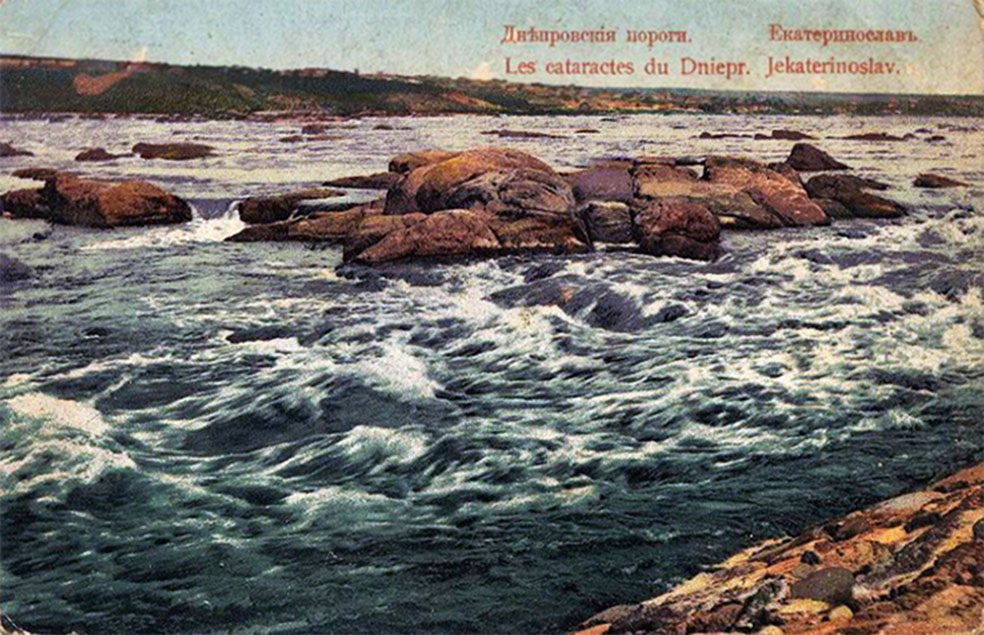
Then comes the passage that settled the philological argument. Constantine lists the seven great cataracts of the lower Dnieper, and for each he gives the name "in Rhosic" and the name "in Slavonic" — two different languages, for the same rocks, in the same document, from an informant who evidently had both 220:
| Constantine's Rhosic form | Old Norse | Constantine's Slavonic form | Meaning he gives |
|---|---|---|---|
| Essoupi | Sof eigi | (same) | "Do not sleep" |
| Oulvorsi | Hólmfors | Ostrovouniprach | "Island waterfall" |
| Gelandri | Gellandi | — | "Noise of the rapid" |
| Aeifor | Eyforr | Neasit | "Pelican" / ever-violent |
| Varouforos | Bárufors | Voulniprach | "Wave waterfall" |
| Leanti | Hlæjandi | Veroutzi | "Boiling of the water" |
| Stroukoun | Strukum | Naprezi | "The little rapid" |
The Slavonic column is transparently Slavic. The Rhosic column is transparently Old Norse. A Byzantine emperor writing in Constantinople in the 950s, with no stake whatever in a controversy that would not begin for eight hundred years, recorded that the people called Rus and the people called Slavs spoke two different languages, and preserved enough of both to be checked. Every serious modern treatment of the question starts here 1157.
The rapids themselves are gone. They were drowned in 1932 by the reservoir of the hydroelectric dam at Zaporizhzhia. The last photographs of them date from the 1910s.
What changed and what was replaced
From a convoy to a country
The transformation the atlas is tracking is not the arrival of Norsemen. Norsemen had been arriving since the 750s. It is the conversion, across roughly four generations, of a seasonal extractive operation into a territorial state — and the mechanism of that conversion was the annual tribute circuit that Constantine described.
Poliudie is the pivot. It is a system with two faces. Seen from Kyiv, it is revenue: an armed retinue rides out each winter, visits the tributary peoples, collects furs and slaves and provisions, and returns in spring to load the convoy. Seen from a Drevlyanian village, it is an occupation that arrives annually with weapons. It is also, crucially, a claim to territory. A trading post claims a site; a tribute circuit claims everything the circuit touches. Once you are riding the same route every November, you have a border, whether or not you have a word for one 115.
The consequences compounded:
- A single point of aggregation. Everything the forest zone produced now flowed to Kyiv before it flowed anywhere else.
- A permanent armed retinue — the druzhina — maintained year-round out of that flow, and therefore available for purposes other than trade 21.
- A diplomatic personality. By 907 the Rus were raiding Constantinople in enough force to extract terms; by 911 they had a written treaty.
- A dynasty. The line traced from Rurik through Igor, Olga, Sviatoslav and Volodymyr ruled in the East Slavic lands until 1598.
The names in the treaty of 911
The strongest single piece of documentary evidence for the composition of the early Rus elite is the list of envoys preserved in the Primary Chronicle's copy of the treaty concluded with the emperor Leo VI in 911. The chronicle records fifteen names for the Rus side, and they are, without exception, Norse 31:
Karl, Ingjald, Farulf, Vermund, Hrollaf, Gunnar, Harold, Kami, Frithleif, Hroarr, Angantyr, Throand, Leithulf, Fast, Steinvith.
Set beside the second treaty, concluded around 944, the list becomes an instrument for measuring change. The 944 preamble carries dozens of names — envoys, merchants, members of the ruling household — and a substantial number of them are Slavic 18. In one generation, the governing class of Rus went from uniformly Norse-named to mixed. Two generations after that, the ruling prince is called Sviatoslav, a Slavic name borne by the son of Igor and Olga, both of whose names are Norse (Ingvar, Helga).
The Norse did not conquer the Slavs, and they did not simply assimilate to them either. Both were dissolved into a thing that had not existed before either of them arrived at it.
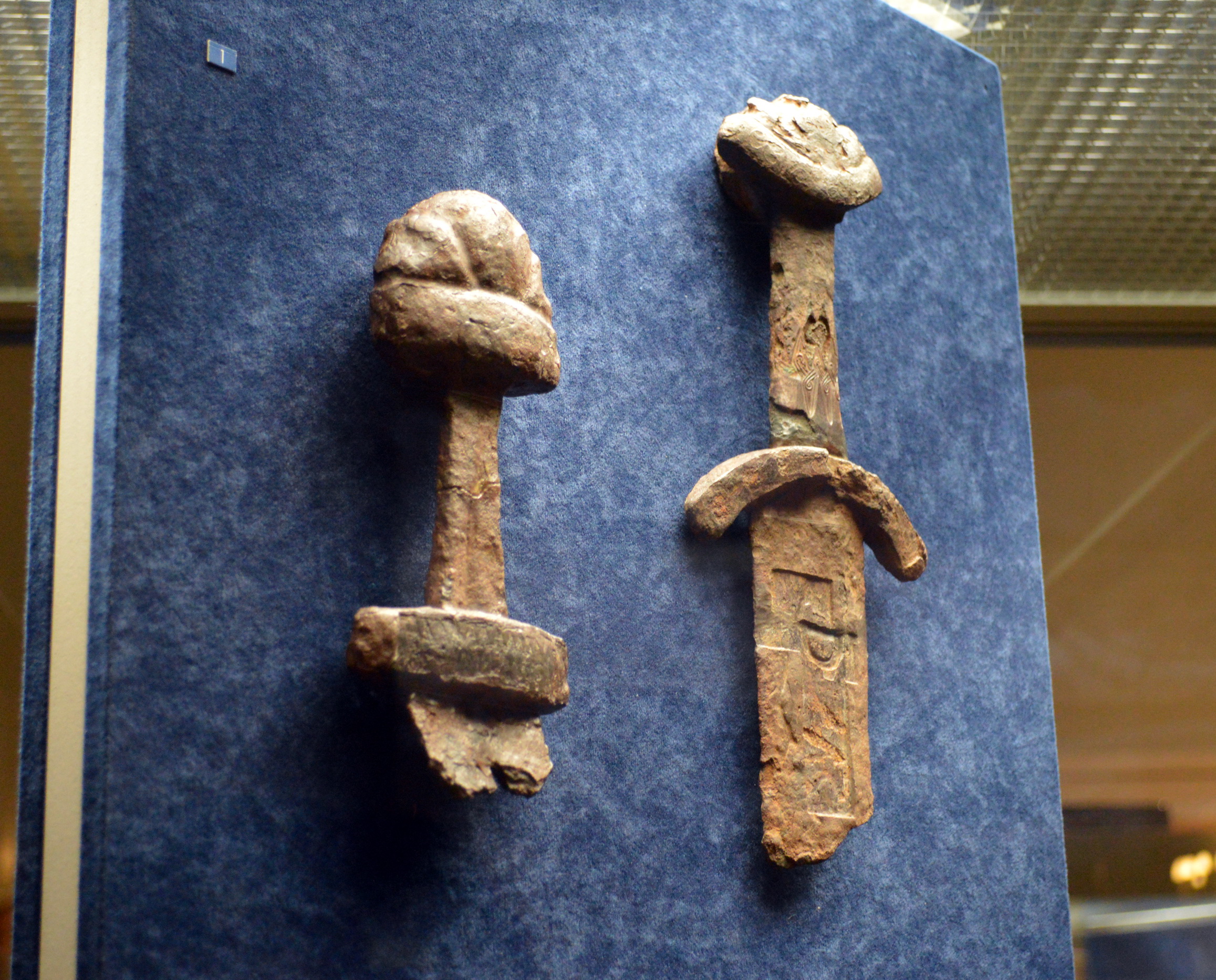
That is the synthesis, and it is visible in the ground as well as on the page. At Gnezdovo on the upper Dnieper — the great portage complex near modern Smolensk, at its height between roughly 920 and the 960s, with thousands of burial mounds — Scandinavian boat-cremations and chamber graves sit in the same cemetery field as Slavic and Baltic burials, and the grave goods mix Scandinavian brooches, Frankish swords, Byzantine silks and Islamic silver in single assemblages 56. At Chernihiv, the enormous mid-tenth-century kurgan known as the Black Grave produced Scandinavian-style sword hilts, Byzantine coins, and a pair of decorated aurochs drinking horns whose ornament has no single national parent at all.
Constantinople as counterparty and employer
The other half of the transformation happened at the southern end of the route. A war-band that raids a city is a nuisance; a polity that signs a treaty with it has been recognised. The 911 agreement with Leo VI is a working commercial and legal instrument, and its provisions describe a relationship rather than a truce 31:
- Regulated access. Rus merchants entering Constantinople were to be lodged in a designated quarter outside the walls, enter the city in limited numbers, unarmed, and under an official's supervision.
- Reciprocal legal procedure. Killing, theft and assault between Rus and Greeks were assigned agreed remedies rather than left to reprisal.
- Shipwreck and salvage obligations on both sides — the clause of a treaty between parties who expect to keep meeting.
- Military service. Rus who wished to serve the emperor were free to do so, and the emperor undertook to accept them.
That last provision matters more than its length suggests. It converted the surplus of an armed society into an export as reliable as furs, and it ran for centuries: Rus and later Scandinavian troops in imperial service became the standing formation known as the Varangian Guard, and the traffic in fighting men between the northern rivers and the Bosphorus outlasted the trade in silver that began it 1216.
The relationship was not sentimental in either direction. Constantine VII was writing a manual on how to manage the Rus, in a chapter that sits between advice on handling the Pechenegs and advice on handling the Khazars. The Rus, for their part, attacked Constantinople in 860, in 907, in 941 and again in 1043. Treaty and assault were two settings on the same instrument, and both parties understood the arrangement as a negotiation conducted partly in writing and partly in ships.
Olga's reform, 947: the first administration
Poliudie had a structural flaw, and in 945 it killed a prince. According to the Primary Chronicle, Igor collected tribute from the Drevlyanians, sent most of his retinue home, then returned with a small party to demand more. The Drevlyanians came out from Iskorosten and killed him, on the reasoning the chronicler puts in their mouths: if a wolf gets among the sheep and is not killed, he will take the whole flock 3.
What followed is the atlas's clearest example of a cost and an institutional advance being the same event. Olga's reprisals as the chronicle narrates them — Drevlyanian envoys buried alive in a boat, a second embassy burned in a bathhouse, a massacre at Igor's funeral feast, and finally the burning of Iskorosten — belong to a text with an obvious folkloric architecture, four escalating revenges in the manner of a saga, and the atlas does not present them as reportage 38. But the reform that follows is a different kind of claim, administrative and dull in exactly the way invented stories are not.
In 947, the chronicle says, Olga travelled the Novgorod land and the Msta and the Luga and established pogosty and uroki: fixed places at which tribute was to be delivered and fixed quantities in which it was owed 3. The change is small on the page and enormous in effect:
- Tribute became predictable. A quota is a number the payer can know in advance.
- Collection became territorial rather than personal. The prince's agents sat at fixed points; the circuit no longer had to be ridden by the prince himself with an army.
- The occasion for the Drevlyanian war was removed. The killing of Igor was caused by a demand that exceeded custom. Fixing the amount abolished that category of dispute.
- A local infrastructure of authority appeared. The pogost is the ancestor of a whole subsequent geography of administrative and later parish centres.
Valentin Yanin argued that Olga's settlement should be read as the earliest germ of the legal tradition that emerges in written form as the Russkaya Pravda 8. Whether or not one accepts the direct line, the structural point stands: this is the moment the polity stops being a war-band with a route and starts being a government with a map.
What was replaced
Set against the gains, the ledger of what the transmission displaced is specific:
- The tribal polities. The Drevlyanians as an autonomous people end in 946. The Vyatichi, the last to be brought in, are recorded as tributaries to the Khazars until Sviatoslav's campaigns and are still being fought in the eleventh century. The chronicle's tribal list is, functionally, a casualty list.
- The Khazar tributary system, and with it the Khazar polity itself — destroyed outright, as the next section sets out.
- The pre-Christian religion of the East Slavs. Volodymyr's pantheon of 980 and its demolition in 988 bracket the entire documented life of East Slavic paganism: it is described only in the act of being installed by a prince who then abolished it. No East Slavic pre-Christian text exists.
- The Norse identity of the ruling house, which is the counter-current in this record. By 988 the dynasty was Slavic-speaking and Orthodox Christian. The Scandinavian element did not conquer; it was absorbed.
What the cost was: the commodity was people
The silver is a receipt
The founding revenue of the Rus polity was the export of enslaved human beings, and the evidence for this is not literary but numismatic. Hundreds of thousands of Islamic silver dirhams have been recovered from hoards across Scandinavia, the Baltic and the East Slavic river lands — a flow of coin from Abbasid Iraq and then Samanid Central Asia so far outside normal exchange volumes that it demands an explanation in kind 1413.
The northern forest zone exported furs, wax, honey, amber and slaves. Of those, only one has the value density to account for the silver at the observed scale, and only one leaves the archaeological signature that Marek Jankowiak's work identifies: settlement disruption in the Slavic lands correlated in time with the dirham surge 13. Jankowiak's reconstruction — that the ṣaqāliba of the Arabic sources were the principal commodity, not an incidental one — has become the leading interpretation of the silver, though the conversion from coin volume to a number of human beings remains genuinely contested and published estimates vary by an order of magnitude. The atlas does not assert a total. It asserts what the sources assert.
Ibn Rusta, writing at the turn of the tenth century, is unambiguous about the business model: the Rus "have no cultivated lands; they eat only what they carry off from the land of the Saqlaba" 18. The Arabic geographers were describing a functioning export economy, and its inventory was people taken from the same East Slavic communities that this record's "Before" section describes.
The trade was legal, routine and written down
It is important not to file this under atrocity, which would let it off too lightly. Slaving was not an aberration in the Rus system; it was a line item in its diplomacy. The treaty of 944 contains clauses dealing with enslaved people as commodities and as fugitives — a price schedule for a Rus-held captive who escapes to the Greeks, obligations to return runaways in either direction, provisions on the sale of captives taken in war 31. Governments write clauses like that about trades they expect to continue.
The destinations were far beyond the Black Sea. Enslaved people moving south and east out of the Slavic lands reached Baghdad, Khurasan, the Samanid cities of Central Asia, Fatimid Egypt and Umayyad al-Andalus, where ṣaqāliba became a standing category in the sources — palace guards, administrators, eunuchs 13. The eunuch trade in particular required castration centres along the route, which is a detail that resists euphemism and should not be given one.
Three things follow, and the atlas states all three:
- The victims are anonymous. Not one enslaved person from this traffic is known by name. The chronicle names princes; the treaties name envoys; the coin names caliphs. The commodity is uncounted and unnamed by design.
- The perpetrators were mixed. By 900 the retinues doing the raiding were Norse-led but not Norse-only, and the tributary system's beneficiaries increasingly had Slavic names. This was not one people selling another; it was a state selling the people it governed and the people next door.
- The proceeds built the institution. The silver did not merely enrich individuals. It paid the druzhina, and the druzhina was the government.
922, at Bulgar
The most detailed surviving eyewitness account of the Rus was written by an Abbasid envoy who met them at the Volga Bulgar market in 922. Ahmad ibn Faḍlān described their appearance, their trading, their idols, their washing, and then — at length, and with evident discomfort — the funeral of one of their chieftains 1110.
The dead man's property was divided in three: for his family, for his grave-clothes, and for the drink consumed at the ceremony. A girl among his enslaved household was asked who would die with him; one agreed, or was made to agree. For ten days she was given drink and attended. Then, aboard the beached ship, she was held down by an old woman whom Ibn Faḍlān says the Rus called the Angel of Death, stabbed between the ribs while two men strangled her with a cord, and burned with her owner 1112.
James Montgomery's study of the passage warns against reading it as neutral ethnography — Ibn Faḍlān was a Muslim jurist recording what he regarded as barbarism, and his narrative is shaped by that judgment 10. The warning is correct and does not change the material fact recorded, which is corroborated in kind by the archaeology of Rus chamber graves containing more than one body. The atlas names the event as what it was: the murder of an enslaved woman as a funeral good.
946: Iskorosten
The cost of the tribute system fell on the tributaries, and it is documented most fully at the point where they refused. Iskorosten was the Drevlyanian centre; after the killing of Igor in 945, the chronicle has Olga besiege it and, by the ruse of the tribute of sparrows and pigeons, burn it down. Of the survivors, the account states that some were killed, some given to the retinue as slaves, and the rest left to pay tribute 3.
The Drevlyanian episode's narrative furniture is folkloric. Its outcome is not: an autonomous East Slavic people, named in the chronicle's own tribal list, ceases after 946 to appear as a political actor. Whatever the sparrows were, the polity was extinguished.
965–969: the end of Khazaria
The largest single act of destruction in this record was directed outward. Sviatoslav, son of Igor and Olga, campaigned against the Khazar khaganate from about 965: Sarkel on the Don was taken and refounded as a Rus post, and in 968–969 the capital Itil at the Volga mouth and the Caspian city of Semender were destroyed 168. The chronology and whether it was one campaign or two remain debated.
The result is not debated. A polity that had dominated the western steppe for three centuries, that had given the Rus ruler his first title, and that had taxed the East Slavic forest zone, ceased to exist as a state. The geographer Ibn Ḥawqal, writing in the 970s, records the aftermath in a sentence that has been quoted ever since: today, he says, no trace remains of Bulghar, nor of Burtas, nor of Khazar, because the Rus destroyed them all 19.
That is a first-hand contemporary judgment of scale, from a writer with no reason to flatter anyone involved. The Khazar case also completes the record's logic. The tribute system the Norse-led retinues built in the forest was a competitor to the Khazar tribute system, drawing on the same population and selling into the same markets. When the northern operation grew strong enough, it did not negotiate a share. It removed the incumbent.
983: the lot falls on a Varangian's son
One last documented death belongs here, because it shows the cost running in the other direction. In 983, after a successful campaign, the Primary Chronicle says the elders and boyars at Kyiv cast lots to select a youth for sacrifice, and the lot fell on the son of a Varangian who had come from among the Greeks and was a Christian. The father refused to hand the boy over, denounced the idols, and a crowd tore down his house and killed them both 3.
The two are commemorated as Theodore and John, the first martyrs named in the East Slavic record. The episode is a small one and it is doing several kinds of work at once: it is evidence of human sacrifice at Kyiv within five years of the conversion; it is evidence that Christianity was already present in the Rus elite through Byzantine service; and it is evidence that the Norse-descended population of Kyiv was by then divided against itself along a line that had nothing to do with origin.
The argument that has not ended
Since the eighteenth century, the question of how Scandinavian early Rus was has been fought as a proxy for something else. The first scholars to publish the medieval sources systematically — Bayer, Müller and Schlözer, working in the Russian Imperial Academy — argued for a Scandinavian origin of the Rus. Mikhail Lomonosov led the opposition, proposing a Slavic derivation from the Ros, a Dnieper tributary; the anti-Normanist line was taken up again by Gedeonov, Ilovaisky and Vasilevsky in the late nineteenth century, and was elevated to something close to state doctrine in the Soviet period.
The evidentiary position in 2026 is not symmetrical, and the atlas does not pretend it is. The Norse etymology of Rus, the exclusively Norse envoy list of 911, Constantine VII's two-language rapids, the 839 identification of the Rhos as Swedes, and the Scandinavian material in the burials at Gnezdovo, Chernihiv and Ladoga constitute a body of independent, mutually corroborating evidence from four different traditions 11557. Modern anti-Normanism is a revisionist minority position within the scholarly mainstream.
What that evidence does not support is the use to which it is regularly put. A Norse etymology for a state's name says nothing about who built the state, whose descendants live in it, or who has a claim to it — the polity of 950 was already Slavic-speaking, and its ruling family had been absorbed within four generations. Franklin and Shepard's framing is the sane one: the question is not the ethnicity of a founder but the assembly of a system, and the system was built by Norse, Slavs, Finns and Balts working the same rivers 1. The record ends where it began, with a word. Rus meant rowing. It was a description of an activity, applied by one people to another, and it became the name of a third thing that neither of them had set out to make.
What followed
-
753Dendrochronology dates the earliest structural timbers at Ladoga on the Volkhov to no later than 753 CE - the oldest firmly dated Norse settlement in eastern Europe, a century before the Primary Chronicle's founding narrative.
-
839The Annals of St-Bertin record men calling themselves Rhos at Louis the Pious's court at Ingelheim, sent to Constantinople by a ruler titled chacanus; Frankish investigation concludes they are Swedes. The first appearance of the name in a European document.
-
882Oleg is said to have taken Kyiv and made it the seat of the Rus, moving the polity's centre from the Volkhov to the middle Dnieper and onto the road to Constantinople.
-
911The Rus-Byzantine treaty of 911 is concluded with Leo VI. Its fifteen named Rus envoys - Karl, Ingjald, Farulf, Vermund, Hrollaf and the rest - are without exception Norse.
-
922Ahmad ibn Fadlan, envoy of the Abbasid caliph, witnesses a Rus ship-cremation at the Volga Bulgar market, including the killing of an enslaved girl by the woman he calls the Angel of Death.
-
945Igor is killed by the Drevlyanians at Iskorosten after returning to demand tribute beyond the customary amount. The structural flaw in the poliudie circuit becomes lethal.
-
947Olga establishes pogosty and uroki - fixed collection points and fixed tribute quotas - across the Novgorod land and the Msta and Luga rivers. The first administrative reform recorded in the East Slavic lands.
-
969Sviatoslav destroys Sarkel, and in 968-969 Itil and Semender. The Khazar khaganate, which had taxed the East Slavic forest zone for three centuries, ceases to exist as a state.
-
983At Kyiv the lot for a human sacrifice falls on the son of a Varangian Christian; father and son are killed by a crowd. Commemorated as Theodore and John, the first martyrs named in the East Slavic record.
-
1932The Dnieper rapids that Constantine VII recorded in both Norse and Slavic are submerged by the reservoir of the hydroelectric dam at Zaporizhzhia. The last photographs date from the 1910s.
Where this lives today
References
- Franklin, Simon, and Jonathan Shepard. The Emergence of Rus 750-1200. Longman History of Russia. London and New York: Longman, 1996. en
- Constantine VII Porphyrogenitus. De Administrando Imperio. Greek text edited by Gyula Moravcsik, English translation by R. J. H. Jenkins. Revised edition. Dumbarton Oaks Texts 1. Washington, DC: Dumbarton Oaks Center for Byzantine Studies, 1967. grc primary
- Cross, Samuel Hazzard, and Olgerd P. Sherbowitz-Wetzor, trans. The Russian Primary Chronicle: Laurentian Text. Cambridge, MA: The Mediaeval Academy of America, 1953. orv primary
- Nelson, Janet L., trans. The Annals of St-Bertin. Ninth-Century Histories, vol. 1. Manchester: Manchester University Press, 1991. la primary
- Duczko, Wladyslaw. Viking Rus: Studies on the Presence of Scandinavians in Eastern Europe. The Northern World 12. Leiden and Boston: Brill, 2004. en
- Androshchuk, Fedir. Vikings in the East: Essays on Contacts along the Road to Byzantium (800-1100). Studia Historica Upsaliensia 240. Uppsala: Uppsala universitet, 2013. en
- Мельникова, Е. А. Древняя Русь и Скандинавия: Избранные труды. Под ред. Г. В. Глазыриной и Т. Н. Джаксон. Москва: Русский Фонд Содействия Образованию и Науке, 2011. ru
- Петрухин, В. Я. Русь в IX-X веках: От призвания варягов до выбора веры. Москва: Форум / Неолит, 2013. ru
- Schramm, Gottfried. Altrußlands Anfang: Historische Schlüsse aus Namen, Wörtern und Texten zum 9. und 10. Jahrhundert. Rombach Wissenschaften, Reihe Historiae 12. Freiburg im Breisgau: Rombach, 2002. de
- Montgomery, James E. "Ibn Faḍlān and the Rūsiyyah." Journal of Arabic and Islamic Studies 3 (2000): 1-25. en
- Ibn Faḍlān. Mission to the Volga. Edited and translated by James E. Montgomery. Library of Arabic Literature. New York: New York University Press, 2017. ar primary
- Lunde, Paul, and Caroline Stone, trans. Ibn Fadlān and the Land of Darkness: Arab Travellers in the Far North. London: Penguin Classics, 2012. ar primary
- Jankowiak, Marek. "Tracing the Saqāliba: Slave Trade and the Archaeology of the Slavic Lands in the Tenth Century." In Felix Biermann and Marek Jankowiak (eds.), The Archaeology of Slavery in Early Medieval Northern Europe. Cham: Springer, 2021, pp. 161-181. en
- Noonan, Thomas S. The Islamic World, Russia and the Vikings, 750-900: The Numismatic Evidence. Variorum Collected Studies Series. Aldershot: Ashgate/Variorum, 1998. en
- Shepard, Jonathan. "The Origins of Rus' (c. 900-1015)." In Maureen Perrie (ed.), The Cambridge History of Russia, Volume 1: From Early Rus' to 1689. Cambridge: Cambridge University Press, 2006, pp. 47-72. en
- Golden, Peter B., Haggai Ben-Shammai, and András Róna-Tas (eds.). The World of the Khazars: New Perspectives. Handbook of Oriental Studies, Section 8: Uralic and Central Asian Studies 17. Leiden: Brill, 2007. en
- "Vikings in Russia: origins of the medieval inhabitants of Staraya Ladoga." Archaeological and Anthropological Sciences (2019). DOI: 10.1007/s12520-019-00897-2. en
- Ibn Rusta. Kitāb al-Aʿlāq al-nafīsa (Book of Precious Records), c. 903-913. English selections in Lunde and Stone, Ibn Fadlān and the Land of Darkness (London: Penguin, 2012). ar primary
- Ibn Ḥawqal. Kitāb Ṣūrat al-Arḍ (The Configuration of the Earth), c. 977. English selections in Lunde and Stone, Ibn Fadlān and the Land of Darkness (London: Penguin, 2012). ar primary
- Jenkins, R. J. H., F. Dvornik, B. Lewis, Gy. Moravcsik, D. Obolensky and S. Runciman. Commentary on the De Administrando Imperio. Dumbarton Oaks Texts. London: Athlone Press, 1962. en
- Katona, Csete. "Rus' Warriorhood: Warfare, Society and Identity." PhD dissertation, Central European University, 2024. en
- Melnikova, E. A., and V. Ja. Petrukhin. "The Origin and Evolution of the Name Rus': The Scandinavians in Eastern-European Ethno-Political Processes before the 11th Century." Tor 23 (1990-91): 203-234. en