The Norse reached America in 1021 — and left with two stolen boys
Three sod halls at the tip of Newfoundland, a decade of voyages into the Gulf of St Lawrence, and the first recorded killing of Indigenous North Americans by Europeans. Almost nothing crossed in either direction. This is the atlas's control case: what a transmission looks like when the receiving culture does not want it and the senders cannot compel it.
In 1021 — a date now fixed to the calendar year by a solar storm recorded in tree rings — Norse crews out of a Greenland colony of about five hundred people were felling timber at Epaves Bay, on the northern tip of Newfoundland. They built eight sod structures, smelted the first iron in the Americas, and carried butternuts home from the Gulf of St Lawrence. They traded red cloth and dairy for furs, and refused to trade iron. They killed eight men found sleeping under three overturned skin boats, lost their leader to the arrow that answered it, and sailed home with two abducted children. Then they stopped coming. Nothing of theirs entered the Indigenous record. The story was put to use nine hundred years later.
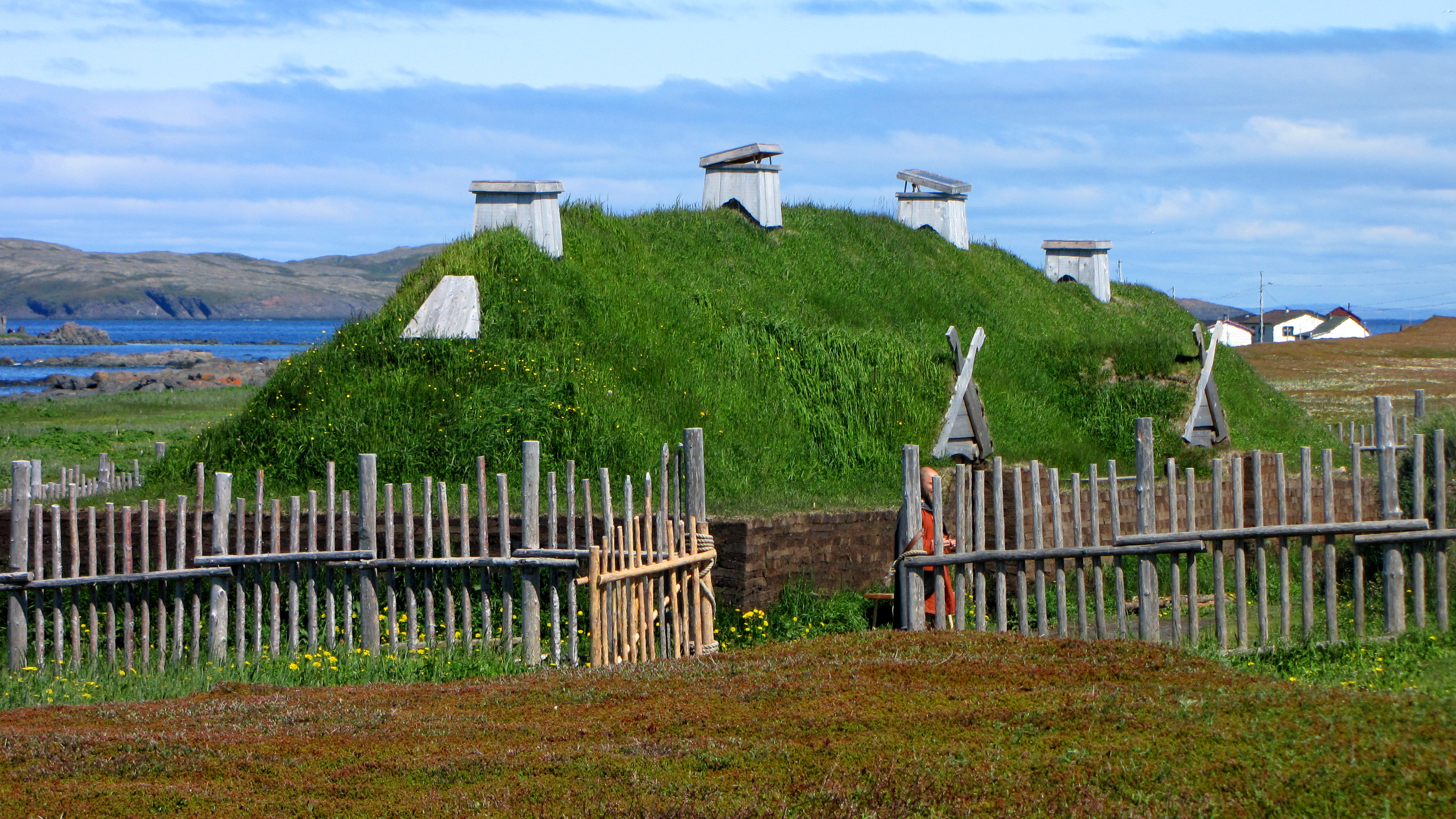
The coast the Norse sailed into
In the year 1021, three trees were felled at the top of the Great Northern Peninsula of Newfoundland, on a shallow inlet now called Epaves Bay, by people using iron blades 3. They had not arrived at an empty coast. Epaves Bay had been in use for something over five thousand years before them, and the archaeological sequence there records at least five distinct Indigenous occupations before the Norse and one after 4. The Maritime Archaic tradition worked the bay from roughly 4000 to 1000 BCE. The Groswater Palaeo-Inuit followed, c. 1000–500 BCE. Middle Dorset occupations date to c. 400–750 CE, the Cow Head and Beaches complexes to c. 800–850 CE, and the Little Passage tradition — immediate ancestors of the people the English would later call Beothuk — to c. 1200–1500 CE 4. The Norse slotted into a gap in that sequence, and the gap was about a century and a half wide.
This is the first thing to hold steady, because almost every popular account of Vinland gets it backwards. The Norse were not the first people to reach North America, or the hundredth, or the ten-thousandth. They were latecomers to a continent whose northern coastline had been inhabited, mapped in memory, hunted, fished and buried in for millennia. What they were was the first people from the eastern hemisphere to arrive and leave a written account, which is a much smaller claim and a much more interesting one.
Who was on the coast in 1021
Three broad populations were within reach of the Norse landings, and they were not one people.
- Recent Indian traditions (Beaches, then Little Passage) — the island of Newfoundland, from roughly the eighth century through to European contact. Ancestral to the Beothuk. Their deposits at L'Anse aux Meadows itself sit on both sides of the Norse layer 4.
- Ancestors of the Innu — the interior and coast of Labrador, the country the Norse named Markland.
- Dorset Palaeo-Inuit — northern Labrador, Baffin Island and the high Arctic; a genetically and culturally distinct Arctic population, unrelated to the Recent Indian peoples, who had left the island of Newfoundland by around the eighth century 11.
A fourth population is conspicuously absent. The Thule, ancestors of today's Inuit, had not yet expanded across the Canadian Arctic into Greenland; that movement comes roughly two centuries later. Whoever the Norse met in 1021, it was not them.
Which of the three the sagas call skrælingar is genuinely unresolved, and the atlas will not pretend otherwise. The saga descriptions of skin-covered boats and of a weapon flung from a pole — usually read as a sling or a form of ballista — point toward a Palaeo-Inuit material culture. The dense Recent Indian occupation immediately around L'Anse aux Meadows points toward ancestral Beothuk. Annette Kolodny, reading the sagas' southern voyages against Wabanaki oral tradition, argues for the ancestors of the Mi'kmaq and other Dawnland peoples further south in the Gulf of St Lawrence 9. All three readings are held by serious scholars. None is secure.
These were economies, not absences
The habit of describing pre-contact North America by what it lacked is a bad habit, and it distorts this record specifically, because the story of Vinland is a story about a receiving culture that did not need anything the senders had.
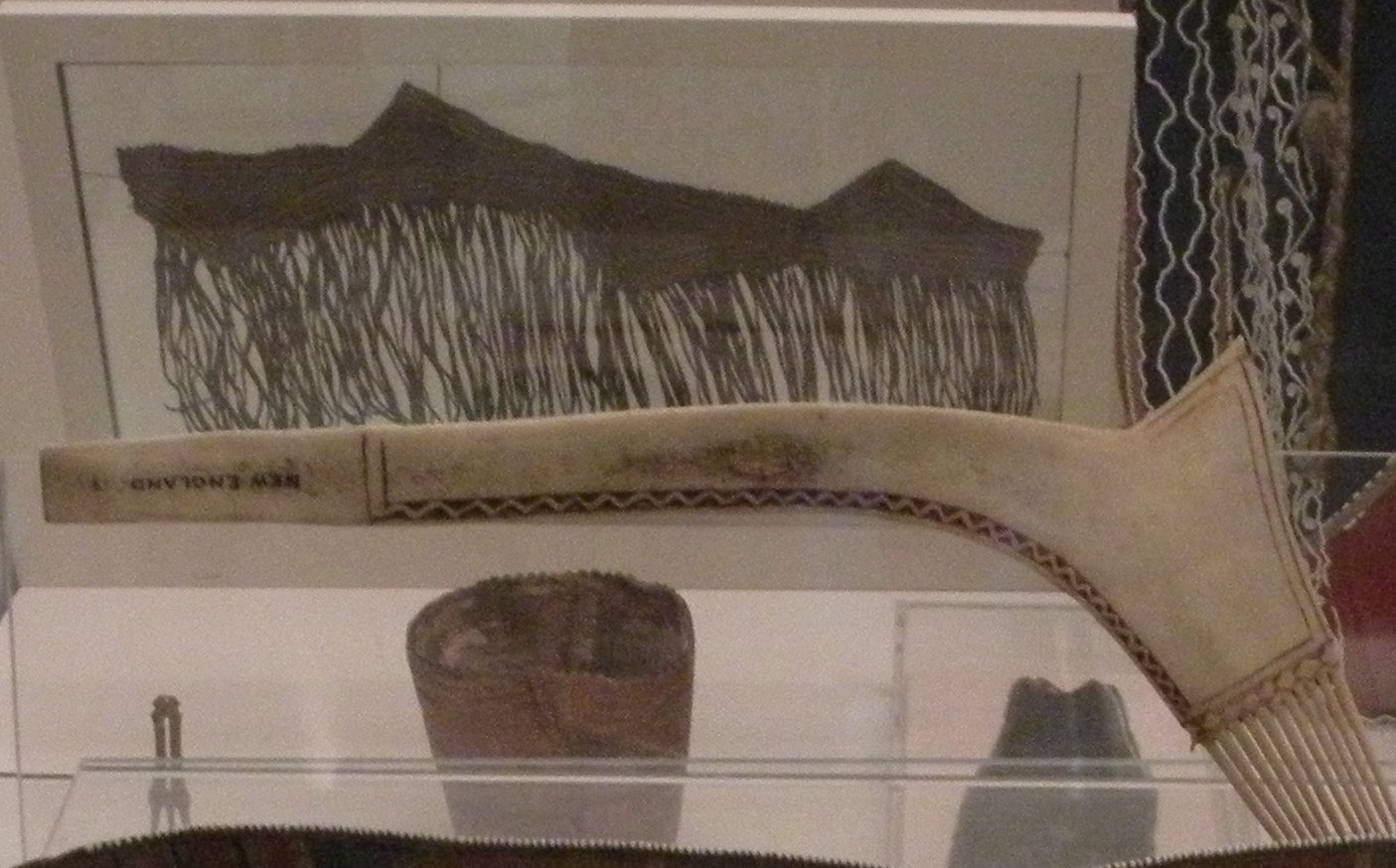
The peoples of the Newfoundland and Labrador coast in the eleventh century ran marine-mammal and caribou hunting economies of considerable technical sophistication. They had skin boats capable of open-water work, bows, ground-stone and bone toolkits, sea-ice knowledge, seasonal round systems that moved populations between interior caribou grounds and coastal seal and bird colonies, and — in the Beothuk case, documented later — an elaborate use of red ochre on bodies, tools, canoes and burials that gave the people their English nickname 10. Their birchbark canoes had a distinctive high-sided design suited to coastal crossings. They were not waiting for anything.
What they did not have was metallurgy, domesticated stock beyond the dog, cereal agriculture, sail, and writing. The Norse had all five. In the standard account of a transmission, that asymmetry is the engine: the party with the harder technology transmits it, and the receiving culture is rebuilt around the gift. That is what happened when the arquebus reached Tanegashima and when the alphabet reached the Aegean. It is not what happened here, and the reason it did not is the substance of this record.
The demographic side of the asymmetry ran the other way, and it ran hard. Population estimates for the pre-contact northeast are contested and always will be, but the orders of magnitude are not in doubt: the peoples of Newfoundland, Labrador and the Gulf of St Lawrence in the eleventh century numbered in the thousands to tens of thousands, and the Greenland Norse who might in principle have followed the ships numbered about five hundred, of whom perhaps ninety were ever at Epaves Bay at once 16. Every transmission in this atlas that reshaped a receiving culture ran along a gradient of force, of numbers, or of desire. On this coast the force gradient pointed at the Norse, the numbers gradient pointed at the Norse, and the desire gradient — the one thing that could have carried a transmission across on its own — was blocked by the senders themselves.
The word skræling
The Old Norse skrælingi, plural skrælingar, is the word both Vinland sagas use for every Indigenous person the Norse encounter, from Newfoundland to Markland, and it is not neutral. Its likeliest derivation is from a root meaning dried, shrivelled or shrunken; the Icelandic sources later apply the same word to the Thule Inuit met in Greenland. It flattens at least three unrelated peoples into one contemptuous category, and the flattening is itself a piece of evidence: the Norse were not curious enough about the people they met to distinguish them.
Eiríks saga rauða gives a description that is hostile in the same register. The Norse see boats — "nine canoes made of hides" with "snout-like staves" brandished from them — and then, at closer range, people: "They were short men, ill-looking, with their hair in disorderly fashion on their heads; they were large-eyed, and had broad cheeks" 6. That is the first written European physical description of an Indigenous American. It is a caricature written by someone who was, at most, repeating a two-hundred-year-old story, and it set a tone that held.
A colony of five hundred sends ships west
Greenland: a farming culture with no forest and no ore
The Vinland voyages did not come from Norway or from Denmark. They came from a two-generation-old colony on the fjords of south-western Greenland, founded around 985 by Eiríkr rauði after his outlawry from Iceland, and that colony's specific problem is the whole explanation for the voyages 13.
The Greenland Norse were Icelanders by descent and by law, farming cattle, sheep and goats on thin fjord pasture, hunting seal and caribou, and exporting walrus ivory. Their population at the turn of the millennium was on the order of five hundred people; at its thirteenth-century height, the Eastern Settlement around Eiríksfjörður and Einarsfjörður together with the smaller Western Settlement near modern Nuuk may have supported two to three thousand 13. They were structurally short of two materials their entire technology assumed. Greenland has no forest worth the name, and every ship, every roof beam, every barrel stave had to be driftwood, imported, or fetched. Greenland has no accessible iron ore, and iron was the material that made a Norse ship a Norse ship.
The colony's one export of value was walrus ivory, hunted on the Norðrsetur grounds far up the west coast in summer and shipped east through Iceland and Norway, where it paid for the iron, the grain, the church fittings and the ships' gear the Greenlanders could not make 13. That is the shape of the economy: a European farming society running on an Arctic hunting subsidy, at the end of the longest supply line in the medieval North Atlantic, permanently one bad decade from insolvency. Kirsten Seaver's reconstruction makes the point that the Greenlanders were not marginal people clinging on at the edge of the world; they were a functioning, church-building, tithe-paying, Latin-literate community that happened to be located where the two commonest materials in the European toolkit did not exist.
A community in that position has two options when it needs timber and iron: buy them from Norway at the far end of the ivory trade, or go and get them. Labrador is 700 kilometres from the Greenland fjords. Norway is 3,000.
So the ships went west, and the first documented one went by accident.
Bjarni's refusal and Leifr's purchase
Grœnlendinga saga — the earlier and, most scholars think, the more reliable of the two Vinland sagas — opens the sequence with Bjarni Herjólfsson, blown off course on a run from Iceland to Greenland and carried past three unknown coasts 5. He describes them in order: land that was flat and forested, then a second of similar character, then a third that was "high and mountainous with glaciers on it" 6. Bjarni does not land on any of them. He is looking for his father, he finds him at Herjólfsnes, and the sagas record that he was criticised for his lack of curiosity.
Leifr Eiríksson bought Bjarni's ship and retraced the route in reverse, and the naming is one of the more purely commercial acts in medieval literature. Each land is named for what could be taken from it. The glacier coast becomes Helluland, flat-stone land. The forested coast becomes Markland, forest land — "Because of its resources, this land shall be named, and it will be called Markland" 6. The third becomes Vínland. These are not the names of a discoverer. They are the names of a supply survey.
The year 1021, to the year
For four decades after Helge Ingstad and Anne Stine Ingstad identified the Norse structures at L'Anse aux Meadows in 1960, the site's date was a radiocarbon range: somewhere around the turn of the millennium, give or take a lifetime 78. In 2021 that changed.
Margot Kuitems, Birgitta Wallace and colleagues took three pieces of worked wood from the Norse deposits — fir, probably balsam fir, and a juniper or thuja — each of which "had all been modified by metal tools, evident from their characteristically clean, low angle-in cuts," which on this coast in this period means Norse, because no Indigenous population there worked wood with metal 3. In 993 CE a cosmic-ray event, almost certainly a solar storm, drove atmospheric radiocarbon up by about nine parts per thousand worldwide, leaving a spike visible in tree rings on every continent. The team found the 993 spike, counted outward to the bark-edge ring, and got twenty-nine. All three trees were felled in the year 1021.
The paper's own summary of what this means is worth quoting exactly: "Our new date lays down a marker for European cognisance of the Americas, and represents the first known point at which humans encircled the globe" 3. That second clause is the larger claim. Human populations had spread east out of Africa across Eurasia and into the Americas by the Bering land bridge; in 1021 a westward-moving branch met the far edge of an eastward-moving one, and the species closed a loop it had been open on for fifty thousand years.
A 2019 study by Paul Ledger, Linus Girdland-Flink and Véronique Forbes complicates the neatness slightly and usefully. Bayesian modelling of the site's legacy radiocarbon puts the start of Norse activity at cal AD 910–1030 and its end at cal AD 1030–1145, and the team identified a previously unrecorded cultural layer dating to the twelfth or thirteenth century containing walnut and hop-type pollen and beetle species known from Norse contexts in Greenland 4. Their reading is careful: this points to "sporadic Norse activity beyond the early 11th century" rather than continuous settlement, and raises the possibility that L'Anse aux Meadows "could have been a shared zone of interaction" 4.
Eight buildings, ninety people, under a decade
What the ground holds is not a colony. It is a base.
| Feature | Evidence |
|---|---|
| Structures | Eight, in three complexes: three dwelling halls, four workshops, one smithy |
| Construction | Sod over a wooden frame, in the Icelandic and Greenlandic manner |
| Metalworking | Bog-iron smelting and a forge — the first iron smelting anywhere in the Americas |
| Boats | Shoreline depressions interpreted as boat sheds; iron boat rivets in quantity |
| Personal objects | A bronze ring-headed pin of Norse type; a soapstone spindle whorl |
| Occupancy | On the order of sixty to ninety people at maximum |
| Duration | Under a decade of use, probably far less in aggregate |
The spindle whorl matters more than its size suggests. Spinning was women's work in Norse society, and its presence at the site is one of the strongest indications that the Vinland voyages carried women as well as crews — which the sagas independently assert, naming Guðríðr Þorbjarnardóttir, who bore a son named Snorri in Vinland, and Freydís Eiríksdóttir 12.
Birgitta Wallace, who worked the site for Parks Canada across four decades, established the interpretation that has held: L'Anse aux Meadows was a gateway, a winter base and transshipment point at the entrance to a much larger region, not the Vinland of the sagas but the door to it 216.
The butternuts, and how far south the ships went
The single most informative object from the site is a nut.
Three butternuts — Juglans cinerea — and one worked butternut burl were recovered from the Norse deposits 12. Butternut has never grown in Newfoundland. It does not grow anywhere within hundreds of kilometres of L'Anse aux Meadows. The nearest wild stands are in north-eastern New Brunswick and the St Lawrence valley, and they occupy almost exactly the same range as wild grapes, and ripen at the same season. Somebody carried them north.
The butternut therefore does what no saga sentence can: it proves, materially, that the Norse working out of Epaves Bay reached the southern Gulf of St Lawrence, roughly the Miramichi and Chaleur Bay country, where grapes grow and the sandbars, rivers and hardwoods of the saga description of Hóp are all present 12. Vinland was not a place. It was a coastline several hundred kilometres long, of which the Newfoundland base was the northernmost hinge.
Wallace's account of why this coastline was nevertheless abandoned is the most economically literate thing written about the episode. Vinland offered grapes and lumber, both of which were available in Europe; what it "lacked" were "other essentials: luxury metals, spices, textiles, weapons, and armour — and family, political, religious, and personal connections" 16. The voyage from Greenland exceeded 2,500 kilometres, farther than the run to Norway. And the Greenland colony had abundant unused land at home and nothing like the population to work a second frontier.
What changed, and what was replaced
Here the record breaks the pattern of every other entry in this atlas, and it is worth stating the break plainly rather than dressing it up. What changed in the receiving culture was, as far as five decades of excavation can determine, nothing.
The trade that is on the record
Trade did happen, and both sagas describe it in enough detail to be credible.
In Eiríks saga rauða, Þorfinnr Karlsefni's party at Hóp trades with people who arrive by water and want one thing: "this people in their purchases preferred red cloth; in exchange they had furs to give, and skins quite grey" 6. The Norse ran short of cloth and began cutting it into narrower and narrower strips; the saga records, with what reads like admiration for a good market, that "the Skrælingar gave for it still quite as much, or more than before" 6. In Grœnlendinga saga the currency is dairy instead: Karlsefni "asked the women to bring out dairy products to them, and as soon as they saw the dairy products, they wanted to buy those and nothing else," and the goods that came the other way were "gray pelts, sable, and all kinds of furs" 6.
Read carefully, this is a fur-trade transaction of exactly the kind that would dominate the same coast from the sixteenth century onward — furs out, textiles and novelties in — occurring five hundred years early, in miniature, and lasting one season.
Karlsefni's embargo
There is one more clause, and it is the most consequential sentence in either saga.
"The Skrælings then untied their bundles and offered them, wanting to trade for weapons, but Karlsefni forbade his men to trade weapons with them" 6.
The Indigenous traders knew what they wanted. It was not cloth and it was not cheese; those were what they settled for. They wanted iron, and the Norse leadership understood immediately that iron was the one commodity that could not be allowed across, because iron was the entire margin of Norse advantage in a place where they were outnumbered. The first arms embargo in the history of the Americas was declared before the first winter was out, and it was declared on iron.
That decision is the hinge of the whole record. The Norse arrived carrying the technology that would, five centuries later, restructure the continent. They knowingly withheld it. The transmission failed in part because the senders refused to make it — and the refusal tells us something the sagas do not say outright, which is that both parties understood the stakes of the exchange perfectly well. The people on the beach were not marvelling at wonders. They were assessing a trade partner, identifying the one item worth having, and asking for it. They were refused, and they went on refusing to be interested in the substitutes.
What may have crossed: the contested evidence
Three bodies of evidence have been advanced for Norse material reaching Indigenous hands, and all three are contested. The atlas gives each its strongest form and its objection.
- The Helluland material. Patricia Sutherland's Helluland Archaeology Project examined four Dorset sites — Nanook in the Tanfield Valley on southern Baffin Island, Nunguvik on northern Baffin, Avayalik in northern Labrador, Willows Island in Frobisher Bay — and reported Scandinavian-style spun yarn, notched and decorated wood, European-type whetstones bearing traces of copper alloy and smelted iron, a whalebone shovel of Greenlandic Norse form, tally sticks, Old World rat fur, and stone-and-turf construction 12. Sutherland reads these as sustained contact, possibly a trading station. The objection is blunt: the Royal Ontario Museum characterises the objects as only "possibly" indicating contact, and critics have concluded that "there appears to be no convincing archaeological evidence that contact occurred." The dispute is unresolved and became institutionally bitter.
- The Maine penny. A silver penny of Óláfr kyrre of Norway, struck between 1065 and 1080, recovered in 1957 by an amateur digger at the Goddard site on Naskeag Point in Maine — an Indigenous settlement with a wide trade network, occupied c. 1180–1235. Kolbjørn Skaare of the University of Oslo identified the coin and published it in 1979 15. The coin is unquestionably genuine. Its provenance is not: it was lifted without archaeological control by a collector, and a planted-hoax reading remains live.
- The L'Anse aux Meadows overlap layer. The twelfth-to-thirteenth-century deposit reported in 2019, with its Norse-associated ecofacts sitting in a horizon that may be Indigenous in affiliation, is the most recent and the most cautious of the three. Its own authors describe it as raising "more questions than answers" 4.
Notice what is not on this list: a single Norse artefact securely excavated from an undisturbed Indigenous context in Newfoundland, and a single Indigenous adoption of Norse technique anywhere.
What did not cross: the receiving culture's record
The negative evidence is the strongest evidence in this record, and it is unusually clean.
The Little Passage sequence on the island of Newfoundland runs unbroken from roughly the twelfth century to European contact in the sixteenth, and into the Beothuk of the historical period, and it shows no iron, no Norse-derived form, no change in toolkit, no change in settlement pattern, and no discontinuity that anyone has been able to attribute to the events of 1021 410. No Norse loanword has ever been securely identified in Beothuk, in Innu-aimun, or in Mi'kmaq. No Indigenous oral tradition of the encounter has been recovered that scholars agree is independent of the sagas, though Kolodny argues that Wabanaki traditions of stone-carrying strangers preserve something of it 9. In material terms the Norse passage through Newfoundland is close to archaeologically invisible from the Indigenous side.
Neither condition existed here. The receiving cultures wanted iron and were refused it; they did not want cloth and cheese enough to reorganise around them. And the Norse could not compel, because there were sixty or ninety of them at the far end of a 2,500-kilometre supply line, and there were, on the coastlines they were probing, populations orders of magnitude larger. Wallace's judgement is that eastern New Brunswick alone held a Mi'kmaq population dense enough to offer "formidable resistance" to any Norse encroachment 16.
What changed on the Norse side
The one culture measurably altered by the Vinland voyages was the one that made them, and even there the change was informational rather than material.
Vinland entered the northern European record and stayed there. Adam of Bremen, writing his Gesta Hammaburgensis ecclesiae pontificum around 1075 on the authority of King Sveinn Ástríðarson of Denmark, reports an island in the ocean "called Winland, because grapevines grow there wild, yielding the finest wine," where "crops grow there in plenty without having been sown" 18. That notice, written barely fifty years after the felling of the trees at Epaves Bay, is the oldest surviving written reference to the American continent by anyone from the eastern hemisphere. It is four sentences long, and nothing followed from it for four hundred years.
The knowledge did not become a project. It became a place-name in a chronicle and, two centuries later, two sagas.
It is worth being precise about why nothing followed, because the usual answers are wrong. It was not that the Norse forgot; the 1347 annal entry proves they did not. It was not that the route was lost; Markland was reachable in a week from the Greenland fjords. It was not even, primarily, that the Skrælingar were hostile, though Karlsefni's conclusion says they were. It was that the only society with both the ships and the geographic knowledge to act on Vinland numbered a few hundred people, was already fully extended maintaining two settlements on Greenland, and had no surplus population, no state, no capital and no institution capable of mounting a colonial project. The knowledge sat in the one place in Europe that could not use it. When Greenland itself failed — the Western Settlement gone by the mid-fourteenth century, the Eastern Settlement silent after the 1450s — the knowledge went with it, surviving only as literature in Iceland 13.
Markland: three centuries of quiet extraction
One thread does run on, and it is the thread that shows what the relationship actually was.
The Icelandic annals record, under the year 1347, a small ship arriving in Iceland from Greenland, blown off its course home, with a crew of seventeen or eighteen and a cargo of timber taken in Markland 17. It is a routine entry about a routine voyage, which is exactly why it matters. Three hundred and twenty-six years after 1021, Greenlanders were still crossing the Davis Strait to cut wood on the Labrador coast, and it was unremarkable enough that the annalist mentions it only because the ship ended up in the wrong country.
That is the shape of the Norse relationship with North America in a sentence: not settlement, not conquest, not exchange, but a small, persistent, undocumented extraction of timber from a coast whose inhabitants had no say in the matter. The 1347 entry is the last written record of a European reaching the Americas before Columbus.
What the cost was
The transmission failed. The killing did not.
Eight men under three boats
Grœnlendinga saga places the episode on Þorvaldr Eiríksson's expedition, the second of the Vinland voyages, a year or two after Leifr's. Þorvaldr's party rounds a headland he likes enough to say, in the saga's phrasing, "It is beautiful here, and here I would like to build my home." Then:
"They then returned to the ship and saw three mounds on the sand inland from the headland and went there to investigate and saw three skin boats and three men under each. They divided their party and captured all of them, except one who escaped with his boat. They killed the other eight and then returned to the headland" 6.
Nine men were asleep, or sheltering, under three overturned skin boats on a beach. The Norse divided into three parties so that all three boats could be taken at once, which means the action was planned rather than panicked. They seized all nine. One got away. They killed the remaining eight.
No motive is supplied — not theft, not threat, not provocation, not even the formulaic honour-injury that Icelandic saga narrative usually supplies to make a killing legible. The men are found, taken and killed, and the narrative moves on to the return to the headland. This is the first recorded killing of Indigenous North Americans by Europeans, and its most striking literary quality is that the text does not think it requires explanation.
Krossanes
The retaliation came the same day. A large force of skin boats came down the fjord; the Norse defended from behind gunwale-shields; and Þorvaldr took an arrow through the gap between the ship's side and the shield.
"I have received a wound under my arm," he says in the saga, "and an arrow flew between the ship's side and the shield, under my arm, and here is the arrow, and this will be my death. Now I advise you to prepare your journey back as quickly as possible, and you shall carry me to that headland which I found most suitable for settlement... You shall bury me there and set crosses at my head and my feet, and always call it Krossanes from now on" 6.
Cross-ness. Cross-headland. The first European to die on the North American mainland is buried under a Christian cross on land he had chosen, in the saga's own sequencing, immediately before killing eight of the people who lived on it. The text supplies a full page of ritual for the burial of one Norseman and one clause for the deaths of eight Indigenous men. That imbalance is not the atlas's editorialising; it is the primary source's own architecture, and every account of Vinland written since has inherited it.
Hóp, and Freydís with the sword
Eiríks saga rauða records the second violent encounter, at Hóp, during Karlsefni's expedition, and this one begins as commerce and turns.
A bull belonging to Karlsefni's party "rushed out of the wood and bellowed loudly," and the traders scattered; when they returned it was in numbers and in arms, "a great crowd of Skrælingar boats, coming down upon them like a stream," with "war-slings, or catapults" throwing something heavy enough to rout an armoured line 6. The Norse broke and ran. The rout was stopped by Freydís Eiríksdóttir, pregnant and unable to keep up, who picked up a dead man's sword, bared her breast and struck it with the flat of the blade: "At this they were frightened, rushed off to their boats, and fled away" 6.
The saga's casualty count is precise and small: "Two of Karlsefni's men fell, and four of the Skrælingar" 6. And the conclusion Karlsefni draws is the epitaph of the whole enterprise — that "though the land might be choice and good, there would be always war and terror overhanging them," and that they should therefore go home 6.
There is one more killing to enter, and it is Norse-on-Norse. Grœnlendinga saga gives Freydís a later expedition in partnership with two Icelandic brothers, Helgi and Finnbogi, which ended when she engineered a quarrel and had their party bound and killed: "All the men were killed, but the women were left, and no one wanted to kill them. Then Freydís said, 'Lay an axe in my hand.' This was done, and she killed the five women there, striking them down herself" 6. Five women, killed with an axe by the daughter of Eiríkr rauði, in Vinland. Whatever else the sagas are, they are not a heroic account.
Two boys taken at Markland
The last documented act of the Vinland voyages is an abduction, and it is the least-known fact in this record.
Sailing home, Karlsefni's ships put in at Markland — the Labrador coast — and found a small group on shore: one bearded man, two women, two boys. The Norse took the two boys. The adults escaped. The saga then reports, without comment, what was done with them: "They taught them their language and baptized them" 6. It records the boys' testimony in Norse — that their mother was called Vætilldi and their father Uvægi, that two kings ruled over their people, named Avaldamon and Avaldidida — and it records that the ships carried them to Greenland to overwinter with Eiríkr's household 6.
Two children were taken from a beach in Labrador by armed strangers, carried across the Davis Strait, stripped of their language and their religion, and used as informants. This happened 471 years before Columbus shipped Taíno captives from Hispaniola to Spain. Nothing further is known of them. The sagas do not record their original names — only the names of the parents they were taken from.

The bill, counted
The atlas's practice is to count, so here is the count. The documented human cost of the Vinland transmission, from the two saga sources, is:
| Event | Dead | Taken |
|---|---|---|
| Krossanes, Þorvaldr's expedition | 8 Indigenous men | — |
| Krossanes, retaliation | Þorvaldr Eiríksson | — |
| Hóp, Karlsefni's expedition | 4 Indigenous, 2 Norse | — |
| Markland, homeward voyage | — | 2 Indigenous boys |
| Freydís's expedition, internal | Helgi, Finnbogi and their men; 5 Norse women | — |
Twelve Indigenous people killed and two children abducted, against a European toll of Þorvaldr, two men at Hóp, and the party Freydís destroyed. Measured against the Antonine Plague or the Atlantic trade this is a rounding error, and the atlas is not going to inflate it into something it was not. Measured as a sequence, it is precise: contact, trade, refusal of the key technology, unprovoked killing, retaliation, battle, abduction, withdrawal. Every element of the post-1492 pattern is present in 1021, at a scale of twelve, because the demographic conditions that would later make it a continental catastrophe did not yet exist.
The bill that is not the Norse's
The Beothuk — the descendants of the Little Passage people whose deposits lie above and below the Norse layer at L'Anse aux Meadows — ceased to exist as a people in the nineteenth century. An English count in 1768 put them at about 350, perhaps half of an earlier figure; by 1811 the number recorded was 72 10. In March 1819 a party of settlers seized a woman named Demasduit at Red Indian Lake and killed her husband Nonosabasut when he tried to prevent it; she was renamed Mary March, painted in St John's by Lady Henrietta Martha Hamilton, and was dead within the year. Her niece Shanawdithit, the last known Beothuk, died of tuberculosis in St John's on 6 June 1829 10.
This is not the cost of the Norse transmission, and the atlas will not bill it to them. The causes were English and Newfoundland-settler: displacement from the salmon rivers and coastal sealing grounds the Beothuk depended on, deliberate violence, tuberculosis, and eight hundred years of separation from anything that happened in 1021. Ingeborg Marshall's reconstruction, which remains the standard account, is a nineteenth-century history from end to end 10.
The distinction has to be made explicitly, because the alternative — letting a Norse record absorb a Beothuk catastrophe because both happened on the same island — is the exact failure mode this atlas exists to avoid. Costs belong to the transmissions that caused them. This one does not belong here. It is recorded here because the people who paid it are the same people whose ancestors drove the Norse off, and because a record that mentions the Beothuk only as extras in a Viking story would be its own kind of erasure.
The afterlife of the record
The last cost of Vinland is the use that was made of it, and this one is not eleventh-century at all.
From the 1830s onward the Vinland sagas were pressed into service in the United States and Canada as a charter: proof of a white, Protestant, Norse first arrival that could be set against Catholic and Italian claims on Columbus and, more quietly, against Indigenous priority altogether. Annette Kolodny's In Search of First Contact is the definitive treatment of what she calls the Anglo-American anxiety of discovery — the long effort to find in the sagas a founding that excluded both the immigrants and the people already here 9. The Kensington runestone, the Newport tower, Leif Erikson Day, and a shelf of nineteenth-century books arguing that America was not discovered by Columbus all belong to this history.
Its emblem is the Vinland Map. Yale unveiled it in 1965, after seven years of study, as a fifteenth-century map showing Vinlanda Insula west of Greenland. In 2021 a Yale team led by Beinecke curator Raymond Clemens, using X-ray fluorescence and Raman microspectroscopy, showed that the map's lines and text are drawn in an ink containing titanium and barium — the signature of a titanium-white pigment first manufactured in the 1920s. Clemens's statement was not hedged: "The Vinland Map is a fake. There is no reasonable doubt here" 19. Kirsten Seaver had made the documentary case for forgery seventeen years earlier 14.
The Norse did not conquer North America. They did not colonise it, convert it, trade it into dependency, or transmit to it. They reached it, killed twelve people, stole two children, cut wood on it for three centuries, and went home. The damage done in their name was done nine hundred years later, by people who needed the story to mean something it did not.
What followed
-
1021L'Anse aux Meadows becomes the only authenticated Norse site in the Americas: eight sod-over-wood structures in three complexes, comprising three dwelling halls, four workshops and one smithy, occupied by roughly sixty to ninety people for under a decade.
-
1021The smithy at Epaves Bay smelts bog iron and works it at a forge — the first iron smelting carried out anywhere in the Americas, and a technology the Norse then explicitly refuse to trade.
-
1021Three butternuts and a worked butternut burl, of a species that has never grown in Newfoundland, prove that Norse crews reached the southern Gulf of St Lawrence — the New Brunswick coast where wild grapes and butternut share a range.
-
1005Eight Indigenous men are killed by Thorvald Eiriksson's party at the place the Norse then name Krossanes — the first recorded killing of Indigenous North Americans by Europeans. Thorvald dies of an arrow wound in the retaliation.
-
1010Thorfinn Karlsefni forbids his men to trade weapons to the Indigenous traders who ask for them — the first arms embargo in the history of the Americas, and the deliberate refusal that helps make the transmission fail.
-
1010Two Indigenous boys are seized on the Markland coast, carried to Greenland, baptised and taught Old Norse — an abduction that precedes Columbus's shipment of Taino captives to Spain by 471 years.
-
1075Adam of Bremen records Winland in the Gesta Hammaburgensis on the authority of the Danish king Sveinn Astridarson — the oldest surviving written mention of the American continent from the eastern hemisphere, and four sentences long.
-
1347The Icelandic annals record a Greenland ship blown to Iceland while returning from Markland with a cargo of timber, evidence that Greenlanders were still crossing the Davis Strait to cut wood 326 years after 1021, and the last written record of a European reaching the Americas before Columbus.
-
1960Helge and Anne Stine Ingstad identify the Norse structures at L'Anse aux Meadows, ending four centuries of speculation about Vinland's location; the site is inscribed as a UNESCO World Heritage Site in 1978.
-
2021Kuitems and colleagues fix the felling of three trees at the site to the exact year 1021 using the 993 CE cosmic-ray spike in tree rings, establishing the first calendar-precise date for a European presence in the Americas.
-
1965Yale unveils the Vinland Map as a fifteenth-century document; in 2021 X-ray fluorescence and Raman microspectroscopy show its ink contains titanium and barium from a pigment first manufactured in the 1920s, and the library declares it a forgery.
-
1829Shanawdithit, the last known Beothuk, dies of tuberculosis at St John's on 6 June 1829 — a nineteenth-century settler catastrophe that the atlas records here and explicitly declines to bill to the Norse transmission.
Where this lives today
References
- Wallace, Birgitta Linderoth. Westward Vikings: The Saga of L'Anse aux Meadows. St. John's: Historic Sites Association of Newfoundland and Labrador, 2006. en
- Wallace, Birgitta. "The Norse in Newfoundland: L'Anse aux Meadows and Vinland." Newfoundland and Labrador Studies 19, no. 1 (2003): 5-43. en
- Kuitems, Margot, Birgitta L. Wallace, Charles Lindsay, Andrea Scifo, Petra Doeve, Kevin Jenkins, Susanne Lindauer, Pinar Erdil, Paul M. Ledger, Veronique Forbes, Caroline Vermeeren, Ronny Friedrich, and Michael W. Dee. "Evidence for European Presence in the Americas in ad 1021." Nature 601, no. 7893 (2022): 388-391. en
- Ledger, Paul M., Linus Girdland-Flink, and Veronique Forbes. "New Horizons at L'Anse aux Meadows." Proceedings of the National Academy of Sciences 116, no. 31 (2019): 15341-15343. en
- Eyrbyggja saga; Groenlendinga saga; Eiriks saga rauda. Islenzk fornrit IV, edited by Einar Ol. Sveinsson and Matthias Thordarson. Reykjavik: Hid islenzka fornritafelag, 1935. is primary
- The Vinland Sagas: The Norse Discovery of America. Groenlendinga saga and Eirik's Saga, translated with an introduction by Magnus Magnusson and Hermann Palsson. Harmondsworth: Penguin Classics, 1965. Passages also checked against the Icelandic Saga Database editions of Groenlendinga saga and Eiriks saga rauda. en primary
- Ingstad, Helge. Vesterveg til Vinland: oppdagelsen av norrone boplasser i Nord-Amerika. Oslo: Gyldendal Norsk Forlag, 1965. no
- Ingstad, Anne Stine, and Helge Ingstad. The Norse Discovery of America. 2 vols. Oslo: Norwegian University Press, 1985. en
- Kolodny, Annette. In Search of First Contact: The Vikings of Vinland, the Peoples of the Dawnland, and the Anglo-American Anxiety of Discovery. Durham, NC: Duke University Press, 2012. en
- Marshall, Ingeborg. A History and Ethnography of the Beothuk. Montreal and Kingston: McGill-Queen's University Press, 1996. en
- Fitzhugh, William W., and Elisabeth I. Ward, eds. Vikings: The North Atlantic Saga. Washington, DC: Smithsonian Institution Press in association with the National Museum of Natural History, 2000. en
- Sutherland, Patricia D. "The Norse and Native North Americans." In Vikings: The North Atlantic Saga, edited by William W. Fitzhugh and Elisabeth I. Ward, 238-247. Washington, DC: Smithsonian Institution Press, 2000. See also the Helluland Archaeology Project reports on the Nanook, Nunguvik, Avayalik and Willows Island sites. en
- Seaver, Kirsten A. The Frozen Echo: Greenland and the Exploration of North America, ca. A.D. 1000-1500. Stanford: Stanford University Press, 1996. en
- Seaver, Kirsten A. Maps, Myths, and Men: The Story of the Vinland Map. Stanford: Stanford University Press, 2004. en
- Skaare, Kolbjorn. "En norsk penning fra 11. arh. funnet pa kysten av Maine, USA." NNF-Nytt 2 (1979): 4-17. no
- Wallace, Birgitta. "L'Anse aux Meadows: Different Disciplines, Divergent Views." In Viking Settlements and Viking Society: Papers from the Proceedings of the Sixteenth Viking Congress, edited by Svavar Sigmundsson. Reykjavik: University of Iceland Press and Hid islenzka fornleifafelag, 2011. en
- Islandske Annaler indtil 1578, edited by Gustav Storm. Christiania: Det norske historiske Kildeskriftfond, 1888. The Markland entry appears under the year 1347. no primary
- Adam of Bremen. Gesta Hammaburgensis ecclesiae pontificum, book IV, chapter 39, composed c. 1073-1076. English translation: History of the Archbishops of Hamburg-Bremen, translated by Francis J. Tschan. New York: Columbia University Press, 1959; revised edition 2002. la primary
- "Beinecke Library's Vinland Map Determined to Be a Fake." Yale University Library news release, 1 September 2021, reporting the X-ray fluorescence and Raman microspectroscopy analysis led by Raymond Clemens. en