The wheel rolls out of Uruk and rewrites how Eurasia moves (~3500 BCE)
A two-wheeled cart pictograph scratched on a clay tablet in the Eanna precinct of Uruk around 3500 BCE marks the earliest secure record of wheeled transport. Within five centuries the technology was on the Pontic-Caspian steppe, riding under Yamnaya wagon-dwellers, and the speed of the Old World had been permanently reset.
In the late fourth millennium BCE, scribes in the Eanna temple precinct at Uruk in southern Mesopotamia incised onto clay tablets the earliest known pictographs of wheeled vehicles — a sledge body resting on two disc wheels, dated by associated radiocarbon to 3517–3370 cal BCE. Within a single human lifetime, near-identical depictions appear on a Funnel Beaker pot at Bronocice in southern Poland and as deep parallel cart ruts beneath a long barrow at Flintbek in northern Germany. By 3000 BCE wagons with solid disc wheels were being buried, in pieces, above Yamnaya graves on the Pontic-Caspian steppe. The wheel itself was a peaceful gift. The wagon-pastoral economy it enabled carried Indo-European speech into Europe and South Asia, displaced earlier languages whose names we have lost, and put the timber of three continents under sustained pressure for the first time. The cost of the wheel is not a sacked city. It is the silent reorganisation of how every later civilisation would move.

A world without the wheel
Before the late fourth millennium BCE, every overland load in Eurasia was moved by the same three means: a human back, a pack animal, or a sledge dragged across mud, snow, or polished log rollers. None of those means scaled. A human porter could carry roughly twenty to thirty kilograms over a long day; an ox could carry sixty to eighty under a properly fitted load, and a donkey perhaps half that; a sledge pulled by a paired team across favourable terrain could move several hundred kilograms but lost most of that advantage the moment the ground roughened or the load was asked to climb 1. The bulk-transport ceiling for any settled community was set by these limits, and the limits were biological. They had been the same for the entire Neolithic.
The receiving societies of the wheel's diffusion were not undifferentiated. By 3500 BCE, the southern Mesopotamian alluvium under the late Uruk culture had built the world's first cities, with Uruk itself covering perhaps two hundred and fifty hectares and supporting a population variously estimated at twenty-five to forty thousand, fed by an irrigation economy that allowed barley yields per worker beyond anything available to dryland agriculture 2. Six hundred kilometres west, in the steppe and forest-steppe between the Dnieper and the Volga, scattered late Eneolithic communities — including the late Cucuteni-Trypillia, the Sredny Stog culture and its successors — were already managing cattle, sheep, and the first domesticated horses, but without cities, without writing, and without the surplus-accumulating temple economies that supported the Mesopotamian innovations 3. Northwest of that, in the Polish loess country and the North European Plain, Funnel Beaker (Trichterbecherkultur) farmers were raising long barrows and beginning the megalithic tradition of Atlantic and northern Europe. These were the populations who would receive the wheel.
What Mesopotamia already had
The wheel did not appear in Mesopotamia out of nothing. By the time the Eanna IVa scribes carved a wagon pictograph, the potter's wheel had been spinning in Mesopotamian workshops for at least five hundred years, and a sledge-based hauling industry was moving stone, reeds, and grain along temple causeways 2. The Uruk-period temple complexes contained mass-produced bevel-rim bowls used as ration containers in what John Nicholas Postgate has called "the first administered economy on a state scale" 4. Sledges were drawn by men or by paired oxen across a network of canal-side roads, and the technological imagination of the late Uruk craftsmen had already begun to fuse rotation with translation: a potter's wheel rotates without carrying anything, a sledge translates without rotating, and the wheeled wagon is the working synthesis of the two ideas.
What the Uruk world did not yet have was the axle. The decisive technical step was not the disc — anyone who has watched a log roll knows what a disc does — but the rigid axle and the fitted nave through which a wheel could turn independently while the load remained level 5. That assembly required carpentry tools and joinery skills that Uruk possessed in abundance for boat-building and door-hanging. The earliest wheels were not turned on a lathe and were not spoked. They were three planks of timber doweled edge-to-edge into a rough disc, sometimes sixty to ninety centimetres across, with a central socket cut for a fixed wooden axle 1. The whole assembly creaked, lost grease in summer, and would have travelled at three to four kilometres per hour over reasonable ground. It was enough.
What the steppe world had instead
The pre-wheel Pontic-Caspian steppe was a world organised around walking. The communities of the Sredny Stog horizon, c. 4500–3500 BCE, herded cattle and sheep in river-valley pastures and made occasional excursions out onto the grass with goods on their backs or on pack oxen. The Botai culture in northern Kazakhstan, dated to c. 3700–3100 BCE, has yielded the earliest secure archaeological evidence for the management of horses — the famous horse-milk lipid residues recovered from Botai pottery by Outram and colleagues 6 — but the horses of Botai were a dead-end domestication, genetically distinct from the modern domestic horse lineage that traces back, on the 2021 ancient-DNA work of Librado and colleagues, to the Volga–Don steppe around 2200 BCE 7. In other words: at the moment the wheel was first depicted at Uruk, no steppe community had a wagon, and no steppe community yet had the horse that would later pull it.
This is the calibration that lets us feel what the wheel changed. A steppe community in 3600 BCE had to keep its herds within walking distance of water. The grass between the river valleys, vast and ungrazed, was effectively unreachable. The steppe was not yet the steppe of horsemen and wagon-dwellers that Herodotus would describe four thousand years later. It was a strip of cattle pasture along the rivers, with empty grass on either side and pre-Indo-European languages spoken in valleys whose names we will never recover.
The Trypillia mega-sites in the loess country
West of the steppe proper, in the rich loess country between the Carpathians and the Dnieper, the Cucuteni-Trypillia complex of the late fifth and fourth millennia BCE represents the high-water mark of pre-wheel Eneolithic settlement in eastern Europe. The Trypillia phase BII–CI of the mid-fourth millennium produced what Müller, Rassmann, and Videiko have described as "mega-sites" — vast nucleated agglomerations such as Talianki, Maidanetske, and Nebelivka, each covering between two hundred and four hundred hectares with concentric rings of houses, plough-cultivated cereal fields running out from the perimeter, and population estimates in the upper thousands or low tens of thousands 22. The Trypillia communities painted geometric pottery on a scale and at a refinement not matched anywhere else in fourth-millennium Europe, smelted copper, and probably spoke a language of which we have no record and no descendant.
The Trypillia mega-sites are the closest thing to true cities that pre-Bronze-Age Europe produced. They did not have writing, did not have monumental temples or palaces, and did not have wheels. They moved bulk goods on the backs of oxen and on sledges, the same way the Linearbandkeramik farmers of the Rhine had done two millennia earlier. By 3300 BCE the mega-sites had begun to depopulate; by 3000 BCE they were abandoned. The standard archaeological reading attributes the collapse to soil exhaustion under intensive cereal cultivation, possibly compounded by climatic deterioration in the late Atlantic period, but the chronological coincidence with the arrival of wagon-pastoralism in the steppe immediately east is hard to ignore 22. The Trypillia world was the last great farming civilisation in eastern Europe that the wagon did not directly displace; in the centuries after its collapse, the same loess corridors would be repopulated by Yamnaya-descended communities who had wagons and no longer needed Trypillia-style nucleated farming to organise a landscape.
How the wheel moved
The spread of the wheeled vehicle across Eurasia in the late fourth millennium BCE is one of the most precisely datable diffusion events in prehistory, and one of the most contested. The earliest unambiguous depiction of a wheeled vehicle is the Eanna IVa pictograph at Uruk, a sledge body on two disc wheels in which Hans Nissen and Robert Englund have identified the proto-cuneiform sign that would become the Sumerian word gigir, "wagon" 8. Associated radiocarbon dates from the Eanna IVa archaeological context cluster between 3517 and 3370 cal BCE. The Bakker, Kruk, Lanting and Milisauskas synthesis published in Antiquity in 1999 — the foundation paper for any later discussion — laid out the European parallels alongside the Mesopotamian evidence and concluded that the two corpora were essentially contemporaneous 9.
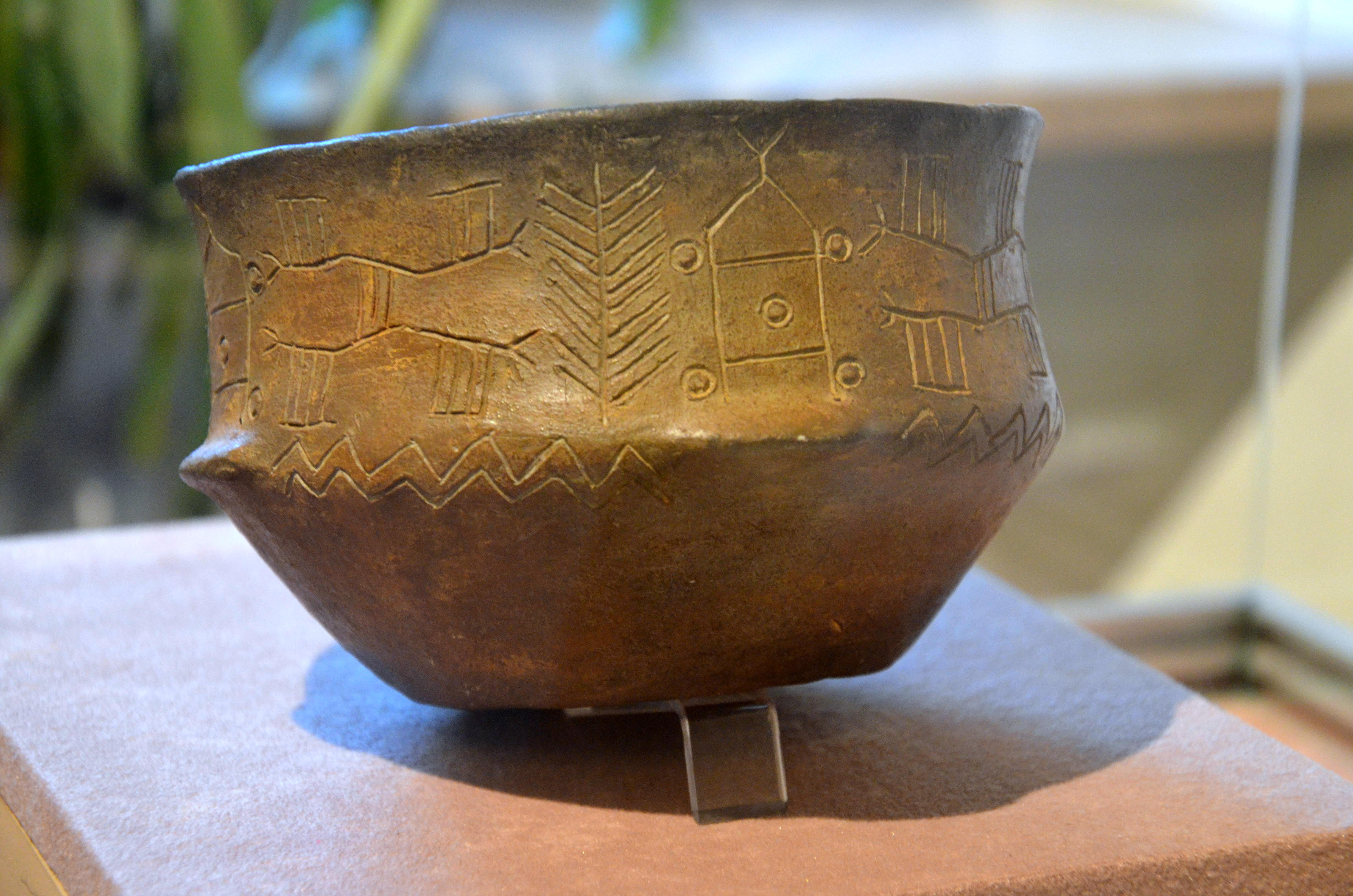
The Bronocice pot, a Funnel Beaker vessel excavated between 1974 and 1980 in the Polish loess country fifty kilometres northeast of Kraków, carries five rudimentary wagon depictions incised around its shoulder: a vehicle with a yoke pole and four wheels, drawn from above in the manner of a child's map 10. Animal bone in the same pit yielded a radiocarbon date around 3400 BCE. The pot is now held in the Archaeological Museum of Kraków. Sixty kilometres south of Kiel, at Flintbek in Schleswig-Holstein, parallel cart ruts beneath a megalithic long barrow have been radiocarbon-dated by Doris Mischka to between 3420 and 3385 cal BCE — the earliest direct evidence of wheeled-vehicle use anywhere in the world, the ruts themselves still preserved as the soil discolourations left by wagon wheels rolled across wet ground three and a half thousand years ago 11.
Five hundred kilometres north of Bronocice, in the peat of the Ljubljana Marshes at Stare gmajne, the oldest intact wooden wheel ever recovered — a disc of ash and oak, seventy-two centimetres in diameter, with its surviving oak axle — has been dated by dendrochronology and AMS radiocarbon to 3340–3030 cal BCE 12. It is held today in the City Museum of Ljubljana. The Ljubljana wheel is a generation or two later than the Eanna pictographs and the Bronocice pot, but it is the physical object the texts and drawings describe: a tripartite plank disc, four to five centimetres thick, fitted to a square axle that rotated with the wheel rather than under it. It is the wagon technology of the third European millennium frozen in waterlogged anoxia.
Was it one invention or several?
The Bakker 1999 synthesis treated the European and Mesopotamian evidence as contemporaneous but did not resolve the direction of diffusion. Stuart Piggott, in The Earliest Wheeled Transport (Thames and Hudson, 1983), had argued for a single origin — almost certainly Mesopotamian — with northward and eastward diffusion to Europe and the steppe; he treated the synchronicity of the European and Near Eastern evidence as the artefact of an extraordinarily rapid transmission rather than independent invention 13. The German archaeologist Stefan Burmeister, working in the Topoi Excellence Cluster's Digital Atlas of Innovations, has consistently pressed the polycentric alternative: the wheel-and-axle assembly is technically simple enough, he argues, that several independent fourth-millennium populations could plausibly have crossed the same threshold within a century or two of one another, and the assumption of a single point-source diffusion encodes a colonialist habit of reading prehistory 14.
The argument is not yet settled. The current consensus, summarised by David Anthony in The Horse, the Wheel, and Language (Princeton, 2007), leans toward a single late-fifth- or early-fourth-millennium origin somewhere in the broad zone of contact between the late Uruk world, the Caucasus, and the western steppe, with very rapid horizontal diffusion in all directions thereafter 15. The Allentoft and Haak ancient-DNA work of 2015 has nothing direct to say about the wheel itself, but it has reframed the surrounding history: by demonstrating a massive late-fourth- and third-millennium-BCE migration from the steppe into central Europe — the famous Yamnaya component that supplies roughly seventy-five percent of the ancestry of the Corded Ware horizon — it has shown that the technological transmission and the demographic transmission ran along the same routes at the same time 1617.
The northward path
The most carefully reconstructed route is the northern one, which connects the late Uruk world to the steppe through the Caucasus. Aleksandr Häusler in the late twentieth century and, more recently, Pavel Kuznetsov in Antiquity have traced the technological connection through the Maikop culture of the north Caucasian piedmont, c. 3700–3000 BCE — a society that was almost a Mesopotamian colony in some of its material culture, importing southern luxury metalwork and probably southern wagon technology 18. Maikop kurgans contain bronze ornaments paralleled in northern Syria and the disassembled remains of wheeled vehicles that look like the descendants of the Eanna pictograph. From the Maikop horizon the wagon moves north onto the steppe, where the Yamnaya cultural-archaeological complex, c. 3300–2600 BCE, will adopt and transform it.
The Maikop intermediary is the closest the wheel's diffusion comes to a documented relay. The Maikop chieftain's grave excavated by Nikolai Veselovsky at Oshad in 1897 yielded gold and silver vessels in unmistakeable Mesopotamian style, lapis lazuli imported through the same trade network that supplied the Eanna treasuries, and weapons in arsenical copper alloyed to the same proportions as the Uruk corpus 18. The Maikop society was not a Mesopotamian colony in the political sense, but it was a Mesopotamian client in the commercial sense, and the wagon arrived in its kurgans as a piece of the same import portfolio that brought the gold and the lapis. From Maikop the technology runs north across the steppe rivers on its own; by the early third millennium the wagon is at Storozhevaya Mogila, by the mid-third millennium it is at Sharakhalsun and Akkermen, and by 2500 BCE it has reached the eastern edge of the Yamnaya horizon at the foot of the southern Urals — where, three centuries later, the Sintashta culture will rebuild it as the spoke-wheeled chariot.
The European route and the loess corridor
The European route is harder to reconstruct because no single intermediary like Maikop stands out in the record, but the technical and chronological pattern is clear. By 3500–3300 BCE the wheel is in northern Germany (Flintbek), southern Poland (Bronocice), the Swiss lake-dwellings, and the southeastern Alpine foreland (Stare gmajne in the Ljubljana Marshes), with a near-synchronous distribution that has prompted Burmeister's polycentric argument 14. The earliest European wheels are technically distinct from the Mesopotamian disc — they tend to be tripartite plank assemblies rather than the cross-grain disc more characteristic of the southern corpus — but the conceptual jump is the same and the chronology is too tight for any plausible long northern overland route through the Balkans without leaving an intermediate trail of evidence we have not found. The most parsimonious reading remains a southern origin with multiple parallel transmission paths through the Caucasus and the Balkans, but the question is open and the literature is unsettled. Klimscha's 2018 German-language synthesis lays out the European evidence in its full detail and concludes, cautiously, that the central European wagon is technically autochthonous in its specific construction even if its original idea probably comes from the south 23.
What the wheel built on the steppe
The Yamnaya inheritance of the wagon is the largest single consequence of the Mesopotamian wheel transmission, and the one most directly visible in the human gene pool of modern Eurasia. By 3000 BCE, Yamnaya wagon burials had become standard practice across the Pontic-Caspian steppe. The wagons themselves were heavy, slow, ox-drawn objects with solid disc wheels of sixty to seventy centimetres' diameter — the same assembly seen in the Ljubljana wheel and presumably in the Eanna pictograph — and the typical Yamnaya wagon burial places the disassembled wagon over or beside a pit grave under a kurgan mound. Storozhevaya Mogila, on the Dnieper, excavated by Aleksei Terenozhkin in 1951, is the type site. The Sharakhalsun cluster in the North Caucasus piedmont preserves a sequence of wagon graves running through the Yamnaya into the succeeding Catacomb culture, c. 2600–2200 BCE 19.
What the wagon allowed, and what no earlier steppe technology had allowed, was the disconnection of the herd from the river. The grass between the rivers — vast tracts of the Pontic, Caspian, and southern Ural steppe that had been off-limits to settled pastoralists because they could not carry water far from a known source — became, for the first time, useable as primary pasture.
The wagon carried water, tents, women, children, cooking gear, and a portable household into the grass; the cattle followed. David Anthony, drawing on the linguistic and archaeological evidence together, argues that the wagon was the necessary technological precondition for the late Proto-Indo-European speech community's expansion across the steppe, because it was the wagon that made the eastern Pontic-Caspian grass habitable 15.
The Yamnaya horizon and the spread of Indo-European
The 2015 Allentoft and Haak ancient-DNA studies, published simultaneously in Nature, established what twenty years of linguistic argument had only suggested: the late-fourth- and third-millennium population of the steppe expanded westward into central Europe and eastward across the Eurasian grass at a scale and speed that justify the word "migration" in its full demographic sense 1617. The Yamnaya genetic component supplies roughly three-quarters of the ancestry of the Corded Ware horizon in central Europe, and a substantial component of the Late Neolithic and Early Bronze Age populations of Britain, Iberia, and the Balkans. On the linguistic side, James Mallory and Douglas Adams, in The Oxford Introduction to Proto-Indo-European, have shown that the late Proto-Indo-European lexicon contains a securely reconstructed wheel-and-wagon vocabulary — words for axle, nave, yoke, hub, and wheel — that fix the speech community in the period after wheeled transport had become culturally normal 20. The wagon vocabulary is in the protolanguage. The wagon technology is in the kurgans. The migration is in the DNA.
The consequences of the Yamnaya expansion are harder to count than the gold in a sacked palace, because they unfold across two millennia. By 2500 BCE the Corded Ware peoples of central and northern Europe — Yamnaya descendants with roughly twenty-five percent local Neolithic admixture — had reshaped the central European landscape; by 2000 BCE the Indo-Aryan-speaking communities of the southern Urals had developed, in the Sintashta culture of the Trans-Urals, the spoke-wheeled chariot that would carry the technology into a new phase entirely 21. The wagon and the wheel are the substrate of every subsequent step.
What the wheel replaced
The transmission did not arrive in an empty world. The wagon-pastoral economy displaced earlier ways of life and earlier speech communities whose names have not been preserved. The pre-Indo-European languages of central and northern Europe — the languages spoken by the makers of the megaliths, the Linearbandkeramik farmers, the Cucuteni-Trypillia town-dwellers of the Dniester loess — went extinct or were absorbed into the incoming Indo-European speech, with the exception of a few isolates such as pre-Greek that survived in toponyms and substrate vocabulary. Basque is the only language in Europe today that is undisputedly descended from a pre-Indo-European tongue spoken before the wagon arrived. Everything else — Greek, Latin, Celtic, Germanic, Slavic, Baltic, Albanian, Armenian, Iranian, Indic — descends from the speech of communities whose ancestors stood up beside a wagon at some point in the fourth or third millennium BCE 20.
The Cucuteni-Trypillia complex is the cleanest example of replacement. At its peak around 3700–3400 BCE, Cucuteni-Trypillia had produced what some scholars have called "mega-sites" — vast nucleated settlements such as Talianki and Maidanetske, each covering several hundred hectares with populations possibly approaching ten thousand, sustained by intensive cereal agriculture and a complex ceramic tradition 22. By 3000 BCE the Cucuteni-Trypillia mega-sites had been abandoned and the Trypillia language, whatever it was, had vanished from the archaeological record. The Yamnaya wagon-pastoralism that replaced them did not sack the mega-sites in any documented event; it absorbed, marginalised, and out-competed them across two centuries of demographic and ecological pressure. The destruction was structural. There are no named victims. There is only the silence of the abandoned tells along the Dniester.
What the wheel built in the cities
In the south, in Mesopotamia and its margins, the wheel did not produce migration. It produced a different transformation. Through the Early Dynastic period (c. 2900–2350 BCE) the wheeled wagon became a standard component of Mesopotamian urban infrastructure: temple processions, royal funerals, military supply trains, agricultural haulage. The Standard of Ur, c. 2600 BCE, now in the British Museum, shows four-wheeled battle wagons pulled by paired equids — almost certainly onagers or onager-donkey hybrids — running over fallen enemies on its War panel. The wagons of the Standard of Ur are not chariots in the later steppe sense; they are heavy, slow, four-wheeled platforms with solid disc wheels of the same family as the Ljubljana wheel 13. The Standard's wagon driver is depicted with the reins wrapped around his waist, hands free for a javelin — a postural detail that the Egyptian and Hittite military scribes of the second millennium would later copy with their lighter spoke-wheeled chariots.

The pictographic gigir sign of late Uruk evolved through the Early Dynastic into the Sumerian cuneiform sign for "wagon" and "chariot" alike; in Akkadian the word is narkabtu and refers principally to the lighter military vehicle of the second millennium. The administrative tablets of the Ur III period (c. 2100–2000 BCE) record the issue of wagons to royal messengers and the maintenance schedules for the temple wagon teams 4. The wheel had become, in the southern alluvium, a piece of the bureaucratic furniture.
The specific Mesopotamian innovation that the steppe did not develop, and that distinguishes the southern from the northern reception of the wheel, is the battle wagon as an institutional military formation. The Standard of Ur is not a folk-art depiction of one chieftain's outing; it is the formal record of an Early Dynastic city-state's military establishment, in which the four-wheeled battle wagon stands at the head of an organised army with infantry behind. The Royal Cemetery at Ur excavated by Leonard Woolley in 1922–34 yielded the physical wagons themselves — wooden frames preserved as soil discolourations, with the bronze nail-heads of the wheel rims surviving as visible objects, all carefully recorded by Woolley's draughtsmen 4. The Ur III administrative texts a few centuries later record the salaries of wagon-builders attached to specific temple complexes and the rations issued to the teams of onagers that drew them. None of this institutional military infrastructure existed on the contemporary steppe, where the wagon was a domestic and pastoral technology rather than a state-military one — a divergence that lasted until the Sintashta chariot innovation of c. 2000 BCE collapsed the distinction.
What the cost was
The wheel is a record with a low cost severity rating because the transmission itself was not violent. No city was sacked at the moment a wagon arrived. The receiving steppe populations adopted the technology with apparent enthusiasm and integrated it with their own pastoralism rather than under any duress. The Maikop intermediaries between Uruk and the steppe were trading partners, not subject peoples. Nothing in the archaeological record of the late fourth millennium suggests that the wheel travelled at the point of a spear, or that the populations who acquired it paid a tribute or surrendered an autonomy in exchange.
But a low rating is not a zero rating, and the wheel's bill, when it comes, comes in the dispersed structural form that the integrated-cost framing of this atlas is designed to capture.
The timber drawdown
The first and most directly attributable cost is the pressure on the woodland resource. The solid-disc wagon wheel of the late fourth and third millennia was a substantial piece of carpentry: three planks of seasoned hardwood, doweled together with hardwood pegs, fitted to a square hardwood axle, joined to a wooden frame that was itself a substantial piece of timber 1. A working farm wagon required perhaps a hundred and fifty kilograms of seasoned hardwood. In southern Mesopotamia, where the alluvium produces date palms but very little large hardwood, the timber for the early wagons came from the Zagros foothills and the Amanus mountains to the north, hauled south on the same canal systems that had supplied the temple roof beams. The Uruk-period temple economy ran an industrial-scale timber import operation, and the wagon technology made a permanent claim on it 4.
In central Europe and on the steppe the local woodlands supplied the timber, but the demand was real and recoverable. Florian Klimscha, in the Frühe Räder und Wagen synthesis published by Habelt in 2018, estimates that a typical late-fourth-millennium Funnel Beaker community of two hundred people would have required between three and six working wagons at any given time and that the maintenance cycle on the solid-disc wheel — replacement every eight to twelve years of use — represented one of the larger sustained calls on hardwood within the local economy 23. The deforestation of the central European loess country, traceable in pollen sequences from the fourth millennium onward, has many causes, but the wagon is one of them.
The Mesopotamian timber demand is the better documented case. The Uruk-period temple complexes used long cedar beams for roof construction, and the same cedar trade — running south from the Amanus and the Lebanon ranges through Levantine coastal ports and then east overland — supplied the wood for the early wagon corpus. The Lebanese cedar logged for the temples and the wagons of Uruk in the late fourth millennium was the first stage of a deforestation cycle that ran through the Bronze Age and into the historical record: by the time of Gilgamesh, in the late third millennium, the Epic of Gilgamesh could describe the Cedar Forest as a place a hero went to slay a monster — Humbaba — in order to bring timber back to the city, a narrative that condenses centuries of progressive resource extraction into a single mythological journey. The wagon is one of the technologies that established that extraction pattern. It is not the only one, but it is one of the earliest.
Language replacement
The second cost is the one for which we have the fewest named victims and the strongest demographic signal. The Yamnaya wagon-pastoral expansion, beginning around 3300 BCE and continuing for a thousand years across the European and central Asian grasslands, replaced an unknown but substantial number of pre-Indo-European speech communities with the Indo-European languages from which most of the modern European, Iranian, and South Asian linguistic families descend. The Allentoft and Haak ancient-DNA work has shown that the replacement was demographic as well as linguistic: in some regions of central Europe, the Late Neolithic mitochondrial gene pool turns over almost completely between the Corded Ware and the preceding farming horizon 1617.
The people who spoke the displaced languages did not vanish in a single event and did not, so far as we can tell, vanish through any identifiable named violence. They were out-competed across decades and centuries by a wagon-borne pastoralism that could move faster, hold more land, and feed more children per unit of grass than the settled farming systems it encountered. The cost has no Battle of Megiddo and no Burning of Carthage. It has only the silence of languages we will never reconstruct. The atlas marks the cost honestly: a structural displacement on a continental scale, with no documented atrocity at its centre, but with a real human toll that no scholarly accounting can recover in detail.
The demographic signal from the 2015 ancient-DNA studies is striking enough to bear quoting directly. Haak and colleagues found that the Yamnaya-related ancestry component in the late-Neolithic Corded Ware population of central Germany approached seventy-five percent — a level of population replacement that, in any historical context where written records exist, would be associated with a conquest or a colonisation. In the prehistoric record, where there are no written records, the same demographic signal must be associated with a slower, more diffuse, and probably more multi-stage process. The wagon-pastoral expansion did not destroy the pre-Indo-European populations in any single event. But across the centuries during which the Yamnaya horizon spread, those populations either adopted the incoming language and material culture, were genetically absorbed, or shrank in absolute terms because their farming economies could not match the per-capita carrying capacity of wagon-borne pastoralism on the same land. Whichever combination of those mechanisms operated in any particular region, the result by 2000 BCE was a Europe in which the great majority of the population spoke languages descended from late Proto-Indo-European and carried genetic signatures descended from the Yamnaya kurgans. The pre-Indo-European inheritance survives in toponyms, in scattered substrate vocabulary, and in Basque 161720.
The chariot, and the cost that follows
The wagon was not the chariot, but it was the chariot's necessary precondition. Around 2000 BCE, in the Sintashta-Petrovka culture of the southern Trans-Urals, the descendants of the Yamnaya developed a new variant of the wheeled vehicle: lighter, faster, spoked-wheeled, two-wheeled, drawn by a paired team of horses rather than oxen 21. The Sintashta chariot is the technology that would later produce the chariot warfare of the Hittite, Egyptian, and Mycenaean second millennia, the maryannu aristocracy of the Mitanni, the ratha of the Rigvedic hymns, and — through a long chain of military descents — the heavy cavalry of the medieval European battlefield. That is a separate record in this atlas, and the cost framing there is materially different: chariot warfare sacked specific cities and killed identifiable named people in specific dated battles. The wagon did not. But the wagon made the chariot possible.
What survives
For a record with the wheel at its centre, the inventory of what survives is unusual in two respects. The first is that the technology itself has never been displaced. Every wheeled vehicle in use today — the freight wagon, the railway carriage, the automobile, the bicycle, the suitcase — is in unbroken technological descent from the late Uruk pictograph and the Ljubljana plank disc. There is no historical period after 3500 BCE in which any populated region of Eurasia or Africa lost the wheel and had to reinvent it. The technology has run continuously for fifty-five centuries, which makes it one of the most persistent transmissions in the atlas, justifying its persistence rating of five.
The second is that the wheel is one of the very few transmissions in this atlas whose presence in a given society has been argued to be optional. Wheeled vehicles famously did not take hold in pre-Columbian Mesoamerica, where the technology was known — the so-called Mesoamerican wheeled animal figurines from Veracruz and the Gulf Coast prove it — but was not deployed as transport, almost certainly because of the absence of suitable draught animals and the terrain economics of the central Mexican plateau. The wheel was also marginal across much of the Sahara and the Sahel between the eighth and the nineteenth centuries CE, displaced by the camel caravan in conditions where wagon technology was structurally uncompetitive. The wheel is not, in other words, the inevitable arrival of progress. It is a particular technology with particular conditions of viability, transmitted from late Uruk Mesopotamia under particular conditions to particular receiving cultures that found it useful. Where those conditions held, it persisted absolutely. Where they did not, it could be set aside.
The wheel's bill — modest by the standards of this atlas, real by any honest accounting — is paid by the woodlands of three continents and by the language families displaced in the wake of the wagon-pastoral expansion of the late fourth and early third millennia. The transmission itself was as peaceful as the alphabet's. The world it remade was permanent.
What followed
-
-3500Eanna IVa wagon pictographs, ~3500–3350 BCE: the earliest unambiguous depiction of a wheeled vehicle appears in the proto-cuneiform tablet record at Uruk, dated by associated radiocarbon to 3517–3370 cal BCE. The sign that would become Sumerian gigir, "wagon", is born.
-
-3400Bronocice pot, ~3400 BCE: a Funnel Beaker vessel from southern Poland is incised with five rudimentary four-wheeled wagons, the earliest such depiction in Europe. It is now held in the Archaeological Museum of Kraków.
-
-3400Flintbek cart tracks, 3420–3385 cal BCE: parallel wagon ruts preserved beneath a megalithic long barrow in Schleswig-Holstein, northern Germany — the earliest direct physical trace of a wheeled vehicle anywhere in the world. The tracks were excavated and radiocarbon-dated by Doris Mischka.
-
-3200Ljubljana Marshes Wheel, 3340–3030 cal BCE: a complete tripartite plank disc of ash and oak with its surviving oak axle, recovered from waterlogged peat at Stare gmajne in Slovenia and dated by dendrochronology and AMS radiocarbon. Now held in the City Museum of Ljubljana.
-
-3300Maikop wagon imports, ~3300–3000 BCE: kurgan burials in the north Caucasian piedmont contain disassembled wheeled-vehicle remains alongside imported Mesopotamian metalwork — the relay point through which the wagon moves from the Uruk world onto the steppe.
-
-3000Yamnaya wagon burials, ~3000 BCE: the disassembled-wagon kurgan burial becomes a standard rite across the Pontic-Caspian steppe (Storozhevaya Mogila, Sharakhalsun, and dozens of other sites), and the wagon-pastoral way of life takes hold in the grass between the river valleys.
-
-3000Cucuteni-Trypillia mega-sites abandoned, ~3000 BCE: the great nucleated settlements of the Dniester loess — Talianki, Maidanetske, possibly the largest pre-urban settlements anywhere in fourth-millennium Europe — are vacated and the Trypillia language disappears from the record, displaced rather than conquered by the incoming wagon-pastoralism.
-
-2600Standard of Ur, ~2600 BCE: a shell-and-lapis mosaic from the Royal Cemetery at Ur depicts four-wheeled battle wagons drawn by paired equids running over fallen enemies — the wheel as routine urban-military infrastructure a millennium after the Eanna pictograph. Now in the British Museum.
-
-2750Corded Ware horizon, ~2900–2350 BCE: the Yamnaya-descended Corded Ware peoples of central and northern Europe carry roughly three-quarters Yamnaya genetic ancestry (per Allentoft and Haak 2015) and the Indo-European languages from which Germanic, Slavic, and Baltic descend.
-
-2000Sintashta spoke-wheeled chariot, ~2000 BCE: the descendants of the Yamnaya in the southern Trans-Urals develop the lighter spoke-wheeled war chariot drawn by paired horses — the wagon's high-speed military descendant. See the atlas record on the Indo-European chariot.
Where this lives today
References
- Piggott, Stuart. The Earliest Wheeled Transport: From the Atlantic Coast to the Caspian Sea. London: Thames and Hudson, 1983. The foundation synthesis of the early-wheel evidence across Europe and the Near East; still the standard reference for the technical reconstruction of the tripartite plank wheel. en
- Algaze, Guillermo. Ancient Mesopotamia at the Dawn of Civilization: The Evolution of an Urban Landscape. Chicago: University of Chicago Press, 2008. en
- Rassamakin, Yuri. "The Eneolithic of the Black Sea Steppe: Dynamics of Cultural and Economic Development 4500–2300 BC." In: Late Prehistoric Exploitation of the Eurasian Steppe, edited by Marsha Levine, Yuri Rassamakin, Aleksandr Kislenko and Nataliya Tatarintseva. Cambridge: McDonald Institute for Archaeological Research, 1999, pp. 59–182. en
- Postgate, J. N. Early Mesopotamia: Society and Economy at the Dawn of History. London and New York: Routledge, 1992. en
- Bulliet, Richard W. The Wheel: Inventions and Reinventions. New York: Columbia University Press, 2016. en
- Outram, Alan K., Natalie A. Stear, Robin Bendrey, Sandra Olsen, Alexei Kasparov, Victor Zaibert, Nick Thorpe, and Richard P. Evershed. "The Earliest Horse Harnessing and Milking." Science 323, no. 5919 (2009): 1332–1335. en
- Librado, Pablo, et al. "The origins and spread of domestic horses from the Western Eurasian steppes." Nature 598 (2021): 634–640. en
- Englund, Robert K. "Texts from the Late Uruk Period." In: Mesopotamien: Späturuk-Zeit und Frühdynastische Zeit, edited by Josef Bauer, Robert K. Englund and Manfred Krebernik. Orbis Biblicus et Orientalis 160/1. Freiburg and Göttingen: Universitätsverlag and Vandenhoeck & Ruprecht, 1998, pp. 13–233. Also: Nissen, Hans J., Peter Damerow and Robert K. Englund. Archaic Bookkeeping: Writing and Techniques of Economic Administration in the Ancient Near East. Chicago: University of Chicago Press, 1993. en primary
- Bakker, Jan Albert, Janusz Kruk, Albert E. Lanting and Sarunas Milisauskas. "The earliest evidence of wheeled vehicles in Europe and the Near East." Antiquity 73, no. 282 (1999): 778–790. en
- Milisauskas, Sarunas and Janusz Kruk. "Late Neolithic Crisis, Wheel and Wagon Imagery, and Megalithic Architecture in Bronocice, Poland." Archaeologia Polona 49 (2011): 19–46. Also: Milisauskas, Sarunas (ed.). European Prehistory: A Survey. 2nd ed. New York: Springer, 2011, chapter on the Bronocice site. en primary
- Mischka, Doris. "The Neolithic burial sequence at Flintbek LA 3, north Germany, and its cart tracks: a precise chronology." Antiquity 85, no. 329 (2011): 742–758. en
- Velušček, Anton, Katarina Čufar and Maks Merela. "Kolišča v Stare gmajne / Pile-Dwellings at Stare gmajne and the wooden wheel with axle from the Ljubljana Marshes." Arheološki vestnik 60 (2009): 39–80. With supplementary AMS radiocarbon dating by the Vienna Environmental Research Accelerator. en primary
- Crouwel, J. H. Chariots and Other Wheeled Vehicles in Italy Before the Roman Empire. Oxford: Oxbow, 2012. With background discussion of the Mesopotamian and Levantine wheel-and-wagon corpus. en
- Burmeister, Stefan. "Early Wagons in Eurasia: Disentangling an Enigmatic Innovation." In: Appropriating Innovations: Entangled Knowledge in Eurasia, 5000–1500 BCE, edited by Joseph Maran and Philipp W. Stockhammer. Oxford and Philadelphia: Oxbow Books, 2017, pp. 69–77. See also Burmeister's longer essay "Innovation as a Possibility: Technological and Social Determinism in Their Dialectical Resolution" in The Interplay of People and Technologies, Edition Topoi, 2017. en
- Anthony, David W. The Horse, the Wheel, and Language: How Bronze-Age Riders from the Eurasian Steppes Shaped the Modern World. Princeton: Princeton University Press, 2007. See in particular chapter 4 ('Language and Time 1: The Last Speakers of Proto-Indo-European') and chapter 12 ('Seeds of Change on the Steppe Borders'). en
- Haak, Wolfgang, et al. "Massive migration from the steppe was a source for Indo-European languages in Europe." Nature 522 (2015): 207–211. en
- Allentoft, Morten E., et al. "Population genomics of Bronze Age Eurasia." Nature 522 (2015): 167–172. en
- Kuznetsov, Pavel F. "The emergence of Bronze Age chariots in eastern Europe." Antiquity 80, no. 309 (2006): 638–645. With supplementary discussion of the Maikop intermediary in Anthony 2007, chapter 12. en
- Shishlina, Natalia I. Reconstruction of the Bronze Age of the Caspian Steppes: Life Styles and Life Ways of Pastoral Nomads. BAR International Series 1876. Oxford: Archaeopress, 2008. With detailed catalogue of the Sharakhalsun and adjacent Yamnaya–Catacomb wagon-burial complexes. en
- Mallory, J. P. and D. Q. Adams. The Oxford Introduction to Proto-Indo-European and the Proto-Indo-European World. Oxford: Oxford University Press, 2006. See chapter 13 ('Transport') for the reconstructed wheel-and-wagon vocabulary of late Proto-Indo-European. en
- Chechushkov, Igor V. and Andrey V. Epimakhov. "Eurasian Steppe Chariots and Social Complexity During the Bronze Age." Journal of World Prehistory 31, no. 4 (2018): 435–483. en
- Müller, Johannes, Knut Rassmann and Mykhailo Videiko (eds.). Trypillia Mega-Sites and European Prehistory, 4100–3400 BCE. Themes in Contemporary Archaeology 2. London and New York: Routledge, 2016. en
- Klimscha, Florian. Frühe Räder und Wagen: Eine Geschichte der prähistorischen Mobilität in Mitteleuropa und Vorderasien. Frühe Forschungen am Landesmuseum Hannover. Bonn: Habelt, 2018. The standard German-language synthesis of the prehistoric wheel-and-wagon corpus across central Europe and the Near East. de