Wine walked west from the Caucasus to the Mediterranean (~6000 BCE)
The world's first wine was fermented in buried clay jars in a Neolithic Georgian village. Over four thousand years the domesticated vine travelled to the Aegean, where it became a god, a marketplace, and a way of keeping time. The transmission cost no one anything.
Around 6000 BCE, in the mud-brick villages of Shulaveris Gora and Gadachrili Gora in the South Caucasus, people fermented grapes in 300-litre clay jars — the earliest wine chemistry can find. Over the next four millennia the domesticated vine travelled west to the Levant, Egypt, Anatolia, and the Aegean, where wine became the drink of palaces, the body of a god named Dionysus, and the centre of the Greek symposium. The grape was already in the Mediterranean; what arrived was the knowledge of how to make it into wine — a transmission that, at the moment it happened, took nothing from anyone.

Before the vine was tamed
A world that knew the grape but had no wine
Before roughly 6000 BCE, the wild Eurasian grape grew across a band of forest and river valley running from the South Caucasus to the Aegean, but no human society had yet built an institution around it. The plant was Vitis vinifera subspecies sylvestris: a dioecious, forest-climbing liana whose small, sharp, thick-skinned berries ripened on separate male and female vines, so that any given plant might bear no fruit at all. Its juice was sour and its yield erratic. Neolithic foragers and the first farmers of the Levant, Anatolia, and the Aegean gathered these wild grapes, ate them, and dried them, and the pips turn up in their middens — but a gathered grape is not a vineyard, and crushed fruit left to spoil is not wine 29. The distance between the two is the whole subject of this record.
The receiving world, in the millennia before viticulture reached it, was a patchwork of agrarian villages that had domesticated wheat, barley, sheep, goats, pigs, and cattle, but had no domesticated vine. Their fermented drinks, where they had them, were made from grain or honey, not systematically from grapes. There was no specialized storage vessel for wine, no calendar organized around the vintage, no vocabulary distinguishing must from lees from vinegar, and no god of the grape 26. To feel what the transmission changed, one has to hold this absence steadily in view: the Mediterranean did not lack grapes. It lacked wine — the deliberate, repeatable, storable transformation of grape sugar into alcohol, and the entire social architecture that would grow up around it.
The wild vine: biology of an untamed plant
To understand why wine had to be transmitted rather than simply invented everywhere grapes grew, one has to understand the plant. The wild grape is dioecious: male and female flowers occur on separate individuals, and only the females set fruit, and then only if a male grows close enough to pollinate them. A forager who found a fruiting wild vine could not count on its offspring fruiting, nor on a cutting reproducing its qualities reliably. The berries themselves were small, intensely acidic, and heavily pipped, with thin flesh — closer to a sour currant than to a modern table grape 24. A liquid pressed from them and left in a porous, unsealed pot would as often turn to vinegar as to wine.
This biology is why the archaeological record of the pre-transmission Mediterranean shows grape pips — at Neolithic sites such as Franchthi Cave in southern Greece and Sitagroi in the north — without showing wine. Gathering and eating wild grapes is one thing; the controlled, repeatable production of a stable alcoholic drink is another, and it required two innovations the wild plant did not supply on its own: a self-fertile vine that bred true, and a vessel and method that could carry fermentation reliably to completion and then keep the result 27. Both of those innovations were worked out, first, in the South Caucasus, and both had to travel before the Mediterranean could have wine of its own.
What the early Mediterranean drank
Reconstructing the pre-viticultural drink of the eastern Mediterranean is an exercise in chemistry as much as archaeology. Biomolecular work on Neolithic and early Bronze Age pottery has identified a range of fermented beverages — barley beer, honey mead, and mixed "grogs" combining grain, honey, and fruit — long before grape wine became the regional staple 216. These drinks were local, improvised, and tied to the materials at hand. Where wild grapes were included, they were one fruit among many, not the organizing principle of the beverage.
- Grain beers, brewed from the same domesticated cereals that fed the village, were the workaday ferment of much of the Near East.
- Honey meads appear wherever beekeeping or wild-honey gathering was practised.
- Mixed fermented "grogs" — grain, honey, and assorted fruits including wild grape — show up in residue analyses from Anatolia and the Aegean.
- Date and fig ferments were available at the southern, warmer margins.
None of these required a domesticated plant, a dedicated vineyard, or specialized equipment. They were made in the same jars used for everything else and drunk young. The category that did not yet exist was the one that would come to dominate: a single-fruit beverage, made from a plant bred specifically to yield it, stored for months or years, and traded across the sea as a luxury 911.
Settlements without a wine economy
The point of the "before" is calibration. In the sixth millennium BCE, an Aegean or Levantine village was a self-provisioning unit. Its surplus, where it had one, was grain and oil. Its drink was made and consumed locally. There were no amphorae stacked for export, no vineyards terraced across hillsides, no merchant whose living depended on moving wine from a producing region to a thirsty one. The vine, where it grew, was wild at the wood's edge — useful, but not yet capital.
What arrived from the South Caucasus over the following millennia was not the grape, which the Mediterranean already had. It was the idea and the technology of wine: a domesticated, self-pollinating vine that could be cloned and planted in rows; a method of fermenting and storing its juice at scale; and, riding behind these, the social fact that the resulting liquid was worth far more than the grain it displaced. That bundle — plant, process, and prestige — is the transmission this record traces.
The transmission: a vine walks west
The qvevri villages of the South Caucasus
The earliest secure evidence for wine as a deliberate product comes not from the Mediterranean but from a cluster of Neolithic villages in the middle Kura valley, in what is now the Republic of Georgia. At Shulaveris Gora and the neighbouring tell of Gadachrili Gora, excavators recovered large clay storage jars whose interior walls had absorbed the chemical signature of grape wine. In 2017, a team led by Patrick McGovern of the University of Pennsylvania published the analysis in the Proceedings of the National Academy of Sciences, reporting tartaric acid together with the associated acids — malic, succinic, and citric — that together fingerprint grape wine rather than any other fruit 1. The villages belong to the Shulaveri–Shomu culture, and the dated layers run to roughly 6000–5800 BCE, pushing the chemically attested origin of viniculture back by several centuries and relocating it firmly to the South Caucasus.
The case did not rest on the jar residues alone. The 2017 study combined the chemistry with environmental evidence from around the sites — grape pollen, ancient starch and grape-cell remains, and even the fruit flies that swarm fermenting fruit — to argue that grapes were being grown, gathered, and fermented locally, not merely traded in from elsewhere 1. The picture is of a settled farming community that had folded the vine into the same domesticated economy as its wheat and its sheep, and had worked out how to turn its fruit into a storable drink. This is the difference between a windfall and a technology: the Shulaveri evidence points not to a lucky ferment but to a repeatable practice embedded in village life.
The McGovern team stated the significance plainly: the residues "provide the earliest biomolecular archaeological evidence for grape wine and viniculture from the Near East, at ca. 6,000–5,800 BC" 1. The scale is as telling as the date. The most common jar form at these sites held upward of 300 litres, and the vessels were decorated, in at least one celebrated case, with raised motifs that read convincingly as clustered grapes and a dancing figure beneath a vine. A 300-litre jar is not an accident of fermentation. It is infrastructure — evidence that the grape had already been domesticated, was being cultivated deliberately, and was being processed in quantities far beyond casual consumption 12.

Why the Caucasus, and what domestication meant
The South Caucasus was a plausible cradle for two converging reasons. First, it lies within the natural range of the wild grape, so the raw material was abundant. Second — and this is the discovery that genomics added to McGovern's chemistry — the region was one of the places where the wild vine was actually transformed into a crop. In 2023, a large international study led by Yang Dong and colleagues, sequencing thousands of cultivated and wild grapevine genomes, reported in Science that grape domestication happened not once but in two centres at roughly the same time, around 11,000 years ago: one in Western Asia and one in the South Caucasus, the latter giving rise to the wine grapes of the West 4.
Domestication mattered because of the plant's sex life. The wild vine is dioecious; cultivators selected, almost certainly without understanding the mechanism, the rare hermaphroditic mutants whose flowers were self-fertile and therefore reliably fruitful. A self-pollinating vine could be propagated by cuttings — cloned — so that a single superior plant became a whole vineyard of genetically identical descendants 24. This is why the Shulaveri jars imply more than a good year for wild grapes. As McGovern argued, the quantities point to a vine already brought under human control, "cloned and transplanted by horticultural techniques." The grape had become a crop, and a crop can travel.
The route and the mechanism
Wine did not march to the Mediterranean in a single campaign. It seeped, over three to four thousand years, carried by the slow westward drift of people, cuttings, and technique. The vine moved as cuttings and as knowledge, and the archaeological trail marks its progress:
| Date (approx.) | Site / region | Evidence |
|---|---|---|
| 6000–5800 BCE | Shulaveris Gora, Gadachrili Gora (Georgia) | Tartaric-acid residue in 300-litre jars; earliest wine 1 |
| 5400–5000 BCE | Hajji Firuz Tepe (Zagros, Iran) | Resinated grape wine in a kitchen jar 3 |
| 4300 BCE | Dikili Tash (northern Greece) | Pressed grapes and fermentation markers — earliest Aegean wine 7 |
| 3150 BCE | Abydos, tomb U-j (Egypt) | ~700 jars of wine imported from the Levant 15 |
| 1700–1450 BCE | Minoan Crete | Wine as an elite, redistributive commodity 8 |
At Hajji Firuz Tepe in the northern Zagros, McGovern and colleagues had already, in 1996, identified resinated grape wine in a nine-litre jar set into a Neolithic kitchen floor, dated to about 5400–5000 BCE — terebinth resin added as a preservative, proof that the wine was made on purpose and meant to keep 3. Northward and westward into Anatolia, southward into Mesopotamia and the Levant, the vine spread with the farming frontier. By the second half of the fifth millennium BCE it had reached the northern Aegean: at Dikili Tash in Greek Macedonia, Nicolas Garnier and Soultana-Maria Valamoti combined residue chemistry with the recovery of actual pressed grape skins and pips to demonstrate winemaking around 4300 BCE — "the earliest solid evidence for the Eastern Mediterranean and Europe" 7.
Through Anatolia and Mesopotamia
The vine's path into the wider Near East was shaped by climate as much as by contact. The grape grows best where winters are cool and the summers are dry but not scorching — conditions met across the Anatolian plateau, the Levantine hills, and the northern Zagros, but poorly met on the hot alluvial plains of southern Mesopotamia. The result was a geography of production and a geography of desire that did not coincide. In Anatolia, viticulture took deep root: by the second millennium BCE the Hittite kingdom treated vineyards as valuable, legally protected property, and Anatolian wine was a recognized commodity of the Middle Bronze Age 112. Hittite ritual and legal texts assume the vineyard as a fixture of the cultivated landscape, something worth guarding and worth litigating over.
Southern Mesopotamia, by contrast, was beer country. The Sumerians and their successors brewed barley beer as their everyday drink and imported wine from the cooler highlands to the north and east as a costly luxury — a drink of temples, palaces, and the wealthy rather than of the labouring household 216. This asymmetry is itself a sign of how the transmission worked. Where the vine could be grown, it was grown; where it could not, wine became an import worth carrying long distances, which in turn knit the wine-producing highlands into trade with the grain-and-beer plains. The same logic — produce where you can, ship to those who cannot — would later drive wine across the whole Mediterranean. Already in the third and second millennia BCE, the seam between where wine was made and where it was merely craved was generating the commerce that made wine a strategic good and not only a drink.
Egypt receives a royal luxury
Egypt offers the clearest early snapshot of wine arriving as a foreign luxury before it became a domestic industry. In the late fourth millennium BCE, the Nile valley had no significant viticulture of its own, yet wine was already prized at the very top of society. In tomb U-j at Abydos, the burial of a Dynasty 0 ruler conventionally called Scorpion I and dated to about 3150 BCE, excavators found roughly 700 large jars — on the order of 4,500 litres of wine — interred for the king's afterlife. Analysis of the pottery showed it had not been made in Egypt: the jars, and the wine in them, had been produced in the southern Levant and carried some 700 kilometres overland and by ship to Upper Egypt 15. Wine, at this date, was something a Levantine vineyard made and an Egyptian king was buried with.
The residues told more than provenance. Patrick McGovern and colleagues identified, alongside the grape markers, the chemical traces of tree resins, herbs, and figs — evidence that this earliest Egyptian wine was already a compounded, medicinal-ritual preparation, a herbal wine rather than a simple ferment 15. Only later, through the Early Dynastic period and into the Old Kingdom, did the Egyptians plant their own vineyards in the Nile Delta and make wine a domestic product, complete with labelled jars recording vintage, vineyard, and royal estate. The arc is compressed and legible: import the luxury, prize it at the apex of power, then localize the technology. It is the same sequence by which wine would conquer one Mediterranean society after another.
The vessel and the unbroken technique
One detail of the transmission deserves singling out, because it survived in the South Caucasus itself for eight thousand years. The Shulaveri jars are the direct ancestors of the Georgian qvevri: a large, egg-shaped earthenware vessel buried to its neck in the ground, in which the crushed grapes — juice, skins, stalks, and pips together — are fermented and then aged. The buried jar holds a stable temperature and a generous surface for the wine to clarify against. In 2013, UNESCO inscribed the method on its Representative List of the Intangible Cultural Heritage of Humanity, describing how "the wine-making process involves pressing the grapes and then pouring the juice, grape skins, stalks and pips into the Qvevri, which is sealed and buried in the ground so that the wine can ferment for five to six months before being drunk" 12.
What travelled to the Mediterranean was the principle, not always the buried jar. Different receiving cultures adapted the technology to their own clay, climate, and taste — above-ground jars, treading floors, the eventual amphora for transport. But the chain of practice that began at Shulaveris Gora never broke at its source. The Georgian qvevri tradition is, by the measure of continuous documented use, the oldest living winemaking method on earth — a transmission whose origin point is still in production 1112.
What changed, and what it displaced
From a wild ferment to a domesticated institution
When wine arrived, it did not merely add a beverage to the Mediterranean menu. It installed an institution. A domesticated, cloned vine is a long-term capital investment: a vineyard takes three to five years to bear, decades to mature, and rewards the holder of land and labour who can wait. Wine stores and travels in a way that fresh fruit and weak beer do not, which means it can be accumulated, taxed, gifted, and shipped. Almost everywhere it took hold around the Mediterranean, wine attached itself to the apparatus of power — to palaces, temples, and the households of the wealthy — precisely because it concentrated value in a storable, transportable form 8911.
The transformation reorganized the land. Across the Bronze Age Mediterranean, the vine joined grain and the olive to form the agricultural triad on which the region's economy and diet would rest for the next three millennia. Hillsides too steep for cereals were terraced for vines; labour was redirected into pruning, training, harvesting, and pressing; surplus that had been grain became wine, a denser and more exportable wealth. The archaeologist Tim Unwin frames the whole sweep of this as a historical geography — the steady conversion of landscape, labour, and trade route into a viticultural order that the modern Mediterranean still wears on its terraced hills 9.
The triad and the remade landscape
The agricultural triad of grain, olive, and vine was not merely a diet; it was a way of organizing a whole society's relationship to its land. Grain fed the body and demanded the flat, fertile plain. The olive and the vine, by contrast, could be coaxed from thin, stony hillsides that grew no cereals, and so they brought marginal ground into production and multiplied the value a given landscape could yield. But they did so on a different clock. A grain field returns its crop within a single year; a vineyard demands years of patient investment before its first serious yield, and rewards continuity of ownership across generations. Planting a vineyard was, in effect, a bet on the future and a claim staked on land — and such bets were most easily made by those who already held land, labour, and the means to wait 911.
That logic helped concentrate wealth and tie families to particular plots across the centuries. It also bound the Mediterranean together commercially, because a region that terraced its hills for vines produced a surplus it could not drink and had to sell, while regions ill-suited to the grape became reliable buyers. Jean-Pierre Brun's study of wine and oil in the ancient Mediterranean traces in technical detail how presses, treading floors, and storage evolved to serve this order — an entire material apparatus of production that the pre-viticultural village had never needed 5. The vine, in short, did not just change what people drank. It changed what hillsides were for, who profited from them, and how the sea's communities were knit into one another's appetites.
Wine as the currency of power
Nowhere is the political character of wine clearer than in Bronze Age Crete and the Mycenaean mainland. In a 1996 review of the Cretan evidence, Yannis Hamilakis argued against treating wine and oil as neutral staples and for reading them as instruments in "the dialectics of power" — goods through which authority was established and legitimated, labour exploited, and rival factions competed 8. Wine was not simply consumed; it was deployed. The feast, the gift, and the controlled distribution of a prestige drink were how Bronze Age elites bound followers and displayed standing.
The decipherment of Linear B put words to this. The Mycenaean palace archives, edited in the standard edition of Michael Ventris and John Chadwick, record wine as a managed commodity and preserve a festival called me-tu-wo ne-wo, the "feast of the new wine" — a calendar of the vintage already woven into the religious year 14. The same tablets carry the name di-wo-nu-so: Dionysus, the wine god, already present in the Greek world more than three thousand years ago 14. By the time the vine reached the Aegean palaces, it had become inseparable from the way power fed, rewarded, and sanctified itself.
A new vocabulary, a new god, a new sociability
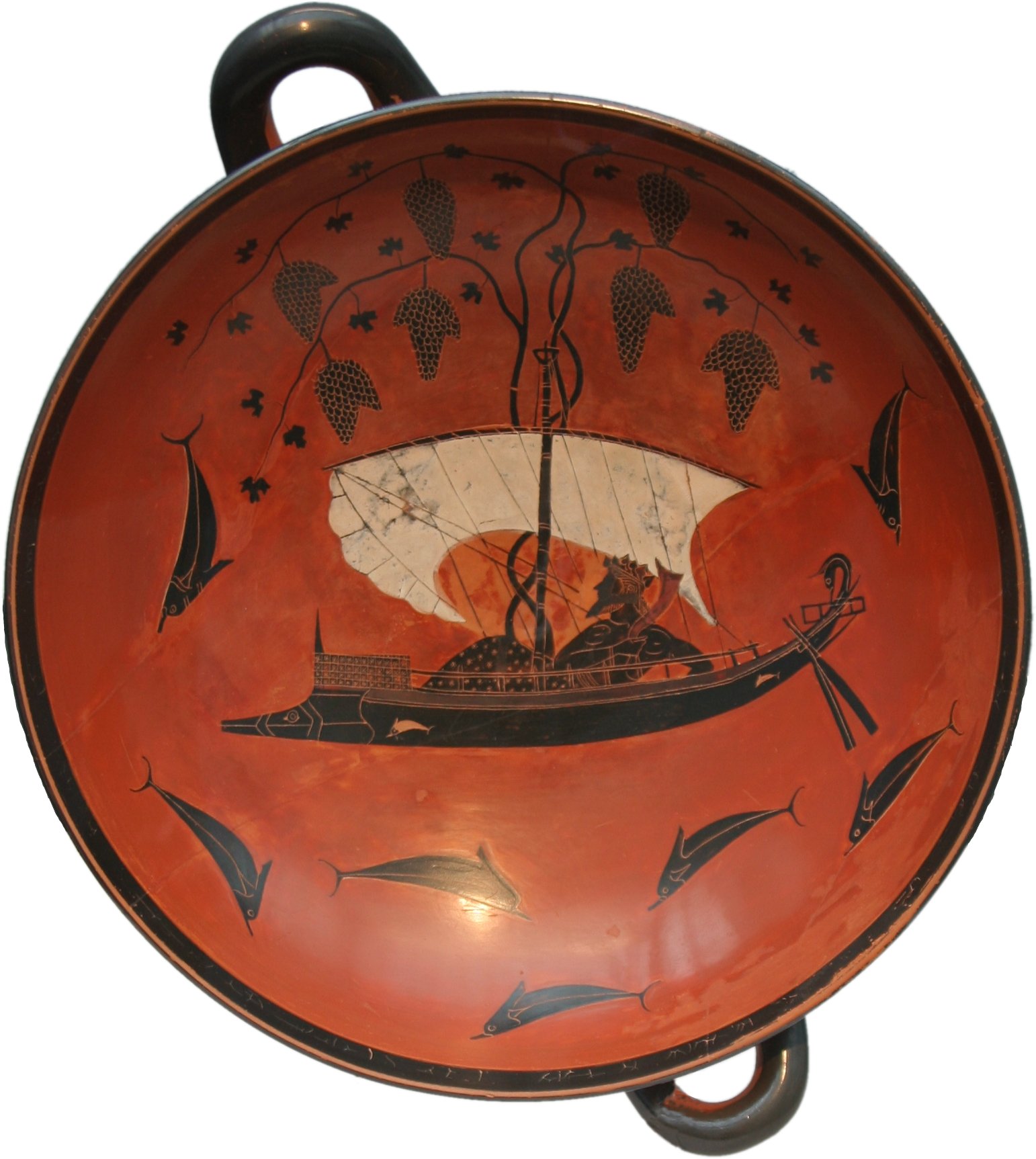
The deepest mark wine left on the Mediterranean was cultural. Greek civilization built around it an entire complex of practice and meaning that had no pre-viticultural equivalent. Dionysus — the god the Mycenaeans already named — became the patron of a religion of intoxication, theatre, and ecstatic release, his image carried on the most celebrated drinking vessels of the age, among them the black-figure cup on which the painter Exekias showed the god reclining in a ship as vines and dolphins spill across the sea. Around the drinking of wine grew the symposion, the formalized male drinking party at which Greek poetry, philosophy, and politics were transacted, the wine deliberately diluted with water so that conversation might outlast sobriety 6.
A new vocabulary and a new set of categories came with all this:
- the distinction between must, wine, lees, and vinegar as named stages of a single process;
- the libation, wine poured out to the gods, a ritual gesture unavailable to a culture without wine;
- the symposium and its etiquette of mixing, toasting, and ordered drinking;
- wine as medicine, prescribed and theorized in the Hippocratic tradition;
- the vintage calendar, the agricultural year reorganized around pruning and harvest.
The poet Hesiod, around 700 BCE, set the viticultural year down in verse in the Works and Days, instructing the farmer when to prune and when to gather and dry the grapes — proof that by the Archaic period the vine's calendar was simply part of how a Greek understood the passing year 13. The Mediterranean had absorbed wine so completely that it now organized time, worship, sociability, and medicine around it.
The vine's second journey: colonization and the amphora
Having received the vine, the Greeks became its carriers, and in doing so they completed the transmission's reach across the whole Mediterranean. From the eighth century BCE onward, Greek colonists planted vineyards wherever they settled — across southern Italy, which they came to call Oinotria, the "land of trained vines," along the coasts of Sicily, and at Massalia (modern Marseille) around 600 BCE, from which viticulture spread up the Rhône into what would become Gaul 95. Phoenician traders carried the vine westward along their own routes toward Iberia and North Africa in the same centuries. The grape that the South Caucasus had domesticated and the Aegean had sacralized now became a colonial crop, planted on three continents within a few hundred years 59.
What made this second journey possible was a piece of packaging: the ceramic transport amphora. The amphora turned wine from a thing made and drunk locally into a commodity that could be sealed, stacked in a ship's hold by the thousand, and traded across open sea. André Tchernia's reconstruction of the Roman wine trade rests precisely on these vessels — their shapes, stamps, and findspots map the routes and volumes of an industry 10. The amphora was to ancient wine what the shipping container is to modern goods: the standardized unit that made long-distance trade in a perishable liquid not merely possible but enormous. With it, the transmission that had begun as cuttings passed from village to village became a Mediterranean-wide economy.
Wine, medicine, and the order of the table
Wine did not only feed worship and trade; it entered the body of Mediterranean knowledge. In the Hippocratic medical tradition, wine was both a remedy in its own right and the universal solvent in which other drugs were dissolved and delivered — prescribed for wounds, fevers, and digestion, graded by colour, age, sweetness, and strength, and matched to the patient and the complaint 6. A culture that had no wine had no such pharmacology; a culture that had it built an entire therapeutics around the one substance that could carry medicine into the body and lift the spirits while doing so. Wine became, in the ancient phrase, a thing that both harmed and healed depending on the measure.
That preoccupation with measure shaped manners as much as medicine. The Greeks drank their wine mixed with water, in ratios they debated and moralized, and they regarded drinking it unmixed as the mark of barbarians and drunkards. The symposiarch who ruled a drinking party set the mixture and the pace. Around this discipline grew an elaborate order of the table: vessels specialized for mixing, cooling, dipping, and drinking; rules of toasting and sequence; the conviction that civilized people drank in a particular, controlled way and that how one drank revealed what one was 611. None of this apparatus — pharmacological, social, moral — had existed in the Mediterranean before wine. It was built, piece by piece, on top of a Caucasian plant.
What was pushed to the margin
Every institution that arrives displaces something. Wine's victims were not people but other drinks and other arrangements. As the vine spread and wine became the prestige beverage of the Mediterranean elite, the older fermented drinks — grain beer, honey mead, the mixed fruit grogs — were pushed down the social scale and toward the geographic margins. They did not vanish, but they became the drink of the poor, the mark of the barbarian, the not-wine against which civilized drinking defined itself. Greek and later Roman writers treated beer-drinking peoples as crude by comparison, and the cultural prestige that had once been distributed among many local ferments concentrated almost entirely in the grape 69.
The wild vine, too, was marginalized in a quieter sense. As cultivated, cloned, hermaphroditic vines spread, the dioecious wild grape of the forest edge ceased to matter economically; the genetic and cultural future belonged to the domesticate. And the landscape itself was remade: terraced for vines, planted in the triad, reorganized around a crop that demanded patient capital and rewarded those who already held land. None of this was violent. But it was a genuine displacement — of beverages, of plants, and of an older, more local way of drinking.
What the cost was
A transmission with almost no bill
This record is, deliberately, a counterpoint. Many transmissions in this atlas arrive carried on violence, extraction, or coercion, and their cost is the center of the story. The westward journey of wine is not one of them. The spread of viticulture from the South Caucasus to the Mediterranean over four millennia was, so far as the evidence shows, a peaceful diffusion: cuttings and technique moving with farmers, traders, and the slow contact of neighbouring communities. No conquest carried the vine. No population was enslaved to deliver it. No culture was destroyed in the act of receiving it. The grape was already present in the receiving lands; what spread was knowledge and a domesticated plant, and knowledge does not have to be taken at sword-point.
This is why the record's cost severity is set at zero. The transmission proper — vine, vessel, and method moving west — extracted nothing from the South Caucasus and demanded nothing of the Mediterranean except the labour of learning to grow and ferment. The senders were not despoiled; the Shulaveri–Shomu tradition not only survived but persists, in the living Georgian qvevri practice, eight thousand years later 1112. There is no body count here, no displaced people, no annihilated city. Honesty about cost cuts both ways: where the bill is genuinely zero, the atlas says so, and resists the temptation to manufacture a tragedy to match its usual register.
The downstream ledger that is not this record's
To say the transmission was costless is not to say wine was. Over the following millennia, wine became the engine and the lubricant of economies that were anything but gentle — and intellectual honesty requires naming them, while keeping them in their proper place. The clearest example is Roman Italy. By the late Republic, wine production had been industrialized on slave-staffed estates, the latifundia, whose output the historian André Tchernia reconstructed from the amphorae that carried it across the Mediterranean in their millions 10. Behind the elegant amphora and the cultivated vineyard stood chained agricultural labour, much of it enslaved war captives, working presses and terraces for the profit of absentee landowners. Far later, European colonial powers would plant vineyards in the Americas, in South Africa, and elsewhere on the backs of coerced and enslaved labour.
The colonial centuries extended the same pattern across oceans. European powers carried the vine to the Americas, to South Africa, and to Australia, and where they planted it on a plantation model they worked it with coerced and enslaved hands, just as they worked sugar and cotton. The vineyards of the early Cape and of colonial Spanish America were not gentle places. But here again the cost belongs to the system, not to the plant: it was the plantation, the conquest, and the institution of slavery that extracted the suffering, using viticulture as one crop among several through which they did so.
These are real costs, and they are severe. But they are not the cost of this transmission. They are the costs of particular later institutions — Roman slavery, colonial plantation systems — that used wine, as they used grain and sugar and cotton, as a vehicle. The vine did not require slavery any more than wheat did; the slavery belonged to Rome and to the colonial order, and it is documented in the records that treat those systems directly. The cuttings that travelled from Shulaveris Gora to Crete carried no such bill. To load the four-thousand-year diffusion of a beverage with the sins of every later regime that profited from it would be to confuse a thing with its abuses 10.
Holding the line at zero
The editorial decision, then, is to hold the cost at zero and to defend the holding openly. The standard this atlas applies is causal and proximate: what did this transmission, in its own movement, take from anyone? The answer for wine's westward spread is: nothing measurable. The marginalization of beer and mead was a shift in fashion and prestige, not a violence. The remaking of hillsides into vineyards was an economic transformation freely adopted by the cultures that adopted it. The one society that might be called the "source" — the Shulaveri–Shomu and its Georgian descendants — lost nothing and kept everything, down to the buried jar.
What this record offers instead of a body count is calibration of a different kind: proof that not every powerful transmission is paid for in suffering. Wine reshaped the diet, religion, economy, and sociability of half the world, and it did so, at the moment of transmission, for free. That a thing later became an instrument of extraction does not retroactively make its origin extractive. The bill for Roman slavery is charged to Rome. The journey of the vine is charged to no one — and a history honest about cost must be willing to record a zero as carefully as it records a massacre 911.
There is even a kind of justice in where the story ends. The culture that gave the world wine was not, as so often happens, erased or impoverished by the gift. Eight thousand years after the first grapes were crushed into a buried jar at Shulaveris Gora, the descendants of that tradition are still pressing grapes into qvevri in the same valleys, by a method UNESCO now protects as a heritage of all humanity 12. The plant they domesticated has become, by some measures, the most widely cultivated fruit on earth, and the drink they invented underwrites economies, religions, and rituals across the planet. Most transmissions in this atlas trace a line from a giver to a taker, with the cost falling on one side of the exchange. This one traces a gift that cost the giver nothing and enriched the world — and then left the giver, uniquely, still in possession of the original art. The vine walked west, and no one was the poorer for its walking.
What followed
-
-6000Wine is fermented at scale in 300-litre clay jars at Shulaveris Gora and Gadachrili Gora in the South Caucasus — the earliest chemically attested grape wine and the ancestor of the Georgian qvevri.
-
-5400At Hajji Firuz Tepe in the Zagros, resinated grape wine is stored in kitchen jars, showing the deliberate making and preservation of wine has spread south into the Iranian plateau.
-
-4300Winemaking reaches the northern Aegean: at Dikili Tash in Greek Macedonia, pressed grape skins and fermentation markers give the earliest solid evidence for wine in the Eastern Mediterranean and Europe.
-
-3150In the Egyptian tomb U-j at Abydos, roughly 700 jars of wine are interred with King Scorpion I — wine imported overland and by sea from the Levant, now a luxury fit for a king's afterlife.
-
-1700On Minoan Crete, wine becomes an elite, redistributive commodity managed by the palaces — a good through which authority is established, labour organized, and rival factions compete.
-
-1250Mycenaean Linear B tablets record wine as a managed commodity, name the festival of the 'new wine', and already carry the name di-wo-nu-so — Dionysus — three millennia before classical Greece.
-
-700Hesiod's Works and Days sets the viticultural year to verse, instructing the farmer when to prune and when to gather and dry the grapes: the vine's calendar is now simply part of the Greek year.
-
-530The painter Exekias shows Dionysus reclining in a ship among vines and dolphins; the symposium, the libation, and a religion of the wine-god are now central to Greek life.
-
-150In Roman Italy wine is mass-produced on slave-staffed latifundia and shipped across the Mediterranean in millions of amphorae — a downstream extraction that used wine but was not caused by its transmission.
-
2013UNESCO inscribes the Georgian qvevri method on the Intangible Cultural Heritage list, recognizing an unbroken winemaking tradition running eight thousand years from the same valleys where wine began.
Where this lives today
References
- McGovern, Patrick E., et al. "Early Neolithic wine of Georgia in the South Caucasus." Proceedings of the National Academy of Sciences 114, no. 48 (2017): E10309–E10318. en
- McGovern, Patrick E. Ancient Wine: The Search for the Origins of Viniculture. Princeton: Princeton University Press, 2003 (2019 ed.). en
- McGovern, P. E., Glusker, D. L., Exner, L. J., and Voigt, M. M. "Neolithic resinated wine." Nature 381 (1996): 480–481. en
- Dong, Yang, et al. "Dual domestications and origin of traits in grapevine evolution." Science 379, no. 6635 (2023): 892–901. en
- Brun, Jean-Pierre. Le vin et l'huile dans la Méditerranée antique : viticulture, oléiculture et procédés de transformation. Paris: Éditions Errance, 2003. fr
- Phillips, Rod. A Short History of Wine. London: Allen Lane, 2000. en
- Garnier, Nicolas, and Soultana Maria Valamoti. "Prehistoric wine-making at Dikili Tash (Northern Greece): Integrating residue analysis and archaeobotany." Journal of Archaeological Science 74 (2016): 195–206. en
- Hamilakis, Yannis. "Wine, oil and the dialectics of power in Bronze Age Crete: a review of the evidence." Oxford Journal of Archaeology 15, no. 1 (1996): 1–32. en
- Unwin, Tim. Wine and the Vine: An Historical Geography of Viticulture and the Wine Trade. London: Routledge, 1991. en
- Tchernia, André. Le vin de l'Italie romaine : essai d'histoire économique d'après les amphores. Rome: École française de Rome, 1986. fr
- Harutyunyan, Mkrtich, and Manuel Malfeito-Ferreira. "The Rise of Wine among Ancient Civilizations across the Mediterranean Basin." Heritage 5, no. 2 (2022): 788–812. en
- UNESCO. "Ancient Georgian traditional Qvevri wine-making method." Representative List of the Intangible Cultural Heritage of Humanity, inscription 00870, 2013. en primary
- Hesiod. Works and Days, in Theogony, Works and Days, Testimonia, ed. and trans. Glenn W. Most. Loeb Classical Library 57. Cambridge, MA: Harvard University Press, 2006 (lines 609–614). en primary
- Ventris, Michael, and John Chadwick. Documents in Mycenaean Greek. 2nd ed. Cambridge: Cambridge University Press, 1973. en primary
- McGovern, Patrick E., Mirzoian, Armen, and Hall, Gretchen R. "Ancient Egyptian herbal wines." Proceedings of the National Academy of Sciences 106, no. 18 (2009): 7361–7366. en
- McGovern, Patrick E. Uncorking the Past: The Quest for Wine, Beer, and Other Alcoholic Beverages. Berkeley: University of California Press, 2009. en